Politics
Why Men Are Attached To Eating More Meat

In February, Secretary of Health and Human Services Robert F. Kennedy Jr. shared a video of him eating steak, exercising shirtless and drinking whole milk in a hot tub with ’00s-era musician Kid Rock. The internet’s response to the video was largely bewilderment and mocking, but whether or not the pair succeeded in looking cool, they certainly telegraphed an attempt at masculinity.
The video draws a straight line between the person responsible for US food and health policy and the “manosphere,” as some call it — the side of the internet that largely consists of fitness videos aimed at young men but is also known for introducing its followers to misogynistic, homophobic and antisemitic ideas. So, it might be worth paying attention to what he — and other men in the public eye — wants to be seen eating.
Research shows that not only do men tend to eat more meat than women globally, but also that men are more reactive and defensive to messaging that suggests they lower their meat consumption, be it for personal health or ethical, animal welfare or climate-related reasons.

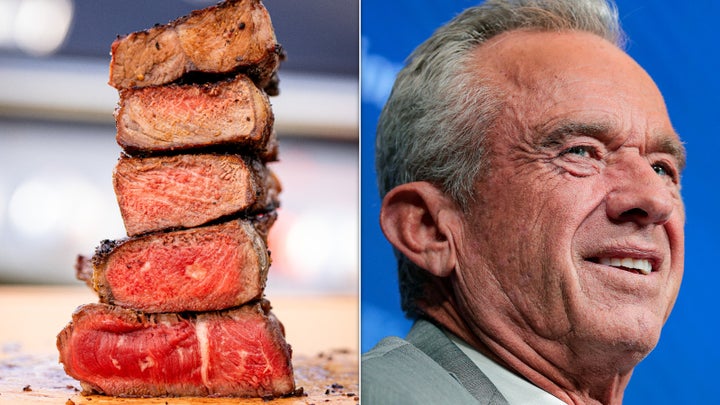
The beef-loving, vegetarian-hating dad guy is a pop culture trope at this point: Think Parks and Recreation’s Ron Swanson, or Homer Simpson, who famously said, “You don’t win friends with salad.” Cartman of South Park once said, “If you don’t eat meat at all, you become a pussy” (which, in the show’s context, turned out to be kind of literally true). In any case, you can bet that the manliest man dudes, whether aspirational or not, will be offended and maybe even downright hostile if presented with a meatless plate.
“If you go to women and say, ‘[Meat] is really bad, you should probably think about cutting down,’ women will tend to respond by cutting down,” said Sophie Attwood, a psychologist and behavioral scientist whose work focuses on food choice as it relates to human health and environmental sustainability. “Whereas, if you do that to men, what happens is they push back, go right into defence mechanisms — and then they increase intake.”
It’s a generalization, she qualifies, but one that she attests to seeing replicated consistently in the research. This led her to wonder: Why exactly are men so connected to meat?
Daniel Rosenfeld, a UCLA psychologist who studies eating behavior and morality, offers some theories.
“There isn’t 100% certainty on why the meat-masculinity association exists, but a good account is one of historical and evolutionary narrative. We have this image in our heads that as humans, Homo sapiens, we are traditionally hunter-gatherers, from pre-agricultural times, and that’s kind of the glorified era of what our instincts tell us to do, in a lot of people’s minds,” Rosenfeld explained. This provides some justification for seeing divergent gender roles as something natural and inherent, rather than socially imposed.
“Men fall into the ‘hunter’ category in our minds, and women the ‘gatherer’ category. And so that’s one explanation for why people view it as manly to eat meat, because meat comes from animals that we have to hunt,” Rosenfeld said. Eating an animal signifies dominance over nature (even though you probably bought it from a store rather than hunting and killing the animal yourself), and for many, masculinity and dominance are inseparable.
Conversely, “a salad or tofu or other plant-based foods can be viewed as having more feminine attributes because those are gathered and not hunted,” he said.
Rosenfeld uses the term “narrative” intentionally — it’s less about any actual anthropological fact than it is about our beliefs. Modern scientists generally agree that early humans ate majority plant-based diets, and the meat they did eat was often collected by scavenging rather than hunting. It’s a far cry from the 18.5 pounds of meat consumed by the average American every month, but the reality hasn’t stopped modern humans from trying to replicate our “fantasy image,” as Rosenfeld puts it, of humans (and human men especially) as big consumers of meat.

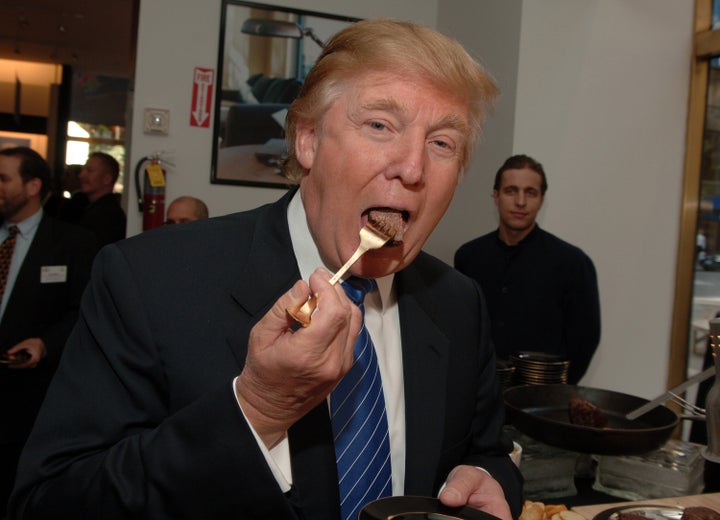
Stephen Lovekin via Getty Images
Consider the paleo diet, which includes meat and is quite literally meant to mimic hunter-gatherer diets. Or, at the more extreme end, the “carnivore diet,” whose proponents claim that, actually, early humans ate entirely or almost entirely meat and that modern humans ought to as well for optimal health (despite heaps of scientific evidence suggesting otherwise).
Another idea that Rosenfeld said may influence the meat-manliness connection “can be an association of meat and protein, and protein and muscle, and muscle and manhood.”
We can see both of those ideas coming into play in pop culture and public figures like the Liver King, a manosphere influencer who wanted his fans to believe that his muscular stature was purely a result of following an “ancestral lifestyle,” i.e., eating plenty of raw organ meat, before eventually being exposed for his use of steroids. In “American Canto,” her book about their personal relationship, journalist Olivia Nuzzi described RFK Jr., saying, “like all men, but more so, he was a hunter.” It’s an evocative description, but also a literal one: Kennedy is into falconry. It’s hardly a coincidence that the man currently leading American food and nutrition policy fits the mould of masculinity, especially in such a way that’s both flashy and traditional.
Regardless of where the association comes from, it still doesn’t completely explain why men can be so defensive of their meat-eating, even when it comes up against established science or their own values. We may get a hint, however, by zooming out.
A recent study out of Germany found that men of lower socioeconomic status tend to consume the most meat. Another study, from 2024, found that gender differences in meat consumption were the widest in the most gender-egalitarian countries (Scandinavian nations take the top spots, while the US and UK fall around the middle). It seems that when men are (or believe themselves to be) socially or economically disempowered, meat becomes more meaningful.
In the US today, it’s hardly a secret that men are falling behind women in categories like education, employment and even health. A generation or two ago, it was not only possible, but common, for a man to support a wife and kids on the income from a single, even blue-collar, job. Men today may still feel that being a “provider” is intrinsic to their identity, even as it becomes impossible for them to provide in the same way they saw their grandfathers doing. So if you’re not a provider, what are you? Are you really a man?
Attwood notes that diet is uniquely important in identity construction — not just for meat-eating men, but other kinds of people, like, say, environmentally conscious academics and vegan journalists. “If you’re under threat, your identity is under threat. So your whole thing is about trying to neutralise the threat and reassert the identity, which means you are going to hang on to these symbols to use to communicate to others,” she said.
Some aspects of masculine identity can be considered neutral or even positive, like the desire to provide for others materially. But traits like dominance are inherently hostile, falling into that bucket we call “toxic masculinity.” And these ideas are so culturally embedded that we see them playing out in pop culture and even in policy.
With the release of the latest USDA food pyramid, which features a cartoon T-bone in its illustration of nutritious foods, RFK Jr. announced the end of the nation’s “war on protein,” waged by liberal food policy and “big villains” like the American Heart Association. Never mind that most Americans are already eating too much protein, or that in the last decade, food companies have quadrupled the amount of high-protein products on the market. Never mind that virtually every major health authority agrees that red meat and full-fat dairy are associated with poor health outcomes, especially regarding the very same chronic illnesses our health administration claims to be targeting. And definitely never mind that the very same federal agency just last October announced a battery of plans to “strengthen the American beef industry,” suggesting an entirely different motivation for pushing meat-eating on the general population.
Because what matters here isn’t scientific fact, it’s the story being told. Meat eating is good and natural, and anyone who tells you otherwise is a “villain” to be defeated. Making America Healthy Again means embracing tradition and rejecting any nutritional science that challenges it. Making America Great Again means taking our rightful place as the world’s most powerful nation, able to dominate all the rest. And if anyone suggests you swap in plant-based protein every so often? What they’re really telling you is to stop being a man.
Or so the story goes, anyway.
You must be logged in to post a comment Login