AUGUSTA, Ga. — A head coach to your favorite golfing stars offers this: “You hear this more at Augusta than anywhere else: ‘I can’t take my range game to the course.’”
This is not a pre-tournament comment. It’s something you hear after the Thursday rounds have been posted.
There’s a reason for that as there is a reason for everything. The tournament practice range at Augusta is about 300 yards wide, flatter than the famous club driveway behind it, with only about a dozen pins and a dozen pines at which to aim. On the course itself, once you’re off the tee, there are few flat lies, lots of pine straw, greenside grain leaning this way and that — and a nervous system in overdrive. So in that sense, the range and the tournament course — on Thursday, on Friday, on the weekend — are on different planets.
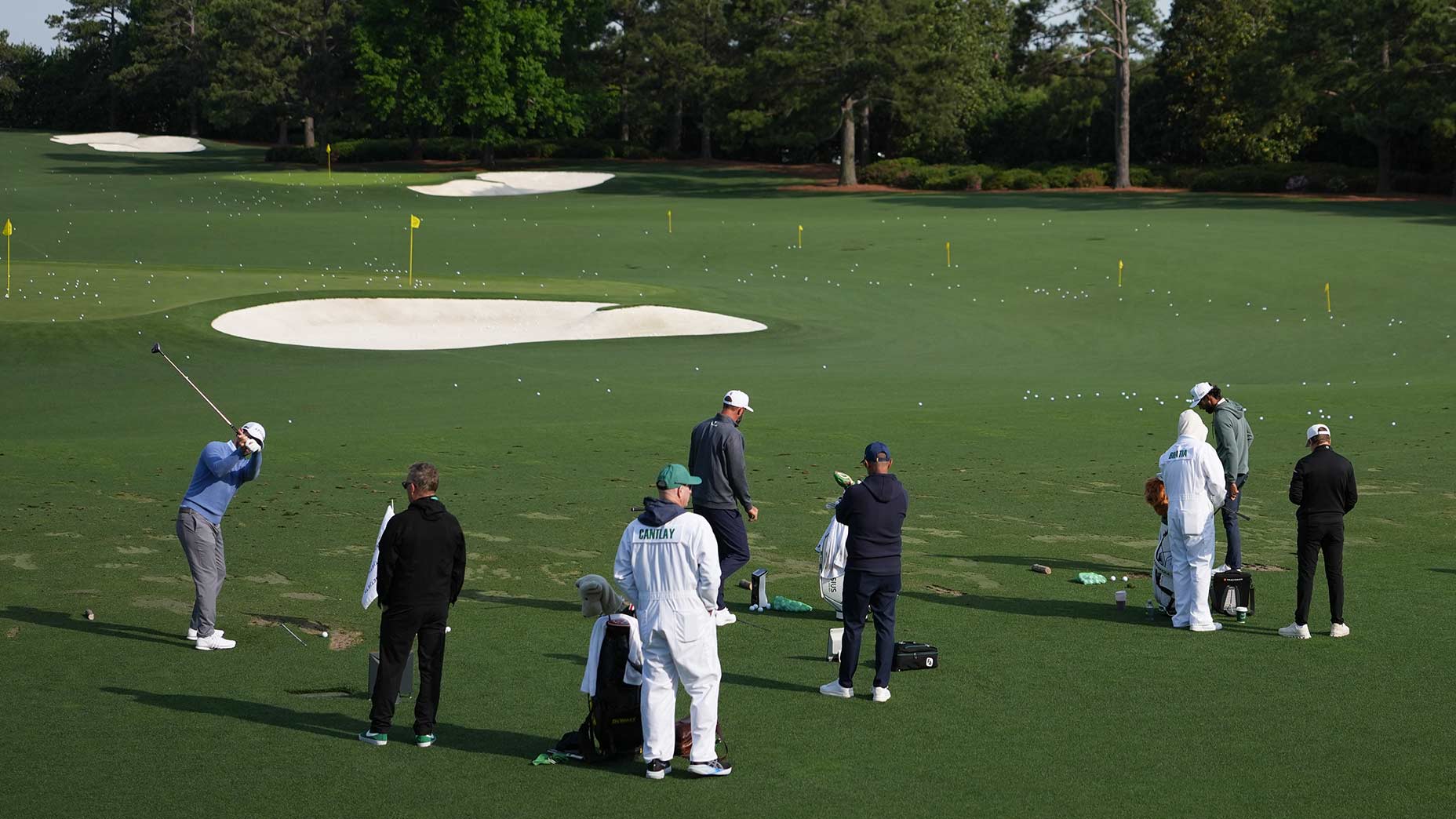
But there’s something else that happens more at the Masters, the first Grand Slam event of the year, than anywhere else. At 4:30 Thursday afternoon, there were six players on the range and six instructors. There were two players on the putting green with instructors. There was another player by the chipping green, his coach behind him. Over the course of the afternoon, more players came to this temple of practice for a post-round session, every last one (but one) accompanied by a teacher. Every coach had either a phone or a tablet in hand and many of the players had Trackman devices diagnosing their every swing.
This is a relatively new development, player and coach continuing to work together after the start of a tournament. In the 1990s, you would often see Ernie Els and sometimes Tiger Woods on a range without an instructor with a tournament underway. (Every blue moon, you’d see Els or Woods alone on the range, the caddie sent home for the day. Incredible to watch.) But over the past 10 or 15 years, and you see this more at Augusta intra-tournament than anywhere else, the professional golfer has morphed from lonesome cowboy to CEO of Team Your Name Here.
In 2015, Jordan Spieth won the Masters. In 2016, he was the third-round leader after an indifferent Saturday 73. He had been going it alone that week. Saturday night, he made an emergency call to his swing coach, Cameron McCormick, looking for help with a case of the short rights. McCormick arrived Sunday morning. Whatever they worked on worked, until it didn’t. Spieth shot a Sunday 73 and Danny Willett won by three. Over the past decade on the Augusta range, you see a player, you see an instructor and a gizmo.
“It’s probably been a real thing for the last 10 or 15 years,” Adam Scott said Thursday. He’s 45 and has been a touring pro playing the world for 25 years. “There aren’t 85 coaches here this week, but then there’s someone like Pete Cowen who has a bunch of guys. And I’m not just saying [swing] coaches. There are chipping coaches, putting coaches, psychologists. There are a lot of coaches.”
But only one coach is allowed on the range with the player at Augusta and it’s always the main swing coach. It’s good for business. A swing coach at the Masters is usually highly invisible, but when you’re on the inside it’s an enviable place to be.
“Ideally, you’ve got everything organized before you get here,” said Scott, who shot a first-round 72. “I feel a lot of the time when I had a coach here they were just watching and not saying too much. Even on a day like today, when you’re a little off, sometimes you just need someone to say, I didn’t feel good today, but I don’t think it’s bad. What do you think? ‘Nothing wrong with it. Go hit 20 balls and come back tomorrow.’ But it looks like everyone is going for perfection.”
Augusta National is not a course that lends itself to perfection. Things go wrong. It’s kind of a head game, because Augusta National, the club, sells the pursuit of perfection, but things go wrong from Thursday morning to Sunday night, for every last player.
And that’s the point of the unnamed mental coach here — the players are searching for perfection on the range with a tournament underway, and it’s counter-productive. The real work, the mental coach said, should be between the player and the caddie, because the player and the caddie are out there together. You can’t make a lifeline call in tournament golf.
“Early in my career, there was a phase where the coach wasn’t around a lot, and I think that was good,” Scott said. “At 21, I didn’t know what bad golf was. I’d just go out and play.
“Later, it was more about taking it to the next level, with more eyes on it. That was how it worked for me, and it worked well. Now I have a lot less of that. I speak to Trevor [Immelman] often about how I feel and my swing but I don’t have him watching all the time. There are phases.”
Rory McIlroy, for instance. There have been times in his career where his lifelong swing coach was behind him every time he went to the range. And then there was last year, when McIlroy won the Masters. There was no talk about his team, no discussion of we did this and we did that. He and his caddie, Harry Diamond, were on the range. He and Diamond were on the 18th green Sunday night. McIlroy signed his playoff scorecard. The only other signature required was his opponent’s.



You must be logged in to post a comment Login