For 120 minutes in Vancouver, Switzerland and Colombia played as if defeat frightened them more than victory tempted them. Then came the penalties, and with them the kind of theatre the match had spent two hours refusing to offer.
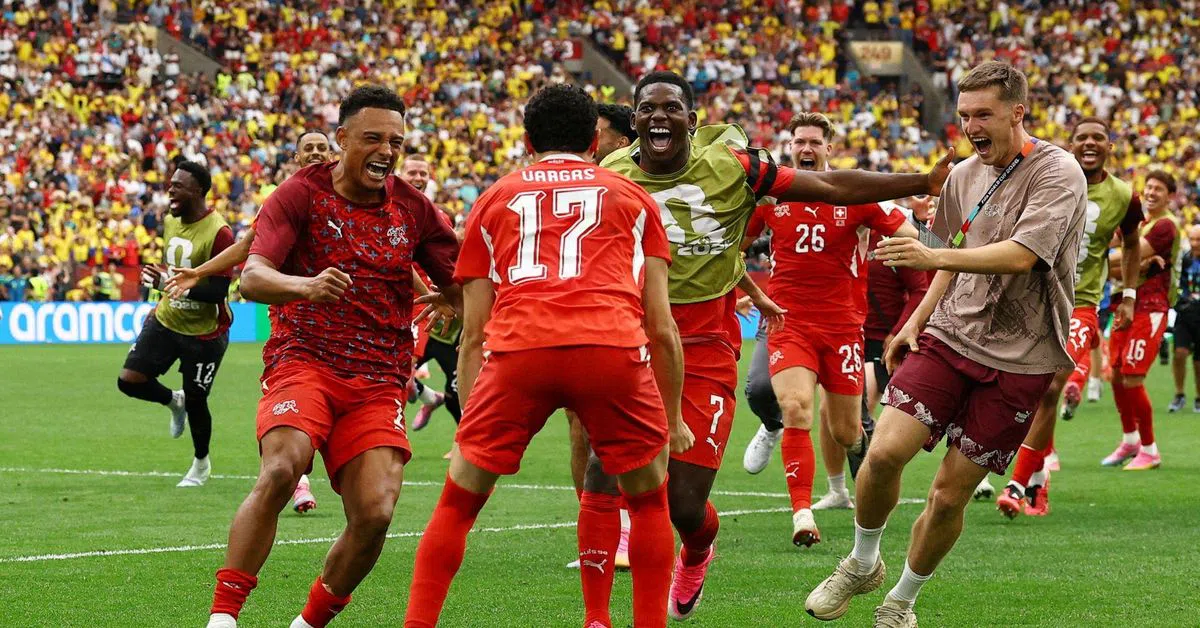
Ruben Vargas stroked the decisive kick into the bottom corner as Switzerland beat Colombia 4-3 in a shootout after a goalless draw early Wednesday morning, Indian time, reaching their first World Cup quarter-final since 1954. Gregor Kobel was the Swiss hero, saving Cucho Hernandez’s penalty after Davinson Sanchez had already struck the crossbar for Colombia.
Switzerland will now face holders Argentina in Kansas City, a meeting few would call easy but one they have earned through organisation, nerve and a refusal to let another Round of 16 end in familiar pain.
“It is very difficult for me to realise what we achieved today,” Vargas said. “For 120 minutes we gave it all on the pitch. We faced a strong opponent, but now we made history.”
Colombia, who had hoped to reach only their second World Cup quarter-final after 2014, were left with another penalty wound. They also lost a shootout in the last 16 in 2018, against England.
A match trapped by its own stakes
This was the final Round of 16 tie and, on quality of drama before penalties, probably the most cautious knockout match of the tournament. Two excellent defensive units cancelled each other out. The combined expected goals figure across 90 minutes was just 0.7, a reflection of how little space either side allowed and how rarely either goalkeeper was seriously exposed.
Colombia entered the match with one of the tournament’s strongest defensive records, having conceded only once in their previous games. Switzerland, too, were compact and disciplined, even after suffering a major pre-match setback when Johan Manzambi was ruled out with a knee injury sustained in training.
The 20-year-old attacker had been Switzerland’s breakout player of the tournament, contributing three goals and two assists. Without him, the Swiss lacked the spark to unsettle Colombia regularly.
Colombia, backed by a sea of yellow at BC Place, had the better early chance. In the 21st minute, Gustavo Puerta curled an effort from around 18 yards towards the far corner, forcing Kobel into a sharp diving save to his left. Switzerland responded through Fabian Rieder from a tight angle, but Camilo Vargas held firm.
After that, the match settled into a long stretch of tension rather than invention.
Kobel, crossbar and Colombian agony
If the 90 minutes were controlled by caution, the final moments of regulation and extra time at least hinted at what might have been.
Dan Ndoye almost won it for Switzerland in the 91st minute, making a clever run before dragging a low shot across goal and just wide of the far post.
In extra time, Colombia centre-back Jhon Lucumi came even closer. He rose unmarked to meet a corner and crashed his header against the crossbar. For a moment, the stadium seemed ready to erupt. Instead, the ball stayed out, and the match returned to its anxious rhythm.
There was also one penalty appeal for Colombia when Jaminton Campaz went down after contact with Miro Muheim in the first period of extra time. The pro-Colombia crowd demanded a spot kick, but referee Ivan Barton saw it as a collision rather than a foul. There was contact, but not enough to make it a clear error or a decisive intervention.
The match moved, almost inevitably, to penalties.
How the shootout turned
Juan Fernando Quintero and Granit Xhaka converted the opening penalties. Then Sanchez stepped up for Colombia, with Kobel offering him the right side of the goal. Sanchez took the route but hit the crossbar. The ball bounced down near the line but did not cross it.
Zeki Amdouni then scored from a short run-up to put Switzerland ahead. Campaz kept Colombia alive with a low effort that squirmed under Kobel.
Manuel Akanji had a chance to strengthen the Swiss position but fired over the bar. At that point, the shootout had found its balance again.
Then Kobel made the save that decided the night. Hernandez went to his right. Kobel went the same way and pushed the ball away brilliantly.
Cedric Itten scored down the middle. Luis Diaz answered for Colombia to make it 3-3. That left Vargas with the fifth Swiss kick and the chance to carry his country past a barrier that had stood for generations.
He sent Camilo Vargas the wrong way and finished low. The Swiss bench poured forward. A team that had made consistency its identity finally added progress to it.
Switzerland finally break the Round of 16 wall
Switzerland have become one of international football’s most reliable tournament qualifiers. This was their sixth successive World Cup. But reliability had also become a cage.
They had fallen in the Round of 16 in 2006, 2014, 2018 and 2022. They had also suffered penalty pain at Euro 2024, losing 5-3 to England in the quarter-finals. This win did more than move them into the last eight. It removed the burden of a repeated ending.
It is Switzerland’s fourth World Cup quarter-final in history and their first since 1954, when they hosted the tournament. For a side often praised for being organised, professional and difficult to beat, this was a night when they became something more: historic.
Their defensive structure gives them a chance against Argentina. Lionel Messi and company have scored freely in the knockouts, but they also came dangerously close to exiting against Cape Verde and Egypt. Switzerland will not overwhelm Argentina with flair, but they can frustrate, compress space and wait for moments through Breel Embolo and, if fit, Manzambi.
They will be hard to beat. At this stage, that is no small thing.
Colombia’s yellow wave ends in silence
Colombia’s football at this tournament was not always perfect, and this match was not one of their better attacking displays. But their supporters were among the defining sights and sounds of the World Cup.
BC Place felt more like Barranquilla than Vancouver. Colombian fans vastly outnumbered Swiss supporters, turning the stadium into a yellow wall. They had followed their team across all three co-host countries — Mexico, Canada and the United States — through changing time zones, climates, altitude and humidity.
Head coach Nestor Lorenzo had acknowledged the difficulty before the game, saying Colombia had been exposed to nearly every kind of condition the tournament could offer. Their supporters accepted the same challenge with colour and noise.
The previous night, fans had filled the streets outside the team hotel, singing and waiting for the players. Luis Diaz appeared on a balcony, punched the air and sent them into another wave of excitement.
That devotion made the shootout defeat even more painful.
Was this James Rodriguez’s farewell?
The loudest emotional moment before the shootout came in the 66th minute, when James Rodriguez was substituted. Thousands of Colombian fans stood and applauded.
Rodriguez turns 35 later this week, and every major tournament appearance now carries the possibility of being his last. He made his senior debut in 2011 and has become arguably Colombia’s greatest player, leading the country’s all-time appearance list. This was his 132nd cap.
There were still flashes in Vancouver: a turn away from pressure, a precise forward pass, the old ability to see the next move before others. But those moments faded as the minutes accumulated. His legs looked tired, and his influence waned.
Rodriguez is currently without a club after leaving Minnesota United in May, only three months after joining them. It is possible that this was his final World Cup appearance. If so, Colombia’s supporters seemed to understand the weight of the moment before the rest of the night had even reached its heartbreak.
A defensive duel, not a failure of ambition alone
It would be easy to call this match poor. It was certainly not open, fluid or rich in chances. But that is only half the explanation.
Both sides defended well. Switzerland closed lanes and prevented Colombia’s creative players from receiving comfortably between the lines. Colombia’s back line, one of the best at the tournament, denied Switzerland the space they needed, particularly in Manzambi’s absence.
The result was a game in which risk felt too expensive. Neither side wanted to be the one to make the mistake. That produced a cautious 120 minutes, but it also made the shootout feel even more severe. After so much control, the match was decided by nerve.
Switzerland had more of it.
Argentina await
The quarter-final against Argentina in Kansas City will ask a different set of questions. Argentina will bring Messi, emotional momentum and the confidence of surviving two chaotic knockout matches. Switzerland will bring shape, discipline and the knowledge that they have already crossed a psychological threshold.
They may not have lit up the Round of 16, but they survived it. For a team haunted by this stage for nearly two decades, that matters.
Colombia leave with regret, admiration from their supporters and another penalty scar. Switzerland leave with history.
The last Round of 16 match completed the quarter-final line-up. It did not offer goals. It offered endurance, pressure and, finally, one calm touch from Ruben Vargas that sent a nation where it had not been for 72 years.


























































You must be logged in to post a comment Login