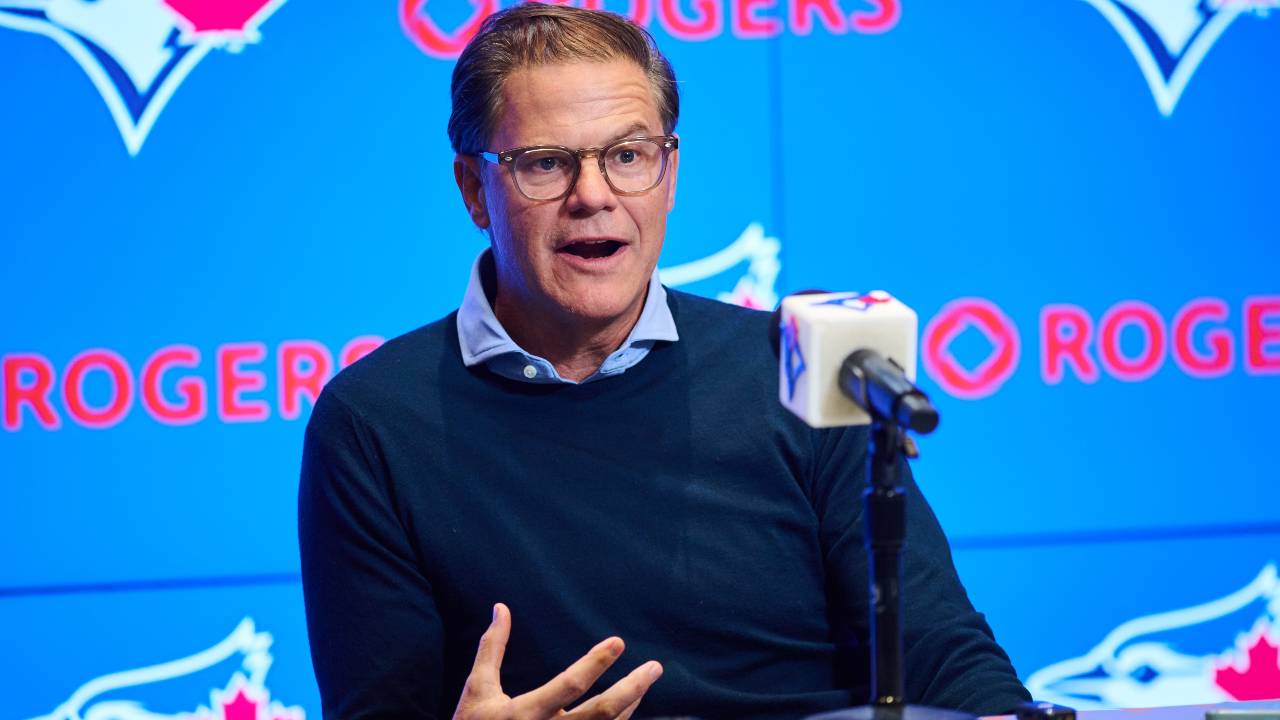
PHILADELPHIA – Deep breaths taken post trade deadline, it’s a good time to zoom out and survey how the Toronto Blue Jays are set up for 2027 and beyond. After all, while GM Ross Atkins didn’t totally punt on the season at hand before Monday’s cutoff, the driving force in what he and the front office pulled off was about stabilizing the foundation for the future.
As he explained once the chaos had stopped, the Blue Jays “were determined to do what was best for the organization and try to optimize things given a situation that was less than ideal.” That meant putting in place assets for the years to come, with some benefit as well as some sacrifice in the present, especially in the bullpen where Jeff Hoffman’s absence has been immediately noticeable in the games since.
That being said, most pertinent is the way the Blue Jays are set up for next year and beyond and how they’re positioned to deal with the pending free agencies of George Springer, Shane Bieber, Max Scherzer, Jameson Taillon, Yimi Garcia and, potentially, Myles Straw, who has an $8 million club option, while also improving the group.
So, let’s examine their asset mix, including upper minors depth and potential impact prospects lower in the system, moving forward:
Majors: Dylan Cease (through 2032); Jose Soriano (through 2028); Trey Yesavage (through 2031); Cody Ponce (through 2028); Spencer Arrighetti (through 2030); Jose Berrios (through 2028); Bowden Francis (through 2029)
In the system: John Klein (triple-A); Jake Bloss (triple-A); Josh Stephan (triple-A); Nolan Perry (double-A); Gage Stanifer (double-A); Johnny King (high-A); Cole Carlon (complex); Dasan Hill (Vancouver)
Outlook: Signing Cease during the off-season was the first step in remaking the rotation and Soriano’s acquisition secured a high-end complement. Behind the hard-throwing duo are Yesavage and Ponce, who will be returning from a season-ending knee injury, along with Berrios, in the latter half of next season, and Francis, coming back from Tommy John surgery. Spencer Miles is an intriguing possibility and his future role is being debated after a massive spike in his workload in what’s been his first full season of pro ball. One of Bloss, Stephan, Perry and Stanifer may also emerge shorter term, with King and Hill longer-term prospects, but the rotation remains an area that requires work in the off-season. That’s what makes the Soriano acquisition so important, reducing the amount of restocking needed in the winter, when there’s likely to be a compressed and chaotic free agency period due to the looming lockout.
Majors: Louis Varland (through 2030); Tyler Rogers (through 2028 with a vesting option for 2029); Braydon Fisher (through 2031); Mason Fluharty (through 2031); Spencer Miles (through 2031); Brendon Little (through 2030)
In the system: Yariel Rodriguez (through 2027 with a 2028 player option); Chad Dallas (triple-A); Ricky Tiedemann (triple-A); Lazaro Estrada (triple-A); C.J. Van Eyk (triple-A); Chase Lee (triple-A); Javen Coleman (triple-A)
Outlook: Bullpens are typically the most volatile area of the roster so depth matters here, but with Varland at closer and Rogers, Fisher and Fluharty bridging to him in leverage, the Blue Jays have a strong base to build from. If Miles isn’t stretched out, his repertoire plays in leverage and he’s an internal possibility to replace the loss of Hoffman’s important innings. A slate of optionable bulk arms in Dallas, Estrada and Van Eyk help underpin the improved starting depth with Klein and Stephan. Another leverage lefty has long been a need, one Little has struggled to fill and one the traded Adam Macko, who is out of options next year, needs runway to grow into. If Tiedemann is finally healthy, now is his window. The Blue Jays had hoped a healthy Garcia would be part of their group this season, too, so finding replacements for him and Hoffman are sure to be off-season goals.
Majors: Alejandro Kirk (through 2030); Brandon Valenzuela (through 2031)
In the system: Willie MacIver (triple-A); Aaron Parker (double-A); Ryan Sprock (high-A); Will Brick (complex)
Outlook: Kirk and Valenzuela are among the best pitch framers in the majors, with the potential for impact at the plate. The broken thumb Kirk suffered a week into the season is a likely factor in his struggles at the plate, although his time down did allow Valenzuela to emerge. An important winter task will be developing a plan to optimize a work split in 2027 that best leverages both, as will building up the depth behind them. MacIver’s acquisition from Texas earlier this year built in one option, while player-development staff is excited by Parker’s progress at New Hampshire. Still, the organization’s catcher-of-the-future is Brick, the 18-year-old from Memphis picked in the fourth round this year who is only at the very start of his buildup.
Majors: Vladimir Guerrero Jr. (through 2039); Kazuma Okamoto (through 2029); Addison Barger (through 2030)
In the system: Sean Keys (triple-A); Charles McAdoo (triple-A); JoJo Parker (low-A); Juan Sanchez (low-A)
Outlook: The most pressing matter for the organization is helping Guerrero regain his form from last October. No single player alters the trajectory for the club more than the 27-year-old, who is grinding his way through a stunningly difficult season. The only Blue Jays contract that runs longer than his deal is the club’s Rogers Centre lease, so one way or another, he’s going to be a fixture at first base. Okamoto, meanwhile, has silenced doubts about how he’d handle third base defensively and has been the club’s sole source of consistent power, his 24 homers one fewer than George Springer (12), Daulton Varsho (7) and Guerrero (6) combined. Assuming Barger is healthy and ready to go after a UCL repair in his right elbow, he could be used on the hot corner to spell Okamoto on occasion with the bulk of his reps likely to come in the outfield. Keys and McAdoo both have pop and, at minimum, are up-and-down players capable of filling in gaps. Parker and Sanchez, two of the club’s top position-player prospects, are both left-side of the infield players who may end up at third base.
Majors: Andres Gimenez (through 2029); Ernie Clement (through 2029); Josh Smith (through 2028); Lenyn Sosa (through 2029); Davis Schneider (through 2030)
In the system: Josh Kasevich (triple-A); Jay Harry (triple-A); Josh Rivera (triple-A); Ty Southisene (high-A); JoJo Parker (low-A); Juan Sanchez (low-A)
Outlook: Gimenez and Clement give the Blue Jays a high-floor pairing up the middle, especially on the defensive side, but the club is relatively really thin behind them, a factor in the acquisition of the versatile Smith, who had 2.9- and 1.8-win seasons in 2024 and ’25, as calculated by FanGraphs. Kasevich and Harry, who also plays the outfield, are knocking on the door and help protect the roster, but the next potential impact regulars here now that Arjun Nimmala fronted the package for Soriano are Parker and Sanchez, who are a couple of years away. Gimenez is now four years removed from his all-star 2022 season and while there’s always that potential upside at the plate, he’s primarily a defensive player at this point. Clement, on the other hand, remains a high-contact pest that can move up and down the lineup as needed, but is best as a table-setting secondary piece in the order.
Majors: Anthony Santander (through 2029); Addison Barger (through 2030); Nathan Lukes (through 2030); Jesus Sanchez (through 2027); Myles Straw (club option for 2027)
In the system: Brett Bateman (triple-A); Yohendrick Pinango (triple-A); Jay Harry (triple-A); Rudy Martin Jr. (triple-A); RJ Schreck (triple-A); Victor Arias (double-A); Blaine Bullard (low-A); Jake Cook (low-A)
Outlook: The Blue Jays are most unsettled here, especially if Barger’s recovery takes longer than expected or Santander’s shoulder issues, which derailed his first two seasons with the Blue Jays, aren’t repaired by surgery. How much either can be counted upon to deliver next year is uncertain as a result, making the outfield an area of peril and opportunity. Without a clear centre-fielder in place, picking up Straw’s club option makes increasing sense, especially given that a $1.75 million buyout essentially makes him a $6.25-million call. Lukes is a useful platoon bat who will still be cost effective heading into his first year of arbitration, although Sanchez, heading into his final season of arbitration eligibility, is a more intriguing call platforming off $6.8 million this year. He has massive power, something the team desperately needs, but whether bringing him back or reallocating his money to someone else will be a key decision. Bateman, part of the return for Gausman, is an interesting option but the depth options seem to be similar to what they already have in place. That makes outfield and designated hitter are the easiest areas for the Blue Jays to add the impact so vital to a better offence next year.




































You must be logged in to post a comment Login