As screen sizes continue to grow in popularity for home entertainment, 70-inch TVs offer an ideal balance of immersive viewing and manageable footprint for most living rooms. While exact 70-inch models remain limited—often budget-oriented—shoppers frequently turn to the closely related 75-inch and 77-inch classes, where premium technologies like OLED, QD-OLED and advanced Mini-LED dominate 2026 recommendations.
Experts from RTINGS.com, CNET, PCMag, TechRadar and Consumer Reports highlight a mix of high-end performers and value-driven options. True 70-inch sets tend to be entry-level LED models from brands like Samsung, LG and Hisense, but the best overall experiences come from stepping up to 75- or 77-inch versions for superior brightness, contrast and features.
Here are the top five recommendations for large-screen TVs in the 70-inch category for 2026, based on recent lab tests, real-world performance and current availability.
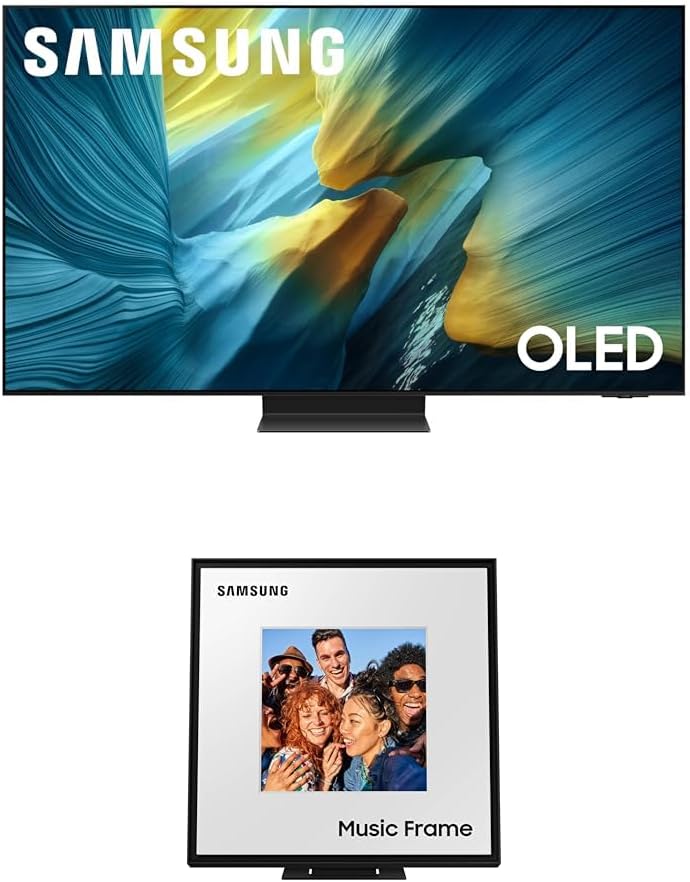
Samsung’s flagship QD-OLED series leads RTINGS.com’s rankings for 70-75-77 inch TVs in 2026. The 77-inch S95F delivers exceptional image quality with vibrant colors, near-infinite contrast and peak brightness that outperforms traditional OLEDs in bright rooms. It supports HDR10+, Dolby Vision (via updates in some regions) and boasts low input lag for gaming at up to 165Hz.
Advertisement
Reviewers praise its anti-reflective coating and wide viewing angles, making it ideal for family movie nights or sports viewing. Priced as a premium option, it excels in color volume and accuracy, earning top marks for HDR performance. Available in 77-inch (closest to 70-inch premium), it’s a standout for those prioritizing cinematic quality over exact size matching.
CNET awarded the LG G5 its first Labs Award for Best Color Accuracy in 2026, calling it a “massive improvement” over predecessors. This OLED model shines with pixel-perfect blacks, excellent upscaling and support for Dolby Vision, HDR10 and HLG. It offers strong gaming features, including four HDMI 2.1 ports, 120Hz (up to 165Hz in some modes) and VRR.
Available in 77-inch for OLED purists and select 75-inch configurations, the G5 handles bright environments better than prior generations while maintaining OLED’s signature contrast. TechRadar and PCMag note its value in the high-end segment, especially for mixed-use—movies, gaming and streaming.
TCL’s Mini-LED lineup, particularly the 75QM8K, tops mid-range charts on RTINGS.com and appears in multiple “best 75-inch” lists. With thousands of local dimming zones, it achieves high brightness for HDR content and impressive contrast for an LCD-based TV. Google TV integration provides a smooth smart platform, plus 144Hz refresh rates for gaming.
The QM7K variant offers similar performance at a lower price point, making it a strong contender for budget-conscious buyers seeking big-screen impact. CNET and Business Insider highlight TCL’s affordability without major sacrifices in picture quality, positioning these as go-to options for sports enthusiasts and casual viewers.
Hisense continues its rise with models like the 75U8QG, praised by PCMag and TechRadar for bold brightness and solid gaming credentials. Mini-LED backlighting delivers deep blacks and vivid colors, with support for Dolby Vision and high refresh rates. It’s particularly strong in well-lit rooms, where many OLEDs struggle.
The U65QF series earns “best budget” nods from PCMag for larger sizes, offering excellent value under $1,500 in some configurations. Consumer Reports includes Hisense in top-performing big-screen lists, citing great HDR and sound quality that reduces the need for external audio setups.
Business Insider and CNET name the Samsung S90F as a top overall pick, blending QD-OLED excellence with relative affordability compared to flagships. It features wide color gamut, low reflection and gaming perks like 4K at 144Hz. The 77-inch version provides immersive scale with minimal compromises on contrast or motion handling.
Advertisement
Reviewers appreciate its lightweight design and easy setup, making it practical for wall mounting. It serves as a strong alternative to the S95F for those wanting premium OLED without the absolute top-tier price.
Key considerations for 2026 buyers include panel type: OLED excels in dark-room contrast and perfect blacks, while Mini-LED/QLED offers superior brightness for daytime viewing. Gaming features like HDMI 2.1, VRR and low latency matter for consoles, and smart platforms (webOS, Google TV, Tizen) affect usability.
Prices fluctuate with promotions, but 75-77 inch premiums range from $1,000-$3,000+, with budget LEDs closer to $800-$1,200. Availability favors 75-inch for LED/Mini-LED and 77-inch for OLED due to manufacturing standards.
As CES 2026 innovations like tandem OLED and RGB Mini-LED roll out, these models represent the current cream of the crop. Shoppers should check retailer deals and read hands-on reviews for the latest firmware updates enhancing performance.
Advertisement
Whether prioritizing cinema-grade blacks, blazing HDR brightness or wallet-friendly size, these five stand out in 2026’s competitive large-screen market.
Disclosure: This post contains affiliate links. We may receive a commission for purchases made through these links at no additional cost to you.
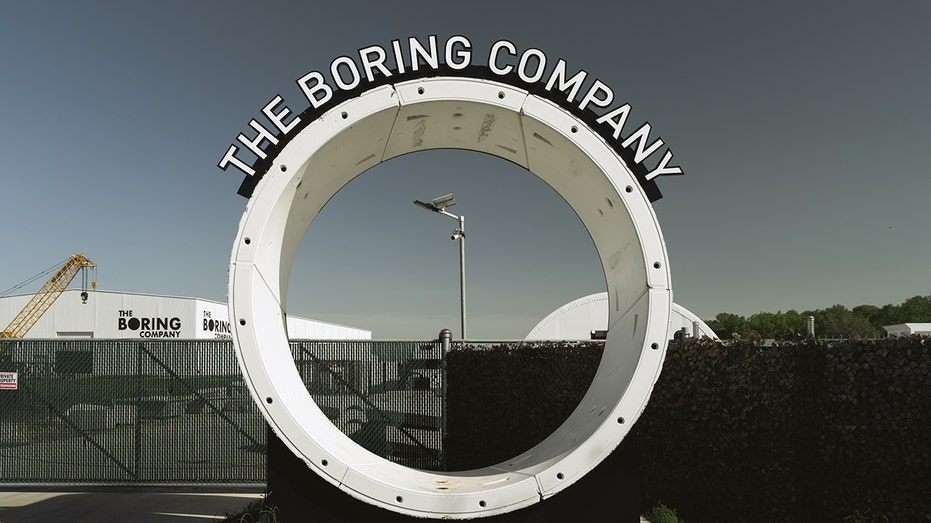
Several U.S. cities could soon see major underground transportation upgrades led by billionaire Elon Musk’s The Boring Company (TBC).
In a Tuesday post on X, the construction company named the winners of its nationwide “Tunnel Vision Challenge,” naming New Orleans, Louisiana, and Dallas, Texas, as candidates for new transportation systems.
Advertisement
“Thanks again to all of the participants — your enthusiasm and positivity has been inspiring for the TBC team,” the company wrote.
Baltimore, Maryland, was initially named as a winner, but TBC later announced Wednesday that the project will not move forward following early discussions.
A Tesla Inc. electric vehicle is driven through The Boring Company’s Las Vegas Convention Center Loop during the Consumer Electronics Show in Las Vegas, Nevada, on Jan. 5, 2023. (Patrick T. Fallon/AFP via Getty)
The next phase will involve collaboration with local officials and regulators, along with geotechnical borings to determine feasibility.
Advertisement
In a Wednesday update, TBC provided additional details on its early discussions with local leaders in both Dallas and New Orleans, saying both proposed projects had “great initial meetings.”
Two additional cities — Hendersonville, Tennessee, and San Antonio, Texas — remain under consideration as discussions continue.
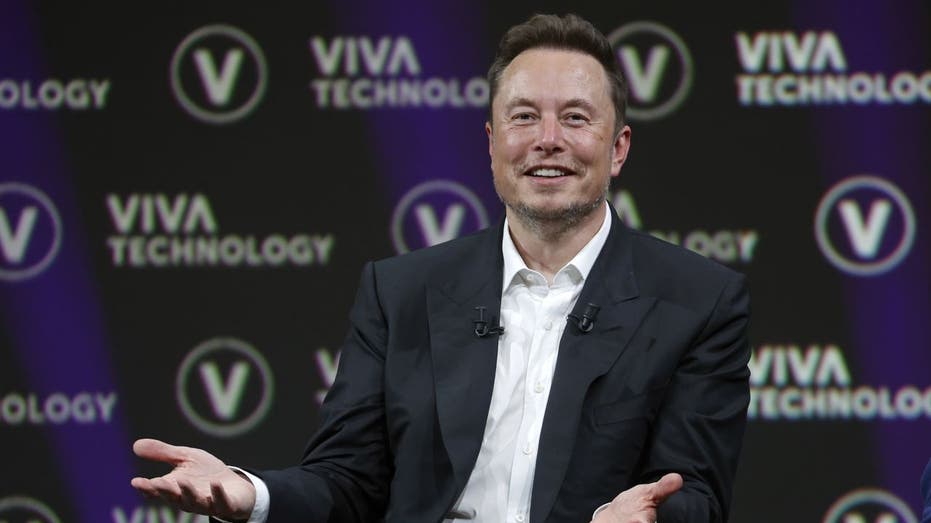
Elon Musk attends the Viva Technology conference at the Porte de Versailles exhibition center on June 16, 2023, in Paris, France. (Chesnot/Getty Images)
The challenge, which launched in January, invited proposals for a one-mile tunnel concept, with the winning concept promised a free build.
Advertisement
Separately, TBC was recently selected to begin negotiations on a proposed underground transit system connecting Universal Orlando’s parks.
The company’s most notable project is the Las Vegas Convention Center (LVCC) Loop, which opened in 2021 after about a year of construction.
Argan, Inc. (AGX) Q4 2026 Earnings Call March 26, 2026 5:00 PM EDT
Company Participants
David Watson – CEO, President & Director Joshua Baugher – Senior VP, CFO & Treasurer
Conference Call Participants
Advertisement
Jennifer Belodeau – Institutional Marketing Services, Inc. Robert Brown – Lake Street Capital Markets, LLC, Research Division Christopher Moore – CJS Securities, Inc. Ati Modak – Goldman Sachs Group, Inc., Research Division Michael Fairbanks – JPMorgan Chase & Co, Research Division
Presentation
Operator
Advertisement
Good evening, ladies and gentlemen, and welcome to the Argan, Inc. earnings release conference call for the fourth quarter and fiscal year ended January 31, 2026. This call is being recorded. [Operator Instructions] There is a slide presentation that accompanies today’s remarks, which can be accessed via the webcast.
At this time, it’s my pleasure to turn the floor over to your host for today, John Nesbett and Jennifer Belodeau of IMS Investor Relations. Please go ahead.
Jennifer Belodeau Institutional Marketing Services, Inc.
Advertisement
Thank you. Good evening, and welcome to our conference call to discuss Argan’s results for the fourth quarter and fiscal year ended January 31, 2026. On the call today, we have David Watson, Chief Executive Officer; and Josh Baugher, Chief Financial Officer.
I’ll take a moment to read the safe harbor statement. Statements made during this conference call and presented in the presentation that are not based on historical facts are forward-looking statements. Such statements include, but are not limited to, projections or statements of future goals and targets regarding the company’s revenues and profits. These statements are subject to known and unknown factors and risks. The company’s actual results, performance or achievements may differ materially from those expressed or implied by these forward-looking statements, and some of the factors and risks that could cause or contribute to such material differences have been described in this afternoon’s press release and in Argan’s
Seeking Alpha’s transcripts team is responsible for the development of all of our transcript-related projects. We currently publish thousands of quarterly earnings calls per quarter on our site and are continuing to grow and expand our coverage. The purpose of this profile is to allow us to share with our readers new transcript-related developments. Thanks, SA Transcripts Team
The impact of the Iran war on global oil prices could push the rate of inflation facing U.S. consumers higher, which would leave Federal Reserve policymakers in a difficult spot as they weigh possible interest rate cuts.
An analysis by economists at Goldman Sachs projected that Brent crude oil prices, a common benchmark for the global oil market, are expected to remain elevated, averaging $105 a barrel in March and $115 in April before falling to $80 a barrel in the fourth quarter of 2026. That’s based on oil shipments through the Strait of Hormuz remaining very low for six weeks.
Advertisement
In an adverse scenario where oil flows are disrupted for 10 weeks, the firm estimates Brent oil would peak at $140 a barrel and decline to $100 a barrel in the fourth quarter of 2026. A severely adverse scenario that includes disruptions for 10 weeks and infrastructure damage is a persistent hit to oil production would yield a peak at $160 a barrel and put oil at $115 a barrel in the fourth quarter of 2026.
“Most of the impact of the war on U.S. inflation will come from higher oil prices,” the Goldman economists said, noting that their “rule of thumb is that a 10% increase in oil prices raises headline PCE inflation by 0.2pp and core inflation by 0.04pp,” with much of the rise coming from transportation costs.
Inflation is expected to be higher this year in Goldman Sachs’ updated forecast due to the oil price shock caused by the Iran war. (AFP via Getty Images)
Goldman Sachs’ analysis also included a look at other commodities like fertilizer that could have higher costs due to limits on exports from the Gulf. It estimated that higher fertilizer prices could boost food prices by about 1.5% this year, raising headline inflation by 0.1 percentage point.
Advertisement
Additionally, second-round effects stemming from higher inflation expectations could boost inflation by 0.1 of a percentage point by the end of 2026 under the baseline scenario, or 0.4 of a percentage point under the severely adverse scenario.
Those factors could push the Federal Reserve’s preferred inflation gauge higher. The personal consumption expenditures (PCE) index was up 2.8% on a headline basis in January, while core PCE, which excludes volatile measures of food and energy, was up 3.1% in January. Both figures were well above the Fed’s long-run target of 2% inflation, and policymakers opted against cutting rates at their last two meetings given the elevated readings.
The Goldman Sachs economists’ analysis finds that, given higher oil prices, the impact on food prices and the more mild impact of other commodities and inflation expectations, they raised their December 2026 PCE inflation estimate by 0.2pp to 3.1% in the baseline scenario.
Advertisement
In the adverse scenario, PCE inflation would be 3.6% in December after peaking at 4.6% this spring, while the severely adverse scenario would leave PCE inflation at 4% at the end of the year after peaking at 4.9%.
The firm also raised its core PCE inflation forecast to 2.5% at the end of the year in the baseline scenario, while it would be 2.6% in December under the adverse and severely adverse scenarios.
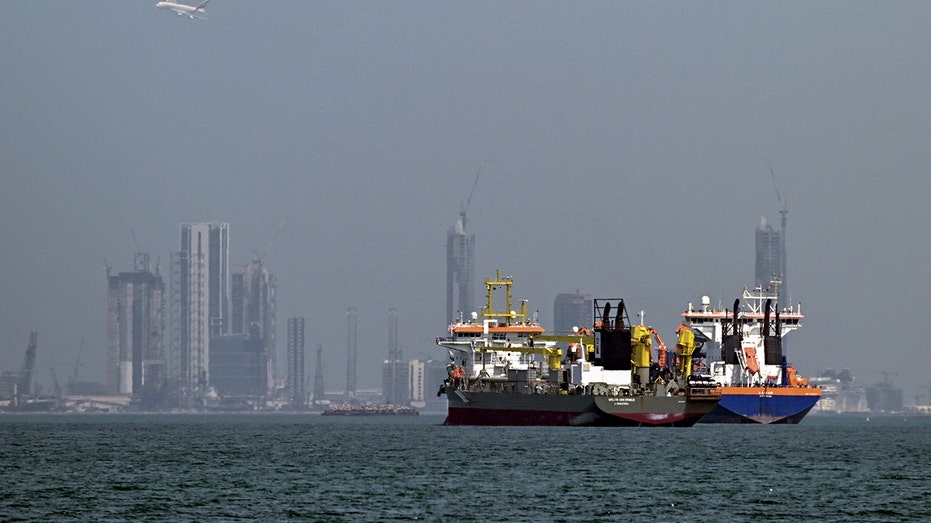
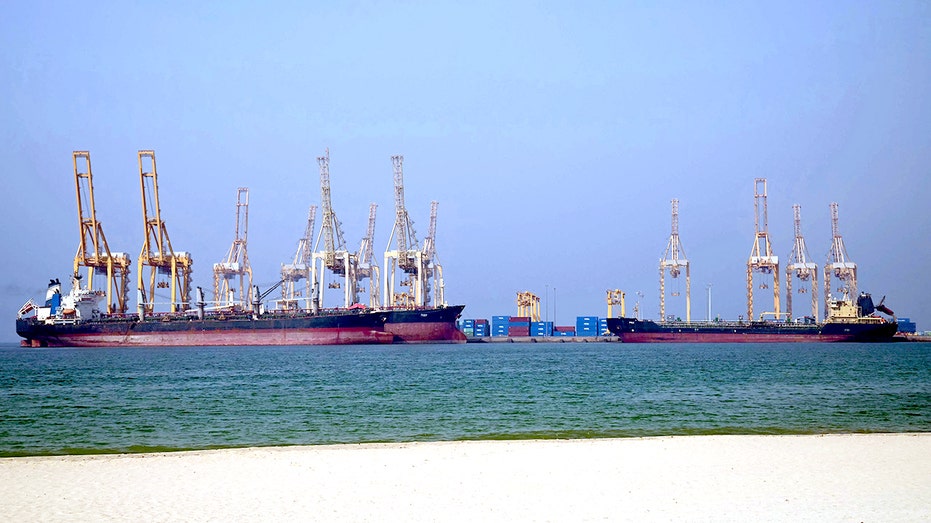
The flow of oil tankers through the Strait of Hormuz has been constrained during the Iran war. (Giuseppe Cacace/AFP via Getty Images)
Goldman Sachs also lowered its forecast for economic growth, reducing 2026 gross domestic product (GDP) growth to 2.1% in the fourth quarter compared to the same period the prior year or 2.4% on a full-year basis under the baseline scenario. The GDP growth forecast would fall to 1.9% fourth quarter-to-fourth quarter in the adverse scenario and 1.8% in the severely adverse scenario.
Advertisement
The firm also raised its 12-month recession probability by 5 percentage points to 30%.
The economists didn’t alter their baseline forecast for Federal Reserve interest rate cuts, which featured two 25 basis point rate cuts in September and December. They explained that they expect the unemployment rate to rise to 4.6%, above the 4.4% median projection of Fed policymakers at their latest meeting.
However, they did raise the probability of the Fed staying on hold this year from 20% to 25%, while lowering the probability of insurance cuts from 15% to 10%, due to the relatively higher inflation readings they anticipate.
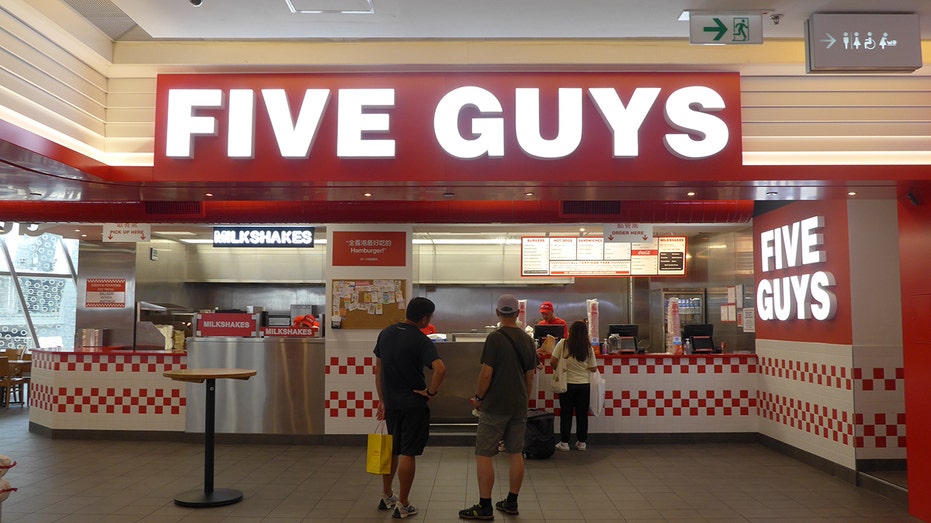
Five Guys is rewarding employees after an unexpectedly overwhelming promotion put heavy pressure on store crews.
The burger chain said it was distributing about $1.5 million in bonuses to workers after a buy-one-get-one (BOGO) deal on Feb. 17, which was launched to celebrate its 40th anniversary but quickly exceeded expectations.
Advertisement
“The promotion spread far beyond what we anticipated, and our hardworking crews were placed in a difficult situation,” Five Guys said in a Feb. 18 statement.
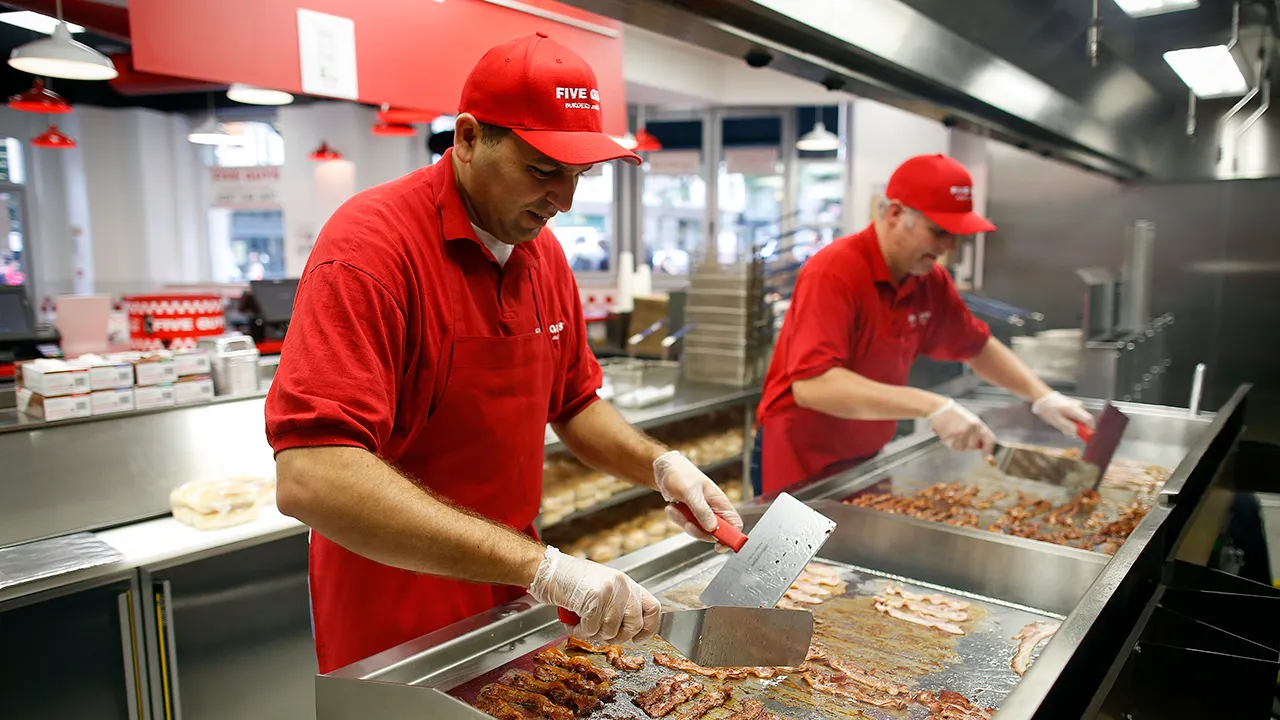
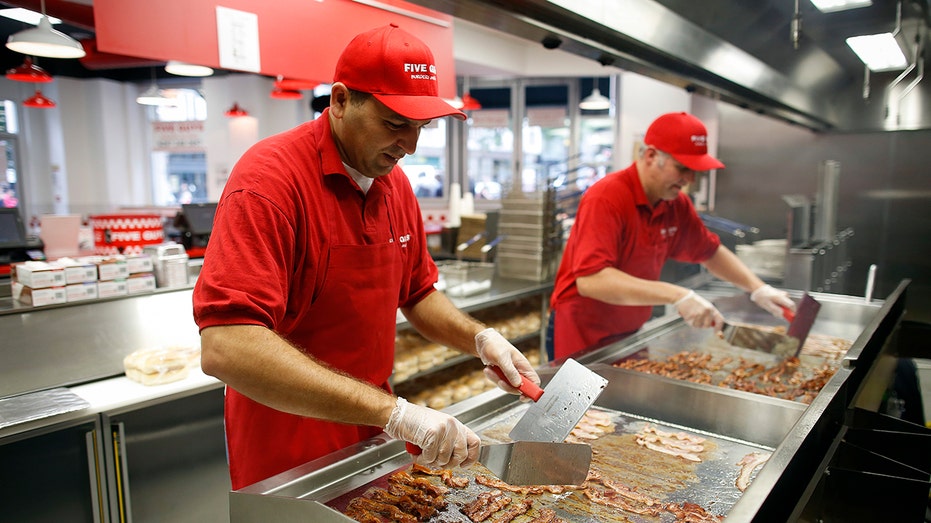
Chefs fry bacon on a griddle in the kitchen at Five Guys in London July 2, 2013. (Simon Dawson/Bloomberg via Getty Images)
The company noted some locations ran out of food, closed early and experienced online ordering issues.
“We also want to recognize the incredible men and women working in our restaurants,” the statement continued. “They handled it with the same grit and dedication that has defined Five Guys for four decades.”
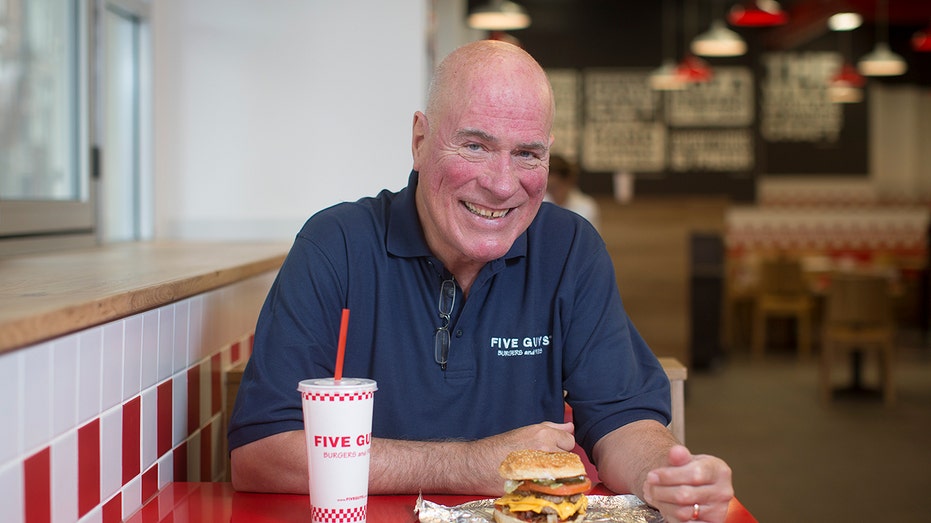
Jerry Murrell, founder of Five Guys, poses for a photo in London July 2, 2013. (Simon Dawson/Bloomberg via Getty Images)
CEO Jerry Murrell told Fortune he wrote 1,500 bonus checks, acknowledging the company underestimated demand and wanting to recognize employees for handling the surge.
“I didn’t want anybody shooting me in the back or anything after the first day, because we really screwed it up. We had no idea that we were going to get that kind of response,” Murrell told the outlet.
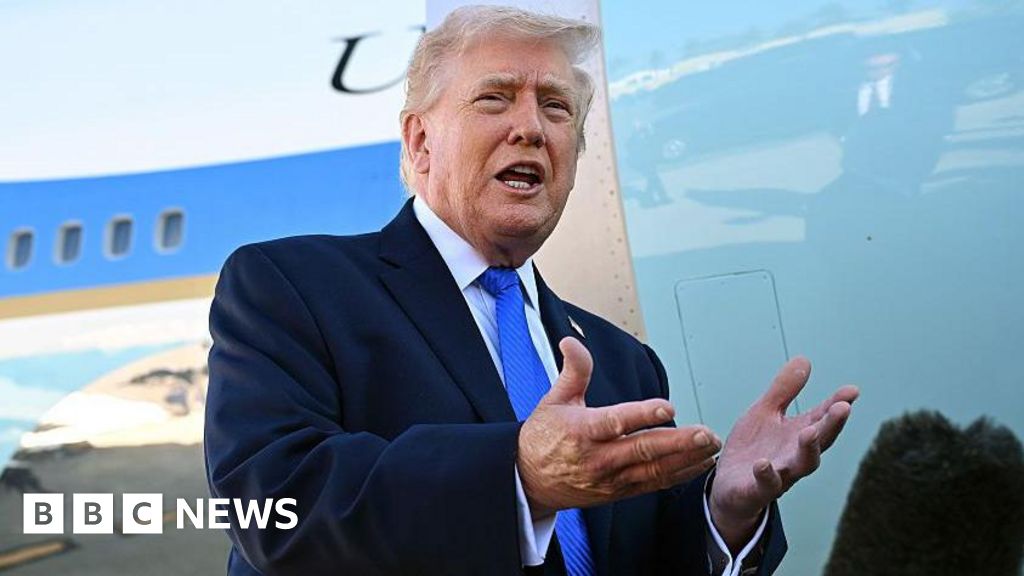
“There is no more powerful way to recognize the historic achievements of our great country and President Donald J. Trump than US dollar bills bearing his name,” Bessent said. US banknotes have traditionally carried the signatures of Treasury officials.
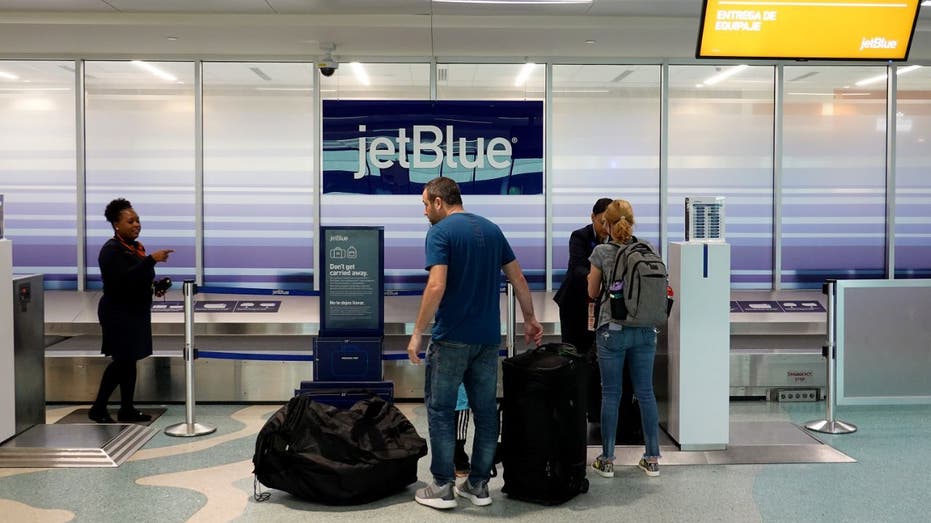
JetBlue said on Thursday that it’s adding a new route to its offerings while also adding more flights out of one of the low-cost carrier’s Florida hubs starting this summer.
The company announced that it will expand its offerings at Fort-Lauderdale-Hollywood International Airport, including a new route to Cleveland, Ohio, that will offer daily service starting on July 8.
Advertisement
Several existing domestic routes to and from Fort Lauderdale will see additional flight options for travelers starting when the changes take effect on either July 8 or 9.
JetBlue is adding one daily flight to each of Atlanta, Newark, Jacksonville, Las Vegas and Philadelphia. The Atlanta and Newark routes will each have four daily flights, while both Las Vegas and Philadelphia will have three per day and Jacksonville will have two. JetBlue will also add two more weekly flights to Norfolk, which will boost the frequency to once a day.
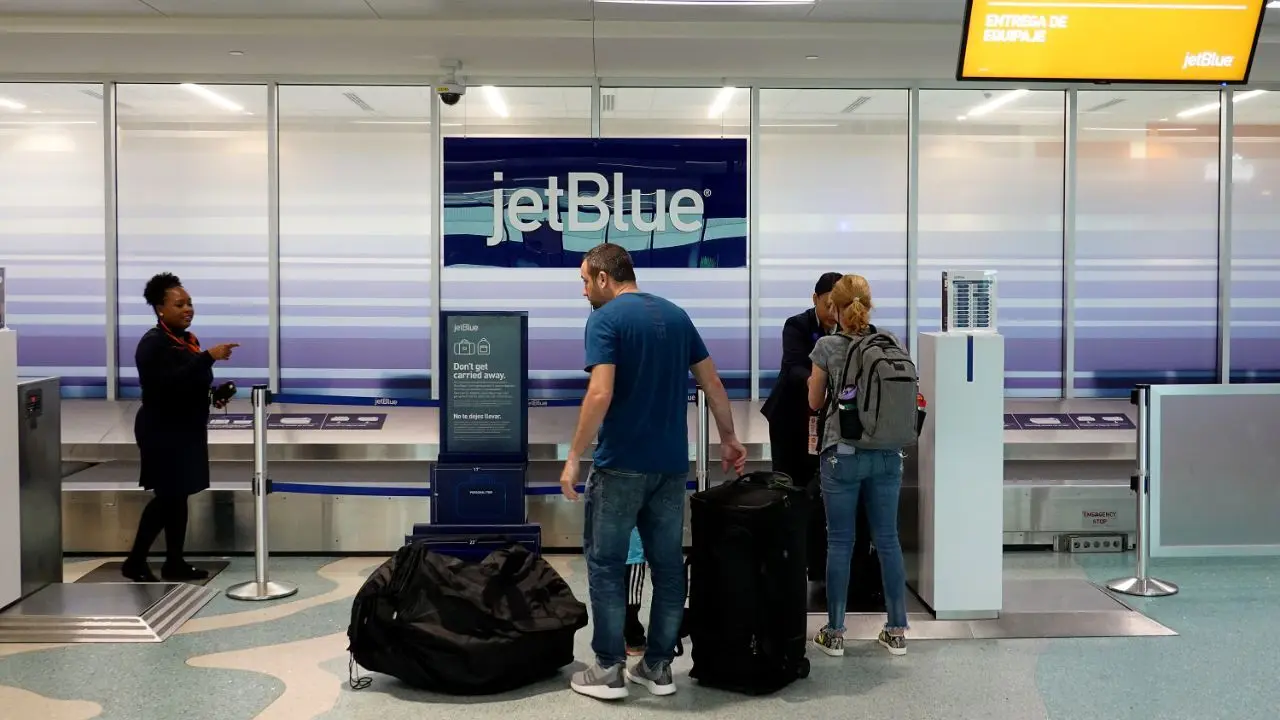
JetBlue is expanding its service offerings from Fort Lauderdale-Hollywood International Airport starting this summer. (Joe Raedle/Getty Images)
International flights to destinations in the Caribbean will also see a boost under the change. Aruba will see four more weekly flights, up to once a day.
Advertisement
An additional daily flight to Santo Domingo, Dominican Republic, will increase the frequency to twice a day, while three more weekly flights to St. Maarten will leave that route with daily service from Fort Lauderdale.
“These latest additions reflect our ongoing strategy to build an undeniably strong and relevant network in Fort Lauderdale by adding both new destinations and more frequencies where our customers want to fly,” said Daniel Shurz, senior vice president of revenue, network and enterprise planning at JetBlue.
“As we continue to grow in Fort Lauderdale, we’re offering customers more choice, more flexibility and a more connected network,” Shurz added.
Advertisement
JetBlue’s move comes after it signaled earlier this month that it’s on track to deliver $850 to $950 million in incremental operating profit by 2027 due to its JetForward plan, which seeks to curb costs, expand its network and improve services for travelers over the long term.
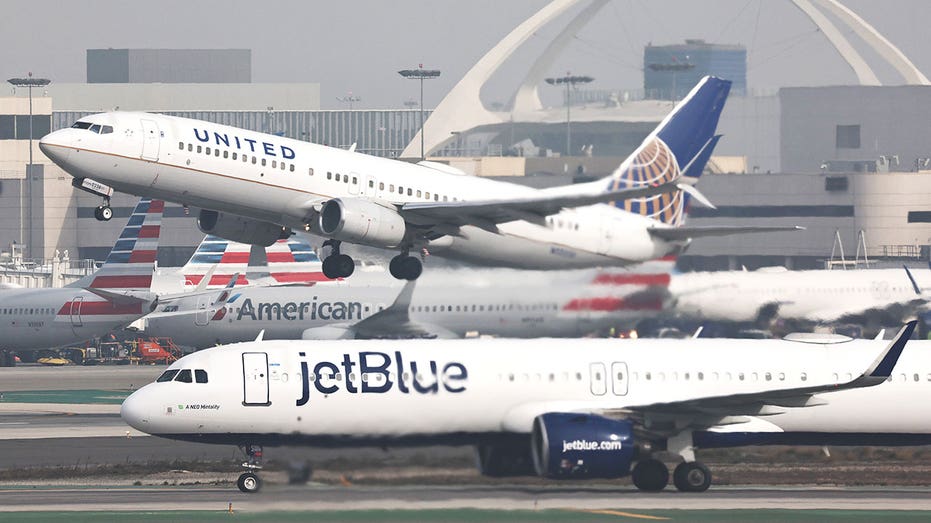
JetBlue and United announced a partnership last year. (Mario Tama / Getty Images)
The airline is about two years removed from calling off a $3.8 billion merger with Spirit Airlines, after a federal judge blocked the proposed tie-up over the potential competitive impact and antitrust concerns.
JetBlue and United Airlines announced a partnership last year that allows travelers to book flights on both carriers’ websites and interchangeably earn and use points in their frequent flyer programs.
Under the partnership, JetBlue also agreed to provide United access to slots at New York City’s congested JFK International Airport for up to seven daily round-trip flights starting in 2027.
Psychologist Jonathan Haidt discusses a landmark verdict holding Meta and YouTube liable for harming a teenager’s mental health on ‘The Big Money Show.’
Jonathan Haidt, a social psychologist and author of “The Anxious Generation,” says mounting concerns over social media’s impact on children have hit a “turning point.”
Speaking Thursday on FOX Business’ “The Big Money Show,” Haidt pointed to a closely watched social media trial, citing internal Meta communications in which employees described Instagram as “a drug” and acknowledged they were “basically pushers.”
Advertisement
“What we learned is that the companies really behaved abominably,” Haidt said. “Congress created the problem, and now I’m thrilled to see tweets and statements from senators and congressmen [from] both parties saying, ‘We’ve got to do something about this.’”
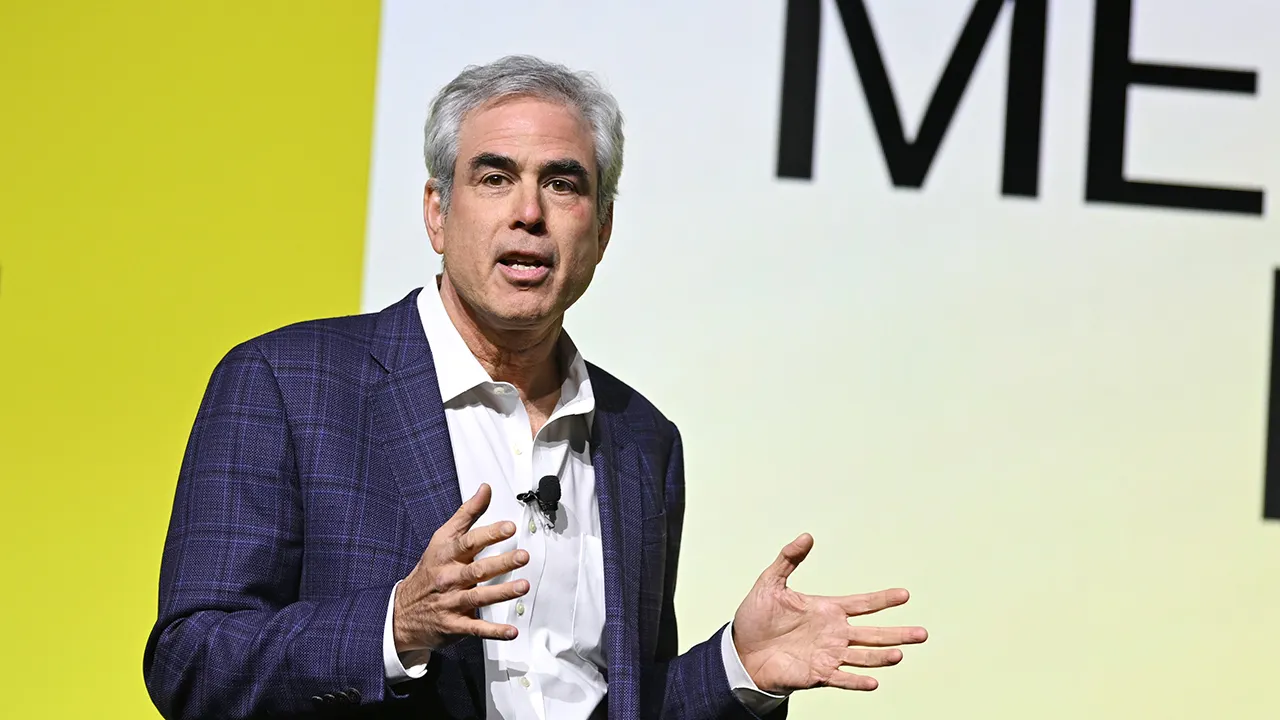
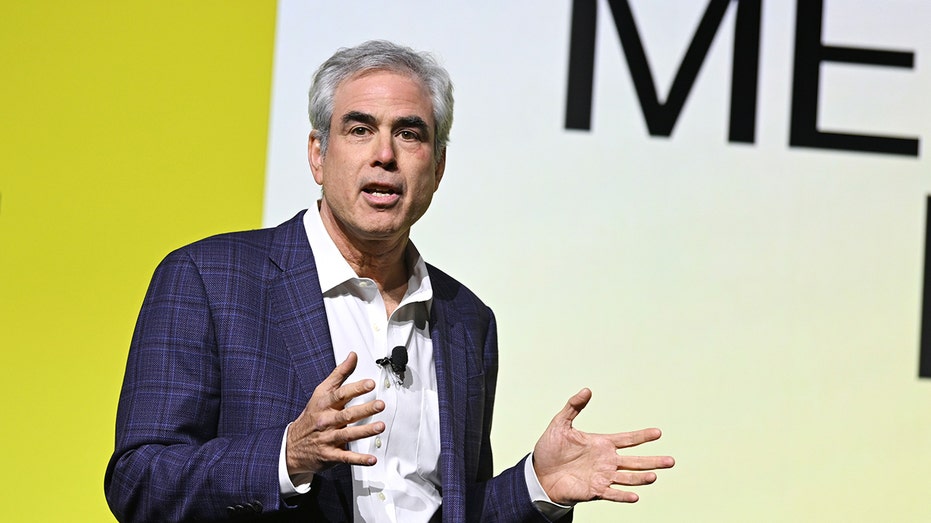
Jonathan Haidt at Project Healthy Minds’ World Mental Health Day Festival held at Spring Studios on Oct. 10, 2025 in New York, New York. (Kristina Bumphrey/Variety via Getty Images / Getty Images)
Haidt said the recent jury verdict could mark the beginning of a much larger wave of litigation.
“We believe that there are literally millions of victims,” Haidt said. “… Hundreds of kids are dead.”
Advertisement
With “millions of potential plaintiffs,” he warned, the financial consequences for tech companies could be enormous.
“I think we’re looking at a giant case of karma coming for these companies,” Haidt said. “They were able to exploit kids for decades and now their deeds are catching up with them.”
He argued the crisis was shaped in part by decades-old policy decisions.
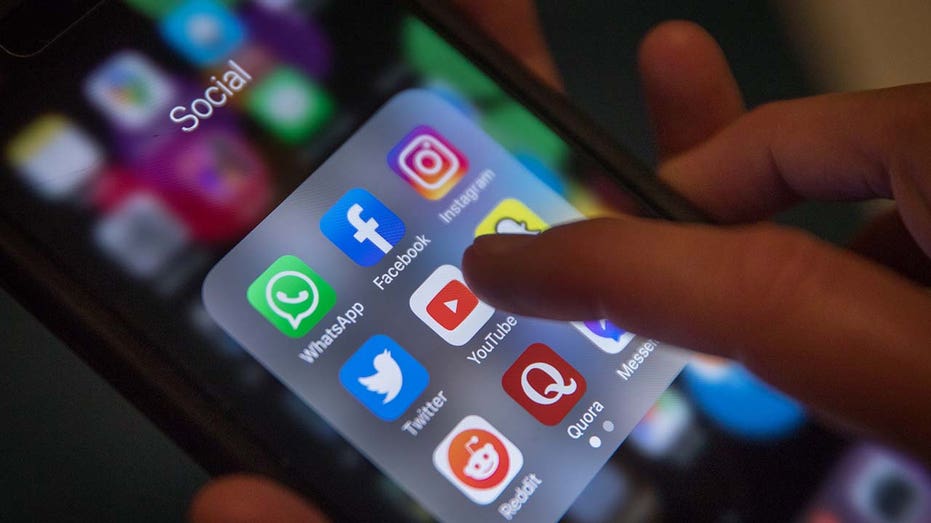
Social media apps are seen in this photo illustration. ( Matt Cardy / Contributor / Getty Images)
Haidt pointed to laws like Section 230 of the Communications Decency Act, which shields platforms from liability, and federal rules that allow companies to collect data from users who simply claim to be over 13.
However, public awareness is shifting — driven in part by recent jury verdicts and policy changes abroad, according to Haidt.
“We are at a turning point,” he said. “There is now a global understanding that this stuff is just wildly inappropriate for children.”
On Wednesday, a Los Angeles jury found Meta and Google liable in a case accusing the companies of designing addictive products for young users, awarding the plaintiff $6 million in damages.
Advertisement
Google and Meta both told FOX Business they plan to appeal the verdict.
Family members of victims outside Los Angeles Superior Court after a jury verdict Wednesday, March 25, 2026, in Los Angeles. (Kayla Bartkowski / Los Angeles Times via Getty Images / Getty Images)
In a separate case, a New Mexico jury on Tuesday ordered Meta to pay $375 million after finding the company misled users about platform safety and allegedly enabled child sexual exploitation.
Meanwhile, Australia implemented a landmark law in December banning users under 16 from holding social media accounts — one of the strictest online safety measures globally.
“We parents can’t deal with this on our own,” Haidt said. “We’re all having the same fight with our kids.”
Fox News Digital’s Jasmine Baehr, Louis Casiano and Ashley Carnahan contributed to this report.


















































You must be logged in to post a comment Login