


Connect with us
DAPA Banner

Sports

Harry Maguire on Tuchel’s England phone call, Carrick’s Man Utd revival and his problem with Ruben Amorim

Published

on

Harry Maguire was stepping onto a late afternoon flight to Bournemouth with his Manchester United teammates when a WhatsApp message pinged his phone. It was the England manager, Thomas Tuchel, asking if they could talk that evening.

Butterflies fluttered. Maguire hadn’t played for England for nearly two years, since he appeared in a Nations League game against Ireland in 2024. He had never played for Tuchel and there had been very little contact from the manager since he took the job last January. “I knew if I missed this camp, I don’t think I would have been back in the England setup,” Maguire admitted.

The defender has endured a mixed season. He struggled for form and fitness under Ruben Amorim and felt inhibited by the manager’s beloved back-three formation. But a run of games in Michael Carrick’s transformed United side have kindled faint hopes of playing in a third World Cup, at the age of 33.

Sitting on the plane, Maguire turned to fellow England prospect Kobbie Mainoo. “I asked Kobbie if he’d got a text as well and he said, ‘yeah’,” Maguire smiles. That offered some reassurance and, two hours later, Tuchel rang to confirm he was finally back in the England squad for World Cup warm-up games against Uruguay and Japan at Wembley.

Maguire rang round his family to share the news. His mum cried, though she was on holiday in Spain at the time and he suggests the tears may have been helped along by a few Sangrias. “It felt a bit like my first call-up,” he says. “I’ve played 60-odd games for England and been to three major tournaments, but when you’re playing every game, you don’t want to take it for granted, but you get comfortable with the setup. And then when it’s taken away from you all of a sudden, it hurts.”

Advertisement
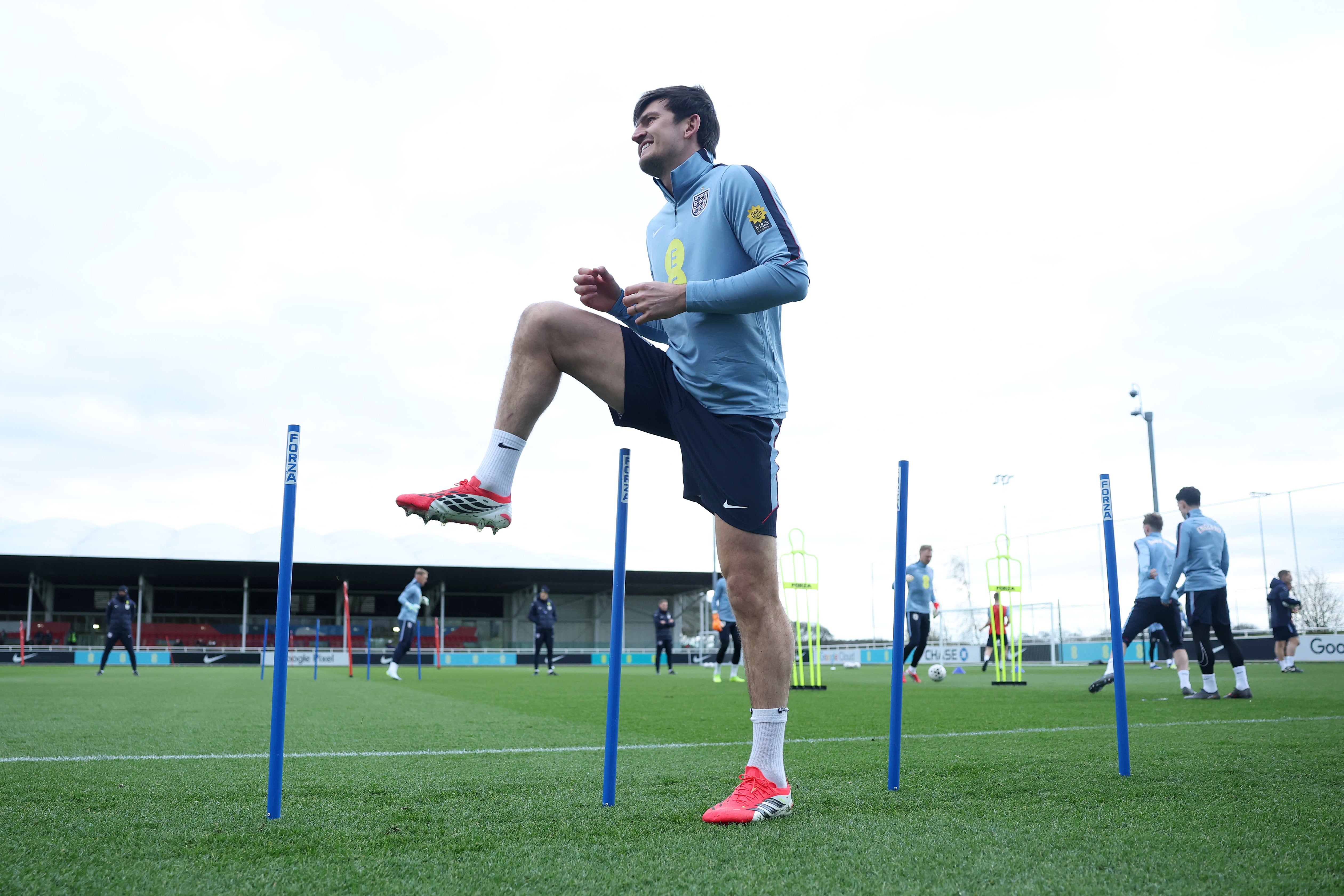
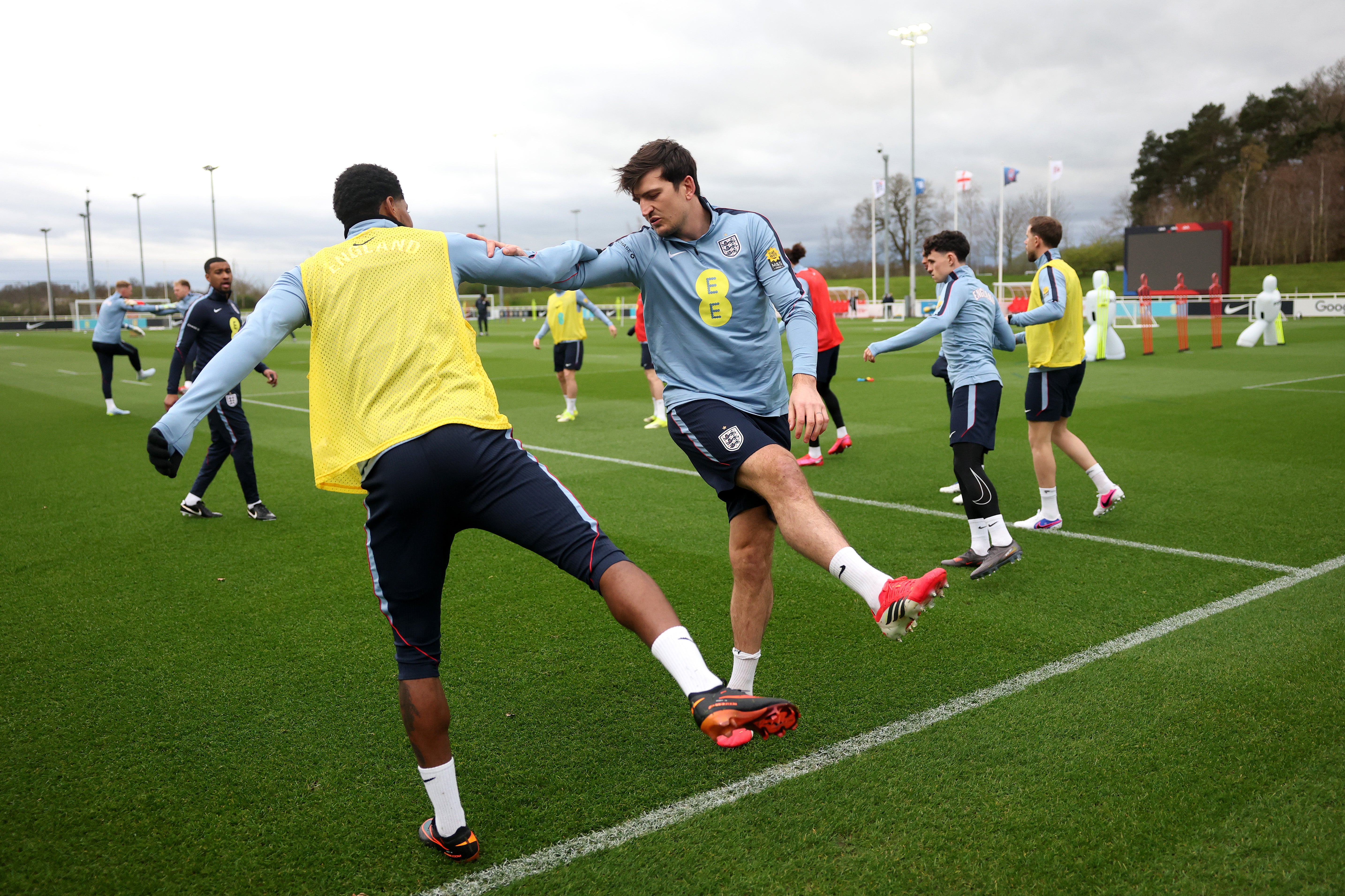
Harry Maguire in training for England at St George's Park
Harry Maguire in training for England at St George’s Park (The FA via Getty Images)

Maguire is speaking in a quiet room at England’s second home, St George’s Park, in Burton-upon-Trent, back where he feels he belongs. He spent seven years as a mainstay under Gareth Southgate, first on the left side of a back three and later in a pairing with John Stones. Over the past two years he had to get used to watching England as a fan again, taking his career full circle, back to when he was a Hull City player travelling around France with friends watching Euro 2016 from the stands.

“It did hurt [to watch England] but I still wanted them to win,” he says. “I have a lot of friends here. There are times when you feel like you should be in the squad and then that probably hurts a little bit more, but the last three camps I wasn’t fit, I wasn’t playing every game for Manchester United, I was in and out, I was playing three games and getting injured. When you don’t build up that rhythm, you don’t really have an excuse.

“It hurt more when I watched them in the final against Spain, losing that game [Euro 2024 final].”

Away from England, Maguire focused on performing for his club. He enjoyed working with Amorim but felt the central role in a back three limited his best attributes, consigned to be a sweeper when he wanted to roam and charge and challenge opponents physically. His freedom to carry the ball upfield was clipped, and it all added to the narrative that he was a fading force.

“When you’re playing in a back five and you’re playing that middle one, automatically people think you’re a little bit older and can’t move as much. I’ve always said I much prefer playing in a back four. I feel like I can play more aggressive, play more on the front foot and I feel like that’s a big part of my game.”

Advertisement
Harry Maguire’s club form has put him back in the picture for England
Harry Maguire’s club form has put him back in the picture for England (Owen Humphreys/PA)

Amorim will be a great manager, Maguire insists. It just didn’t click. “I really like Ruben, I think he’s got great ideas. Those ideas just didn’t work at Manchester United. I do believe he’ll go on and have an amazing career. At his next club he’ll probably go and win many, many football matches.”

Carrick’s reign has been transformational. Maguire has enjoyed the freedom of a back four as United have climbed the table to third, in a strong position to qualify for next season’s Champions League with seven games to go. Surely the players want him to stay beyond the summer?

“Listen, Carrick coming in, he’s been amazing. He speaks really, really well. He’s tactically very, very good. He’s brought in some amazing staff, [such as] Steve Holland. [But] it’s not up to us. I think we’ve got to finish the season strong, and then I think he should go right into the mix with the other candidates.

“It’s going to be a big summer. We know that for Manchester United. We need bodies in to help the squad. It’s going to be a big recruitment in the management department, and I’m sure the hierarchy will get it right.”

Maguire has stayed fit and found form in recent weeks, ironically right up until Tuchel’s phone call. The next night he scored a goal at Bournemouth, but was sent off as United settled for a draw – “a harsh” red card, he says.

Advertisement
Maguire is competing for a place on the plane to North America
Maguire is competing for a place on the plane to North America (The FA via Getty Images)

A one-game suspension means he won’t play for United again until 18 April at the earliest, when they travel to Chelsea. That time off will at least offer a window to speak to the club about his future, with his contract expiring at the end of the season. Maguire wants to stay, and the way he talks suggests that something might almost be agreed.

“What that agreement is, I’m sure you’ll find out over the next few weeks,” he says. “I think it’ll get sorted sooner rather than later, whether I stay or leave. I love this club, but it’s got to be right for myself, it’s got to be right for the club as well. I don’t want to be staying on a sentimental value. I want to be staying because I want to be there and the club want me to drive the club forward still, and they feel like I’ve got a big part to play in it.

“[I want to be] playing games and helping the team on and off the pitch. I want to be important to the club. So we need to sit down and speak – and I’ve got a long time off now with the red card.”

Only three months ago, Maguire’s international and club careers appeared to be in their winter days. Suddenly they are in full bloom again. He never gave up hope of travelling to North America to experience one more World Cup as a player, rather than a fan, when summer comes around. “I kept it free, just in case.”

Source link

Advertisement
Continue Reading
Click to comment

You must be logged in to post a comment Login

Leave a Reply

Sports

McLaughlin: Outlook for coaches at Utah, BYU & Colorado

Published

on

Big Ten logo

Indiana should go into the 2026 season as the preseason No. 1 team in college football after landing QB Josh Hoover out of the portal from TCU.

Plus, Curt Cignetti still has the best staff in the country.

On today’s episode of Locked On College Football, Spencer McLaughlin and ‘Locked On Bama’ host Luke Robinson discuss the Crimson Tide’s ongoing QB battle in Tuscaloosa.

Does Austin Mack have a built-in advantage over Keelon Russell?

Advertisement

Colorado Buffaloes logoColorado enters 2026 with some pressure on Deion Sanders to win, aided by new OC Brennan Marion.

‘Locked On Buffs’ host Kevin Borba shares thoughts on his conversation with Colorado’s new playcaller.

05:42 Hoover’s Potential and Playoff Expectations
06:44 “Josh Hoover Stands Out
17:34 Alabama QB Battle Breakdown
22:32 Patience Pays Off in Football
28:34 Deion Sanders & Colorado’s Future
30:35 Coach Criticized for Job Success
33:45 Utah, BYU, Colorado Coaching Outlook

/ @lockedoncollegefootball  

Source link

Advertisement
Continue Reading

Sports

Jonah Coleman Enters the Chat for Vikings

Published

on

Advertisement

Jonah Coleman runs with the ball during a game against the Maryland Terrapins.
Washington Huskies running back Jonah Coleman (1) carries the ball through traffic, pushing upfield against the Maryland defense on Oct. 4, 2025, at SECU Stadium in College Park as the Huskies leaned on their ground game during a competitive matchup. Mandatory Credit: Jamie Sabau-Imagn Images.

Are you ready for the Minnesota Vikings to draft a dynamic young running back for the first time in eons? The club took a step in the right direction this week, meeting with rookie tailback Jonah Coleman.

The Vikings keep doing homework on this deep 2026 running back class, and that is excellent.

Coleman is considered the third- or fourth-best running back in this year’s class, and there’s a small chance that he transfers his purple uniform from Washington to Minnesota.

Advertisement

Coleman Fits Minnesota’s Search for Backfield Juice

The Vikings have nine draft picks in 2026.

Jonah Coleman runs with the ball during a game against the Maryland Terrapins. Jonah Coleman Vikings
Washington Huskies running back Jonah Coleman (1) carries the ball through the defense, working upfield against Maryland on Oct. 4, 2025, at SECU Stadium in College Park as the Huskies leaned on their rushing attack during a competitive road matchup. Mandatory Credit: Jamie Sabau-Imagn Images.

Vikings Meet with Coleman

In all likelihood, the Vikings will draft a halfback somewhere in April’s draft, and the franchise now has a meeting with Coleman on record.

SI.com‘s Will Ragatz wrote this week, “The Vikings will host Coleman on a Top 30 visit, per Arye Pulli. The former Arizona and Washington standout has recorded over 1,100 yards from scrimmage in each of the last three seasons and scored 27 touchdowns in 25 games for the Huskies.”

Advertisement

“He’s been an efficient college runner who can also catch the ball (87 career receptions) and pass protect. There’s a lot to like about Coleman, but he’s also undersized at 5’9″ and isn’t particularly explosive.”

At the moment, Coleman is projected as a 3rd-Round pick, and Minnesota has two of those in the chamber.

A Superb Landing Spot

In Minnesota — if the Vikings press the button on Coleman — he’ll strut into a wonderful situation, not oozing with the pressure of an immediate RB1. The Vikings have Jordan Mason and Aaron Jones back in 2026, and they figure to take the bulk of rushing attempts next year if healthy.

Advertisement

With a man like Coleman, he can mature for a season as the RB3, be promoted to RB2 if an injury emerges — it probably will — or win the RB1 job outright if he’s that damn effective at training camp and in the preseason.

Coleman will also have offensive teammates as weapons, including Kyler Murray, Justin Jefferson, Jordan Addison, T.J. Hockenson, and the aforementioned running backs. The spot is ideal for Coleman, and he might be ideal for the Vikings.

The Green Bay Packers could give Coleman a peek, as well.

Zone Coverage‘s Mitch Widmeier on Coleman to Green Bay: “A true three-down back with the Huskies, Coleman could be an every-down back if he reaches his ceiling in the NFL. For Green Bay specifically, two things stand out. Coleman had a grand total of two fumbles in 551 career rushing attempts. That covers two years with Arizona and another two with Washington. Coleman protects the football as well as any college running back has in the last four years.”

Advertisement

“If you want to play running back in Green Bay, you need to protect the rock, have some capability to pass block, and possess a certain level of character. Check, check, and check. Coleman could be selected as early as Round 2, or he could fall into Round 4. If nobody selects him in the second round, he will be an awfully tempting option for Green Bay.

Coleman’s Scouting Report

Coleman is 5’8″, 220 pounds, has 4.5 speed, and has a style similar to Ray Rice from the Baltimore Ravens (without the spotty reputation) 15 years ago. He can catch the ball out of the backfield, and he scored 27 touchdowns at Washington in the last two years.

NFL Draft Buzz on Coleman’s rookie profile: “Coleman is not going to test his way into a higher draft slot, and his game does not need him to. His vision between the tackles finds creases before they fully develop, and his patience within zone schemes lets linemen finish their work before he commits.”

Advertisement

“He averaged over five yards per carry in 2024 behind an offensive line ranked 105th nationally in run-blocking grade, which speaks louder than any combine drill. Zone-heavy offenses are the natural fit. Where Coleman separates from other power backs in this class is ball security paired with receiving ability. One fumble across 396 career touches keeps you on the field in December.”

Jonah Coleman walks toward the locker room after a game against UC Davis. Jonah Coleman Vikings
Washington Huskies running back Jonah Coleman (1) heads toward the locker room after the final whistle, leaving the field following a win over UC Davis on Sep. 6, 2025, at Husky Stadium in Seattle as Washington wrapped up its opening-week victory. Mandatory Credit: Joe Nicholson-Imagn Images.

Power backs who can act as receivers are somewhat rare.

NDB added, “He caught 31 passes for 354 yards in 2025 and looked comfortable on underneath routes, giving coordinators the option of leaving him in on passing downs. Pass protection needs refinement; he brings effort against blitzers but his technique is still developing.”

“His floor is a reliable early-down grinder who handles 15 to 20 touches and controls tempo without putting the ball on the ground. His ceiling is a three-down back in a system that values patience over home-run speed.”

The Alternatives

Advertisement

Assume the Vikings want a rookie running back, Notre Dame’s Jeremiyah Love isn’t available, and a different team picks Coleman. These would be the options before the end of Round 5:

  • Jadarian Price (Notre Dame)
  • Mike Washington Jr. (Arkansas)
  • Emmett Johnson (Nebraska)
  • Nick Singleton (Penn State)
  • Kaytron Allen (Penn State)
  • Demond Claiborne (Wake Forest)
Jonah Coleman rushes with the ball during a game against UC Davis. Jonah Coleman Vikings
Washington Huskies running back Jonah Coleman (1) takes a handoff and pushes forward during first-quarter action, attacking the defense against UC Davis on Sep. 6, 2025, at Husky Stadium in Seattle as Washington established its ground game early. Mandatory Credit: Joe Nicholson-Imagn Images.

The Vikings have also formally met with Johnson from Nebraska and Claiborne of Wake Forest.

Coleman will turn 23 in August. Minnesota hasn’t drafted a game-changing running back since Dalvin Cook, and that was nine years ago.


avatar

Source link

Advertisement
Continue Reading

Sports

IPA President on India’s global pickleball push, Olympic Dream and IPBL’s impact (Exclusive)

Published

on

Pickleball in India is quietly but steadily moving beyond its tag as a casual, recreational sport and turning into a serious competitive discipline. The Indian Pickleball Association’s recognition as the National Sports Federation has played a key role in this shift, bringing much-needed structure and credibility to the sport.

With systems like rankings, organised tournaments, and grassroots initiatives now in place, pickleball is beginning to build a proper pathway for players across the country. Coupled with rising participation and growing interest from brands and investors, the sport is not just spreading rapidly but also starting to establish India as a credible force on the global stage.

In an exclusive and freewheeling conversation with Sportskeeda, the President of the IPA, Suryaveersingh Bullar, opens up on the pickleball ecosystem in India and why he thinks the sport could become a potential Olympic medal opportunity for the country in the future:


Q1. The Indian Pickleball Association recently gained NSF (National Sports Federation) status. How does this milestone change the structure of the sport?

The granting of NSF status is the most significant milestone for any sport. With IPA becoming the sole governing authority, it allows us to push for inclusion in programs like Khelo India, university competitions, and the School Games Federation of India, as well as explore integration into the CBSE sporting system.

This recognition ensures athletes receive the same prestige as those in traditional sports, while also opening doors to government grants, SAI training facilities, and eligibility for honours like the Arjuna Award.

Advertisement

Importantly, it brings standardisation and governance. We are implementing national standards, certification programs, and have launched a coaching certification. We are also working towards referee certification and setting up an equipment testing lab in India to support local manufacturing and quality control.


Q2. Where does pickleball stand in India today, and what is your long-term vision?

Over the past year, pickleball in India has transitioned from a niche recreational activity into a high-growth performance sport. The IPA has driven this through structured ranking tournaments, international representation, and high-performance centres.

But this is just the beginning. We believe pickleball has the potential to bring India an Olympic medal once it is included in the Games. Our vision is to make India a top-three global powerhouse, with athletes capable of winning medals at the Asian Games and Olympics.

Advertisement

Q3. What steps are being taken to grow the sport beyond metro cities and at the grassroots level?

We are working aggressively to take pickleball beyond metros. A key step is our partnership with Sports Gurukul to launch a national inter-school championship, leveraging a network of over 500 schools.

IPA operates across 27 states, and we are focusing on district-level expansion to identify talent in Tier 2 and Tier 3 cities. We are also promoting portable nets, allowing any flat surface to become a pickleball court, making the sport highly accessible.

Efforts to integrate pickleball into Khelo India will further accelerate grassroots growth.

Advertisement

Q4. How is IPA building a talent pipeline to compete globally?

We have established a structured development framework anchored by a transparent ranking system and a tiered tournament structure from district to national level.

High-performance centres provide elite coaching, while international exposure remains a priority. India’s seventh-place finish at the Pickleball World Cup (among 78 nations) highlights our progress.

Our partnership with the US Open gives national champions direct entry, bypassing the lottery system. Additionally, a dedicated selection committee scouts talent nationwide and supports players with training, sponsorships, and international opportunities.

Advertisement

Q5. What does the IPA tournament roadmap look like over the next 12–18 months?

The structure includes IPA-run state tournaments culminating in the annual Nationals, alongside a rapidly growing calendar of IPA-sanctioned events.

We conducted around 110 tournaments last year and expect to nearly double that. The Indian Open is now an IPA-sanctioned global event, and discussions are underway to host the first Asian Pickleball Championship in India, potentially featuring over 18 countries.

Indian teams will also compete in global events like the World Cup, the US Open, and the amateur EPIC World Championship in Singapore.

Advertisement

Q6. Are there plans to collaborate with schools, colleges, or private leagues to accelerate adoption?

Yes, collaboration is central to our strategy. The Indian Pickleball League (IPBL), held in Delhi and sanctioned by IPA, was a major success and significantly boosted the sport’s visibility.

We have also launched the national inter-school championship with Sports Gurukul and are exploring inter-college competitions. These initiatives are helping us build a strong ecosystem and drive widespread participation.


Q7. Infrastructure is a key challenge for emerging sports. How is IPA addressing this?

Advertisement

Infrastructure is always a challenge, but pickleball’s growth has led to courts emerging across the country. IPA is partnering with private facilities to use them as training and awareness centres.

We are also in talks with sponsors to set up high-performance centres and with the Sports Authority of India to establish academies within existing stadiums. Since pickleball requires relatively less space, we are confident of expanding infrastructure rapidly over the next two years.


Q8. What does the professional pathway look like for a young player in India today?

A young player today can enter through district-level tournaments, progress through state rankings, and eventually compete at the IPA Nationals.

Advertisement

From there, standout performers gain access to high-performance centres, national camps, and international exposure. With structured rankings, scouting systems, and global tournament pathways, the route to becoming a professional athlete in pickleball is now clearly defined.


Q9. How do you see the commercial side of pickleball evolving in India? What role will leagues like IPBL play?

Pickleball is growing strongly as a commercial sport. It offers excellent returns on investment due to its accessibility and appeal across age groups.

Leagues like the IPBL have already elevated the sport’s profile with broadcast backing and team ownership from major business houses. Going forward, the IPBL can play a role similar to the IPL – creating opportunities for players, coaches, referees, brands, and sponsors, while driving the sport’s overall growth.

Advertisement

Q10. What is your message to young athletes considering pickleball?

Whether you dream of representing India at the Pickleball World Cup, the US Open, or even the Olympics in the future, the IPA is here to support you. The infrastructure is growing, the system is in place, and the opportunities are expanding.

Grab a paddle, your journey to the top starts now!