Sports
LeBron James adds to his legacy as Lakers eliminate dysfunctional Rockets

LeBron James has played 23 NBA seasons. His legacy, no matter how you feel about it, is mostly written. Sure, he could do a bit more accumulating. He’s set pretty much every record he’s going to set, but he could always widen the gap between himself and No. 2. A fifth championship would be nice, but let’s not kid ourselves, winning one as part of an ensemble in his 40s doesn’t carry the same weight that his apex titles as the best player in the world did. That stuff is mostly window dressing, though.
At some point in or around James’ peak, you either decided you believed he was better than Michael Jordan, or you didn’t. Nothing that happens in his 40s is going to change your mind, nor should it. He’s not himself anymore, and though he maintained some proximity to his peak far longer than Jordan did, debating the relative merits of 41-year-old LeBron against Wizards-era Jordan just isn’t especially interesting. There’s no firm consensus on peak Jordan vs. peak James, but there’s no new information coming on that front.
The first-round series we just watched — James’ Los Angeles Lakers taking down the Houston Rockets in six games — says little about that debate. But it certainly says something. The Lakers were a +425 underdog to the Rockets entering this series, technically making it the biggest upset of James’ career. Sure, those odds didn’t account for Kevin Durant’s eventual health status, but Houston had Durant for Game 2 and still lost.
For the Lakers, Luka Dončić missed the entire series and Austin Reaves returned only for Games 5 and 6. The Lakers averaged around 116 points per game in the regular season. Those two, on average, scored just under 57 and assisted on another 34. There’s some overlap with the two assisting one another, of course, but there are also invisible points they generate through advantage creation. How many Lakers points this season started with Dončić drawing two on the ball before several passes turned into an open layup?
You can’t fully quantify what the Lakers were without in this series. It was the entire offensive identity they spent the year building, including the reduced role James took on as the season progressed. A 41-year-old James and coach JJ Redick reinvented the team effectively enough over the course of three weeks that they were able to beat the Rockets, a 52-win opponent, in six games. It was a diminished 52-win opponent, of course, but therein lies the noteworthy contrast.
Lakers overcame injuries while Rockets failed to adjust
Houston lost Fred VanVleet before the season. They never quite figured out how to play without him. Then they lost Steven Adams. They were significantly worse without him as well. The Rockets had every available resource at their disposal to undergo the sort of reinvention that the Lakers did. The Lakers traded their only available second-round pick at the deadline for Luke Kennard. The Rockets sat on a mountain of draft capital. Houston has a roster full of young, highly drafted players eager for bigger roles. The Lakers, aside from James, were comprised mostly of players cast off by other teams. Marcus Smart and Deandre Ayton were bought out by their last teams. The Lakers are Kennard’s fifth team. Bronny James was supposedly a nepo draft pick.
The Rockets even had time. They’ve known about VanVleet’s injury since September and Adams’ since January. The Lakers lost Dončić and Reaves on April 2. They did in weeks what Houston couldn’t in months.
LeBron James promised the Lakers everything, then gave them every last ounce
Sam Quinn
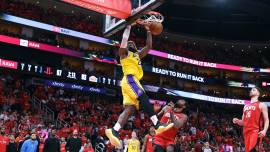

There are plenty of Lakers figures — Redick especially — who deserve plaudits for that, and there are even more Rockets figures who deserve blame. But boil this down, and it was possible because the Lakers had James, the greatest problem solver in the history of basketball, on their team. And even if James is not who he once was physically, he’s the sort of player and thinker capable of taking disparate parts and turning them into a cohesive team. He’s been doing this for decades.
How different is this, really, from leading the 2007 or 2018 Cavaliers to the NBA Finals? The stakes are lower, but the principle applies. No matter who you have on your roster, James is going to maximize them.
There are exceptions, of course. The 2011 Finals stand out as the most notable, and it’s the biggest stain on an otherwise spotless resume. The 2022 Russell Westbrook debacle, a combination of injuries, poor roster construction and all manner of locker room issues, stands out as well. There are certainly individual players who had to take smaller roles besides him — Chris Bosh and Kevin Love being the obvious examples.
But whatever full team you give James, he’s going to take it to its absolute ceiling. He knows how to make the most of the rosters he has, even if individual components of those rosters aren’t always happy with where he thinks they fit into it. Since that 2011 Finals loss, he’s made the Finals eight more times. He lost a few more years due to injury, and Nikola Jokić proved an insurmountable foe for a stretch, but he didn’t lose a series in which his team was favored again until 2025 — when he was 40 and his roster was so thin that his coach played an entire second half using only five players.
Merely having James is no longer an automatic trip to the Finals, but it’s an assurance that your team will be as good as it can feasibly be. And in this series, that was better than the Rockets.
Differences between LeBron, Kevin Durant on full display
That’s part of what made the Rockets such an interesting foil for a series like this. James really only has two remote historical peers left in the NBA, Stephen Curry and Durant, and since the latter left the former, his teams have pretty consistently underachieved. Not all of that is his fault. He didn’t cause the pandemic that split up the Nets, of course. But he didn’t hold that team together, either. He couldn’t lift up a Suns team with two other star-level talents. They lacked role players, but the sort of talent downgrade Phoenix made swapping him out for Dillon Brooks, Jalen Green and a pick shouldn’t lead to an eight-win improvement.
The Rockets didn’t have Durant for five of the six games in this series. They did have him for 78 of the 82 regular-season games. What does it say about his presence that none of Houston’s highly-touted young players grew in the ways we hoped they would playing beside him? How much responsibility does he bear for the lack of resiliency the Rockets showed early in this series? Certainly not all of it. Probably some of it. Stars, whether they want to be or not, are culturally load-bearing.
The Lakers won a series they should have lost because they had James on their team, and he managed to unlock the absolute best from players like Kennard, Smart and Rui Hachimura. The Rockets lost in the first round of a season that started with championship expectations primarily because of injuries, but also, to some extent, because the Hall of Famer they imported to create those championship expectations wasn’t able to create or sustain a culture that empowered his young teammates in the same way.
There are basketball reasons for that (James is a legendary playmaker and Durant, almost two decades in, still struggles with double-teams) and there are intangible ones (Durant not being on the bench for Game 3, even to receive treatment, hardly suggested an especially close team, and we now know the Durant burner scandal was addressed and ultimately tabled in the locker room), but the end result is the same. The difference between the two is that Durant has historically been a solo artist, while James has built a career making his teams the absolute best they could be.
That’s not going to convince you to rank James ahead of Jordan if you weren’t already there. It’s just a nice encapsulation of what his presence has meant for the past 23 years. James’ undermanned team faced the undermanned team of one of his greatest rivals, and James won the matchup handily.
It may not change his legacy, but it epitomizes what that legacy is all about.
You must be logged in to post a comment Login