Sports
Mike Brown fails first major test as Knicks coach with Game 2 collapse vs. Hawks

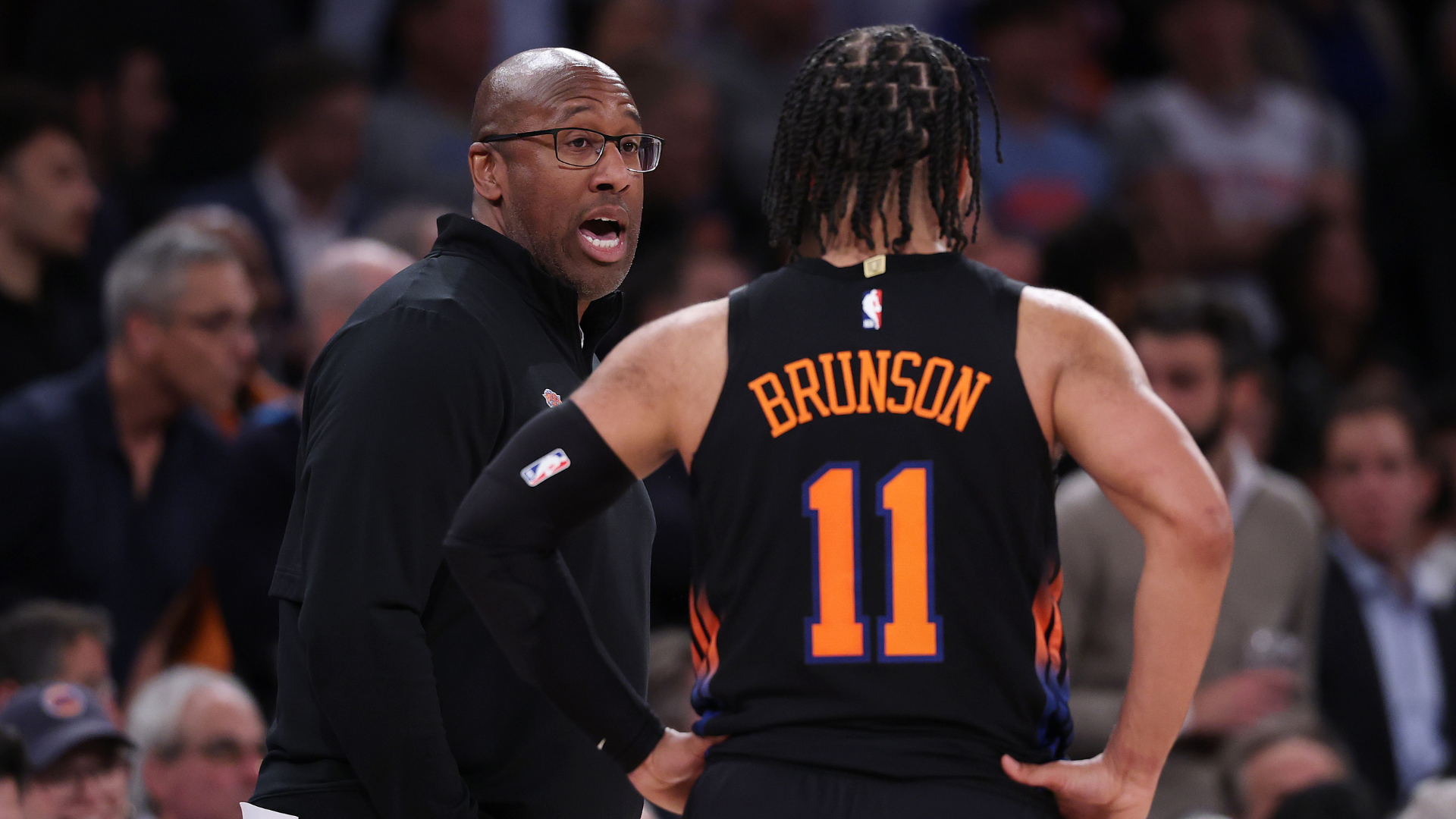

Mike Brown arrived in New York with a laundry list of fan complaints to address from the tenure of his predecessor, Tom Thibodeau. In his first regular season on the job, he plucked basically all of that low-hanging fruit.
Shot-selection? The Knicks jumped from 28th to 12th in 3-point attempt rate. Lack of ball- and player-movement on offense? NBA.com tracking data shows the Knicks moved from 18th to 14th in passes per game and 21st to 10th in average distance traveled per game offensively.
Lineups featuring both Jalen Brunson and Karl-Anthony Towns didn’t defend well enough? Those lineups rated in the 41st percentile in terms of defensive efficiency last season, but the 52nd this season, according to Cleaning the Glass. Over-reliance on the starters? Last year, New York’s starting five played 940 regular-season minutes, 226 more than any other five-man unit. This year, it played 541, making it not even the most-used lineup in basketball. The Knicks are so deep that deadline acquisition Jose Alvarado didn’t even play in Game 1 against the Hawks. There are even rumors about standout rookie Mo Diawara being hidden ahead of his offseason restricted free agency. The Knicks suddenly have more depth than they know what to do with.
On paper, Brown’s first regular season should be viewed as an enormous success. It hasn’t felt that way mostly because, frankly, the regular season is no longer a meaningful barometer for this team’s performance. The Knicks have averaged around 50 wins over the past four seasons. They’ve won at least one playoff series three years in a row. When your owner goes on the radio and shares Finals expectations, the message is clear: all of those regular-season improvements are nice, but it means nothing if it doesn’t translate to the playoffs. Beating Washington and Brooklyn in March is nice. This year’s Eastern Conference runs through Detroit, Boston and Cleveland, three teams Tom Thibodeau beat in recent postseasons. They’re the measuring stick.
It turns out, Brown’s first major test as New York’s coach didn’t come against one of those teams. It came in the first round against a team the Knicks should have handled relatively comfortably. The Knicks held double-digit leads in both halves of Game 2 against the Atlanta Hawks, including a 12-point advantage at the start of the fourth quarter. New York hadn’t blown a lead that big with so little time left in a home playoff game since 1994 against the Pacers. They did so on Monday, and it was an almost entirely self-inflicted wound. If this was Brown’s first real test as New York’s head coach, he failed.
Missing KAT
The most visible manner in which he did so came during that late-game collapse. With 4:24 remaining on the clock, Karl-Anthony Towns attempted and missed a 3-pointer. It was the last time he would touch the ball in the game. His involvement in the offense, to this point, was reduced to two screens: a “screen the screener” action to set Josh Hart up to screen for Jalen Brunson with a bit less than four minutes left and then a single ball-screen for Brunson with around 50 seconds remaining. Otherwise, he was essentially a spacer.
And hey, Towns is certainly capable of serving as a floor-spacer. In certain matchups, you’re probably fine with him doing that while Brunson cooks. In this, particular matchup, Towns had just scored 14 points on 6-of-7 shooting in the third quarter and was being defended by Jonathan Kuminga. Opponents have vexed New York’s offense for two years by putting a wing on Towns and a center on the weaker shooting Hart, and that was indeed the case down the stretch with Onyeka Okongwu taking the Hart matchup. Brown’s failure to solve that problem — one well-known a year ago — hardly bodes well for the later rounds.
It’s not as though Okongwu was lurking near the basket down the stretch, either. Hart was Brunson’s primary screener, so Okongwu was getting switched onto the ball far behind the arc. New York couldn’t take advantage largely because too much of their late-game offense revolved around players, usually Brunson, occasionally others, dribbling the air out of the ball and running out the clock. They’ve earned the right to do so. Brunson’s playoff heroics are well-chronicled, and New York had the NBA‘s No. 3 clutch offense this season.
It just begs the question, if you’re not going to try to involve Towns in the offense, should he really be on the floor? You’re still getting some value out of having Towns on the floor as a spacer, but size is New York’s big advantage in this series. If you’re not actively taking advantage of the mismatches he gets, you might as well close with Mitchell Robinson and emphasize defense to hold your lead.
It was the culmination of issues that have plagued Towns and the Knicks all year. He attempted a career-low 13.8 field goals per game this season. “I mean, our offense is our offense,” Towns said after a February game New York lost to Detroit despite the Pistons missing their top two centers. “It’s been that way all year.” Through two playoff games, Towns has attempted 25 total shots. Not exactly ideal usage for a max-contract, offense-centric center playing against an undersized opponent.
A staggering problem?
The Knicks could get away with this if it were simply a crunch-time issue. Remember, the Hawks outscored them by eight in the last three-and-a-half minutes or so of Game 1, including an 11-0 run that surely gave Knicks fans flashbacks to their Game 1 collapse against Indiana a year ago. It didn’t matter because they’d built an insurmountable 19-point lead. New York’s lead was smaller in Game 2 — only eight points with five minutes to go — largely because of mismanaged bench lineups.
The Knicks sat Brunson and Towns at the same time for around 12 total minutes in Game 2. They lost those minutes by eight points. There is an apparent strategic purpose for that decision. The Knicks have thus far mostly avoided overlapping minutes between Towns and Robinson in this matchup. It makes sense to play Robinson early in quarters or in the last two minutes as a deterrent to intentional fouling—the former because it gets the Knicks into the bonus early, the latter because off-ball fouls in the last two minutes go for one shot and the ball rather than two shots. Brunson sits early in the second and fourth quarters, so now, apparently, so does Towns.
The problem with not staggering them, though, is that lineups featuring Towns and no Brunson now have a pretty lengthy track record of success. Over the past two regular seasons, the Knicks have a +11.5 net rating in those minutes, and last postseason, it was +14.9. These lineups tend to perform admirably defensively, but they’re also a way to keep Towns engaged in the offense for those later moments that too often become Brunson-centric. Asking bench lineups without their top two — or sometimes three — creators to score effectively is just too tall an order. Atlanta turned a nine-point first-quarter deficit into a brief second-quarter lead during a run in which New York played with just a single starter, first OG Anunoby, and then Hart, on the floor.
Brown argued in favor of the lineups featuring no Brunson or Towns. “I don’t (think) the game got away there,” he told reporters. “We’ve played that lineup at end of regular season and it was pretty good.” As Clippers reporter Justin Russo noted, Brown was technically correct. The Knicks were +32 with both of them off of the floor after March 1… but they were -63 in such situations before that. Considering the way Game 2 played out, it’s hard not to question the move not to stagger the two stars. It’s harder to get away with star-less minutes against playoff-level opponents and scouting.
A poorly timed timeout
Every point, every decision potentially matters in games like this. Case in point: this game was decided by one. The game ended on a frantic sequence in which CJ McCollum missed two free throws, and Mikal Bridges wound up taking and missing a contested, game-winning jumper. Though there was confusion on the broadcast, New York didn’t have a timeout it could have used to draw something else up. However, Brown’s decision-making earlier in the quarter was partially responsible for that.
Teams are only allowed to use two timeouts in the last three minutes of a half. Brown could have taken a “use it or lose it” timeout before the three-minute mark. He didn’t, and instead decided to take one with 2:43 remaining. “A couple of possessions weren’t fluid so I wanted to make sure we had something we wanted to get to,” Brown explained after that game. However, that meant that the timeout Brown used with 10 seconds remaining to set up the Brunson 3-pointer that pulled New York within a point was the last one the Knicks could use in regulation.
Brown wasn’t sure if he actually would have used the timeout if he’d had it. “Five to seven seconds is close,” he explained. “It would’ve been my gut feel. There’s a chance I could’ve taken a timeout, if I had one, and then there’s a chance I wouldn’t have. I thought it was a good shot, Mikal got up the floor, I thought he got to his spot. He was a little off balance, but I don’t think the shot was under a ton of duress. That’s shots that he’s hit for us in the past.”
Even if it’s a shot Bridges is capable of making, it probably isn’t the one you’d draw up for such a situation. You’ve leaned on Brunson in such situations all year and all games. You just drew up a bucket for him seconds of game time earlier. Even against a set defense, you’re better off trying to set him up again.
Brown isn’t the only reason New York lost Game 2. It’s hard to miss 10 free throws and win a close playoff game. McCollum made a number of well-contested shots down the stretch. But playoff games go haywire sometimes. Think back to that Game 1 loss against the Pacers for the Knicks a year ago. Sometimes your opponent makes a bunch of shots they shouldn’t. Sometimes your players miss shots they should make. There’s nothing you can do about that. But it’s a coach’s job to insulate their team against those outlier moments. Build a big enough lead, pluck enough of the low-hanging fruit, and those moments won’t hurt you as often.
Thibodeau got fired because he didn’t do that. He left the Knicks vulnerable, and the Pacers punished them for it. Brown addressed a lot of what went wrong for him a season ago, but Game 2 represented his first high-stakes game that fell within that margin for outlier error. The Hawks took advantage. No matter where you stand on the Towns usage dilemma, especially late in games, those unorthodox lineup choices ultimately doomed the Knicks against Atlanta, and their chance at drawing something up for a better final response was lost on questionable timeout usage. Now the series is tied, and home-court advantage is sacrificed. There’s a long way to go, but the onus is on Brown to right the ship moving forward.
You must be logged in to post a comment Login