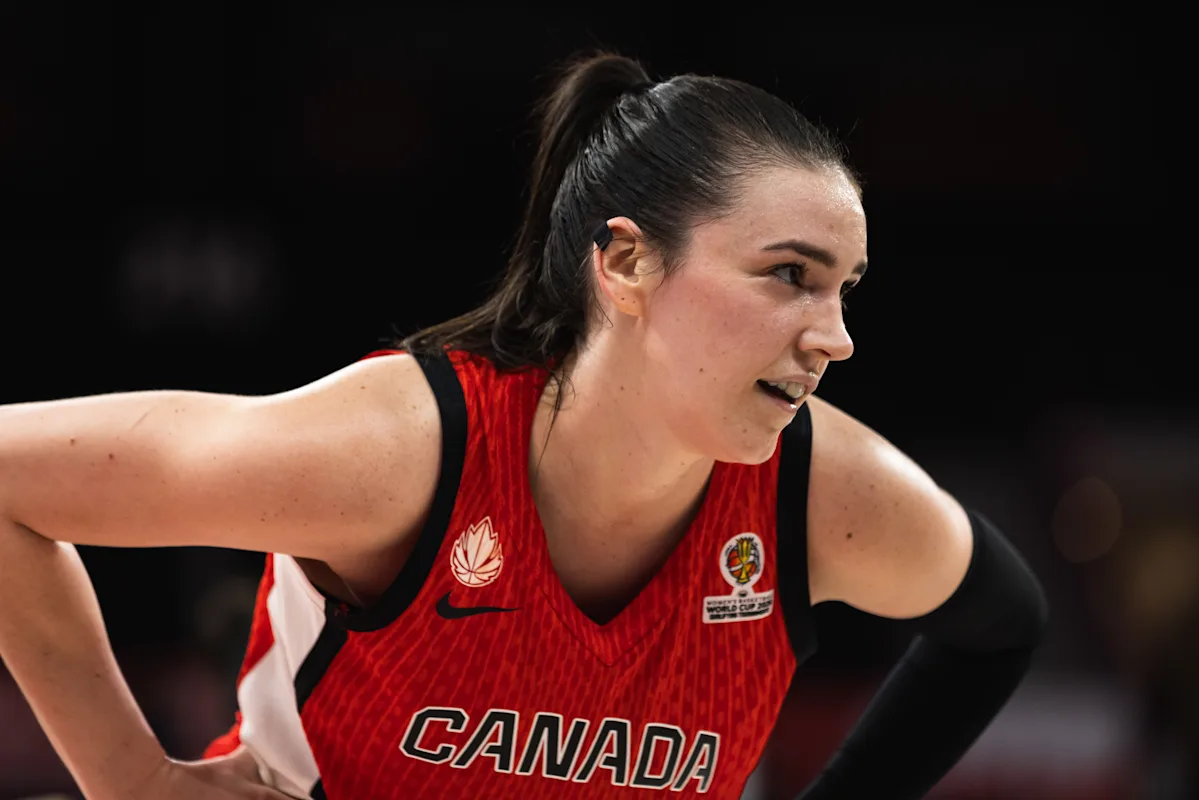
The Portland Fire selected Bridget Carleton with the No. 1 pick in the 2026 WNBA Expansion Draft.
A member of the Minnesota Lynx since 2019, the Canadian sharpshooter will be a founding player for the rebirth of the Fire. Canada’s first WNBA team, the Toronto Tempo, selected Julie Allemand with the second pick in the expansion draft. The Belgian point guard has three seasons of WNBA experience, most recently playing for the Los Angeles Sparks in 2025.
Advertisement
Here’s how the whole expansion draft unfolded:
First round
-
Portland: Bridget Carleton (Minnesota; unrestricted free agent)
-
Toronto: Julie Allemand (Los Angeles; restricted free agent)
-
Portland: Carla Leite (Golden State; under contract)
-
Toronto: Nyara Sabally (New York; under contract)
-
Portland: Luisa Geiselsöder (Dallas; reserved)
-
Toronto: Marina Mabrey (Connecticut; unrestricted free agent)
-
Portland: Emily Engstler (Washington; reserved)
-
Toronto: Aaliyah Nye (Las Vegas; under contract)
-
Portland: Maya Caldwell (Atlanta; reserved)
-
Toronto: Lexi Held (Phoenix; reserved)
-
Portland: Chloe Bibby (Indiana; reserved)
Second round
-
Toronto: Mariá Conde (Golden State; contract expired)
-
Portland: Haley Jones (Dallas; reserved)
-
Toronto: Maria Kliundikova (Minnesota; reserved)
-
Portland: Nyadiew Puoch (Atlanta; rights held)
-
Toronto: Adja Kane (New York; rights held)
-
Portland: Sarah Ashlee Barker (Los Angeles; under contract)
-
Toronto: Nikolina Milić (Connecticut; reserved)
-
Portland: Sug Sutton (Washington; restricted free agent)
-
Toronto: Kitja Laksa (Phoenix; reserved)
-
Toronto: Kristy Wallace (Indiana; contract expired)
-
Portland: Nika Mühl (Seattle; under contract)
Although free agency and the college draft still are to come, let’s evaluate the current state of the inaugural rosters for the WNBA’s 14th and 15th franchises.
Portland Fire roster analysis
The Fire roster reflects the basketball philosophies of general manager Vanja Černivec and head coach Alex Sarama. Černivec came to Portland after a season with the Valkyries, a team that prioritized system and culture over traditional star power to great success during their inaugural season, while Sarama, most recently an assistant with the NBA’s Cleveland Cavaliers, is known for his constraints-led approach, an offensive philosophy that empowers players to adapt to on-court circumstances rather than adhere to more scripted sets.
Advertisement
Even more than the Valkyries did, the Fire, at least as currently consistuted, lack a typical star, but, headlined by No. 1 pick Carleton, the players seemed suited to help realize the vision of Cernivec and Sarama. It’s also a roster that provides an infrastructure for a higher-wattage star to eventually slide into, whether that happens in the upcoming free agency period, through the college draft or next offseason.
It makes sense that Carleton, with her experience in the Lynx’s sophisticated offensive system, appealed to Portland as their one unrestricted free agent draftee. Carleton also has demonstrated malleability across her pro career. Although a role player in Minnesota, she has assumed primary scorer responsibilities when playing overseas, as well as for the Canadian national team.
Considering Cernivec came from Golden State, it’s also unsurprising that Portland grabbed Leite with their second selection. It’s the second-straight year Leite has been an expansion draft selection, something that should be considered a compliment to the upside she’s flashed with both the Valkyries in the WNBA and Casademont Zaragoza in EuroLeague Women. Her value not only comes from her potential as an off-the-bounce scorer, but also from the fact that she’s under contract for three more seasons, including 2026.
Advertisement
Emily Engstler, Maya Caldwell and Haley Jones, drafted from Washington, Atlanta, and Dallas, respectively, and all of whom are reserved players, bring different flavors of multi-positional versatility that would seem to fit with Portland’s philosophies. Sarah Ashlee Barker, a first-round pick by the Sparks in last year’s college draft, sports a skillset that suggests she could replicate the combination of high-volume 3-point shooting and creation of Carleton. Barker also has three years remaining on her rookie-scale contract.
On the big front, offensive skill was the priority for Portland, as both Luisa Geiselsöder and Chloe Bibby, arriving via Dallas and Indiana, are comfortable behind the arc and with the ball in the their hands, although, due to a lack of foot speed and strength, both leave something to be desired on the defensive end.
At the moment, Portland profiles as a potentially fun offense, one that will need to score a lot of points because they may also sacrifice a lot on the other end. After the draft, Černivec did suggest the team intended to prioritize bigs during free agency, with such players potentially enhancing the team’s defensive viability.
The point guards drafted can at least provide some defensive resistance, as former Mystic Sug Sutton and former Storm Nika Mühl, who will miss the 2026 season as she recovers from an ACL injury, can heat up the ball at the point of attack. Based on comment from Černivec, it appears the team intends to invest in Mühl as a longterm piece, in spite of her current unavailability.
Advertisement
Toronto Tempo roster analysis
While the Fire’s roster seems to reflect a clear identity, it’s more difficult to discern the Tempo’s vision for their expansion season.
Thus far, it’s a roster much different from the ones head coach Sandy Brondello has manned in her previous two spots, both of which produced championships. In Phoenix, Diana Taurasi and Brittney Griner, along with one Skylar Diggins season, were the centripetal stars. In New York, she again was in charge of a super team, guiding the likes of Brenna Stewart, Sabrina Ionescu and Jonquel Jones.
Currently, Marina Mabrey most approximates a star. But while capable of star-level scoring nights, as she showed at Philly is Unrivaled, Mabrey lacks the night-to-night consistency of true WNBA stars, as demonstrated during her tenure with the Sun last season. After the draft, general manager Monica Wright Rogers emphasized that the organization valued Mabrey’s competitiveness, suggesting that Toronto’s decision to presumably make her their featured offensive player, as she was the team’s unrestricted free agent selection, extends beyond her on-court production.
Including Mabrey, Toronto has compiled a more traditional roster.
Advertisement
With Brondello herself being a former point guard, nabbing restricted free agent Allemand, a steady offensive orchestrator, with the team’s first pick shouldn’t have been too surprising. Lexie Held, Mariá Conde and Kritsy Wallace, from Phoenix, Golden State and Indiana, respectively, give Toronto more on-ball operators. An experienced EuroLeague standout, Conde, a Spanish national who played collegiately at Florida State, has never suited up in the W; it will be interesting if she decides now is the time to take her talents stateside. Brondello also has extra familiarity with Wallace from the Australian national team.
Familiarity also describes Toronto’s frontcourt strategy, as they selected New York bench bigs Nyara Sabally and Adja Kane. Drafting Sabally with their second first-round selection was a bit curious, even though she is under contract for the coming season. While talented, injuries have prevented her from consistently playing, much less fulfilling her potential. Potential certainly describes Kane, a 6-foot-3 and 21-year-old big from France who was drafted by the Liberty last season but stayed overseas. Maria Kliundikova and Nikolina Milić give Toronto two more bigs with good size and a measure of offensive versatility, as both have experimented with a 3-point shot. Not in the WNBA since 2019, Kliundikova played for the Lynx last season. While drafted from the Sun, Milić last played in the WNBA in 2023, when she was a member of the Lynx.
Aaliyah Nye, certainly, will be expected to provide 3-point shooting for the Tempo. As rookie, she had some big games for the Aces, with her prowess as a 3-point shooter exceeding her 31 percent mark. Toronto can also benefit from her rookie-scale contract. Kitja Laksa offers the possibility of more 3-point shooting, although she also scratched under 32 percent from behind the arc in her first WNBA season with the Mercury.
Advertisement
More than the Fire, the Tempo likely need a significant move or two in free agency, or to really hit on the No. 6 pick in the college draft, for this roster to credibly compete on a nightly basis, which, according to Wright Rogers, is the intention. Right now, Toronto seems too reliant on Mabrey outbursts or the occasional hot shooting night from Nye to generate wins.
What’s your assessment? Are you intrigued by the Fire? Do you see the vision with Tempo?
And, what do you wish we knew about existing teams’ protected player lists, who was actually available for drafting and any behind-the-scenes agenting or angling that influenced the selections made by Portland and Toronto?
Advertisement
Share all your expansion draft analysis, curiosities and questions.




















































You must be logged in to post a comment Login