Sports
Ping Scottsdale TEC Putters aren’t ‘Zero-Torque.’ They claim this is better

Ping’s latest putters aren’t “Zero-Torque,” but their take on the putter industry’s biggest craze has loads of other ways to help you get it in the hole.
The company is bringing its first Onset putters to a full retail release in the new Scottsdale TEC line after teasing the technology with a PLD limited release last year. Of the three head shapes in the line, two are in Ping’s Onset configuration, which moves the shaft back behind the putter face, but not directly through the center of gravity of the putter.
The striking white mallets also feature Ping’s new EyeQ alignment technology to help focus your eye and deliver the putter more accurately.
“The new Scottsdale TEC putters represent an exciting new opportunity for golfers to improve their putting,” Ping CEO & President John K. Solheim said in a release. “The use of eye-tracking research has given us some great insights into the best ways to help golfers improve their focus and sink more putts. We’ve also chosen to make this line exclusively mallets to better serve the growing market for these types of designs while continuing to offer stroke-type fitting through optimal CG placement. All the Scottsdale Tec models are designed with proven Ping performance, including high MOIs and a fantastic feel. We’re seeing some nice Tour adoption as well as we come into the key season.”
Scottsdale TEC, which stands for “Tour Elevated Concepts,” has already made a splash on the PGA Tour after being first teased at the RSM Classic last November. Tony Finau and Matthieu Pavon led back-to-back PGA Tour events in SG: Putting in February and Wyndham Clark just added the Ally Blue Onset to the bag last week.
Keep reading below for more on the Ping Scottsdale TEC putters, including my take on the release.
What’s actually new with Ping Scottsdale TEC putters — and why you should care
Why Ping’s Onset putters aren’t “Zero-Torque”
Ping Principal Design Engineer Tony Serrano describes the difference between Ping’s Onset putters and “Zero-Torque” putters by imagining you need to haul a trailer with your car. You’re always going to tow it, and it goes where you lead it. But when you have to reverse your car, maneuvering that trailer in front of you becomes very difficult.
Ping’s approach to Onset putters is the same: the shaft sits in front of the Center of Gravity, rather than directly through it, as in other low-torque putters on the market.
“With zero torque, the shaft axis is going directly through the CG,” Serrano told GOLF. “That’s not what we want. We still want to pull the CG, because that’s what creates stability through the stroke. So even though the shaft is set back, the CG is far enough behind it that you’re always pulling it, not pushing it.”


Jack Hirsh/GOLF
That means Ping can push the CG farther back in the head to add stability and by moving the shaft back, that frees up the face to help you align the club (more on this in a bit).
The configuration also means the shaft and CG relationship is very similar to a blade putter, while still having mallet stability. Despite the center-shafted design, the Ally Blue Onset has five degrees of toe hang while the Ketsch Onset has 15 to fit Ping’s straight and slight arc stroke types, respectively.
“Because we can move the CG so far back with the aluminum body and steel sole, that shaft-to-CG relationship gets closer to what you see in a blade,” Serrano said. “So you kind of get the balance and feel of a blade, but with the forgiveness of a mallet.”
The Hayden, a new shape for Ping, is a more traditional round mallet shape with a double-bend shaft.
Keeping a Quiet Eye
One of the major benefits of the Onset is the ability to afford the golfer a completely unobstructed view of the face, making alignment easier.
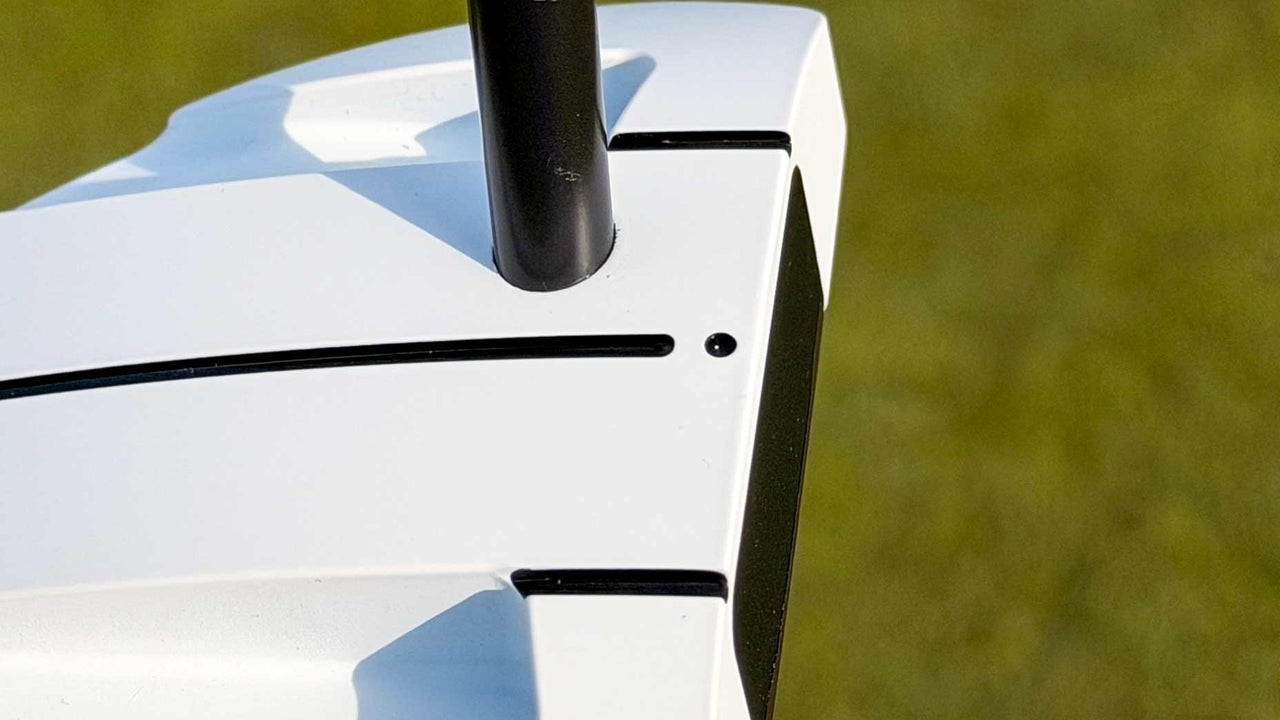
Scottsdale TEC takes that concept even further by introducing EyeQ alignment technology.
Jack Hirsh/GOLF
The EyeQ technology came from studies linking the phenomenon known as Quiet Eye where the longer duration a player can lock their gaze on the ball during the stroke, the stronger the correlation to skill and better performance.
Ping engineers found a dot on the topline of the putter, followed by a line that significantly improved Quiet Eye when compared to a solid line or a blank top.
“What we found with the dot is that it really helps quiet the eyes,” Seranno said. “When players had nothing or just a line, their gaze was moving around a lot more, but with the dot it just locked in. Right before they start the stroke, everything is focused in one place.”
Until I saw the putters, I was confused what the eye was supposed to do once you started the stroke and moved the putter, but I found my gaze immediately locked on the ball in that moment.
The bright white finish helps the alignment feature stand out even more and grabs the consumer’s attention at retail.
Same name, new TEC
The Scottsdale name is an important one for Ping, whose founder, Karsten Solheim, began designing putters in a Scottsdale garage.
It was used last year for the initial line of Scottsdale putters, which featured a soft PEBAX insert, a material commonly used for superior energy transfer in running shoes.

Jack Hirsh/GOLF
But the new Scottsdale TEC line stands out from its predecessor with multi-material construction. Instead of the bodies being cast steel, the rest of the putter is milled from aluminum with steel sole plates.
Milling out of aluminum allowed Ping much more flexibility with the CG properties, one of the reasons they were able to create the stability from the Onset configuration.
“The biggest thing is going from a cast head to a milled aluminum head with a steel sole,” Serrano said. “That gives us a lot of discretionary weight to move around, so we can really maximize MOI and place the CG exactly where we want it. It’s just a higher level of precision and performance compared to cast.”
The Ping Scottsdale TEC putter lineup
There are three shapes in the Scottsdale TEC line with two being in the Onset configuration. The Ally Blue Onset is also available with a counter-balanced setup.
Ally Blue Onset

Jack Hirsh/GOLF
What is it: A square mid-mallet shape with an onset shaft and 5 degrees of toe hang for players with minimal stroke rotation. Also available in a counter-balance model.
Who it’s for: Players who want an ultra-stable and easy-to-align mid-mallet to match a straight-back and straight-through stroke.
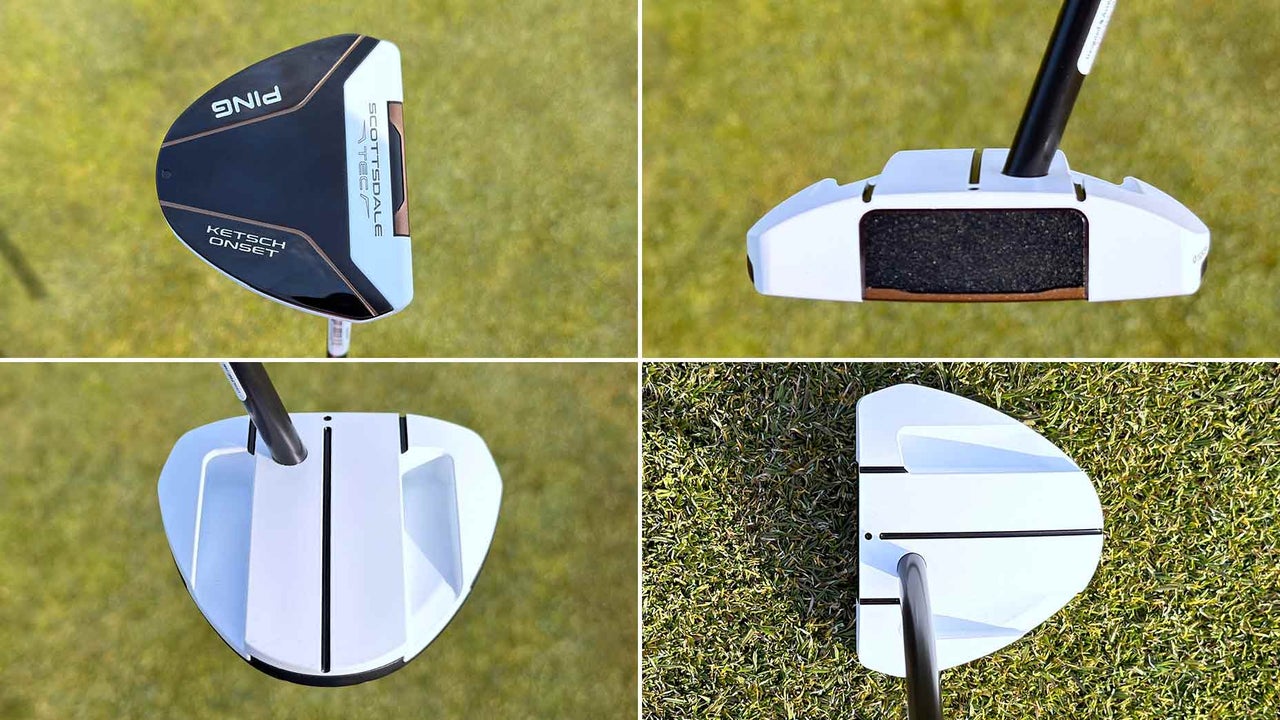
Ketsch Onset
Jack Hirsh/GOLF
What is it: A larger mallet with 15 degrees of toe flow to match strokes with a slight arc.
Who it’s for: Players looking to take advantage of the alignment and stability benefits of onset, but with more of a feeling of release through the stroke.
Hayden

Ping
What is it: A more traditional round mallet shape with a double-bend shaft for face balance.
Who it’s for: Players with minimal arc who want to take advantage of alignment aids but in a traditional configuration.
My take: Something in between low-torque and conventional
As someone who has been using a low-torque for the better part of the last six months, both of the Scottsdale TEC Onset putters really intrigue me.
With both, you’re able to get the extreme stability that has been a staple of this new putter category, get the aiming benefits of having the shaft off the face all the while retaining the feel of the putter releasing that I’m so used to.
I’ve been experimenting with low-torque putters as a way of resetting my hands, similar to what Rickie Fowler talked about in his switch back to a center-shafted putter. These Scottsdale TEC Onset putters offer a way of doing that while still having an awareness of the putter face.
In my testing, I’ve also found the PEBAX insert, which I thought was a bit soft on the original Scottsdale line, so be a little more responsive and feel more like a milled putter, which is something Tony Finau mentioned when he switched to the Ally Blue Onset this year. It’s definitely still on the softer side, something I prefer, but not mushy, making it easier to transition from a milled face to this.
The thing you notice right away is how easy these putters are to aim, thanks to both the high contrast white look and the EyeQ alignment aids. It’s very easy to lock onto the dot before your stroke and then lock onto the ball when you take it away.
I look forward to seeing where this configuration goes. Ping has been taking their time with their Onset models, with this being the first full retail release after the PLD Milled Special Edition Ally Blue Onset last year. The Ketsch is a nice additional option to the Ally Blue, but I’d love to see what other shapes the configuration would work with as well as the alignment aids.
You must be logged in to post a comment Login