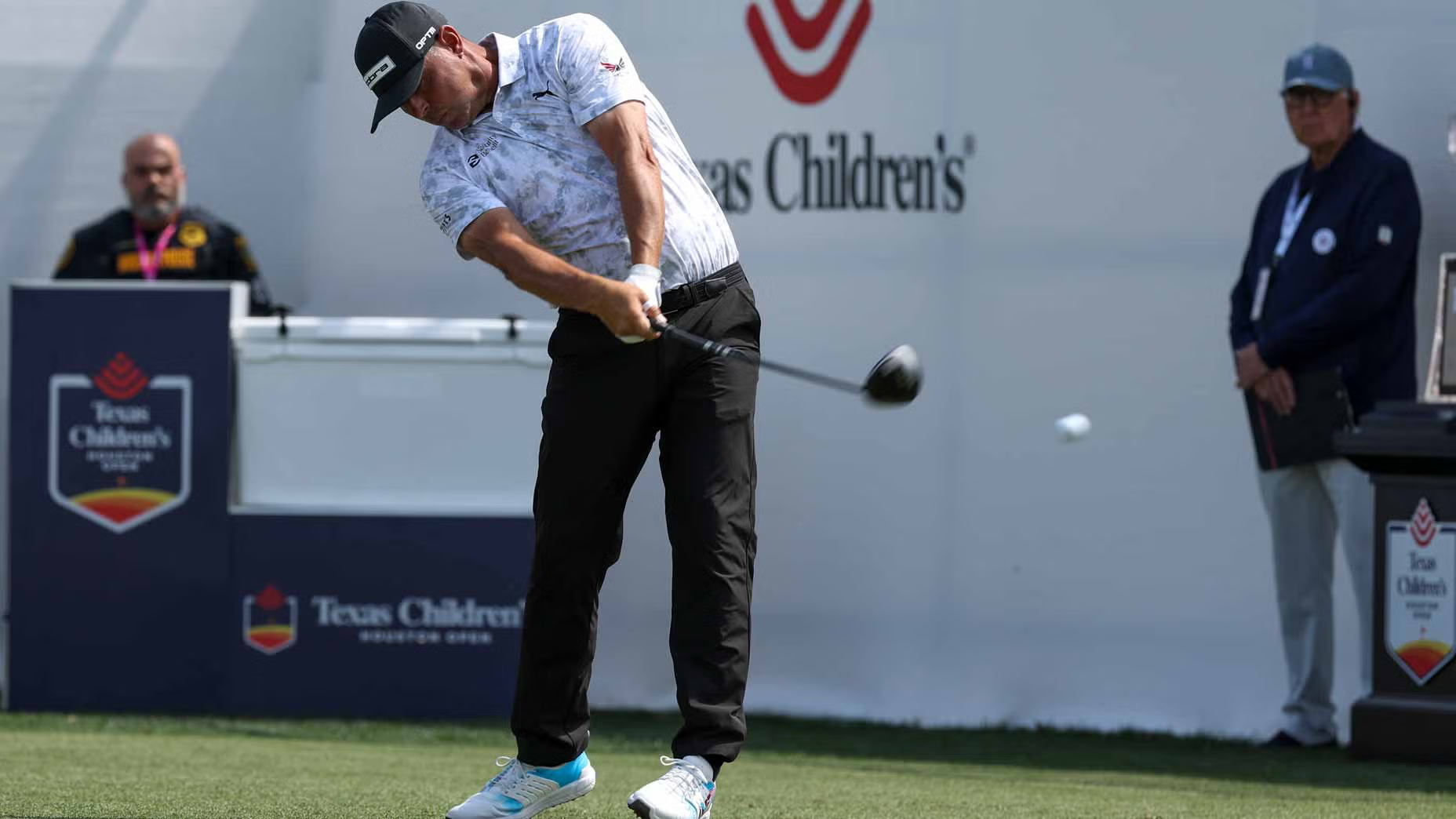
Yarwood is a GOLF Top 100 Teacher at Alpine Country Club in northern New Jersey, and he’s got an impressive resume. He’s taught multiple major winners, USGA champions and high-level amateurs throughout his decorated career. These days, however, most of his time is spent inside a lesson studio with recreational golfers. And lately, a curious theme has emerged.
“A new phenomenon,” Yarwood says. “About 90 percent of amateur players now come in saying, ‘I don’t know what I’m doing anymore. I’ve consumed so much golf content, I’m completely confused.’
“It’s an epidemic.”
Advertisement
In some ways this should come as no surprise. Social-media scrolling has become a default pastime, perhaps the default pastime. Increasingly, our spare moments are instinctively filled by reaching for our phones and letting the algorithm take the wheel as we mindlessly consume content tailored specifically to our interests.
For me, and perhaps for you, that means golf. Specifically, swing tips and tricks.
But lately I can’t escape the feeling that corner of the internet feels massively oversaturated. Any golf-swing sicko can open their go-to app and see what I mean.
Fix your backswing in 40 seconds The secret to a square clubface every time The best swing tip you’ll ever hear
Advertisement
Scroll a little longer and you might even see two consecutive videos offering conflicting advice (in fairness, written instruction content is at times guilty of the same thing), each with hundreds of thousands of views.
It’s easy to understand the appeal of this sort of content. The videos are short and digestible. They’re simple, polished and promise quick results. Best of all, the “expert” tips are free. And, yes, there is a chance they’ll help you. If they don’t leave you lost in the wilderness.
Golf is a game that can never be perfected, but that hasn’t stopped generations of players from chasing improvement. Nor should it! There’s nothing quite like flushing an iron, posting a personal best or carding a birdie. The game is endlessly addictive, and it has a way of occupying the mind like nothing else.
So when a social-media video promises to help in that pursuit, it acts as catnip for the golfing soul. But when every video is offering a fix, a more important question emerges: How do you know if scrolling is helping your game . . . or hurting it?
Advertisement
A new era of golf instruction
Like so much else in the modern era, golf instruction has evolved alongside technology.
There used to be limited options when it came to finding quality golf tips. You could go to a PGA pro at a local club who, if you were lucky, had a proven track record of turning out successful students. Or you could rely on the written word, burying your nose in golf-instruction classics like Ben Hogan’s “Five Lessons” or Harvey Penick’s “Little Red Book” or picking up the latest issue of GOLF Magazine.
But as society has become increasingly tethered to phones and screens, you’re more likely finding your instruction from a well-packaged tip on social media.
Today, if you want a slice fix you can find hundreds of options in seconds, each promising to straighten you out. Same goes for a stubborn hook, the chipping yips or a lack of power. Whatever ails your game is only a quick Google search — or a few scrolls — away from a promised cure.
Advertisement
On the surface, this shift seems like an overwhelming positive. Golf instruction has long been expensive, and the internet has significantly lowered that barrier to entry. But accessibility doesn’t necessarily equate to quality.
“I actually think golfers are more educated now,” says Tony Ruggiero, a GOLF Top 100 Teacher who splits time between Alabama and Florida. “They understand terminology better and watch more instruction than ever. But they’re not any better at understanding what’s actually causing their swing issues. They chase effects instead of causes, and then they go down rabbit holes.”
There are different incentives at work here. Social media rewards simple explanations and promises quick results — but content creators don’t have much pressure to actually deliver results to any one individual. Effective coaching requires proper diagnosis and context, and it focuses on the important part: results. When those elements are missing, even well-meaning advice can send golfers searching for answers in all the wrong places.
More harm than good?
Yarwood, who heads south to teach during the winter, says his concerns about swing-thought saturation are validated every time a perplexed player walks through his door. “You get coaches who can theorize and look great online,” he says. “But like social media in general, you’re only seeing the highlight reel. They have very little history, very little application.”
Advertisement
Ruggiero has noticed a similar pattern during his days on the lesson tee at Montgomery Country Club in Alabama and Old Palm Golf Club in South Florida.
“It’s changed a lot,” Ruggiero said. “If you’d asked me that three, four, five years ago, I’d have said, ‘Yeah, I get it sometimes.’ But now, it’s almost every lesson.”
Therein lies one of the biggest problems with social-media golf instruction: the lack of personalization. There’s no guarantee that the tip being presented is the one you actually need.
Take the over-the-top swing, for example. It’s one of the most common ailments among recreational golfers — and, not coincidentally, one of the most popular “fixes” offered by social-media coaches. But here’s the catch: not every over-the-top move is caused by the same underlying fault.
Advertisement
For example, oftentimes the cause of an over-the-top swing is an open clubface caused by a bad grip. But if that’s the case and you start making changes to swing more inside-out, you’ll hit it even worse. What you really should be doing is fixing your grip and clubface, which in turn will naturally improve your club path and allow you to swing more from the inside.
Most golfers don’t realize that — or are at least willing to roll the dice with whatever video they see next promising to cure the issue they’re dealing with. Unfortunately, often the fix being prescribed has little to do with the fault.
“If you’re not diagnosing the cause, you can make things worse,” Ruggiero said. “There are many different causes of something like an over-the-top swing. The information might be correct, but it’s not always helpful for your problem.”
It’s a vicious cycle. One new feel makes things worse, so the golfer searches for another fix. That fix might help temporarily, but it could also lead to more issues, so they go searching for another fix. Before long, the brain is overloaded with information, and the swing is in a pretzel.
Advertisement
“It’s like going into a Walgreens,” Ruggiero said. “Everything in there can help you — if it’s really treating what’s wrong with you. But if you take one thing from every aisle, you’ll end up in the hospital. That’s what golfers are doing. They’re taking a little bit of everything, even though most of it has nothing to do with their actual problem.”
Don’t mistake popularity for pedigree
One of the more subtle dangers of online golf instruction is that visibility is often mistaken for expertise. Put differently, social media is a different skill set than golf coaching. Algorithms reward engagement, but they don’t always (or ever?) verify that the information comes from a trusted source. As a result, some of the most popular swing tips online come from instructors with little history of producing measurable results with real students.
“Watching these videos can be harmful because a lot of people self-appoint themselves as experts when they’re actually not,” Yarwood says. “If you’re going to look online, you should be looking for people with real history — people who can actually show results, not staged content, not bravado.”
In traditional coaching environments, credibility is built over time. A coach’s reputation is tied to the players they’ve developed, those players’ success and the improvements they sustain over time. Online that accountability largely disappears. A swing tip can rack up millions of views without the coach having ever developed any players of note or even lowered handicaps.
Advertisement
That disconnect can be frustrating for teaching pros, and especially dangerous for casual recreational golfers. An instructor who “looks the part” and speaks with authority can be mistaken for an expert, even if their real-world teaching résumé is thin.
That doesn’t mean all online instruction should be dismissed. Far from it, in fact. Many of the most accomplished coaches in the world — those who teach major champions and elite amateurs — regularly share thoughtful, high-quality content digitally. Heck, you can even find excellent instruction directly from major champions, such as Bryson DeChambeau and Padraig Harrington.
But it’s important for consumers to go through a vetting process. Before adopting a swing tip, golfers should ask a few simple questions: Does this coach have a history of developing players? Have their students succeeded in competitive golf? Do they explain who a tip is for, rather than claiming it’s a fix-all for everyone? Answers to those questions matter far more than follower counts or views.
“If you’re looking for help, you should ask: ‘Who is this person? What’s their track record?,’” Ruggiero says. “It’s no different than medical advice. You can get it online from someone who’s not a doctor, but you don’t really know.”
Advertisement
In the end, the platform isn’t the problem. The problem is confusing reach with results — and mistaking popularity for pedigree.
The right way to get better online
Social media itself isn’t the problem. Nor is the quest to learn via online content.
For golfers, social platforms have lowered the barrier to entry, providing access to some of the brightest minds in the sport. For instructors, these platforms offer a way to share ideas, demonstrate expertise and reach players who might never set foot on their lesson tee. Much of that content is thoughtful, credible and genuinely helpful.
The key, however, is to use these tools responsibly. That means resisting the urge to scroll thoughtlessly from tip to tip, absorbing every new idea as if it’s equally correct and equally applicable to the one before it. Improvement doesn’t come from collecting swing thoughts. It comes from understanding what advice applies to your game.
Advertisement
“Instruction shouldn’t be entertainment,” Yarwood says. “Watch the PGA Tour if you want entertainment. Instruction isn’t like Spotify. Otherwise, you end up with too many swing thoughts, like putting your music library on shuffle.”
In a game where progress is built on commitment, the smartest golfers aren’t the ones chasing every new fix. They’re the ones who know which voices to trust — and when to stop scrolling and start practicing.

Lionel Messi has been linked with a surprise move to Galatasaray, a transfer that could see him play alongside Nigerian striker Victor Osimhen at the Turkish club.
The eight-time Ballon d’Or winner is currently on a break from competitive football, with the new Major League Soccer season set to begin on February 21.
With the 2026 World Cup drawing closer, Messi is believed to be considering a short spell outside the United States to stay fit and sharp ahead of the tournament.
Advertisement
Reports in Turkey claim that talks have already taken place between Galatasaray and the Argentine star. Messi is said to be open to a four-month deal that would see him play 12 matches for the club.
However, the move would depend on a key condition. Messi is reportedly only willing to play matches in Istanbul and does not want to feature in away games. He is said to prefer playing exclusively at RAMS Park.
It is also claimed that Messi turned down an offer from Saudi club Al Hilal, as he is keen to avoid injuries before the World Cup.
Advertisement
Galatasaray are believed to have opened discussions with Messi and his representatives as they explore the possibility of completing the deal before the transfer window closes on Thursday.
The Turkish champions have six home matches left in the league, one home game in the Turkish Cup group stage and a home tie in the UEFA Champions League play-off against Juventus. It is unclear if Messi would be willing to play the away leg against the Italian side if the move goes through.
Lionel Messi taking the 2022 World Cup to his Argentina teammates during the presentation ceremony. PHOTO CREDIT: Jimoh Otisoro.
Galatasaray are currently assessing whether the deal is realistic, with talks said to be moving quickly.
If completed, Messi would team up with Osimhen, who has become a key player at the club. Osimhen helped Galatasaray win a domestic double in the 2024/25 season, scoring 37 goals in 47 matches across all competitions.
Messi, on his part, led Inter Miami to their first-ever MLS Cup title in 2025.
Advertisement
Galatasaray currently sit top of the Turkish Super Lig with 49 points, three ahead of rivals Fenerbahce, with 14 matches still to play.
The club’s president has previously hinted that a move for Messi was not impossible, insisting that Galatasaray’s financial position and growing success allow them to dream big.
No golf event is more soaked in alcohol than the WM Phoenix Open, the annual warmup act to (no copyright issue here!) the big game. Coors Light is a tournament sponsor. So is Jack Daniel’s; Don Julio tequila; LaMarca Prosecco wine; and Tito’s vodka. To this scene, we add (for the first time in few years) Brooks Koepka, with his fullback’s physique and his Michelob Ultra sponsorship. He won in Phoenix in 2021. He T3ed there in 2022. Nobody would be surprised to see him contend. The Brooks Koepka comeback tour.
Last week was a dress rehearsal. In San Diego, we saw nervous Brooks, making his return to the PGA Tour after going LIV for a three-year stint, one short of his contracted length. It was weird, in this debut, to see this jockiest of golfing men not own the space around him. But there’s something subdued about the Farmers Insurance Open, the Torrey Pines courses dwarfed by the Pacific Ocean, morning fog acting like a muffler on the whole enterprise.
Phoenix is nothing like it. The tourney there is boozy. Fan and player alike is uninhibited. Ballplayers thrive there. The guess here is that BK 2.0 is going to start looking a lot like the OG edition, the one we know and know. He might not be ready to win yet, and he didn’t win anywhere in the world last year. But he’ll sashay his way around the course in his old familiar way. He’ll be among his people. All that beer-and-football energy.
This is a whole new thing for the PGA Tour, the returning golfer after an enriching LIV run. Patrick Reed will be coming back ’round Labor Day. Kevin Na and Hudson Swafford are likely to get some kind of playing status on Tour again, though you will be forgiven if you don’t notice. On the other end of the noise spectrum, Bryson. It would not be a shocker to see DeChambeau come in from the cold next year, despite, despite missing the once-in-a-lifetime Feb. 2 deadline for the Tour’s grand Returning Member Program. If Bryson wants to come home, there will be a RMP II. He has been sounding unsettled, most recently with his 72-holes-is-not-what-we-signed-up-for remarks. Also, the whole LIV team thing — featuring your RangeGoats, your Cleeks, Bryson’s own Crushers squad — hasn’t exactly caught fire yet. Bryson plays in another league anyhow: Team YouTube. Kill-ing-it.
Advertisement
So Koepka is back and everybody on the PGA Tour is happy-happy-happy. Well, not everybody everybody. Wyndham Clark has questions, as does Viktor Hovland and Hideki Matsyuama. But the Big Three are totally down with it: Brian Rolapp, in his first full year as the PGA Tour’s first CEO; Tiger Woods, the 50-year-old golfing icon who doesn’t really play anymore but has a full-time gig as a golf entrepreneur and as Brian Rolapp’s consiglieri; and Rory McIlroy, the most powerful person in golf. Reason being, he knows a lot about tournament golf, global golf, and he has the ear of the fellas who are going to finance a lot of the PGA Tour’s future for-profit enterprises, the Fenway Sports Group, John Henry presiding.
It is head-spinning, to think about how quickly things have changed here. As a wise man once said, managing is about managing change. When Koepka went LIV — June 2022 — the Tour was still the Tour, the one your grandparents would have pretty much recognized. There was a straight line from Joe Dey (the first commissioner) to Jay Monahan (the fourth and last). What the Tour leadership has done since the arrival of LIV is manage change, sometimes clumsily, now in the language that makes the whole world take notice: We gonna make you some money.
Koepka is lucky that he is not making this return when Joe Dey was running the show. Dey, who came to the nascent PGA Tour after a long career at the USGA, was a rule-of-law golfing ethicist. The sanctity of the scorecard was his starting point, and golf’s starting point, for everything. The comportment of the player was a sacred to him, too. To varying degrees, the commissioners who followed Dey — Deane Beman, Tim Finchem, Jay Monahan — all carried the Dey flame. There was something righteous about being a golfer on Tour, at least when the sun was out. (At night, you were on your own.) Any of the four commissioners might have extracted a promise from the returning Koepka: Don’t be waving five fingers to others after playing a 5-iron shot. Also, my good man: Could you at least pretend that your media sessions are less irritating than those let’s-try-it-again secondary TSA inspections?
Advertisement
As for Reed, Dey and Beman in particular would have had a field day with him, in his meet-the-principal session before returning to the Tour: We cannot have any more rules debacles (incidents at the 2019 Hero event and the 2021 Farmers tournament are at the top of the list), and we cannot have any more frivolous lawsuits aimed at beloved members of the Green Division of the Fourth Estate.
Koepka’s return has created a template for how you get back. You write a letter, you sign a check, you play a tourney feeling kinda bashful, you get your groove back over time.
The friendly-wager bets here are Koepka top-10s this week; the New England Patriots will cover the spread (and then some) in the big game, for no other reason than the Fenway Sports Group is on a roll and this game is FSG-adjacent; Coors Light will win the exposure game during the day, the golf telecast on CBS, but Mich Ultra and its Anheuser-Busch adult cousins will carry the night on NBC, during the big game. Here’s to Sunday. Bartenders really should be able to get endorsement deals for their TV remotes, what your grandparents called “the clicker.”
Arsenal moved a step closer to ending their long wait for major silverware after edging past Chelsea to book a place in the Carabao Cup final.
Holding a 3–2 advantage from the first leg, the Gunners completed the job with a dramatic late goal in a tense second-leg clash at the Emirates Stadium.
The breakthrough finally arrived in the seventh minute of added time when substitute Kai Havertz kept his composure to score the winner. The German forward skipped past goalkeeper Robert Sanchez before calmly finishing to spark wild celebrations among the home fans.
Advertisement
Mikel Arteta’s side will now face either Manchester City or Newcastle United in next month’s final at Wembley, as they chase their first major trophy since 2020.
Arsenal began the match on the front foot but found clear chances hard to come by in the opening half, with Chelsea setting up in a defensive back five. The visitors stayed compact and frustrated the hosts for long periods.
Chelsea boss Liam Rosenior tried to change the momentum just after the hour mark by introducing attacking options, including Cole Palmer, but Arsenal remained organised and rarely looked troubled at the back.
Advertisement
As the game drifted towards extra time, Arsenal continued to push, and their persistence was rewarded in the dying moments. Havertz, recently back from injury, showed sharpness and confidence to deliver the decisive goal and secure a 4–2 aggregate victory.
The Gunners last lifted a major trophy when they beat Chelsea in the FA Cup final in Arteta’s first season in charge. They had not reached the League Cup final since 2018.
This latest success underlines Arsenal’s progress this season. They sit top of the Premier League, remain active in other cup competitions and now have a clear chance to turn their strong form into silverware.
With a settled squad and growing belief, Arteta’s side will head to Wembley hopeful that this could be the start of a trophy-winning chapter.
Minnesota Vikings head coach Kevin O’Connell watches the action from the sideline at U.S. Bank Stadium, captured during first-half play on Sep 21, 2025, as Minnesota hosted Cincinnati. The moment reflects in-game oversight and communication as O’Connell monitored personnel groupings, situational decisions, and tempo against an AFC opponent in a regular-season matchup. Mandatory Credit: Jeffrey Becker-Imagn Images.
If you think the Minnesota Vikings are “running it back” with their coaching staff, that just isn’t the case. Over the last few weeks, the club has lost six coaches and counting, mostly to promotions, while head coach Kevin O’Connell continues to backfill the positions.
Six departures have piled up, forcing Minnesota to reshuffle some jobs early in the 2026 offseason.
Yes, O’Connell’s coaching tree is germinating.
Advertisement
Six Departures Change O’Connell’s Staff
The 2026 offseason didn’t skimp on purple coaching changes.
Brian Angelichio oversees practice duties at Hanbury Manor during the Vikings’ international session in Thundridge, captured on Sep 30, 2022, as Minnesota prepared offensive installations abroad. The image reflects Angelichio’s role in coordinating tight ends and passing concepts while players adjusted to travel, schedule changes, and a condensed preparation window. Mandatory Credit: Kirby Lee-Imagn Images
Brian Angelichio (offensive passing game)
New Job:Pittsburgh Steelers Offensive Coordinator
Angelichio departed Minnesota on Wednesday, heading to Mike McCarthy’s new staff in Pittsburgh. NFL Network’s Ian Rapoport tweeted, “The Steelers are finalizing a deal to hire Vikings passing game coordinator Brian Angelichio as their new offensive coordinator, per me and Tom Pelissero. Angelichio, also the TEs coach, is back with coach Mike McCarthy. They were together in Green Bay.”
Advertisement
It’s the top job Angelichio has held in college and professional football through 30 years, and he’ll inherit a stout offensive line, along with wide receiver DK Metcalf, running back Jaylen Warren — and perhaps even Aaron Rodgers.
Minnesota will need a new passing game coordinator on offense.
Marcus Dixon (defensive line)
New Job:Dallas Cowboys Defensive Line Coach
Advertisement
Dixon’s contract wasn’t renewed this offseason; he evidently stayed his welcome. But in Dallas, he’ll work for Brian Schottenheimer and notably lead defensive tackles like Quinnen Williams and Kenny Clark. Life would be easier for Dixon if Micah Parsons still patrolled Dallas’s defense, but that’s not possible after the Cowboys shipped him to Green Bay five months ago.
Ryan Nielson, who interviewed for the Vikings’ defensive coordinator position in 2023, will take over Dixon’s spot after notably coordinating the Jacksonville Jaguars’ defense in 2024.
Michael Hutchings (safeties)
New Job:University of California Defensive Coordinator
Advertisement
Hutchings actually left town in December before the end of the regular season, jumping at the chance to lead the Cal Bears’ defense.
SI.com‘s Jeff Faraudo wrote around Christmas, “New Cal football coach Tosh Lupoi continues to assemble a young staff of assistants, officially announcing the hiring on Friday of Minnesota Vikings assistant Michael Hutchings as the Bears’ defensive coordinator.”
“Hutchings, a Bay Area native who was a prep All-American at De La Salle High School and played linebacker at USC, comes to Cal later three seasons coaching defensive backs with the Vikings, the past two years as safeties coach. In that role, he worked with former Cal star Cam Bynum, who had three interceptions during the 2024 NFL season.”
The Vikings’ safety job remains vacant in early February.
Advertisement
Daronte Jones (defensive passing game)
New Job:Washington CommandersDefensive Coordinator
Perhaps the biggest news of this coaching style — after Brian Flores signing an extension to remain with the Vikings — Jones will get his crack at an NFL defense all by himself. He spent five seasons in Minnesota, but left for a year in 2021 to coach LSU’s defense.
Jones won’t walk into a dream situation, yet he’ll have the tutelage of head coach Dan Quinn, who comes from a staunch defensive background.
Advertisement
These players are already on Jones’s depth chart: Trey Amos (CB), Javon Kinlaw (DT), Frankie Luvu (LB), Jer’Zhan Newton (DT), Daron Payne (DT), Jeremy Reaves (S), and Mike Sainristil (CB).
Minnesota hired Steelers defensive backs coach Gerald Alexander to replace Jones. SteelersNow‘s Chris Ward on Alexander: “Alexander is a big loss for the Steelers, especially with how cornerback Joey Porter Jr. developed under his stewardship.”
“He spent the 2024 season with the Las Vegas Raiders as a safeties coach under defensive coordinator Patrick Graham, who’s now the DC with the Steelers. Alexander will work under defensive coordinator Brian Flores in Minnesota. Flores was a finalist for the Steelers’ head coach position.”
Chris Kuper (offensive line)
Advertisement
New Job: N/A
The Vikings’ offensive line underachieved in 2025, even after formulating a formidable fivesome that included Christian Darrisaw, Donovan Jackson, Ryan Kelly, Will Fries, and Brian O’Neill. Injuries rattled the unit, too, and the trenches never really found their groove.
Chris Kuper stands on the sideline at State Farm Stadium during playoff action on Jan 13, 2025, as Minnesota faced the Rams in the NFC wild card round. The moment captures Kuper tracking offensive line adjustments, protection calls, and in-game communication amid postseason pressure and elevated tempo and overall execution. Mandatory Credit: Mark J. Rebilas-Imagn Images
So, O’Connell did not renew Kuper’s contract, and he remains a coaching free agent.
Assistant offensive line coach Keith Carter accepted a promotion to Kuper’s spot last month.
Mike Pettine (assistant head coach)
Advertisement
New Job: N/A
Pettine retired a few weeks ago and claimed he may return to the NFL in time. He later revealed in an interview with a Cleveland Browns-themed podcast that he and the aforementioned Flores didn’t see eye to eye, which is probably why Pettine exited stage left.
O’Connell used Pettine on the offensive side of the coaching staff in 2025 because Pettine couldn’t deal with Flores, or so he implied on the podcast.
Mike Pettine speaks with defenders along the Vikings’ bench at Ford Field during first-half action on Jan 5, 2025, as Minnesota met Detroit. The scene highlights Pettine’s in-game leadership, offering schematic reminders and situational adjustments while the defense regrouped between series during a tense divisional matchup under playoff implications. Mandatory Credit: David Reginek-Imagn Images
Pettine originally joined the Vikings at the dawn of the O’Connell era in 2022.
The Miami Dolphins’ offensive coordinator for the last four seasons, Frank Smith, has taken over for Pettine as assistant head coach, and many believe Smith will force the Vikings to run the football more often and more efficiently. They need it.
Sep 15, 2022; Kansas City, Missouri, USA; Amazon executive chairman Jeff Bezos in attendance before the Kansas City Chiefs play against the Los Angeles Chargers at GEHA Field at Arrowhead Stadium. Mandatory Credit: Jay Biggerstaff-Imagn Images
The Washington Post shuttered its venerable sports department on Wednesday, part of a larger layoff involving one-third of the newspaper’s staff.
“The Washington Post is taking a number of difficult but decisive actions today for our future, in what amounts to a significant restructuring across the company,” a Post spokesperson said in a statement. “These steps are designed to strengthen our footing and sharpen our focus on delivering the distinctive journalism that sets The Post apart and, most importantly, engages our customers.”
Executive editor Matt Murray announced the changes in a video conference with employees.
The move comes with Post reporters already on site covering Super Bowl LX and the Milano Cortina Winter Olympics.
Advertisement
“It’s like somebody taking a hammer to my heart,” Sally Jenkins, who wrote a Post sports column until she left the paper last summer, told The Ringer. “It’s not just broken. It’s broken into about 20 pieces, one for every single one of my close friends there.”
Some sports reporters are expected to move into other roles, but the exact number was not reported.
A skeleton crew will continue to produce what Murray described as features about sports as a “cultural and societal phenomenon.”
The Post has undergone repeated changes, downsizings and reinventions since Amazon chief Jeff Bezos purchased the paper in 2013.
Advertisement
In addition to cutting the sports pages, the Post is reducing its international footprint, making the Metro section more “nimble and focused” and eliminating the Books section.
Nigeria’s U-20 women’s team, the Falconets, delivered a dominant performance as they thrashed the Oyo State women’s side 15–0 in a friendly match played behind closed doors in Ibadan on Tuesday.
The test game was part of the Falconets’ build-up to their FIFA U-20 Women’s World Cup qualifying fixture against Senegal and offered a clear sign of the team’s attacking strength ahead of the decisive tie.
Adegbemile Rebecca stole the spotlight with three goals, while Alaba Olabiyi and Ifeanyi Kindness both scored twice. Ramotalahi Kareem, Nwachukwu Chisom, Moshood Shakirat, Janet Akekoromowei, Mamudu Mary, Oscar Precious, Kafayat Mafisere and Adeshina Fatimoh also got on the scoresheet to complete the emphatic win.
Advertisement
The coaching crew used the closed-door encounter to fine-tune tactics, assess player combinations and test overall team balance ahead of the qualifier.
The Falconets will take on Senegal in the first leg of the U-20 Women’s World Cup qualifier on Saturday, February 7, at the MKO Abiola Stadium in Abeokuta. The match is scheduled to kick off at 4:00 pm.
The stable of Anthony and Sam Freedman seeks a steadier autumn run for Tom Kitten than the spring’s disruptions.
Spring saw Tom Kitten in perpetual recovery mode following a gate scratch during the Group 1 Memsie Stakes (1400m) at Caulfield in August.
Tom Kitten joined the Freedman father-and-son operation for his first time after James Cummings left Godolphin.
The new season will see Cummings launch his training in Hong Kong.
Advertisement
According to Sam Freedman, the gelding’s prior prep flowed smoothly to the intended opener, with the co-trainer stating the ongoing one is even stronger.
Marcus Rashford’s future appears to lie away from Manchester United, with a move to Barcelona looking a strong possibility at the end of the season
Barcelona boss Hansi Flick is reportedly the strongest advocate for wanting to keep Marcus Rashford at the club beyond the summer. Rashford’s loan from Manchester United expires at the end of the season, but Barcelona retain an option to make the move permanent.
Rashford has made it clear he wants a long‑term future at the Camp Nou, having previously reiterated his desire to stay. “Of course what I want is to stay at Barca,” he told Sport.
Advertisement
“It’s an end goal, but it’s not the reason why I’m training hard and giving it my best. The purpose is to win. Barca is a huge, fantastic club, built to win titles. I can’t be in a place where important objectives are not demanded of you;
“For me it is more difficult to be motivated and give my best at a club where the demand is not maximum. I’m in the perfect place and environment to continue my journey as a football player, so I just try to do my best every day and help the team win. We’ll see what happens next summer.”
It’s now being reported in Spain that Flick has already made his stance clear to the board and president Joan Laporta. He is believed to see the England international as a strong fit for the club’s vision and sees his skill set match naturally with the rest of the attacking department.
In Flick’s view, a player with Rashford’s level of international pedigree, still operating in his prime years, is reportedly an asset ‘too valuable to overlook.’
Trabzonspor delivered a strong second-half display to claim a comfortable 3–0 victory over Fethiyespor in Group A of the Turkish Cup.
Nigerian players Anthony Nwakaeme, Paul Onuachu and Chibuike Nwaiwu all featured as the Black Sea side brushed aside their lower-league opponents.
The match remained goalless for much of the contest, with Fethiyespor holding firm for over an hour. However, Trabzonspor raised the tempo late on and quickly took control.
Advertisement
The breakthrough came in the 69th minute when Ernest Muçi finished neatly after being picked out by Nwakaeme, whose vision and movement caused problems for the defence.
That goal sparked a flurry of action. Seven minutes later, Nwakaeme doubled the lead with a fine individual effort, cutting inside before firing a powerful left-footed strike into the top corner.
Trabzonspor wrapped up the win in the 78th minute. Onuachu, who came on at the break, showed his striker’s instinct by tapping in from close range to make it 3–0.
Advertisement
Defender Chibuike Nwaiwu also played his part as Trabzonspor stayed solid at the back and comfortably managed the closing stages.
The result lifts Trabzonspor to the top of Group A with six points from three matches, putting pressure on their rivals in the race for qualification.
The game was particularly encouraging for Nwakaeme, who scored his first goal of the season after returning from a long injury absence. His performance will be a big confidence boost as the campaign progresses.
Onuachu also maintained his impressive form, taking his total to 14 goals in 19 appearances in all competitions.
Advertisement
For Fethiyespor, the defeat leaves them bottom of the group with just one point, leaving their hopes of progressing in the Turkish Cup hanging by a thread.
Gavin McKenna, a star forward for the Penn State hockey team who is widely considered the top prospect for the 2026 NHL Draft, is facing a felony charge following an alleged incident at a bar in State College, Pennsylvania, on Saturday night, Onward State reports.
According to a court filing, McKenna is awaiting a preliminary hearing after being charged with felony aggravated assault and misdemeanor simple assault, as well as summary counts of harassment and disorderly conduct. The Felony I charge is defined as “attempts to cause serious bodily injury or causes injury with extreme indifference.”
According to Onward State, McKenna and other members of Penn State’s hockey team met at Doggie’s Pub with friends and family after Saturday’s game against Michigan State at Beaver Stadium before the alleged assault occurred. McKenna is accused of assaulting an individual, who reportedly suffered a broken jaw in the incident.
An NCAA rule change allowed junior hockey players from the Ontario Hockey League, Western Hockey League and Quebec Maritimes Junior Hockey League to play Division I hockey. In the past, junior hockey players were considered professionals and therefore weren’t allowed to play in the NCAA, but the change allowed a prospect of McKenna’s caliber to go through the college recruiting process in the U.S.
As a 17-year-old, McKenna put together a sensational season for the Medicine Hat Tigers in the Western Hockey League in 2024-25. He posted 129 points (41 goals, 88 assists) in 56 games while also producing 38 points (nine goals, 29 assists) in 16 playoff games as Medicine Hat won the WHL Championship. McKenna, who recorded a 54-game point streak, ranked second in the WHL in points and fifth in goals while leading the league in assists.