Of course we did. This is Super Bowl week. Pats and Hawks! Bad Bunny! Commercials! Quit hogging the dip! But the thing is, though, every week feels like a super week in pro football. Regular season! NFL draft! Signings! Every week seems meaningful.
Even when it’s tough to watch.
This season, Dave Berri’s Detroit Lions were predicted to contend. But players got hurt. And the Motor City faithful suffered. Please trust that the analysis that follows was spoken in a pained tone.
Advertisement
“I think in one game — against the Vikings — their starting center came off the practice squad,” Berri said. “And you’re like, ‘Well, I don’t think you’re going to win this game.’ I think they could have just said, ‘Well, probably not.’ I don’t know that you can block the Vikings defensive line with a practice squad center. And then he left the team three days later, so there you go.
“And then they were telling me, Jared Goff, you didn’t play a very good game. ‘Well, I only had one second to throw the ball. I mean, he is the center. He is pretty close to the other team. So I don’t know what you wanted me to do about that.’ So, yeah, it was just, games like that, I don’t know what you want us to do. I wish coaches could just say that. It’s like, they’re different players. Those aren’t the players I want playing. There’s a reason why they were on the practice squad.”
Poor Berri, right? And yes, you’re still on a golf site.
Berri’s other job is in sports economics. He teaches it. He’s written books and articles about it. He’s established himself as one of the country’s authorities on the subject. A couple years ago, I talked with him, and I felt it was right to do so again, considering all of the news around golf and money — and football. We talked about the PGA Tour and its new CEO, Brian Rolapp — who came from the NFL. We talked about YouTube — which now broadcasts NFL games. We talked about LIV Golf and Saudi Arabia — where the NFL is hosting an event in March. We talked about Bryson DeChambeau — who’s in the midst of contract talks not unlike a quarterback or defensive end.
Advertisement
We also wondered whether pro golf could become appointment viewing — in the way that it is for the NFL.
Regardless of how the play is.
(Editor’s note: The interview has been lightly condensed.)
Brian Rolapp in August at the Tour Championship.
Getty Images
Advertisement
I. THE PGA TOUR — AND ITS NEW CEO
Last June, the PGA Tour named Brian Rolapp as its CEO. Who’s Rolapp? An NFL man, he’d been thought of as a potential successor to NFL commissioner Roger Goodell (and he still might be). But now Rolapp is in golf, and over the past few months, he’s created a “Future Competition Committee” aimed at examining the Tour’s competitive model and developed a pathway for Brooks Koepka to return to the Tour after a four-season stint with LIV Golf.
Last year, the PGA Tour hired the second-in-command of the NFL as the PGA Tour’s first-ever CEO. What can pro golf take from the NFL model? What should it ignore?
I’m going to argue pretty much nothing. This is a totally different sport. The difficulty is, going from the NFL to the PGA Tour, is that football is a very, very good television sport. I don’t know if golf has quite the same television appeal. I think there’s a ceiling to how many people are going to tune in to watch golf. And I don’t know how you change that. Despite the amount of coverage it gets, it’s never been one of the major sports. It gets a lot of attention because it does appeal to executives, right? The people who make decisions love golf. But I don’t know that it’s the kind of sport that you’re going to get — the Super Bowl is going to have 150 million people tune in to watch this, right? I don’t know how you’re going to get that for golf. People are aware of who Tiger Woods is and stuff like that, but the number of people who tune into this is somewhat small, and I don’t know how he’s going to change that. It’s been around a long time. People are aware of it. I just don’t see what specifically you can do that’s going to dramatically change the model. Introduce defense?
One of Rolapp’s pillars is scarcity. This year, there are fewer players who have received full-time playing privileges, and there are rumors that, starting next year, there will be fewer tournaments. The thought is the PGA Tour right now runs essentially from January all the way through Thanksgiving, where there is really no offseason, whereas Major League Baseball has an offseason, NFL does, NBA does — to where you then miss it. Like where opening day in baseball is an event. Like week one of the NFL is an event. Is less play better or worse for the product?
Advertisement
I think there’s an argument to be made that if you make it more scarce, then people are going to value more what they do get to see and that’s not a ridiculous argument. That’s OK. Is that going to dramatically change anything? I don’t think that’s going to happen. It’s a small change that could theoretically help. I think the counter argument is there’s a value in having it on all the time. If you look at the NFL, the NFL was scarce. It was very scarce. It used to be, if you want to watch an NFL football game, it was on Sunday. And then they moved it to Monday night, right? And that was a big change. And then they didn’t really do much after that for a long time. And now they have it so that there’s NFL games on Thursdays and Fridays and Saturdays and Sundays and Mondays. Has that made the NFL worse? I don’t know. I don’t think that’s true. And they do the same with college football. I mean, college football is on almost every night now. And so I don’t know that that’s made it worse. It is the case that if you have a lot of events, then your ratings for each one will likely be lower because people are not going to commit themselves to seven days a week watching something. But I think your overall viewership would probably be higher because you have more events you’re selling and the amount of attention people are paying to you might be higher. So I can see what he’s saying. I think that could help. I don’t know that that dramatically changes anything.
As you said, Sunday’s a big thing, Monday night’s a big thing, Thursday night’s become a must-watch event. What could the PGA Tour try to do to duplicate that?
Yeah, that’s a tough one. One issue that you have with the PGA Tour, and it’s the same problem that afflicts cricket, is that you don’t have an event that lasts three hours and decides the winner. It’s a four-day event. And that requires some level of commitment on the part of the viewer. And you could say, well, just tune in the last day. But there’s stuff that went on before that. The solution they came up with in cricket was the T20 approach where you change the game so it’s a three-hour event. And that seems to have worked. So one option is create events where instead of it’s a four-day tournament, go, OK, we’re going to do a three-hour.
Grant Horvat last March at the Players Championship.
Getty Images
Advertisement
II. YOUTUBE — AND WHY IT’S SUCH A PHENOMENON
YouTube’s popularity has exploded, especially so in golf. Good Good. Bob Does Sports. Grant Horvat. The Bryan Bros. And many more. This past summer, there was also an International Invitational, hosted by Bob Does Sports and Barstool Sports, which attracted hundreds of thousands of views.
To me, YouTube golf has become as popular as it is because it’s fast, it’s digestible.
The advantage of YouTube is this — I’m going to give you a totally different way of thinking about this. So if you look at the rise of K-pop and how that happened, K-pop takes off internationally when YouTube becomes a thing. And the reason why YouTube is crucial to the story is because prior to YouTube, the only way you could get your music on the radio or on MTV was if a decision-maker decided to put it there. And the problem is the decision-maker has their own tastes. And their own preferences. And so they’re going to put on what they like. And we have this idea that network executives know what the audience wants. We have countless examples of network executives having no idea what the audience wants, and they’re totally shocked when they put something on there. When you do YouTube, though, YouTube is a different model. Now the viewer gets to decide. You decide what you want to listen to. And suddenly K-pop becomes this huge thing because everyone individually chooses what they want. And so when you create a product for YouTube, you’re allowing the audience to decide what they want themselves, rather than the network executive saying, ‘I have so much time at ABC or ESPN or whatever, and I’m going to dedicate this amount to that.’ And that can completely transform what you’re doing. You have to be responsive to what the YouTube audience wants, right? You have to pay attention to that because they’re choosing it themselves. They’re not letting the network do it for them.
Is there anything pro golf can take from YouTube?
Advertisement
I don’t know. I think the advantage is you’re letting the viewers pick what they want, so if you give them a menu of things, you’re going to find faster what they like and what they don’t like better than what an executive could do. Because executives again are making decisions based on their personal preferences and they are absolutely convinced that they know the answer, they know what people want, but history says they don’t. How to convert that to a sports model is challenging, though. Because, again, they have to be live. I do think there’s some value if the PGA Tour could come up with events that really were in a shorter time frame. We’re going to have you play 18 holes. Or even just do nine holes. See what happens. Nine-hole pressure. I wonder if you could create a golf course — here’s an idea: Create a golf course where things are like par-6 or par-7. So make it so it’s longer, right? And do like nine of them. I mean, you can think about making events so it’s like, I’m going to highlight this particular aspect of golf. Maybe you create a course that makes the putting more difficult. Maybe you make the course that makes hitting the drives more difficult. Things like that. You could create a whole tour where you’re saying these events are going to focus on these skills, but these events will focus on these other skills.
There’s just all sorts of things you could do, but you have to create it so that the event is shorter in time period, because longer time periods, you’re really just appealing to your major fans. You’re not not appealing to the average fan. You got to bring the casual fan into the thing. That’s why the NFL works so well. Casual fans can watch it. You don’t have to know a whole lot about the intricacies of football to watch football. You can see what’s going on. They’re at the 30-yard line. I can see it. They ran a play. They got four yards. They just said it, I saw it, there you go. You don’t need to know, well, do you see how they got the four yards? Do you see the left tackle pulled on it? I don’t give a crap. You got to create events that bring in casual fans. You can’t focus on the hardcore fans. This is where the NHL went wrong. So many years ago in the NHL, they did this thing with the purple puck where you could see where the puck was. And the hardcore fans got pissed off with that. ‘I can see where the puck is.’ Yeah, most people can’t. Most people don’t know where it is. And so that really helps. ‘Yeah, I don’t like it.’ So they got rid of it. You know what, this isn’t for you. You’re going to watch regardless. I don’t need to make you happy. Hockey also suffers from a problem in that you do have to watch. It isn’t like football or baseball where it can be on in the background and you can look at the score every once in a while and go, ‘Oh, I got an idea what’s going on.’
If you look at the hockey television ratings, they are persistently very low. It does really well in person. They sell out the arenas very consistently, but the ratings on television are terrible. And they’ve always been terrible because they construct the broadcast to appeal to the hardcore hockey fan and they don’t do it to appeal to the casual hockey fan, and if you’re going to build up a sport, it’s always the casual fan that matters. That’s what baseball’s been trying to do. They had a problem with pitchers just sort of milling around on the mound and not doing anything. And people were like, It’s kind of boring watching him take 45 seconds to throw the damn pitch. Put in a pitch clock.
I think that shot clock is one of the best sports ‘inventions’ since maybe the three-point line.
Advertisement
It makes the game much faster, and it gets them focused on what they’re doing. And you’re like, OK, that’s good, I like that. That’s the kind of thing that you want to do. The whole notion that the crowd has to be quiet when golfers are playing? Every other athlete has to hear noise. You can yell if you want. I think that might make it more interesting. Let ’em yell, let ’em see what happens.
Yasir Al-Rumayyan and Jon Rahm in August at LIV Golf’s team championship.
Getty Images
III. LIV GOLF — AND HOW LONG THE SAUDIS WILL BACK IT
This week, LIV Golf started its fifth season, and there are questions on its future, as there are with any new sports league. The central one, though, is this: Will its primary backer, the Saudi Arabia Public Investment Fund, continue to support the circuit?
The last time we talked, the PGA Tour had taken money from a sports ownership group and that came after a preliminary deal between the Tour and the Saudi PIF. That is currently still being negotiated and might not see the light of day. At one point last year, Donald Trump met with the Saudi PIF governor, but nothing has happened. So the question I have is, what are the benefits and detractions to looking into Saudi investment in American sports?
Advertisement
The Saudis are looking for things to invest in because the oil industry is not eternal. At some point, that’s going to be a problem for them. And there’s a huge attraction for rich people being involved in sports. And if you can’t play sports, I guess the next best thing is to buy the sports. So that’s why they’re doing it. The problem is, the Saudis tried to create a brand-new golf league by itself, which I think I told you wasn’t going to work, and it doesn’t seem like it’s working. You just can’t do that. There’s no tradition. You can’t just take people and stick them in a tournament that looks the same as every other tournament and say, well, now they’re going to compete over here doing this. It’s like, I don’t know what it is they’re fighting for. The Masters means something because there’s a history to it. But creating another league is probably not going to work If it’s the same product, which I think it was, right? Four-day tournaments, right?
Yeah, see, that’s the same thing. You’re doing exactly the same product. If they wanted to do something, what they should have done is what we were just talking about a moment ago. You know, create a bunch of contests that are totally different. But if you just do exactly the same thing, but there’s no tradition, well, I don’t think you’re going to have any audience then. It’s not the players by themselves. There’s the history that matters. What the past players did matters. If there’s no history, then it matters less. And the audience doesn’t have an idea why it’s significant. Why does this matter? And so that was the problem the Saudis have. So I understand what they were trying to do. But it was unlikely that was going to be terrifically successful. And you can see now the top stars moving back to the PGA Tour because well, money’s nice, but at the end of the day, you are a professional athlete. You do want to compete against the best, and you want people to pay attention to you.
Last year, it was reported that LIV Golf was losing money at a clip of nine figures a year, though recently the CEO of LIV Golf said that the league could turn a profit in five to 10 years. My question is, how long does Saudi Arabia stick with LIV? Do they believe in it no matter what, or do they eventually pull the plug?
Advertisement
I don’t know. They have an immense amount of money. The amount of money that they’re spending on this is quite small, relative to what money they have. So therefore, they could do it indefinitely if they want, if that’s what they like. It’s really up to their preferences. I don’t believe, and I said this to you before, I don’t think they’re doing it to make a profit. They already have money. They’re not trying to make money. They do want an audience. I think they want people to pay attention to them. And if that doesn’t happen, then I don’t think they want to keep doing that. That CEO telling you — how exactly are you planning on making a profit in 10 years? What do you think is going to happen? This is where an academic would be like, I don’t see how that’s possible. Where are you getting that from? What is your analytical tool that tells you that that’s going to happen? That just doesn’t seem very likely from where you’re starting. How are you going to get an audience? If you don’t have an audience now and your stars are leaving you, why do you think you’re going to have an audience 10 years from now? Are the stars going to come back? You didn’t have much of an audience with the stars. You’ll have less of an audience without the stars. But how long will they do it? As long as they want to do it. They have the money. I think what matters to them more than anything is, is anyone paying attention?
Bryson DeChambeau on Thursday at LIV Golf’s Riyadh event.
Getty Images
IV. BRYSON DECHAMBEAU — AND HIS CONTRACT
In 2022, Bryson DeChambeau was among the players who signed deals to leave the PGA Tour and join LIV Golf, and that contract is expiring at the end of the year. DeChambeau figures to have significant leverage in the negotiations, which begs the question: How much will he ask for from LIV, should he want to return?
When LIV formed in 2022, many of its stars signed contracts that are now expiring, including Bryson DeChambeau. And in that time, Jon Rahm signed for what’s been reported as a nine figure deal. And Brooks Koepka and Patrick Reed left to return to the PGA Tour. And LIV continues to try to gain a foothold. And DeChambeau won a U.S. Open and developed a significant YouTube presence. Given all of that, how much money could DeChambeau demand?
Advertisement
Oh, I don’t know. I have no idea. I mean, it’s obviously a lot more than [Rahm’s]. Again, the problem is, if you’re thinking about this in terms of a business like a Taco Bell, and you’re thinking about revenues and costs and how much revenue this person brings in and what they’re worth to me, the answer would be they wouldn’t pay him much of anything because there’s not really much revenue being generated. But that’s clearly not what they’re doing. I mean, they’re trying to build something here. They can’t afford to lose more stars. And they also have this incredibly large sum of money that they can throw at this. And so when that’s the case, how much money can you command?
Could he ask for a billion dollars?
I would. I would ask for $2 billion. I would just throw it out there. ‘$2 billion. What do you got? $2 billion. You got $2 billion?’ I mean, they have $2 billion. And let’s see if they counter.
Has there ever been an athlete who has had that much leverage?
Advertisement
No, in the sense because you’re dealing with — what is the amount of money they have to invest in this? What do the Saudis have?
OK, so you have $1 trillion. OK, now think about that. So you think about a typical owner of a sports team. Typical owner of a sports team might have $10 billion. You have $1 trillion. And you’re desperate. I’d demand $2 billion. I’d demand $3 billion. That’s $3 billion. ‘You have $1 trillion, give me $3 billion.’ ‘You know, I’m not doing it.’ ‘Well, then I’m not playing.’ So, you know, I would demand just the most ridiculous sum of money possible because none of the revenue or cost issues make any difference. You’re doing this because you want to gain an entry into the space. And without a star, it won’t happen. So your decision is, how much are you going to pay me to make this happen for you? And if the answer is, you’re not willing to, well, then I don’t do it. Then you try it on your own. Good luck with that. It also depends on how much he wants to do it. I mean, how much do you want to actually continue participating in this? I would just throw out some ridiculous money.
Jeeno Thitikul last week at the LPGA’s Tournament of Champions.
Getty Images
Advertisement
V. THE LPGA — AND A WNBA MOMENT
Popularity in women’s sports has skyrocketed, especially so in the WNBA. Can the LPGA, under new commissioner Craig Kessler, capture that attention, or even surpass it?
You’ve written extensively on the WNBA. And my question is, how can the LPGA duplicate that type of success?
The WNBA success came about — and I think is what happened — is that we had Covid and the women’s basketball in college and men’s basketball in college both went to bubbles. And Sedona Prince does the video and says, look, the bubbles aren’t equal. They built a giant weight room for the men. They didn’t build anything for the women. They gave them a tower of dumbbell racks. And as a result of that, the NCAA investigates itself, and there is a legal team that looks at them and they issue a report and there’s a whole bunch of media coverage and then suddenly, within months, there is a change in how women’s college basketball gets covered. Suddenly, for the first time in history, the network puts a regular-season game on the networks. That had never happened before. Suddenly they’re telling the women, you can call your tournament March Madness, just like the men’s. Suddenly, the entire tournament for the women is on television. That was not the case before that. Or at least, it wasn’t the case for much of its history. So suddenly, college basketball becomes accessible and had not been accessible before. And not surprisingly, within a year or so of that happening, one of the players becomes a massive star. Caitlin Clark becomes a huge star. And the way they report this is, oh, we discovered Caitlin Clark and now we started covering this. No, I can see in the data that you started covering it first and then Caitlin Clark became the star. That is exactly how it always goes. It’s always the coverage first and the star second. It’s not the star first and then the coverage. Then Caitlin Clark moved to the WNBA, and the networks go, you know what, we should be covering that. There’s a lot of interest in this. And then the WNBA gets a whole bunch more coverage. And people are like, in 2024, it’s Caitlin Clark. Well, then in 2025, Caitlin Clark gets hurt. But they kept the coverage the same and the ratings go up even higher. And you’re like, it was never Caitlin Clark. It was just the coverage changed.
So how can the LPGA duplicate that? Well, you somehow have to change the coverage. And how do you change the coverage? Well, that’s the real problem that they have. How do you change the coverage? How do you get it so that you get the same kind of consistent, I’m-on-television-all-the-time coverage. Think about the way the media covers the final of the major tournaments on the men’s side and how they cover the ones on the women’s side. The volume of stories is going to be a lot higher on the men’s side. If you don’t have the same kind of media attention, if you’re just reporting the winner, if you’re not doing the coverage consistently as it goes along, it’s going to limit your fan appeal. But I do think if we go back to the whole diversity issue, given the fact the LPGA is more diverse, there’s a bigger audience potentially there if you could get them to pay attention to it. I think that makes a difference. So I think there’s a lot of stories that you could tell on the women’s side. But you have to want to do that.
Advertisement
When there was more media coverage of the WNBA, they told the Caitlin Clark story, they told other players’ stories. Is there a way that the LPGA can market its players to get to that level?
Absolutely. And the advantage of golf is the same advantage tennis has. The athletes are individuals and therefore the audience relates to them very rapidly. See, that’s the problem in team sports. Team sports, at the end of the day, you’re asking somebody to form an emotional attachment to something that’s entirely fictitious. There is no such thing as an Indiana Fever. That doesn’t exist. There’s no such thing as a Boston Celtic. Those things don’t exist. But when you’re doing tennis or golf or boxing, that’s a person. And if you can simply get the audience to connect to the person, where either they like the person or they don’t like the person — I’m rooting for them or I’m rooting against them — either way, you’re paying attention. So the way to do it is to find a way to get it so the audience has some kind of emotional attachment to that person. Tell the person’s story. Was there some sort of struggle that led them to become a golfer? Are there issues here that we should know about? Are there rivalries that we should know about? And that’s what happens in tennis, right? Tennis is you get to know the personalities of the players and it allows you to connect with who you’re watching. And that’s the key, right? That’s the key.
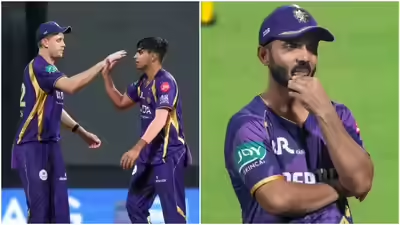
Cameron Green’s non-availability as a bowler had trigged a sharp response from KKR skipper Ajinkya Rahane (IPL/BCCI)
Cricket Australia have been forced to put out a clarification on why Australian allrounder Cameron Green is not allowed to bowl for his franchise Kolkata Knight Riders in IPL 2026, after skipper Ajinkya Rahane took a swipe at the Australian board when asked about Green’s abstinence from bowling duties during KKR’s opening fixture against Mumbai Indians at the Wankhede Stadium, Mumbai, on Sunday.KKR failed to defend a total of 220, with Rahane blaming it on the inexperienced bowling unit and the true nature of the Wankhede track – the same strip which saw nearly 500 runs being scored in the T20 World Cup 2026 semifinal between India and England earlier this month.KKR have been grappling with injuries, and Rahane conceded that the non-availability of Green as a bowler dented the team’s balance.“I think when hopefully Green starts to bowl soon, the combination will be slightly different,” said Rahane during the post-match interaction. “At the moment, we have to see the balance and who can bowl well for us. Batting-wise, as I said, we batted really well, but finding that balance with the ball is really important. So, hopefully, Green starts to bowl soon, then we can find out whether the combination will be okay.“And when asked why the 26-year-old was not bowling, he shot back, saying, “That question you need to ask Cricket Australia,” leaving the on-air commentators Ravi Shastri and Kevin Pietersen speechless for a bit.However, Cricket Australia responded to Rahane’s remarks, stating that Green is suffering from a lower back injury and KKR were made fully aware of the situation beforehand.“Cameron has a lower back injury which is being managed but requires him to abstain from bowling for a short period,” a CA spokesperson said, as quoted by FOX Sports.“Cameron is currently rebuilding his bowling loads in India with a view to return in around 10–12 days’ time. KKR has been communicated with and is fully aware of this information,” the report further stated, attributing it to the spokesperson.Green, the most expensive buy of the IPL 2026 auction at INR 25.20 Cr, came out to bat at one-down, scoring 18 off 10 balls, but was not pressed into action with the ball as Mumbai Indians batters made merry against an inexperienced KKR bowling unit. Every KKR bowler was taken to the cleaners by Rohit Sharma and Ryan Rickelton of Mumbai Indians, who combined for an opening stand of 148 in just 11.1 overs.Vaibhav Arora was taken for 52 runs in his four overs, while Blessing Muzarabani leaked 34 runs in his three overs. Kartik Tyagi, the impact sub, returned figures of 4-0-43-1. But the biggest letdown for KKR were their spin twins — Sunil Narine and Varun Chakaravarthy — who proved ineffective on the Wankhede track, giving away 78 runs between them in seven overs.
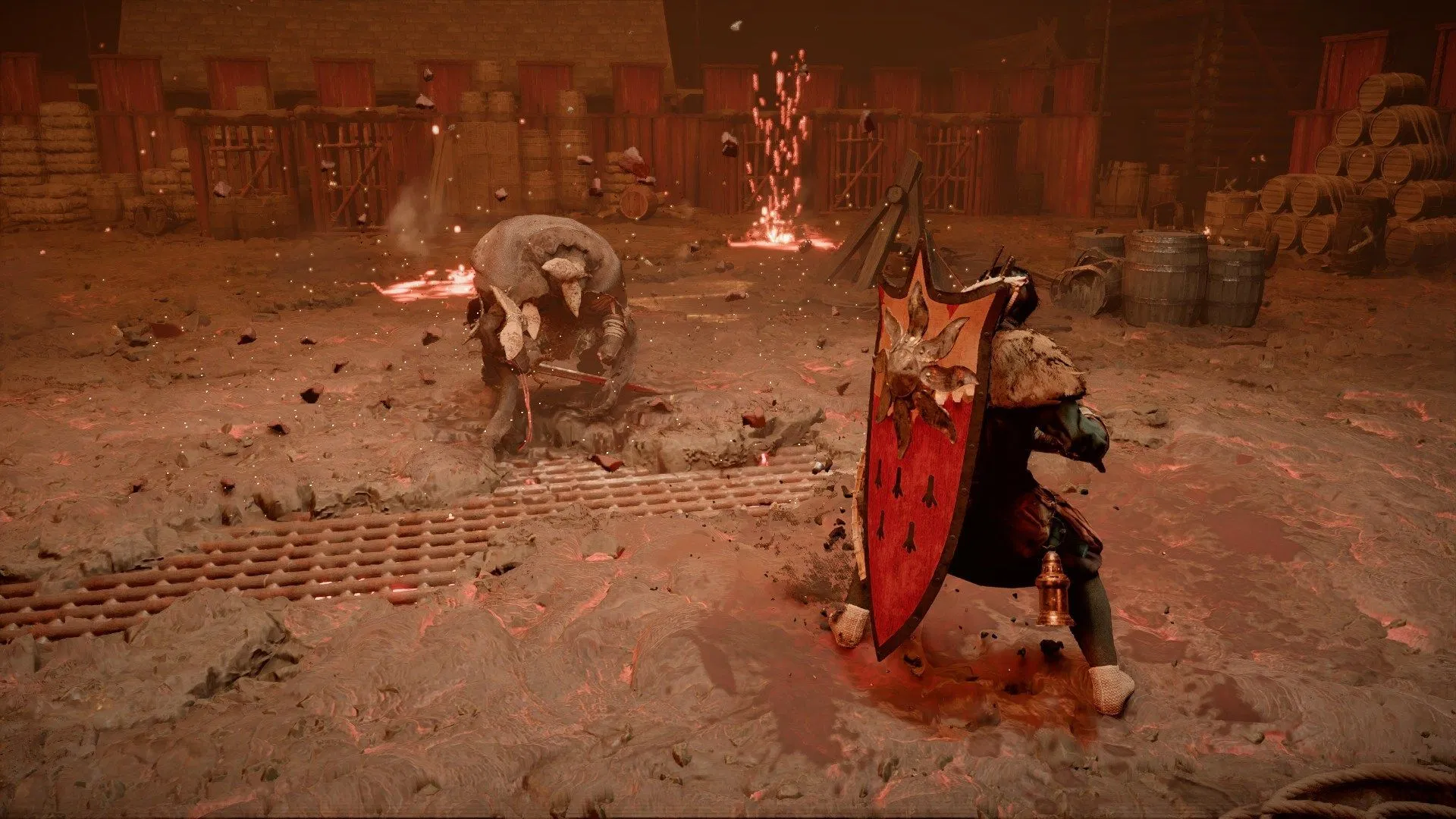
Following a major patch release earlier, the developers have added several hotfix updates to Crimson Desert on March 30, 2026. Pearl Abyss has a dedicated space where players can report in-game issues, and it’s commendable that those bugs are being fixed quickly. The latest adjustments fix numerous UI features and in-game interactions.
Here are all of the included hotfixes mentioned in Crimson Desert Patch Notes Version 1.01.01.
All Crimson Desert hotfixes released with patch version 1.01.01
A hotfix with several fixes is going out across all platforms. For the best experience, we recommend receiving this latest patch. Please check the below notice for details and to see if it’s available for download on your platform.
Advertisement
With Crimson Desert patch 1.01.00 improving plenty of in-game mechanics, and also adding more content to the title, the hotfix patch version 1.01.01 fixes a total of eight bugs. These updates are available for all platforms, including PC, Mac, PlayStation, and Xbox. And as for PC (Steam), the update size is only 208 MB.
With that said, here are the fixes included in patch version 1.01.01:
“Fixed an issue where the “Use” button for the Talisman of the 5 new mounts appeared on Damiane and Oongka.
Fixed an issue where Blackstar remained flying in place after death instead of disappearing.
Fixed an issue where the A.T.A.G was not destroyed even when its Health reached 0.
Fixed an issue where the UI for selecting a tempering target became unavailable in certain conditions.
Fixed an issue where holding down the button to follow NPCs during missions on horseback caused the horse to move abnormally.
Fixed an issue where Sprint could not be used while riding the White Bear.
Fixed an issue where the controls became unavailable while using “Examine” with the Constellation Helm.
Fixed an issue where Refinement of equipment was not possible for Damiane and Oongka.”
The White Bear is one of the legendary mounts that came with patch 1.01.00, and the developers have already included a bug fix around its riding interaction. With all the recent updates, it’s fair to say that if the community raises an issue (that potentially needs fixing), Pearl Abyss might fix it in time.
Consider the Orlando Magic. They have patient, deep-pocketed ownership, smart and experienced management with an eye on the big picture and loads of high-end talent.
They sold off an underwhelming core at the right time and turned the draft capital into one of the best young forwards in the game in Franz Wagner, taken eighth overall in 2021 with one of the picks they got from the Chicago Bulls. They tanked briefly but effectively and ended up with Jalen Suggs, taken No. 5 in 2021, and Paolo Banchero, taken first overall in 2022. Banchero became an all-star in his second season at age 21, and Suggs was all-defence in his third season at 22.
Having made the playoffs two years in a row, the Magic then went for it and cashed in some draft capital (as in four unprotected first-round picks and a pick swap) for Desmond Bane, a tough, two-way wing to bolster their biggest weaknesses: shot creation and three-point shooting.
Advertisement
He’s played well this season.
There are more good moves — drafting up-and-coming Anthony Black in the lottery in 2023 and Tristan Da Silva in 2024. Both look like long-term rotation players.
But sometimes things just don’t come together. For the Magic, it’s been most of this snake-bitten season, but it may have culminated Sunday evening at Scotiabank Arena.
In a game with significant Eastern Conference playoff implications, the Magic looked like a team fiddling through the pre-season.
Advertisement
The Raptors’ 139-87 win doesn’t quite capture the Magic’s capitulation. Over a nearly eight-minute stretch in the first half, the Raptors scored 31 unanswered points, an NBA record for the play-by-play era (since the 1996-97 season, roughly 30 years).
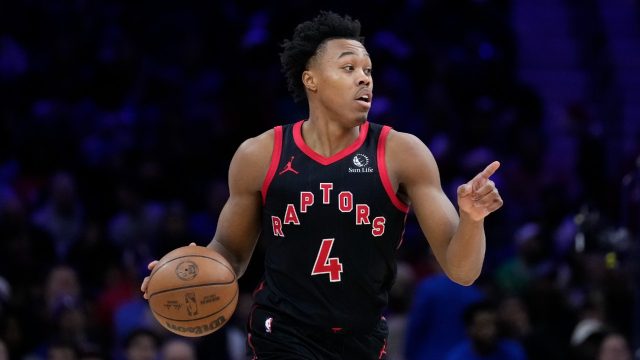
“I actually didn’t know that that was even happening,” said Scottie Barnes, who set a new career-high with 15 assists to go along with 23 points and three steals in 28 minutes. His three steals gave him a career-best 102 on the season, and along with his 109 blocks, make him the only player in the NBA to top 100 of each so far this year. “I think we were all super locked in. Just trying to keep causing turnovers and keep trying as hard as we can on defence that it just helped the lead grow for us.”
Orlando gave up 19 turnovers in the first half, which the Raptors turned into 30 points. It was the second-most turnovers in a half for which there are available statistics. Toronto led 70-43 at halftime.
The Raptors were their typically handsy, pesky selves as they made a season-high 18 steals, but on multiple occasions, the Magic simply made careless passes out of bounds or over their teammates’ heads or through a forest of arms and legs.
Advertisement
The result was ugly. The 52-point winning margin was the second-largest in Raptors history.
The whole thing was a little weird. For the second time in a month Raptors head coach Darko Rajakovic credited a higher power, for his team’s performance, which was one way to explain how his team played their most dominant basketball of the season with Brandon Ingram (heel inflammation), Immanuel Quickley (missed his fourth straight game with plantar fasciitis) and Colin Murray-Boyles (back spasms) all out of the lineup. Jamison Battle (illness) was out, too.
But who can the Magic blame? Orlando Magic head coach Jamahl Mosley tried to shoulder the blame, but he’s not passing the ball to the other team.
To their credit, against some adversity, the Raptors rallied.
Advertisement
“Obviously we dealt with several injuries today and I felt in the locker room before the start of the game there was a lot of determination there. The guys really wanted to go out there and compete,” Rajakovic said.
What was the Magic’s excuse? It’s hard to fathom.
The game represented arguably Orlando’s last best chance to pull itself into contention for a top-six finish and a guaranteed playoff spot in the East. It would have given the Magic a 2-1 edge in the season series with the Raptors and pulled them within one game of Toronto.
Now it’s the Raptors that have the tiebreak, and they are three full games ahead of eighth-place Orlando (39-35) with eight to play. Toronto still has a fight on its hands to stay in the top six. They are 42-32 and a half game up on Atlanta in sixth and one game up on Philadelphia in seventh. But if they slip back into the play-in tournament, it likely won’t be due to the Magic.
Advertisement
The Raptors aren’t a perfectly constructed team. What would Barnes be able to do if he actually could be something close to a full-time point guard, surrounded by shooters who can stretch the floor in every direction? We’ve never been able to see it in Toronto. Even after converting 13-of-29 threes against Orlando, the Raptors are 25th in made threes this season and 23rd in three-point percentage.
But put the ball in his hands and good things happen. Barnes has 49 assists in the last four games, third in the NBA over that span.
The Raptors do have a collective energy that, for the most part this season, has made them better than the sum of their parts.
It’s allowed a previously unproven Sandro Mamukelashvili to take his first shot at regular playing time and thrive as the first big off the bench. He was +47 on Sunday and finished with 19 points on 13 shots.
Advertisement
It’s there when RJ Barrett battles through a shoulder injury to put up 24 points on 8-of-14 shooting. It’s there when Alijah Martin and A.J. Lawson, the Raptors’ little-used two-way contract players, step into a crucial game and contribute 22 points on 8-of-13 shooting combined.
Injuries are a huge part of the Magic’s story: their core of Wagner, Banchero, Suggs and Bane have played just 130 minutes together this season. They are +10.1 per 100 possessions when they do.
But if the flesh is weak, the spirit doesn’t seem much better.
They were only missing Wagner on Sunday and they completely no-showed. It was their seventh loss in eight games, their only win coming over the lowly Sacramento Kings.
Advertisement
The Raptors haven’t done everything right over the past three years. A talent sell-off and four years out of the playoffs have hardly yielded a bucket full of top lottery picks. Who the future star is that will ride alongside Barnes is still very much to be determined.
But they have played together and they have committed to playing a high-energy style of defence. They pass the ball.
They have a very good chance at making the playoffs; teams a lot further along the talent acquisition curve — the Magic just being one of them — are in danger of missing them.
Credit where credit is due.
Advertisement
NBA on Sportsnet
Livestream 40-plus regular season Toronto Raptors games, marquee matchups from around the association, select NBA Playoffs games, the NBA Draft and summer league action on Sportsnet+.
Georgia on their minds: Mamukelashvili and Orlando Magic centre Goga Bitadze had a lengthy catch-up at centre court before the game started. The two big men are the only Georgian players in the NBA and represented the national team this past summer at EuroBasket. They have known each other forever. “Me and Goga played each other when I was like, six or seven years old, and he was tall and he was the only person able to block my shot and I really hated it. I was thinking, ‘Who is this tall guy?’ I was the tallest and he was the tallest. He was always a physically gifted and strong guy. I feel like he was the first player or second player against who I really had to adjust. [But] I’m so happy for him and hopefully he gets better. But I’m super happy to play him and I think he’s representing the country amazingly.”
To dunk or not do dunk: When you’re six-foot-one, dunking can be stressful. The outcome is not guaranteed. But every once in a while, Jamal Shead (12 points, 10 assists, three steals) will decide it’s time. “Whenever I’m actually open, I’ll try,” said Shead. “I need the time to get my legs under me. I don’t like dunking. It’s scary. It’s a long way for me.” But the stars aligned early in the fourth quarter with the Raptors leading by 51 points. Shead shot the gap, was off on a breakaway and loaded up. It was his third dunk of the season (on three attempts) and the sixth of his career (on nine attempts).
Yes, they follow the standings: “I think everyone goes home and checks it,” said Mamukelashvili. “We’re right there. We fought through the whole year to kind of get ourselves in a good position. We slipped up, we came back. Now we know that everything is so stacked, the margin of error is so small, I feel you got to be aware of it. I watch other games, Miami, Orlando, Atlanta — all the teams that are right there with us, what they’re doing and how they’re doing it and make sure we stay on top.”
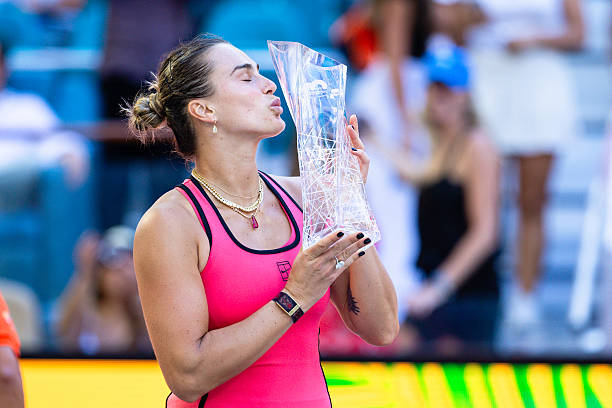
Aryna Sabalenka holds the Butch Buchholz championship trophy after defeating Coco Gauff of the United States on Day 12 of the Miami Open at Hard Rock Stadium in Miami Gardens, Florida, on March 28, 2026. (Photo by Mauricio Paiz/NurPhoto via Getty Images)
Aryna Sabalenka defeated Coco Gauff in three sets to win the Miami Open final, holding her nerve in a match that could have easily slipped either way.
After the win, Sabalenka said:
“I was trying to remind myself I’m strong enough to handle that,” she said, talking about the pressure in the third set.
Advertisement
She also opened up about the work she’s been doing behind the scenes with her team.
“We were chatting a lot, trying to dig deep and find the reason why I’m letting these finals get too much in my head… mentally we found a way to improve.”
Even after losing chances in the second set, she said her focus was simple: stay positive and reset.
Advertisement
“I lost a couple of opportunities in that second set, but I was just trying to stay mentally positive.”
In the end, that shift in mindset made the difference, as she stayed composed and closed out the match, something she admitted had been a challenge for her in past finals.
Shaheen Afridi Ball Tampering Controversy: A stalwart of Pakistan cricket and skipper of the PSL franchise Lahore Qalandars, Shaheen Afridi found himself under the spotlight for a major controversy in the final phase of the match against Karachi Kings on Sunday. The incident unfolded just before Lahore pacer Haris Rauf was set to bowl the final over. In a video that surfaced on social media, the trio of Rauf, Shaheen Afridi, and Fakhar Zaman appeared to be doing something with the ball while engaged in discussion.
The umpires concluded that the ball had been tampered with and imposed a five-run penalty on the Lahore franchise. Karachi Kings capitalised on the situation and wrapped up the chase within the first three balls of the 20th over.
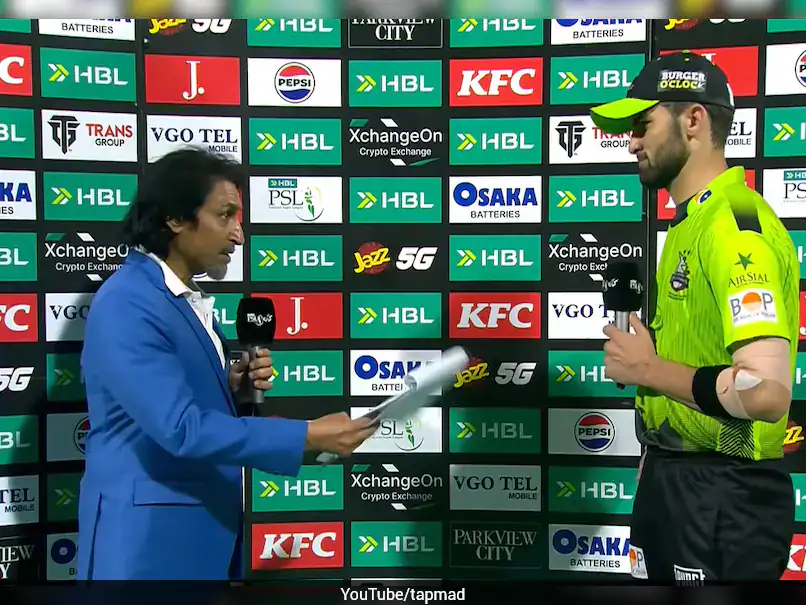
During the post-match presentation, Pakistan legend Ramiz Raja pressed Shaheen, the Lahore skipper, about what had transpired before the final over. The pacer fumbled multiple times while attempting to answer and claimed he was unaware of what had happened.
Advertisement
“I don’t know about this, and we’ll see if it’s there in the camera and discuss what it is. Actually, five runs were taken and we can’t do anything,” Shaheen said at the presentation.
Ramiz Raja to Shaheen Afridi:
“The ball was taken from you at the end because of the ball tempering so what are your thoughts on that?”
Shaheen Afridi:
Advertisement
“I don’t know about this. We will see that in cameras. We will discuss who did that.” pic.twitter.com/j2f8ofri3y
Ramiz, however, refused to let the matter slide and continued to probe Shaheen on the ball-tampering allegations.
Advertisement
“You have to ask the umpires why they changed the ball. When we asked them why they changed the ball, they told us to go away. When they were making the decision, the umpires requested us, even the captain, to return to our fielding positions,” Ramiz explained.
In a statement after the match, Lahore star Sikandar Raza said: “I can only speak for myself. There was never any attempt on my part to change the condition of the ball, or even to try. All I remember is that when I was trying to dry the ball and make it shine, the umpires asked us not to dry it under the shirt. Who they are accusing, unless we see the proof, I think it’s a big decision. I have not been called for an enquiry.”
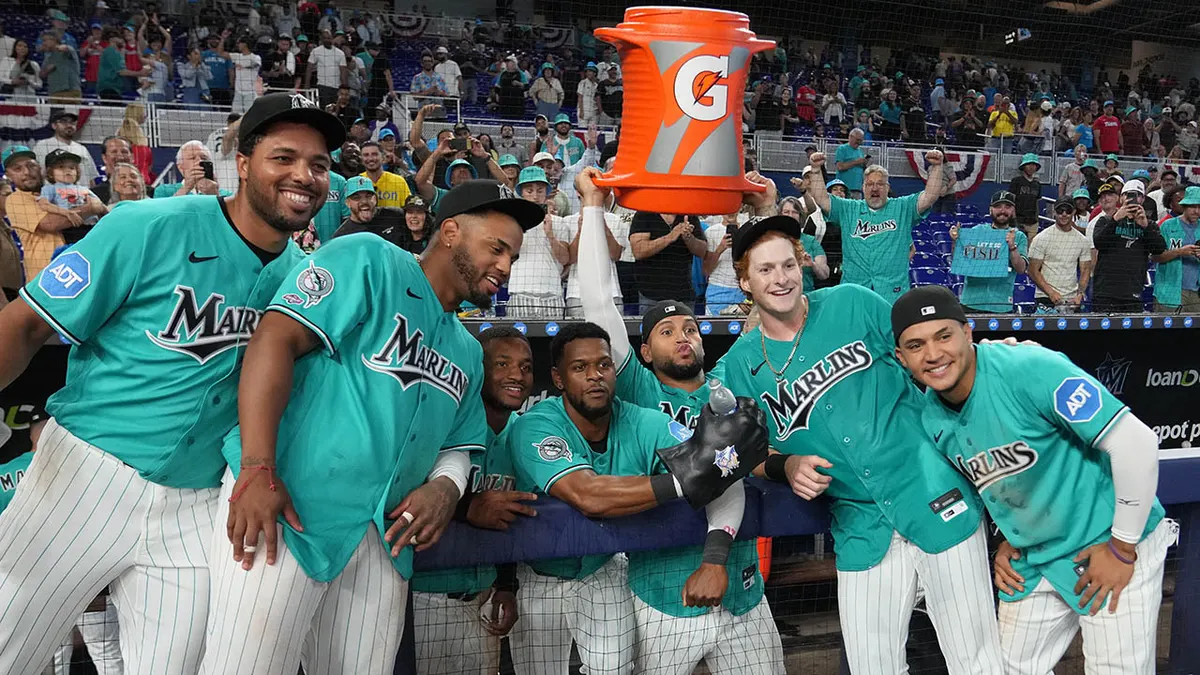
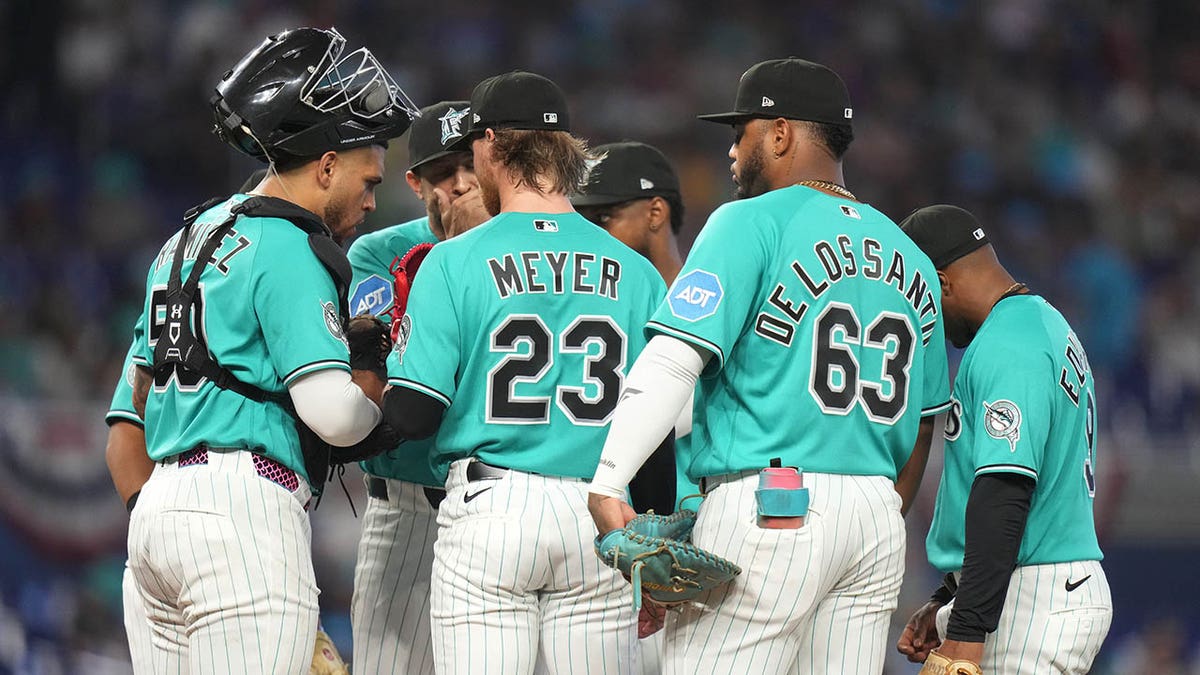
The Miami Marlins turned back the clock on Sunday against the Colorado Rockies and presented fans with a throwback uniform to kick start Teal Sundays.
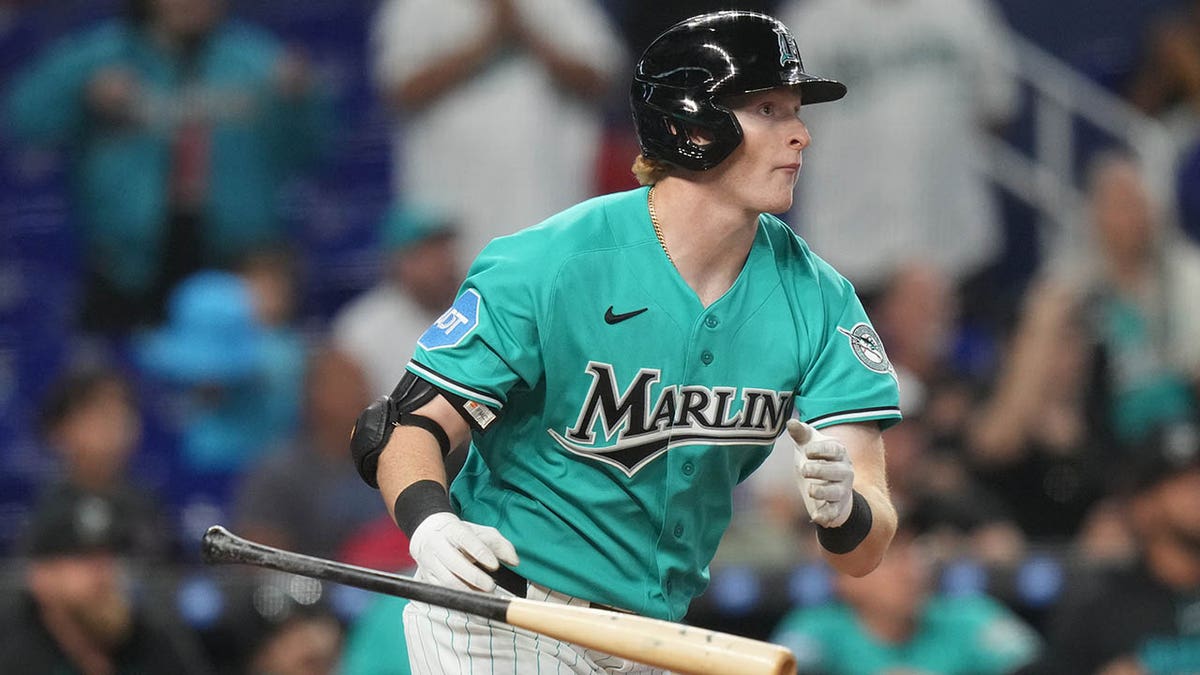
The nostalgic look of the uniform may have been the lucky charm they needed to get a win over the Rockies. Owen Caissie came up to the plate with one on and two outs. He took a Victor Vodnik pitch deep to right field for the walk-off home run.
Miami Marlins’ Owen Caissie, second from right, poses with his teammates after hitting a walk-off two run home run to defeat the Colorado Rockies in a baseball game, Sunday, March 29, 2026, in Miami. (AP Photo/Lynne Sladky)
The Marlins announced the organization would be hosting Teal Sundays for their home games during the season. The jersey featured the old teal uniforms with the original Florida Marlins logo stitched in.
“This jersey is so much more than just a uniform,” a message on their website read. “It’s an ode to those moments where fans fell in love with the team. It honors the Fightin’ Fish who started it all and the players who carry that legacy into the next era of Marlins baseball.”
Miami Marlins pitcher Max Meyer (23) meets on the mound during the first inning of a baseball game against the Colorado Rockies, Sunday, March 29, 2026, in Miami.(AP Photo/Lynne Sladky)
The Marlins were established as an MLB franchise with the Rockies in 1993. While Miami has had their share of teardowns and rebuilds, the team won World Series titles in 1997 and 2003.
Miami will look to get back to the playoffs this season under second-year manager Clayton McCullough. The Marlins haven’t made the postseason since 2023.
Miami Marlins’ Owen Caissie runs after hitting a walk-off two run home run during the ninth inning to defeat the Colorado Rockies in a baseball game, Sunday, March 29, 2026, in Miami. (AP Photo/Lynne Sladky)
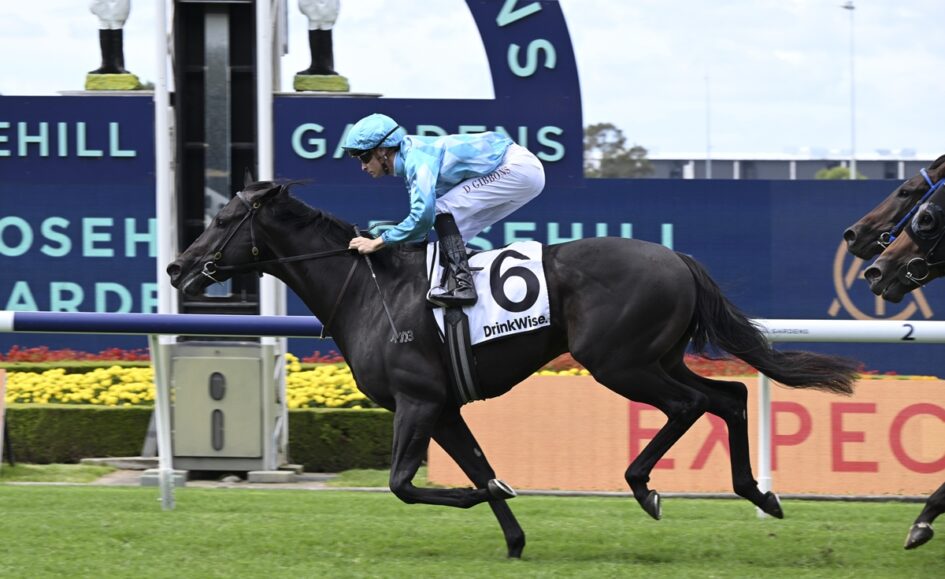
Successfully completing the first pair of objectives in a three-phase roadmap, rising star colt Southend now aims to cap it off with a tilt at the Group 1 Champagne Stakes.
Securing the Paul Perry (1300m) at Newcastle on his first start, Southend then ventured to Rosehill on Saturday where he lifted the Group 3 Baillieu (1400m) to qualify for the Championships.
“That has always been the plan. To go to Newcastle, here today, then if he looks as though he’s had enough we’ll stop him, and if not he’ll go to the Champagne in three weeks,” co-trainer Gerald Ryan said.
“He’s a very good horse, I think.”
Advertisement
Southend descends from the accomplished former English miler-sprinter Palace Pier, taker of five Group 1 victories, via a So You Think three-quarter sister of Ryan’s previous sharp galloper Peltzer.
Nevertheless, that family connection did not sway Ryan and partner trainer Sterling Alexiou when selecting Southend at the yearling sales.
“That wasn’t the reason I bought him,” Ryan said.
“The week before the sales, Sterling had gone home for a few days and when he came back I said, ‘I reckon I found one for you’. I took him down to Mill Park (Stud’s barn), there were five horses there we looked at, and I never told him which one it was.
Advertisement
“This horse came out and Sterling, goes, ‘he’s a classic’ and I said, ‘I know. This is the one I want you to like’.”
Under Dylan Gibbons, Southend ($7.50) accelerated from the midway point of the straight and stormed home to pip Persian Wonder ($2.90 fav) by 1-1/4 lengths, while Nomadic ($81) was a nose behind in third place.
Gibbons remarked that Southend’s win came via innate ability and he will improve markedly with seasoning.
“The thing I loved most is that last furlong, he was just looking for some challengers. God help him when he learns what his job is,” Gibbons said.
Advertisement
“I’m sure he will eat up and bounce out of the run, and we’ll have a crack at the big one (Champagne Stakes). If he can take any natural improvement again, it’s scary to see where he can get to.”
Head to betting sites for racing betting markets on the Champagne Stakes showdown.
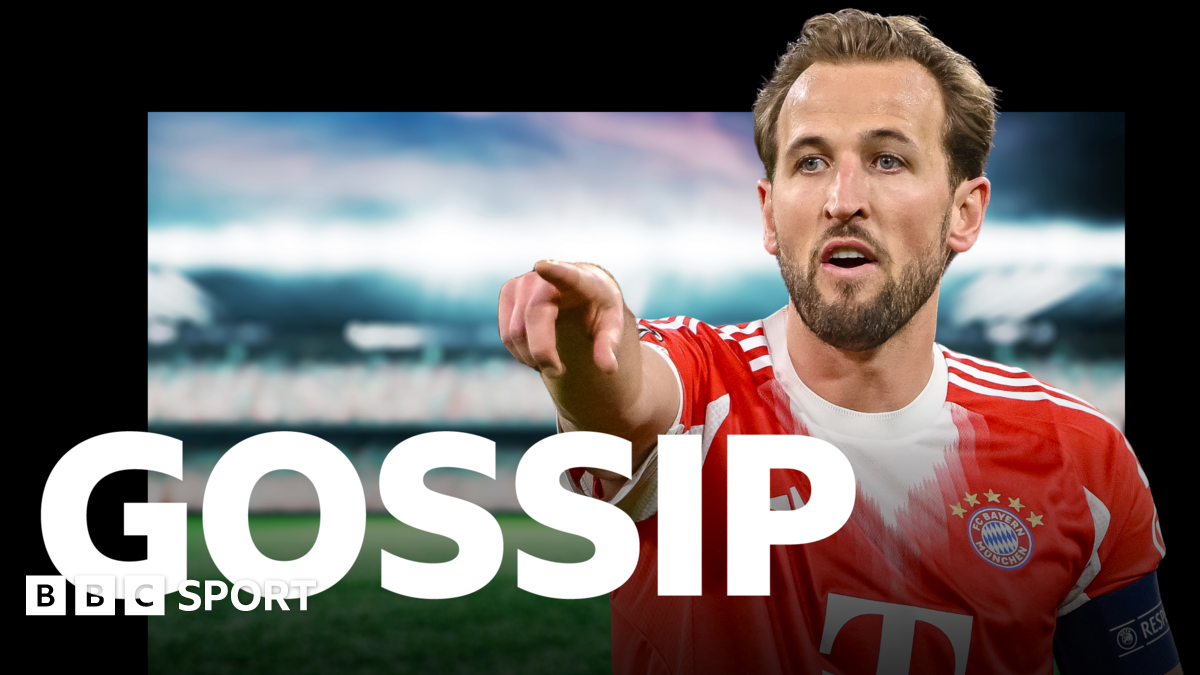
Bayern Munich are wary of Saudi Pro League clubs targeting Harry Kane, Bernardo Silva is set to leave Manchester City and Inter Miami start talks with Manchester United‘s Casemiro.
Bayern Munich honorary president Uli Hoeness is wary of the Saudi Pro League trying to tempt England striker Harry Kane as the German club continue talks with the 32-year-old over a new deal beyond summer 2027. (Kicker – in German), external
Portugal midfielder Bernardo Silva, 31, has told Manchester City that he will be leaving the club when his contract runs out in the summer. (Caught Offside), external
Scotland midfielder Scott McTominay is not talking to Saudi Pro League clubs as the 29-year-old’s focus remains in Italy with Napoli.(Fabrizio Romano), external
Barcelona will offer 37-year-old Poland striker Robert Lewandowski, whose contract at the club runs out in the summer, a new one-year deal which includes a significant pay cut and more performance-related bonuses. (Sport – in Spanish), external
Juventus are looking at the prospect of adding Lewandowski and 27-year-old France forward Randal Kolo Muani, who is on loan at Tottenham from Paris St-Germain, to their ranks. (Gazzetta dello Sport – in Italian), external
Advertisement
Chelsea and France defender Malo Gusto, 22, says Liam Rosenior is a “top manager” despite criticism following their recent poor form. (ESPN), external
Inter Miami have started talks with Brazil midfielder Casemiro’s camp about signing the 34-year-old, who will leave Manchester United in the summer, but the Major League soccer side face competition from other teams in Europe and Saudi Arabia. (Fabrizio Romano), external


;)
;)
;)
;)
;)








































You must be logged in to post a comment Login