Tech & AI
Nagra AMP II-S: The $27,900 Swiss Power Amplifier That Refuses to Chase Watts

Nagra has never shown much interest in winning the watts-per-dollar competition. With its new AMP II-S stereo power amplifier listed at $27,900 and delivering 120 watts per channel into 8 ohms, the Swiss manufacturer clearly isn’t starting now. If you’re shopping for maximum horsepower at the lowest possible price, you’ve wandered into the wrong showroom.
The AMP II-S replaces the Classic AMP that debuted in 2015, building on more than a decade of development across Nagra’s HD and Reference product lines. The new amplifier isn’t about doubling the power output or introducing another proprietary technology with an acronym nobody can remember. Nagra has focused on the power supply, input circuitry, mechanical construction, and noise isolation, with the goal of improving performance without abandoning the design philosophy that made its predecessor successful.
Earlier this year, we covered the introduction of Nagra’s PREAMP II-S, the vacuum tube preamplifier that established the new Series II family. The AMP II-S completes that initial pairing, combining a tube-based control component with solid-state power amplification. It’s an interesting proposition for listeners who appreciate Nagra’s recording heritage but don’t necessarily have the budget, space, or patience for the company’s more extravagant Reference electronics.
Related Reading:


What’s Different From the Original Nagra Classic AMP?
The Classic AMP was never an exercise in brute force. Rated at 100 watts per channel into 8 ohms, it used MOSFET output devices and a sophisticated power supply incorporating active power factor correction and an unusually substantial 300,000 µF capacitor bank.
That amplifier established a design approach focused on stability, low noise, and maintaining control over demanding loudspeaker loads. Rather than throw it away, Nagra has revisited the underlying engineering, applying lessons learned from its more ambitious amplifiers.
The most significant changes are inside the chassis.
The AMP II-S uses a new linear power supply built around a custom 800 VA potted transformer, with increased voltage headroom and energy reserves. Nagra says this should improve the amplifier’s ability to handle demanding musical transients without compression or a loss of control.
The input board is derived from Nagra’s flagship Reference AMP, accompanied by revised circuit layouts, upgraded internal wiring, and optically isolated controls. The objective is to reduce unwanted interference between circuits while improving channel separation and the precision of stereo imaging.
Nagra also retains a single pair of MOSFET output transistors per channel, avoiding the complexity of larger parallel output stages. The new amplifier operates in Class AB, with its first 10 watts delivered in Class A. That’s an appealing arrangement for listeners who value low-level resolution but don’t want a full Class A amplifier heating the listening room throughout the winter.
There’s also a measurable improvement in the published channel separation specification, from greater than 70 dB on the Classic AMP to greater than 90 dB on the AMP II-S.
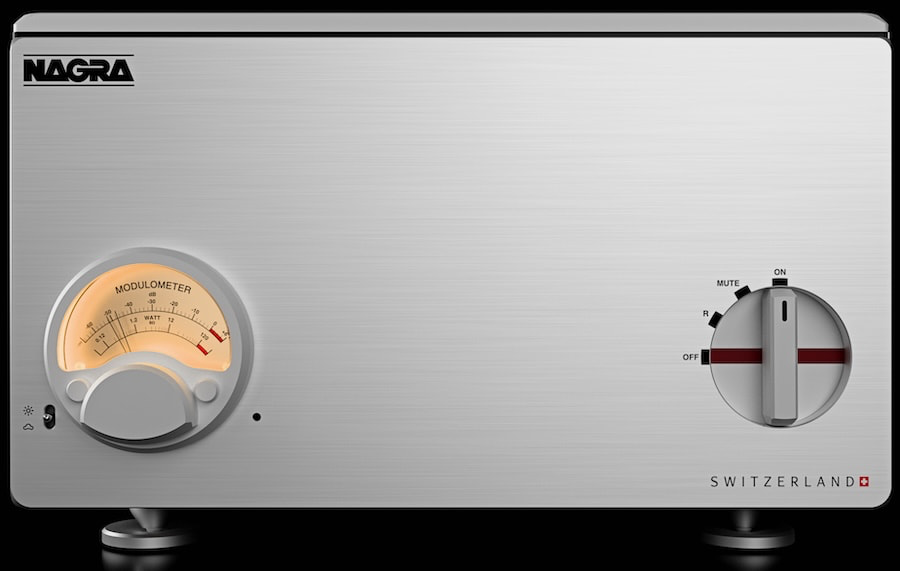

Swiss Precision, Without the Industrial-Sized Chassis
Nagra has also made substantial changes to the mechanical design. A large CNC-machined heatsink provides thermal stability, while a dedicated transformer suspension is intended to reduce the transmission of mechanical vibrations into the chassis.
The front-panel controls are optically isolated from the audio circuitry, reflecting Nagra’s preference for keeping potential sources of electrical noise away from the signal path. These may sound like small details, but they matter when the engineering objective is to preserve very low-level musical information.
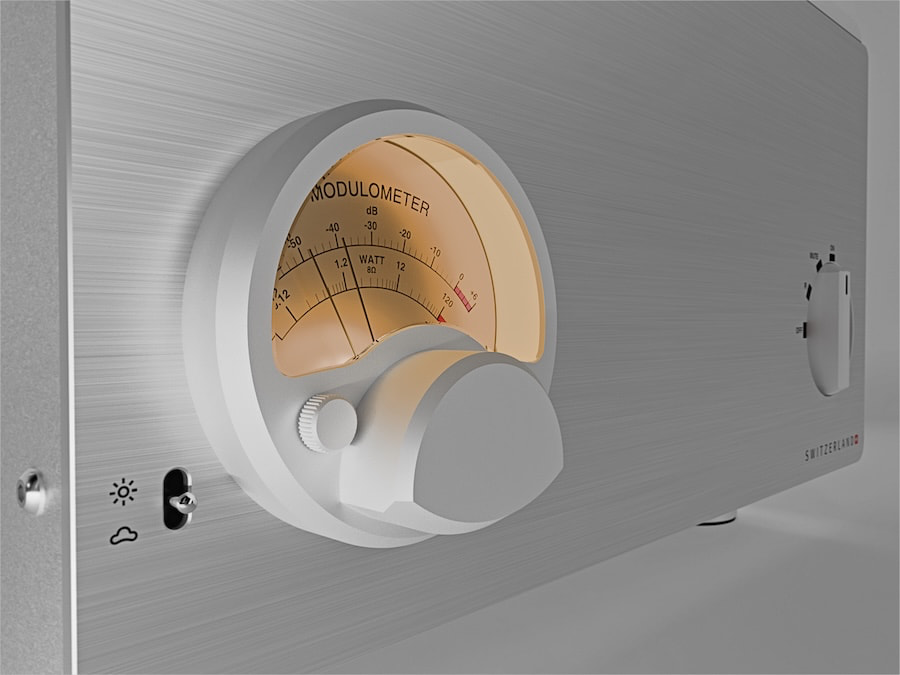
The familiar Modulometer remains on the front panel, providing an unmistakable connection to Nagra’s professional recording machines, particularly the legendary IV-S reel-to-reel recorder. It also ensures that anyone walking into your listening room knows this isn’t something you picked up during a weekend sale at Best Buy.
One rather interesting development is the additional mass. The original Classic AMP weighed approximately 39.7 pounds, while the AMP II-S tips the scales at 54 pounds. Nagra has clearly invested in more substantial mechanical construction rather than trying to impress customers with an empty box and an oversized price tag.
Nagra AMP II-S Specifications
- Type: Two-channel solid-state power amplifier
- Amplifier class: Class AB, with the first 10 watts operating in Class A
- Rated power output: 120 watts RMS per channel into 8 ohms
- Output devices: One pair of MOSFET transistors per channel
- Power supply: Linear design with custom 800 VA potted transformer
- Frequency response: Below 10 Hz to 75 kHz (+0/−3 dB)
- Channel separation: Greater than 90 dB
- Signal-to-noise ratio: Typically 110 dB, A-weighted
- THD+N: Less than 0.05% at 120 watts
- Input impedance: Greater than 100 kilohms
- Output impedance: 60 milliohms
- Analog inputs: Balanced XLR and unbalanced RCA
- Control connections: Remote input and output
- Dimensions (D × W × H): 461 x 280 x 174 mm (18.15 x 11.02 x 6.85 inches)
- Weight: 24.5 kg (54 lbs)

What Makes the Nagra AMP II-S Unique?
What distinguishes the AMP II-S isn’t any single specification. It’s Nagra’s decision to combine a relatively uncomplicated output stage with substantial power delivery, mechanical isolation, and input circuitry developed through its far more expensive Reference program.
That approach is increasingly unusual in a market where manufacturers compete with ever-higher power ratings, elaborate circuit architectures, and enough output transistors to populate a small electronics factory.
The AMP II-S also offers something that doesn’t appear on a specification sheet: continuity. Nagra’s products have maintained a recognizable design language and engineering philosophy across generations, and the Series II components are intended to preserve that identity while bringing newer technology into a less extravagant product family.
It doesn’t hurt that the amplifier looks like a piece of precision laboratory equipment rather than an illuminated gaming PC that wandered into an audiophile’s living room.
The real question is whether those engineering decisions translate into audible improvements over the Classic AMP. Nagra claims greater transparency, spatial precision, bass definition, and dynamic authority, but those remain manufacturer claims until we can evaluate the amplifier under controlled listening conditions.
The Competition: Gryphon and Audio Research Have Something to Say
At this price, Nagra isn’t competing with ordinary two-channel amplifiers. Two particularly interesting alternatives offer very different approaches to high-end amplification.
Gryphon Essence Stereo — $26,400
Denmark’s Gryphon Essence delivers 50 watts per channel into 8 ohms in pure Class A, supported by a substantial high-current power supply and dual-mono architecture. Where Nagra combines Class A operation at lower output levels with the greater efficiency of Class AB, the Essence places considerably more emphasis on sustained Class A operation.
The Gryphon is a physically imposing amplifier weighing approximately 99 pounds, and its operating characteristics are very different from the Nagra. For listeners who prioritize Class A amplification and have suitable loudspeakers, it deserves serious consideration.
Audio Research Reference 160S — $28,000
The American alternative comes from Audio Research, whose Reference 160S uses eight KT150 output tubes to deliver 140 watts per channel. It features automatic tube biasing, switchable Triode and Ultralinear operating modes, balanced and single-ended inputs, and the company’s distinctive GhostMeters.
The Reference 160S is a fundamentally different proposition. It offers the flexibility and character of an all-tube output stage, but also brings the heat, weight, and eventual tube replacement costs that come with the territory. At approximately 100 pounds, it isn’t something you’ll casually move when rearranging the furniture.
Neither competitor makes the Nagra irrelevant, but both demonstrate how much choice exists at this price level. Buyers are selecting an amplification philosophy as much as a power rating.
The Bottom Line
The Nagra AMP II-S is unlikely to persuade anyone who evaluates amplifiers by dividing watts into dollars. There are vastly more powerful alternatives for considerably less money, and Nagra has never suggested otherwise.
What makes this release compelling is the company’s willingness to revisit an established design rather than replace it with something unrecognizable. The AMP II-S brings more than a decade of accumulated engineering experience to one of Nagra’s core products, and the improvements appear substantial enough to warrant serious attention.
Whether it actually sounds better than the Classic AMP remains to be determined. At nearly $28,000, it should, and not by an amount that requires three engineers, a soundproof laboratory, and an interpreter to explain. Our experience with their equipment has always been a positive one and we’re particularly interested in their “entry” level gear because it’s actually affordable when you consider the most relevant competition. Nagra combined with DeVore Fidelity and Boenicke are some of the best sounding systems we’ve heard in recent years.
Pricing & Availability
The Nagra AMP II-S made its world premiere at Absolute Sounds’ The Happening event in the United Kingdom on October 17-18, 2026. Additional presentations are scheduled for the Audio Video Show in Warsaw and the Tokyo International Audio Show, both taking place October 23-25.
The official UK recommended retail price is £21,998, including VAT. U.S. retailer Unveil Sound currently lists the amplifier at $27,900, although that price has not yet been independently confirmed as Nagra’s official American MSRP.
The amplifier is entering distribution through authorized dealers, with regional availability and demonstration arrangements varying by market.
For more information: www.nagraaudio.com
You must be logged in to post a comment Login