Tech & AI
Sony ECM-AX10 Spatial Audio Microphone Adds Eclipsa Audio Support for Smartphone Creators

Sony might be best known to consumers for BRAVIA TVs, headphones and home theater gear, but pro audio has been part of the company’s DNA for decades. In 2026 alone, Sony expanded that side of the business with products including the affordable IER-M500 professional IEMs, and it is now turning its attention toward something potentially more consequential: making spatial audio easier to capture at the source.
The new Sony ECM-AX10 Spatial Audio Microphone is aimed at professional and hobbyist content creators, but its ability to capture first-order Ambisonics for use in Eclipsa Audio production workflows makes this more than another microphone announcement. Eclipsa Audio is built on the open, royalty-free IAMF spatial-audio format developed through the Alliance for Open Media and backed heavily by Google and Samsung. YouTube already accepts Eclipsa Audio content, while compatible TVs and soundbars can reproduce it at home.
So where is Sony going with this? The ECM-AX10 suggests the company wants a larger role in the entire immersive-audio workflow, from recording and production to distribution and playback. Sony already describes its professional strategy in terms of supporting creators from acquisition through delivery, and its growing emphasis on spatial-audio production makes the AX10 look less like a one-off microphone and more like another piece of that puzzle.
Related Reading: Watch Out, Dolby Atmos: Google’s Eclipsa Audio Is Coming For You

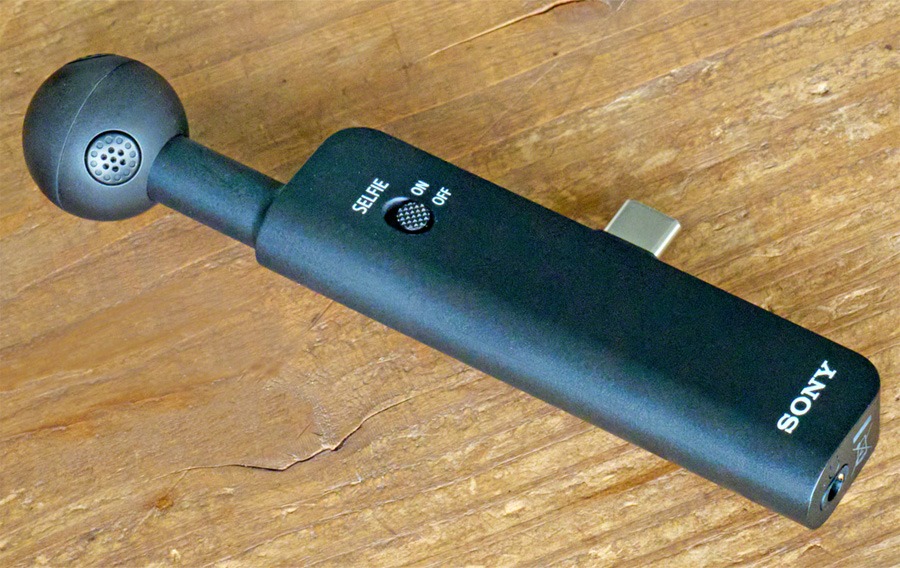
Why the Sony ECM-AX10 Matters for Smartphone Content Creators
Smartphones have come a long way, and an increasing number of creators now use them to record both video and audio.
However, while many smartphones can capture surprisingly high-quality video, their built-in audio recording often falls short. That is hardly surprising, considering those microphones also have to handle phone calls, meetings and everyday voice communication.
To expand the live audio recording capabilities of smartphones and other compatible devices, Sony has introduced the ECM-AX10, a very compact microphone that plugs directly into the USB Type-C port of a smartphone.

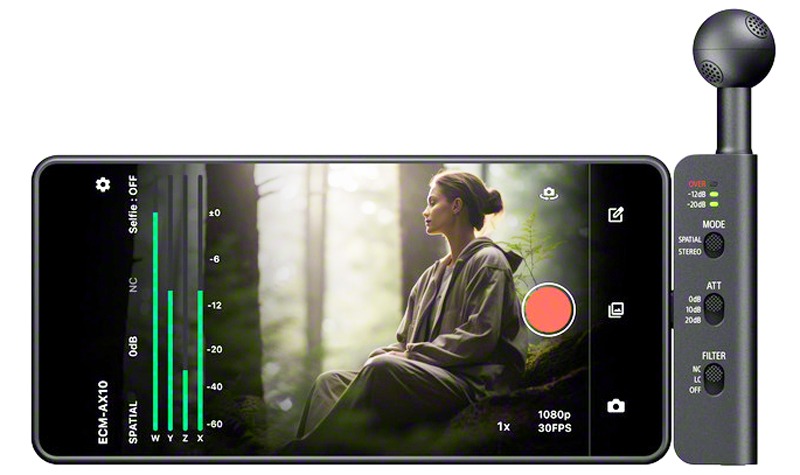
Once plugged in, the ECM-AX10 elevates a smartphone’s live recording capabilities with professional-quality spatial audio. Users can capture audio and video simultaneously without the need for separate synchronization.
ECM-AX10 use examples include:
- Travel, city walks and food experiences
- Music performances and live events
- Sports, motorsports and enthusiast content
- Family events, personal archiving and 360° video
- Capturing natural sounds, sound effects and ambience for post-production
With its built-in technology and flexible recording options, the ECM-AX10, when paired with a smartphone, can support a range of spatial and immersive audio workflows, including Eclipsa Audio, Ambisonic, binaural and stereo audio.
As a result of its built-in technology and flexible use possibilities, the ECM-AX10 in combination with a smartphone becomes a tool for supporting Eclipsa and Ambisonic, Binaural and stereo Audio workflows
Ambisonics: This is a four-channel, scene-based capture method used for immersive audio production. Ambisonics B-format is a full-sphere, speaker-independent spatial audio format that captures sound from all directions, including horizontal azimuth and vertical elevation.
Pro Tip: Sony’s spatial-audio processing converts audio captured with the ECM-AX10 into first-order Ambisonics, preserving direction, ambience and low-frequency detail.
Binaural: This supports two-channel spatial listening over headphones and is compatible with many existing apps.
Stereo: The ECM-AX10 also supports high-quality, atmospheric two-channel recording for broad compatibility with speakers, devices and apps.

Eclipsa Audio: The ECM-AX10 captures first-order Ambisonics spatial audio, which can then be used to create Eclipsa Audio content based on the IAMF (Immersive Audio Model and Format) standard. Sony is also a licensed Eclipsa Audio adopter.
For the ECM-AX10’s mobile workflow, Eclipsa Audio output for YouTube requires Sony’s free editing app. The app processes the Ambisonics recording and prepares it for Eclipsa Audio distribution. Without that additional Eclipsa processing step, content can be exported for conventional stereo or binaural playback.
Similar to Dolby Atmos, Auro-3D, DTS and Sony 360 Reality Audio, Eclipsa Audio extends beyond traditional surround sound by incorporating height information. Sounds can be positioned around and above the listener to create a more immersive three-dimensional presentation.
Eclipsa Audio is based on the open IAMF standard and is designed to adapt immersive content to different playback environments and compatible devices, including TVs and soundbars. For ECM-AX10 users, the important distinction is that the microphone provides the spatial Ambisonics capture; Eclipsa Audio is created during post-production rather than recorded directly by the microphone.
Publishing Destinations: Stereo and binaural versions can be prepared for broad distribution through platforms such as Instagram, X, Facebook and other compatible services. For immersive Eclipsa Audio playback, the ECM-AX10 workflow can create an IAMF/Eclipsa Audio version for YouTube using Sony’s free editing app. Actual Eclipsa Audio playback also requires a compatible device.
ECM-AX10 Features
- Microphone Type: Spatial audio microphone for smartphones.
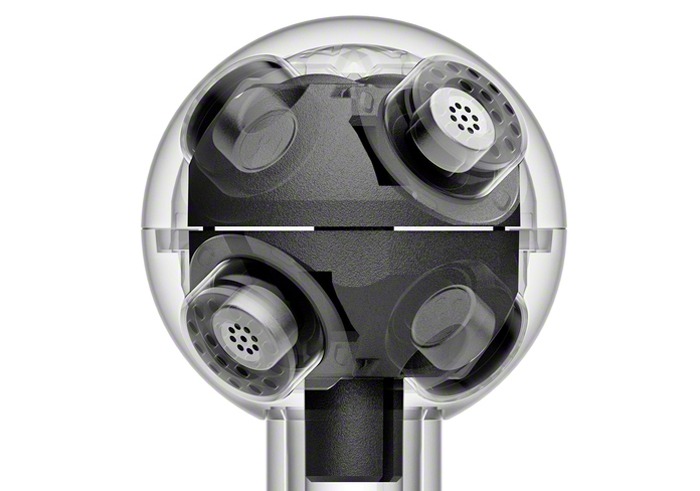
- Microphone Array: Four omnidirectional microphone capsules are arranged around a newly developed spherical module.
- Mode Selection Switch: Switches between Spatial Audio and Stereo modes.
- Peak Level Meter: Provides an indication of the strength of the incoming audio signal. If the input level is too high, attenuation may be necessary to prevent clipping.
- ATT (Attenuation): If an input signal is too strong, it can overload the system, resulting in clipping and harsh digital distortion. ATT reduces the input level to keep the recorded audio clean and within safe operating limits.
- Noise Control: Noise Cut and Low Cut settings help reduce unwanted noise.
- Selfie Mode: A Front alignment selector makes it easier to maintain proper sound orientation when recording selfies or front-facing video with a smartphone.
- Accelerometer: A built-in accelerometer automatically detects the microphone’s tilt angle, helping keep recorded spatial audio aligned with the video based on the smartphone’s orientation.
- Audio Recording Format Support: First-order Ambisonics, binaural and stereo.
- Audio Post-Production Format Support: Ambisonics (48 kHz, 32-bit float, four-channel AmbiX, Eclipsa Audio) and binaural/stereo (48 kHz, 16-, 24- or 32-bit). Audio editing can also be performed directly on the same smartphone used for recording.
- Input: USB Type-C direct connection for smartphones and other compatible recording devices.
- Output: 3.5 mm headphone monitoring output, compatible with the Sony IER-M500 IEMs and other wired IEMs and headphones.
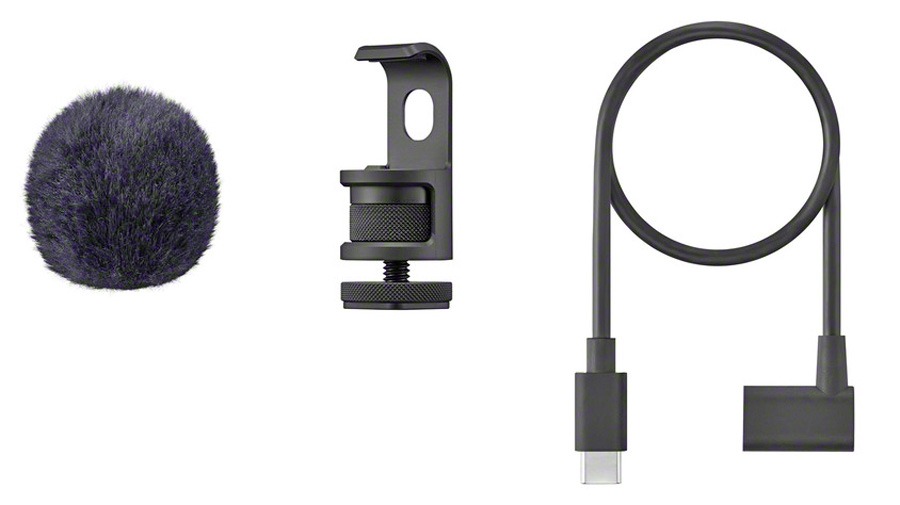
- Included in the Package
- Windscreen
- USB Type-C extension cable
- Cold-shoe microphone holder
- Spacer sheet

The Bottom Line
At $249, the Sony ECM-AX10 packs an unusual amount of recording capability into a microphone small enough to plug directly into a smartphone. Its real advantage is not simply better audio quality, but the ability to capture both conventional stereo and spatial audio without requiring a separate recorder, microphone array or complicated synchronization workflow.
That makes the ECM-AX10 particularly interesting for creators who want to move beyond basic smartphone audio. Its four-capsule design supports first-order Ambisonics capture, binaural and stereo production, while Eclipsa Audio support provides another path for creating and distributing immersive content. Editing can also remain within a mobile workflow, depending on the software being used.
What makes the ECM-AX10 genuinely different is how much of the immersive audio production chain Sony has condensed into one compact device. A creator can capture spatial audio alongside video on a smartphone, monitor the recording through wired headphones or IEMs, and then move that material into an Ambisonics or Eclipsa Audio post-production workflow without hauling around a conventional field-recording rig.
For monitoring, Sony’s $119 IER-M500 professional IEMs could also make a logical companion to the ECM-AX10, providing a relatively affordable Sony-based recording and monitoring setup for creators who want to keep the entire kit portable.
Price & Availability
The Sony ECM-AX10 Spatial Audio Microphone is priced at $249.99 USD (CAN $349.99) and is available through Sony.
You must be logged in to post a comment Login