Tech & AI
Washington governor sets up space council to boost business ventures targeting the final frontier


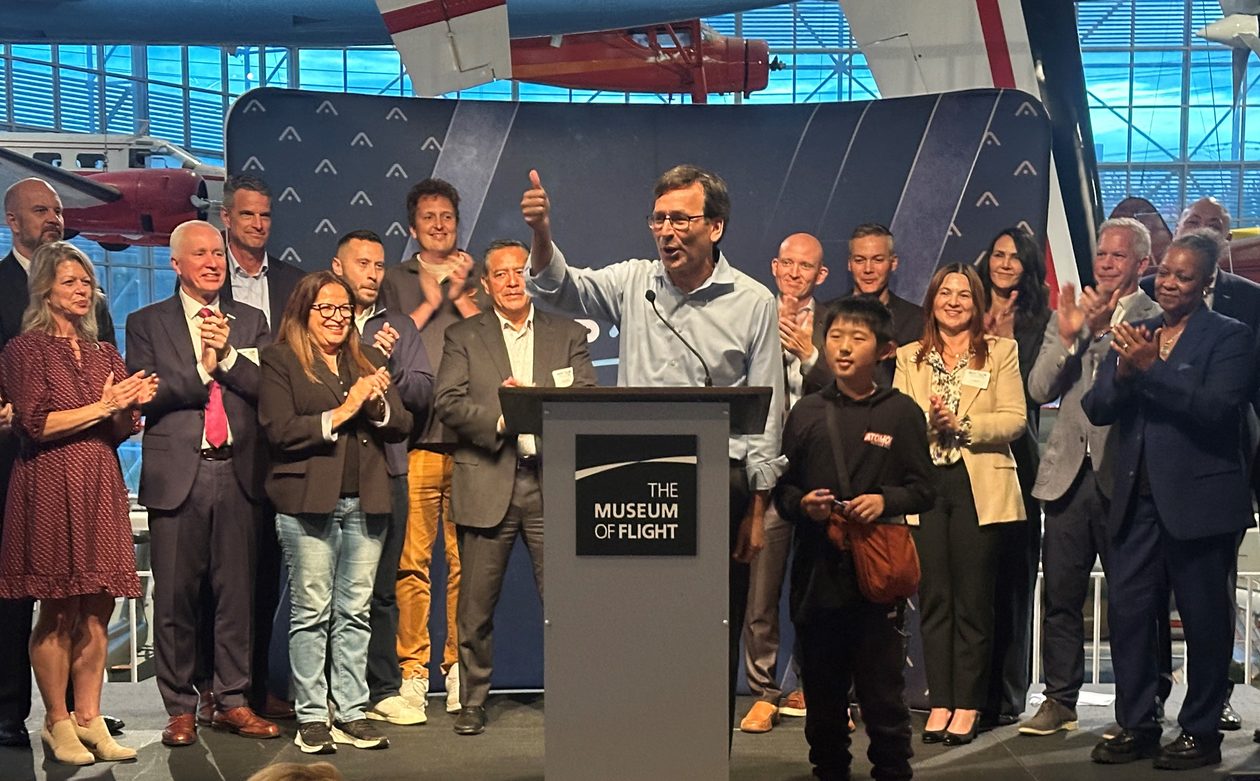
Washington Gov. Bob Ferguson has created a public-private council to elevate the Evergreen State’s profile as regional clusters compete for primacy in America’s space industry.
The 23-member Washington Space Council was introduced tonight at the Museum of Flight during a kickoff event for Seattle Space Week, a celebration organized by Space Northwest.
“The council will help keep us competitive by comparing Washington with other leading states in the industry and identifying ways we can continue to improve and compete,” Ferguson said.
Washington state already ranks as one of the nation’s space industry hotspots. “We’re proud to have a cluster of more than 90 space companies employing more than 13,000 workers, generating over $4 billion in annual economic activity and $1.6 billion in annual payroll,” Ferguson said.
But Andy Lapsa, co-founder and CEO of Kent, Wash.-based Stoke Space, told tonight’s crowd that several other regions are competing with the Pacific Northwest for space-related investments. “States like Florida and Texas and Colorado want this industry, and they want it bad,” he said. “They compete for it every day. Washington has every advantage it needs to lead them all, and the window to use those advantages is open right now.”
Boeing has historically been the state’s leading venture in aerospace, but when you focus on ventures that concentrate strictly on space, Blue Origin is high on the list. Seattle is particularly strong in the satellite sector: More than half of the world’s satellites are built in the Seattle area, thanks to SpaceX’s Starlink facilities in Redmond and Woodinville, plus Amazon Leo’s factory in Kirkland, BlackSky’s production plant in Tukwila and Xplore’s operation in Bellevue.
Gravitics, Interlune, Portal Space Systems, Starcloud and Starfish Space are among other space ventures represented on the Washington Space Council. The list also includes elected officials, union leaders, educators and investors, plus representatives from space-related tech companies and Pacific Northwest National Laboratory.
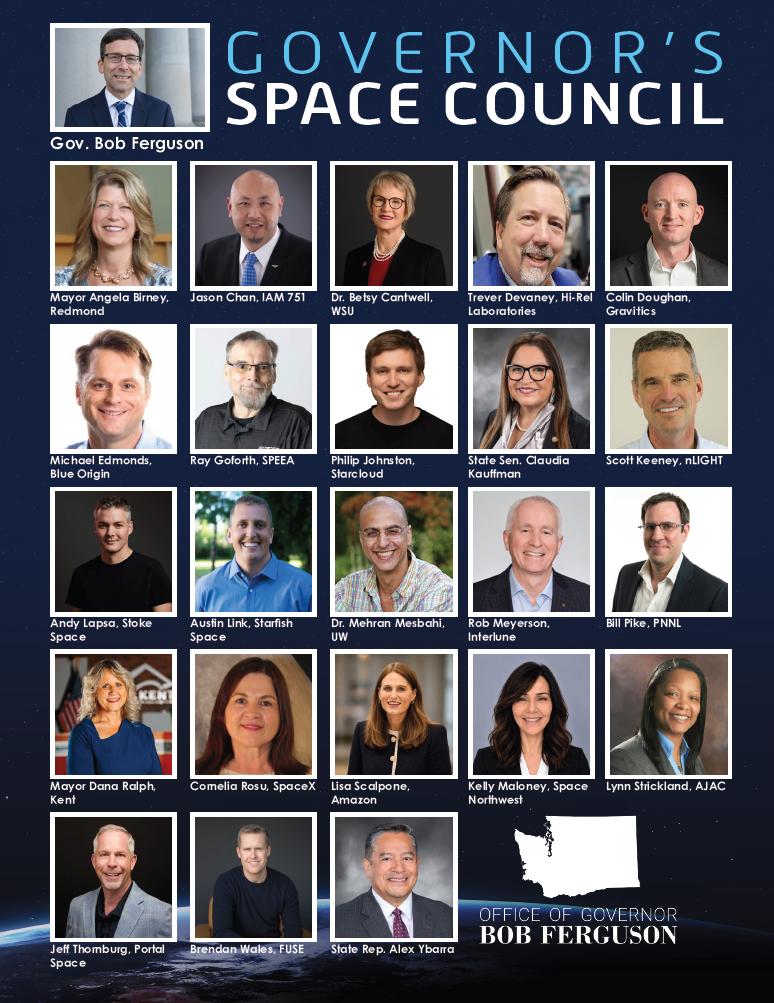

Ferguson said the council will “identify barriers for the industry and find opportunities for growth.”
“That includes, by the way, workforce development, infrastructure and much more,” he said. “And the council will look for ways we might be able to develop Washington-based commercial launch capabilities. That would be a very exciting addition to what we’re doing right here in Washington.”
Ferguson brought a member of the audience, 10-year-old Sebastian Yu, to the stage when he signed the executive order that officially created the council. After the signing, the governor handed the pen to Yu.
“Your assignment, Sebastian, is that when we do that first launch, you have to save this pen and bring it with you to the first launch,” Ferguson said. “Take care of this pen, OK? I’m going to expect to see it again someday.”
Notes from the kickoff:
- Space Northwest presented three awards to recognize contributions to the region’s space industry. The Shooting Star award for municipal support went to the city of Kent, Wash. Portal Space Systems won the Rising Star award for emerging space companies, and SpaceX won the North Star Award for large space companies.
- Kent Mayor Dana Ralph noted that her city’s connection to the space industry goes back to Boeing’s work on the lunar rovers for NASA’s Apollo moon missions in the 1970s, while acknowledging that Kent can’t rest on its laurels. “Our job is to make it possible for companies to build and grow and hire. That means reinvesting in the basics: roads, great mobility, water, sewer, plentiful and easily accessible energy and industrial land,” she said.
- Mehran Mesbahi, professor and chair of the University of Washington’s Department of Aeronautics and Astronautics, highlighted efforts to boost careers in the space industry. “We have Husky Satellite Lab, a group of energized students at UW, and we’re going to create a certificate program around space systems going forward,” he said.
Seattle Space Week continues on Tuesday with the Space Northwest Symposium at the Federal Way Performing Arts & Event Center.
You must be logged in to post a comment Login