Tech
3 Things That Make The American Ford Mustang Different From The European Version

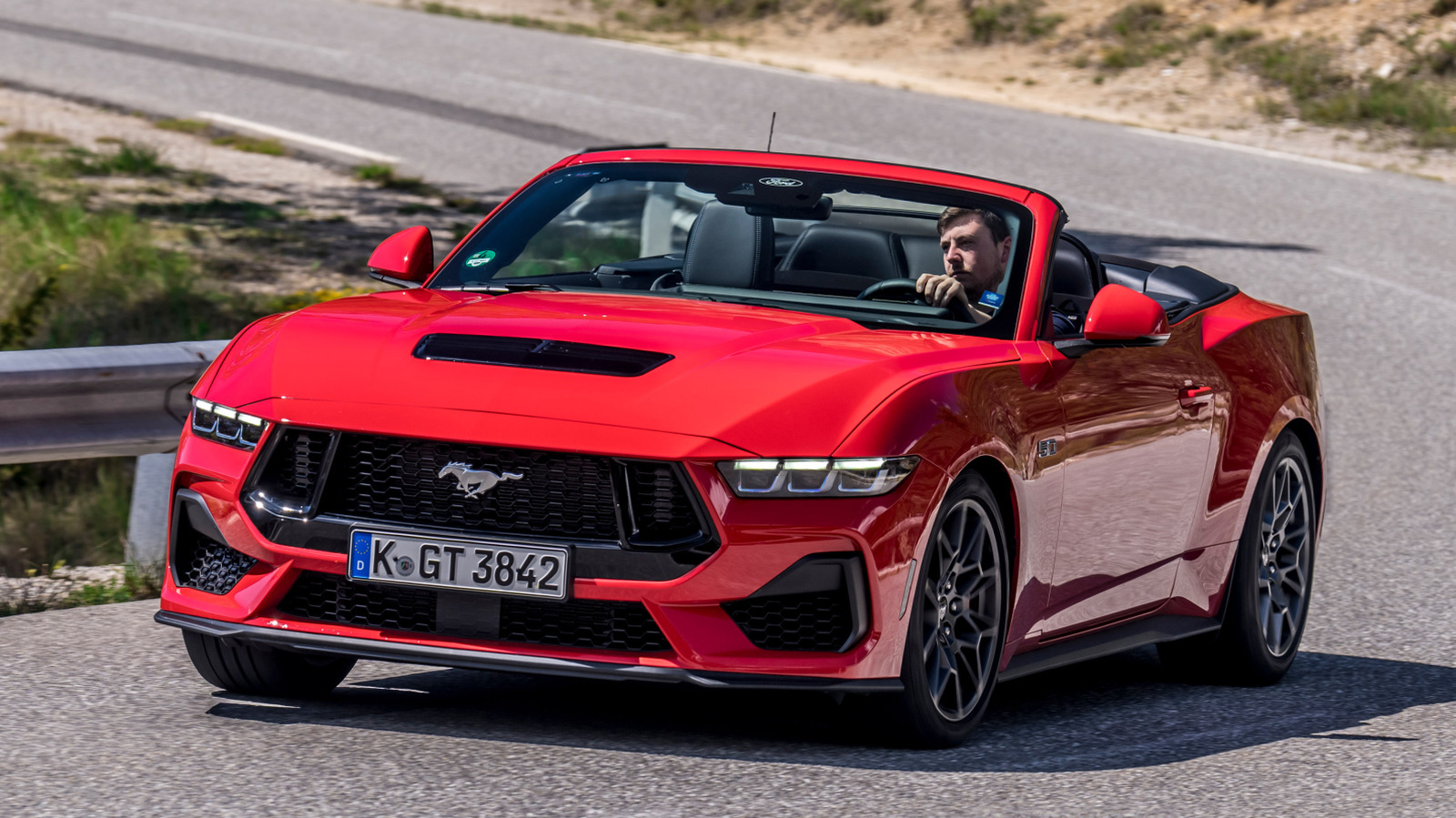

The Ford Mustang that is currently sold in Europe has a number of similarities to the U.S. model, but it also differs in numerous ways, incorporating a number of changes that make it viable to sell in Europe from a marketing perspective, while also enabling the Mustang to meet the necessary standards that every vehicle sold in the EU must conform with. Just like with other American and European cars, there are differences between the EU market Mustang and the American versions.
The current Mustang sold in both Europe and the U.S. is the seventh-generation S650 model, which has been on sale since the 2024 model year. On the outside, it displays its new “tri-bar” LED headlights, set into a more aggressive front end, with wider rear fenders. Inside, there have been major changes, with a new interior featuring two digital displays that can be configured to each owner’s preferences.
The digital instrument cluster measures 12.4 inches, while the adjoining central touchscreen is larger at 13.2 inches. This significant change to the Mustang’s interior is clearly an attempt on Ford’s part to attract a younger, more tech-savvy customer to its long-running ponycar, in Europe as well as in the U.S. The seventh-gen ‘Stang is definitely one of the best-looking Mustangs Ford has ever made.
European Mustangs are all made with V8 engines
After offering the previous, sixth-generation Mustang in both four-cylinder EcoBoost and V8 GT versions and seeing most buyers opting for the full-fat V8, Ford made the decision to offer only the V8 in Europe when the seventh-generation model went on sale. The current Mustang lineup consists of the Mustang GT, in either coupe or convertible form, and the Mustang Dark Horse coupe, which showed us why Ford’s Mustang is a survivor.
Just as with the U.S. versions, the Euro Mustang GT and Dark Horse are powered by a 5.0-liter V8 engine, but due to stricter emissions controls, the GT model loses 40 horsepower, dropping its output to 440 horsepower, compared to 480 for the U.S. version. The Mustang Dark Horse model is also restricted, generating only 448 horses, sacrificing 52 to the European emissions gods. Transmission options consist of either a six-speed manual or a 10-speed automatic, both or which drive the rear wheels. The GT features a limited-slip differential, while the Dark Horse runs a Torsen limited-slip diff. An added bonus for European Mustang customers will be a standard Performance Pack, which comes with an active valve exhaust, 19-inch alloy wheels, and the previously mentioned limited-slip differential.
Performance figures provided by Ford show that the 10-speed automatic provides better acceleration figures. The 0-100 km/h run (equal to 0-62 mph) goes by in 4.9 seconds for the GT coupe and in 4.4 seconds for the Dark Horse, which is still pretty good, considering the power loss.
European Mustangs are much more expensive
By the time that the Mustang conforms to European emission regulations and is shipped thousands of miles to its destination, it ends up costing quite a bit more than the U.S. version. The U.S. base Mustang GT Fastback coupe with the Performance Pack added, which comes closest to the Euro spec GT, lands here for $54,455 including destination charges but without taxes. The European price for the same car, on Ford’s German website, comes out to 62,400 Euros, which at the current exchange rates comes out to about $71,000, which does include Europe’s value-added tax, 19% in Germany’s case.
This amounts to a $16,601 premium that European buyers pay for the least expensive Mustang, with even higher prices for optioned-up GTs. Then there’s the Dark Horse, which starts at 75,000 Euros, which converts to $85,398 including the VAT. That becomes an upcharge of $19,863 when compared to the least expensive U.S.-purchased Dark Horse, which is $66,075 with destination but before taxes. Even after you add local sales tax, that’s still quite a difference.
Then there are the individual option prices, some of which benefit European buyers. Ford allows European buyers to specify any color at no additional charge, while the U.S. website charges $495 to $995 for six out of nine colors offered. The front Recaro sports seats cost 1,800 Euros, or almost $2,100 additional in Europe, but must be ordered with the GT Performance package in the U.S., which is already standard on the Euro model, boosting the price up by around $8,000. Simply put, there are some tradeoffs.
Right-hand drive manufacturing
In addition to the normal left-hand drive versions of the European Mustang that are made for the majority of European countries that drive on the right side of the road, there are also European Mustangs produced for those countries that drive on the left side of the road, which includes the United Kingdom, Ireland, the Isle of Man, Cyprus, and Malta.
While Ford did a decent job of moving the steering wheel and the pedals to the right side of the Mustang, it came up short as far as the center console goes. Just as it had done with the previous generation of Mustang, Ford continues to use the console designed for the left-hand drive version. While this is most likely a cost-saving move on Ford’s part, it leaves the Mustang’s parking brake on the passenger’s side of the console with the right-hand drive setup. This makes things complicated when the driver wants to use the parking brake’s added functionality as a drift brake.
The Mustang’s drift brake, intended for track use only, can be activated with a few simple steps. After first pressing either the Mustang Pony button on the dash or choosing Features on the car’s touchscreen, the driver can then select My Mustang, followed by Track Apps and then Drift Brake. This enables the drift brake feature, which can either brake or fully lock up the rear wheels only, letting the driver drift the car sideways.
Methodology
For this analysis of the major differences between the Ford Mustang made for the European market and the Mustang made for the U.S. market, we reviewed a variety of materials put out by Ford itself on this topic. The manufacturer materials were supplemented by other publications, with data including performance differences as a result of the different markets’ emission regulations, and the compromises made during the car’s conversion to a right-hand drive version.
Pricing information was converted from Euros into dollars, based on the exchange rate at the time this article was written. The prices in the article also include the value-added tax for the German market, while the U.S. prices include destination charges, but do not include any local sales taxes that may apply.
You must be logged in to post a comment Login