If your weekend plans involve sinking into the couch and wondering what to do next, consider this your rescue package. This week’s lineup comes with a bonus – every single movie here is completely free to stream. I dug through Tubi and Pluto TV‘s libraries and found a pothead comedy, a Swedish vampire film that reinvented the genre, and a Korean horror movie that still gets talked about years later. So, add these free films to your Weekend watchlist right away!
Jane (Anna Faris), an unemployed actress, accidentally eats a full batch of her roommate’s weed-laced cupcakes right before a packed day of errands. What follows is a chaotic, one day journey across Los Angeles as Jane tries to replace the cupcakes, make it to a big audition, and pay off her drug dealer, all while progressively getting more baked. However, paranoia and ridiculous distractions keep derailing her at every turn.
I recommend this one almost entirely for Anna Faris, who fully commits to playing stoned and turns this low-budget comedy into an absolute masterclass in slapstick humor. She won a Best Actress award at the Method Fest for the role, and it is easy to see why after watching her navigate simple tasks like an obstacle course. It is far from a polished film, and critics were split on it at release, but if you are in the mood for something silly and low-effort to watch, this one delivers exactly that.
Oskar, a lonely twelve-year-old boy who gets bullied at school, strikes up a friendship with Eli, the strange new girl who moves in next door and only appears at night. As their bond deepens, a string of mysterious deaths begins spreading through their snowy Stockholm suburb. Oskar soon discovers Eli harbors a dark, bloodthirsty secret. Rather than leaning into typical vampire horror tropes, the film treats Eli’s condition as something tragic, tangled up in themes of isolation, first love, and quiet violence.
Director Tomas Alfredson shot the whole movie in muted blues and silences, letting the dread build gradually instead of relying on jump scares. Kåre Hedebrant and Lina Leandersson give remarkably mature performances for child actors, carrying scenes that require real emotional complexity. The final scene near the end is a masterpiece of tension and visual storytelling.
A quiet mountain village in South Korea is suddenly struck by a mysterious, violent sickness that drives locals to murder their families. An incompetent police officer named Jong-goo steps up to investigate the gruesome crime scenes. When his own daughter shows identical symptoms, his search for answers turns into a desperate race against time.
What starts as a straightforward procedural investigation slowly spirals into something far stranger, blending shamanistic ritual, possession, and paranoia. The intense exorcism sequence midway through is easily one of the most hypnotic scenes in modern horror cinema. I recommend this one for how thoroughly it commits to its slow burn, letting the mystery deepen for over two hours before its full scope becomes clear. That patience pays off with one of the most talked-about endings in recent horror cinema.
Doing anything on a frozen lake can carries some amount of risk. Nevertheless, every year events ranging from car racing to ice skating are held on them. As such, proper safety precautions are needed, the most important of which is ensuring the ice is thick enough to withstand the weight of whatever may be on it. This is done by cutting holes into the ice and measuring its depth in several locations. But this is a dangerous and imperfect process only giving a rough picture of actual thickness. So to solves these problems, a team of students at ETH Zurich made an ice measuring submersible drone.
The concept of ice measurement employed is, on paper, reasonably simple. When a sonar pulse is sent out, some of the energy will return off the bottom of the ice sheet, but some of it will pass through creating a second return. By measuring the difference in these two returns, the thickness can be calculate with a high degree of precision. Attach the sonar to a submersible and give it a positioning system and you can simply get a thickness map, right? Well, employing theory in practice is a far more complicated prospect as the students soon found out.
The submersible itself is slightly positively buoyant. It features two concrete ballasts to adjust the center of gravity and six propulsion motors for six degrees of freedom. It’s powered by a NVIDIA Jetson to allow for autonomous operations and a whole host of sensors. Navigation is handled by a variety of sensors, mostly GPS and SBL. The GPS antenna sits in a radome at the top of the submersible, allowing for a strong enough signal for a positional fix when touching the bottom of the ice. SBL works similarly to sonar, where a transmitter on the submarine sends out an audio ping, received by a trio of hydrophones used to calculate the drone’s position.
But does all this complexity really work? Well, mostly. A number of real-world factors greatly compound the submarine’s effectiveness. The signal noise from in the sonar makes accurate measurements nigh impossible with that methodology. As such, the team used a depth based approach, by touching the submarine to the bottom of the ice, and measuring the water pressure and therefore depth, the ice’s thickness can be easily calculated. However, this method too is not without flaws. When snow falls on alpine lakes, it pushes the ice sheet downward, and a new ice sheet can form on top. This top sheet’s layer is what’s most important, but the depth measurement can only take into account the overall sheet’s thickness. Regardless, this was a really impressive first test of the submersible, and we look forward to seeing where it goes from here!
I spent some time in the internet’s fakest mall, filling a shopping cart with things I could not buy, hunting for discounts on products that do not exist, and checking out three separate times for a grand total of $0.00. Then I placed a fake food order and smoked a cigarette I could not taste, with strangers I will never meet, on a rooftop that does not exist either. My bank balance never changed, but my brain, annoyingly, did.
When I first heard about South Korea’s growing “dopamine sites,” I assumed they were another internet oddity I would poke around for five minutes and forget by lunch. Instead, I found a surprisingly clever idea hiding beneath the absurdity. You can browse endless imaginary products, add everything to your cart, and complete a purchase that never actually exists. These websites aren’t trying to sell you anything. They’re trying to recreate the feeling of shopping while removing the part that empties your wallet.
🦔In South Korea, “dopamine sites” have spread among Gen Z. Fake food delivery apps where you browse menus, fill a cart, and simulate an order you never place. Fake shopping sites where you track a courier that doesn’t exist. Virtual smoke break rooms where you sit with strangers… pic.twitter.com/lCax1TT4cu
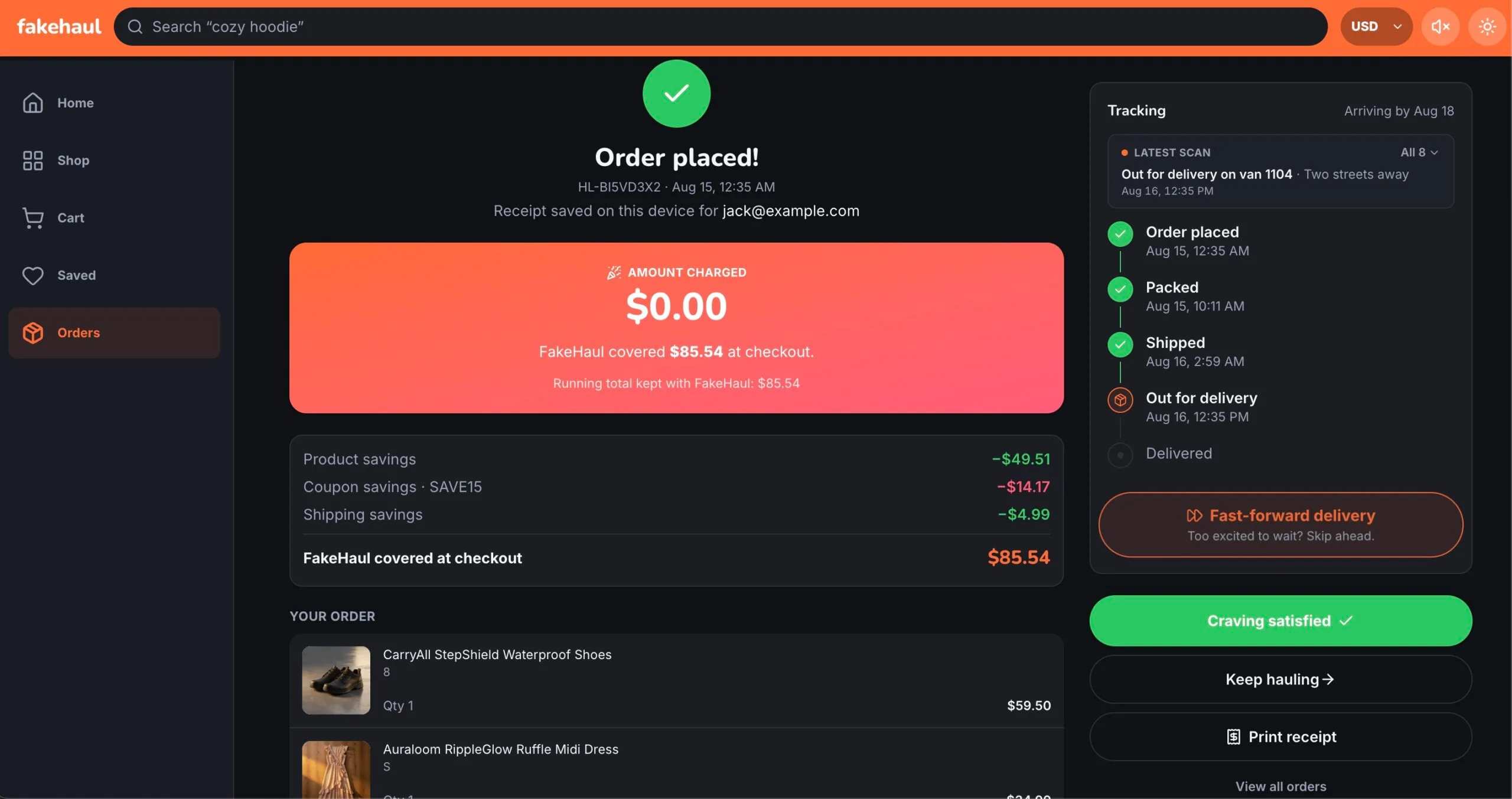
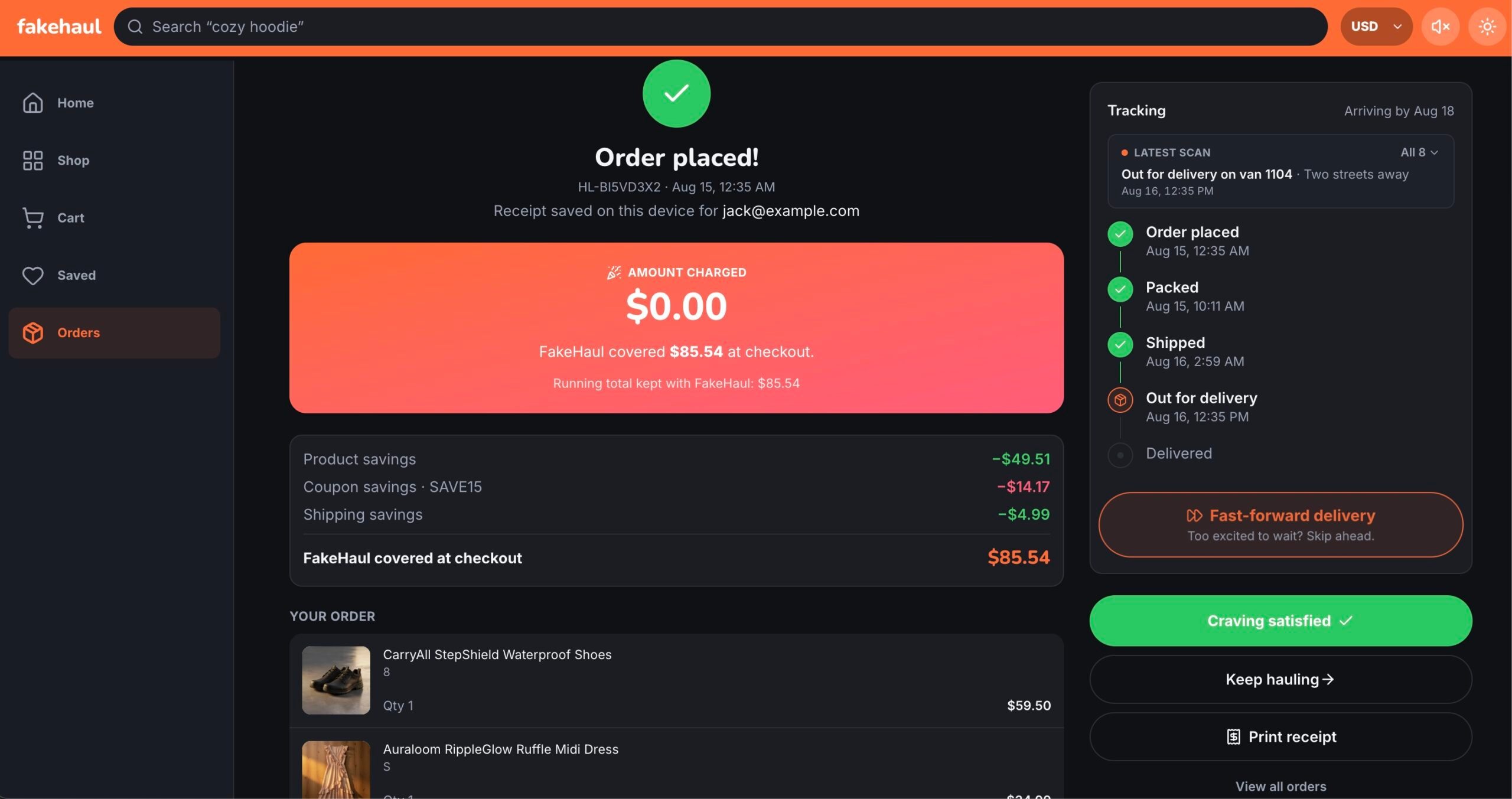
FakeHaul is where I lost the most time, and I mean that as a genuine compliment to whoever names these products. I added a “CarryAll StepShield Waterproof Shoes” marked down to $59.50 from a suspiciously specific $92.00, a yoga mat I do not need, and a dress I can’t wear.
Advertisement
A countdown timer insisted my deal expired at midnight, which is absurd for a product that was never manufactured, and yet I felt a flicker of urgency, the kind that makes you click ‘Add to cart’ before your brain catches up with the fact that none of this is real. Every checkout landed at exactly $0.00, despite the price tag, and I kept going back for more, not entirely out of curiosity anymore. There was a small, undeniable hit somewhere in there.
Completing a purchase on FakeHaulManisha Priyadarshini / Digital Trends
The purchase was never real, but the dopamine hit was
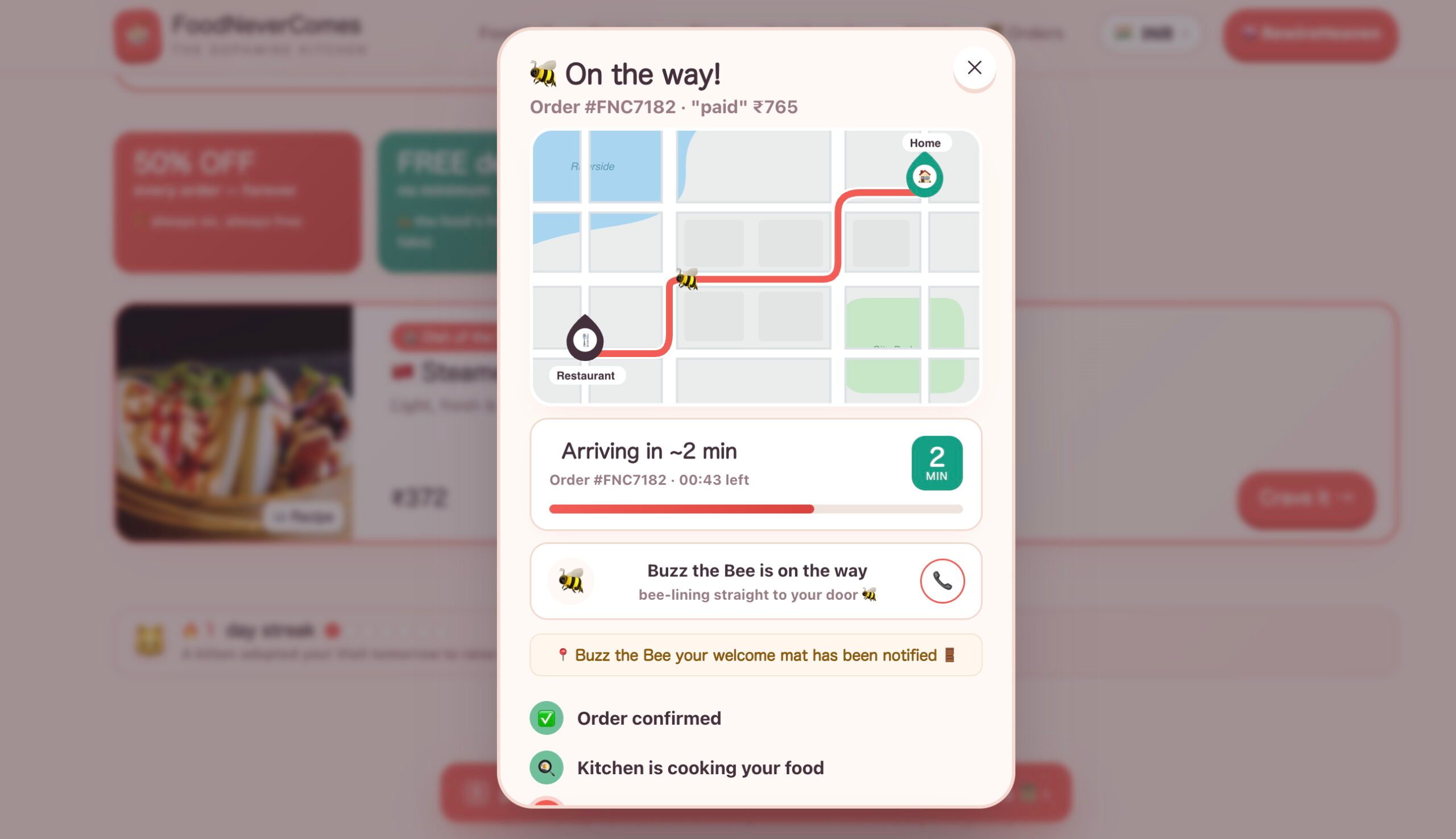
Tracking screen on fake food delivery site FoodNeverComesManisha Priyadarshini / Digital Trends
Next, I tried the fake food delivery site FoodNeverComes, where I placed an order for steamed bao buns and watched a little bee icon crawl across a map toward my fake address. Watching that tracker move gave me the same small thrill I get from a real delivery app – complete with the anticipation, the countdown, the little rush of “it’s almost here.” When the tracking window vanished and nothing showed up, I actually felt slight disappointment, which tells you everything about how convincing this whole illusion is.
Shopping isn’t the only habit these sites fake
Damta.world is another dopamine site that lets you take a virtual cigarette break, which somehow worked the best of all three. You can tap to light it, tap again to flick off the ash, and hold the filter to blow an actual doughnut-shaped smoke ring, complete with crackling ASMR sound effects.
Damta World
A live counter told me how many strangers were smoking alongside me in real time, while anonymous messages scrolled by from people just quietly getting through their day. I spent a few minutes there, and it felt like an actual break, calm in a way I did not expect from tapping an animated cigarette on my screen.
Do they actually help or simply replace one habit with another?
Psychologists interviewed about dopamine sites say they may satisfy the urge to spend without the financial consequences, but they also point out that users are still rehearsing the same behaviors. Browsing, comparing, adding items to a cart, and checking out are the very rituals many people are trying to escape.
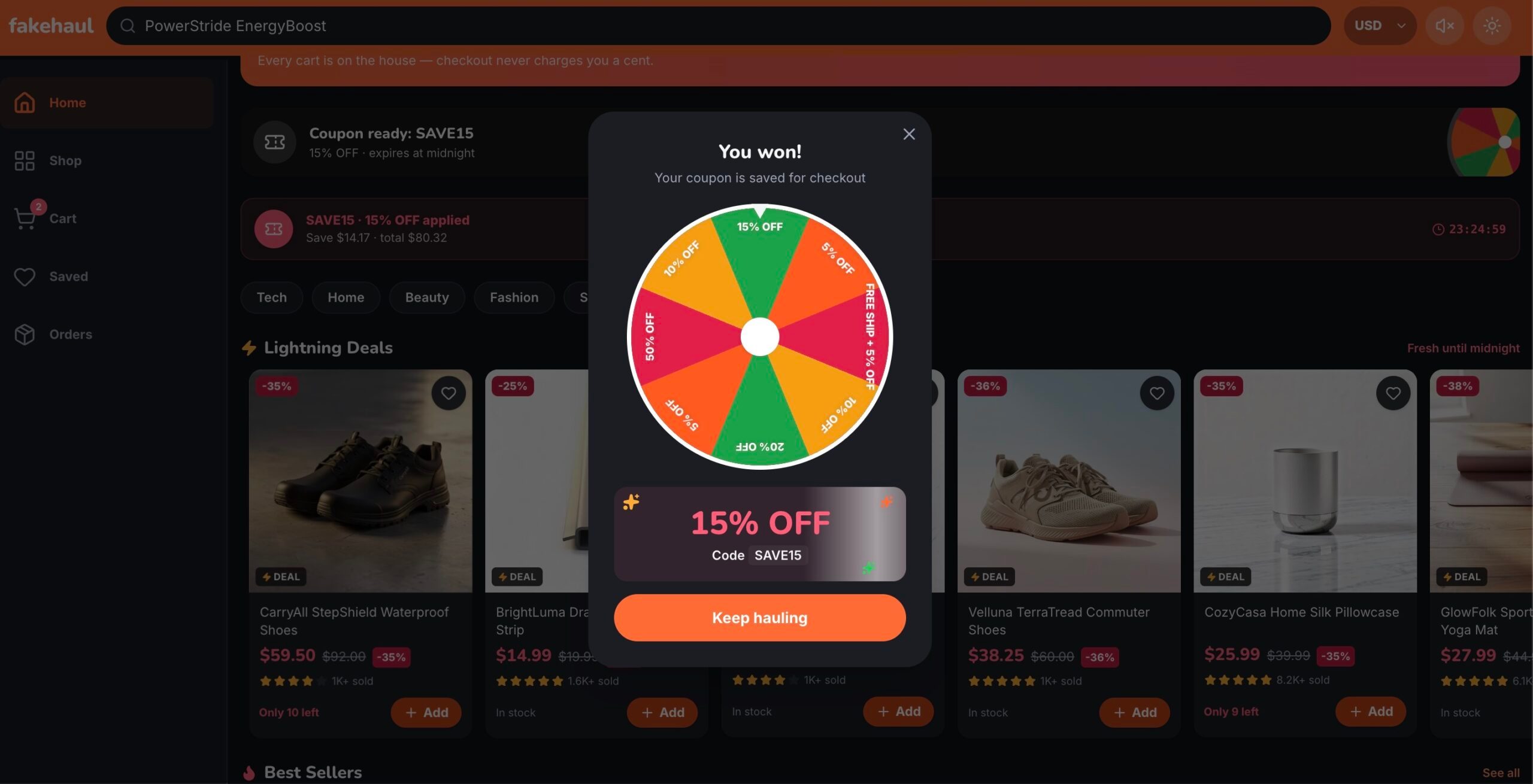
Daily Coupon WheelFakeHaul
Even FakeHaul’s creator admits the line is blurry. Features like a daily coupon wheel could keep people returning, raising the possibility that a tool designed to reduce compulsive shopping could become another engagement loop.
Given how easily my brain fell for the dopamine hit, I don’t think these websites are a cure for impulse spending. But I do think they reveal something about how shopping apps or addictive habits work. Shopping or social media apps basically trigger a psychological loop, and these fake sites just strip the products away, leaving the psychology fully exposed. What is left is a surprisingly entertaining reminder that the biggest reward was never the purchase. It was everything that happened before checking out.
General Motors is making a major change to its electric vehicles: every GM EV for the 2027 model year will get a native North American Charging Standard (NACS) port. Chevrolet, Cadillac and GMC models will all make the switch, allowing drivers to connect directly to compatible Tesla Superchargers and other NACS fast-charging networks without carrying a DC charging adapter.
According to a report by Electrek, the move covers GM’s entire 2027 EV lineup, including the Cadillac Escalade IQ, Escalade IQL, Lyriq, Optiq and Vistiq; Chevrolet Bolt EV, Blazer EV, Equinox EV and Silverado EV; and the GMC Hummer EV Pickup, Hummer EV SUV and Sierra EV.
GM is finally making fast charging less complicated
The change matters because charging standards have been one of the more frustrating parts of owning an EV. Most 2026 GM electric vehicles still use the older CCS1 connector, meaning owners need GM’s $275 NACS DC adapter to access compatible Tesla Superchargers and other NACS fast chargers.
Tesla
The 2026 Cadillac Optiq has already made the transition, while the reborn Chevrolet Bolt, arriving in 2026 as a 2027 model, will also feature a native NACS port. Drivers buying a 2027 GM EV will still need adapters for some older charging infrastructure. CCS1 DC fast chargers will require a separate adapter, while most existing Level 2 charging equipment uses the J1772 connector. GM sells those adapters for $189 and $67, respectively, or $256 as a package.
For anyone shopping for a new GM EV, the native port should remove one particularly annoying piece of equipment from the charging routine. Plugging into a compatible Tesla Supercharger should work without reaching into the trunk for an adapter.
Advertisement
One charging app could make the experience even easier
GM is also trying to reduce the number of charging apps and accounts EV owners have to juggle. Energy Pass is integrated into the MyChevrolet, MyCadillac and MyGMC apps, allowing drivers to register and pay across multiple charging networks from a single account.
Chevrolet
Supported networks currently include Tesla Supercharger, IONNA, Electrify America and ChargePoint, with EVgo planned for later. GM says the combined networks represent nearly 70% of U.S. DC fast chargers. Plug & Charge is also supported at compatible stations, allowing the vehicle to handle authentication while payment is processed automatically. The feature is already live at IONNA and is being expanded to additional networks, including Tesla Superchargers.
GM’s 2027 lineup should make fast charging considerably simpler, particularly for road trips. CCS1 and J1772 adapters will still be worth keeping in the trunk, though. The charging standard may be settling down, but the old infrastructure isn’t disappearing overnight.
Google Workspace is that ubiquitous modern business tool that almost feels invisible. We use it every day here at WIRED, whether that’s for writing first drafts of articles in Docs, analyzing data in Sheets, or sharing files in Drive. And recently, I’ve been using the Gemini AI implementation that’s built right into these tools, which is handy in all sorts of ways.
Google Workspace grants access to all kinds of productivity features that can help streamline processes and increase communication within a team or organization. It’s not free, but here’s the good news: If you’re looking at a Workspace account for yourself (or for your team), Google is offering discounts until the end of 2026 using one of the Google Workspace coupon codes below. You can save up to 14 percent on plans for the first three months, whether you’re signing up as an individual or as a business. Either way, the Google Workspace promo code down below is what you want to use.
If you use Google’s apps and AI, it’s worth looking at this all-inclusive service. We break down the plans and how much they cost.
Save up to 14% Off These Google Workspace Promo Codes 2026
There are some notable differences between each Workspace plan – I’ll dig into them in the next section – but all three plans come with access to the full slate of Workspace apps. You get Gmail, Drive, Calendar, and Meet, of course, but even the cheapest Starter plan includes basic access to Google’s other apps, such as NotebookLM and Gemini inside the Workspace suite. If you want to save, make sure to click one of the promo codes at the top of this page to secure your discount.
Google is making changes to its productivity suite again, and some of it may cost you money. Here’s what you need to know.
What Is the Best Google Workspace Plan?
Google offers four different Workspace plans, though only three are relevant for most people. There’s Starter, Standard, and Plus, as well as Enterprise, which is only available if you contact Google’s sales team. There isn’t a minimum number of users on any of the plans, but the bottom three options (Starter, Standard, and Plus) support up to 300 users. If you need more than that, you’ll need an Enterprise plan.
Advertisement
Although you have access to all the apps regardless of the plan you choose, there are some important differences, particularly between the Starter and Standard plans. Both include secure storage through Google Drive, but Starter comes with 30GB per user while Standard comes with a massive 2TB per user. Plus bumps that up to 5TB per user. Across all plans, storage is in a shared pool, so each additional user adds to the total pool of storage your organization can use.
Gemini is also a big difference between Starter and Standard. Although both have access to the Gemini app, Starter only has Gemini in Gmail and Vids. Standard (and Plus) includes Gemini across the full suite, including in Docs, Sheets, Slides, Drive, Meet, and Chat.
AI can tackle your email mountain so you don’t have to. Here’s how to decide whether Gmail’s new productivity feature makes sense for your workflow.
Starter is a great option for anyone just getting started, regardless of if you’re a freelancer or a small business with a handful of employees. In addition to 30GB per user and limited access to Gemini, Starter comes with a few other limitations. It doesn’t support e-signatures in Docs, nor advanced features of Meet, such as noise cancellation. The bread and butter of Workspace is all here, though. You get a custom domain in Gmail, up to 100 participants in Meet, and the full Google suite of productivity apps.
Standard, as the name suggests, is Workspace proper, and it’s built for teams that need room to grow. That shows up most clearly in storage space, jumping from 30GB to 2TB per user. Standard basically cuts all the red tape on Starter. There aren’t any limitations on Gemini (it’s available across the full suite), Meet features like noise cancellation are available, and you can host up to 150 participants in a Meet call. Standard even comes with expanded access to NotebookLM, Google’s AI-driven note and research tool, with different chat modes and up to 20 generative audio overviews per day.
Advertisement
At the top of the range is Plus, which is focused on larger businesses. You don’t get any extra apps with this plan, but you do get 5TB of storage per user, along with up to 500 participants in Meet calls. The real reason to upgrade to Plus is security and admin controls, however. It includes Vault for data retention, along with LDAP access – basically a server for centralized account management, if you aren’t familiar.
Joshua Kushner’s Thrive Capital has bought roughly $215mn of Amazon shares, disclosed in a regulatory filing on Friday. It lands in the same week the firm told investors it is selling part of its OpenAI stake, in a company Amazon now owns close to 5% of.
Joshua Kushner’s Thrive Capital has bought roughly $215mn of Amazon shares. The position was disclosed in a regulatory filing on Friday. Thrive declined to comment and Amazon did not respond to a request for comment.
It arrives in an awkward week for a clean reading. Thrive’s first formal investor letter, sent days earlier, disclosed that the firm is selling part of the OpenAI stake that has come to define it.
Amazon is now an OpenAI shareholder. It completed a $50bn investment this month for a holding of close to 5%, ahead of the company’s expected listing.
Advertisement
Read together, the two moves look less like a new bet than a change of wrapper. Thrive is reducing an illiquid private position and adding a liquid public one that contains a slice of the same asset.
Amazon holds the other side of the race too. It has funded Anthropic repeatedly, agreeing to put in up to $25bn more in April, and booked a $16.8bn paper gain on that stake in a single quarter.
Underneath both sits the compute. AWS supplies much of the infrastructure the model companies run on, which is the exposure a shareholder actually buys.
The stock has been rewarded for it. Amazon passed $3 trillion in market value this month, the fifth company to manage it.
Advertisement
None of this is a one-off. Thrive put about $100mn into Shopify earlier this year, citing AI tailwinds in e-commerce, and its public holdings already include Figma, StubHub and Oscar Health, the insurer Kushner co-founded.
Kushner set out the logic himself. “Many of our growth-stage companies compete with, partner with, or become the next generation of public technology companies,” he wrote. “The more precise our understanding of public markets, the better our judgment will be in private markets.”
That is a reasonable argument, and it is also a venture firm filing 13Fs. The distinction between backing private companies and trading public ones is getting harder to see, and Thrive is at least doing it where everyone can watch.
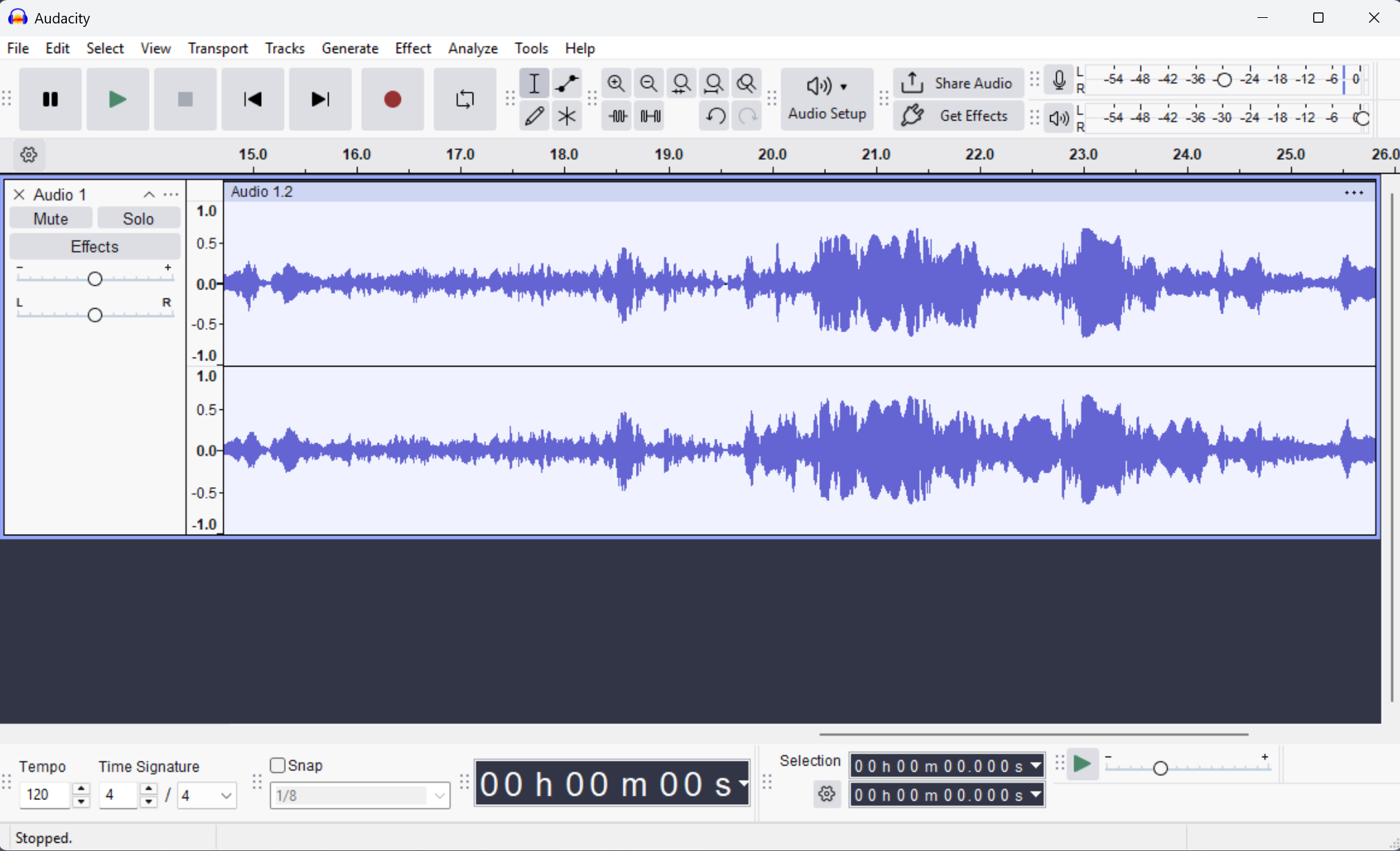
Audacity is a free and open source audio software for multi-track recording and editing. It can record live audio through a microphone, mixer, or digitize recordings from other media. With some sound cards, and on any recent version of Windows, Audacity can also capture streaming audio.
Import sound files, edit them, and combine them with other files or new recordings. Export your recordings in several common file formats.
Is Audacity suitable for recording a podcast?
Yes, Audacity features a large number of effects and preset EQ curves with real time preview. It also lets you import and export WAV, AIFF, AU, FLAC, and MP3 natively. In addition, an auto-duck feature lets you mix different audio tracks or voiceovers for recording a proper podcast.
Is Audacity safe to use?
Audacity is free and open-source software that’s been around for many years, so yes, it’s safe to use. There was some controversy in 2021 after the company was acquired by Muse Group and changes were made to the program’s privacy policy, but thankfully the community’s protests got Audacity back on track.
Advertisement
Does Audacity work on Android or iOS?
No, Audacity is not available for Android or iOS, but WavePad offers similar functionality and is available on mobile for free.
What are the best Audacity features?
Audacity packs several features for recording and editing different type of audio files such as:
100+ sound effects.
Support for 16-bit, 24-bit and 32-bit audio files
Simple audio compressor
A built-in mixer
Plot Spectrum window for detailed frequency analysis
Batch processes for tuning up several audio files at once
What are the best Audacity alternatives?
WavePad and ocenaudio are well known alternatives for recording and editing audio files.
Is Audacity free?
Yes, Audacity is free and open-source. You can use this software for any personal or commercial purpose.
Features
Recording
Advertisement
Audacity can record live audio through a microphone or mixer, or digitize recordings from other media.
Export / Import
Import, edit, and combine sound files. Export your recordings in many different file formats, including multiple files at once.
Sound Quality
Supports 16-bit, 24-bit and 32-bit. Sample rates and formats are converted using high-quality resampling and dithering.
Plug-ins
Support for LADSPA, LV2, Nyquist, VST and Audio Unit effect plug-ins. Effects can be easily modified in a text editor – or you can even write your own plug-in.
Editing
Easy editing with Cut, Copy, Paste and Delete. Also unlimited sequential Undo (and Redo) in the session to go back any number of steps.
Effects
Real-time preview of LADSPA, LV2, VST and Audio Unit (macOS) effects. Plug-in Manager handles plug-in installation and addition/removal of effects and generators from the menus.
Accessibility
Tracks and selections can be fully manipulated using the keyboard. Large range of keyboard shortcuts.
Analysis
Spectrogram view mode for visualizing and selecting frequencies. Plot Spectrum window for detailed frequency analysis. Support for Vamp analysis plug-ins.
What’s New
This is a patch release. It contains the following changes:
#10688 Fixed an exception thrown when pasting into a newly-created track (Thanks, David Bailes (@DavidBailes)!)
#10870, #10884, #10775, #10629 Fixed tone generation, waveform-scale setting, SetClip Name parameter,
and clip-boundary command names for scripting and macros (Thank you, David Bailes (@DavidBailes)!)
#11106 Fixed the loading of presets for the Distortion effect (A million thanks, David Bailes (@DavidBailes)!)
#10947 Fixed paste into an empty audio track not preserving the source sample rate (Thanks, Juan Gabriel Colonna (@juancolonna)!)
#10776 Allowed AltGr modifier in label and clip name editing (Thanks, Davide Peressoni (@DPDmancul)!)
#9938 Added options to choose where silence is truncated (start/middle/end) (Thanks, Noah Rosenfield (@nosenfield)!)
Remember Animusic? They were these incredible animated music videos with original tunes being played by computer-generated robots. Well, the MegCell Pulse might be the coolest robots-playing-music thing we’ve seen since Animusic.
Built by [Bruce] over six years’ time, this futuristic wonder features two robots working in concert to play acoustic guitar, just like a pair of human hands would. You just feed them digital tablature, and off go the fraternal twins, with one doing the fretting, and the other doing the plucking via six individual plectrum. It’s digital music producing analog sound from a physical instrument.
How does MegCell Pulse work? It’s essentially a system of gears, magnetic actuators, and arms, contained in a 3D-printed structure. The only real limitations are that it can’t traverse the entire fretboard, nor can it slide between frets. That said, you can absolutely buy one for your own guitar via [Bruce]’s modestly-goaled Kickstarter.
Advertisement
The kicker here is that you can’t buy an assembled MegCell Pulse; you must print and build it yourself. Back on the upside, the most expensive supporting tier is a mere $100. For that price, you get the complete digital plans. That includes 3D print files, an assembly guide, the control software, and a parts list. Be sure to check out the demo videos embedded after the break.
Google began distributing third-party app stores through its Play Store earlier this week, but not everyone is happy with the company’s approach. The Verge reports that Judge James Donato, the US District Court judge who oversaw the company’s antitrust case with Epic, believes Google has introduced unnecessary “anticompetitive friction” to the download process and has given the company a week to make changes.
The judge took issue with the way Google presents third-party app stores in search results and the current process for installing them from the Play Store. Epic’s lawyers reportedly demoed entering the search term “store for apps,” which turned up no results for app stores and only results for physical stores like Walmart. The lawyers also showed that even if users are able to find third-party app stores, they’re not displayed in the normal list of search results and are instead buried under a banner for third-party app stores. “That is not acceptable, that has to be fixed. I want every possible variation that’s even only 70 percent properly phrased,” Donato said.
Google’s decision to replace the normal “Install” button with a “View” button on the only third-party app store on the Play Store, Aptoide, was also a major point of contention. Donato suggested that making people jump through an extra layer of menus to install the store was discouraging them from downloading it, according to The Verge. In response to Donato’s complaints, Google ultimately agreed to make changes and implement them in the next week.
Advertisement
The company first announced it would support third-party app stores in March 2026, one of several results of a settlement it reached with Epic near the end of 2025. The settlement was a modified version of the remedy Donato came up with in 2024, which largely focused on loosening Google’s control of the Play Store in response to the court finding the company had a monopoly on app distribution in 2023. Clearly Google’s first pass wasn’t loose enough.
Test cricket returns to Sri Lanka after more than a year as the hosts prepare to take on neighbours India in an exciting two-match Test series, starting from August 15 in Galle. For India, more than Sri Lanka, there are crucial World Test Championship (WTC) points at stake.
After losing to South Africa at home, India now need 8 wins out of 9 matches to make it to the WTC final. Sri Lanka, meanwhile, need 6 out of 7 wins to keep their hopes alive, but they also depend on other results.
However, India will be without the services of their ace pacer Jasprit Bumrah, who has sustained an impact injury to his left knee. Sri Lanka, on the other hand, will be without opener Pathum Nissanka and wicket-keeper Kusal Mendis.
Advertisement
The head-to-head record sits heavily in favour of Shubman Gill’s men. India haven’t lost a series against Sri Lanka since 2008. In fact, India last lost a Test match against Sri Lanka way back in 2015. But that was a very different Indian side.
The recent home results against New Zealand and South Africa have left a big question mark on the Indians’ spin-batting capabilities, which will be exactly what the Sri Lankan spinners will look to exploit.
India also got some valuable game time ahead of the series in a three-day practice match against Sri Lanka Cricket XI in Colombo. Devdutt Padikkal made the most of the opportunity, smashing 142, and looks set to be a straight swap for the injured Sai Sudharsan at No. 3.
Read on to find out how to watch the Sri Lanka vs India test series from wherever you are, including free options.
Advertisement
Can I stream Sri Lanka vs India 1st test for free?
Cricket fans in India and Sri Lanka that haven’t yet cut the cord are in luck!
In India, the match is available for free on DD Sports but only for DD Free Dish viewers. DD Free Dish is Prasar Bharati’s free-to-air DTH service that requires a compatible DD Free Dish set-top box and dish antenna.
Likewise, in Sri Lanka, the match is free-to-air on Siyatha TV.
Cord-cutters in Australia, meanwhile, have a sneaky trick they can use to watch the Test match live: Kayo Sports offers a 7-day free trial to new users, letting you catch all five days of action live and free.
Advertisement
Outside any of these countries right now? No worries, you can still stream the action by using a VPN. More details below…
Use a VPN to watch Sri Lanka vs India 1st test from anywhere
If you’re keen to watch cricket but you’re away from home and your preferred coverage is geo-blocked, you could always use a VPN to access it (assuming you’re not breaching any broadcaster T&Cs, of course). You may be surprised by how simple it is to do.
The best VPN right now? We recommend NordVPN – it does everything and comes with a 75% discount, and three months for free.
Advertisement
Quick start: Using a VPN to watch Sri Lanka vs India 1st test from anywhere
Using a VPN is incredibly simple, just follow these steps.
1. Install the VPN of your choice. As we’ve said, NordVPN is our favorite.
2. Choose the location you wish to connect to in the VPN app. For instance if you’re visiting the U.S. and want to view an Australian streaming service, you’d select a location from Down Under (like Perth) from the server list.
Advertisement
3. Sit back and enjoy the action. Head to Kayo Sports and watch Sri Lanka vs India just like you would at home.
How to watch Sri Lanka vs India 1st test live streams in the US
(Image credit: Other)
Cricket streaming service Willow TV is the place to watch the Sri Lanka vs India 1st test in the US.
If you don’t have it as part of your cable package, you can watch Willow coverage through your choice of Sling TV’s Desi Binge Plus or Dakshin Flex plans – starting from $10 per month.
Advertisement
Alternatively, you can add Willow TV to your Prime Video subscription and watch cricket live streams from there.
Outside the US right now? You can make use of NordVPN to catch the action.
How to watch Sri Lanka vs India 1st test live streams in the UK
The first test between Sri Lanka and India will be broadcast on TNT Sports 1 & 4 in the UK, with live streaming available via HBO Max.
Advertisement
HBO Max in the UK starts at £5.99 per month, but you’ll have to get the TNT Sports plan if you wish to stream TNT Sports channels 1 to 4. That costs £25.99 per month for a fixed 12-month contract.
If you’re on holiday outside the UK, you can use NordVPN to access Sri Lanka vs India on HBO Max.
How to watch Sri Lanka vs India 1st test live streams in India
(Image credit: Wikimedia Commons)
In India, Sri Lanka vs India 1st test at Galle is being shown on the Sony Sports Network, with live streaming available via Sony LIV.
Advertisement
Sony LIV subscription plans in India start at ₹599 for the Mobile-Only yearly plan, or you can get the ₹999 Premium yearly plan.
If you’re currently out of India but want to watch the matches live, you’ll need to get yourself a VPN, as per the instructions above.
How to watch Sri Lanka vs India 1st test live streams in Australia
(Image credit: free)
The Sri Lanka vs India test series is being shown on Kayo Sports.
Advertisement
Kayo Sports starts at AU$30 per month after a 7-day free trial. Or you can get your first month for AU$1.
Outside Australia right now? Use NordVPN to access your favorite live cricket streams.
First Test: August 15-19; Galle International Cricket Stadium
Advertisement
Second Test: August 23-27; Colombo (SSC)
What time does the Sri Lanka vs India 1st test match start?
The first Sri Lanka vs India test match starts at 10am IST / 5:30am BST / 12:30am ET every day from Saturday, August 15 to Wednesday, August 19 at the Galle International Cricket Stadium.
We test and review VPN services in the context of legal recreational uses. For example: 1. Accessing a service from another country (subject to the terms and conditions of that service). 2. Protecting your online security and strengthening your online privacy when abroad. We do not support or condone the illegal or malicious use of VPN services. Consuming pirated content that is paid-for is neither endorsed nor approved by Future Publishing.
Bottom line: Anthropic is heading toward a possible October IPO, with many investors telling the Financial Times that they expect the company to reach a valuation of $2 trillion or more. That figure would make it the largest public offering on record and put the company at the top of a market that is becoming increasingly cautious about AI spending and valuations.
The expectations are driven by Anthropic’s rapid revenue growth. Investors expect its annualized revenue to reach $100 billion to $120 billion by the end of 2026. Anthropic said in May that its annualized revenue had surpassed $47 billion.
“If Anthropic is growing 800% a year, you’d think at the incredibly low end they would trade at 30 times [revenue],” one investor in the group told the Financial Times. “That would make them a $3 trillion company.”
Anthropic has not set a public valuation target for the offering. Several investors said senior executives had not shared one privately, either. Still, backers have built their own models based on the company’s enterprise sales growth and the performance of its AI systems.
Advertisement
The company has gained ground against OpenAI and Google this year. Its strategy has centered on business customers, with companies using Anthropic’s models and tools in internal workflows and customer-facing products. Ramp data showed that Anthropic increased its share of US business spending on AI last month.
The same data points to a growing issue for the sector: companies are watching their AI bills more closely. Ramp analysts said businesses were “hitting their limit on AI spend” and shifting some workloads to cheaper systems.
Anthropic’s top model costs more than two and a half times as much to use as OpenAI’s flagship model, according to Artificial Analysis. Chinese open-weight models are considerably cheaper. That price gap matters as companies shift from pilots and small projects to large-scale deployments, where inference costs can rise quickly.
Some customers have already changed their approach. Rather than pushing employees to use the most capable AI tools whenever possible, they have moved certain tasks to lower-cost models. The shift does not necessarily mean demand for frontier systems is falling. It does mean companies are deciding more carefully which workloads require the highest-performing models.
Advertisement
Anthropic filed paperwork with the Securities and Exchange Commission in June. The filing placed the company in a quiet period, limiting what it could say publicly about its financial results. Anthropic declined to comment on the planned offering.
The company has raised just under $100 billion from venture capital firms, sovereign wealth funds, and other institutional investors in 2026. Its valuation reached $965 billion in May, including new investment, when it moved ahead of OpenAI for the first time.
But a public listing would come with risks that private investors have so far been willing to accept. Anthropic has faced pressure from the Trump administration and remains in litigation with the Defense Department, which labeled the company a supply-chain risk earlier this year.
The Commerce Department’s export controls also forced Anthropic to briefly remove its Fable 5 and Mythos 5 models in June. Two investors said the disruption slowed overall revenue growth that month and raised concerns among customers who relied on the models.
Advertisement
The company recovered after that period, according to the investors. Even so, the IPO will test whether public-market investors are willing to place a multitrillion-dollar valuation on an AI company that is growing quickly but operating in a market where pricing pressure, regulation, and competition are all increasing.
“It’s easy to come up with challenges,” said an Anthropic investor who has also backed AI groups including OpenAI and SpaceX, which went public at a $1.77 trillion valuation in June. “But the company continues to be in first position in performance, positioning and what people want exposure to.”






 The submersible itself is slightly positively buoyant. It features two concrete ballasts to adjust the center of gravity and six propulsion motors for six degrees of freedom. It’s powered by a NVIDIA Jetson to allow for autonomous operations and a whole host of sensors. Navigation is handled by a variety of sensors, mostly GPS and SBL. The GPS antenna sits in a radome at the top of the submersible, allowing for a strong enough signal for a positional fix when touching the bottom of the ice. SBL works similarly to sonar, where a transmitter on the submarine sends out an audio ping, received by a trio of hydrophones used to calculate the drone’s position.






















![Who's your favorite girl in Digital Circus? [Money Money Green green meme] #shorts #trend](https://wordupnews.com/wp-content/uploads/2026/02/1771002718_maxresdefault-80x80.jpg)



































You must be logged in to post a comment Login