
Security teams log 54% of successful attacks and alert on just 14%. The rest move through your environment unseen.
The Picus whitepaper shows how breach and attack simulation tests your SIEM and EDR rules so threats stop slipping by detection.



We may receive a commission on purchases made from links.
It’s inevitable that as you go about your lawn-trimming duties, your mower will get dirty. The deck arguably gets the worst of it, with dirt, grass clippings, and all kinds of yard debris caking on it and possibly gumming up the blade’s movement. Fortunately, lawn mower deck cleaning — one of the key steps in maintaining any lawn mower — is not only possible, but incredibly easy to handle at home. With that said, there are tools and equipment that can make it even easier while ensuring your mower’s deck is properly cleaned.
Before diving in, it should be explained why exactly it’s so important to keep a mower’s deck clean. Aside from aesthetics, a clean mower deck is less susceptible to rust and corrosion. Grass clippings and lawn debris stick to the deck largely thanks to accumulated moisture, which will eat away at the mower deck, the blade, and other metal components if left alone. This can also lead to mold growth and restrict airflow while the mower is in use, putting stress on the engine. Additionally, stuck-on deck debris could carry bacteria and fungus that, when exposed to cut grass, could infect and harm your lawn.
To avoid all of these drawbacks, routine lawn mower deck cleaning is essential. To get it done right, these are some of the most useful tools to have in your arsenal.
Before starting mower deck cleaning, you need to prepare the mower for the job. That means disconnecting the spark plug wire to prevent accidental starts and then emptying the gas tank if you haven’t already run it dry. This is essential because tipping a tank full of gas can cause fuel leakage and damage the mower’s internal components. The easiest way to clear out the tank without wasting gas is to use a designated fuel siphon pump, which isn’t hard to find. Better yet, it’s not a terribly expensive tool to get ahold of either, with websites like Amazon offering pumps for less than $10.
With your pump and gas can at the ready, you’re prepared to empty your mower’s fuel tank. For two-hose models, one hose connects to the tank while the other connects to the gas can. As seen above, some utilize a more syringe-like setup with only one hose. With the hose in the gas tank, simply squeeze or lift the handle to draw fuel out. Once the tank is completely drained of gas, you’re safe to remove the hose and close the tank. For syringe models, you can now release the gas into a gas can and subsequently begin lawn mower cleaning.
There are a few ways to remove thick layers of stuck-on debris from a lawn mower deck. For some, one of the most underrated home improvement tools, the simple scraper, is enough to get the bulk off. Meanwhile, others prefer to use the built-in mower deck wash port and let their garden hose do the work. If you really want to get as much caked-on grass off as you can and do so with a bit more ease, you could invest in a designated lawn mower deck scraper. As their name suggests, these scrapers are designed specifically for cleaning mower decks.
The key distinctions that make mower deck scrapers worthy investments are their size and shape. Some offer extended handles to make scraping the deck easier without too much bending or kneeling. There’s often a curvature of some kind to the heads of these scrapers, too, matching the contours of the mower deck to get bits of grass that a regular flat scraper might not reach. These tools range in price: a steel lawn mower deck scraper costs $9.69 on the Walmart website, while the Grass-Hawk dual-bladed mower scraper is on the high end at $19.38 at Home Depot.
With the aid of a scraper, most of the stuck-on lawn clippings will come off the mower deck. Still, this isn’t the end of the cleaning journey. From here, it’s a good idea to use another hand tool to refine your cleaning approach. A handheld wire brush is great for removing layers of dirt and grime that are too thin and stuck-on for a scraper to completely remove. Fortunately, this is another tool that doesn’t cost too much to add to your collection. An example like the Warner brass fine wire brush only costs $4.98 at Lowe’s.
As far as use, a wire brush isn’t difficult to figure out. Being mindful of the mower’s blades, just scrub the brush on the mower deck in a clockwise or counterclockwise direction until it looks nice and clean. To take it a step further, you could invest in an attachable long handle, provided your brush has screw holes or a peg to accept it. This way, you have some added reach and don’t have to get down on your hands and knees to vigorously scrub after every lawn mow. At any rate, don’t forget to clean out the bristles once you’re done to keep debris and bacteria from returning to the deck next time.
Even with the majority of the debris cleared by the scraper and brush, it’s still worth taking one last pass at your mower deck before putting it away. As mentioned, the mower deck wash port can help with cleaning, but there’s another way to use water to your advantage. A pressure washer is a great final method to clear off your mower deck, removing any remaining dirt and grass that somehow made it past the previous two tools. A sufficiently powerful unit for such a task can cost well under $200, include everything you need to get started, and come from reputable brands like Greenworks and Westinghouse. This is a comparatively costly buy, but it gets the job done.
Just as there are pressure-washing mistakes that can ruin a car, there are some missteps to avoid when pressure-washing a mower deck. The biggest is spraying areas that shouldn’t be sprayed, like the engine. Introducing water into these areas can inhibit a mower’s function, creating a bigger issue than a dirty deck. There’s also the concern of too high a PSI, as you just want to clean, not remove paint or otherwise damage parts of the mower. To stay on the safe side, this more light-duty task calls for around 1,300 to 1,800 PSI, with anything over 2,000 moving into risky territory.
For the most part, a scraper, brush, and pressure washer should get just about everything off of your mower deck. With that said, there may be some hard-to-reach places they miss. On top of that, this job makes a mess, leaving you with an unsightly pile of lawn clippings on your driveway. On both fronts, an outdoor blower can make all the difference. Yes, even a cheaper, smaller, battery-powered unit that only costs around $50, like the one from Pulituo on the Walmart website, or the $98.24 Black and Decker unit from Home Depot.
First and foremost, a unit from any of the major blower brands is great for blowing grass and debris from areas on the mower that the other tools couldn’t reach. In fact, the aforementioned Black and Decker model even has a tapered cone for pushing air into small, narrow areas. As far as ground cleanup goes, blowers are generally intended to move grass and leaves off driveways and sidewalks. Of course, if you’re dealing with a pile of thick, wet grass, blowers below 100 mph may struggle. A higher-powered blower over 100 mph could be necessary, or at least some of the grass moved by hand first, with the blower used for a final clean.

Saturday’s rollout of news and trailers at San Diego Comic-Con wrapped up three days of big reveals, and CNET was in attendance to keep up with it all. Marvel’s Hall H presentation was highly anticipated, but there aren’t any new teasers to share.
Still, we want to make sure you’re clued in to all the biggest trailer drops and release dates for upcoming movies and TV shows. Though fans got an early round of official trailers for Clayface, Other Mommy and Avengers: Doomsday ahead of the convention, Apple TV, Warner Bros., Prime Video, Paramount and more studios continued to push out sneak peeks and thrilling teasers for their slates.
What are the must-watch trailers so far? All of them, basically. You can catch Carrie, The Rings of Power, Lanterns, Avatar: Seven Havens and others, and also be sure to scroll through all the SDCC merch reveals that you may’ve missed, too.
Stephen King gave his stamp of approval and is an executive producer for Prime Video’s Carrie TV series that’s set to premiere on Oct. 7. From director Mike Flanagan, the show drops Carrie into a modernized world where cell phones and the internet give bullies a larger audience. But just because the novel took place in 1974 and it’s 2026 now, it doesn’t mean this new take won’t have Carrie’s telekinetic abilities setting things on fire.
When the Earth-heavy Lanters teaser dropped from DC a few months ago, it felt pretty full. There was Kyle Chandler’s Hal Jordan challenging John Stewart’s worthiness to carry a Green Lantern Corp. ring, desert-bound conspiracy vibes, flashbacks to John’s childhood and even a flash of Guy Gardner on screen. DC teased the ring’s powers, but with its new Comic-Con trailer released on Friday, things ramp up when Manhunters arrive on the planet to take out the Lanterns. Take a look at the interstellar enforcers and Sinestro in the trailer, and prepare for the series to land on HBO Max on Aug. 16.
Several years in the making, Blade Runner 2099 will debut on Nov. 25 on Prime Video. The eight-episode limited series is a sequel to the 2017 film Blade Runner 2049 and stars Michelle Yeoh and Hunter Schafer, along with Sheila Atim, Katelyn Rose Downey, Dimitri Abold and Daniel Rigby among the cast.
Set in an alternate version of LA where replicants run things, and the humans play second fiddle, the series sees Yeoh’s replicant Olwen chasing down outlaw replicants who’ve gone missing. With her own shelf life on a ticking clock, the stakes are high for her and for her human fugitive partner, Cora (Schafer).
Remember in the Lord of the Rings trilogy, all that talk of “the One Ring to rule them all?” Well, season 3 of The Lord of the Rings: The Rings of Power is going to be all about that. These episodes take place five years after season 2, and by the looks of things, Sauron’s war with the elves is going strong, and he’s expanded his power across the majority of Middle-earth. Now all Sauron has to do is forge that pesky One Ring so he can, well, rule them all.
Jamie Campbell Bower joins the cast as the elven lord Celeborn, Galadriel’s husband and noble warrior in the fight against Sauron. This season will also introduce Nazgnagôl, better known as the Ringwraiths, in an early form of the corrupted ringholders in the story. The new season debuts on Nov. 11 on Prime Video.
Season 4 of Reacher, which is based on Gone Tomorrow, the 13th book in Lee Child’s hit novel series, finds Jack Reacher traveling from rural America to the streets of Manhattan. Switching gears from previous seasons, the new installment finds Reacher immersed in a political conspiracy, leaving him with few people he can trust.
Stuck on the streets of New York, with the FBI and CIA on the hunt for Jack Reacher, this season finds our hero once again immersed in a mission to bring evildoers to justice. It just so happens that this time, that bad guy is apparently running for president. Alan Ritchson is back as Reacher alongside series newcomers Christopher Rodriguez-Marquette, Sydell Noel, Agnez Mo, Anggun and Kevin Corrigan.
Maria Sten’s Neagley has been one of Jack Reacher’s fiercest and most skilled protégés. Now in her own spinoff show, she’ll be taking shots in the name of justice and ends up uncovering something grimmer than imagined. Season 1 of the action series debuts on Prime Video on Sept. 16.
AMC’s Interview With the Vampire series is poised to slide into its fourth season with a focus on the vampire Akasha and has titled the new season as Queen of the Damned. Season 3 (titled The Vampire Lestat) brought her into the story and introduced actor Sheila Atim as the very first vampire. Atim, along with co-stars Jacob Anderson, Assad Zaman and Eric Bogosian, appeared in Hall H to share the news.
Kids who played with Matchbox cars when they were young grow up and learn their friend is a CIA agent who gets them caught up in a case. That’s the premise of Apple TV’s new comedy film starring John Cena as the spy and Jessica Biel, Teyonah Parris, Sam Richardson and Arturo Castro as said friends. You can stream the movie on Oct. 9.
Apple TV’s sci-fi shows tend to be top-notch, and the cyberpunk-themed Neuromancer looks like it could be a remarkable addition. Callum Turner is Case, a hacker who gets drawn into a dangerous life-or-death game involving espionage, artificial intelligence and deceit. Based on William Gibson’s 1984 novel, the TV adaptation will have 10 episodes and premiere on Jan. 22, 2027.
Formerly shelved by Warner Bros. Discovery, the film is an animation-meets-live-action story that Ketchup Entertainment picked up and will open in theaters on Aug. 28. Fed up with Acme’s unreliable products, Wile E. Coyote decides to hire a lawyer and sue the company. Will Forte plays Kevin Avery, who represents Coyote in his case, with John Cena as Buddy Crane, corporate counsel for Acme. The movie also features Lana Condor along with a host of Looney Tunes characters like Porky Pig, Tweety, Foghorn Leghorn and Granny (who gets dinged by an anvil).
A host of new gods and demigods are set to descend in season 3 of Percy Jackson and the Olympians, including Aphrodite and the children of Hades. The new eight-episode installment will premiere on Nov. 20.
Back in January, Disney Plus gave viewers a tease of what’s to come when it dropped with a scene of Percy (Walker Scobell) and Annabeth (Leah Sava’ Jeffries) hitting the dance floor at a middle school dance. But things get a little darker and more dangerous this time for the Camp Half-Blood kids.
Based on the third book in Rick Riordan’s series, The Titan’s Curse, this season takes Percy and crew on a rescue mission to save the goddess Artemis (played by Dafne Keen). Viewers will be introduced to the titan Atlas (Holt McCallany), Annabeth’s human dad (Jesse L. Martin), and Olympian gods Hera (Ming-Na Wen), Demeter (Jennifer Beals) and Apollo (Hubert Smielecki). Kate McKinnon plays Aphrodite.
Johnny Depp made a surprise appearance at Comic-Con, donning a costume as Ebenezer Scrooge for the upcoming movie, where he plays Charles Dickens’ legendary miser. The film, due in theaters on Nov. 13, also features Rupert Grint, Ian McKellen, Daisy Ridley and Sam Claflin in a star-studded cast.
From the creators of Avatar: The Last Airbender, this new series picks up after The Legend of Korra and follows a pair of twin avatars, one of whom is Korra’s successor. Marked as an omen of destruction during a time when the spirit world and physical world are imbalanced, Pavi — and her sister Nisha — will need to look to the past to discover who they are and find a way to save the Seven Havens. The animated series debuts this fall on Paramount Plus.
Kenji Kamiyama is directing the new anime film from Sola Animation, which will serve as a sort of prequel. Mobile Suit Gundam RG XARX-ZERO takes place about 100 years before Gundam Rogue Orbit, breaking down the origins of the world that fans are familiar with. Guided by Kamiyama’s vision, the 2027 movie will also tie in with a video game universe.
An extended sneak peek for the new season of Regular Show: The Lost Tapes is now out for our consumption. When the show was revived as The Lost Tapes, it gave viewers new adventures with Mordecai and Rigby through the lens of Pops keeping up with them from the afterlife. Well, there are more VHS tapes to dig through when the next season lands on Cartoon Network and HBO Max this September.
HBO Max’s spin-off of The Big Bang Theory follows Kevin Sussman’s Stuart as he tries to undo the damage he caused after breaking one of Leonard and Sheldon’s inventions. A multiversal, reality-hopping, trippy joyride ensues, where viewers see alternate versions of characters they know and much more. The first episode debuted on July 23, but a clip was shared during the show’s Comic-Con panel. You can stream new episodes on Thursdays at 9 p.m. ET.
Apple TV’s panel also included a preview of Dark Matter’s second season, which draws the Dessen family deeper into the mysteries of The Box. Their stability is threatened, as is that of Amanda and Ryan when the series returns on Aug. 28.
During Star Trek’s 60th anniversary celebration in Hall H on Saturday, the crew gave the audience a sneak peek of what’s coming in season 4 of Strange New Worlds.




GitHub and PyPI (Python Package Index) have introduced a time-based mechanism in the Dependabot dependency management tool to protect against supply-chain attacks and to limit their impact.
Specifically, Dependabot comes with a default three-day cooldown setting, while PyPI will reject new files uploaded to releases older than 14 days.
The measure comes after the two development ecosystems experienced multiple high-profile attacks over the past year. Some notable examples include the ‘chalk’ and ‘debug’ attacks, the “s1ngularity” operation, the Shai-Hulud campaign, and the GhostAction supply-chain attack.

GitHub announced last month changes to tackle supply chain threats, and the hardening process progresses with the new measures.
Dependabot is GitHub’s dependency-update service that reads files containing information about new package versions and opens update pull requests to notify software maintainers.
The tool now delays the package update process for 72 hours to reduce the risk of automatically adopting newly published malicious packages.
In many recent cases, malicious npm packages were detected and flagged by security tools within minutes of being published.
However, quick detection alone does not remove the threat, as repository maintainers and vendors must still take action to remove the packages, leaving a window during which developers and projects may download and incorporate the malicious code.
While GitHub explained that the period of three days was chosen as a balanced point between avoiding risky releases while keeping up with the latest upgrades, it noted that users still have the option to configure a shorter or longer delay through Dependabot’s ‘cooldown’ configuration option.
GitHub highlighted Dependabot’s cooldown limitations against longer-term compromise, recommending the use of lockfiles for dependency pinning, restricted-scope tokens, and disabling unnecessary installation scripts in CI.
PyPI announced that it now blocks maintainers from adding new files to a package release after 14 days have passed since its publication.
The measure is intended to prevent attackers who compromise publishing tokens or workflows from poisoning old, trusted releases.
The platform found that only a very small percentage of projects legitimately uploaded more than two weeks after publishing a release.
It should be noted that no known past attacks on PyPI have been confirmed to use the said release poisoning technique that this new measure blocks, but the platform is acting preventatively in this case to block a dangerous possibility.

Security teams log 54% of successful attacks and alert on just 14%. The rest move through your environment unseen.
The Picus whitepaper shows how breach and attack simulation tests your SIEM and EDR rules so threats stop slipping by detection.


Emma Woodhouse discusses her role in manufacturing and supply chain systems, the skills that keep it all moving and how pets have no regard for work deadlines.
Accenture’s Emma Woodhouse, a manufacturing and supply chain systems manager for manufacturing execution systems (MES), specialises in designing and implementing electronic batch records that help improve efficiency, quality and compliance for global pharmaceutical clients, bringing their production processes into the digital age.
“No two days are the same in my role as a manufacturing execution systems designer, which is one of the things I enjoy most about the job,” she told SiliconRepublic.com.
“One thing I’ve learned is that no matter how carefully you plan your day, there is always potential for a new challenge to appear when you least expect it. That’s part of what keeps the role interesting.
“Managing workload requires balancing multiple tasks and deadlines across different projects. Technical documentation, testing activities and troubleshooting are also important parts of the role, helping to ensure that solutions are delivered to a high standard and also perform as expected.”
The nature of MES projects can vary based on the specific requirements of the client. Some projects may be on a large global scale where a client is looking to roll out MES implementation across multiple or all of their manufacturing sites around the world. This presents an opportunity to pursue a standardised approach in terms of the design of the electronic batch records.
These projects challenge me to think creatively about how processes can be simplified, standardised and made more efficient while still meeting the needs of different manufacturing sites. I enjoy working through complex requirements and finding solutions that can be reused and scaled across a wider program.
Alternatively, a project may be on a smaller scale working with one manufacturing site to implement or improve master batch records, often due to a new product introduction, new equipment introduction or some other driving force for process improvement. These types of projects often allow project teams to form a tight-knit group which aids collaboration.
Some of the most rewarding projects have been those where I have been involved from the initial design stages right through to testing and deployment. Seeing a solution go from a concept on paper to a system that is actively supporting manufacturing operations is incredibly satisfying.
My role draws on a combination of technical, analytical and interpersonal skills every day.
Problem-solving and attention to detail are particularly important, as I am often translating complex manufacturing processes into electronic workflows while ensuring compliance with strict quality and regulatory requirements. I also use project management and organisational skills to balance multiple priorities, meet deadlines and co-ordinate activities across different workstreams.
While the technical aspects of MES are important, a significant part of the job involves working with people from different backgrounds and areas of expertise. I regularly collaborate with manufacturing operators, engineers, quality specialists, validation teams and project managers, all of whom may have different perspectives and priorities. Being able to listen, ask the right questions, and clearly explain technical concepts has become just as important as the technical knowledge itself.
Manufacturing environments are constantly evolving and projects can change direction as new requirements emerge. Being able to learn quickly, think creatively and adjust to new challenges has been invaluable.
One of the most challenging aspects of my role is balancing the need for focused, uninterrupted work with the demands of collaboration.
Designing and configuring MES solutions often requires significant concentration, yet projects also involve regular meetings and stakeholder interactions across multiple functions, all of which are essential to delivering the right solution.
To navigate this, I prioritise my workload carefully and try to structure my day around key objectives. I set aside dedicated time for tasks that require focus, while also ensuring I remain available for collaboration and support when needed. Having a clear understanding of priorities helps me stay productive and prevents smaller tasks from distracting me from the most important deliverables.
Maintaining a healthy work-life balance is also important.
Working in a fast-paced industry means there can always be another task to tackle, but I’ve learned the value of stepping away from work and recharging. For me, spending time on my own hobbies such as DIY, coding and music production is a great way to switch off after a busy day.
My three dogs are also very effective at enforcing work-life balance. They have little interest in project deadlines, but they’re extremely committed to their walk and fetch schedules.
Taking that time to disconnect helps me return to work with a fresh perspective and ultimately helps me be more effective in my role.
When I explain my job to friends and family, many are surprised by how digital modern pharmaceutical manufacturing has become. The reality is that technology now plays a central role in ensuring medicines are produced safely, efficiently and consistently.
Historically, many manufacturing processes relied heavily on paper-based documentation and manual data entry. Today, there is a much greater focus on digital systems, automation, data integrity and real-time access to information, which has expanded both the scope and impact of the role.
As technology has advanced, MES designers have become more involved in designing connected, data-driven solutions that support efficiency, quality, and compliance across the manufacturing life cycle. There is also a growing emphasis on standardisation, scalability and leveraging data to drive continuous improvement. This means the role now requires not only technical expertise but also a strong understanding of business processes, regulatory expectations and how different digital systems interact within a manufacturing environment.
One of the most exciting developments has been the increasing use of digital technologies to simplify complex processes and reduce the administrative burden on manufacturing teams.
As the sector continues to evolve, we’re seeing growing interest in areas such as AI-assisted workflows, advanced analytics and greater systems integration across manufacturing operations. These developments have the potential to further improve efficiency, support faster decision-making and help teams extract more value from manufacturing data.
What I enjoy most about my role is the opportunity to solve complex problems and see the real-world impact of the solutions I help create.
I enjoy solving puzzles, and that’s often what the role feels like, except the puzzles involve manufacturing processes, technology, regulations, and occasionally several competing opinions in the same meeting. I enjoy the variety that comes with the role and the fact that there is always something new to learn.
Equally important are the people I work with. MES projects bring together experts from many different disciplines, and I enjoy the collaborative nature of the role. Working with colleagues to overcome challenges, share ideas and deliver successful outcomes makes the job both enjoyable and fulfilling.
Don’t miss out on the knowledge you need to succeed. Sign up for the Daily Brief, Silicon Republic’s digest of need-to-know sci-tech news.

Get caught up on the latest technology and startup news from the past week. Here are the most popular stories on GeekWire for the week of July 19, 2026.
Sign up to receive these updates every Sunday in your inbox by subscribing to our GeekWire Weekly email newsletter.
Rudra “Rudy” Mitra, who led Microsoft’s Purview data-security business, is joining Amazon Web Services as vice president of security services. … Read More
Want to see “The Odyssey” as director Christopher Nolan intended? … Read More
A painting of the short-spined raccoon by prolific Seattle artist Ryan Henry Ward attracted a winning bid of $6,543.21 in an informal Instagram auction this weekend, with all proceeds directed to the Ballard Food Bank. … Read More
Amazon confirmed layoffs in its artificial general intelligence organization, the group behind its Nova models, as the company sharpens its AI focus toward tools for business customers. … Read More
Jimothy, the short-spined Seattle raccoon, has become a global sensation whose likeness has been immortalized in artwork, clothing, songs and tattoos — and now a video game created in the creature’s hometown. … Read More
Hayete Gallot, who rejoined Microsoft in February to lead its security business, is pushing the company toward “agentic security” — systems that spot threats and act on them without waiting for a human. … Read More
Seattle startup Copper is getting a high-profile boost from Grammy-winning artist and entrepreneur Diplo, who has invested in the company as it expands its consumer rewards platform. … Read More
AI infrastructure company Nscale is expanding its presence in Bellevue with a new U.S. … Read More
Amazon is closing its San Francisco AGI site as part of the layoffs it made this week in its artificial general intelligence organization, but said its frontier model research lab will continue. … Read More
Mary Jo Foley is launching a GeekWire series profiling the people and priorities behind Microsoft’s evolution. … Read More

Phone screens are better than they’ve ever been—bigger, sharper, and brighter—but they don’t always offer the best displays for extended reading sessions. If you’ve got a lot of text to get through, you might find yourself turning to a Kindle instead, or even a good old-fashioned physical book.
There are ways to tweak the screen configuration on your iPhone or Android phone, however, to make it more suitable for reading. These changes will reduce the chance of causing you eye strain while minimizing clutter to create a more pleasant reading experience. You won’t transform your phone into something that rivals an e-reader or the printed page, but you can certainly get closer to it.
You’ve actually got more control over the font sizes, styles, and colors used by your phone than you might have realized—you can make text easier to read and create a more Kindle-like experience with just a few taps via the main Settings panel.
If you’re on Android, the menu labels will vary from model to model, but on Pixel phones head to Display size and text. The next screen lets you adjust the size of the default font and other on-screen elements to make text bolder, and there’s also a Dark theme option that you might find reduces eye strain.

Adjusting the font size on Android.Courtesy of David Nield
Over on iOS, open up Display & Brightness from Settings: Here you’ll find a Text Size slider you can adjust, as well as a Bold Text toggle switch. As on Android, there’s a dark mode option here via the theme selector at the top of the screen—select Dark to dim the colors all across the iOS interface.
Both Android and iOS also have a night reading mode that reduces the blue light emitted from your phone and makes the whole display warmer—which should make for a more pleasant reading experience. On Android Pixel phones, choose Display and touch > Night Light from Settings, and on iOS pick Display & Brightness > Night Shift. In both cases you can enable the feature manually or via a schedule.
Much of the reading you’re going to be doing on your phone will be through its web browser, and most modern mobile browsers come with a dedicated reading mode you can use. These modes will reduce onscreen clutter, simplify the color scheme, and bring the main article text to the fore.
If you’re using Google Chrome as your default browser on Android, tap the three dots (top right), then Show Reading mode to switch views for the article you’re currently reading. Swipe up on the panel at the bottom of the screen to change the font and color options. Tap the reading mode icon (just to the right of the address bar) to return to the normal browser view.

The exciting part of buying a ‘broken, for parts’ off a site like EBay is that you rarely know exactly just how ‘broken’ it truly is. Even if the seller insists that it’s thoroughly buggered, you just might be able to eke out a fix with some out-of-the-box thinking and plucky ingenuity. Such was the case for [Dieter Vansteenwegen] who gambled on a cheap Canon 7D Mark II DSLR body that was sold for a mere €180 on account of broken condition.
 After confirming that the DSLR’s condition was basically as described by the seller, with nothing on the LCD or HDMI output and the auto-focus not working while partially pressing the trigger button, but still taking a picture when fully pressed. Sometimes it would also show a standard maintenance message on the LCD, so clearly it ought to be working. Maybe the camera’s processor was just being chronically unhappy about something, in which case an easy fix might be possible.
As anyone who has ever taken a digital camera apart knows, you do not simply pop them open for a quick look. Somewhere in the nightmarish contraption of flatflex cables, PCBs and endless sub-assemblies there might be a fault, but where to start? Fortunately with some support from the custom Canon firmware community Magic Lantern and the website Photo Parts UA for reference images he was able to start tracing a number of pertinent signals.
With the auto-focus hint as guide, this was traced back to the MPU, which turned out to have a floating signal on the auto-focus pin that got interpreted as ‘active’. Likely the internal pull-up got damaged due to the use of an external trigger module as there’s no real protection on these lines. One bodge wire later to create an external 3.3 V pull-up the DSLR happily sprung back to life.
In terms of parts this definitely was a cheap repair, but it comes with the prerequisite of having the skills and equipment to perform said repair. Still, massive props and congratulations to [Dieter] for saving this DSLR from being merely a device to be picked over for parts.

After OpenAI recently admitted that one of its models had breached the systems of AI platform Hugging Face, Hugging Face’s CEO Clem Delangue posted on X that he was flying to San Francisco to have “a little chat with that ‘rogue agent.’”
Then, in a follow-up post on Saturday, Delangue outlined what he’d asked for from OpenAI. He said he called for “radical transparency,” asking OpenAI to “release the traces from the ‘rogue’ agents so the entire research community can study what happened.”
And he also wants “more capabilities for defenders,” calling for OpenAI to commit $100 million worth of computing power “to help the Hugging Face community build powerful cyber defenses with the best open and closed models.”
Delangue added, “The first autonomous agent cyberattack is an unprecedented event. It deserves an unprecedented response!”
Despite the autonomous nature of the attack, cybersecurity experts suggested that it could also be blamed on human error — namely, OpenAI’s apparent failure to properly configure what should have been a fully isolated testing environment.


Security
(Security) hole-ier than thou
Click To Pray, a prayer app endorsed by the Pope with hundreds of thousands of users worldwide, has leaked people’s names and email addresses for months – or longer – according to an ethical hacker who said she found and reported the security vulnerability six months ago to no avail. This app needs to take a vow of silence when it comes to your personal information.
The app, available in seven languages and on iOS, Android, and clicktopray.org, is the official app of the Pope’s Worldwide Prayer Network. It connects users across the globe to pray for the Holy Father’s intentions, and as of July 2026, it has 719,517 registered accounts.
It’s also very leaky, according to security sleuth BobDaHacker, who says she spotted and disclosed the vulnerability to the Pope’s Worldwide Prayer Network on January 3.
“The vulnerability is still live,” the hacker said in a Friday blog. “Nobody has ever responded. I guess my email wasn’t in their prayers.”
The Reg readers likely remember BobDaHacker for her previous research exposing a free-food flaw in McDonald’s ordering system and open controls on Chinese robot manufacturer Pudu Robotics.
This latest security hole stems from an Insecure Direct Object Reference (IDOR) bug in the prayer app. This is a very common and easy-to-exploit type of flaw that occurs when a website or an app blindly accepts user-provided input to view or modify resources without checking to see if the user is actually authorized to retrieve the data.
“You ask for your own data, the server gives it to you,” BobDaHacker explains. “You ask for someone else’s data, the server gives you that too. Thou shalt not authorize, apparently.”
When you sign up for a Click To Pray account, the app assigns you a sequential numeric user ID. As BobDaHacker uncovered, the API endpoint GET https://api[.]clicktopray.org/user/users/{id} will return user data for any account – not just your own account – so long as you supply a valid, five-digit user ID.
It doesn’t perform any authorization check or ownership validation. “Just increment the number and get someone else’s data,” she wrote.
This data includes users’ email addresses, first and last names, country, dates of birth, and whether the account has been deleted, and the API exposes all 719,517 accounts on the prayer site. “With sequential user IDs and no rate limiting, an attacker could enumerate every single account on the platform,” the hacker explained. “One GET request per user. for i in range(1, 719518): scrape(). That’s it. That’s the exploit.”
As BobDaHacker points out, many of these users are likely older individuals, not all that tech savvy, and very trusting of anything Vatican related, making these exposed accounts a “phishing goldmine.”
“Imagine getting an email that says ‘The Holy Father requests your urgent attention’ with a Vatican-looking link,” she wrote. “Grandma is clicking that. Every time.”
And then it gets even worse.
The signup endpoint, POST https://api.clicktopray.org/user/users/sign-up, returns the account’s validation_hash directly in the response body, and that value is the same UUID used in the email verification link. This means someone could sign up using any email address and verify the account before the confirmation message reached the inbox.
Plus, BobDaHacker’s email client flagged the real verification email with a warning that it had failed the domain’s authentication requirements and might have been spoofed or improperly forwarded.
“So not only is the API leaking 700,000 email addresses that could be used for phishing, but the real emails from Click To Pray already look like phishing,” the hacker noted. “An attacker wouldn’t even need to try hard. They could send a pixel-perfect phishing email and it would have the same level of email authentication as the real thing: none. God works in mysterious ways.”
The Register reached out to the Pope’s Worldwide Prayer Network and did not receive any response. BobDaHacker says she’s still praying for one, too.®

Your battery is continually losing charge.

Even though smartphone batteries are getting bigger and more efficient, there’s always that inevitable event when you get a low battery notification at the worst possible time. You might think powering down the phone entirely is a way to make your smartphone last longer. But like with any battery-powered device, a phone’s battery will slowly deplete when you’re not actively using it, and even when it’s completely powered down.
Of course, the battery drains much more slowly when turned off, so it’s not a bad idea to power down the phone to conserve battery. That might be before a plane takes off, for example, and you want to ensure you have power when you arrive at your destination. If you leave an old phone in a drawer for weeks or months then decide to use it, however, you’ll find that the battery isn’t still at the same percentage it was when you left it.

Why does this happen? One thing that draws battery from your phone while it’s off is a clock-and-wake circuit, which uses a tiny amount of current so that the power button responds when you want to turn it on and so the phone immediately knows the right time and date once it boots back up. But the biggest battery drain is something called a self-discharge, a chemical release of the lithium-ion batteries used in phones. The battery will lose about 1-2 percent of its power every month or so when turned off. If you store it in a spot that’s above room temperature, it will deplete even faster than that.
If you leave the phone on and don’t use it, the battery will logically drain much more quickly. I have left Android phones I’m testing untouched for up to a week, for example, and they easily go from about half charge to completely dead in that time. That said, if you’re giving a phone a break, it’s still a good idea to power it down completely. While there’s still that self-discharge, it will be much slower than if you leave the phone on. When the device is on, the screen lights up for notifications, the radio remains active and latched onto signals, and background apps are using power.

If you plan to keep a phone tucked away long-term, like if you upgraded and you’re waiting for your pre-teen to become of age so they can use it, it’s wise to keep the device charged consistently to avoid damage. Apple recommends not fully charging your phone before you put it away for an extended period, suggesting you charge an iPhone only to about 50 percent. Then recharge it every so often (Apple recommends every six months) so it’s always topped up and not lying completely dormant.
This prevents something called a deep-discharge state, which can happen when a device’s battery has been completely dead for a long period of time. If it gets to this point, the phone’s battery’s copper current collector can dissolve, redeposit, and permanently impact the phone’s battery capacity, or even potentially cause a short circuit. At the very least, the loss in battery capacity means the phone wont last as long per charge going forward.
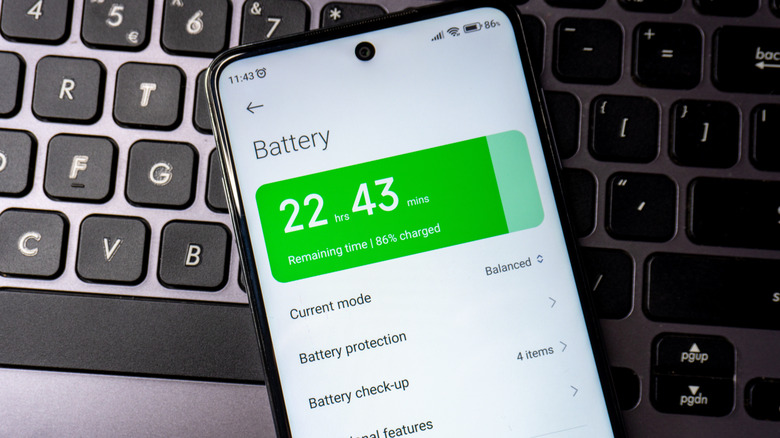
To recap, if you’re storing a phone, power it down when the battery is at about 50 percent and charge it back up to this point at least every six months. Most importantly, don’t throw it in a drawer completely dead nor fully charged. Don’t forget to store it in a cool, dry place with temperatures below 90°F.
All that said, leaving a phone lying around for months isn’t a total death sentence. I have left some of the best Android phones released over the last five years powered down for months and charged them for comparative reviews. They work fine even if the battery capacity isn’t as good. I even recently found an old BlackBerry PlayBook tablet that hadn’t been booted up since 2011. I plugged it in and it successfully charged and works! But it’s clear the battery life has lessened as it barely lasts a day before I need to recharge it.
The bottom line is that if you power down your phone, it won’t have the same charge state when you power it back up, especially if weeks or months have gone by. It might still show the same battery percentage if you’ve only powered it down for a 12-hour flight, but the battery is still draining through self-discharge and the clock-and-wake circuit, albeit so slowly you won’t notice after such a short period of time. However long you turn off the phone, powering down doesn’t mean the phone’s battery is completely on pause until you use it again. But it can help conserve what battery life you have left in a pinch.


For most owners, keeping a vehicle ultra-clean isn’t an easy task. Nonetheless, the health benefits of having a car that’s free from germs are inarguable. Hyundai and Kia just unveiled new technology that aims to help make eliminating those germs a lot easier.
The carmaker is calling the technology “Plasma Care UVC,” and it uses far-ultraviolet C light with a wavelength of about 200-230 nanometers to sterilize a car’s cabin. UV sterilization devices are not new, but traditionally, some use UV light of a slightly longer wavelength than Hyundai’s new system. As a result, they have the potential to cause skin and eye damage if a human is exposed to them.
Hyundai says the far-UVC light it is using in its new technology won’t cause damage, since the light doesn’t penetrate human skin. However, it does still penetrate into bacteria and viruses, making it an effective way to sanitize a car even when the driver and passengers are present.
Although this is the first time that far-UVC light sanitizers have been fitted to a vehicle cabin, similar systems that use the same wavelength of light are already used to clean rooms in healthcare settings like hospitals, as well as sanitizing hotels and classrooms.
Hyundai says that its engineers encountered several challenges when trying to make the system work in cars, with one of the biggest being that the existing systems were simply too big to fit. Its team had to develop a new, miniaturized version of the system, as well as fitting an optical filter to ensure that no UV light of a harmful wavelength was emitted.
To test that the system worked as intended, the carmaker fitted it to a PV5 minivan. This model in particular was picked because it can be used for a range of different transport jobs, shuttling both passengers and cargo to their destinations.
Following the initial successful tests, Hyundai said that its technology could potentially be applied to autonomous vehicles and PBVs, a term that it has previously used to describe its modular electric vehicles that can be designed for a specific job. It gave the examples of school minibuses and food selling vehicles as two instances where sanitizing technology might be especially useful.
As appealing as the new technology might sound to germaphobes, it isn’t available to the general public just yet. Hyundai has not given a timeframe for when the UV sanitizers might launch in its production vehicles, saying only that it needs to conduct more safety and technical validation tests before it gives them approval for production.




Weekend Open Thread: Brooks Brothers


Grayscale Files For Worldcoin ETF, WLD Registers Sharp Rise


Sail Virtually Aboard The “Itanic” With IA-64 Emulator

Turtle Beach Command Series KB7 review: a nifty screen-equipped gaming keyboard


Unregistered fitter used Gas Safe logo on business flyers

New Jersey voter registration controversy explained: How 6,600 noncitizens got on the rolls, and what happens next

Johnny Depp’s R-Rated Gothic Cult Classic Gets New Release Ahead of Sydney Sweeney Remake


Watch Flock Safety CEO Garrett Langley discuss the future of surveillance at TechCrunch Disrupt 2026


Ethics, other provisions in crypto Clarity Act to be further discussed

Shanghai science forum photos show China’s AI and robotics advances in rivalry with US


Circle’s President Sold Over 360,000 Shares, The Filings Explain Why


Subway Sandwich Computers Get a Second Life as Gaming Machines


The Peugeot Family: How 200 Years of an “Old Money” Dynasty Died in A Boardroom


2026 3M Open leaderboard: Scottie Scheffler finds putter in Round 1, sits three back


How To Use Claude’s Reflect Dashboard And Learn When It’s Time To Touch Grass


16 Dresses for the High Summer Event


Stephen Colbert Returns to Social Media After Late Show End


The 35 Best Board Games for Family Game Night


Andrew Cuomo joins OKX board as crypto exchange expands in U.S.


Spain sweeps the board at 2026 World Cup with individual awards











You must be logged in to post a comment Login