Tech
A lawsuit says Oura’s sleep stages are AI guesses with a coin flip’s odds

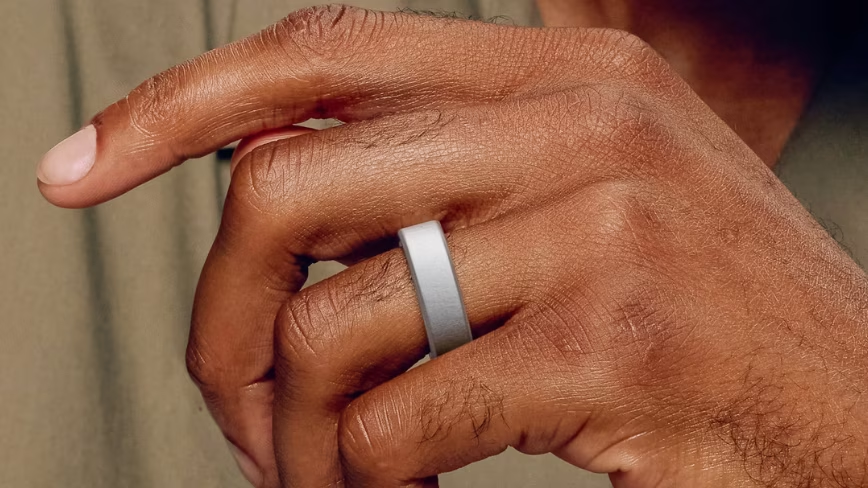

A proposed class action filed in San Francisco alleges Oura’s sleep staging is generated by AI estimates rather than measurement, and names Finnish parent Oura Health Oy as a defendant. Oura says it stands behind its science and accuracy claims.
The number Oura puts on its own product pages is now the subject of a lawsuit. A proposed class action filed in the Northern District of California alleges the company’s sleep tracking cannot support its accuracy claims, and names both Oura Inc. and its Finnish parent Oura Health Oy as defendants.
The disputed line is specific. Oura has advertised “95% Sleep Staging Accuracy compared to clinical sleep lab,” which the complaint argues a finger-worn device cannot substantiate.
The physical argument is the core of it. A polysomnography sleep study measures brain activity, eye movement and muscle tone through electrodes, none of which a ring has.
The filing’s language is not restrained. It describes Oura’s sleep stages as “AI-generated guesses” with roughly “a coin flip’s chance” of being right.
It leans on published research for that. The complaint cites a study of 45 patients that found overall sleep stage classification accuracy of 53.18%, with REM sleep overestimated by an average of 31.56 minutes.
Oura rejects the characterisation. “We stand behind our science, research, and accuracy claims,” a spokesperson said, adding that its sleep staging has been compared favourably against polysomnography in multiple studies.
The case carries seven counts, including fraud by misrepresentation and breaches of California’s Unfair Competition Law and False Advertising Law. Alongside damages, it asks for a corrective advertising injunction requiring prominent disclaimers.
The timing is the uncomfortable part. Oura filed confidentially for a US initial public offering in May, after reaching an $11bn valuation that made it Europe’s most valuable consumer health hardware company.
Europe has an interest here beyond ownership. The same 95% figure is marketed to European buyers, where the Unfair Commercial Practices Directive prohibits misleading claims about a product’s main characteristics and about “the results and material features of tests or checks carried out on the product.”
Until recently that mattered less in practice. Since June 2023 the Representative Actions Directive has let designated consumer bodies bring collective redress actions across the EU, and unfair commercial practices sit in its annex.
Oura knows the machinery from the other side, having sued a rival over its own patents. Whether any European consumer organisation picks this up will say more about the new redress regime than about the ring.
You must be logged in to post a comment Login