Tech
A rethink for China’s carmakers as regulators tell them to fix quality, not add features

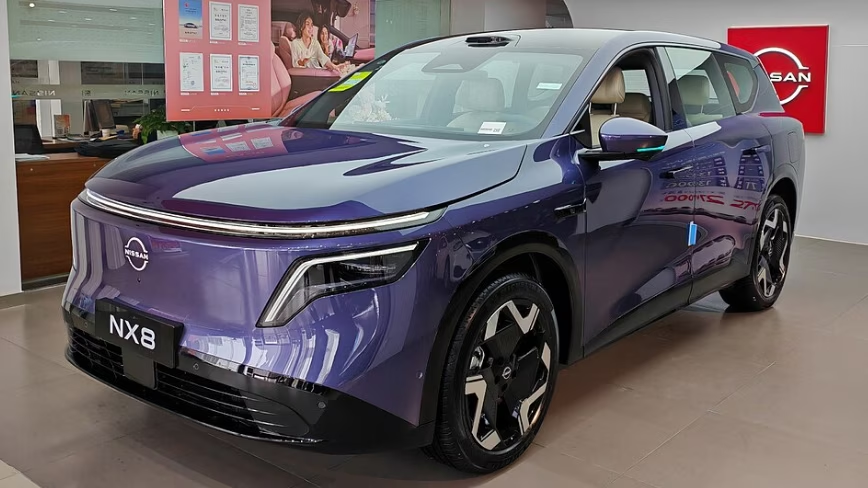

Four Chinese ministries have begun a yearlong vehicle quality campaign that bars carmakers from changing technical parameters through over-the-air updates after test samples are sealed, with penalties including suspension from the product catalogue. A separate mandatory standard requires physical controls for 19 functions from July 2027.
Four Chinese ministries have launched a yearlong inspection campaign covering intelligent connected vehicles. It began on 27 August and is about build quality and conformity, not new technology.
The clause worth reading twice concerns software. Carmakers may not alter a vehicle’s technical parameters through over-the-air updates once test samples have been sealed, CnEVPost reported.
That closes a specific gap. A car can be approved in one configuration and delivered in another, with nobody retesting it.
The penalties are administrative rather than financial. Public naming, suspension from the product catalogue, and a bar on filing new models.
The timing follows a difficult month. China’s market regulator oversaw the recall of four million cars whose interior emergency door releases were hard to find in the trim.
Inspectors will test structures, crash performance, battery packs and electrical safety. Some samples will be cross-checked against what the manufacturer submitted.
A separate standard goes further on hardware. GB 4094-2026 requires physical controls for 19 functions, among them gear selection, wipers, hazard lights and the switch that turns driver assistance off.
The requirements are unusually prescriptive. Each control needs a surface of at least 10mm square, a fixed position, and it has to work when the power does not. New model applications must comply from July 2027, and models already approved from January 2028.
Europe reached a version of this first and stopped shorter. Euro NCAP’s 2026 protocol asks for physical controls on five functions, being indicators, hazard lights, horn, wipers and the emergency call.
The difference is what happens if you ignore it. In Europe a carmaker loses a star, and in China it loses the right to sell the model.
Europe’s binding rules sit elsewhere. The general safety regulation and the UN software update rules apply to every car registered in the EU, and neither mentions buttons.
On updates the two are diverging. European rules ask a manufacturer to assess whether an update changes what was approved, and the Chinese campaign says do not change it.
Which is the reversal worth noting. The market that built its industry on screens is legislating them back, and Europe is still asking nicely.
You must be logged in to post a comment Login