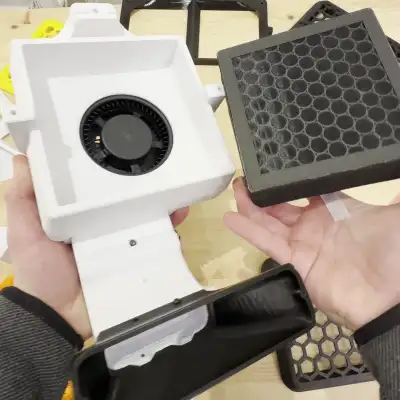
3D printing has had its time to spread its wings into the everyday home, yet many of those homes lack the proper ventilation to prevent the toxic VOCs from escaping. Because of this, [Clura] has put together an entire open-sourced smart enclosure for most open concept printers.
While certain 3D printers or filament choices lend themselves to being worse than others, any type of plastic particles floating around shouldn’t find their way into your lungs. The [Clura] enclosure design includes HEPA and carbon filters in an attempt to remove this material from the air. Of course, there’s always the choice to have a tent around your printer, but this won’t actually remove any VOCs and air located inside a simple enclosure will inevitably escape.
What makes this enclosure different from other, either commercial or open-source designs, is the documentation included with the project. There are kits available for purchase, which you may want for the custom PCB boards for smart features such as filament weighing or fume detection. Even still, if you don’t want to purchase these custom boards the Gerber files are available on their GitHub page.
Advertisement
As smart as this enclosure is, it still won’t fix the issues of what happens to the toxins in your print after it’s done printing. If you are interested in this big picture question, you are not alone. Make sure to stay educated and help others learn by checking out this article here about plastic in our oceans.
The Oscars remain the ultimate prize in Hollywood. It’s the award Leonardo DiCaprio chased for decades before finally winning, the stage where Matthew McConaughey’s heartfelt “three things every day” speech moved audiences around the world, and the moment where stars, both new and established, find true validation. And in 2026, the competition for the golden statuette looks fiercer than ever.
Leading the battle are the Best Actor nominees, including Timothée Chalamet for Marty Supreme, who has perhaps been the most vocal about his chase for greatness. But he faces some formidable competition, including Leonardo DiCaprio for One Battle After Another and Michael B. Jordan for Sinners.
On the actresses’ side, Emma Stone for Bugonia is widely considered the favourite, though Jessie Buckley delivered an equally compelling performance in Hamnet. In fact, it was a surprise that her co-star Paul Mescal did not receive a nomination.
Advertisement
The Oscars 2026 ceremony will air live in more than 100 countries around the world. But some lucky viewers – in the UK and Australia, as well as in the US through a few sneaky methods – can watch the entire three-and-a-half-hour spectacle completely free. Read on to find out how…
How to watch the 2026 Oscars for free
Audiences in the UK and Australia have the easiest way to watch the 2026 Oscars live for free. The ceremony streams on free platforms in both countries.
Away from home? Use a VPN to access your local streaming services from anywhere in the world.
Use a VPN to access the 2026 Oscars from anywhere
NordVPN is our best VPN (we actually have our own in-house expert, Mike, who tests VPNs 24/7 and he rates NordVPN top for price, streaming, security, etc).
Advertisement
Nothing works as well as Nord when it comes to unblocking streaming services – so you can access your favorite Oscar 2026 live streams from anywhere!
Quick start: Using a VPN to watch the 2026 Oscars free
2. Connect to a server based in your home country where the ceremony is free to watch, such as the UK, Australia, or even the US.
3. Fire up ITVX, 7plus, or a US free-trial streaming service of your choice, such as Hulu or YouTube TV.
5. Watch the 2026 Oscars on streaming without cable TV, from anywhere, for FREE.
Advertisement
When will the 2026 Oscars take place?
The 98th Academy Awards will take place on Sunday, March 15, at the iconic Dolby Theatre at Ovation Hollywood in Los Angeles. The ceremony will begin at 7pm ET / 4pm PT, with the show expected to run for around three and a half hours.
Who will host the 2026 Oscars?
Conan O’Brien has been confirmed as the host of the 98th Academy Awards for what will be his second consecutive year.
Advertisement
Oscars 2026 nominations
Category 1: Actor in a Leading Role Timothée Chalamet, Marty Supreme Leonardo DiCaprio, One Battle after Another Ethan Hawke, Blue Moon Michael B. Jordan, Sinners Wagner Moura, The Secret Agent
Category 2: Actor in a Supporting Role Benicio Del Toro, One Battle after Another Jacob Elordi, Frankenstein Delroy Lindo, Sinners Sean Penn, One Battle after Another Stellan Skarsgård, Sentimental Value
Category 3: Actress in a Leading Role Jessie Buckley, Hamnet Rose Byrne, If I Had Legs I’d Kick You Kate Hudson, Song Sung Blue Renate Reinsve, Sentimental Value Emma Stone, Bugonia
Category 4: Actress in a Supporting Role Elle Fanning, Sentimental Value Inga Ibsdotter Lilleaas, Sentimental Value Amy Madigan, Weapons Wunmi Mosaku, Sinners Teyana Taylor, One Battle after Another
Advertisement
Category 5: Animated Feature Film Arco Elio KPop Demon Hunters Little Amélie or the Character of Rain Zootopia 2
Category 6: Animated Short Film Butterfly Forevergreen The Girl Who Cried Pearls Retirement Plan The Three Sisters
We test and review VPN services in the context of legal recreational uses. For example: 1. Accessing a service from another country (subject to the terms and conditions of that service). 2. Protecting your online security and strengthening your online privacy when abroad. We do not support or condone the illegal or malicious use of VPN services. Consuming pirated content that is paid-for is neither endorsed nor approved by Future Publishing.
Here come the literal fun police. A newly proposed House Resolution, H.R. 3385, would no longer classify three-wheeled autocycles (not to be confused with trikes, like the Harley-Davidson Freewheeler) as motorcycles in the United States — or a car. This would leave autocycle owners in a challenging position when it comes to vehicle registration. It could even make them entirely illegal.
H.R. 3385 was introduced by Representative Derrick Van Orden earlier in 2026 in an attempt at narrowing down the definition of the term “motorcycle.” If the bill passes, it would exclude three-wheel vehicles from this category since it states that motorcycles must be steered with handlebars, not a steering wheel. The bill defines a motorcycle as a vehicle with a seat or saddle, with no more than three wheels, and steered by a handlebar. This definition would go into effect within 120 days of the bill’s approval.
However, these autocycles are already not allowed to be registered as cars since they are short one wheel, according to the federal definition of a “car.” This would leave owners of popular autocycles like the Polaris Slingshot and Vanderhall Venice in a pretty tough predicament, so advocates are fighting back.
Advertisement
Motorcycle community fights back against H.R. 3385
Sandi Smolker/Getty Images
The Motorcycle Industry Council has formally opposed H.R. 3385, writing a letter addressed to the House Energy and Commerce Subcommittee. Without a separate category for autocycles, this new bill would remove this special vehicle type from registering as a motorcycle and as a car. At that point, it would be illegal to register them — and maybe sell them.
In the January 2026 letter, the Council explained why placing autocycles in a “classification limbo” would be harmful. First, H.R. 3385 would cause conflict between the federal law regarding motorcycles and some state laws. The Motorcycle Industry Council claimed this would “throw state laws into chaos” since many states rely on the federal definition of a motorcycle to set their own laws.
Advertisement
Second, the bill would eliminate the entire autocycle market, causing many manufacturers in the United States to go out of business. Plant closures would also lead to layoffs, cut skilled jobs from the market, and damage dealership revenue. Wrote the Council: “We respectfully urge you to protect American innovation and jobs that support the manufacturing sector and oppose H.R. 3385. We believe that regulatory clarity should support market growth, not act as a ‘death knell’ to a thriving sector of the powersports industry.”
Security cameras flood store shelves, but good 4K options are few and far between, especially if you’re on a tight budget. Wyze changed that with the Cam Pan v4, priced at $46 (was $60), the first of their cameras to record in Ultra HD (3840 x 2160 quality). This update makes a significant impact; the footage is significantly crisper than what you get with most inexpensive pans. Zooming in on details such as a face or a license plate creates a completely different image. That is especially true in retrospect.
Full 360-degree pan and 180-degree vertical tilt allow you to capture the entire room or a huge outdoor area in one image, whether inside or out. You can operate it all from the Wyze app, configure it to sweep around automatically, or track any movement that occurs. An enhanced CPU with its own AI technology makes following people, pets, cars, and other objects appear silky smooth and decreases the quantity of information that slips through the net.
4K Ultra HD Clarity with 360° Pan and 180° Tilt Coverage – Experience crystal-clear monitoring day and night with a wide field of view and remote…
AI-Powered Motion Tracking for Pets & People – Next-gen CPU with integrated NPU enables faster processing and enhanced AI capabilities. Automatically…
Robust Indoor/Outdoor Durability – Place your camera in or out, right-side up, up-side down, with an IP65 weather rating, this outdoor security camera…
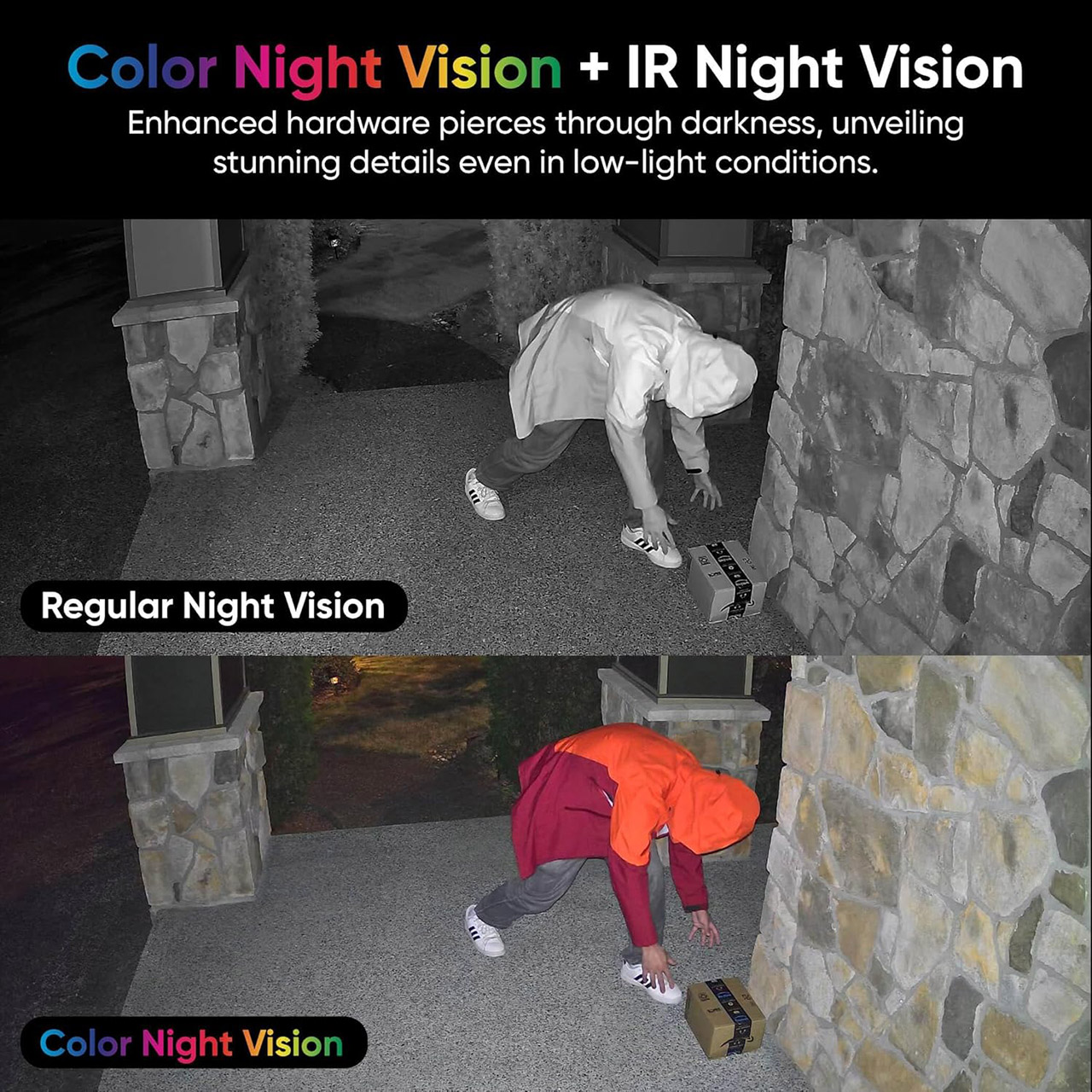
Color night vision is a big plus in low-light situations, as it converts to IR and goes black and white when necessary, but a built-in spotlight kicks in to provide some color detail if something gets close, with a brightness of up to 60 lumens. The footage stays clear at night, allowing you to see what’s going on without being washed out.
Advertisement
Both 2.4GHz and 5GHz Wi-Fi networks are supported (including Wi-Fi 6, which provides a more robust connection over longer distances). The app makes setup simple, and it works as well indoors and outdoors, thanks to its robust IP65 weather rating. It has a plug-in power supply and no battery, which is good and straightforward.
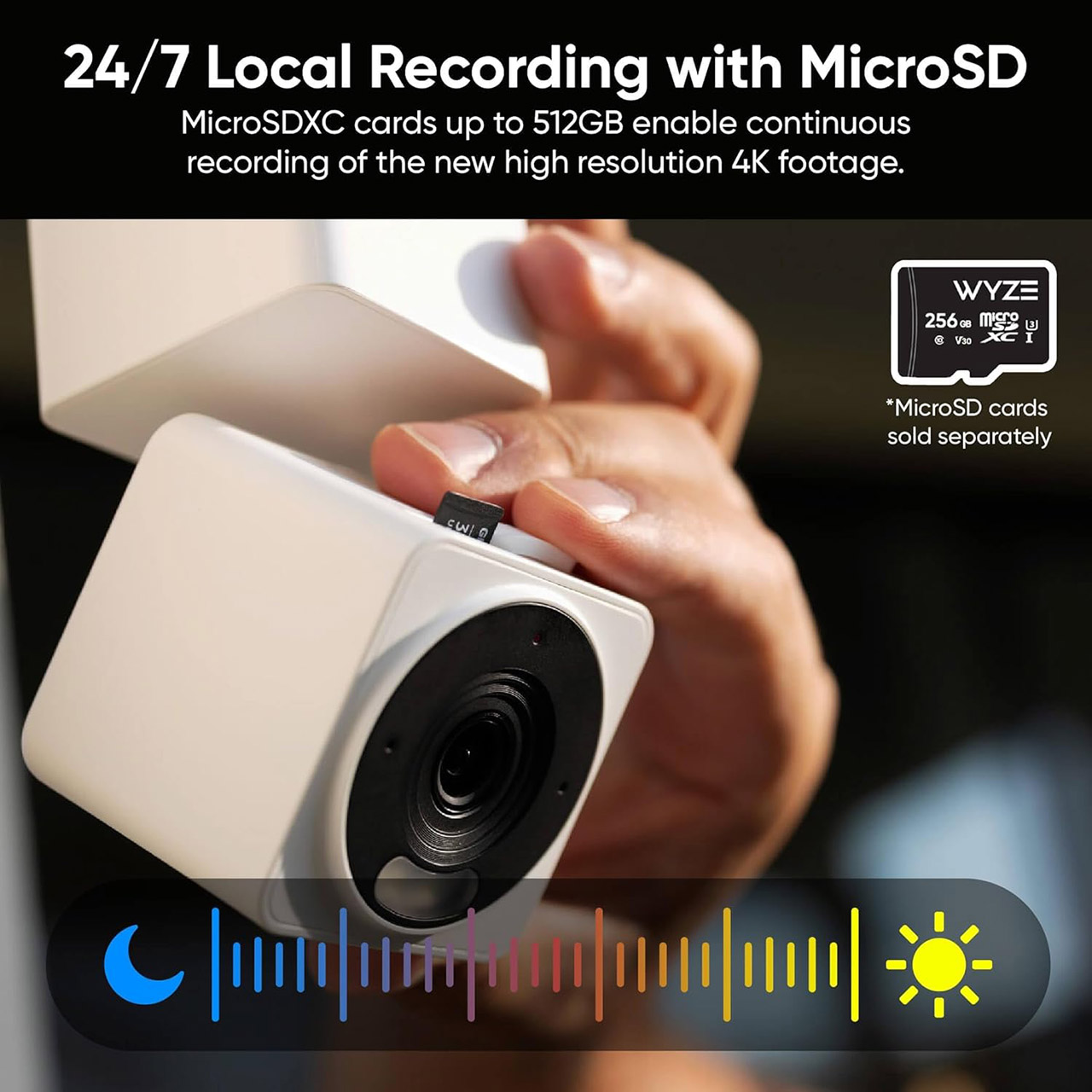
Storage is also reasonably priced, since you can simply insert a microSD card for continuous recording or event footage without incurring any monthly fees. If you wish to store it in the cloud, that is also an option. You also receive two-way audio (with a built-in speaker and microphone) and a 100dB siren in case you need to alert unwelcome visitors.
The video quality runs at 20 frames per second during the day and 15 at night, which reduces file size while maintaining smooth action. Digital zoom can reach up to 8x, allowing you to zoom in on distant features without sacrificing too much quality in 4K. At a time when most inexpensive security cameras still use 1080p, the Wyze Cam Pan v4 is quietly raising the bar for everyday security.
Starbucks has disclosed a data breach affecting hundreds of employees after threat actors gained access to their Starbucks Partner Central accounts.
As the world’s largest coffeehouse chain, Starbucks has over 380,000 employees (also known as partners) and operates nearly 41,000 locations across 88 countries.
In data breach notification letters filed with Maine’s Attorney General and sent to affected employees on Tuesday, the company says that it discovered the incident on February 6.
A joint investigation with external cybersecurity experts found that the attackers compromised 889 Starbucks Partner Central accounts used to manage employment details, personal information, benefits, and HR information.
Advertisement
Starbucks said the threat actors had access to affected individuals’ accounts between January 19 and February 11, but didn’t explain why it took five days to remove them from its systems.
“On or about February 6, 2026, Starbucks Corporation (‘Starbucks’ or ‘we’) became aware of potential unauthorized access to certain Starbucks Partner Central accounts,” the company said. “The investigation has determined that an unauthorized third party accessed certain Starbucks Partner Central accounts after obtaining the login credentials through websites impersonating Partner Central.”
The personal information exposed in the incident includes employees’ names, Social Security numbers, dates of birth, and financial account and routing numbers.
Starbucks notified law enforcement agencies after discovering the breach and advised employees to monitor their bank accounts for suspicious activity that could indicate fraud or identity theft. The company is also providing impacted partners with two years of free identity theft protection and credit monitoring service through Experian IdentityWorks.
Advertisement
“Upon learning of the incident, we took prompt steps to investigate the nature and scope of the incident and respond to it,” Starbucks added. “We also notified law enforcement and took measures to further strengthen security controls related to access to Starbucks Partner Central accounts.”
A Starbucks spokesperson also told BleepingComputer, after the article was published, that the data breach doesn’t affect customers.
“We recently identified that a limited number of retail partners had inadvertently interacted with deceptive websites impersonating an employee-facing site. This allowed an unauthorized third-party to access certain partner accounts,” the spokesperson said. “We quickly resolved the issue, notified affected partners, and operations have since returned to normal. There’s no impact on customers’ data.”
Starbucks’ Singapore division also confirmed a data breach affecting over 219,000 customers in September 2022, after a threat actor compromised the systems of a third-party vendor that stored the affected customers’ data.
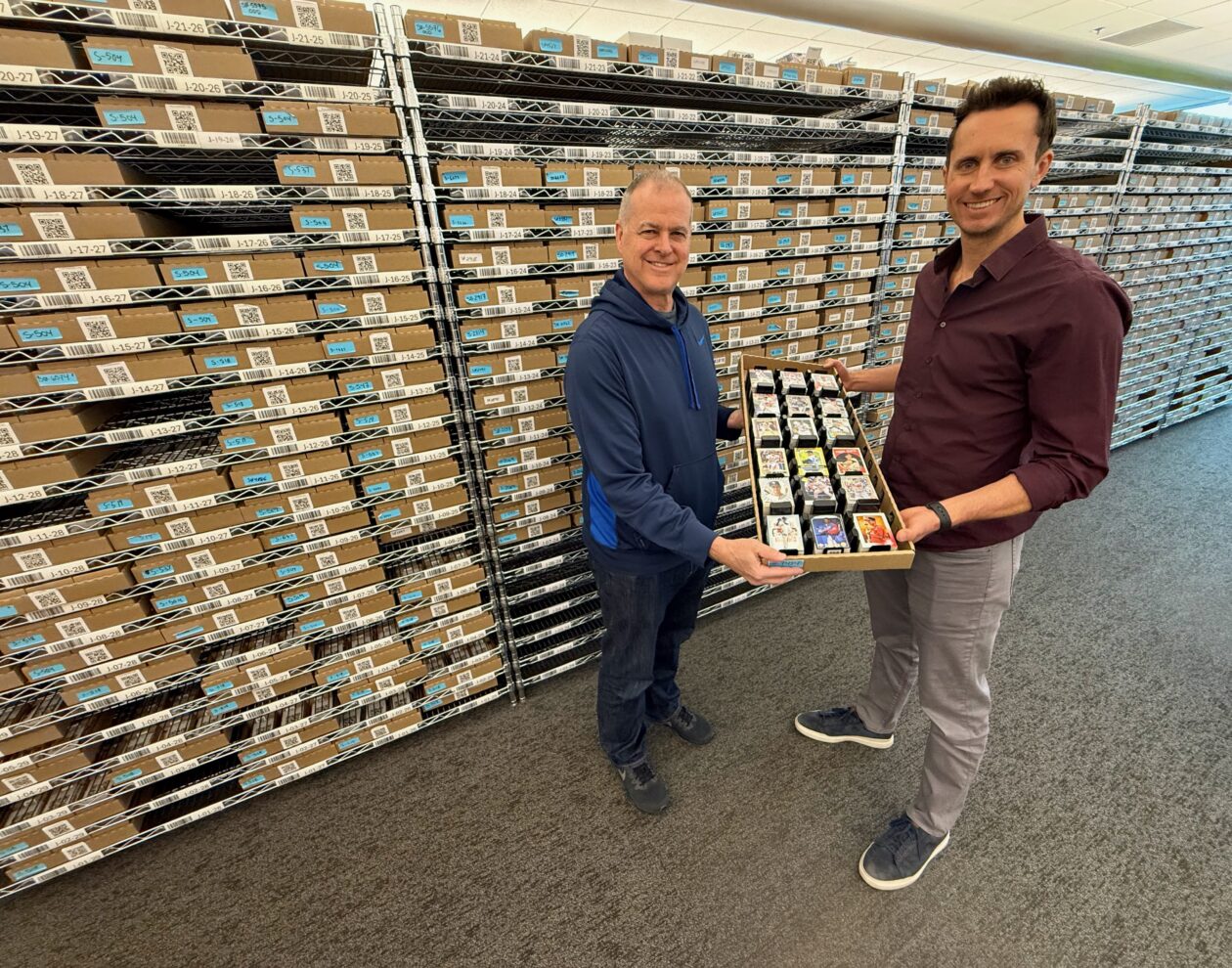
Gradient CEO Tim Clothier, left, and CTO Matt Lubbers hold one of the thousands of trays of trading cards that have been processed by the company’s robotics and AI systems at the startup’s Renton, Wash., headquarters. (GeekWire Photo / Kurt Schlosser)
Matt Lubbers says the genesis for his new startup was a visit to his friend Tim Clothier‘s house, where a living room view of Mount Rainier was partially obstructed. The problem? A mountain of trading cards from Clothier’s personal collection was in the way.
They weren’t just in the living room. The garage was full of boxes of cards stacked on top of more boxes. A longtime collector, Clothier numbers his lot at about 7 million cards. Separating and organizing them all by hand, he figured he could handle about 25,000 cards a week. He told his wife it would take about 15 years to sort them at that pace.
“I don’t think it was crazy for me to say, ‘What are you doing here?’” Lubbers told GeekWire.
“My friends, when they’re over, I’ll be sorting and they kind of run the other way,” Clothier said.
But Lubbers was different, as Clothier explained: “Matt’s very inquisitive and he started asking questions, and he said, ‘What do you think technology could do for you?’”
Advertisement
More than four years after that initial conversation, the startup co-founders are answering that question. Renton, Wash.-based Gradient is up and running, using custom robotics and artificial intelligence to help sort, analyze, list and sell sports trading cards, gaming cards, and more.
The goal is to grab a slice of the $15 billion U.S. trading card market, to help customers manage collections small and large, and to simply and quickly get a return on eBay for sometimes forgotten treasures.
Card geeks and engineers
Boxes of trading cards mailed to Gradient from customers around the U.S. In the back corner, a makeshift studio where Gradient livestreams card auctions on eBay. (GeekWire Photo / Kurt Schlosser)
The stealthy operation is located across the hall from the headquarters offices for Seattle Sounders FC at the soccer club’s Renton facilities — the Providence Swedish Performance Center & Clubhouse. Sounders majority owner Adrian Hanauer is an investor in Gradient, which has raised $6 million from mostly friends and family.
Clothier, the CEO, has known Hanauer since he was 15 years old. He spent 30 years at Pacific Coast Feather Co., the Hanauer family’s onetime pillow and blanket manufacturing business.
The sprawling Gradient space looks like any upstart tech company office with a few notable exceptions. There are boxes upon boxes full of trading cards everywhere, stacked near rows of rolling racks also containing boxes of cards — 10 million in all and room for three times that.
Advertisement
A close look at any open box or neat stack of cards reveals the faces of sports heroes past and present across baseball, football, basketball, hockey and more.
Around a few tables there are employees shuffling through some cards by hand. Others at computer stations digitally flip through card files or write the code that helps manage such work. The environment is a mix of card geeks and engineers.
And in one corner, the hum of eight robotic sorters can be heard, pulsing with little bursts of air and whirring as components move cards back and forth on a custom rigging apparatus that looks like something from a rock concert stage.
The system is the brainchild of Lubbers, the chief technology officer, who is a computer vision and AI expert who spent the past 15 years building complex systems and robots for autonomous vehicles and self-flying drones at ZF Group, Faraday Future, Voyage, Amazon Robotics and Zipline.
Advertisement
“We saw that there wasn’t much tech, at the time, in this industry. That’s what got us excited,” he said. “What if we could process cards extremely fast? What if we could reduce the amount of time someone, a customer or even expert, took to identify or price or list the card? That’s what we built.”
Up to 100,000 cards a day can be processed by the robots — and there is room to add more machines.
Stacks and rows of trading cards in a custom storage and rack system at Gradient. (GeekWire Photo / Kurt Schlosser)
Lubbers is especially protective of what he’s built, and wasn’t ready yet for GeekWire to shoot photographs or video of the robots at work.
Under bright lights, the machines rapidly move cards to flatbed scanners to capture images of the card backs as cameras positioned overhead take photographs of the card fronts. Every single card is physically and digitally cataloged.
While it may sound like fast-moving robots could be a recipe for disaster when mixed with delicate and sometimes quite valuable paper cards, the system is impressive. From the shape of the 3D-printed trays in which the cards are picked and then dropped, to the buttery soft suction fingers that gently lift each card, there is great care taken to never mark or damage any card.
Advertisement
The collected images are instantly sent to a nearby server room where three custom supercomputers — utilizing a high-density configuration similar to NVIDIA’s H100 or H200 chips — house six GPUs each. These machines handle all AI model training and inference testing, crunching through 500,000 images a day to analyze and score cards against a database of 30 million variants.
Storing and managing a collection
A baseball trading card for Seattle Mariners great Edgar Martinez sits at the center of a pile of cards in the Gradient office. (GeekWire Photo / Kurt Schlosser)
Gradient joins an increasingly tech-heavy ecosystem where AI-powered platforms like Ludex, CollX, Card Boss and eBay’s own scan-to-list feature are already used by collectors to instantly grade and price cards with quick scans via mobile phone apps. Gradient’s closest industrial competitor is probably TCG machines, which makes a robotic sorter used by card shops to process thousands of cards an hour.
Gradient’s goal beyond demonstrating how quickly it can process and accurately assess many thousands of cards is also to prove that it can efficiently store them, find them easily via QR-coded boxes and trays, and move them on the collectors’ market.
The company is just getting started in attracting customers, but its largest so far has given Gradient more than 500,000 cards to process.
Different subscription price tiers attract different customers and collection sizes. Pay-as-you-go card scanning runs 40 cents per card. A premium level subscription is $9.99 per month for up to 10,000 cards; Pro is $29.99 per month for up to 30,000 cards; and Commercial is $99.99 per month for up to 100,000 cards. The levels include secure storage and other perks.
Advertisement
Customers gain access to a personal web portal where they can manage their collections and see images of their cards, read the card details, list them on eBay through the Gradient Collects store, and monitor active and sold listings. A customer can choose one card or “send all my cards to eBay” and Gradient’s system will generate such a request.
Gradient takes between 16% and 20% per sale, depending on the subscription level, with 13% or 14% of that covering the costs with eBay.
The startup, which employs 25 people, streams live auctions on eBay where hosts excitedly open packs of Pokémon cards from a makeshift in-house studio located behind piles of boxes. And the company is also building its own marketplace so it can give customers the option of listing with Gradient, eBay or both.
Like a kid opening a fresh pack of cards at the corner mini mart, the possibilities with Gradient seem pretty endless. Especially for the kid, or, let’s face it, the adult collector, who finally uncovers those attic shoeboxes stuffed with thousands of cards and doesn’t know where to start.
Advertisement
“Our job is to help you digitize and inform you what you have, and then you get to choose what you wanna do with it,” Lubbers said.
The iRestore Elite Helmet + Battery is on sale, from March 15 through March 31, dropping to $1,879 ($419 off). Considering the helmet alone retails for $1,899, this deal scores you a rechargeable battery at no extra cost.
The additional battery makes the treatments far more convenient. Instead of being tethered to a wall outlet, you can move around during sessions. A single charge lasts roughly two weeks of daily 12-minute treatments, so you won’t even need to recharge often.
IRestore Elite Helmet + Battery for $1,879 ($419 off)
iRestore
Elite Helmet + Battery
Advertisement
IRestore Elite combines LEDs with its proprietary laser diodes that operate in the 655 to 680 nanometer range; the combination is designed to penetrate deeper than standard red light therapy, while the LEDs help distribute the light evenly across the scalp for maximum efficacy. Treatments take just 12 minutes a day, but like most routines, consistency is crucial. Fortunately, the included storage case makes it easy to keep up the habit even when you’re traveling.
WIRED reviewer Julia Forbes spent 16 weeks testing the iRestore Elite on both herself and her husband, who are dealing with different degrees of hair thinning and loss. Within two weeks of consistent use—alongside iRestore’s shampoo, conditioner, supplements, and serum—her husband started noticing baby hairs sprout along his receding hairline and more fullness at the crown. Forbes discovered that the treatments help prevent eczema flare-ups on her scalp.
We may receive a commission on purchases made from links.
Simple electrical tasks are among the many home improvement projects you can try doing yourself without professional help. While just about any DIYer can change out electrical sockets and light switches, and many can install a new ceiling fan or replace a garbage disposal, it’s important to have the right tools for the job.
Advertisement
There are easy-to-use electrical tools that can test for the presence of voltage, ensure wiring is connected to new outlets correctly, and measure temperatures without contact to check components for overheating. In addition, using good-quality hand tools makes the work easier and helps deliver professional-level results.
A word to the wise, however: Licensed electricians undergo extensive training to ensure their safety while they’re working on energized lines. That is, of course, because of the inherent risks involved working with electricity; it’s important to recognize and avoid the worst mistakes you can make when doing electrical work. However, as long as you keep safety in mind, anyone can easily use some of the electrical tools Home Depot has on offer to perform basic DIY electrical tasks.
Advertisement
A non-contact voltage tester
While a multimeter is handy to have around the home and garage for general use and testing purposes, a non-contact voltage tester can identify energized circuits without getting too close. One highly-rated example from Home Depot is the Klein Tools NCVT3P priced at $29.97, although the big-box retailer carries several versions from Klein and other brands.
The Klein NCVT3P is a digital dual-range non-contact voltage tester with an integrated LED flashlight that detects the presence of alternating current (AC) ranging from either 12 to 1,000 volts or 70 to 1,000 volts. It also comes with a pocket clip to keep it readily available either on your person or in tool bag, automatically powers off when inactive to save its battery, features drop protection from up to 6.6 feet, and has an IP67 intrusion rating against dust and water.
The NCVT3P’s user-selectable dual ranges allow it to detect power in standard-voltage electrical wiring found in homes and buildings as well as low-voltage applications such as landscape lighting and irrigation systems. Positively detecting voltage in a circuit provides for a safer work environment, making this device an absolute must for anyone doing electrical work themselves.
Advertisement
Users have the option to use the NCVT3P with the flashlight and audible alarm on or off while testing for voltage. They can also choose to use the lower-range voltage setting to provide more sensitivity when testing for higher voltages. The unit is simple to use and understand; a green light indicates no voltage detection, while a red light means the circuit is energized. Home Depot customers give it a 4.6-star rating across 592 reviews.
Advertisement
A digital GFCI receptacle tester
Once you’ve installed a new outlet in our home or shop, it’s often a good idea to test it before plugging in something expensive. One way to ensure you’ve gotten all the right wires on the right connections is to use a receptacle tester. Home Depot carries a wide variety of brands and styles, but it’s hard to beat the Milwaukee digital GFCI receptacle tester priced at $26.97, especially with its 4.7-star rating across 70 reviews.
This Milwaukee tester comes with the two AAA batteries required to use it, and has the added feature of testing ground fault circuit interrupter (GFCI) receptacles, those outlets with a reset button on them. These types of outlets are designed to protect against dangerous electrical shocks, and a GFCI tester is a safe way to ensure they are working correctly before trusting them with your life or your appliances.
The Milwaukee digital GFCI receptacle tester is easy to use; simply press the power button and plug it in to any standard household 120V outlet, and the incorporated green and red LED lights will indicate if the outlet is working correctly or has a fault. At the same time, the backlit LCD screen displays pertinent information, such as the amount of voltage detected and any electrical issues like reversed wires. The screen’s hold function retains the information until it’s cleared, a handy feature when you’re using the tester behind a refrigerator or furniture and can’t see clearly until you pull it back out. Pushing the test button with the unit inserted into a GFCI outlet will show if the interrupter is working correctly.
Advertisement
An electrician’s hand tool kit
A proper set of hand tools is a must for any DIY electrical work, although they’re often among the most underrated tools you’ll need for wiring jobs. An electrician’s hand tool set, like the 4-piece Milwaukee electrician’s hand tool kit priced at $55.88 from Home Depot, is a good example; it includes a multibit screwdriver, wire cutters, wire strippers, and a utility knife. It’s also a good choice based on its 4.7-star rating stemming from 1014 reviews.
The wire stripper/cutter included with the Milwaukee electrician’s tool kit features a simple locking mechanism for one-handed operation, spring-loaded jaws, a curved wire cutting blade, and the capability to strip solid wire sizes from 18 to 10-gauge and stranded wire from 20 to 12-gauge. In addition, the tool has a tapered nose with pliers and provisions to cut #6-32 and #8-32 bolts and straighten the threads after for easy installation.
Advertisement
The other tools in the kit are likewise useful. The 11-in-1 screwdriver contains eight hex screwdriver bits, including square bits, and three common nut driver sizes. The screwdriver handle is three-lobed for increased leverage and comfort. The mini flush cutter is spring loaded for simple one-handed operation. The tool produces precise cuts on thin wire strands and cleanly cuts cable tie ends to reduce snag hazards, leaving a professional appearance to your DIY job, and Milwaukee’s Fastback folding utility knife has an easy to open “press-and-flip mechanism” that allows users to deploy the blade with one hand. The knife’s design also allow changing blades without requiring the use of tools.
Advertisement
An infrared thermal imaging camera
While these high-tech tools are admittedly relatively high priced your average DIYer, infrared thermal imaging cameras come in handy around the home and garage. They’re especially handy for electrical work. You can use them to inspect outlets, junction boxes, breakers, and sub-panels for hot spots, which can indicate wiring issues like undersized wires, excessive amperage draw, and loose connections.
Home Depot sells infrared thermal imaging cameras produced by a variety of top brands. The rechargeable pro thermal imaging camera from Klein Tools, for example, lists for $649.99. A less expensive infrared thermal imaging camera is the Mileseey TR10, which sells for $159.99 at the retailer. Additionally, it features a better overall rating — 4.8 stars to Klein’s 4.5 — but both devices have fewer than 30 reviews each, likely due to their high cost.
The TR10 thermal camera features a high-resolution 240×240-pixel screen with a 25hz refresh rate for clearer, smoother imaging. The unit senses temperatures between -4 degrees up to 1,022 degrees Fahrenheit, displaying temperatures as a range of colors and identifying the high, low, and center-point temperatures on the screen with an accuracy of +/-2 degrees Celsius. A simple trigger pull captures the display image, and the TR10 IR thermal camera’s built in 8GB memory allows storage of 30,000 screen images. Users can transfer the stored images to a laptop, PC, or tablet by using an applicable USB-C cord.
Advertisement
Why these easy-to-use electrical tools from Home Depot were chosen
Photovs/Getty Images
It’s clear that an electrician’s tool kit likely contains much more than these four Home Depot tools. However, many of these may be more technical in nature or too complicated for use by beginner DIYers without the necessary training and acquired skills.
That’s why we focused on the electrical tool categories highlighted here. They’re all easily attainable and simple to use, ensuring immediate competence and supporting electrical safety when used by anyone. The specific examples are also highly rated by users and come from reputable companies like Klein Tools and Milwaukee. Only the Mileseey TR10 infrared thermal imaging camera strays from the ranks of established brands. It was included here due to its budget price compared to alternative products, its strong initial user reviews, and the company’s history of quality electronics, namely in the form of range finders used for golfing.
Nvidia controls processors and networking, forming the backbone of AI factories today
Nvidia could soon control not just chips but energy, models, and applications
Huang frames AI not as software, but as the foundation of modern industry
Nvidia chief executive Jensen Huang recently described artificial intelligence through the metaphor of a multi-layered system.
The framework explains how modern AI systems operate as an industrial chain rather than isolated software tools.
The structure consists of five layers: energy, chips, infrastructure, models, and applications, which interact with industries and consumers.
Article continues below
Advertisement
How the AI stack functions across layers
“Every successful application pulls on every layer beneath it, all the way down to the power plant that keeps it alive,” Huang wrote, illustrating how intelligence generated in real time depends on physical resources across the computing ecosystem.
Nvidia already dominates the processor layer, supplies networking technologies, and provides computing platforms inside large data centers.
Advertisement
The company’s influence over infrastructure includes systems that connect thousands of processors into machines capable of generating intelligence continuously.
These facilities, sometimes described as AI factories, require land, electrical supply, and networking systems to operate at scale.
Sign up to the TechRadar Pro newsletter to get all the top news, opinion, features and guidance your business needs to succeed!
Huang noted that the construction of new chip fabrication plants, computer assembly facilities, and data centers is occurring in multiple regions.
Advertisement
“We are a few hundred billion dollars into it,” he wrote. “Trillions of dollars of infrastructure still need to be built.”
The expansion reflects one of the largest industrial buildouts associated with modern computing.
At the top of the stack sit applications that convert computing capacity into economic value.
Advertisement
Huang cited examples, including drug discovery platforms, industrial robotics, legal analysis tools, and autonomous vehicles, which act as physical embodiments of artificial intelligence.
“A self-driving car is an AI application embodied in a machine,” he wrote. “A humanoid robot is an AI application embodied in a body.”
These systems rely on models capable of processing language, images, scientific data, and real-world environments, increasing demand for computing resources across the lower layers of the stack.
The framework also suggests how Nvidia could expand across the layers it described.
Advertisement
Companies controlling foundational technology sometimes extend into adjacent layers, similar to Amazon after building AWS.
Nvidia has been actively expanding into networking systems and large-scale computing infrastructure.
The company has also invested in areas such as photonics that affect how data moves between computing systems.
If Nvidia expands further into models, infrastructure, energy supply, or applications, the company could operate across most of the layers described in Huang’s framework.
Advertisement
By framing AI as a layered stack, Nvidia is not just explaining the industry, it is staking its claim across it.
From chips to infrastructure to applications, the company wants to have its cake and eat it too.
Reading analog clocks is a pretty straightforward skill to learn. However, if you’ve already learned to read and don’t want to pick up the extra skill, a word clock is a perfect solution for telling time. [povey_tech] found some nice examples in the wild but didn’t appreciate the price, so he set about building his own.
The build is based around an ESP32 microcontroller. While many projects in this vein would use the onboard wireless connectivity to query network time servers, in this case, the board relies on the user manually setting the time and a DS1307 real-time-clock module to keep a steady tick. Also onboard is a VEML7700 ambient light sensor, which the microcontroller uses to control the brightness of the WS2812 LEDs inside the board.
The words themselves are laser cut out of acrylic panels, with everything set inside a tidy oak picture frame. A layer of anti-reflective glass in front helps cut down on glare, while [povey_tech] was so kind as to implement two LEDs per letter to allow for lovely color gradients to be displayed. Configuring the clock is easy thanks to a webpage hosted on the ESP32 that allows for control of dimming modes, colors, and setting the time. Home Assistant integration is something planned for the future.
A threat actor tracked as Storm-2561 is distributing fake enterprise VPN clients from Ivanti, Cisco, and Fortinet to steal VPN credentials from unsuspecting users.
The attackers manipulate search results (SEO poisoning) for common queries like “Pulse VPN download” or “Pulse Secure client” to redirect victims to spoofed VPN vendor sites that closely mimic VPN solutions from legitimate software vendors.
After examining the attack and command-and-control (C2) infrastructure, Microsoft researchers discovered that the same campaign used domains related to Sophos, Sonicwall, Ivanti, Check Point, Cisco, WatchGuard, and others, targeting users of multiple enterprise VPN products.
In the observed attack, Microsoft found that the fake sites link to a GitHub repository (now taken down) that hosts a ZIP archive containing a fake VPN MSI installer.
Advertisement
Fake Fortinet website Source: Microsoft
When executed, this file installs ‘Pulse.exe’ into %CommonFiles%\Pulse Secure, and drops a loader (dwmapi.dll) and a variant of the Hyrax infostealer (inspector.dll).
The fake VPN client displays a legitimate-looking login interface that invites victims to enter their credentials, which are captured and exfiltrated to the attacker’s infrastructure.
The malware, which is digitally signed with a legitimate, but now revoked, certificate from Taiyuan Lihua Near Information Technology Co., Ltd., also steals VPN configuration data stored in the ‘connectionsstore.dat’ file from the legitimate program’s directory.
To reduce suspicion, the fake VPN client displays an installation error after stealing the credentials, and redirects them to the real vendor’s site to download the legitimate VPN client.
“If users successfully install and use legitimate VPN software afterward, and the VPN connection works as expected, there are no indications of compromise to the end users […], [who] are likely to attribute the initial installation failure to technical issues, not malware,” explains Microsoft.
Advertisement
Meanwhile, in the background, the infostealer malware creates persistence for Pulse.exe via the Windows RunOnce registry key, ensuring the infection survives system reboots.
The researchers recommend that system administrators enable cloud-delivered protection in Defender, run EDR in block mode, enforce multi-factor authentication, and use SmartScreen-enabled browsers.
Microsoft has also provided indicators of compromise (IoCs) and hunting guidance to help detect and block this campaign early.
Malware is getting smarter. The Red Report 2026 reveals how new threats use math to detect sandboxes and hide in plain sight.
Download our analysis of 1.1 million malicious samples to uncover the top 10 techniques and see if your security stack is blinded.