
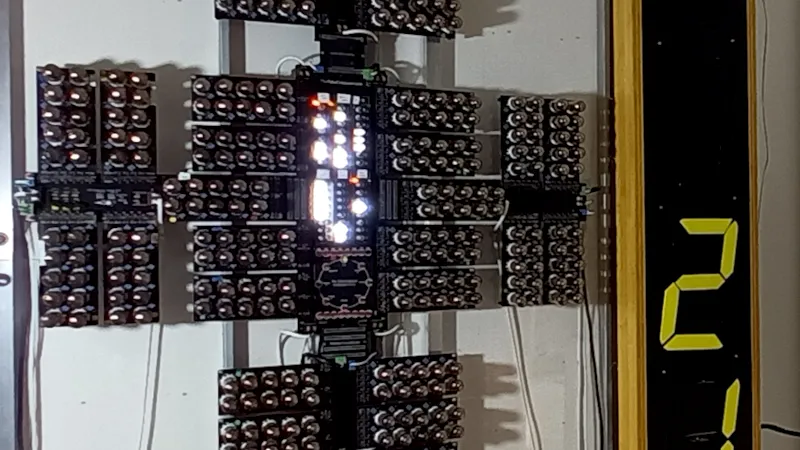
The earliest all-electronic computers used vacuum tubes, and most of us will know about machines such as ENIAC or Colossus. Vast machines that required the budget of a country at war to build, andfill very large rooms. It’s very pleasing then to see that a useful vacuum tube computer can be made which has neither of these requirements, as with this example from [Mike] that uses former eastern bloc double-triodes.
It’s an 8-bit design following a von Neumann architecture with 16 instructions, whose operational block diagram would be instantly recognisable to anyone used to working with a 1970s-era 8-bit microcomputer. It follows a NOR-based design in the same manner as the famous NASA machines from the Apollo programme, and as we understand from the description it uses more modern parts for its I/O circuitry. Physically it’s a surprisingly compact wall-mounted unit, and it has an accompanying ex-British Rail flip-digit display as well as a control panel for a simple airship simulator game. There’s a website with full details, if you are interested.
We like this machine, a lot. It may not be the largest computer we’ve seen and it certainly isn’t the first one with vacuum tubes, but it’s a very impressive achievement to have created it. If tubes in computing interest you meanwhile, we took a trip to see the daddy of them all.
Should [Mike] enter this into the Retrocomputing Challenge? We think so.
You must be logged in to post a comment Login