Tech
ABX Audiophiles DIY Speaker Project Targets Open-Baffle Enthusiasts: AXPONA 2026

I stopped by the La Dolce Audio room at AXPONA expecting to spend time with the tube amplifiers Terry Gesualdo and I had been talking about on the bus ride over. He’s working with some unusually adjustable designs built around pentode tubes that most manufacturers avoid, which is exactly the kind of thing that gets my attention.
But the amplifiers weren’t what stopped me in the doorway.
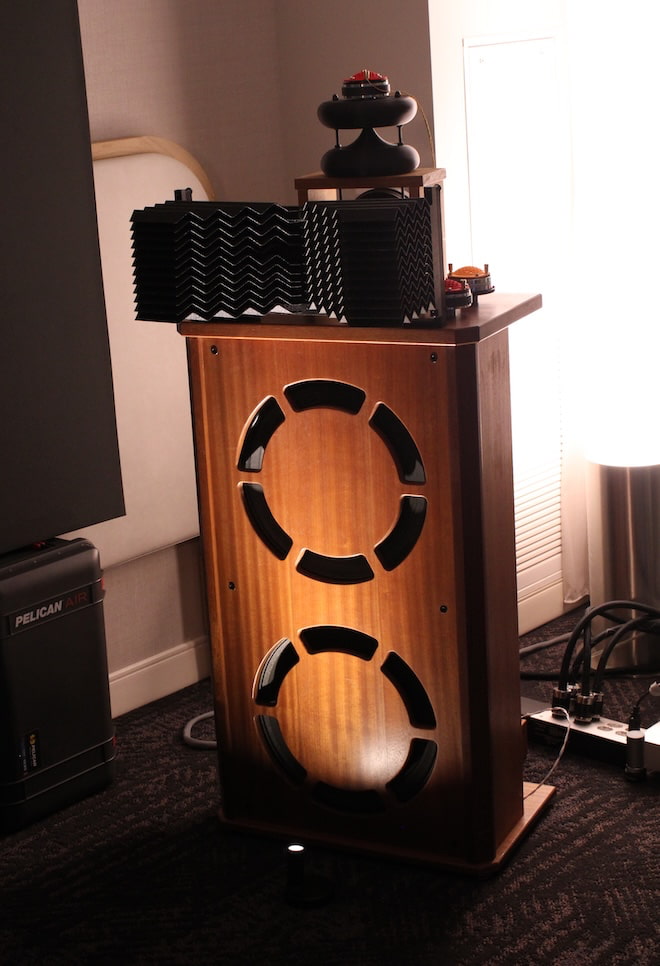
Front and center was a pair of speakers that didn’t look like they belonged in a conventional system. Two large drivers mounted on a walnut baffle, topped by a compression horn feeding a wide black waveguide. And that was it. No enclosure, no box, nothing hiding behind them.
They weren’t unfinished. That was the design.
The speakers in question are one variation of the ABX/LDA open-baffle design, developed by James Owens of ABX, Terry Gesualdo of La Dolce Audio, and a growing community of builders on Discord. The concept isn’t complicated, and that’s the point: build something affordable, accessible, and genuinely good sounding without turning it into a science project that only a handful of people can finish.
In its most stripped-down form, this is about as DIY as it gets. A sheet of plywood, a couple pieces of 1×6, two shelf brackets, a pair of large drivers (three if you count the coaxial tweeter), and a simple five-part crossover. That’s the baseline. From there, builders can take it as far as their skills, patience, and garage space allow.
Driver-wise, it’s not messing around. You’ve got a 15-inch coaxial handling midrange and treble duties, paired with an 18-inch woofer to move serious air. The original coaxial concept traces back to a Darrel Hawthorne design, and after Hawthorne Audio closed in 2016, Gesualdo worked with Eminence, along with Hawthorne’s blessing, to develop an updated version so the platform wouldn’t disappear with the brand.

The naming keeps that lineage intact. The 15-inch is now the HA15, with a smaller HA10 also in the pipeline.
The crossover follows the same philosophy as the rest of the project. Keep it simple, keep it accessible, and don’t overthink it.
You’re looking at two inductors, a 15 mH 15 AWG air core inductor handling the midrange on the coaxial, and a 10 mH choke for the woofer, assuming the 18 inch driver. From there, it’s a set of speaker taps, a capacitor on the tweeter, either 3.3 µF or 40 µF depending on the specific tweeter revision, and an L pad to dial in the tweeter level.
That’s the entire network.
No PCB, no exotic layout requirements, no black box. Everything can be hand wired with basic parts and a soldering iron. If you can follow a diagram and take your time, you can build it.
Baffle designs run the full spectrum from basic to borderline art project, but they all share a common idea: some form of slot loading to help extend bass response.

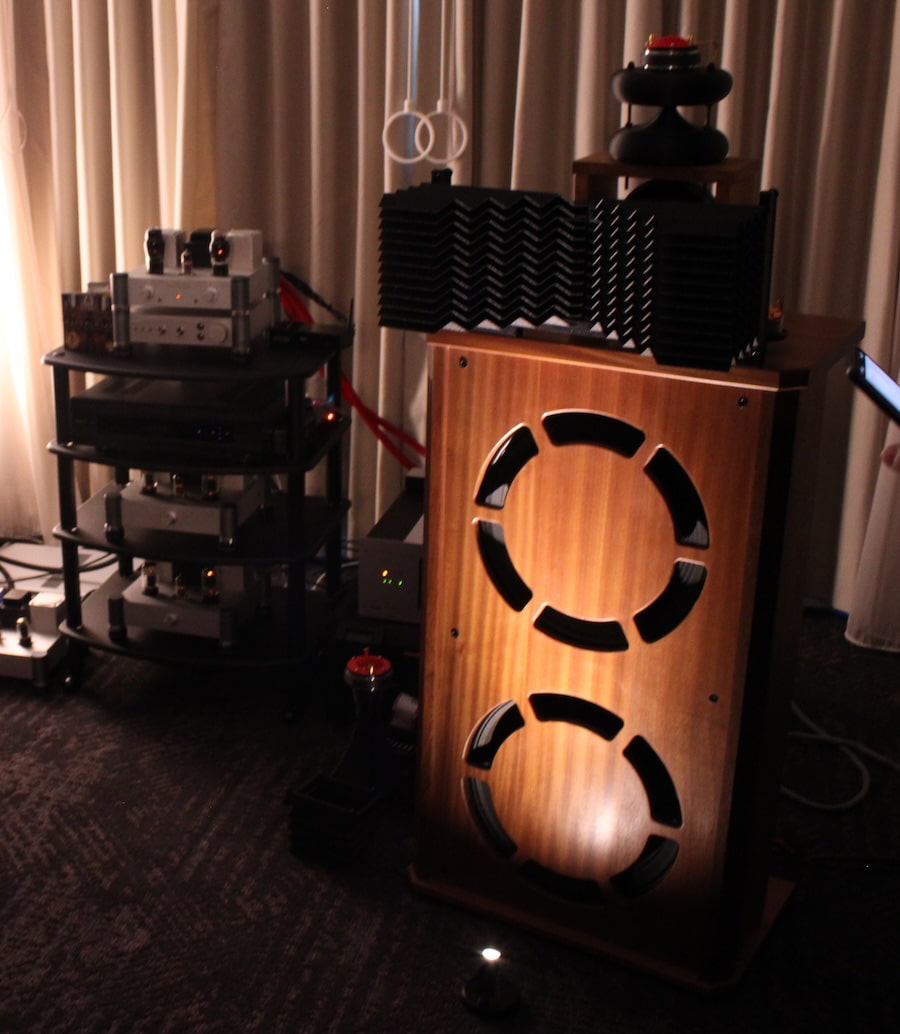
At the entry level, it can be as simple as rectangular cutouts in a sheet of plywood. From there, things escalate. Ring-loaded designs in straight grain hardwoods. More ambitious builds with spirals carved into slabs of figured Claro walnut that look like they belong in a gallery instead of a listening room.
The pair at the show leaned toward the more refined end. They used ring-loaded ports in a lightly figured walnut baffle and ditched the coaxial tweeter altogether. In its place was a compression horn paired with a large 3D printed labyrinth lens, designed to improve dispersion and add a bit more realism compared to the original coaxial approach.
It’s a clear sign that this isn’t a static design. It’s evolving, and the community is driving a lot of that evolution.
At this point, there are at least nine established versions, with La Dolce Audio offering designs and build kits, and even more variations circulating through the Discord channel for those who want to experiment.
For anyone looking to step off the beaten path, or just wants the satisfaction of saying “I made those,” the ABX/LDA open baffle project makes a strong case.
It’s established enough that you’re not gambling on the result. The foundation works, but it remains open to interpretation, letting builders take it as far as their skills and imagination allow.
That’s the appeal. You’re not just assembling a speaker. You’re shaping it.
At a show where the average speaker costs more than an entry level SUV, this feels like a reality check. Not everyone is dropping that kind of money, and this doesn’t pretend that you should. It just offers another way in, and a pretty smart one if you’re willing to put in the effort.
For more information: abxaudiophiles.org
You must be logged in to post a comment Login