Tech
Accuphase DP-470 CD Player Arrives as U.S. CD Sales Surge 16%

Nobody appears to have informed the Compact Disc that its funeral was held years ago.
U.S. CD sales increased 16% to 16.3 million units during the first half of 2026, according to Luminate, and that growth still reached 6.7% when K-pop sales were removed from the equation. At the same time, the hardware industry has suddenly developed a serious case of silver-disc fever, with new CD players and transports arriving from Marantz, NAD, FiiO, Quad, Shanling, Cayin, Mission, TEAC and others at prices ranging from under $200 to several thousand dollars.
The latest manufacturer to join that increasingly crowded party is hardly some Kickstarter operation with a transparent plastic lid and Bluetooth.
Accuphase has introduced the DP-470, a dedicated high-end CD player that replaces the DP-450 and borrows technology from the considerably more ambitious DP-570S SACD/CD player. It goes on sale in Japan in late August for ¥528,000 including tax. Accuphase has not announced U.S. pricing or availability, and we will update this article when those details become available.
There is something wonderfully 2026 about one of Japan’s most traditional high-end manufacturers introducing a new machine whose primary purpose is extracting 16-bit/44.1kHz audio from a plastic disc introduced in 1982.
Apparently progress occasionally involves finding your jewel cases again.
This Is Not Just a DP-450 With a New Number
The DP-470 remains a CD-only player. It does not play SACDs, which Accuphase reserves for models such as the DP-570S higher in the range. But calling it a conventional Red Book player understates what Accuphase has done with the digital section.
The mechanical side starts with a high-rigidity, low-center-of-gravity CD drive designed to isolate the optical pickup from vibration. Accuphase uses an elastic damping system between the transport and loading mechanisms, an eight-pole neodymium magnetic disc clamp and a three-layer bridge structure intended to suppress chassis resonance and noise generated by the spinning disc. The tray itself is machined from an aluminum block.
None of that makes the disc contain more data. The objective is to give the optical system the quietest and most mechanically stable environment possible while it reads what is already there.
This is Accuphase, after all. Nobody was expecting the transport to be held together with two screws and optimism.
The More Important Changes Are Inside the DAC


Accuphase retains the ESS ES9026PRO used by the DP-450, but employs it through the company’s four-circuit parallel MDS+ conversion architecture. Accuphase says operating four DAC circuits in parallel improves characteristics including noise, distortion and linearity compared with using a single circuit.
The more significant change is the addition of ANCC — Accuphase Noise and distortion Cancelling Circuit — in the I/V conversion stage. The circuit uses a secondary amplifier to cancel noise and distortion generated by the main amplifier. The company has also redesigned the DAC board and optimized the power supply architecture. ANCC is technology already used in the more expensive DP-570S, so this represents some meaningful trickle-down rather than changing the display font and calling it a new generation.
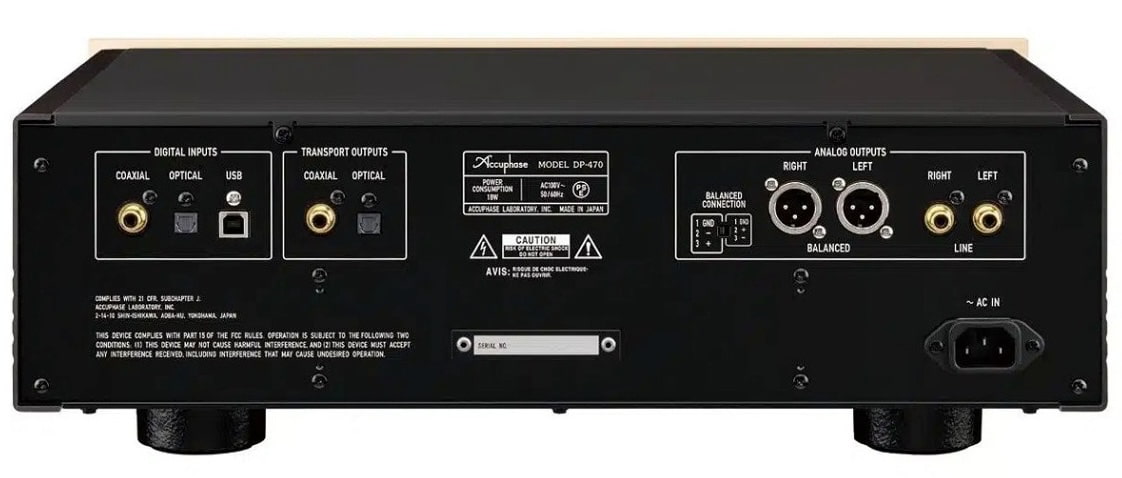
Accuphase also uses its Direct Balanced Filter architecture with independent signal paths for the RCA and balanced XLR analog outputs, reducing interaction between them. Output level can be adjusted from 0 dB to -60 dB in 1 dB increments, and the balanced outputs include a phase selector.
Accuphase DP-470 Key Specifications
- Dedicated Red Book CD player
- ESS ES9026PRO DAC
- Four-circuit parallel Accuphase MDS+ D/A conversion
- ANCC noise and distortion cancellation in the I/V conversion stage
- High-rigidity, low-center-of-gravity CD transport
- Machined aluminum disc tray
- Independent Direct Balanced Filter circuitry for RCA and XLR outputs
- RCA and balanced XLR analog outputs
- Coaxial and optical digital outputs
- USB Type-B, coaxial and optical digital inputs
- USB PCM support up to 384kHz/32-bit
- USB DSD support up to 22.5MHz using ASIO Native
- DSD up to 11.2MHz using DoP
- Coaxial PCM input up to 192kHz/24-bit
- Optical PCM input up to 96kHz/24-bit
- Adjustable analog output level from 0 to -60 dB
- 465 x 151 x 393mm
- 13.7kg / approximately 30.2 pounds
- Five-year warranty in Japan

Your Streamer Is Invited Too
This may be the most important thing separating the DP-470 from purist machines such as the Hegel Viking.
Accuphase has turned the DP-470 into a high-resolution standalone DAC as well as a CD player. A computer can feed the USB input, while a network streamer or other digital source can use the coaxial or optical connections. Owners can therefore use the same Accuphase DAC and analog output stage for both physical discs and other digital sources.
That makes considerably more sense in a modern high-end system than requiring someone to buy an expensive CD player and then duplicate its DAC circuitry in another box for streaming.
The irony is difficult to miss. Streaming was supposed to eliminate the CD player. The new generation of CD players is responding by becoming the DAC for the streamer.
Who Is the DP-470 Competing With?
Until Accuphase announces U.S. pricing, positioning the DP-470 precisely against American-market competitors requires some restraint. Converting ¥528,000 into dollars and pretending that figure represents a U.S. MSRP would be misleading because distributor margins, tariffs, freight and regional pricing can substantially alter the final number.
But the competitive neighborhood is already obvious.
The Hegel Viking, currently selling for about $5,500 in the U.S., takes the opposite approach. It is unapologetically devoted to 16-bit/44.1kHz Red Book CD playback and does not provide digital inputs for using its DAC with outside sources. Hegel’s argument is purity; Accuphase’s is versatility without abandoning serious mechanical engineering.
The Luxman D-03X is probably the closest conceptual rival. It is another Japanese dedicated CD player with balanced outputs and a high-resolution DAC section that accepts USB, coaxial and optical sources. Its USB implementation supports PCM up to 384kHz/32-bit and DSD to 11.2MHz.
Further down the price ladder, products such as the Rotel DT-6000 combine dedicated CD playback with a high-quality DAC, while the new Marantz CD 70 at $750 demonstrates just how quickly the category is filling up at more attainable prices. The point is not that a $750 Marantz buyer is cross-shopping an Accuphase. It is that manufacturers at almost every level have reached the same conclusion: people are buying discs again, and quite a few of them would apparently like something better than the DVD player hiding in the basement.
Why the DP-470 Is Interesting
The DP-470 is unusual because Accuphase is not treating the CD revival as retro fashion.
There is no Bluetooth transmitter, transparent lid, rechargeable battery or attempt to make the player resemble something that escaped from a 1997 Sony catalog. Accuphase has instead applied some of its current high-end digital engineering to a format with a fixed 16-bit/44.1kHz specification and then made the DAC useful enough to justify its existence in a system that probably streams as well.
That tells us something about where the CD revival is going.
The first wave was inexpensive used discs and younger buyers rediscovering physical ownership. The next brought portable players from FiiO, Shanling and Cayin. Marantz, NAD, TEAC and Mission followed with new home components. Now Accuphase is willing to invest in an entirely new high-end player.
Nobody builds a 30-pound CD player with a machined aluminum tray because they expect the format to disappear next Tuesday.
The Bottom Line
The Accuphase DP-470 is not interesting because CD playback suddenly required DSD 22.5MHz support. It is interesting because the company is investing serious engineering resources in a dedicated CD player at the exact moment the supposedly obsolete format is showing unexpected sales growth.
U.S. CD sales rising 16% in the first half of 2026 does not mean streaming is in trouble, and it certainly does not mean vinyl has been dethroned. It does mean that millions of listeners still want physical music they actually own, while manufacturers have recognized that those listeners range from teenagers buying $200 portable players to audiophiles willing to put an Accuphase on the equipment rack.
The DP-470 gives the latter group a substantial transport, balanced analog stage and high-resolution DAC without trying to turn itself into a music server or streaming platform.
Thirty-four years after people started predicting the death of the Compact Disc, Accuphase has built another one.
The CD remains extremely poor at following instructions.
Price & Availability
The Accuphase DP-470 will be released in Japan in late August 2026 for ¥528,000 including tax. Accuphase’s Japanese website officially lists the player, while the company’s international site currently identifies the DP-470 as a forthcoming product.
U.S. pricing and availability have not been announced. We have not converted the Japanese price into a speculative U.S. MSRP because that would not accurately reflect Accuphase’s regional distribution and pricing structure.
We will update this article as soon as official U.S. pricing and availability become available.
For more information: Accuphase CD Players
You must be logged in to post a comment Login