Connect with us

Tech

Adding A Panadapter To A Classic Receiver

Published

on

There was a time when only the richest ham radio operators could have a radio with a panadapter. Back in the day, this was basically a spectrum analyzer that monitored a broad slice of the receiver’s intermediate frequency so you could see signals on either side of the receiver’s actual frequency. Today, with SDR technology and computers, this is an easy thing for receivers to implement. But what if you want to refit a classic radio? It isn’t that hard, and [Mirko Pavleski] shares his notes on how he tackled the project. You can also check it out in the video below.

The plan is simple. A FET amplifier taps the radio’s IF stage before the first IF filter. This provides good isolation and buffering. Then, an emitter follower stage provides a matched output to the SDR through a low-pass filter. The SDR remains tuned to the IF frequency, of course. The rest is essentially software and procedures.

Of course, your exact connection to your radio will differ unless you have the same receiver shown in the video. A modern scope with an FFT should be able to help you quickly locate a good spot, though.

Advertisement

Of course, you could just listen through the SDR, but that doesn’t seem sporting but that’s what it looks like he does in the demonstrations. Essentially, he’s using the radio’s RF system via the first IF mixer, then letting the SDR handle the rest. But you could just use the display and tune the radio instead.

If you really wanted a cool system, you could frequency count the internal frequencies and display the correct frequencies in software. Then you could also track the current frequency. This would make it seem more like a traditional panadpater and less like just replacing most of the radio’s features with an SDR.

We’ve seen these before, of course. Many times.

Advertisement

Source link

Advertisement
Continue Reading
Click to comment

Leave a Reply

Your email address will not be published. Required fields are marked *

Tech

AI recession: A memo laid out how AI could kill jobs. Wall Street panicked.

Published

on

Last year, investors worried that AI would crash the economy by making too little money.

Now, they fear it will do so by making too much.

On Sunday, a little-known financial analysis firm called Citrini Research published a piece of science fiction: A memo dated June 2028, in which its researchers sketch a pocket history of “the global intelligence crisis” — an AI-triggered meltdown of the world’s financial, economic, and political systems.

In this account, the problem isn’t that AI proves unprofitable — and America’s data centers become rusted-out memorials to a 21st century Tulip Mania.

Advertisement

In Citrini’s telling, AI does exactly what its boosters promised (at first, anyway). The technology fuels rates of productivity growth unseen since the 1950s, generates mind-boggling profits for its owners, and massive GDP gains.

  • A viral Substack post sketched how AI could trap the economy in a doom loop — and freaked out investors.
  • It explained how AI could devalue white-collar labor and destroy consumer demand.
  • The post also argued that AI agents will destroy the business models of several specific companies.
  • But there are many reasons to doubt the scenario’s plausibility.

But it also irrevocably devalues white-collar labor and rapidly destroys a wide array of major businesses. Over time, the AI boom eats the rest of the economy. Growth and the S&P 500 both collapse, unemployment tops 10 percent, the mortgage market wobbles, the Occupy Silicon Valley movement blocks the entrance to OpenAI’s offices — all while the big labs keep raking in cash.

Such counterintuitive soothsaying might seem unremarkable. Bloggers sketch dystopian AI scenarios every day. Yet the Citrini memo appeared to do what few — if any — works of science fiction have done before: reduce the value of US stocks by more than $200 billion.

AI and the white-collar doom loop

To understand why the memo made such an impression, it’s worth examining its vision in more detail.

Advertisement

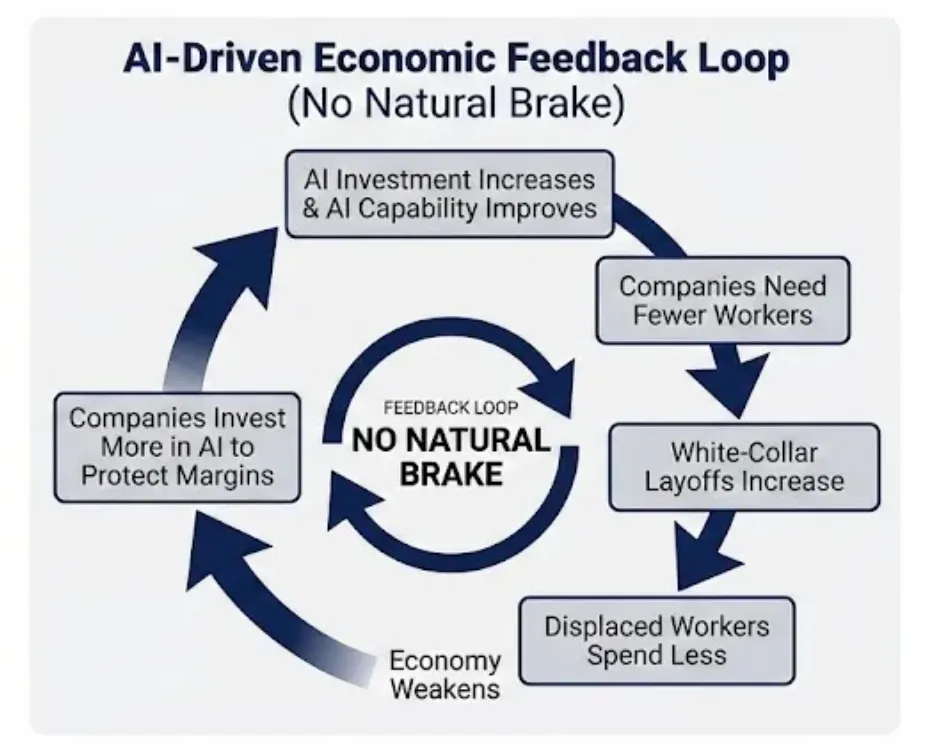
Citrini tells two distinct — but overlapping — stories. The first is about how AI could trigger a doom loop that destroys consumer demand. The narrative goes like this:

  • AI advances render a steadily growing number of white-collar workers obsolete. By the end of 2026, Claude agents can do the work of “a $180,000 product manager for $200/month.” And the same is true of myriad other roles in consulting, software, real estate, financial advice, legal services, and more.
  • Companies respond by cutting headcount and reinvesting their savings in AI.
  • Higher investment in AI leads to more capable agents, devaluing the skills of even more white-collar workers.
  • Displaced professionals slash their spending and drag down wages in the working-class economy: As laid-off McKinsey consultants start driving Ubers, rates for existing drivers fall amid heightened competition. And the same dynamic plays out in other sectors.
  • AI’s productivity gains are generating massive wealth. But most of the returns flow to an extremely narrow elite. And when the super rich get richer, they don’t necessarily spend more money. Sam Altman needs only so many cars and TVs. So much of the AI industry’s profits don’t circulate back into the economy.
  • Meanwhile, upper middle-class Americans are slashing their spending — either because they’re jobless or afraid they will be soon — and blue-collar workers aren’t seeing much wage growth. Thus, consumer demand collapses.
  • As falling demand eats into companies’ profits, they scramble to find cost-savings. More and more discover that the easiest way to shore up their margins is to invest in AI and lay off workers.
  • Higher investment in AI yields even more capable agents.
  • More white-collar workers become obsolete.
  • Companies respond by cutting headcount and reinvesting their savings in AI.

The cycle perpetuates itself with no natural brake.

Graphic of the feedback loop

Citrini Research

Citrini’s second story is a micro one, focused on how AI will disrupt certain businesses and industries. The core idea is that AI agents will turbo-charge competition — and shrink rents — throughout the white-collar economy.

Here’s a summary of the memo’s basic reasoning:

  • Humans have a limited tolerance for comparison shopping. We don’t have the time or patience to exhaustively research every purchase we make. Instead, we default to familiar brands. Even corporate leaders do this when choosing which enterprise software to buy.
  • This has enabled incumbent businesses to charge higher prices than perfectly competitive markets would allow. In total, trillions of dollars of enterprise value rests on this kind of rent extraction.
  • AI agents don’t get impatient. And they can rapidly compare prices from across the entire internet.
  • By 2028, people with no tech savvy will be using AI agents on a daily basis. They’ll simply click open an app and ask it to find them the cheapest flight, best apartment listing, or lowest-fee delivery app.
  • Meanwhile, AI agents will massively lower the bar to entry in the markets for software, travel booking, real estate, food delivery, and much else. Using Claude Code, a single person — let’s call him Bob — can build a new delivery platform in an afternoon.
  • On that platform, Bob offers lower fees than DoorDash or Seamless to consumers, restaurants, and drivers.
  • In our world, Bob’s startup probably wouldn’t get anywhere; at first, it would have few participating drivers and restaurants. Consumers would stick with the brands they knew out of habit and convenience.
  • But in the world where everyone is constantly using AI agents, hungry households don’t log into DoorDash to order pad thai — they ask ChatGPT to order them pad thai through whichever delivery service is charging the lowest fees. Likewise, restaurants and drivers don’t default to working with DoorDash but rather, ask their agents to sign them up for the least extractive platform. Bob’s app can therefore replicate DoorDash’s network in a matter of days.
  • Thanks to people like Bob, rents in the food intermediary economy collapse.
  • Similar dynamics play out in insurance (people and firms don’t automatically renew their coverage but engage in exhaustive comparison shopping), enterprise software (corporations can build their own in-house or choose from a cornucopia of agent-built startups, forcing down rates), real estate (traditional brokerages become unnecessary as AI agents eliminate information asymmetries between buyers and sellers), and elsewhere.

With margins collapsing, these rent-extracting firms accelerate the “do layoffs, invest in AI, see lower demand because no one has jobs, do layoffs” cycle.

And then there’s a financial crisis

Advertisement

In Citrini’s narrative, all this puts strains on the financial system. Traders and businesses made a lot of highly leveraged bets on the then-reasonable assumptions that 1) competition would not suddenly skyrocket throughout the consumer economy and 2) highly skilled professionals would almost always be able to pay off their mortgages.

AI explodes these premises, along with some financial institutions’ balance sheets. Credit conditions tighten. The recession deepens.

There are some problems with these stories

It can be difficult to know precisely why stocks moved up or down at any given time. But on Monday, it sure looked like Citrini’s memo weighed on markets, as shares of several companies it mentioned — including DoorDash — fell unexpectedly. Many financial publications attributed these declines to the Substack post.

Advertisement

For one thing, Citrini said it was merely exploring one under-discussed hypothetical, not claiming that its scenario was likely to happen.

For another, there are many reasons to think Citrini’s narrative is implausible — at least, in its full details.

Here are a few prominent objections to its reasoning:

AI won’t necessarily cause mass white-collar unemployment. Generative AI has been with us for a while now, yet US unemployment remains near historic lows. Even the most AI-exposed professions have been holding up well: Job openings for software developers actually increased over the past year and radiology employment has been rising.

Advertisement

Every previous general purpose technology has eliminated some jobs but also created new ones. The constraint on employment has historically been fiscal and monetary policy, rather than the capabilities of machines. Human wants are infinite. And companies have found countless ways to employ human labor in service of those wants.

There are reasons to think this time will be different — but also, reasons to think it will not. And our experience thus far provides cause for taking the latter seriously.

All that money invested in AI goes somewhere. That said, the memo’s core premise — that AI will displace a wide swath of white-collar workers — isn’t implausible. Its attempt to work through the implications, though, isn’t entirely convincing

In Citrini’s scenario, AI companies are reaping world-historic profits off the largest productivity gains in nearly a century — and plowing them into new infrastructure, at a rate of $200 billion per quarter. The sector’s boom continues, even as consumer demand collapses.

Advertisement

But it’s not clear that these two things could actually persist simultaneously.

When AI labs pour hundreds of billions into data centers, the money does not vanish — it flows to construction laborers, electricians, plumbers, HVAC technicians, steel workers, power plant supervisors, turbine technicians, engineers, and lawyers. And those people turn around and spend a portion of their earnings on goods and services in their local areas.

An economy in which AI monopolizes investment might not be ideal for national welfare. But it isn’t obviously inimical to growth-sustaining demand. Instead of addressing this point, Citrini simply asserts that the money spent on AI doesn’t circulate through the broader economy.

DoorDash exists for a reason. On a micro level, Citrini almost certainly overestimates how easily entrepreneurs can undercut existing firms with the aid of agentic AI.

Advertisement

Sure, Bob can vibecode “DoorSprint” overnight and offer lower fees. But providing competitive customer service, logistics optimization, insurance, or recourse for when a driver steals a pizza isn’t easy. And coding agents can’t instantly persuade restaurants, drivers, and consumers that DoorSprint can be trusted to faithfully mediate financial transactions. Which is a big problem since — in the world Citrini sketches — agentic AI would almost certainly be minting scam apps at industrial scale every day.

Collapsing rents would increase consumer demand. But okay, let’s say Citrini is right that AI will force down prices across a wide array of industries. That would effectively redistribute income away from business owners and toward consumers: When DoorDash is forced to charge lower fees, it makes less money and its customers’ dollars go further.

This sort of redistribution increases consumer demand. Working-class Americans spend a higher share of their incomes than wealthy shareholders do. So taking a dollar from the latter — and giving it to the former — tends to increase total consumer spending in the economy.

This dynamic wouldn’t necessarily outweigh the demand-destroying factors in Citrini’s scenario. But the memo fails to even acknowledge this tension between its two stories.

Advertisement

The government would probably do something. In Citrini’s narrative, America’s productive capacity skyrockets: Thanks to AI, the nation can generate drastically more economic value per worker-hour than it can today.

At the same time, millions of America’s most politically and socially influential citizens are ruined.

The first development would give the US government the capacity to restore growth: It could collect massive revenues from the beneficiaries of all that new production, and give the money to Americans who’d spend it.

The second development, meanwhile, would seemingly give Congress an impetus to enact such redistribution. When high-paid consultants, lawyers, financial analysts, and software engineers are all laid off at once, they are unlikely to suffer quietly. Privileged strata abruptly losing their expected status and living standards is the stuff from which revolutions are made. If their dispossession coincided with a collapse of the broader economy, politicians would likely scramble to redirect dollars in their general direction.

Advertisement

All this said, Citrini’s note is still a fascinating and useful thought experiment. No one can be certain where AI is taking us. And the technology’s consequences could very well be destabilizing.

The fact that Citrini’s memo (apparently) rattled global markets is itself an indication of this moment’s radical uncertainty: Even Wall Street traders are struggling to distinguish science fiction from reality.

Source link

Advertisement
Continue Reading

Tech

TurboTax Service Codes: Up to 20% Off | February 2026

Published

on

TurboTax has been my go-to for self-filing taxes for years. It’s good enough for me—and literally millions of other users. TurboTax has quickly become a favorite among users for its easy-to-use self-filing services, along with easy access to assistance from tax professionals. TurboTax has free self-service for qualifying people, and TurboTax Live Assisted, where you file online with tax expert help if needed, and TurboTax Full Service, where a tax expert will do your taxes and review them with you before filing.

To help you figure out the often confusing process of filing taxes, I’ve written a guide on How to Pay Your Taxes Online, and The Best Tax Services. In both, I included TurboTax and similar services to help navigate between the options available for your specific tax needs. WIRED also has TurboTax coupons to save money while you begin the always-annoying task of filing your taxes this year. Canadian customers click here, these coupons are not for you.

Save 10% With TurboTax Service Codes and 2026 Early Filing Offers

Right now, you can get an extra 10% off Federal online tax filings with today’s TurboTax coupons. And best of all, these savings are in addition to the already-applied early-season discount: up to $40 off if you file by March 30.

You can use this TurboTax coupon for 10% off their most popular online tax products, like TurboTax Full Service. This price includes W-2 and 1040, with state returns for an additional fee. With ExpertFull Service, a tax professional will do your taxes for you, which costs a bit more than DIY-ing it, but can save you headaches and messes when it comes to what you owe. Things only get more expensive as tax season approaches, so file now to get the best price of the season.

Advertisement

If a TurboTax expert didn’t file for you last year, you’ll get even more in savings if you choose Expert Full Service. This service is now a simple flat fee of $150 for new customers, with Federal and State services included. Act soon, because those switching to TurboTax need to file by March 18 for this special discount.

If your taxes are a bit more straightforward, but you still have some questions, TurboTax Expert Assist (Live) offers the best of both worlds, where you file online yourself with tax expert help nearby if you end up needing it. With these TurboTax deals, you’ll get a 10% off TurboTax Live Assisted, with options starting at only $36 and (temporarily) capping out at $150 if you want to fully hand off your taxes. (Like the above service, this discount is for Federal tax products and filing early is the best way to ensure you’re getting the lowest price of the season).

*Price estimates are provided prior to a tax expert starting work on your taxes. Estimates are based on initial information you provide about your tax situation, including forms you upload to assist your expert in preparing your tax return and forms or schedules we think you’ll need to file based on what you tell us about your tax situation. Final price is determined at the time of print or electronic filing and may vary based on your actual tax situation, forms used to prepare your return, and forms or schedules included in your individual return. Prices are subject to change without notice and may impact your final price.

Give a 20% Off TurboTax Discount Code, Get up to $500

To save even more, get a TurboTax referral link, and when your friends use your link, they can get 20% off TurboTax federal products if they’re new customers of the service. As an added bonus, for each friend who files using your link, you’ll get a $25 gift card—you can earn up to a whopping $500 in gift cards (at this point, you’re basically getting another refund in gift cards). Here’s the nitty gritty: friends can receive 20% off the preparation and filing of federal tax return or business federal tax return through a TurboTax Online or TurboTax Live product, through October 31. You’ll get an email with the gift card or charitable donation within 45 days of your friend’s purchase. (Restrictions apply on TurboTax Free Edition, Intuit TurboTax Verified Pro, TurboTax State returns, TurboTax CD/Download products, and other add-on offerings.)

Advertisement

Save up to 20% on TurboTax Business Services

If you’re a small business owner, Expert Assist is probably the best service for you, with qualified tax experts at the ready to help you with any of those tricky filing questions. Right now, if you file your business tax returns with TurboTax, you’ll get 20% off one 2025 personal federal tax return. This type of service is best for those with S-corps and partnerships, and TurboTax will match you with a small business tax expert who knows your industry to maximize your deductions.

In addition to 20% off one personal tax filing offer for business customers, you can also get 10% off Business Expert Full Service and Expert Assist for small business owners. This discount applies to TurboTax federal products only (meaning no state products are included). These massive savings are in addition to early-season discounts.

New Customers Can File For Free in the App

If you’re unhappy with your old service, or just want to switch to TurboTax, you’ll be able to file your own taxes for free if you do it in the TurboTax app by February 28. If you have simple taxes, filing through your phone app is a great way to save big on usual filing fees. And best of all, this applies to Federal and State taxes, including all tax situations. You’ll just need to make sure you didn’t file with TurboTax last year, and this offer only applies to Do It Yourself, not TurboTax Experts, products. To save big and file for free as a new TurboTax customer, you’ll need to make sure you redeem this offer before midnight on February 28.

File for $0 With TurboTax Free Edition

As mentioned above, users can file for free with TurboTax free edition. Around 37% of taxpayers qualify. Simple Form 1040 returns only (no schedules except for Earned Income Tax Credit, Child Tax Credit, Student Loan Interest, and Schedule 1-A). While this may not be the blanket service for every type of tax filer, this works for those with simple finances, so do a little research and see if TurboTax free edition may be right for you to save big instead of spending big. TurboTax free edition includes $0 to file for Federal taxes and $0 for State taxes. This service is ideal for simple uploads, like W-2’s, where all you’ll need to do is import, upload, or snap a photo of your W–2 and TurboTax will autofill your info for you, saving you time and potential headaches.

Advertisement

There are other ways to save too, with TurboTax discount codes for military members. As a thank you, military members can file their own taxes and get both their federal and state taxes done for free returns only (no schedules, except for EITC, CTC, student loan interest, and Schedule 1-A).

Other Free TurboTax Tools for Tax Season

In addition to the differing plans for individuals’ needs, TurboTax also has other helpful resources for this tax season, including a Tax Refund Calculator, where you can estimate your 2026 return by answering questions about your life and income. Similarly, TurboTax also offers a Tax Bracket Calculator to help you estimate your 2025 taxable income. All you need to do is enter your tax year filing status and taxable income to calculate your estimated tax rate.

With TurboTax, you start for free and pay only when you file—plus you get 100% accurate calculations, guaranteed. That’s not all with the guarantees either. TurboTax ensures a “Maximum Refund Guarantee,” meaning if you get a larger refund or less taxes due from another tax preparation method, they’ll refund the applicable TurboTax federal and/or state purchase price paid. You can also get quick answers for any tax questions from AI-Powered Intuit Assist, and for the lazy filers among us (myself included), you can upload or snap a photo of your W-2 and the info will be autofilled for you.

Is There a Service Code for TurboTax?

TurboTax service codes are unique codes, usually issued by customer support for specific situations; these will require you to input the code into the “I have a service code” field before payment. These single-use codes are for any technical or billing issues you may have during the tax filing process.

Advertisement

Even if you don’t have a service code, don’t fret—there are still tons of ways to get TurboTax coupons, including a discount of 10% when you file before Tax Day (April 15). Plus, you can get 20% off TurboTax referral codes if you use a friend’s invite link, and if you send your link to a friend and they purchase an online TurboTax product, you’ll receive e-gift cards of up to $500 as a reward from TurboTax. Save on federal and business tax filings by following here for limited-time offers throughout the 2026 tax season.

Source link

Continue Reading

Tech

Medical device maker UFP Technologies warns of data stolen in cyberattack

Published

on

Medical device maker UFP Technologies warns of data stolen in cyberattack

American manufacturer of medical devices, UFP Technologies, has disclosed that a cybersecurity incident has compromised its IT systems and data.

UFP Technologies is a publicly traded medical engineering and manufacturing company that produces a broad range of devices and components used in surgery, wound care, implants, orthopedic applications, and healthcare wearables.

The company employs 4,300 people, has an annual revenue of $600 million, and a market cap of $1.86 billion, according to recent data.

Wiz

In a filing submitted yesterday with the U.S. Securities and Exchange Commission (SEC), UFP Technologies disclosed that it detected suspicious activity on its IT systems on February 14.

The firm immediately deployed isolation and remediation measures and engaged external cybersecurity advisors to help with the investigation.

Advertisement

Preliminary results of the investigation indicate that the threat has been removed, but the hacker was able to steal data from compromised systems.

“Through the Company’s efforts, the Company believes that the third party responsible for this cybersecurity incident has been removed from the Company’s IT systems, and the Company’s ability to access information impacted by this incident has been restored in all material respects,” reads the SEC filing.

“The incident appears to have impacted many but not all of the Company’s IT systems and affected functions such as billing and label making for customer deliveries. Certain Company or Company-related data appear to have been stolen or destroyed.”

The data destruction note suggests a ransomware or wiper attack, although the nature of the malware remains unclear.

Advertisement

BleepingComputer has contacted UFP Technologies to ask about the attack and whether it involved data encryption/ransom payment demands, but a comment wasn’t immediately available.

At the time of publishing, no ransomware group has publicly claimed the attack on UFP Technologies.

UFP Technologies mentioned that, at this time, it has not determined whether personal information has been exfiltrated. If confirmed at a later time, notifications will be sent to impacted individuals as required by law.

The company stated that, despite the cybersecurity incident, its primary IT systems remain operational. Based on current evidence and assessments, UFP Technologies states it is unlikely that the incident will have a material impact on its operations or financials.

Advertisement

Modern IT infrastructure moves faster than manual workflows can handle.

In this new Tines guide, learn how your team can reduce hidden manual delays, improve reliability through automated response, and build and scale intelligent workflows on top of tools you already use.

Source link

Continue Reading

Tech

Uber Employees Have Built an AI Clone of Their CEO To Practice Presentations Before the Real Thing

Published

on

An anonymous reader shares a report: Some Uber employees have built an AI clone of CEO Dara Khosrowshahi — internally dubbed “Dara AI” — and have been using it to rehearse and fine-tune presentations before delivering them to the actual Khosrowshahi, he revealed on a recent podcast.

Khosrowshahi said a team member told him that some teams “make the presentation to the Dara AI as a prep for making a presentation to me,” and that the bot helps them adjust their slides and sharpen their delivery. Asked by the podcast host whether employees might eventually show Dara AI to the board, Khosrowshahi laughed but noted that AI models still can’t process and act on new information the way executives do. “When the models can learn in real-time, that is the point at which I’m going to think that, yeah, we are all replaceable,” he said.

Source link

Continue Reading

Tech

New York Times Debuts the Midi Crossword, Its In-Between Puzzle

Published

on

The daily New York Times Mini Crossword can be solved in a minute or so, while the newspaper’s iconic original crossword puzzle might take hours. Now, puzzlers who want an in-between diversion can try a new puzzle from the Times, introduced this week — the Midi Crossword puzzle. (And CNET readers can get daily answers for five Times puzzles — Wordle, Connections, Strands, Connections: Sports Edition and the Mini Crossword.)

New York Times Games subscribers can play the Midi in the New York Times Games app for iOS and Android devices, or on mobile or desktop web. It’s online-only, not in the print newspaper. 

“We’re really leaning into the digital-first nature of the puzzle,” NYT Games Puzzle Editor Ian Livengood said in a Times article about the new puzzle. “About once a week, the puzzle will have a visual effect — an extra flourish when you start or after you solve. This could be a cool animation or colorful shading.”

Advertisement

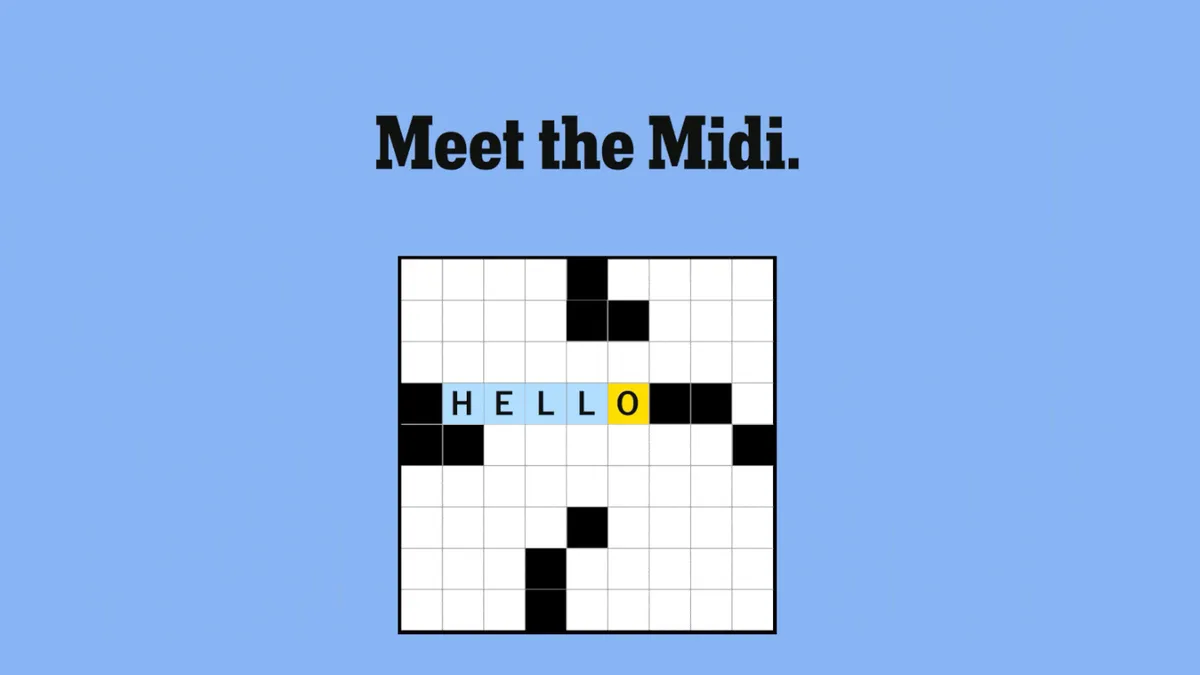
As the name “Midi” suggests, this is a mid-sized crossword puzzle. Where the Mini Crossword usually only has 5 Across and 5 Down clues, the Midi is usually a 9-by-9 puzzle, sometimes as long as 11-by-11.

“If you feel like the Mini is not enough but the Daily is too much, this will be the perfect puzzle for you,” Livengood said.

Each Midi Crossword has a theme that hints at the topics of the clues and answers. Unlike the other puzzles, Livengood says the Midi might occasionally have two-letter words and repeating answers.

I tried the Midi Crossword

Advertisement

I tried Wednesday’s Midi Crossword and solved it in just over 3 minutes. That’s much longer than I spend on the Mini Crossword, but much faster than the original New York Times crossword puzzle takes me. 

I thought most of the clues were pretty simple, and the few tricky ones filled themselves in once I moved from Across to Down.

If you’re a New York Times Games subscriber, this is a nice addition to your daily puzzle stable. It tests your mind a bit more than the Mini, but you can also solve it while watching TV or waiting for someone to text you back.

Advertisement

Source link

Continue Reading

Tech

Today’s NYT Connections: Sports Edition Hints, Answers for Feb. 26 #521

Published

on

Looking for the most recent regular Connections answers? Click here for today’s Connections hints, as well as our daily answers and hints for The New York Times Mini Crossword, Wordle and Strands puzzles.


Today’s Connections: Sports Edition is a fun one. I started mentally connecting the purple category answers right away. Movie-goers and TV watchers, this is a good puzzle for you. If you’re struggling with today’s puzzle but still want to solve it, read on for hints and the answers.

Connections: Sports Edition is published by The Athletic, the subscription-based sports journalism site owned by The Times. It doesn’t appear in the NYT Games app, but it does in The Athletic’s own app. Or you can play it for free online.

Advertisement

Read more: NYT Connections: Sports Edition Puzzle Comes Out of Beta

Hints for today’s Connections: Sports Edition groups

Here are four hints for the groupings in today’s Connections: Sports Edition puzzle, ranked from the easiest yellow group to the tough (and sometimes bizarre) purple group.

Yellow group hint: Meet the new boss.

Advertisement

Green group hint: SNL star.

Blue group hint: WNBA player.

Purple group hint: They’re not real.

Answers for today’s Connections: Sports Edition groups

Yellow group: Coaching decisions.

Advertisement

Green group: Will Ferrell sports movies.

Blue group: Associated with Diana Taurasi.

Purple group: Fictional coaches.

Read more: Wordle Cheat Sheet: Here Are the Most Popular Letters Used in English Words

Advertisement

What are today’s Connections: Sports Edition answers?

completed NYT Connections: Sports Edition puzzle for Feb. 26, 2026.

The completed NYT Connections: Sports Edition puzzle for Feb. 26, 2026.

NYT/Screenshot by CNET

The yellow words in today’s Connections

The theme is coaching decisions. The four answers are extend, fire, hire and promote.

The green words in today’s Connections

The theme is Will Ferrell sports movies. The four answers are Blades of Glory, Kicking & Screaming, Semi-Pro and Talladega Nights.

Advertisement

The blue words in today’s Connections

The theme is associated with Diana Taurasi. The four answers are Connecticut, Phoenix, six golds and White Mamba.

The purple words in today’s Connections

The theme is fictional coaches. The four answers are Bombay, Buttermaker, Dale and Lasso.

Source link

Advertisement
Continue Reading

Tech

The MOST Effective Thermal Mass Works Like A Sunburn

Published

on

Way, way back in the days when men wore beards and wide-lapelled suits in exotic colors, only NASA had access to photovoltaics and ‘solar’ meant solar thermal. In those days of appropriate technology, it was thought that the ultimate in thermal mass was a phase-change material– a salt or wax that in melting and re-freezing could hold far more heat than plain rock or water, which were more often used. Well, now that it’s the 21st century, we’ve got something even better. As Ars Technica reports about a recent paper in Science Magazine, Molecular Solar Thermal (MOST) energy storage can blow that old stuff right out of the water.

Molecular energy storage? That’s where the sunburn comes in. A sunburn occurs because proteins in your skin are denatured– kinked, twisted, and knocked out of shape– by ultraviolet light. The researchers realized that those kinky proteins are pretty energetic: like a spring, they’re storing energy in their distorted structure. Even better, certain chemicals, like the pyrimidone in the study, don’t ‘relax’ the way a phase change material does. It’s not a matter of warming up and giving up the energy stored in the molecular structure when cooling down– the energy needs coaxed out, in this case by an acidic solution.

That poses problems for a closed-loop system, since you’d be continuously diluting the pyrimidone with heat-releasing acid and neutralizing base. On the other hand, 1.65 MJ/kg of energy storage is nothing to sneeze at, especially when you’re collecting it with nothing more technically advanced than a fluid running through clear tubing. Conveniently enough, researchers found a way to make this stuff liquid at room temperature.

Comparing the heat in this MOST storage material to electrical potential in a battery is a case of apples and oranges, but in terms of pure energy density the pyrimidone cooked up for the paper is in the same range as Li-Ion batteries. There is some self-discharge, in that the altered “dewar” state of the pyrimidone decays naturally, but with a half-life of upto 481 days, you could imagine storing up a tankful UV-altered pyrimidone all year round to provide your winter’s heat.

Advertisement
There’s not much power making it to surface in the UV, but lower energy photons cannot effect the transition.

It’s not perfect. Right now you get about 20 “charge cycles” before the molecules break down, but then, if you’re using this for seasonal load-spreading, a two-decade service life is nothing to shake a stick at. It’s only collecting energy from the UV range of the spectrum, which is a tiny fraction of the energy from our sun. The quantum efficiency of the molecule is rather poor as well– it takes a lot of photons to get a dewar transition.

With solar photovaltaics being as cheap as they are, thermal builds are few and far between– even solar water heaters are powered by PV these days. Of course if you’re somewhere that doesn’t get much sun, you could always go for wind power instead.

Thanks to [zit] for the tip! If you’ve seen a bright idea in the wild, or have one yourself, our tips line is open rain or shine.

Source link

Advertisement
Continue Reading

Tech

Salesforce CEO Marc Benioff: This isn’t our first SaaSpocalypse

Published

on

Salesforce pulled out all the stops to convince investors that the AI revolution won’t be its death when it announced fourth-quarter earnings on Wednesday.

Salesforce reported a solid quarter of $10.7 billion in revenue, up 13% year-over-year. For the year, it reported $41.5 billion in revenue, up 10% over the previous year, with both results boosted by its $8 billion acquisition of data management company Informatica last May.

Net income landed at $7.46 billion, and the company offered strong guidance for the year ahead, projecting revenue of $45.8 billion to $46.2 billion — a 10% to 11% increase. It also said its “remaining performance obligation,” or RPO, is over $72 billion. That’s a figure that shows revenue under contact that has not yet been delivered or recognized as earned revenue.

The numbers, though, could only do so much. Software-as-a-service stocks, with Salesforce as their poster child, have been getting hammered lately. Investors fear the rise of AI agents will undermine these companies, making their per-employee-seat business models obsolete. The situation has been dubbed the “SaaSpocalypse.”

Advertisement

The concept hung so heavily in the air during the earnings call that CEO Marc Benioff mentioned the term at least six times.

“You’ve heard about the SaaSpocalypse? And it isn’t our first. We’ve had a few of them,” he said, later adding, “If there is a SaaSpocalypse, it may be eaten by the Sasquatch because there are a lot of companies using a lot of SaaS because it just got better with agents.”

In an attempt to convince the world of its continued health, Salesforce threw everything and the kitchen sink into this earnings report. The company increased its dividend by nearly 6% to $0.44 per share. It launched a new $50 billion share buyback program. That’s always a favorite with shareholders because it both creates a sturdy buyer of shares and reduces the number of shares in circulation (which can boost the stock price).

Techcrunch event

Advertisement

Boston, MA
|
June 9, 2026

The company also revamped the earnings call itself. It was part podcast, part infomercial, and part normal Q&A with a few questions from Wall Street analysts.

Advertisement

Instead of running through the numbers, Benioff interviewed three Salesforce customers on camera to testify to their love of its new agentic options: the CEO of home appliance company SharkNinja; the CEO of Wyndham Hotels and Resorts; and, just to hammer the point, the CEO of SaaStr, the software industry conference and media company. We’ll truncate the interviews to the shortest summary: They all love Salesforce’s AI agent products.

Salesforce also introduced a new metric for its agentic products: agentic work units (“AWU”). The idea here is that rather than simply counting “tokens” — the standard unit of AI processing volume — AWU attempts to measure something more meaningful: whether an agent actually completed a task, like writing to a record, rather than just generating text. (Salesforce logged 19 trillion tokens last quarter, which sounds like a lot but really is not in the AI world.)

“You can ask it a question and it can write you a poem, but that’s not really all that valuable in the enterprise world,” Salesforce president and CMO Patrick Stokes said on the call. So AWU is intended to measure when the agent writes to a record or does some other verifiable task.

On top of that, Salesforce also presented its own architectural vision of the coming world of agents. It shows SaaS software like itself owning most of the tech stack, with the AI model makers on the bottom as unseen, interchangeable, and commoditized work engines.

Advertisement

This was a direct counter to one of the causes of a SaaSpocalypse sell-off earlier this month, after OpenAI released its enterprise agent, Frontier. OpenAI’s architectural vision shows OpenAI owning most of the stack, with systems-of-record SaaS providers (the databases and business-software platforms where companies store their core data) on the bottom as the unseen engines.

And if all that wasn’t enough to influence investors: Benioff was dressed in a black leather jacket, echoing the signature look of the CEO clearly crushing it in the AI world: Nvidia’s Jensen Huang.

Source link

Advertisement
Continue Reading

Tech

Experience F1 tracks with 3D art in Apple Maps ahead of each race

Published

on

Apple Maps has been updated with a new “2026 Formula 1 Tracks Around the World” guide that showcases each racing location. Updated 3D art will be added throughout the season, starting now with Albert Park in Australia.

Apple Maps shown on iPad Pro with F1 tracks labeled around the globe and a sidebar explaining each track
Apple Maps gets F1 guide

It’s almost time for the first F1 season distributed by Apple TV to begin. Apple is known for its vertical integration and brand synergy, and it hasn’t wasted any time with F1 either.
As first discovered by 9to5Mac, Apple is promoting the F1 season in Apple Maps with a new guide. It is titled “2026 Formula 1 Tracks Around the World.”
Continue Reading on AppleInsider | Discuss on our Forums

Source link

Continue Reading

Tech

Today’s NYT Mini Crossword Answers for Feb. 26

Published

on

Looking for the most recent Mini Crossword answer? Click here for today’s Mini Crossword hints, as well as our daily answers and hints for The New York Times Wordle, Strands, Connections and Connections: Sports Edition puzzles.


Need some help with today’s Mini Crossword? Read on for all the answers. And if you could use some hints and guidance for daily solving, check out our Mini Crossword tips.

If you’re looking for today’s Wordle, Connections, Connections: Sports Edition and Strands answers, you can visit CNET’s NYT puzzle hints page.

Advertisement

Read more: Tips and Tricks for Solving The New York Times Mini Crossword

Let’s get to those Mini Crossword clues and answers.

completed-nyt-mini-crossword-puzzle-for-feb-26-2026.png

The completed NYT Mini Crossword puzzle for Feb. 26, 2026.

Advertisement

NYT/Screenshot by CNET

Mini across clues and answers

1A clue: Tesla or Toyota
Answer: CAR

4A clue: What the “M” of BMX stands for
Answer: MOTO

5A clue: Leafy lunch
Answer: SALAD

Advertisement

6A clue: Weighing device
Answer: SCALE

7A clue: “To be,” in Latin
Answer: ESSE

Mini down clues and answers

1D clue: Pepsi and Coke
Answer: COLAS

2D clue: Dickens’s “___ of Two Cities”
Answer: ATALE

Advertisement

3D clue: Took to another floor, as the [circled letters]
Answer: RODE

4D clue: Apple computers
Answer: MACS

5D clue: Dir. from San Francisco to Santa Monica
Answer: SSE

Advertisement

Source link

Continue Reading

Trending

Copyright © 2025