Tech
Advance Paris NOVA Range Debuts at AXPONA 2026 with Vintage Design and a Touch of French Attitude

Advance Paris came to AXPONA 2026 with a clear message: the NOVA range is not here to play nice. These modular integrated amplifiers lean hard into a vintage aesthetic with unmistakable French flair, while taking a very un-American approach to features by making streaming and Bluetooth optional add-ons. At these prices, that decision is going to raise eyebrows. It also might be the point.
Playback Distribution made something else equally clear on the show floor. They are not just moving boxes in the United States and Canada. With their new joint venture with Fidelity Imports, they are positioning themselves as one of the most influential forces in high end audio distribution right now. That matters when a brand like Advance Paris shows up with a full ecosystem that includes the award-winning APEX line, but puts the spotlight squarely on NOVA.
Rob Standley, President and Co-Founder of Playback Distribution, made time early Saturday morning to walk through the lineup alongside the Advance Paris team. The pitch was straightforward. Distinctive design, flexible architecture, and a product strategy that does not follow the same tired playbook as every other streaming amp on the market. Brands that think this is just another European curiosity are about to get a lesson in what strong distribution and retail execution can actually do.
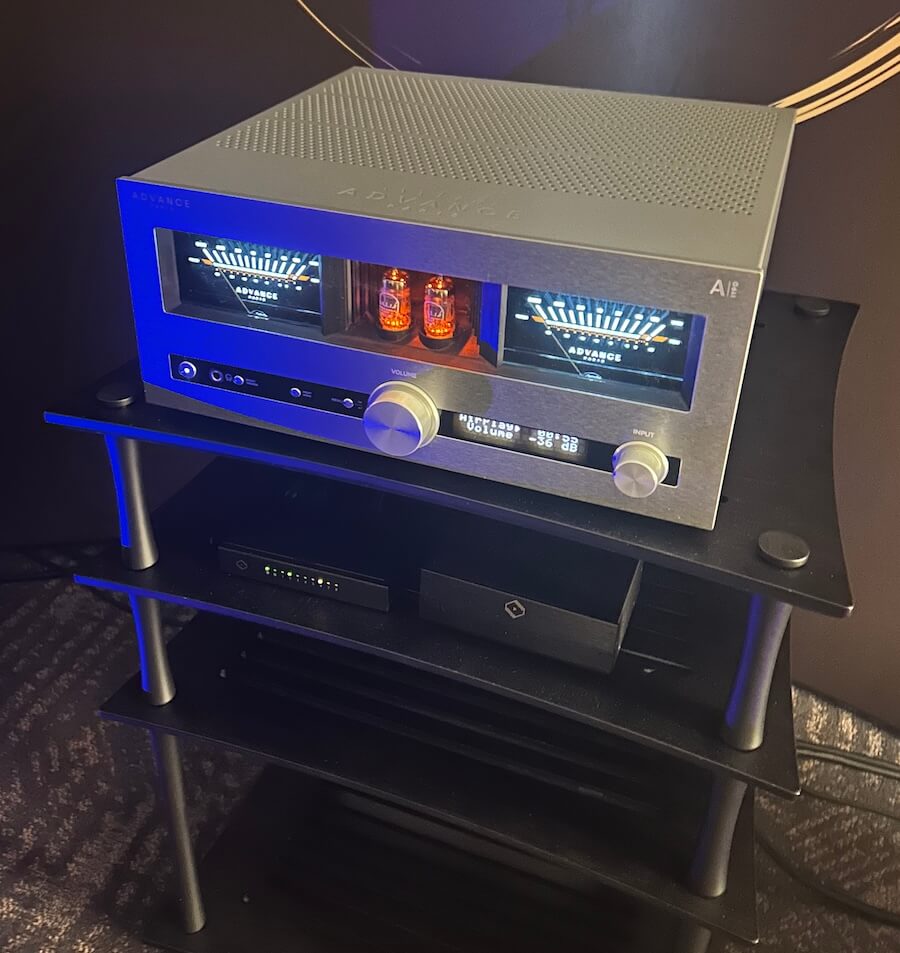

Modular French Integrated Amps with VU Meters That Tip Their Hat to American Vintage
If you’ve spent any time around French hi-fi, you know the extremes. It either strips everything back to the point of near invisibility or goes full statement piece. Devialet and Jadis lean into the theatrical side. Focal threads the needle with polished finishes, wood, and just enough flair. YBA and Lavardin go minimalist and call it a day.
Advance Paris does not follow any of those paths.
The NOVA series lands somewhere in between, but closer to the real world. Metal, glass, and just enough vintage influence to make it feel intentional rather than nostalgic. The VU meters are the tell. They are not there as decoration. They are a deliberate nod to American vintage gear, filtered through a French lens that knows exactly what it is doing.
And here is the part the marketing photos miss. In person, this gear has presence. The tubes glow with just enough warmth to draw your eye without turning the whole thing into a light show. People stop and look. Conversations start there.
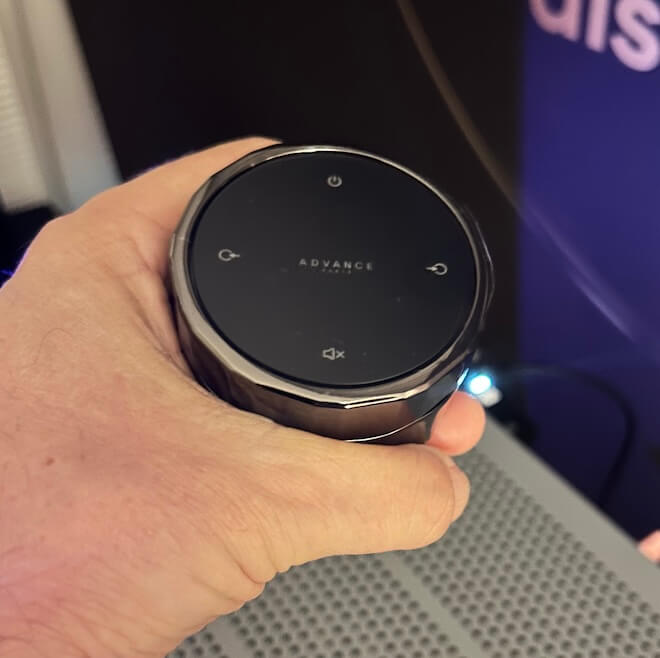
The optional remote is absurd in the best way. Heavy, overbuilt, and clearly designed by someone who has no interest in cutting corners. No plastic, no flex. It feels like it belongs in a design exhibit at the Centre Pompidou, not tossed on a coffee table next to a pile of remotes you never use and left to die next to your
The modular pieces, including the streaming and Bluetooth modules, are handled the way they should be. Plug them in, they work, and then you forget about them. No drama, no clutter, no need to babysit the system. The focus stays on the amplifier, where it belongs.
The integrated amplifiers are built like serious hardware. Dense, rigid, and confidence inspiring without feeling overdone. Think AMX-56 Leclerc in terms of intent and execution. This is not lightweight gear.
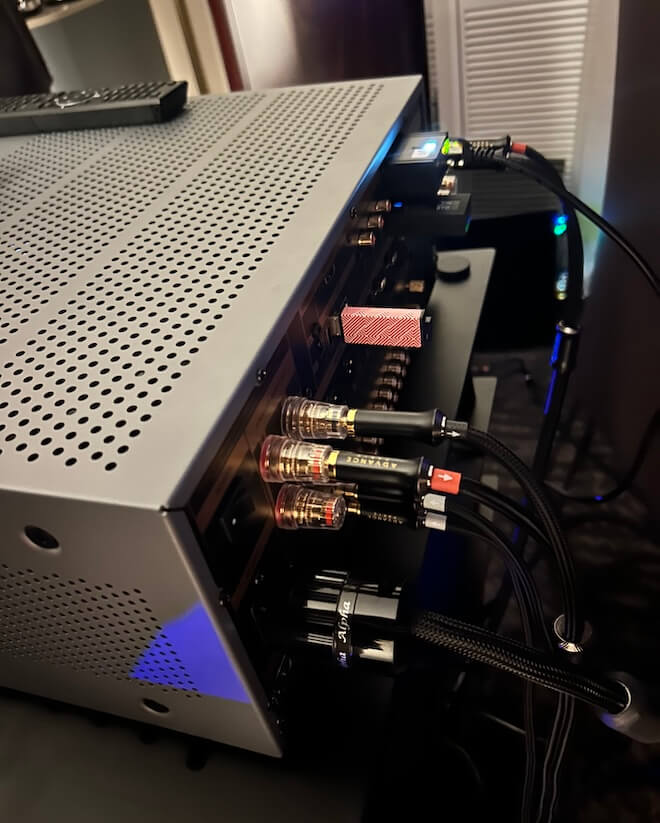
Around back, the connectivity is extensive and thoughtfully laid out. Plenty of inputs and outputs for real world systems, and none of it feels like it was added just to appease low-life reviewers. It draws you in quietly, the way Catherine Deneuve might in a small café in the Marais, cigarette in hand, a half-finished pastry on the table. Effortless, composed, and fully aware of the room without acknowledging it. You catch yourself looking, then looking again. At some point you stop pretending you’re not interested.
Hybrid Integrated Amplifiers with DSP, Dual Subwoofer Support, and Modular Expansion
Both the A-i130 and A-i190 follow the same design approach: an integrated amplifier that also serves as the central hub for a full system. Each combines hybrid amplification, DAC, DSP-based processing, and subwoofer management in a single chassis, with optional modules available for expansion.
Both models use a hybrid topology with an ECC81 tube stage in the preamplifier section feeding a Class A/B power amplifier. Digital conversion is handled by an ESS9017 DAC operating in Quad mode, paired with a 4-channel DSP that manages EQ and room correction for left, right, and up to two subwoofers.
The A-i130 measures 43 x 17.5 x 35.1 cm (16.9 x 6.9 x 13.8 inches) and weighs 13.3 kg (29.3 lbs). The A-i190 is larger at 43 x19.2 x 45.4 cm (16.9 x 7.6 x 17.9 inches) and weighs 19 kg (41.9 lbs).
Both amplifiers support 2.1 and 2.2 configurations with adjustable crossover and independent subwoofer control, allowing proper integration of one or two subs in a two-channel system.
Connectivity is consistent across both models. Inputs include HDMI eARC, USB with DSD support, multiple optical and coaxial digital inputs, five RCA line-level inputs, and an MM phono stage with ground. Outputs include pre-out, record out, dual subwoofer outputs, and a 6.35 mm headphone jack.
Each model supports optional expansion via the A-NTC streaming module and A-BTC Bluetooth module. These add network streaming capabilities and bi-directional Bluetooth, including headphone transmission. Both are also compatible with the optional rotary remote control.

The A-i190 builds on this platform with a dual mono design using two toroidal transformers, increasing output to 190 watts per channel and improving channel separation. It also adds balanced XLR inputs and a balanced XLR pre-out, alongside the RCA pre-out. The phono stage is upgraded to support both MM and MC cartridges. These additions allow the A-i190 to integrate into more complex systems without requiring external components.
Advance Paris A-NTC and A-BTC Modules
The A-NTC streaming cartridge is Advance Paris’ modular approach to network audio. It can operate as a standalone streamer via its optical output, adding streaming to any system with a digital input, or it can be installed directly into the A-i130 or A-i190 for a fully integrated solution with no external box or cabling.
Platform support covers Spotify Connect, TIDAL Connect, Qobuz Connect, AirPlay 2, Chromecast, DLNA, and Roon, with connectivity over Ethernet or Wi-Fi. Resolution is capped at 24-bit/192 kHz, which aligns with most current streaming services and use cases.
The A-BTC module adds bi-directional Bluetooth 5.4 using the same expansion slot. It allows both receive mode (streaming from a phone or tablet to the amplifier) and transmit mode (sending audio to wireless headphones), making it useful for flexible listening scenarios.
Codec support includes aptX HD, aptX Adaptive, aptX Low Latency, AAC, along with LDAC and aptX Lossless as confirmed at AXPONA 2026. This provides broad compatibility across devices, with support for higher-quality wireless audio and low-latency playback for video.

Listening with Vienna Acoustics
Playback Distribution covers a wide range of brands, including Esoteric, TEAC, Advance Paris, PMC, Velodyne, Amphion, AVID, Audio Solutions, and Vienna Acoustics. The A-i190 was paired with Vienna Acoustics Beethoven series loudspeakers, and in a relatively small room, the amplifier didn’t need much effort to get them moving.
Power was clearly not a limitation. Even at moderate levels, there was good control and a sense that the amplifier was operating comfortably within its limits rather than being pushed. That’s not always the case in show conditions.
The tonal balance leans slightly warm through the midrange, but the top end remains open with enough edge to avoid sounding soft. There’s solid weight through the midbass and below, with a level of control that keeps things from getting loose. It’s a presentation that feels balanced rather than exaggerated in any one direction.
Based on this brief listen, the A-i190 appears capable of working with a wide range of loudspeakers, including more demanding designs. Planar speakers from Magnepan or electrostatics like the Quad ESL-2912x seem within reason given the amplifier’s stability and output.
It’s still a show demo, so call it the first bite of the galette, not the one with the fève hidden inside. But there’s enough here to suggest this isn’t just style and attitude. There’s substance underneath, even if the French would probably shrug and tell you it was obvious all along.
For more information: advanceparis.com
You must be logged in to post a comment Login