TL;DR
Researchers found AI advice suppressed judgment suspension from 44% to 3%, accuracy from 27% to 9%, while confidence rose from 30% to 76%. People trusted wrong AI answers.




Researchers found AI advice suppressed judgment suspension from 44% to 3%, accuracy from 27% to 9%, while confidence rose from 30% to 76%. People trusted wrong AI answers.
Researchers from three French and Italian universities found that access to AI advice collapsed people’s willingness to say “I don’t know” from 44% to 3%. Accuracy dropped from 27% to 9%. Confidence, meanwhile, rose from 30% to 76%. “People became much worse, the accuracy was only one third, but they were twice as confident,” said Valerio Capraro, associate professor at the University of Milano-Bicocca.
The study, authored by Capraro with Chiara Marcoccia of École Normale Supérieure and Walter Quattrociocchi of Sapienza University of Rome, deliberately used questions where AI models typically fail: visual details from films, such as the colour of a team’s uniform in Bend It Like Beckham. The researchers used Step 3.5 Flash, a model that was usually wrong on these questions, precisely so any reduction in judgment could not be explained as sensible delegation to a reliable tool. Some participants who would have answered correctly on their own asked the AI and became wrong.
Monetary incentives helped, but not much. Willingness to admit ignorance rose from 3% to 8% and accuracy from 9% to 16%, both still well below the no-AI baselines of 44% and 27%. Wharton researchers coined the term “cognitive surrender” earlier this year to describe the same phenomenon: people accepting incorrect AI answers 80% of the time while reporting higher confidence than those working without AI. The new study adds a sharper data point. It is not just that people trust wrong AI answers. It is that the mere availability of AI suppresses the cognitive habit of recognising what you do not know.

The 💜 of EU tech
The latest rumblings from the EU tech scene, a story from our wise ol’ founder Boris, and some questionable AI art. It’s free, every week, in your inbox. Sign up now!
“For humans, the capacity to say ‘I don’t know’ is very important because it represents the recognition of the limits of our own knowledge,” Capraro said. He is particularly concerned about children, who are growing up with these systems before they have developed critical thinking skills. Google’s AI search overhaul replaced links with confident AI-generated summaries, and Common Sense Media this week called that design an “unacceptable risk” for students. The pattern is consistent: AI products are designed to answer, never to say “I don’t know.” The humans using them are learning to do the same.

Millions of WordPress websites could be at serious risk, researchers are warning, due to two recently patched vulnerabilities that are being actively exploited in the wild.
WordPress developers released a patch for two vulnerabilities – an SQL injection bug tracked as CVE-2026-60137, and a REST API batch-route confusion bug, tracked as CVE-2026-63030.
The former is a medium-severity, 5.9/10 vulnerability affecting WordPress 6.8.x before 6.8.6, 6.9.x before 6.9.5, and 7.0.x before 7.0.2, while the latter is a critical-severity, 9.8/10 flaw affecting versions 6.9.x before 6.9.5 and 7.0.x before 7.0.2 of the world’s most popular website builder.
According to The Register, these bugs are not that dangerous when looked at separately, since they are rather difficult to exploit. However, when chained together, they allow unauthenticated threat actors to execute malicious code remotely, which means full website takeover.
Security researchers at Knott say threat actors picked up on the scent rather quickly.
The patch was released on Friday, but “by the early hours of Saturday morning, successful exploitation was already well underway, initially using public exploit code to exfiltrate hashed credentials, with remote code execution following once additional details were made public,” Knott said.
“From our vantage point across a global client base, we are seeing widespread impact of this vulnerability across organizations of every size and every vertical.”
It is worth mentioning that these vulnerabilities affect WordPress directly, instead of different plugins or themes. WordPress is by far the most popular website builder platform in the world, powering more than half of all websites in existence today.
To protect your assets, make sure to upgrade WordPress to version 6.9.5, since it contains fixes for both flaws.

The best antivirus for all budgets

Follow TechRadar on Google News and add us as a preferred source to get our expert news, reviews, and opinion in your feeds.


The U.S. Justice Department has seized more than 1,000 websites and blocked 1,970 domains used to stream FIFA World Cup 2026 matches without authorization.
Law enforcement authorities identified the seized domains using leads provided by U.S. authorities, FIFA (Fédération Internationale de Football Association), the Motion Picture Association’s Alliance for Creativity and Entertainment (ACE), and multiple entertainment networks, including beIN Media Group, NBCUniversal, Ultimate Fighting Championship (UFC), and Warner Bros.
These seizures are part of several joint law enforcement actions based on investigations by the National Intellectual Property Rights Coordination Center (IPR Center) and the U.S. Homeland Security Investigations (HSI) Washington.

The Justice Department’s Criminal Division seized over a thousand domains as part of Operation Offsides, a joint law enforcement action led by the IPR Center in coordination with HSI Washington and involving 14 partners across 54 countries, including nearly 400 web domains by the end of last month.
“Operation Offsides is part of the Department’s ongoing effort to protect copyright while reducing the risk to American consumers from the malicious software embedded in many illicit streaming services,” said Assistant Attorney General A. Tysen Duva.
“These streamers not only violate copyright laws but also expose viewers to potential threats — including malware attacks and unsecure connections that can compromise personal and financial data,” added HSI Special Agent in Charge Eric Weindorf.

In coordination with the Justice Department’s International Computer Hacking and Intellectual Property program, law enforcement authorities also carried out “Operation Red Card,” blocking hundreds of illegal streaming sites in Argentina, Ecuador, Peru, Brazil, the Dominican Republic, and Colombia.
A second phase of Operation Red Card launched July 10 in Colombia also led to the arrest of four members of the Los Ciberinfiltrados cybercriminal group, charged with illegally accessing telecommunications systems and selling pirated streaming content since at least 2024.
“The unauthorized broadcast of World Cup matches violates intellectual property rights and fuels criminal organizations,” noted IPR Center director Ivan J. Arvelo. “Through Operation Offsides and strong partnerships with law enforcement and the private sector, we identified and seized hundreds of domains, disrupting those who steal and distribute copyrighted content.”
The announcement comes after the FBI’s warning in May that fake websites impersonating FIFA ahead of the 2026 World Cup were selling fake tickets and hospitality packages, stealing personal and financial information, and pushing other scams and fraud attempts related to the event.
In June, Mexican authorities also shut down 44 domains linked to the illegal PirloTV streaming platform and a major sports piracy ring. Collectively, these domains generated over 950 million visits every year, including around 230 million visits from Mexico alone.

Security teams log 54% of successful attacks and alert on just 14%. The rest move through your environment unseen.
The Picus whitepaper shows how breach and attack simulation tests your SIEM and EDR rules so threats stop slipping by detection.
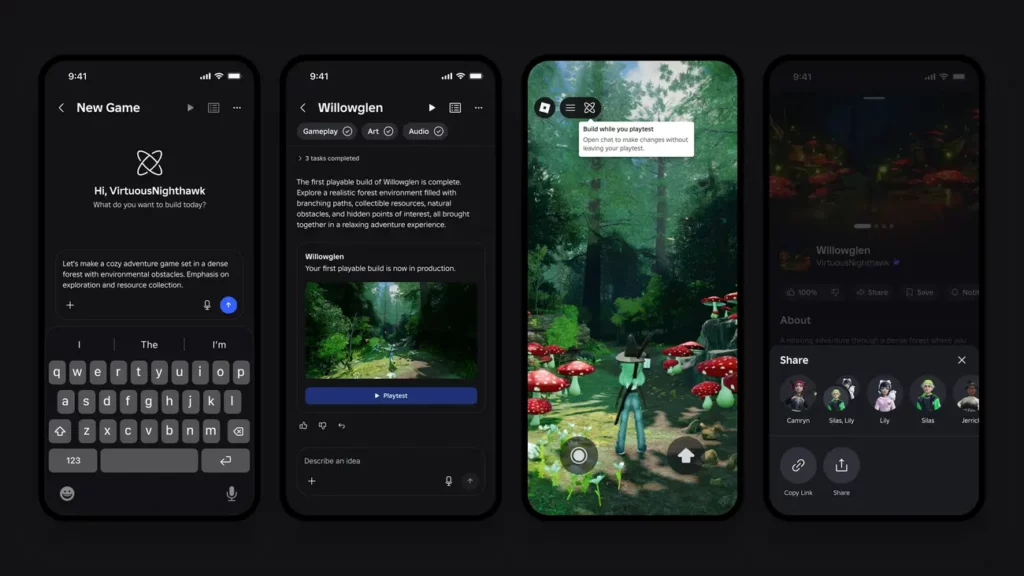
With over 132 million daily active users, Roblox has become one of the world’s biggest platforms for user-created games. Now, the company is taking game creation a step further by launching Build, a new AI-powered tool that allows users to create games using natural language prompts. Roblox says the feature will make game development more accessible to everyone.

Roblox Build is a new feature that makes game creation easier for everyone. The feature introduces a mobile-first creation tab in the Roblox app, which lets users create games virtually from anywhere as long as they write a brief description of what kind of game they want to create using a short text command. The AI creates a playable template of the game, which creators can then customize after testing. After testing and refining the game, it can be posted to Roblox. One can even move to Roblox Studio when more advanced editing features are required, as both platforms work hand in hand.
The Build tool uses AI to do a number of things automatically within the game development process. With the help of Roblox AI and other types of AI technology, Build can create anything from characters and worlds to gameplay, sound effects, and graphics. Roblox says its AI has been trained using gaming-specific data and a large library of 3D models. As a result, it can create game-ready objects and fully playable scenes, helping more users bring their ideas to life.
Roblox plans to expand Studio with a new suite of AI tools for creators. One AI agent will automatically test games and find bugs before release. Another will provide easy-to-understand insights about game performance, and a third will recommend ways to boost player retention and monetization. In addition, Roblox is building AI technology that can generate editable 3D scenes from simple text descriptions.
Roblox is launching Build in public alpha starting July 28. The ability to publish games will first reach selected creators in New Zealand, before expanding to additional countries in the coming months. The company says age-verified users aged 9 and older can use Build during the testing phase. However, only games that clear Roblox’s safety checks will be available to age-verified users aged 16 and above. Roblox also plans to keep the basic version free while introducing paid options for power users later.
According to Roblox, these tools are part of its vision to let anyone turn a game idea into reality. By making development simpler, the company hopes more creators will build and publish engaging games on the platform.


Revolut has major plans to become ‘the world’s first truly global bank’.
Revolut establishes its first banking entity in the Asia-Pacific after receiving regulatory approval in Australia.
With this latest approval, Revolut adds Australia to its full-licensed-banking-footprint across the UK, Mexico and the European Economic Area (EEA).
The company, with its existing retail customer base of more than 1m in the country, will now be competing for market share with Australian banking big wigs Commonwealth Bank, National Australia Bank, Westpac and the ANZ Group.
The UK fintech, which operates across 40 markets and serves more than 75m customers, is aggressively expanding its footprint in a bid to become “the world’s first truly global bank”. It recently won regulatory approval in Peru and the United Arab Emirates, and has applied for a banking license in the US.
Revolut’s regulatory success in Australia comes alongside a nearly A$400m investment commitment into the country over the next five years, including across growth and workforce.
“Launching our Australian bank has been a long-term strategic priority and marks another significant step in our mission to build the world’s first truly global bank. Securing this licence in a market as highly regulated and competitive as Australia is a testament to our business model and our teams,” said Nik Storonsky, the founder and CEO of Revolut.
Matt Baxby, the CEO at Revolut Bank Australia said: “It’s the launchpad for our next chapter, enabling us to expand into a broader suite of products, including savings and credit, to sit alongside the innovative services our customers already rely on every day.
“Our mission remains simple; to build the most seamless, secure, and customer-first banking experience for Australian consumers and businesses.”
The fintech reported its fifth consecutive year of net profitability with gross revenues up 46pc to $6bn in 2025, up from $4bn the year before. It is reportedly gearing to go public around 2028 for a valuation of between $150bn and $200bn.
The company also shared plans to pilot a physical store in Barcelona with a new format built for “how modern customers engage with brands today”.
Don’t miss out on the knowledge you need to succeed. Sign up for the Daily Brief, Silicon Republic’s digest of need-to-know sci-tech news.

Connecting the dots: The anti-PlayStation backlash does not appear to have cooled in the weeks following Sony’s announcement that it will cease manufacturing physical game discs in January 2028. However, despite online sentiment, available sales data shows that angry consumers are not voting with their wallets.
Circana analyst Mat Piscatella recently stated that only seven PlayStation games have sold more than 100,000 physical copies in the first half of 2026. Only two sold more than 10,000 during the week ending July 11, potentially vindicating Sony’s claim that PlayStation owners overwhelmingly prefer digital purchases.
Piscatella’s statistic came in response to the more than 10,000 comments that flooded a recent trailer for the upcoming Sony-published title Wolverine, set to launch September 15. Compared to other Sony trailers with larger view counts, the figure suggests that conversations about the company’s impending digital-only era remain heated.
2 PlayStation video games sold more than 10k physical units in the US during week ending July 11, 2026. 7 have sold more than 100k physical units year-to-date. Source: Circana Retail Tracking Service
– Mat Piscatella (@matpiscatella.bsky.social) July 20, 2026 at 1:37 PM
Although Piscatella’s figures offer only a snapshot of US sales, other numbers paint a similar picture. A Change.org petition demanding Sony continue manufacturing discs has exceeded 300,000 signatures, but Dr. Serkan Toto, CEO of Japanese game industry consultancy firm Kantan Games, recently told IGN that the number is dwarfed by the roughly 50 million PlayStation Plus subscribers.
Sony’s 2025 fiscal year statement also confirms that 78% of the games it sold that year were digital, though the number includes titles that are only available digitally, which constitute the majority of the PlayStation 5’s library. The remaining 22% of sales were physical, amounting to nearly 70 million discs. For those curious, the PlayStation titles that have exceeded 100,000 physical units so far this year are, in order, Resident Evil Requiem, Crimson Desert, MLB The Show 26, 007 First Light, Lego Batman, WWE 2K26, and Call of Duty Black Ops 7.

Frustrated users who prefer physical games are likely powerless to change the PlayStation maker’s course. The company has already begun winding down disc manufacturing operations at its final plant, although games released before 2028 can still receive additional print runs after the cutoff date. Furthermore, the European Union confirmed that it cannot stop console manufacturers from abandoning physical media.
Jumping ship to Microsoft will likely not be an option for long. Rumors suggest that the company is strongly considering forgoing an optical drive for its next Xbox console, expected in 2027 or 2028. However, Microsoft is also reportedly developing a method to transfer physical game copies to digital-only devices.


If you’re tired of buying ink cartridges every few months, this is a good time to switch to a cartridge-free tank printer. Right now, the HP Smart Tank 5101 is $170 (was $260) at Amazon, and comes with 2 years of ink already included in the box.
For home, dorm room, home office, and small businesses printing a mix of monochrome and color documents and photos, it’s an ideal pick. Particularly as HP‘s ink tank printers tend to have larger tank reservoirs compared to rivals like Epson‘s EcoTank range.
✅ Buy it if…
You want to save on running costs because bottled ink is much cheaper than inkjet cartridges and you get four bottles free in the box. We recommend ink tank printers if you’re chiefly printing documents and photos.
❌ Skip it if…
You’re mostly printing text documents – a high-volume laser printer is a much better option for sharper, bolder on-page text.
Having tested HP’s Smart Tank line alongside the Epson EcoTank, Canon MegaTank, and Brother INKvestment range, we strongly recommend ink tank printers over traditional inkjet models that use cartridges.
The pitch for tank printers like the HP Smart Tank 5101 is straightforward: instead of buying ink cartridges that run out every few hundred pages, you refill four visible ink tanks from bottles, and each bottle lasts dramatically longer. HP estimates the included set of ink bottles is good for roughly 6000 pages.
Setup leans on HP’s Smart app, which walks through Wi-Fi connection and initial configuration with guided, step-by-step prompts rather than dropping you into a printer’s typically clunky onboard menu system. Once connected, illuminated smart buttons on the printer itself are meant to guide you through common tasks like printing, scanning, and copying.
Print speed is modest rather than fast — HP rates this around 12 pages per minute for black-and-white and 5 pages per minute for color in normal mode, with the higher-quality “best” setting slower still. That’s typical for tank printers in this price range, and fine for everyday home printing, but not the machine to reach for if you regularly print large batches of documents quickly.
This isn’t the cheapest the 5101 has ever been – back in 2024, it dropped to an all-time low of $140 direct from Amazon. However, it’s cheaper now than any third-party seller has sold it before brand-new ($180 was the price back in April 2025). Typically, we see it selling at around the $190 to $250 mark when not on sale. The highest price it’s been sold for is $280. Right now, it’s also available for $170 at Best Buy, too.
A few honest caveats worth flagging: some reviewers have reported software quirks and occasional paper jams with this model, and if you print only occasionally rather than regularly, the ink in an inkjet’s print head can dry out and clog between uses. This is best suited to households or small offices that print often enough to make the low cost-per-page actually pay off.
For more options, see our guides to the best home printers and best ink tank printers we’ve personally tested.

Motorola’s next device appears determined to bring audio hardware for the rest of the room to watch along. It recently unveiled a powerful new Edge phone, and now, the Moto Pad 70 Groove will launch on July 31 with a nine-unit JBL speaker system capable of delivering up to 48 watts of output. The company has confirmed that the audio-focused tablet will pair those speakers with a 12.1-inch display and a sizable battery designed for long streaming sessions. But we still have no official word on its pricing and global availability.

The unusual sound system contains four tweeters, three woofers, and two passive radiators. JBL handled the audio tuning, while Dolby Atmos and Hi-Res Audio complete the package. It also supports 7.2-channel surround sound, which makes it a solid entertainment machine.
A rotating ring on the rear doubles as a stand, allowing the tablet to sit in portrait or landscape orientation. Motorola has also placed dedicated volume controls on the back, and the device can operate as a Bluetooth speaker for music playing from a phone. Those additions could make the Pad 70 Groove particularly useful around the house. It could sit on a kitchen counter for recipes and podcasts, handle films without immediately demanding headphones, or provide music without requiring a separate portable speaker.

Motorola has confirmed a 12.1-inch “2.5K” panel with a 120Hz refresh rate. It reaches up to 800 nits in High Brightness Mode and supports HDR10 and Dolby Vision, making the device sound purpose-built for video rather than another generic Android slate with louder branding.
A 10,200mAh battery sits inside, with Motorola claiming up to 15 hours of video playback. The company will include a 68W charger. Going by its name, it is also a part of the Pad 70 series, and we did cover the Pad 70 Pro in the past. Performance and price will ultimately decide whether this is a good tablet. But the bigger doubt is if it will be released outside of India.

A new rumor claims that Apple is considering using what it will call a 7-inch screen for one of the 20th anniversary iPhones, although that isn’t as great an increase as it sounds.
One recent rumor claimed that Apple had begun production evaluation for a 2027 iPhone with a display that is curved on all four sides. Then another claimed that the iPhone 20 range would feature a significant redesign.
For the first time, though, a leaker is claiming that Apple is testing what would be its largest iPhone screen. According to Digital Chat Station on Chinese social media site Weibo, if it goes ahead with this screen, Apple will market it as being a 7-inch one.
The claim says, though, that it would actually be 6.96 inches. That’s close enough for Apple’s marketing, but it seems less significant since the current iPhone 17 Pro Max screen is 6.86 inches.
Still, screen sizes are measured diagonally so such a difference could amount to the iPhone 20 Pro Max screen being up to 2% larger than the current model. That’s enough to be noticeable in the hand, although there’s no indication yet whether the pixel density will remain the same.
The last time Apple increased the screen size of its iPhones was in 2024. Then the iPhone 16 Pro Max went up from 6.7 inches to 6.9 inches, while the iPhone 16 Pro screen was 6.3 inches where its predecessor had a 6.1 inch display.
Digital Chat Station says that the new, larger screen size has not been decided on. This leaker has a reasonable track record with Apple leaks, and has recently reported rumors about the screen size of the iPhone Fold 2.
Presented by JumpCloud
The organizations losing confidence in AI are the ones most likely to get it right.
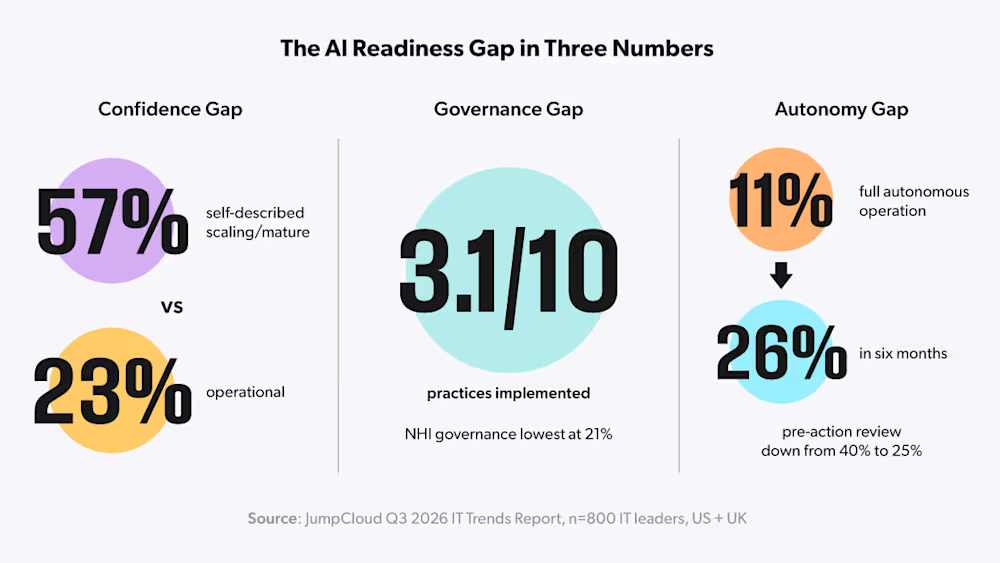
Six months ago, 40% of IT leaders described their organizations as mature in AI deployment. Today that number is 23%. Before you read that as a setback, consider what it actually reflects.
We recently surveyed 800 IT leaders across the U.S. and U.K. for our Q3 2026 trends report, and the data tells a consistent story: the organizations revising their self-assessment downward are overwhelmingly the ones that have moved AI agents from pilots into production. They’re not losing faith in AI. They’re running into the problems that only show up when agents are doing real work in real systems, and they’re being honest about what they found.
That kind of honesty is harder to come by than it sounds, and it matters more than the confidence number itself.
84% of organizations plan to expand AI use in IT operations over the next 6 to 24 months, so the drop in confidence isn’t a retreat. What it reflects is a more accurate picture of what production actually requires.
In a pilot, an AI agent does one thing in a controlled setting. In production, it accesses real systems, makes decisions that affect real workflows, and operates continuously, often without a human in the loop. The governance infrastructure that entails is materially different from what it took to get the pilot working. Most organizations built enough to ship. Fewer built enough to scale.
The IT leaders revising their self-assessment are confronting questions they didn’t have to ask at the pilot stage: Can we see every agent running in our environment? Do we know what each one can access? If an agent behaved unexpectedly last week, how long would it take to find out? For most organizations, at least one of those answers is uncomfortable.

The graphic above captures the structural problem. Across confidence, governance, and autonomy, the same pattern holds: deployment is moving faster than the controls built around it.
The organizations that have closed this gap share specific characteristics. They’ve consolidated their IT environments rather than adding tools to solve each new problem, because every additional platform creates another place where agent identity, access, and accountability can go unmanaged. They treat AI agents as governed identities rather than tolerated shadow processes. And they measure what AI actually produces, not just what it deploys.
The payoff is tangible. Organizations in the top tier of our maturity model are five times more likely to report no barriers to expanding their AI agents than the average organization. They are not more cautious about AI. They are more confident in it, because they built the foundation that makes confidence earned rather than assumed.
The hardest problem in enterprise AI right now is not capability. It is accountability, and the data makes the specific failure point clear: non-human identity governance is the least adopted AI security practice we measured, in place at just 21% of organizations.
Non-human identities now outnumber human users in 83% of organizations, and that population is growing fast. Yet most of those identities exist without the governance structures that every human employee has as a matter of course: no formal record, no named owner, no defined scope of access, no offboarding process when their purpose expires. They keep running. They keep accessing systems. They keep accumulating permissions. We call these Zombie Agents, and they are the service account problem of the AI era, operating at machine speed and in every department.
The accountability gap is where real risk lives. When a human employee takes an action, there is an implicit accountability chain. When an autonomous agent takes an action, that chain breaks unless it has been deliberately engineered. Most organizations have not yet engineered it, and the gap between the autonomy agents are being granted and the oversight structures in place to manage them is widening every month.
When AI maturity confidence was uniformly high across the market, that was worth worrying about. It meant most organizations hadn’t yet run into the hard parts. A selective drop, concentrated among organizations actively running agents in production, means the market is developing a more accurate picture of what AI operations genuinely require.
The organizations recalibrating are doing the work that makes long-term AI adoption possible: building identity infrastructure that covers agents alongside humans and devices, unifying the environments where governance needs to apply, and measuring outcomes rather than just counting deployments. They haven’t lowered their ambitions for AI. They have raised their standards for what it means to run it responsibly.
84% of organizations plan to expand AI use over the next two years. The ones that will do it well are honest enough, right now, to admit what they haven’t yet built.
JumpCloud’s Q3 2026 AI Readiness Research report (n=800 IT leaders, U.S. + U.K.) is available here. The report covers AI agent deployment stages, identity governance gaps, IT unification benchmarks, and budget realism across mid-market and enterprise organizations.
Rajat Bhargava is CEO and Co-founder at JumpCloud.
Sponsored articles are content produced by a company that is either paying for the post or has a business relationship with VentureBeat, and they’re always clearly marked. For more information, contact sales@venturebeat.com.

Rudra “Rudy” Mitra, who spent more than 27 years at Microsoft and most recently led its Purview data-security business, is joining Amazon Web Services as vice president of security services.
Mitra will oversee an AWS portfolio that includes tools such as GuardDuty and Security Hub, which companies use to track security risks across their cloud accounts. AWS recently added AI-specific threat detection to GuardDuty and, perhaps notably given today’s news, extended Security Hub to monitor AI workloads and security inside Microsoft Azure.
He will report to Chet Kapoor, the former DataStax CEO whom AWS hired last year as vice president of search, security and observability, a role that reports to AWS CEO Matt Garman.
“Rudy brings decades of security experience, a passion for building, and a deep understanding of what customers need as the security landscape continues to evolve,” Kapoor wrote on LinkedIn.
Mitra joined Microsoft in 1999 straight out of college, working on early efforts to deliver Office as an online service before launching Purview, the company’s data-security and governance product, in 2014. He announced his exit from Microsoft last week, addressing what was next at the time by saying only that there was “more on that soon.”
His departure comes amid a broader reshuffling of Microsoft’s security leadership this year under Hayete Gallot, who returned from Google in February to run the group and has been reshaping its executive ranks in recent weeks and months.
Gallot replaced Charlie Bell, who had joined from AWS in 2021 and continues at Microsoft as an individual contributor focused on engineering quality. She’s been overhauling the group’s product lineup, according to The Information, which reported last week that at least nine corporate vice presidents who reported to Bell have left the company this year.
Rohan Kumar left for Salesforce in June, Vasu Jakkal stepped down after six years. Krishna Kumar Parthasarathy departed this month after 28 years. Joy Chik, president of identity and network access, announced her retirement in April.
On the inbound side at Microsoft, Naseem Tuffaha returned in June to fill the corporate VP role Kumar had left, after nearly two decades at the company and a stint away.
When Gallot arrived, Microsoft named Ales Holecek, a longtime engineering leader, as the security group’s chief architect, reporting to her. David Weston, another veteran Microsoft executive, also reportedly shifted into the security unit earlier this year.





London Mayor Sadiq Khan handed a peerage by Keir Starmer alongside 15 other Labour figures… just days before the PM leaves No10


Weekend Open Thread – Corporette.com


The House | The City of London can help the new chancellor deliver growth in every postcode


Young campaigners urge incoming PM to act on outdoor junk food ads


CFTC blocks Kalshi from unwinding Michigan trades after court order

Two July Windows Left: The CLARITY Act’s Senate Fight and What Failure Means


Ripple Payments Joins MiCA With 14 Firms, Does It Mean Anything For XRP?


Nvidia Stock Slips After Big Tuesday Rally as Huang Confirms Vera Rubin Chip Is Now in Production Today


Democrats look to World Cup watch parties to register thousands of voters

Disney’s Most Ambitious Failed Star Wars Attraction Is Coming to SDCC


Ripple wins EU-wide access as ESMA adds it to MiCA register


Palantir Shares Rise After Expanded Nvidia Partnership and Fresh Analyst Upgrades Ahead of Earnings Day


Grayscale Files For Worldcoin ETF, WLD Registers Sharp Rise


Injective Submits SEC Transfer-Agent Registration to Onchain Ownership Records


Sail Virtually Aboard The “Itanic” With IA-64 Emulator
Turtle Beach Command Series KB7 review: a nifty screen-equipped gaming keyboard


Dark Secrets Emerge When Jailbreaking LLMs


Registration is now open for March for Men with Kev 2026


XRP BOMBSHELL… XRP OMBOARDED FOR TRANSACTIONS!!!


Unregistered fitter used Gas Safe logo on business flyers


You must be logged in to post a comment Login