Four separate RSAC 2026 keynotes arrived at the same conclusion without coordinating. Microsoft’s Vasu Jakkal told attendees that zero trust must extend to AI. Cisco’s Jeetu Patel called for a shift from access control to action control, saying in an exclusive interview with VentureBeat that agents behave “more like teenagers, supremely intelligent, but with no fear of consequence.” CrowdStrike’s George Kurtz identified AI governance as the biggest gap in enterprise technology. Splunk’s John Morgan called for an agentic trust and governance model. Four companies. Four stages. One problem.
Matt Caulfield, VP of Product for Identity and Duo at Cisco, put it bluntly in an exclusive VentureBeat interview at RSAC. “While the concept of zero trust is good, we need to take it a step further,” Caulfield said. “It’s not just about authenticating once and then letting the agent run wild. It’s about continuously verifying and scrutinizing every single action the agent’s trying to take, because at any moment, that agent can go rogue.”
Seventy-nine percent of organizations already use AI agents, according to PwC’s 2025 AI Agent Survey. Only 14.4% reported full security approval for their entire agent fleet, per the Gravitee State of AI Agent Security 2026 report of 919 organizations in February 2026. A CSA survey presented at RSAC found that only 26% have AI governance policies. CSA’s Agentic Trust Framework describes the resulting gap between deployment velocity and security readiness as a governance emergency.
Cybersecurity leaders and industry executives at RSAC agreed on the problem. Then two companies shipped architectures that answer the question differently. The gap between their designs reveals where the real risk sits.
Advertisement
The monolithic agent problem that security teams are inheriting
The default enterprise agent pattern is a monolithic container. The model reasons, calls tools, executes generated code, and holds credentials in one process. Every component trusts every other component. OAuth tokens, API keys, and git credentials sit in the same environment where the agent runs code it wrote seconds ago.
A prompt injection gives the attacker everything. Tokens are exfiltrable. Sessions are spawnable. The blast radius is not the agent. It is the entire container and every connected service.
The CSA and Aembit survey of 228 IT and security professionals quantifies how common this remains: 43% use shared service accounts for agents, 52% rely on workload identities rather than agent-specific credentials, and 68% cannot distinguish agent activity from human activity in their logs. No single function claimed ownership of AI agent access. Security said it was a developer’s responsibility. Developers said it was a security responsibility. Nobody owned it.
CrowdStrike CTO Elia Zaitsev, in an exclusive VentureBeat interview, said the pattern should look familiar. “A lot of what securing agents look like would be very similar to what it looks like to secure highly privileged users. They have identities, they have access to underlying systems, they reason, they take action,” Zaitsev said. “There’s rarely going to be one single solution that is the silver bullet. It’s a defense in depth strategy.”
Advertisement
CrowdStrike CEO George Kurtz highlighted ClawHavoc (a supply chain campaign targeting the OpenClaw agentic framework) at RSAC during his keynote. Koi Security named the campaign on February 1, 2026. Antiy CERT confirmed 1,184 malicious skills tied to 12 publisher accounts, according to multipleindependent analyses of the campaign. Snyk’s ToxicSkills research found that 36.8% of the 3,984 ClawHub skills scanned contain security flaws at any severity level, with 13.4% rated critical. Average breakout time has dropped to 29 minutes. Fastest observed: 27 seconds. (CrowdStrike 2026 Global Threat Report)
Anthropic separates the brain from the hands
Anthropic’s Managed Agents, launched April 8 in public beta, split every agent into three components that do not trust each other: a brain (Claude and the harness routing its decisions), hands (disposable Linux containers where code executes), and a session (an append-only event log outside both).
Separating instructions from execution is one of the oldest patterns in software. Microservices, serverless functions, and message queues.
Credentials never enter the sandbox. Anthropic stores OAuth tokens in an external vault. When the agent needs to call an MCP tool, it sends a session-bound token to a dedicated proxy. The proxy fetches real credentials from the vault, makes the external call, and returns the result. The agent never sees the actual token. Git tokens get wired into the local remote at sandbox initialization. Push and pull work without the agent touching the credential. For security directors, this means a compromised sandbox yields nothing an attacker can reuse.
Advertisement
The security gain arrived as a side effect of a performance fix. Anthropic decoupled the brain from the hands so inference could start before the container booted. Median time to first token dropped roughly 60%. The zero-trust design is also the fastest design. That kills the enterprise objection that security adds latency.
Session durability is the third structural gain. A container crash in the monolithic pattern means total state loss. In Managed Agents, the session log persists outside both brain and hands. If the harness crashes, a new one boots, reads the event log, and resumes. No state lost turns into a productivity gain over time. Managed Agents include built-in session tracing through the Claude Console.
Pricing: $0.08 per session-hour of active runtime, idle time excluded, plus standard API token costs. Security directors can now model agent compromise cost per session-hour against the cost of the architectural controls.
Nvidia locks the sandbox down and monitors everything inside it
Nvidia’s NemoClaw, released March 16 in early preview, takes the opposite approach. It does not separate the agent from its execution environment. It wraps the entire agent inside four stacked security layers and watches every move. Anthropic and Nvidia are the only two vendors to have shipped zero-trust agent architectures publicly as of this writing; others are in development.
Advertisement
NemoClaw stacks five enforcement layers between the agent and the host. Sandboxed execution uses Landlock, seccomp, and network namespace isolation at the kernel level. Default-deny outbound networking forces every external connection through explicit operator approval via YAML-based policy. Access runs with minimal privileges. A privacy router directs sensitive queries to locally-running Nemotron models, cutting token cost and data leakage to zero. The layer that matters most to security teams is intent verification: OpenShell’s policy engine intercepts every agent action before it touches the host. The trade-off for organizations evaluating NemoClaw is straightforward. Stronger runtime visibility costs more operator staffing.
The agent does not know it is inside NemoClaw. In-policy actions return normally. Out-of-policy actions get a configurable denial.
Observability is the strongest layer. A real-time Terminal User Interface logs every action, every network request, every blocked connection. The audit trail is complete. The problem is cost: operator load scales linearly with agent activity. Every new endpoint requires manual approval. Observation quality is high. Autonomy is low. That ratio gets expensive fast in production environments running dozens of agents.
Durability is the gap nobody’s talking about. Agent state persists as files inside the sandbox. If the sandbox fails, the state goes with it. No external session recovery mechanism exists. Long-running agent tasks carry a durability risk that security teams need to price into deployment planning before they hit production.
Advertisement
The credential proximity gap
Both architectures are a real step up from the monolithic default. Where they diverge is the question that matters most to security teams: how close do credentials sit to the execution environment?
Anthropic removes credentials from the blast radius entirely. If an attacker compromises the sandbox through prompt injection, they get a disposable container with no tokens and no persistent state. Exfiltrating credentials requires a two-hop attack: influence the brain’s reasoning, then convince it to act through a container that holds nothing worth stealing. Single-hop exfiltration is structurally eliminated.
NemoClaw constrains the blast radius and monitors every action inside it. Four security layers limit lateral movement. Default-deny networking blocks unauthorized connections. But the agent and generated code share the same sandbox. Nvidia’s privacy router keeps inference credentials on the host, outside the sandbox. But messaging and integration tokens (Telegram, Slack, Discord) are injected into the sandbox as runtime environment variables. Inference API keys are proxied through the privacy router and not passed into the sandbox directly. The exposure varies by credential type. Credentials are policy-gated, not structurally removed.
That distinction matters most for indirect prompt injection, where an adversary embeds instructions in content the agent queries as part of legitimate work. A poisoned web page. A manipulated API response. The intent verification layer evaluates what the agent proposes to do, not the content of data returned by external tools. Injected instructions enter the reasoning chain as trusted context. With proximity to execution.
Advertisement
In the Anthropic architecture, indirect injection can influence reasoning but cannot reach the credential vault. In the NemoClaw architecture, injected context sits next to both reasoning and execution inside the shared sandbox. That is the widest gap between the two designs.
NCC Group’s David Brauchler, Technical Director and Head of AI/ML Security, advocates for gated agent architectures built on trust segmentation principles where AI systems inherit the trust level of the data they process. Untrusted input, restricted capabilities. Both Anthropic and Nvidia move in this direction. Neither fully arrives.
The zero-trust architecture audit for AI agents
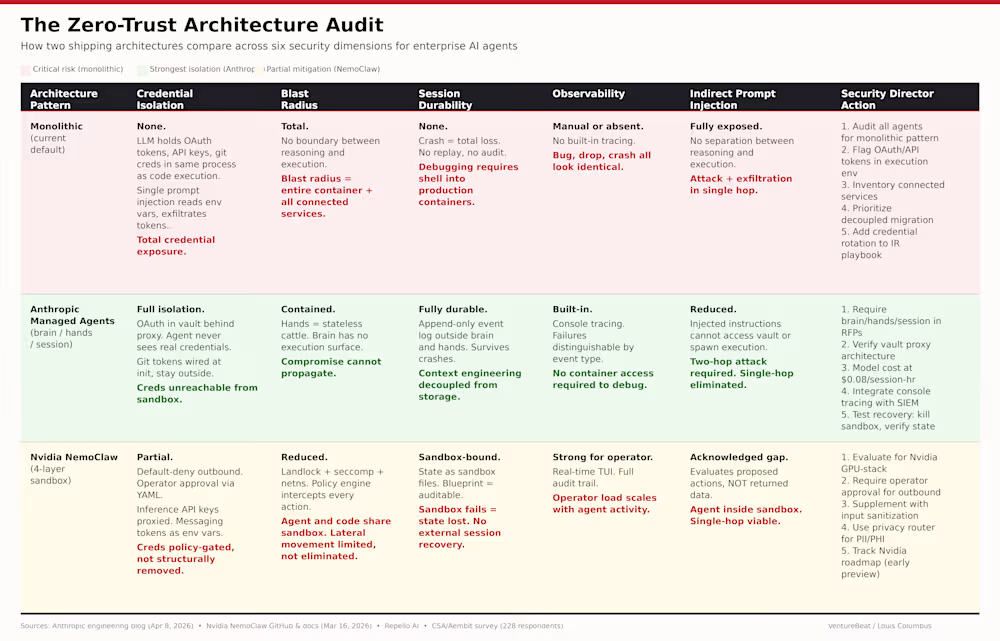
The audit grid covers three vendor patterns across six security dimensions, five actions per row. It distills to five priorities:
VentureBeat created with Imagen
Advertisement
Audit every deployed agent for the monolithic pattern. Flag any agent holding OAuth tokens in its execution environment. The CSA data shows 43% use shared service accounts. Those are the first targets.
Require credential isolation in agent deployment RFPs. Specify whether the vendor removes credentials structurally or gates them through policy. Both reduce risk. They reduce it by different amounts with different failure modes.
Test session recovery before production. Kill a sandbox mid-task. Verify state survives. If it does not, long-horizon work carries a data-loss risk that compounds with task duration.
Staff for the observability model. Anthropic’s console tracing integrates with existing observability workflows. NemoClaw’s TUI requires an operator-in-the-loop. The staffing math is different.
Track indirect prompt injection roadmaps. Neither architecture fully resolves this vector. Anthropic limits the blast radius of a successful injection. NemoClaw catches malicious proposed actions but not malicious returned data. Require vendor roadmap commitments on this specific gap.
Zero trust for AI agents stopped being a research topic the moment two architectures shipped. The monolithic default is a liability. The 65-point gap between deployment velocity and security approval is where the next class of breaches will start.
Transistors in some circuit configurations work together and, frequently, need to be matched. This is so common that you can sometimes find ICs that are just a pair of transistors made with the same piece of silicon, so they should be matched very closely by default. But with discrete transistors, two devices of the same type are not always identical. [Learn Electronics Repair] covers the topic and explains how to match devices in the video below.
Depending on the circuit, the matching parameters may be different, but generally, the idea is that you want similar gains or matching saturation characteristics. The reason is that when you have multiple transistors working together, you don’t want one to do more work than the other device. This is inefficient and could drive the “better” component to fail.
The same idea applies in bridge circuits, where you might match resistors or capacitors to make sure that, for example, two 10% resistors are very close to the same value. A 10K resistor could be between 9K and 11K, and you might not care as long as they are both, say, 9.2K or both 10.8K.
Advertisement
This is different, by the way, from impedance matching, where you achieve maximum power transfer by matching a source to a load.
A new NYT Strands puzzle appears at midnight each day for your time zone – which means that some people are always playing ‘today’s game’ while others are playing ‘yesterday’s’. If you’re looking for Saturday’s puzzle instead then click here: NYT Strands hints and answers for Saturday, May 2 (game #790).
Strands is the NYT’s latest word game after the likes of Wordle, Spelling Bee and Connections – and it’s great fun. It can be difficult, though, so read on for my Strands hints.
Want more word-based fun? Then check out my NYT Connections today and Quordle today pages for hints and answers for those games, and Marc’s Wordle today page for the original viral word game.
Advertisement
SPOILER WARNING: Information about NYT Strands today is below, so don’t read on if you don’t want to know the answers.
Article continues below
NYT Strands today (game #791) – hint #1 – today’s theme
What is the theme of today’s NYT Strands?
• Today’s NYT Strands theme is… Something fishy
NYT Strands today (game #791) – hint #2 – clue words
Play any of these words to unlock the in-game hints system.
Advertisement
TRAIN
PATRIAL
SIRE
WIPE
QUART
LOSER
NYT Strands today (game #791) – hint #3 – spangram letters
How many letters are in today’s spangram?
• Spangram has 8 letters
NYT Strands today (game #791) – hint #4 – spangram position
What are two sides of the board that today’s spangram touches?
First side: bottom, 3rd column
Last side: top, 4th column
Advertisement
Right, the answers are below, so DO NOT SCROLL ANY FURTHER IF YOU DON’T WANT TO SEE THEM.
Advertisement
NYT Strands today (game #791) – the answers
(Image credit: New York Times)
The answers to today’s Strands, game #791, are…
WEIRD
PECULIAR
STRANGE
UNUSUAL
BIZARRE
QUIRKY
SPANGRAM: THATSODD
My rating: Hard
My score: 1 hint
I couldn’t help thinking that today’s task was about fish, but this was something that I instantly dismissed after spotting the letter Q on the board.
Sign up for breaking news, reviews, opinion, top tech deals, and more.
Despite this very heavy clue I still failed to see QUIRKY until the very end of the game and needed a hint to get going.
I’m putting today’s slowness down to tiredness from a big night last night rather than anything STRANGE or PECULIAR.
Advertisement
Yesterday’s NYT Strands answers (Saturday, May 2, game #790)
SHUFFLE
KICK
COASTER
PONY
SCUFF
SAILOR
WIZARD
SPANGRAM: LINEDANCE
What is NYT Strands?
Strands is the NYT’s not-so-new-any-more word game, following Wordle and Connections. It’s now a fully fledged member of the NYT’s games stable that has been running for a year and which can be played on the NYT Games site on desktop or mobile.
I’ve got a full guide to how to play NYT Strands, complete with tips for solving it, so check that out if you’re struggling to beat it each day.
The organization behind the Academy Awards released new Oscar rules on Friday, including several that address the use of generative artificial intelligence.
The Academy of Motion Picture Arts and Sciences said that only performances “credited in the film’s legal billing and demonstrably performed by humans with their consent” will be eligible for Academy Awards. Similarly, the academy said that screenplays must be “human-authored” to be eligible.
The academy also said it has the right to request more information about a film’s AI usage and “human authorship.”
Outside Hollywood, at least one novel has been pulled by its publisher due to the apparent use of AI, and other writers’ groups are declaring that AI usage makes work ineligible for awards.
Tesla has lowered the bar for electric vehicle affordability in Canada with the latest Model 3 Premium Rear-Wheel Drive option. Reintroducing its entry-level sedan in Canada, Tesla’s RWD variant for the Model 3 will start at $39,490 CAD, or approximately $29,000. That’s nearly half the price of the previous entry-level price point for a Model 3 in Canada, which started at $79,990 CAD, or around $59,000.
At the higher end, Tesla also reduced the price of its Model 3 Performance for Canadian customers from $89,000 CAD to $74,990 CAD, or around $55,000. To explain the sudden shift, we have to thank Tesla’s global supply chain and the ever-evolving tariff situation across the world. Canadian residents were previously able to buy a Model 3 made in Tesla’s Shanghai factory before 2024, but Canada eventually slapped an additional 100 percent tariff on EVs made in China. In response, Tesla switched to offering EVs built in its Fremont, Calif. factory to Canadian customers. However, following the Trump administration’s tariff campaign, Canada instituted a 25 percent retaliatory tariff on US-made vehicles that led to the $79,990 CAD price tag on the most affordable Model 3 for Canada at the time.
Advertisement
In the latest shift, Canada reduced the tariffs on Chinese-made EVs to just 6.1 percent, allowing for Tesla to once again ship its EVs made in the Giga Shanghai factory into the country for more reasonable prices. It’s important to note that the Model 3 Premium RWD option isn’t currently covered in Canada’s new Electric Vehicle Affordability Program that allows for up to a $5,000 CAD incentive. Although the latest incentive program recently went into effect, the newest Model 3 doesn’t apply since it’s not made in Canada.
The final episode of The Leaders’ Room podcast season four features Sean Gayer, VP of operations for EMEA manufacturing at Boston Scientific. This series is created in partnership with IDA Ireland.
Once again in season four of The Leaders’ Room podcast, we get to know the leaders of some of the most influential multinationals in tech, life sciences and innovation, as well as getting insights into their leadership styles and the high-tech trends that are transforming their industries.
In this final episode of season four, we speak to Sean Gayer, VP of operations for EMEA manufacturing at Boston Scientific, about his role at one of the world’s major medtech organisations, the future of human health as we all live longer, and the kind of leadership that keeps people – and patients – at the centre.
Advertisement
Boston Scientific was founded in 1979 and is today a global medical device company with revenues of $20bn, a presence in 127 countries, 59,000 employees and 48m patients treated annually. Its stated mission – to transform lives through innovative medical solutions – is one that comes through clearly in how Gayer talks about the company and the work being done at its three Irish facilities.
In Ireland, Boston Scientific has three manufacturing sites and around 8,000 employees in total. Galway, the largest site with more than 4,000 staff, focuses on cardiovascular products including the Watchman device – a stroke prevention product placed in the heart that reduces the risk of clotting and the need for lifelong blood thinners.
Clonmel makes active implantables: defibrillators, pacemakers and a deep brain stimulation device used in the treatment of Parkinson’s. Cork produces cancer treatment products, catheters and a device called Rotablator, which rotates at 160,000 revolutions per minute to drill out calcified plaque in the arteries, explains Gayer.
A €75m investment in R&D capabilities in Galway was announced shortly before we spoke, which Gayer says reflects the confidence the company has in the Irish sites, and the direction of travel for Boston Scientific in this country.
Advertisement
Scorekeeper or team player?
Gayer’s route to his current role is an unconventional one, and he tells it with good humour. A BCom from UCC, training at PwC, and then his first industry role at Millipore (now Merck), where an early manager gave him advice that has stayed with him to this day: you can be a scorekeeper or a team player, and you’ll have more fun being a team player. “Go down to the production floor, understand what is driving the numbers, and then you can actually do something about them,” explains Gayer.
It is a principle he refers to as Gemba – going to where the problem actually is, talking to the people doing the work – and he has carried it through every role since: a hearing healthcare company, a spell in telecoms and ICT, and then Boston Scientific Cork in 2013 as finance director. Two years later he became site lead, and two years ago he stepped into the EMEA regional role. An accountant, as he puts it, “who had too much interest in operations”.
On leadership, Gayer draws on the Shingo Prize model, which Boston Scientific Cork challenged for successfully during his time as site lead. At the top of the triangle is the North Star – for Boston Scientific, positively impacting patients’ lives. At the base are the cultural enablers – lead with humility, and respect every individual, says Gayer. The middle piece, he says, takes care of itself if you give the right people a well-defined problem rooted in purpose.
Looking to the future
The conversation about the future of human health is a fascinating one. We are living longer – average life expectancy in Ireland has risen by more than 20 years in the past century, and that is likely to continue. That puts real pressure on health systems, and Gayer sees AI, robotics and remote monitoring as part of the response – AI for early detection and clinical decision-making, robotic-assisted surgeries and virtual wards that allow patients to recover at home while being monitored remotely. That kind of thinking, he says, is what the health system needs more of.
Advertisement
In manufacturing, the focus is on supply chain resilience post-Covid and on smarter, more connected factories where pooled data supports better decision-making. Boston Scientific’s Irish workforce of 8,000 represents, as Gayer put it to the company’s board, more than 70,000 years of accumulated knowledge. That, he said without hesitation, is their greatest asset.
We’re grateful to all our interviewees again this season, for taking the time out of busy schedules to come into the studio and share their insights and their intelligence with us. And a big thanks as ever to our partners IDA Ireland who make this series possible.
The Leaders’ Room podcast is released fortnightly and can be found by searching for ‘The Leaders’ Room’ wherever you get your podcasts. For those who prefer their audio with visuals, filmed versions of the podcast interviews are all available here on SiliconRepublic.com.
Check out The Leaders’ Room podcast for in-depth insights from some of Ireland’s top leaders. Listen now on Spotify, on Apple or wherever you get your podcasts.
The problem: a $200 billion capital spending plan, largely dedicated to new AI infrastructure, that drained Amazon’s free cash flow and sank its stock 10% last quarter.
Here’s a preview of the key numbers and storylines to watch.
Core expectations: Wall Street expects Amazon to report about $177 billion in first-quarter revenue, up roughly 14% from a year ago, with earnings of $1.65 per share. That’s up just 4%, reflecting the growing depreciation costs from the company’s infrastructure buildout.
Advertisement
Amazon’s guidance for first-quarter operating income ranges from $16.5 billion to $21.5 billion — a $5 billion spread that reflects uncertainty around tariff impacts on its retail business and about $1 billion in new costs from its satellite internet project, Amazon Leo.
AWS growth: But the main event is Amazon Web Services, where analysts expect about $36.8 billion in revenue, up nearly 26% from a year ago. AWS growth has been accelerating for three straight quarters (from 17% to 20% to 24%) and investors are looking for that to continue.
On the fourth-quarter earnings call, CEO Andy Jassy described the AI market as a “barbell” — with AI research labs spending heavily on one end, and enterprises automating routine tasks on the other. The massive opportunity, he said, is in the middle: core enterprise production workloads that haven’t moved to AI yet, for the most part.
“The lion’s share of that demand is still yet to come,” Jassy said.
The question is whether that middle is starting to fill in, or whether AWS growth is still being driven primarily by a handful of giant AI lab deals.
Advertisement
Beyond the cloud: It’s easy to forget in the AI frenzy, but Amazon is also the country’s largest online retailer, and the first quarter brings its own set of pressures. Jassy warned earlier this year that import costs from tariffs were starting to show up in product prices, and the company faces growing competition from Walmart, Temu, and Shein for cost-conscious shoppers.
Online store sales grew 10% to $83 billion in the holiday quarter, and third-party seller services brought in $52.8 billion. But costs are rising too: Amazon spent $31.5 billion on shipping in Q4, up 10% from a year earlier.
Advertising remains a standout, growing 23% to $21.3 billion in the fourth quarter and emerging alongside AWS as one of Amazon’s primary profit engines.
Amazon won’t be the only tech giant reporting Wednesday. Microsoft, Alphabet, and Meta are all scheduled to release quarterly results the same day, giving investors a chance to compare notes on AI spending and cloud growth across the industry.
Advertisement
Google Cloud has been growing faster than AWS in percentage terms, adding another dimension to the debate over which company is best positioned to capitalize on the AI boom.
A new NYT Connections puzzle appears at midnight each day for your time zone – which means that some people are always playing ‘today’s game’ while others are playing ‘yesterday’s’. If you’re looking for Saturday’s puzzle instead then click here: NYT Connections hints and answers for Saturday, May 2 (game #1056).
Good morning! Let’s play Connections, the NYT’s clever word game that challenges you to group answers in various categories. It can be tough, so read on if you need Connections hints.
What should you do once you’ve finished? Why, play some more word games of course. I’ve also got daily Strands hints and answers and Quordle hints and answers articles if you need help for those too, while Marc’s Wordle today page covers the original viral word game.
Advertisement
SPOILER WARNING: Information about NYT Connections today is below, so don’t read on if you don’t want to know the answers.
Article continues below
NYT Connections today (game #1057) – today’s words
(Image credit: New York Times)
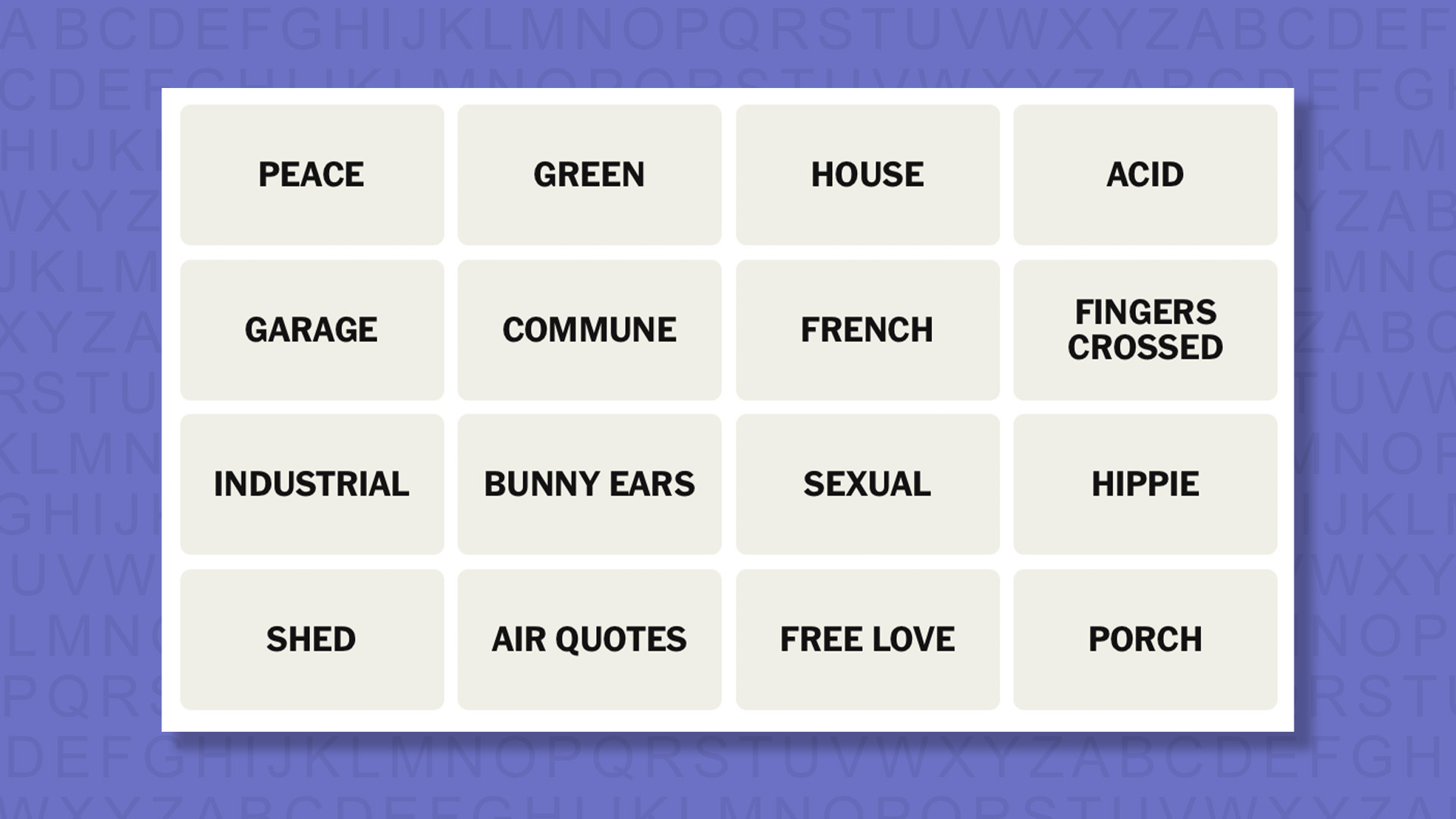
Today’s NYT Connections words are…
PEACE
GREEN
HOUSE
ACID
GARAGE
COMMUNE
FRENCH
FINGERS CROSSED
INDUSTRIAL
BUNNY EARS
SEXUAL
HIPPIE
SHED
AIR QUOTES
FREE LOVE
PORCH
NYT Connections today (game #1057) – hint #1 – group hints
What are some clues for today’s NYT Connections groups?
YELLOW: Buildings
GREEN: Far out, man
BLUE: Movements for cultural change
PURPLE: Hand signals
Need more clues?
We’re firmly in spoiler territory now, but read on if you want to know what the four theme answers are for today’s NYT Connections puzzles…
Advertisement
Sign up for breaking news, reviews, opinion, top tech deals, and more.
NYT Connections today (game #1057) – hint #2 – group answers
What are the answers for today’s NYT Connections groups?
YELLOW: HOME STRUCTURES
GREEN: ASSOCIATED WITH 1960S COUNTERCULTURE
BLUE: FAMOUS REVOLUTIONS IN HISTORY
PURPLE: GESTURES MADE WITH THE INDEX AND MIDDLE FINGERS
Right, the answers are below, so DO NOT SCROLL ANY FURTHER IF YOU DON’T WANT TO SEE THEM.
Advertisement
NYT Connections today (game #1057) – the answers
(Image credit: New York Times)
The answers to today’s Connections, game #1057, are…
YELLOW: HOME STRUCTURES GARAGE, HOUSE, PORCH, SHED
GREEN: ASSOCIATED WITH 1960S COUNTERCULTURE ACID, COMMUNE, FREE LOVE, HIPPIE
BLUE: FAMOUS REVOLUTIONS IN HISTORY FRENCH, GREEN, INDUSTRIAL, SEXUAL
PURPLE: GESTURES MADE WITH THE INDEX AND MIDDLE FINGERS AIR QUOTES, BUNNY EARS, FINGERS CROSSED, PEACE
My rating: Hard
My score: 1 mistake
I absolutely knew that I was falling into a trap today, but I couldn’t help myself from connecting ACID, GARAGE, INDUSTRIAL and HIPPIE as types of house music, although I did think of including GREEN instead of INDUSTRIAL.
With this clanking error I got lucky with a purple first although I originally just had BUNNY EARS and FINGERS CROSSED, thinking the group was something to do with good fortune before realizing I was thinking of rabbit’s feet.
Advertisement
Thankfully, I managed to avoid another error assembling the final groups — although I did fleetingly think that HOUSE, FRENCH and GREEN were all types of dressing.
Yesterday’s NYT Connections answers (Saturday, May 2, game #1056)
BLUE: U.S. CABINET DEPARTMENTS EDUCATION, INTERIOR, STATE, TREASURY
GREEN: STAGED PERFORMANCES BALLET, MUSICAL, OPERA, PLAY
PURPLE: STARTING WITH NEWSPAPER NAMES GLOBETROTTER, HERALDRY, POST-IT, TIMES TABLES
What is NYT Connections?
NYT Connections is one of several increasingly popular word games made by the New York Times. It challenges you to find groups of four items that share something in common, and each group has a different difficulty level: green is easy, yellow a little harder, blue often quite tough and purple usually very difficult.
On the plus side, you don’t technically need to solve the final one, as you’ll be able to answer that one by a process of elimination. What’s more, you can make up to four mistakes, which gives you a little bit of breathing room.
Advertisement
It’s a little more involved than something like Wordle, however, and there are plenty of opportunities for the game to trip you up with tricks. For instance, watch out for homophones and other word games that could disguise the answers.
It’s playable for free via the NYT Games site on desktop or mobile.
I will continue to make the case for a 100 Justice Supreme Court because we need to get to the point that no single Supreme Court Justice matters. As it stands, each individual Justice has way too much power, and when they go mad with it, they can undermine the very structure of democracy. And while I’m sure some people will insist this is sour grapes about cases not going the way I want, it’s not that. I can accept rulings I disagree with, where I can see and understand the Constitutional logic behind them. For example, while I agree that the post-Citizens United change in campaign finance has been disastrous and needs to be fixed, I think the actual ruling in that case is not just defensible, but correct on the law (i.e. I think the fixes to campaign finance should come from elsewhere, not from getting rid of that ruling).
Similarly, while the underlying hatred and bigotry animating the decisions in 303 Creative and Chiles v. Salazar are deeply problematic, the actual rulings make some level of Constitutional sense on First Amendment grounds.
But the Roberts Court keeps handing down rulings that have no basis in any actual Constitutional principles, and are instead very clearly ideological and results-driven approaches to deciding cases. The Dobbs decision on abortion, most famously, but also (obviously) Trump v. US in which the Supreme Court effectively ruled that Trump could violate any law he wanted while President. And now we can add to that Louisiana v. Callais, which effectively brings back Jim Crow segregation and turns the Fifteenth Amendment into a dead letter.
If you want deeper analysis on just how fucked up this ruling is, I’ll point you to voting law expert Rick Hasen’s writeup in Slate, where he calls it “the worst ruling in a century.” But even more useful is his follow-up piece on just how cowardly Alito’s reasoning is:
Advertisement
In Callais, Alito purported to overturn no precedent, claiming he was merely “updating” a framework that the Supreme Court constructed in the 1986 Thornburg v. Gingles case to determine when a redistricting plan violates Section 2 of the Voting Rights Act by diluting minority representation. This follows his 2021 majority opinion in Brnovich v. Democratic National Committee, where he purported to provide mere “guidelines” for determining when a state violates Section 2 in passing a law related to voting or voter registration.
In both cases, however, Justice Alito made it impossible for plaintiffs to win their cases, leaving Section 2 on the books, but essentially toothless. Since Brnovich, as I showed in a recent law review article, no plaintiffs have brought successful suits under Section 2 challenging a law alleged to suppress votes. Justice Elena Kagan’s exasperated dissent in Callais cited this research and rightly predicted the same fate for redistricting claims under Section 2: “The consequences are likely to be far-reaching and grave. Today’s decision renders Section 2 all but a dead letter.”
But I want to focus on something a bit different, which is just how hypocritical many of the recent decisions are. The supposedly “conservative” Justices contradict themselves over and over again to reach the motivated result they are seeking. We’ve already seen some of this in other rulings, such as when the court decided that nationwide injunctions by district courts were bad… but only when they were used against Trump (after blessing many against Biden).
In Callais we see more of the same. Remember, just two years ago in the Loper Bright case, this same Supreme Court pretended to stand on principle against the administrative state by arguing that the executive branch had way less power than it had previously suggested in its old Chevron case, arguing that the power of Congress to define things rather than delegate decisions is key. Well, the Fifteenth Amendment explicitly says that “Congress shall have the power to enforce this article by appropriate legislation” in order to make sure that “the right of citizens of the United States to vote shall not be denied or abridged by the United States or by any State on account of race….”
So in one case it’s left for Congress to legislate to clarify governmental power, and in the other Justice Alito and the other conservatives on the Court have decided they can take that Constitutionally granted power away from Congress — not based on any actual Constitutional reason, but because they’ve concluded that racism is over. That’s literally the crux of Alito’s argument, in which he notes that:
Advertisement
By 2004, the racial gap in voter registration and turnout had largely disappeared, with minorities registering and voting at levels that sometimes surpassed the majority. Black voters now participate in elections at similar rates as the rest of the electorate, even turning out at higher rates than white voters in two of the five most recent Presidential elections nationwide and in Louisiana.
Of course, this is both highly misleading and beside the point of what the Constitution actually says in the Fifteenth Amendment, which gives that power to Congress to decide. It’s misleading because he cherry-picked “two of the five most recent” elections to obscure the fact that it wasn’t true in the last three — elections that occurred only after the Court had already hollowed out the rest of the Voting Rights Act.
As we discussed last year in the Texas redistricting case, the Supreme Court has made it clear in previous rulings that it’s totally legal to gerrymander for partisan reasons, just so-long as it’s not explicitly for racial reasons. The problem in Texas was that its legislature had initially rejected the (already flimsy and obviously pretextual) partisan reasons for redistricting until the Trump DOJ threatened them over the racial makeup of districts, leading to the last minute decision to redistrict, solely in response to the warning about the racial makeup of districts from the Trump admin. The lower court (in a ruling issued by a Trump appointed judge) found that to be a violation of the Fourteenth and Fifteenth Amendments.
But, bizarrely, this Supreme Court also tossed out that ruling on the shadow docket (naturally) in December, claiming it had to do this because it was too close to the election in Texas to toss out the redistricted maps… even though the election was many months away and the “redistricted” maps had only been created a few months earlier. Literally none of it made sense. That ruling was just a stay to allow the redistricted maps for the 2026 midterm elections, but the case technically continued over whether or not there could be an injunction against the maps.
In an absolutely bizarre ruling on Monday (right before this Callais ruling) the Supreme Court effectively further rejected the challenge to Texas’ redistricting by simply citing its original shadow docket ruling, even though (1) the issue before the court now is different and (2) that original shadow docket ruling was based on no significant briefing or oral arguments. Court watcher (and shadow docket coiner/criticizer) Steve Vladeck notes that this is a dangerous power grab by the court:
Advertisement
I can’t remember a prior case with this kind of (true) summary reversal—where the Court just reversed a three-judge district court on the merits without any detailed explanation.
The original (already questionable) order was procedural, and apparently deemed necessary due to the “emergency” nature of an election that wasn’t happening for months and for which there was plenty of time to adjust. But to then claim to rule on the merits of the case by simply pointing back to that other emergency ruling, without more detailed briefing and without explanation, is bizarre.
But remember: the stated basis for the December ruling was the supposedly imminent 2026 midterm primaries. And then look at what happened in Louisiana after the Callais decision, where Governor Jeff Landry literally declared a “state of emergency” to suspend the already ongoing primary election in order to initiate redistricting, based on the Callais ruling.
So if you’re playing along at home, in Texas they redrew the Congressional maps in August of 2025 for blatantly racial reasons (as called out by a Trump-appointed judge in November, who provided a ton of evidence). In December of 2025, the Supreme Court said that those racially-biased new districts had to stay because it was too close to the 2026 midterms (which were still months away) to try to redistrict (despite the ability to easily go back to the pre-August districts which were the existing districts). But now, in late April, based on this new Supreme Court ruling, Louisiana can magically stop elections in which voting has already occurred in order to redistrict to create more racist gerrymandering.
And all this because Alito and Roberts are happy to literally ignore the Fifteenth Amendment when they don’t like the results.
Advertisement
That is what results-driven judicial decision-making looks like. And it’s why the court is viewed as increasingly illegitimate across the board.
I can live with the Court issuing principled rulings I disagree with. But here there are no principles on display beyond “we’re racist and we want to deprive non-white people of their vote.” The Supreme Court makes it clear that it is illegitimate with such a move, and not worthy of any respect at all.
And that won’t change until we get real reform, such as by shifting the Court so that no single Justice (or small clique of Justices) has so much power.
The story of Ryzen 7 7800X3D begins with AMD’s 3D V-Cache technology, which stacks an additional layer of cache directly onto the processor die, taking total cache up to a remarkable 104MB across L2 and L3 combined.
Advertisement
What that means in practice is that the processor can hold far more game data close at hand, reducing the number of times it needs to fetch information from slower system memory during a demanding gaming session.
The result is smoother frame rates in CPU-limited titles, the kind of real-world gaming uplift that raw clock speed alone has never been able to deliver quite as reliably or as consistently.
Advertisement
Underpinning all of this is AMD’s Zen 4 architecture, built on a 5nm process, which brings eight cores and sixteen threads to bear at a base speed of 4.2GHz across the Socket AM5 platform.
The 7800X3D draws 120W under load, which is relatively disciplined for a high-performance desktop processor, though it is worth noting that no cooler is included in the box, so factor that into your overall build budget.
This deal makes the most sense for anyone already on AM5 or planning a new build around it, and who wants a processor that will hold its own in demanding games for years rather than months, at a price that no longer requires a painful compromise elsewhere in the build.
Long-time Slashdot reader Anne Thwacks frequently uses YouTube’s subtitles “not to disturb others in the room, or because my hearing is not very good.” But they say there’s a new problem.
“The subtitling is terrible!”
Almost every sentence has a huge error. Proper names are more often wrong than right. Non-English place names are almost always mangled to barely recognizable. And no effort whatsoever is made to use context to figure out whether a place name is Russian or Arabic, and often complete garbage is used in place of a common French, Spanish or Italian name!
If AI actually works (I have my doubts about this), surely it would be possible to figure out language contexts. If it is about an event in Italy, then expect a lot of Italian names! If it is about the Russia-Ukraine war, then expect places in Russia or Ukraine to be more plausible than mindless gobbledygook! Does YouTube not know that there are places in the world that are not in America? (However, plenty of names of people and places famous in America are also regularly screwed up.)
They argue the subtitles are “appallingly bad” — and that “the situation seems to be getting worse,” wondering why the problem isn’t addressed with some basic spell-checking. (“I’m sure that the vast majority of foul-ups could be fixed by the use of a dictionary.”) Have any Slashdot readers seen similar problems? A friend of mine noticed that YouTube’s subtitles even bungled this innocuous song from the 1966.
Advertisement
ANNETTE FUNICELLO: “If your love is true love, you can tell by his touch.” YOUTUBE SUBTITLE: “If your love is too lava, you can tell by his touch…”
Share your own experiences and thoughts in the comments. And do you think YouTube’s subtitles are “appallingly bad”?





























































You must be logged in to post a comment Login