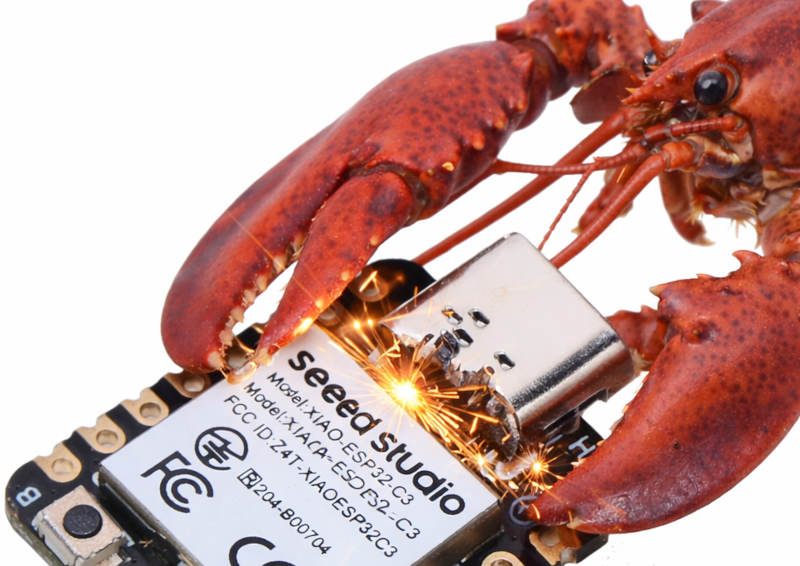
Having an AI assistant is all the rage these days, but AI assistants usually don’t know about your automation setups and may have difficulty dealing with tasks asynchronously. Enter zclaw. It gives you the option to have a personal assistant on an ESP32 backed by Anthropic, OpenAI, or OpenRouter. The whole thing fits in 888KB, and while it doesn’t host the LLM, it does add key capabilities to monitor and control devices connected to the ESP32.
You communicate with the assistant via telegram. You can say things like “Remember the garage sensor is on GPIO 4.” Then later you might say: “In 20 minutes, check the garage sensor and if it is high, set GPIO 5 low.” It has an RTOS for scheduling tasks and is aware of the timezone and common periods. Memory persists across reboots, and you can pick different personas.
Some of the use cases mentioned in the manual show how having something that can precisely schedule, control, or monitor devices might pay off. Ideas like bringing up a lab setup, scheduling plant watering, and more would be difficult to do with just a stock chatbot.
Advertisement
The AI can also introspect. For example, you could create a few tasks on a schedule and then ask the device to “show me my schedules.” You can also create up to 8 tools with a name, description, and action. This lets you describe something like “power_down_bench” and then tell zclaw to execute it on demand or even on a schedule. Overall, an interesting and well-documented setup.
Missile defense begins with sensors that can detect a launch within seconds. One of the key radars used with THAAD is the AN/TPY-2, a high-frequency X-band radar designed to track small, fast-moving objects at long distances.
BARAK (top), PAC-3 MSE (middle) and THAAD (bottom) missiles from Lockheed Martin.
Photograph: Leon Neal/Getty Images
The radar can detect and track ballistic missiles hundreds of kilometers away, following objects traveling at hypersonic speeds and transmitting that data to command centers in real time.
Once a missile launch is detected, defense systems calculate its trajectory and determine where the missile will be at a given moment in flight. Interceptors are then launched to meet it at that exact point in space.
Advertisement
Why Intercepting Ballistic Missiles Is So Hard
Ballistic missiles travel extremely fast. Some reach speeds of more than 20,000 kilometres per hour, fast enough to cross the entire UAE in just a few minutes. Because of those speeds, defense systems often have only minutes to detect, track. and intercept a missile before it descends toward its target.
To respond within that narrow window, missile defense systems rely on multiple technologies working together: early-warning sensors to detect launches, radar networks to track the threat, and interceptor missiles designed to destroy it mid-flight.
The expansion of missile defense systems across the Gulf has been driven largely by the rapid development of ballistic missile arsenals in the region. Iran is widely considered to possess one of the largest ballistic missile inventories in the Middle East.
As a result, Gulf countries have spent more than a decade investing in radar systems, interceptors, and command networks designed to protect critical infrastructure, major cities, and military facilities. The UAE hosts several major military installations, including Al Dhafra Air Base, which houses both Emirati and US forces.
Advertisement
Even when a missile is successfully destroyed, the danger does not disappear entirely.
Intercepted missiles can break apart at high altitude, sending fragments falling back toward the ground. In some cases, debris can still cause damage if it lands in populated areas. Saturday’s incident illustrates that risk: Although incoming missiles were intercepted before impact, falling debris from one interception killed a civilian in Abu Dhabi.
When Xiangyi Cheng published her first journal paper as a principal investigator inIEEE Access in 2024, it marked more than a professional milestone. For Cheng, an IEEE member and an assistant professor of mechanical engineering at Loyola Marymount University, in Los Angeles, it was the latest waypoint in a career shaped by curiosity, persistence, and a belief that technology should serve people—not the other way around.
China University of Mining and Technology; Texas A&M University
Cheng’s work spans robotics, intelligent systems, human-machine interaction and artificial intelligence. It has applications in patient-specific surgical planning, an approach whereby treatment is customized to the anatomy and clinical needs of each individual.
The throughline of her career is sound judgment based on critical thinking. She urges her students to avoid the temptation to accept the answers they’re given by AI without cross-checking them against their own foundational understanding of the subject matter.
“AI can give you ideas,” Cheng says, “but it should never lead your thinking.”
That principle—honed through uncertainty, disciplinary shifts, and hard-earned confidence—has made Cheng an emerging voice in applied intelligent systems and a thoughtful educator preparing students for an AI-saturated world.
Advertisement
From Xi’an to Beijing: A mind drawn to mathematics
Cheng, born in Xi’an, China, grew up in a household shaped by her parents’ disparate careers. Her father was a mining engineer, and her mother taught Chinese and literature at a high school.
“That contrast between logical and literary thinking helped me understand myself early,” Cheng says. “I liked math, and STEM felt natural to me.”
Several teachers reinforced her inclination, she says, particularly a math teacher whose calm, fair approach emphasized reasoning over punishments such as detention for misbehavior or failure to complete assignments.
“It wasn’t about being right,” Cheng says. “It was about thinking clearly.”
Advertisement
She moved to Beijing in 2011 to attend the China University of Mining and Technology , where she studied mechanical engineering. After graduating with a bachelor’s degree in 2015, she was unsure where the field would take her.
“AI can give you more possibilities, but thinking is still our responsibility.”
Intubation is a procedure in which an endotracheal tube is inserted into a patient’s airway—usually through the mouth—to help them breathe. Because placing the tube correctly is not simple and usually must be done quickly, it requires training. That’s why research into robotic or assisted intubation systems focuses on improving speed, accuracy, and safety.
She presented her findings at ICRA in 2018, giving her early exposure to a global research community.
Advertisement
“That acceptance gave me confidence,” she recalls. “It showed me I could contribute to the field.”
Her advisor at Case Western encouraged her to switch from the mechanical engineering master’s program to the Ph.D. track. When the advisor moved to Texas A&M University, in College Station, in 2019, Cheng decided to transfer. She completed her Ph.D. in mechanical engineering at Texas A&M in 2022.
Although she didn’t earn a degree from Case Western, she credits her experience there with clarifying her professional direction.
Shortly after graduating with her Ph.D., Cheng was hired as an assistant professor of mechanical engineering at Ohio Northern University, in Ada. She left in 2024 to become an assistant professor at Loyola Marymount.
Advertisement
Engineering for the body—and the classroom
Cheng’s research focuses on human-centered engineering, particularly in health care. One of her major projects addresses syndactyly, a congenital condition in which a newborn’s fingers are fused at birth. Surgeons rely on their experience to estimate the size and shape of skin grafts to be taken from another part of the body for the corrective surgery.
She is developing technology to scan the patient’s hand, extract anatomical landmarks, and use finite element analysis—a computer-based method for predicting how a physical object will behave under real-world conditions—to determine the optimal graft size and shape.
Xiangyi Cheng designs human-centered intelligent systems with applications in health care and education.Xiangyi Cheng
“Everyone’s hand is different,” Cheng says. “So the surgery should be personalized.”
Another project centers on developing smart gloves to assist with hand rehabilitation, pairing the unaffected hand with the injured one so the person’s natural motion can help guide therapy.
Advertisement
She also is exploring augmented reality in engineering education, using immersive visualization and AI tools to help students grasp three-dimensional concepts that are difficult to convey through traditional learning tools. Such visualization lets students see and interact with a digital world as if they’re inside it instead of viewing it on a flat screen.
Teaching balance in an AI-driven world
Despite working at the forefront of AI-enabled systems, Cheng cautions her students to be judicious in their use of the technology so that they don’t rely on it too heavily.
“AI is not always right and perfect,” she says. “You still need to be able to judge whether the answers it provides are correct.”
As AI continues to reshape engineering, Cheng remains grounded in a simple principle, she says: “We should use these tools. But we should never let them replace our judgment. AI can give you more possibilities, but thinking is still our responsibility.”
Advertisement
In her lab and classroom, Cheng prioritizes independent thinking, critical evaluation, and persistence. Many of her research students are undergraduates, and she encourages them to take ownership of their work—planning ahead, testing ideas, and learning from failure.
“The students who succeed don’t give up easily,” she says.
What she finds most rewarding, she says, is watching students mature. Reserved first-year students often become confident seniors who can present complex work and manage demanding projects.
“Getting to witness that transformation is why I teach,” she says.
Advertisement
For students considering engineering, Cheng offers straightforward advice: “Focus on mathematics. Engineering looks hands-on, but math is the foundation behind everything.”
With practice and persistence, she says, students can succeed and find meaning in the field.
Why IEEE continues to matter
Cheng joined IEEE in 2017, the year she submitted her first paper to ICRA. The organization has remained central to her professional development, she says.
IEEE’s interdisciplinary scope aligns naturally with her work, she says, adding that the organization is “one of the few places that truly welcomes research across boundaries.”
More personally, IEEE helped her see a future she had not initially imagined.
“That first conference was a turning point,” she says. “It helped me realize I belonged.”
A Chrome extension named “QuickLens – Search Screen with Google Lens” has been removed from the Chrome Web Store after it was compromised to push malware and attempt to steal crypto from thousands of users.
QuickLens was initially published as a Chrome extension that lets users run Google Lens searches directly in their browser. The extension grew to roughly 7,000 users and, at one point, received a featured badge from Google.
However, on February 17, 2026, a new version 5.8 was released that contained malicious scripts that introduced ClickFix attacks and info-stealing functionality for those using the extension.
The malicious QuickLens extension
Security researchers at Annex first reported that the extension had recently changed ownership after being listed for sale on ExtensionHub, a marketplace where developers sell browser extensions.
Annex says that on February 1, 2026, the owner changed to support@doodlebuggle.top under “LLC Quick Lens,” with a new privacy policy hosted on a barely functional domain. Just over two weeks later, the malicious update was pushed to users.
Advertisement
Annex’s analysis shows that version 5.8 requested new browser permissions, including declarativeNetRequestWithHostAccess and webRequest.
It also included a rules.json file that stripped browser security headers, such as Content-Security-Policy (CSP), X-Frame-Options, and X-XSS-Protection, from all pages and frames. These headers would have made it more difficult to run malicious scripts on websites.
The update also introduced communication with a command-and-control (C2) server at api.extensionanalyticspro[.]top. According to Annex, the extension generated a persistent UUID, fingerprinted the victim’s country using Cloudflare’s trace endpoint, identified the browser and OS, and then polled the C2 server every five minutes for instructions.
BleepingComputer learned about the extension this week after seeing numerous users [1, 2] reporting fake Google Update alerts on every web page they visited.
Advertisement
“That is appearing in every site i go, i through it could be because Chrome wasn’t updated, but even after uptading it continues to appear,” a user seeking help said on Reddit.
“Of course i will not run the code that it copy on my clipboard on the run box but it keeps appearing in every site, making it impossible to interact with anything.”
BleepingComputer’s analysis of the extension showed it connected to a C2 server at https://api.extensionanalyticspro[.]top/extensions/callback?uuid=[uuid]&extension=kdenlnncndfnhkognokgfpabgkgehoddto, where it received an array of malicious JavaScript scripts.
These payloads were then executed on every page load using a technique that Annex described as a “1×1 GIF pixel onload trick.”
Advertisement
Array of malicious JavaScript payloads Source: BleepingComputer
Because the extension stripped CSP headers on all visited sites, this inline JavaScript execution worked even on sites that would normally block it.
The first payload contacts google-update[.]icu, where it receives an additional payload that displays a fake Google Update prompt. Clicking the update button would display a ClickFix attack, prompting users to perform a verification by running code on their computers.
Fake Google Update alert leading to a ClickFix attack Source: Reddit [1, 2]
For Windows users, this led to the download of a malicious executable named “googleupdate.exe” [VirusTotal] that was signed with a certificate from “Hubei Da’e Zhidao Food Technology Co., Ltd.”
Upon execution, the malware launched a hidden PowerShell command that spawned a second PowerShell instance to connect to drivers[.]solutions/META-INF/xuoa.sys using a custom “Katzilla” user agent.
The response was piped into Invoke-Expression for execution. However, by the time BleepingComputer analyzed the payloads, the second-stage URL was no longer serving any malicious content.
Another malicious JavaScript “agent” delivered by the https://api.extensionanalyticspro[.]top C2 was used to steal cryptocurrency wallets and credentials.
Advertisement
The extension would detect if MetaMask, Phantom, Coinbase Wallet, Trust Wallet, Solflare, Backpack, Brave Wallet, Exodus, Binance Chain Wallet, WalletConnect, and the Argon crypto wallets were installed. If so, it would attempt to steal activity and seed phrases, which would be used to hijack wallets and steal their assets.
Another script captured login credentials, payment information, and other sensitive form data.
Additional payloads were used to scrape Gmail inbox contents, extract Facebook Business Manager advertising account data, and collect YouTube channel information.
A review of the now-removed Chrome extension page claims that macOS users were targeted with the AMOS (Atomic Stealer) infostealer. BleepingComputer has not been able to independently verify if these claims are true.
Advertisement
Google has since removed QuickLens from the Chrome Web Store, and Chrome now automatically disables it for affected users.
QuickLens disabled and flagged as malware by Chrome Source: BleepingComputer
Users who installed QuickLens – Search Screen with Google Lens should ensure the extension is fully removed, scan their device for malware, and reset passwords for any credentials stored in the browser.
If you use any of the mentioned cryptocurrency wallets, you should transfer your funds to a new wallet.
This extension is not the first to be used in ClickFix attacks. Last month, Huntress discovered a browser extension that intentionally crashed browsers and then displayed fake fixes that installed the ModeloRAT malware.
Modern IT infrastructure moves faster than manual workflows can handle.
In this new Tines guide, learn how your team can reduce hidden manual delays, improve reliability through automated response, and build and scale intelligent workflows on top of tools you already use.
Residents across Tehran and other Iranian cities were jolted awake by sounds of loud explosions in the early hours of Saturday morning, as Israel and the US launched joint attacks on Iran.
The attacks, which the US and Israel are calling “preemptive strikes,” come after a period of failed negotiations between the countries, and on the heels of mass protests in Iran earlier this year that saw the death of at least 3,117 civilians, according to government statistics.
Shortly after the first set of explosions, Iranians received bursts of notifications on their phones. They came not from the government advising caution, but from an apparently hacked prayer-timing app called ‘BadeSaba Calendar’ that has been downloaded more than 5 million times from the Google Play Store.
The messages arrived in quick succession over a period of 30 minutes, starting with the phrase ‘Help Has Arrived’ at 9:52 am Tehran time, shortly after the first set of explosions. No party has claimed responsibility for the hacks.
Advertisement
Screenshots shared with WIRED Middle East show messages urging Iranian military personnel to surrender their weapons with the promise of amnesty. They also urged army personnel to join “the forces of liberation” and to “defend your brothers.”
The push notifications are all titled “Help is on the way”, and call on Iranian military members to surrender.
Screenshot: WIRED Middle East
“The time for revenge has come,” one notification received at 10:02 am read (translated from Farsi). “The regime’s repressive forces will pay for their cruel and merciless actions against the innocent people of Iran. Anyone who joins in defending and protecting the Iranian nation will be granted amnesty and forgiveness.”
“For the freedom of our Iranian brothers and sisters, this is a call to all oppressive forces—lay down your weapons or join the forces of liberation. Only in this way can you save your lives. For a free Iran,” another message sent at 10:14 am read.
Advertisement
Cybersecurity analysts confirmed that BadeSabah users had received notifications around the time of the strikes, but have not been able to identify the source of the hack. “At this point, we genuinely do not know who is behind them, whether it was Israel or other anti-government Iranian groups,” says Narges Keshavarznia, digital rights researcher at the Miaan Group, adding that no hacker group has claimed credit.
“Attribution in cases like this is always complex, and it’s still too early to draw conclusions.”
Morey Haber, the chief security advisor at BeyondTrust, however, pointed out that a cyber operation of this nature would almost certainly have been planned in advance.
“The compromise of assets [likely] happened some time ago, and these messages of ‘help’ were timed” strategically, he claims. “This is not a smash-and-grab style of attack. It is nation-state versus nation-state and is being executed with intent and precision.”
Advertisement
Iran on Saturday launched retaliatory kinetic attacks targeting key military bases across the Middle East. Explosions were reported in Bahrain, Kuwait, the UAE, and Qatar on Saturday, including multiple missiles that were intercepted.
Digital Blackout, Cyber Warfare
As the war unfolds, the Iranian public has already faced internet blackouts and weeks of severely reduced connectivity. “The country has been experiencing a widespread internet disruption, and access to the internet has significantly decreased in several parts of the country, including Tehran,” Keshavarznia says.
According to internet monitoring tool NetBlocks, overall network traffic has dropped to 4 percent. Data from ArvanCloud’s Radar monitoring system, an Iranian-operated cloud service, indicates that many of the country’s main data centers and domestic PoP sites have either lost connectivity to the international internet or are experiencing severe disruption, Keshavarznia pointed out.
Communication networks are also down with outages in phone lines and SMS services, and severe degradation of both mobile data and fixed broadband connections. “Incoming international calls to Iran are also reportedly affected. Even using VPNs has become extremely difficult,” she says.
US tech giant Google announced on Tuesday that it will build a new data center in Pine Island, Minnesota. The new facility will be powered by 1.9 gigawatts (GW) of clean energy from wind and solar, coupled with a 300-megawatt battery, claimed to be the ‘world’s largest’, with a 30-gigawatt-hour (GWh) capacity and 100-hour duration… The planned battery would dwarf a 19 GW lithium-ion project in the UAE…
Form Energy’s batteries work very differently from most large batteries today. Instead of using lithium like the batteries in electric cars, they store electricity by making iron rust and then reversing the rusting process to release the energy when needed… Form’s iron-air batteries are heavier and less efficient than their counterparts; they can only return about 50% to 70% of the energy used to charge them, while lithium-ion batteries return more than 90%. However, Form’s batteries have one distinct advantage. They are cheaper than lithium-ion batteries, costing about $20 per kilowatt-hour of storage, which is almost three times as cheap… It will store 150 MWh of electricity and can supply to the grid for up to 100 hours, delivering about 1.5 MW at peak output.
Thanks to long-time Slashdot reader schwit1 for sharing the article.
If you run a company whose entire value proposition is the ability to see patterns, predict outcomes, and connect dots that others miss, you’d think someone in the building might have flagged that suing a small independent magazine over unflattering-but-accurate reporting would only guarantee that millions more people read it.
And yet, here we are.
Palantir Technologies, the infamous surveillance and data analytics giant chaired by Peter Thiel, has filed a lawsuit against Republik, a small Swiss online magazine, over a pair of investigative articles published in December. The articles, produced in collaboration with the investigative collective WAV, detailed a years-long, multi-ministry charm offensive by Palantir to sell its software to Swiss federal authorities. The campaign was, by all accounts, a comprehensive failure. Swiss agencies rejected Palantir at least nine times, with concerns ranging from data sovereignty to reputational risk to the simple fact that nobody needed the product.
The reporting was based on documents obtained through 59 freedom of information requests filed with Swiss federal agencies. The key finding was an internal Swiss Armed Forces report that concluded Palantir’s software posed unacceptable risks because sensitive military data could potentially be accessed by U.S. government intelligence agencies. As the Republik article details:
Advertisement
The authors of the report state that using Palantir’s software would increase dependence on a U.S. provider. It also poses the risk of losing data sovereignty and thereby national sovereignty.
Above all, however, the army’s staff experts say it remains unclear who has access to data shared with Palantir. The following sentence from the Swiss Army report is particularly relevant: “Palantir is a U.S.-based company, which means there is a possibility that sensitive data could be accessed by the US government and intelligence services.”
As if it’s any sort of surprise that European governments are wary of betting on US tech companies with close ties to the US government. It’s not like reports of US spies co-opting US tech companies for surveillance efforts haven’t been front page news over the past twenty years. And now, this administration—with its willingness to antagonize everyone in Europe, and its close ties to Palantir and Thiel? It’s no freaking wonder that the Swiss government was like “yo, maybe pass.”
So how does a sophisticated data intelligence company respond to well-sourced investigative journalism based on official government documents?
By suing the journalists, of course.
Advertisement
But here’s the thing that makes this even more absurd: Palantir isn’t even claiming the articles are false. The company isn’t suing for defamation. It isn’t seeking damages. Instead, it’s invoking a Swiss “right of reply” statute, alleging that Republik didn’t give the company a sufficient opportunity to respond. Palantir wants the court to force the magazine to publish lengthy counter-statements to each article.
According to the FT:
Palantir’s lawsuit, filed in January, is not seeking damages or making libel claims against Republik, but instead alleges that the company was not given sufficient right to reply under Swiss media law. The company objects to Republik’s presentation of the public documents and believes its right to reply has been wrongfully denied.
….
Republik’s managing director Katharina Hemmer said Palantir had wanted the magazine to publish a very lengthy counterstatement to each article. Republik believed the proposed statements did not fairly address or rebut the reporting, she said, adding that the magazine stands by its reporting.
Advertisement
To which I say: good. Because Palantir’s demand here is absurd. Oh boo-fucking-hoo, the big defense contractor didn’t like the coverage? Pull on your big boy pants and get over it. Switzerland’s right of reply law exists so people can correct factual errors, not so corporations can force publications to run PR copy because they didn’t like the tone of accurate, document-based reporting.
And it’s worth noting: Palantir has already used other avenues to respond. The company published a blog post complaining that the Republik article “paints a false and misleading picture” and “hinders important discussions about the modernization of European software.” They’ve got the platform. If Palantir wants to push back on the story, they have many methods of doing so. Hell, they can do so on X any time they want—on what Musk and company like to call the global town square for free speech.
But that’s apparently not enough. Instead, a multibillion-dollar American defense and intelligence contractor is hauling a small independent Swiss magazine into court, not because anything the magazine published was wrong, but because Palantir wants to force the publication to run its talking points under legal compulsion.
Compelled speech isn’t free speech, guys. And this is nothing more than a blatant intimidation campaign to frighten away reporters from reporting the truth about Palantir.
Advertisement
The European Federation of Journalists has called this exactly what it is: a SLAPP suit—a strategic lawsuit against public participation, designed to use the weight and cost of litigation to intimidate and punish journalists for doing their jobs.
“The investigation conducted by WAV and Republik into Palantir is largely based on official documents that journalists were able to access thanks to Swiss freedom of information law,” notes EFJ President Maja Sever. “The legal action brought by this powerful multinational firm against a small Swiss media start-up is, in our view, an attempt at intimidation aimed at discouraging any critical analysis of Palantir’s activities.”
And in case you didn’t catch the irony: the Swiss military rejected Palantir in part because of fears about a heavy-handed American entity with uncomfortably close ties to U.S. intelligence. Palantir’s response to the reporting of that rejection? Behave like a heavy-handed American entity trying to bully a small foreign publication into submission. If anyone at Palantir had run this decision through their own pattern-recognition software, you’d hope a few red flags would have popped up.
Meanwhile, the lawsuit has done exactly what anyone with a passing familiarity with the Streisand Effect could have predicted. The original Republik articles were about the Swiss government politely but firmly declining Palantir’s advances—an embarrassing but relatively contained story.
Now, thanks to the lawsuit, the story has gone international. The Financial Times is covering it. The European Federation of Journalists is covering it. A UK member of parliament has already cited the Republik investigation during a debate on British defense contracts with Palantir, using the story to suggest that the British government “pivot away” from Palantir.
Advertisement
The Republik investigation itself is genuinely worth reading, and not just because Palantir desperately doesn’t want you to.
It paints a picture of a company that spent seven years working every angle to get Swiss federal agencies to buy its products—approaching the Federal Chancellery during COVID, pitching the Federal Office of Public Health on contact tracing, presenting anti-money laundering software to financial regulators, making repeated runs at the military—and getting turned away at every door. Sometimes embarrassingly, such as the Federal Statistical Office director apparently just ignoring Palantir’s outreach entirely.
For a company that brags about its ability to “optimize the kill chain” and whose CEO once told investors that “Palantir is here to disrupt… and, when it’s necessary, to scare our enemies and occasionally kill them,” getting politely rejected by the Swiss statistical office has to sting a little.
But suing the journalists who reported on it? When the entire basis of your lawsuit is “we want you to publish our talking points” rather than “anything you published was wrong,” it makes pretty clear you don’t actually have a substantive response to the reporting. If Palantir thinks the picture is false, the remedy is to demonstrate that the documents are wrong—not to drag a small magazine through expensive litigation until it capitulates or goes broke.
Advertisement
Seriously, how fucking fragile are the egos in the Palantir executive suite that they can’t handle a bit of mildly embarrassing reporting? Grow up.
A Zurich court is expected to rule on the case in March. Whatever the outcome, Palantir has already lost the only contest that matters: the one for public perception. For a company that sells the ability to see around corners, they apparently never thought to search “The Streisand Effect.”
We spend hours testing every product or service we review, so you can be sure you’re buying the best. Find out more about how we test.
Skullcandy Crusher PLYR 720: two-minute review
The Skullcandy Crusher PLYR 720 is an open-back headset with a bass-heavy sound designed to impart as much impact as possible when playing games.
For a gaming headset, the Crusher PLYR 720 has quite a muted appearance; even the RGB lighting is restrained. In fact, the most prominent feature is the sheer bulk of the drivers, which are hard to ignore and aren’t exactly flattering when cupped over your ears.
Advertisement
The entire headset is built to a high standard. The materials feel premium and sturdy, and the various buttons and controls operate with a reassuring solidity. All this means the Crusher PLYR 720 ranks among the best wireless gaming headset in terms of construction.
Wearing the Crusher PLYR 720 is largely a joy, despite that aforementioned bulk. Even when wearing glasses, I experienced little fatigue on my ears or head, even after long sessions.
This is partly due to the thick padding of the earcups, although their inner circumference is smaller than you might imagine from the outside, which may be a problem for those with larger lobes.
Advertisement
The headband is also supremely comfortable. It has a second layer that stretches across the top of your head, therefore eliminating the soreness that single-layer headbands can cause — even those with soft padding.
However, the fit isn’t all that secure. Whenever I leaned my head back, the entire headset almost fell off completely, only saved by the grip of the headband.
Sign up for breaking news, reviews, opinion, top tech deals, and more.
Both the desktop and mobile apps for the Crusher PLYR 720 are easy to use and full of useful tweaks, complete with handy graphs and visualizations to help you make them. In my time with them, they ran smoothly without any glitches or stability issues.
Advertisement
(Image credit: Future)
The overall sound quality of the Crusher PLYR 720 is excellent. When gaming, every detail is audible and impactful, even with the bass dialed back. However, it perhaps lacks the treble clarity of the best headphones around. This is somewhat forgivable when gaming, but less so when listening intently to music. I still found the Crusher PLYR 720 enjoyable for the latter purpose, though, and it’s a better gaming headset than many in this regard.
Given the name, it’s no surprise that Skullcandy’s Crusher feature is the sonic highlight. This allows you to crank the bass of the Crusher PLYR 720 to frankly absurd levels. How much you need to dial in depends greatly on the specific source, but at its best it adds an unparalleled amount of weight to low-end frequencies, from gunshots to kick drums.
The Crusher PLYR 720 also gets THX Spatial Audio support. The head-tracking feature works well enough, although it lacks precision and subtlety. The surround sound distance adjustments also fail to impart a sense of space all that accurately.
Along with these features, there’s also the obligatory EQ graph, with four presets and four custom slots for tuning your own. However, I didn’t find any tweaking useful, as the default flat mode was sufficient for every scenario.
Advertisement
The microphone offers plenty of clarity, too, rendering my voice without distortion. It’s a small shame the stalk can’t be manipulated to the same degree as gooseneck designs can be, but I found the positioning adequate nonetheless.
Connecting the Crusher PLYR 720 to various devices was quick and easy, whether it was via the 2.4GHz USB dongle or Bluetooth. Also, being able to connect to your smartphone and your gaming system simultaneously is a blessing, as this allows you to alter settings in the mobile app mid-play.
The battery life of the Crusher PLYR 720 is quite impressive. Skullcandy quotes a time of 48 hours, and I believe this figure. Over the course of several days, when used with a variety of platforms, all sonic features activated, and RGB lighting on, it still had juice left.
All of these quality features come at a price, though, as the Crusher PLYR 720 sits firmly at the premium end of the market. There are great wireless headsets for considerably less, such as the Razer BlackShark V3 and theBeyerdynamic MMX 150 Wireless, but if you need untold amounts of bass in your life, the Crusher PLYR 720 scratches that itch like nothing else.
The Skullcandy Crusher PLYR 720 costs $269.99 / £229.99 / AU$449.99 and is available now. Two editions are available: Xbox and multi-platform. Both are the same price.
If you want to save some serious money, then the Razer BlackShark V3 might be for you. In our glowing review, we highlighted its comfortable, lightweight design that felt more premium than its mid-range price tag suggests, as well as its impressive noise isolation and versatile sonics. For these reasons, we think it ranks among the best PC gaming headsets around right now.
For those who prize audio quality first and foremost, the Beyerdynamic MMX 150 Wireless is a better option. We were impressed with its immersive sound stage, although we were less taken with its microphone. This headset is also a lot cheaper than the Crusher PLYR 720.
(Image credit: Future)
Advertisement
Skullcandy Crusher PLYR 720 review: specs
Swipe to scroll horizontally
Price
$269.99 / £229.99 / AU$449.99
Weight
0.78lbs / 354g
Advertisement
Compatibility
PC, Xbox Series X/S, PlayStation 5, Nintendo Switch, Android, iOS
Skull-HQ (PC), Skullcandy mobile app (Android and iOS)
(Image credit: Future)
Skullcandy Crusher PLYR 720 review: design and features
Very comfortable
Excellent build quality
Plenty of audio-based features
For a gaming headset, the Crusher PLYR 720 has a reasonably muted style. The design is devoid of any gamer-aesthetic touches typical to many in this sector. The premium-looking and feeling matte black finish even lends an element of sophistication.
The RGB lighting is similarly subtle: there’s some illumination strained through small strips and a honeycomb mesh on the drivers, but the lion’s share is reserved for the inside of the earcups — which, of course, you won’t see when wearing the Crusher PLYR 720.
Advertisement
I should also highlight the build quality of the Crusher PLYR 720, as it’s excellent. Despite it being a relatively light unit, it feels sturdy and well-made. I particularly liked the 180-degree rotating drivers, which is convenient when you want to take a break and hang the headset around your neck.
What makes the headset stand out above all else, though, is the bulky drivers. They’re very wide, which makes the Crusher PLYR 720 less than ideal as a travel companion; not only because the drivers take up a lot of space, but also because they don’t look particularly fetching around your ears.
Despite this bulk, the actual inner circumference of the earcups is quite small. Personally, I didn’t find them too small for my ears, but it’s possible others might.
In fact, I found the Crusher PLYR 720 exceptionally comfortable all-round. There’s plenty of padding on the earcups, yet its fabric is more breathable than many. Also, as a glasses-wearer, I can confirm that the cups don’t present any issues when sat on top the arms of frames.
Advertisement
The headband is solid yet flexible, and feels reassuringly durable. You don’t get any padding here; instead, there’s a supplementary band, made from an elastic material to fit snugly on your head, running underneath the main one. I found this incredibly comfortable; I didn’t experience any aching or fatigue at all, even after long sessions, as I have with many other headsets.
The adjustments for the earcup height are also excellent. They have a sufficient range to accommodate various head sizes, and the operation of these adjustments is very smooth with no notching. Despite this, the cups remain at your chosen height setting with a surprising amount of stability, which impressed me.
However, the overall fit of the Crusher PLYR 720 isn’t particularly secure. The earcup padding provided little friction to the side of my head, so whenever I tilted my head back the entire headset moved with it; only the grip of the headband kept it from falling off completely. However, this wasn’t an issue during normal use, so it’s a trade-off I’m willing to accept for the supreme overall comfort of the headset.
(Image credit: Future)
The switches and other controls on the Crusher PLYR 720 operate with a satisfying solidity and smoothness. There are three main buttons, all of which are easy to reach, thanks to their convenient positioning and generous size. One is named Custom, which is misleading, since as far as I can work out, can only be used to toggle THX Spatial Audio Head Tracking on or off.
Advertisement
The joystick for adjusting volume and other parameters is easy to use for the most part, although there isn’t much feedback when you move it. At least it’s hard to trigger accidentally, by, say, leaning against the back of your chair — something I’ve experienced numerous times with conventional volume wheels.
It’s a slight shame, though, that the jumps between the volume increments are quite large, meaning it’s hard to dial in a very precise volume with the joystick; for such purposes, you’d be better served by the volume settings of your connected device or inside Skullcandy’s software.
Thankfully, the Crusher wheel doesn’t suffer from accidental triggering or overlarge increments. It’s tactile and smooth to operate, while the small point that sticks out makes it easy to know where exactly you are in the setting.
There are three ports on the Crusher PLYR 720: a USB-C port for charging and playback, a 3.5mm audio jack, and the microphone input. All are located on the left-hand driver. The various cables fit securely in these ports, and what’s more, they’re nicely recessed for protection from accidental disconnections.
Advertisement
The microphone appears to be as well made as the rest of the headset. The soft rubber feels more upmarket than many others, but while it can bend around, it’s not a true gooseneck, so gamers who are particular about their mic placement might be a little disappointed by its lack of maneuverability.
(Image credit: Future)
Skull-HQ, the desktop app for the Crusher PLYR 720, is feature-packed and quite easy to use. It has a faux-retro interface that employs the terminal font, tapping into that mid-nineties hacker vibe. It ran smoothly during my time with it; I didn’t experience any slowdown or bugs.
The layout is clear, although I was a little disappointed by the lack of explanations for certain features. Some are only denoted by symbols, which aren’t always self-explanatory. A tutorial for the joystick controls would’ve been appreciated, too, rather than having to always refer to the manual.
There are plenty of tweaks that can be made to the Crusher PLYR 720 in the app. These range from rudimentary RGB customizations and basic adjustments volume, game mix, and the sidetone function.
Advertisement
Beyond these, there’s an parametric EQ with FPS, RPG, Music, and Default (flat) presets to choose from. There are also four custom slots, allowing you to save your own sculpted sound. This is achieved by dragging eight points on a graph, with a range of 32Hz to 16KHz, to cut or boost frequencies by 12BD.
Various adjustments for THX Spatial Audio are available, too, including the ability to set speaker distance. Strangely, however, there isn’t a toggle for the Head Tracking function, as there is in the Skullcandy mobile app (which has a better, cleaner interface than Skull-HQ, by the by).
Then there’s a section for the Crusher bass enhancement. Here, you can alter the cut-off points for the low and high frequencies on another EQ graph. This is rather overkill for such a setting, but nonetheless I always welcome a visual representation for sonic settings. It’s also accompanied by a humorous ditherpunk face depicting various expressions depending on the strength of the Crusher setting.
Skull-HQ even features a hearing test, designed to calibrate the Crusher PLYR 720 based on your individual hearing. What’s more, a knock-off version of Space Invaders is buried in the app, too.
Advertisement
Beyerdynamic MMX 150 Wireless review: performance
Skull-shaking bass feature
Great overall for gaming and music
Clear mic
The general sound of the Crusher PLYR 720 is punchy and clear, with all frequencies represented well. Overall fidelity isn’t quite up there with the best wireless headphones, though, which is most apparent when listening to music. This is due to the slight lack of crispness and clarity at the high end.
It’s the bass response that the Crusher PLYR 720 is sold on, though — thanks to its Crusher feature. Whether this is something you like comes down to personal preference, but I have to say that when the mood struck, I loved cranking the wheel to maximum and letting the drivers shake (and they really do shake) to my favorite bass-heavy tracks or to gunfire, something I certainly noticed when playing Counter-Strike 2.
However, you’ll find yourself riding the Crusher level frequently, as the prominence of the bass enhancement can vary widely between sources; even those you thought had a relatively tame low-end suddenly become a booming mess, causing the drivers to audibly rattle — even before you’ve enabled the extra Crusher Bass Boost on top. In fact, I wouldn’t want maximum “Crushing” for an entire session, even for sources that can handle it without distorting.
The THX Spatial Audio is reasonably effective. With Head Tracking enabled, changes to the audio space react quickly to head movements, without being too disconcerting or disorientating.
Advertisement
However, you’ll have to move your head by large degrees to notice the effect. Also, it’s a shame that the sensitivity of the effect can’t be adjusted, as it lacks the precision and subtlety of some of the best THX headsets and headphones. Adjusting the virtual distance of the surround sound speakers noticeably changes the soundscape, but at the cost of reducing fidelity. What’s more, I found it largely ineffective at imparting a realistic sense of space.
The microphone for the Crusher PLYR 720 is clear and largely free of distortion. The Sidetone mode allows an appropriate level of ambient noise to spill through, so you can hear your own voice more clearly.
(Image credit: Future)
During my time with the Crusher PLYR 720, it proved easy to connect to the various devices I tested it with. The 2.4GHz USB dongle allows for instant plug-and-play, and merely requires the flip of a switch on the dongle itself to change compatibility modes from PC to Xbox.
In terms of connectivity to Microsoft’s console, then, the Crusher PLYR 720 up there with the best Xbox Series X headsets. It also connected to my Nintendo Switch just as easily, via the dongle and Bluetooth.
Advertisement
Oddly, even though I had the Xbox version of the Crusher PLYR 720, it still worked with my PlayStation 5 via the dongle. There’s conflicting information as to whether this is intended or not: the printed manual states that the Xbox variant only works with the PS5 when connected via the 3.5mm audio cable, while the product page on Skullcandy’s website states that wireless play is possible with Sony’s console. If the latter is correct, it then begs the question as to why there are two versions of the Crusher PLYR 720.
It connected seamlessly to my Android smartphone via Bluetooth, with no discernable drop in audio quality. Better yet, you can connect to your phone and console or PC at the same time; during my testing, I was impressed by the ease with which it established and maintained these simultaneous connections. The benefit of this is that you can adjust settings in the mobile app on the fly, taking effect while playing your game.
Even with this multiplatform use, the battery of the Crusher PLYR 720 endured admirably well. Skullcandy claims it can last 48 hours, but with all the bells and whistles enabled, you can see lifespan deplete at a considerable rate in the software readouts. Still, it managed to last several long sessions over a few days, which, in addition to connecting to various devices, also involved activating all its various sound features and keeping the RGB lighting on.
Advertisement
Should I buy the Beyerdynamic MMX 150 Wireless?
Buy it if…
Don’t buy it if…
Beyerdynamic MMX 150 Wireless review: also consider
Swipe to scroll horizontally
Row 0 – Cell 0
Skullcandy Crusher PLYR 720
Advertisement
Razer BlackShark V3
Beyerdynamic MMX 150 Wireless
Price
$269.99 / £229.99 / AU$449.99
Advertisement
$149.99 / £149.99 / AU$350
£159 (around $210)
Weight
0.78lbs / 354g
Advertisement
0.6lbs / 270g
0.7lbs / 336g
Compatibility
PC, Xbox Series X/S, PlayStation 5, Nintendo Switch, Android, iOS
Advertisement
Xbox Series X|S, Xbox One, PlayStation, Nintendo Switch, PC, Mobile
PC, Xbox Series X/S, PlayStation 5, Playstation 4, Nintendo Switch 2, Steam Deck
THX Spatial Audio,detachable Razer HyperClear Super Wideband 9.9mm mic
Five-band EQ, 10 sound presets, Sidetone mode, custom button settings, plug-in mic with noise reduction
Battery life
48 hours
Advertisement
70 hours
50 hours
Software
Skull-HQ (PC), Skullcandy mobile app (Android and iOS)
Advertisement
Arctis Companion App
Beyerdynamic app
How I tested the Beyerdynamic MMX 150 Wireless
Tested for several days
Used for various scenarios and with multiple platforms
Experience reviewing gaming headsets
I tested the Skullcandy Crusher PLYR 720 for several days. Not only did I use it for gaming, but I also listened to music and watched videos with it on.
I tested it with a Windows PC, an Xbox Series S, a PlayStation 5, and a Nintendo Switch, connecting to each of these devices with the USB dongle. I also tested Bluetooth connectivity with the latter console, as well as with my Android phone. I used both the desktop Skull-HQ app and the Skullcandy mobile app to try out all the various features.
Advertisement
I’ve been gaming for decades, using a variety of headsets, headphones, and speakers for the activity. I’ve also reviewed a number of headsets professionally, all the way from budget wired offerings to premium multiplatform wireless options.
“This is just not the right pathway forward,” Isaacman said.
A senior NASA official, speaking on background to Ars, noted that the space agency has experienced hydrogen and helium leaks during both the Artemis I and Artemis II prelaunch preparations, and these problems have led to monthslong delays in launch.
“If I recall, the timing between Apollo 7 and 8 was nine weeks,” the official said. “Launching SLS every three and a half years or so is not a recipe for success. Certainly, making each one of them a work of art with some major configuration change is also not helpful in the process, and we’re clearly seeing the results of it, right?”
The goal therefore is to standardize the SLS rocket into a single configuration in order to make the rocket as reliable as possible, and launching as frequently as every 10 months. NASA will fly the SLS vehicle until there are commercial alternatives to launch crews to the moon, perhaps through Artemis V as Congress has mandated, or perhaps even a little longer.
Advertisement
Is Everyone on Board?
The NASA official said all of the agency’s key contractors are on board with the change, and senior leaders in Congress have been briefed on the proposed changes.
The biggest opposition to these proposals would seemingly come from Boeing, which is the prime contractor for the Exploration Upper Stage, a contract worth billions of dollars to develop a more powerful rocket that was due to launch for the first time later this decade. However, in a NASA news release, Boeing appeared to offer at least some support for the revised plans.
“Boeing is a proud partner to the Artemis mission and our team is honored to contribute to NASA’s vision for American space leadership,” said Steve Parker, Boeing Defense, Space & Security president and CEO, in the news release. “The SLS core stage remains the world’s most powerful rocket stage, and the only one that can carry American astronauts directly to the moon and beyond in a single launch. As NASA lays out an accelerated launch schedule, our workforce and supply chain are prepared to meet the increased production needs.”
Solid Reasons for Changing Artemis III
NASA’s new approach to Artemis reflects a return to the philosophy of the Apollo program. During the late 1960s, the space agency flew a series of preparatory crewed missions before the Apollo 11 lunar landing. These included Apollo 7 (a low-Earth-orbit test of the Apollo spacecraft), Apollo 8 (a lunar orbiting mission), Apollo 9 (a low-Earth-orbit rendezvous with the lunar lander), and Apollo 10 (a test of the lunar lander descending to the moon, without touching down).
Advertisement
With its previous Artemis template, NASA skipped the steps taken by Apollo 7, 9, and 10. In the view of many industry officials, this leap from Artemis II—a crewed lunar flyby of the moon testing only the SLS rocket and Orion spacecraft—to Artemis III and a full-on lunar landing was enormous and risky.
The Artemis II crew rehearse a walkout from the Neil A. Armstrong Operations and Checkout Building at NASA’s Kennedy Space Center.Photograph: Joe Raedle/Getty Images
The CL1 is the first commercial system from the same researchers who wowed the tech world in 2022 by teaching a cluster of 800,000 neurons to play Pong. The new CL1 pushes the idea into engineered hardware, built around 59 electrodes positioned on a planar array of metal and glass…. Read Entire Article Source link
Choosing a high-resolution display for your Mac doesn’t mean splashing out on an Apple Pro Display XDR, and the $2,500 Alogic Clarity 6K Touch monitor proves it.
Alogic Clarity Touch 6K review: 32 inches makes for a huge canvas
At $4,999 before you add a stand, the Pro Display XDR is a beast of a display. Its 32-inch size makes it a great option for productivity and creativity alike, and the 6K resolution makes for Retina-like pinpoint sharpness. Alogic’s alternative matches all of those specs. It also measures 32 inches from corner to corner, and its 6K resolution gives it a pixel density of 216 pixels per inch. Continue Reading on AppleInsider | Discuss on our Forums