

Tech
AI chatbots that are fit only for adults are still appearing in kids toys


A new report from the U.S. Public Interest Research Group (PIRG) Education Fund has raised concerns about the growing use of artificial intelligence chatbots in children’s toys, warning that some of these systems may not be suitable for young users. According to the report, several AI-powered toys integrate chatbot technology that can generate responses similar to those used in adult-focused AI services, potentially exposing children to inappropriate or misleading content.
The study examined a range of toys that incorporate conversational AI features, including interactive dolls, robots, and educational gadgets. Many of these products allow children to speak with a toy that responds in natural language, powered by large language models similar to those used in widely available AI chatbots.
While the technology can make toys more interactive and educational, PIRG researchers argue that the safeguards built into some products may not be strong enough to protect younger audiences. In particular, the report highlights that the underlying AI systems often originate from platforms designed primarily for general users rather than children.
Because of this, the AI responses generated by these toys could potentially include information or conversational themes that are more appropriate for adults than children. The report also warns that the AI may produce inaccurate answers or unpredictable responses, which could confuse young users who tend to trust toys as reliable sources of information.
Researchers reviewing the toys’ documentation and privacy policies also found that some products rely heavily on cloud-based AI systems
This means children’s voice interactions may be transmitted to external servers where the data is processed and used to generate responses. Privacy advocates say this raises additional concerns about how children’s data is stored and used. Some toys may collect audio recordings, user prompts, or other personal information during conversations. If these systems are not carefully designed with child privacy protections, the data could potentially be misused or stored without clear safeguards.

The report also points out that many AI-powered toys include disclaimers buried in their terms of service or product documentation. These disclaimers sometimes state that the AI responses may not always be accurate or appropriate, effectively shifting responsibility onto parents while the toy itself is marketed directly to children.
This situation matters because AI technology is increasingly entering everyday consumer products, including items designed specifically for young audiences. Toys that simulate conversations can have a powerful influence on children, who often treat them as companions or learning tools.
Experts say children may have difficulty distinguishing between reliable information and AI-generated responses that are speculative, biased, or incorrect. As AI systems continue to evolve, ensuring that these technologies are adapted for child safety will become increasingly important.
The findings also highlight a broader regulatory challenge
While many countries have laws designed to protect children’s online privacy, such as the Children’s Online Privacy Protection Act (COPPA) in the United States, these regulations were developed before the rise of generative AI.
Advocacy groups argue that regulators may need to update safety standards and guidelines to address how AI systems interact with children through connected devices.

The PIRG report calls on toy manufacturers to implement stronger safeguards, including stricter content filtering, clearer disclosure about AI use, and more transparent data practices. It also recommends that companies design AI systems specifically for children rather than repurposing models originally built for adult audiences.
Looking ahead, researchers say collaboration between technology companies, regulators, and child safety experts will be necessary to ensure that AI-powered toys remain both innovative and safe.
As artificial intelligence becomes more integrated into everyday products, the challenge will be balancing the benefits of interactive technology with the responsibility to protect younger users from potential risks.


Barely a week after the introduction of the iPhone 17e, rumors are already spreading about the iPhone 18e. The cycle begins again.

iPhone 17e
The Apple rumor mill is always looking toward the future, and often speculates on the next update just as everyone recovers from Apple’s latest launches. As expected, this has already happened for the iPhone 18e.
In a post to Weibo on Saturday by leaker Fixed Focus Digital, Apple is already working on the iPhone 18e. This is apparently “confirmed” by the leaker, and according to an automated translation of the post, the iPhone 18e is “finalized,” whatever that means.
Rumor Score: 🤔 Possible
Continue Reading on AppleInsider | Discuss on our Forums

OpenAI announced Monday it has acquired Promptfoo, an AI security startup founded in 2024 to protect LLMs from online adversaries.
The frontier lab said in a blog post that once the deal closes, Promptfoo’s technology will be integrated into OpenAI Frontier, its enterprise platform for AI agents.
The development of independent AI agents that perform digital tasks has generated excitement about productivity gains. But it’s also given bad actors fresh opportunities to access sensitive data or manipulate automated systems. This deal underscores how frontier labs are scrambling to prove their technology can be used safely in critical business operations.
Promptfoo was founded by Ian Webster and Michael D’Angelo to develop tools that companies can use to test security vulnerabilities in LLMs, including an open-source interface and library. The company reports that its products are used by more than 25% of Fortune 500 companies.
Promptfoo has raised just $23 million since its founding, and was valued at $86 million after its most recent round in July 2025, according to Pitchbook. OpenAI did not disclose the value of the transaction.
OpenAI’s post said Promptfoo’s technology will allow its agent platform to perform automated red-teaming, evaluate agentic workflows for security concerns, and monitor activities for risks and compliance needs. The company also said it expects to continue building out Promptfoo’s open-source offering.
Techcrunch event
San Francisco, CA
|
October 13-15, 2026
Tech
Audio-Technica ATH-ADX7000 at CanJam NYC 2026: The Dynamic Featherweight Flagship That Thinks It’s an Electrostat?

When Audio-Technica announced the ATH-ADX7000, its new $3,500 flagship open back headphone, curiosity spread quickly across the audiophile world. The company brought the model to CanJam NYC 2026, giving enthusiasts and industry insiders a chance to hear what the Japanese manufacturer believes is its most advanced dynamic headphone to date.
My first exposure actually came months earlier. Back in November 2025, our UK Headphone Columnist James Fiorucci asked if he could review Audio-Technica’s new flagship. I’ll admit it. I was a little jealous. After editing his superb review and digging into the design details, the Audio-Technica ATH-ADX7000 became one of the headphones I most wanted to hear in person.

My relationship with Audio-Technica headphones goes back much further than that review. Years ago, when I worked in news radio, their headphones were everywhere in the studio. The slightly top end tilted tonal balance was never exactly my can of Vernors, but I understood why stations relied on them. They were reliable, mostly neutral, durable, lightweight, and reasonably priced in an environment where 40 different people might use the same pair in a single day.
And yes… the Jack Nicholson side of me from As Good as It Gets always wiped them down before and after. If you’ve ever worked in radio, you know why. If you haven’t… trust me. You never really know where the last person’s been.
So after reading Fiorucci’s take and seeing the buzz build around Audio-Technica’s new flagship, CanJam NYC 2026 was my first real opportunity to sit down with the ATH-ADX7000. I didn’t waste it.
Featherweight Design, Heavyweight Sound?
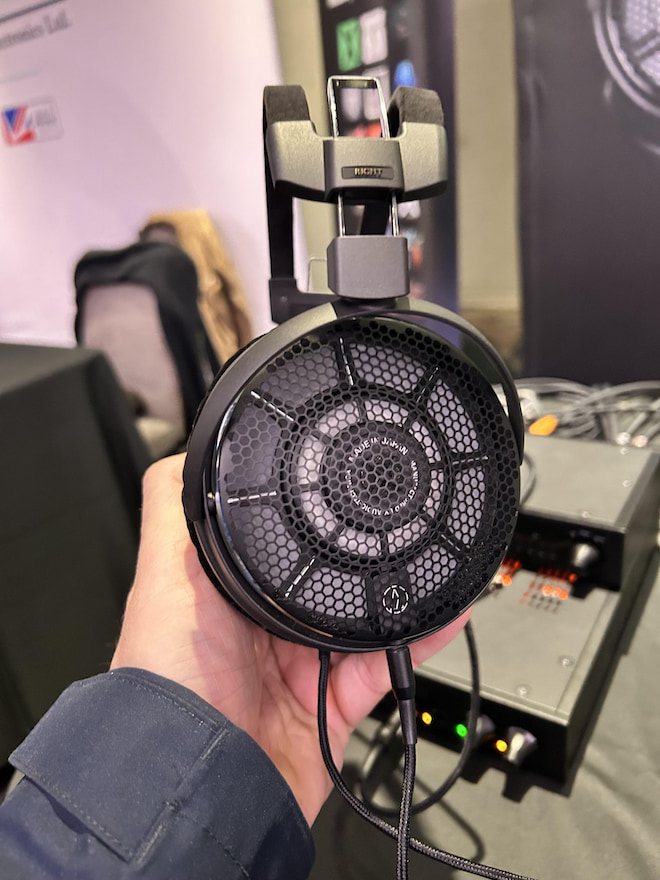
The Audio-Technica ATH-ADX7000 is remarkably light for a flagship open-back headphone. Slip them on and the first thing you notice is how little they seem to weigh on your head. Audio-Technica has long prioritized comfort and low mass in its reference designs, and the ADX7000 continues that tradition with a frame and suspension system that practically disappears during long listening sessions.
At just 275 grams, these things practically disappear the moment they land on your head. I’ve worn heavier baseball caps.
Putting them on the first time at CanJam NYC 2026, I actually paused for a second because it felt like something was missing. The clamping force is moderate, maybe a touch lighter than some listeners might prefer, but when you spend 60+ hours a week sitting in front of a computer listening, writing, and editing, comfort stops being a luxury and becomes survival strategy. In that context, Audio-Technica’s approach makes a lot of sense. They stay put without squeezing your skull like they’re trying to extract a confession. I deny everything. We’ve never met. Not even behind the 7-Eleven on Ocean Avenue in Long Branch at 2:17 a.m.
I had two listening sessions with them at the show, each around twenty minutes, and never experienced the dreaded headband hotspot that some listeners have mentioned. That said, twenty minutes at a show and three hours at home are two very different universes. Anyone who claims to know how a headphone feels long term after a quick demo is either lying or selling something. A few hours of real listening would be needed to make that call with confidence.
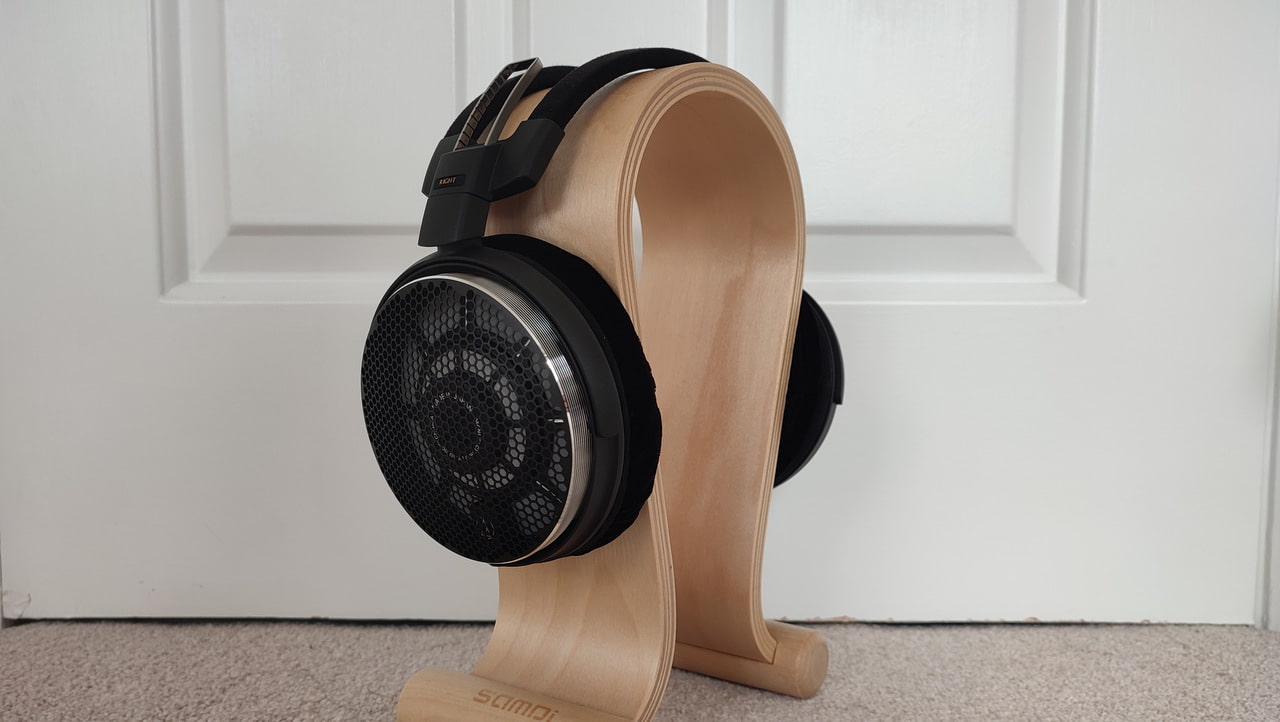
Because they’re so light, it would be easy to assume the ADX7000 is built from plastic. That assumption would be wrong. The frame uses magnesium, which is a far less common material in headphone construction but a clever one. It keeps the structure rigid while shaving off weight — a trick more manufacturers should probably steal.
And yes, each pair is made and hand assembled in Japan, which is exactly what you expect when a headphone costs $3,500. At that price, you want craftsmanship, not something that feels like it rolled off the same assembly line as a pair of airline earbuds.
Put it this way: the ATH-ADX7000 is lighter than a Cleveland pierogi before it hits the fryer — and a hell of a lot easier to live with after a long night.
The headline feature of the Audio-Technica ATH-ADX7000 is its new HXDT driver technology. Each earcup houses a 58 mm diaphragm formed through a precision moulding process designed to maintain a highly uniform circular shape. That level of consistency helps the diaphragm move more accurately, improving detail retrieval and overall clarity. Audio-Technica also aligns the circular components of the driver assembly with micrometre level precision, minimizing unwanted resonances and helping the driver behave exactly as intended.
Impedance is rated at 490 ohms with 100 dB/mW sensitivity, which is very much an Audio-Technica engineering choice. You can run the ATH-ADX7000 from a dongle DAC, but it probably shouldn’t be a bargain-bin one. These headphones clearly reward power and control. If it were my system, I’d lean toward a neutral to slightly warm source with strong bass control to keep the presentation balanced. A good desktop headphone amplifier or a high-powered DAP will get the most out of them.
The Audio-Technica AT-BHA100, now discontinued, was Audio Technica’s reference desktop headphone amplifier designed to drive headphones from 16 to 600 ohms. Its fully balanced design delivered up to 1.5 watts per channel into 16 ohms and 120 milliwatts per channel into 600 ohms, providing the headroom and control needed for high impedance flagship models. Unless my eyes were getting worse under the show lighting, this appears to be the amplifier Audio-Technica brought to power the ATH ADX7000 during its demonstrations.
Electrostatic Lite Without the Electrostatic Hassle?
On the train into Manhattan on Saturday morning, thanks to NJ Transit and its ongoing Portal Bridge construction circus, the ride stretched closer to two hours with the usual power hiccups and delays. Plenty of time to kill, so I reread James Fiorucci’s review and asked myself the obvious question. Was he right?
Turns out…yeah. He was.
The more I listened to the Audio-Technica ATH-ADX7000, the more it became clear that these drift very close to electrostatic lite territory without requiring an energizer or dedicated electrostatic amplifier. Running through tracks from Massive Attack, The Orb, deadmau5, along with a few jazz selections, several things jumped out immediately. Transparency. Excellent detail retrieval that never feels forced. Speed. Dynamic snap. And a very satisfying punch from the mid bass into the lower mids.

And then there is the space. These things are undeniably spacious sounding. Not just wide. New York wide. Like standing on the East River looking across Manhattan, past the Hudson, and all the way into Hiram’s Roadstand parking lot in Bergen County before the soundstage finally taps out. If a headphone can pull that off in a noisy show environment, something serious is happening under those magnesium grills.
The Bottom Line
The Audio-Technica ATH-ADX7000 is not a casual purchase. At $3,500, it firmly sits in the flagship tier. The good news is that it’s still less expensive than the top offerings from Audeze, Abyss, and ZMF Headphones, while delivering a presentation that edges close to electrostatic territory without requiring an energizer.
The extremely high 490 ohm impedance means these headphones reward serious amplification. A good desktop amplifier or powerful DAP will unlock their speed, transparency, and expansive soundstage. But the real question lingering in my mind after CanJam NYC 2026 is this: what would they sound like paired with a dedicated OTL tube amplifier? My suspicion is that the answer could be very, very interesting.
Where to buy:
Related Reading:

The first leak surrounding the Pixel 11 Pro Fold has surfaced, offering an early look at Google’s next foldable phone. According to CAD renders shared by Android Headlines in partnership with OnLeaks, the device will look very similar to the Pixel 10 Pro Fold, though with a slightly slimmer profile and a redesigned camera bump.
Visually, the phone sticks to Google’s now-familiar book-style foldable design with an inner folding display and a cover screen on the outside. The materials also appear unchanged, with an aluminum frame paired with a glass back, while the physical button placement remains the same as before, with the power button sitting above the volume keys.

The most noticeable change appears to be the thinner chassis. The Pixel 11 Pro Fold is expected to measure 10.1mm when folded and 4.8mm when unfolded, making it slightly slimmer than its predecessor. The overall height and width, however, are expected to remain largely the same.
Another notable tweak is the redesigned camera island, which reportedly looks cleaner and more modern, with the LED flash and microphone placed within the upper pill-shaped cutout alongside the sensors. While the exact camera hardware hasn’t been confirmed yet, the report suggests Google could introduce upgrades, possibly borrowing components from the Pixel 10 Pro lineup.

Under the hood, the Pixel 11 Pro Fold is expected to run on the new Google Tensor G6 chip, reportedly built by TSMC on a potential 3nm process, with rumors pointing to a 7-core CPU configuration. Beyond that, much of the feature set is expected to remain familiar, including IP68 water resistance, Qi wireless charging, and support for PixelSnap accessories, while the display sizes and battery capacity are likely to stay largely unchanged from the current generation.
A slimmer Pixel Fold, but not a radical overhaul
It seems Google is following in the footsteps of Samsung, which trimmed the waistline of the Galaxy Z Fold 7. Across the ocean, Chinese labels are already engaged in an even more furious race to make the thinnest foldable phone out there, with the Honor Magic V6 and the Oppo Find N6 being the top contenders. It would be interesting to see whether Google has managed to slim down its next foldable, while also bolstering its ingress protection against dust and water exposure.

While the design leak is a big pre-launch expose, there are murmurs of a few other changes under the hood for the broader Pixel 11 portfolio. Google is reportedly eying a modem supplied by MediaTek, switching away from Samsung. Pixel phones have often struggled with connectivity woes, so let’s hope the MediaTek partnership brings some respite.
As for launch timing, the report suggests Google will likely unveil the Pixel 11 series in August, following the company’s recent launch schedule. Pricing remains unclear for now, though earlier roadmap leaks hinted the foldable could target around $1,500, though that figure may change due to market conditions and tariffs.

Apple’s fourth round of developer betas has arrived, with builds of iOS 26.4, iPadOS 26.4, watchOS 26.4, tvOS 26.4, visionOS 26.4, and macOS Tahoe 26.4 now available for testing.

Apple’s hardware that works with the 26-generation operating systems – Image Credit: Apple
The fourth developer betas for iOS 26.4, iPadOS 26.4, watchOS 26.4, tvOS 26.4, macOS 26.4, and visionOS 26.4 arrive after the third, which landed on March 2 for most, March 3 for macOS. The second round appeared on February 23, and the first round arrived on February 16.
- iOS 26.4 build 4 is 23E5234a, replacing 23E5223f


The Federal Bureau of Investigation (FBI) warns that criminals are impersonating U.S. officials in phishing attacks targeting businesses and individuals who request city and county planning and zoning permits.
In a public service announcement published on Monday, the bureau said that the criminals behind this campaign are identifying potential victims using publicly available information, which also makes their malicious messages seem legitimate and helps them trick suspicious targets.
“Individuals and businesses with active applications for land-use permits are being targeted by criminals impersonating city and county planning and zoning board officials, fraudulently requesting fees associated with these permits,” the FBI warned.
“Victims receive unsolicited emails citing their permit information, zoning application numbers, and/or property addresses. Victims are instructed to pay invoices for fees related to their permits and directed to make payments via wire transfer, peer-to-peer payment, or cryptocurrency.”
The FBI says there are several common indicators that can help detect such schemes, including messages sent from non-governmental domains (such as @usa.com), attachments that ask recipients to request more details via email, and various tactics to push for quicker payments to avoid permit delays.
Scammers may also time their phishing messages to match the timing of official communications with details about zoning permits.
The law enforcement agency advised businesses and individuals to carefully check whether messages they receive from U.S. officials are legitimate by verifying the domain and email address and calling the city or county government to confirm outstanding fees.
Those who were targeted or fell victim to this scam should file a complaint with the FBI’s Internet Crime Complaint Center (IC3) and share the email address, date of email, and/or phone number used by the scammers, the date of the project’s scheduled hearing, the amount listed in the fraudulent invoice, as well as any other financial information provided by the criminals.
Four years ago, the FBI also warned of widespread attacks in which scammers impersonated government or law enforcement officials by spoofing authentic phone numbers to extort money from potential victims or steal their personally identifiable information.
In April 2025, the bureau said that criminals were also impersonating FBI IC3 employees, while offering to “help” fraud victims recover money lost to other scammers.
One month later, the FBI also warned of cybercriminals using AI-generated audio deepfakes to target U.S. officials in voice phishing attacks.

Malware is getting smarter. The Red Report 2026 reveals how new threats use math to detect sandboxes and hide in plain sight.
Download our analysis of 1.1 million malicious samples to uncover the top 10 techniques and see if your security stack is blinded.


Living in the digital age often feels like a double-edged sword. We can connect with virtually anyone, anywhere, at any time. You can chat with a peer in a different time zone, order flowers from the shop across town, and post those cute new pictures of your kids, all in a matter of minutes and from the handy little device you carry around in your pocket. Modern technology allows us to share our lives in ways many of us never imagined even 20 years ago, but there’s also a dark side to digital life. The modern age has made it much easier for scammers to target anyone with even a hint of a digital footprint.
Scams are a timeless crime, far predating the age of FBI alerts. Insurance scams have been around for centuries, but today we’re more worried about phishing scams and deceptive websites. In February 2026, the FBI issued a warning to the public about an emerging, malicious plot that can potentially target anyone who posts photos online. Criminals are finding those photos of your loved ones, be it your children, parents, significant other, or friends, and using them to create fake proof-of-life photos. They’ll then send you these photos to try to fool you into believing that this person has been kidnapped and demand a ransom payment. When presented with a frightening photo of someone we love, many of us may immediately pay up — here’s what to do instead.
A vicious scam

It’s easy to hang up the phone on a would-be scammer that’s talking about your car’s extended warranty and set up your phone to block potential scam calls, but this scam plays deep into fears of our loved one’s safety. After obtaining one of your photos, a scammer may contact you via text message claiming that they’ve kidnapped them and demanding a ransom payment. The text may be violent and will often be timed so that you don’t have long to examine the image before it disappears.
If you receive a text or email similar to this, don’t panic. Take a screenshot of the message if possible and immediately get in touch with the loved one that is pictured to ensure they are safe. You should also closely examine the photo for accuracy — these photos have been manipulated and may have altered or missing physical features or proportions that just look off. If a friend or family member is actually missing, know that posting information online will likely lead scammers to your doorstep.
If you’re concerned about falling victim to this scam, the FBI recommends that you set up a code word with your loved ones that only you know to ensure reliable communication. Also, be sure to report any scam to the FBI’s Internet Crime Complaint Center, even if you don’t fall for it. Include any information that you have, such as phone numbers, photos, and payment information.


A homemade pulse jet engine now powers a winter machine that redefines what is possible on frozen lakes. Zach of Build N Pulsejets had a simple idea, and that was to attach his new 180-pound-thrust propane pulse jet to a child’s kick scooter for high-speed fun on dirt roads. Winter arrived in Michigan far earlier than expected, and before you knew it, he was knee-deep in snow and ice. Zach decided to adjust his plans, and now he has a pulse-jet bike that he enjoys riding across snowy surfaces, turning cabin fever into high-speed thrills.
First, he had to disassemble the scooter, starting with the wheels and then moving on to the fenders, which he removed with his trusty angle grinder. Three snowmobile skis were swapped out for carbide runners with plenty of ice grip, one in front and two in back, forming a stable trike layout. Then he began welding brackets to hold all of this gear in place while keeping the skis and motor steady. The pulse jet, a valveless design with an augmenter, is situated on the side to protect the rider from the flames. A forklift propane tank provides him with enough fuel to keep the machine going for an extended period of time, which is a significant advantage, but it also adds some weight.
Sale

Segway Ninebot S2 Electric Self-Balancing Scooter – Master Your Commute w/t 11.2 mph Max. Speed, 21.7 Mi…
- Speed & Range: Experience exhilarating rides with the Ninebot S2’s impressive top speed of 11.2 mph and range of 21.7 miles.
- Beginner-Friendly: Perfect for riders aged 16-50, the Segway S2 features a user-friendly learning mode, providing a smooth and gradual introduction.
- Adjustable & Supportive: Enjoy a customized fit tailored to your needs, as the Segway S2 accommodates heights ranging from 4’3″ to 6’6″ and supports…
Controlling this beast was a key part of this build, so he took extra time to do it right. The twist-grip throttle connects to a ball valve for extremely accurate fuel flow. He constructed some handmade foot pegs out of bar stock and added additional grip for good measure. To keep from bouncing off the seat, he just bolted in a salvaged one. He also gave some serious thought to the brakes, as a simple stomp brake would be insufficient on ice surfaces. Well, it’s a start, and he’s already thinking about ways to sharpen the serrations to make it more useful.
The first test run took place on a tiny pond, and before you knew it, the engine was roaring to life, its loud, rhythmic buzz booming out. The flames from the pulse jet flared crimson as it kicked in and began propelling the tricycle ahead. It moved okay, but the handling felt a little loose, owing to the fact that the runners had not yet been properly sharpened.

Speeds reached up to 30 mph in short bursts, yet the frame continued to bounce around the uneven ice. To be honest, the heat was getting to the augmenter, which was beginning to sag under its own weight and showing signs of thermal stress. The next step was a longer test run on a Michigan lake’s snowmobile drag strip. What about the acceleration? Let’s just say it was a bit of a battle, since the combined weight of the rider, the big tank, and the engine made it difficult to move forward from a stop, even on super-low friction ice. But once it started moving… well, the momentum simply kept growing.

The trike reached speeds of more than 44 mph (77 km/h), and the sound of the engine resonated across the ice plain as onlookers watched. The good news was that it remained steady even over ruts, despite the lack of suspension. Zach claims that the entire construction was a result of the lengthy winter that the northerners were forced to endure, a means to expend energy when the snow would otherwise lock everything down. The initiative has already provided exactly what he required. Some changes are already in the works, such as sharper carbide edges on the skis, a polished brake surface, and possibly a new coat of paint.
[Source]

Sony could be experimenting with dynamic pricing on the PlayStation Store, according to data spotted by price-tracking site PSPrices.
The platform has noticed that some users are being offered different prices for the same games, suggesting that Sony may be quietly testing a new pricing strategy.
The discovery comes from PlayStation Store data tied to Sony’s public API. In this data, experiment identifiers such as IPT_PILOT and IPT_OPR_TESTING appear alongside certain game listings. Additionally, according to PSPrices, these markers suggest that Sony is running A/B tests on pricing across more than 150 games in 68 regions.
Interestingly, the United States doesn’t appear to be part of the experiment for now. And rather than raising prices, the test currently seems to focus on selective discounts. Meanwhile, some users have reportedly seen price cuts ranging from 5% to 17.5% on major titles. These include Marvel’s Spider-Man 2, God of War, and Red Dead Redemption 2.
Dynamic pricing itself isn’t unusual in other industries. Airlines, hotels and online retailers often adjust prices based on demand, location or user behaviour. However, it’s far less common in digital game storefronts. Most players expect everyone to see the same price for the same title in these stores.
That’s why even a discount-focused test could prove controversial. If one player is offered 10% off a game like Sid Meier’s Civilization VII while another sees a much bigger discount, it could quickly raise questions about fairness.
For now, it’s unclear how long the experiment has been running or whether Sony plans to expand it further. The company hasn’t publicly acknowledged the tests, and Sony has yet to respond to requests for comment.
Still, if the data is accurate, the PlayStation Store could be exploring a pricing model that’s far more personalised than what gamers are used to. As a result, this could fundamentally change how digital games are sold in the future.

To keep , Live Nation is going to have to make some major changes. As first reported by , Live Nation reached a settlement with the Department of Justice in its antitrust case that accused the live entertainment giant of monopolistic practices. Live Nation will reportedly pay at least $200 million in damages to states that were part of the in May 2024, but avoid selling off Ticketmaster.
Live Nation will also be required to make a few changes to its business practices. According to NBC News, Ticketmaster, a subsidiary of Live Nation, will be required to create a “standalone ticketing system” that allows third-party competitors like SeatGeek and Eventbrite to sell tickets on.
The settlement aims to loosen some of Live Nation’s control over venues as well. According to NBC News, the company will have to divest up to 13 amphitheaters and be prohibited from retaliating against venues that choose another ticket seller over Ticketmaster.
The settlement comes less than a week after the case went to trial. While the matter may be concluded with the Justice Department, many of the states’ attorneys general who were part of the lawsuit will be continuing their legal action separately.
“The settlement recently announced with the U.S. Department of Justice fails to address the monopoly at the center of this case and would benefit Live Nation at the expense of consumers,” New York State Attorney General Letitia James wrote in a press release. “We will continue our lawsuit to protect consumers and restore fair competition to the live entertainment industry.” 26 other attorneys general signed onto continuing the lawsuit with James.

iPhone 18e production is on time, leak predictably claims

Kanye West announces concert at SoFi Stadium in Los Angeles as he attemps career comeback

Nick Clegg and Sheryl Sandberg join board of UK AI start-up Nscale after $2bn funding round


-

 Politics6 days ago
Alan Cumming Brands Baftas Ceremony A ‘Triggering S**tshow’
-
Business3 days ago
Form 8K Entergy Mississippi LLC For: 6 March
-

 Fashion3 days ago
Weekend Open Thread: Ann Taylor
-

 Tech4 days ago
Bitwarden adds support for passkey login on Windows 11
-

 News Videos6 hours ago
10th Algebra | Financial Planning | Question Bank Solution | Board Exam 2026
-
 Sports4 days ago
499 runs and 34 sixes later, India beat England to enter T20 World Cup final | Cricket News
-

 Tech7 days ago
Cynus Chess Robot: A Chess Board With A Robotic Arm
-

 Sports2 days ago
Three share 2-shot lead entering final round in Hong Kong
-

 Sports2 days ago
Braveheart Lakshya downs Lai in epic battle to enter All England Open final | Other Sports News
-

 Business6 days ago
Guthrie Disappearance Enters Fifth Week as Family Visits Memorial
-

 Crypto World3 hours ago
Paradigm, a16z, Winklevoss Capital, Balaji Srinivasan among investors in ZODL
-

 NewsBeat4 days ago
Piccadilly Circus just unveiled ‘London’s newest tourist attraction’ and it only costs 80p to enter
-

 Business1 day ago
Search for Nancy Guthrie Enters 37th Day as FBI Probes Wi-Fi Jammer Theory
-

 Politics3 days ago
Top Mamdani aide takes progressive project to the UK
-

 Entertainment3 days ago
Hailey Bieber Poses For Sexy Selfies In New Luscious Lip Thirst Traps
-
 Sports6 days ago
Jack Grealish posts new injury update as Man City star enters crucial period
-

 Tech4 hours ago
Despite challenges, Ireland sixth in EU for board gender diversity
-

 Crypto World5 days ago
New Crypto Mutuum Finance (MUTM) Reports V1 Protocol Progress as Roadmap Enters Phase 3
-

 Tech4 days ago
ACIP To Discuss COVID ‘Vaccine Injuries’ Next Month, Despite That Not Being In Its Purview
-
Entertainment5 days ago
Harry Styles Has ‘Struggled’ to Discuss Liam Payne’s Death