Security teams log 54% of successful attacks and alert on just 14%. The rest move through your environment unseen.
The Picus whitepaper shows how breach and attack simulation tests your SIEM and EDR rules so threats stop slipping by detection.

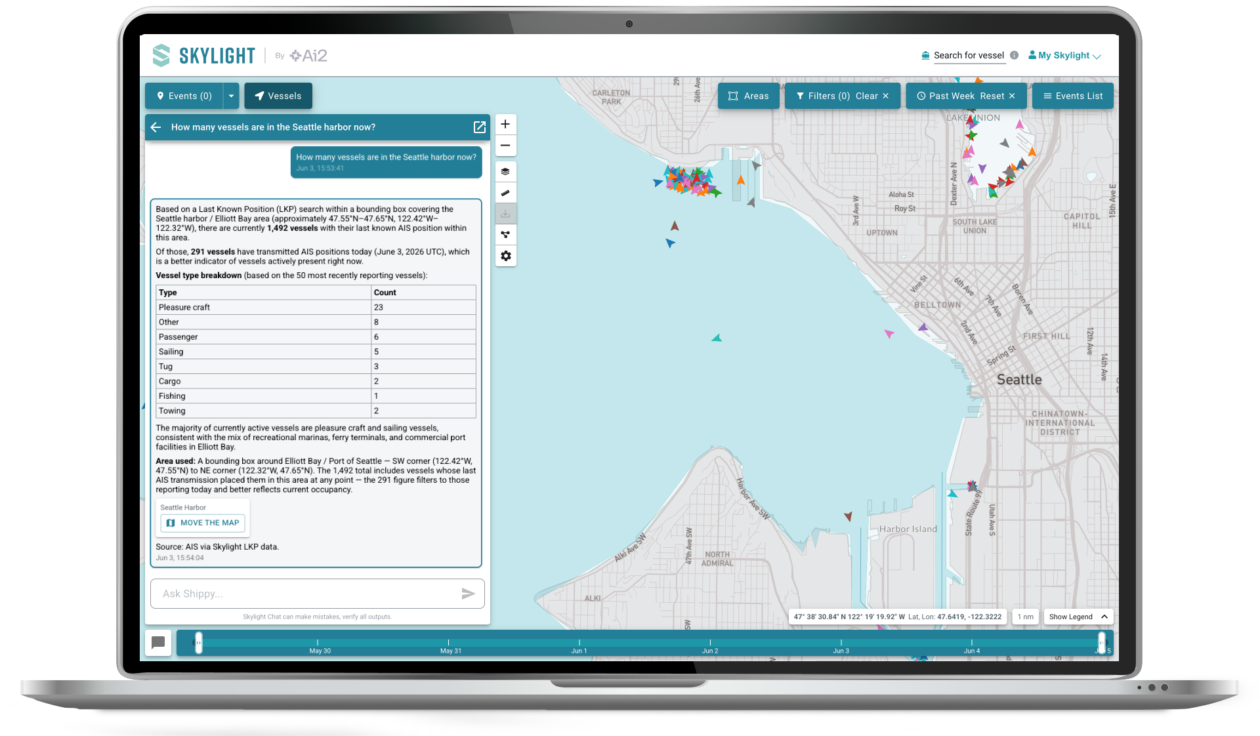
Skylight, the free ocean-monitoring platform built by Seattle’s Allen Institute for AI (Ai2), launched an AI agent that gives maritime analysts answers to plain-language questions about what’s happening across the world’s oceans, from illegal fishing to vessels that have gone dark.
The agent, dubbed Shippy, runs on Skylight’s live vessel-tracking and satellite data, with every answer linking back to the underlying records so analysts can verify and reproduce it.
Skylight is one of a group of environmental projects that moved in 2021 to Ai2 from Vulcan Inc., now known as Vale Group, the late Microsoft co-founder Paul Allen’s holding company.
Researchers at Skylight have spent years building tools to spot illegal, unreported and unregulated fishing, which it says accounts for billions of dollars in losses each year and hits developing countries that depend on their fisheries the hardest. The platform is free, and Skylight says it is used by more than 300 organizations across about 70 countries.
It combines free satellite data with commercial imagery and vessel-tracking feeds to flag suspicious behavior, such as a ship going dark or two vessels meeting at sea to transfer catch.
Ai2 has open-sourced the computer-vision models behind the project.
Like Skylight itself, Shippy will be free to governments, regional fisheries bodies and qualifying nonprofits. For now it is limited to a small group of agencies and partners, with Skylight planning to expand access to a broader community of users as it updates and improves the tool.
Skylight says it built in limits to keep the agent useful and accountable. Shippy sticks to maritime questions, presents facts without making legal judgments, declines defense-related requests, and stops rather than guess when a question runs past what its data can answer. Decisions such as where to send a patrol, the team says, stay with “the humans in the room.”

The launch reflects a broader shift at Ai2 toward applying AI to specific real-world problems. Former CEO Ali Farhadi and other researchers left earlier this year to join Microsoft, as the Ai2 board reconsidered whether the nonprofit should be trying to go toe-to-toe with heavily funded tech giants in developing advanced AI models.

Expeditors International, the Seattle-area logistics company known for never laying off employees, cut about 230 technology-related jobs in the region on Monday, ending a tradition that had been a point of pride for much of the company’s history.
The layoffs hit software developers, quality-assurance testers, project managers, business analysts and others across Expeditors’ offices in downtown Seattle, Bellevue, Lynnwood and Federal Way, according to laid-off employees and others with knowledge of the situation.
Company officials did not respond to messages from GeekWire seeking comment Monday afternoon and evening. The reasons for the layoffs were not clear.
The cuts in the Seattle area represent about 15% of the company’s global tech workforce. Posts on Reddit and LinkedIn indicate that there may have been some additional job cuts outside the region. Expeditors employed about 1,500 people in information systems worldwide as of March 31, up from about 1,360 a year before, according to its first-quarter financial report.
Expeditors was founded in Seattle in 1979 as a single-office ocean freight forwarder and went public on the Nasdaq in 1984. Its stock now trades on the New York Stock Exchange. The company has about 20,000 employees worldwide and posted $11.07 billion in revenue in 2025, with profits of $810 million.
Under Peter J. Rose, a co-founder who served as CEO from 1988 to 2013, it built a reputation for not laying off employees. It held to that practice through the 2008-09 financial crisis and the COVID-19 pandemic, and even as a wave of layoffs swept the technology industry in 2022 and 2023.
The cuts follow major leadership changes. Daniel Wall, who started in 1987 as a messenger and worked his way up over nearly four decades, became CEO in April 2025, succeeding Jeffrey Musser. The tech organization is run by Courtney Hawkins, senior vice president and CIO, who joined Expeditors in 2024, after roles at Starbucks, Nike, Nordstrom and Zulily.
One former employee said there had been hints about the possible cuts for several months, including discussion of a restructuring plan and new job titles in the technology organization.
Another clue, in retrospect, was a change to the company’s website: As recently as January of this year, Expeditors’ online corporate history page credited “our no layoff policy” for making 2010 the company’s best year ever, according to a version of the page captured by the Internet Archive.
By last month, the page had been changed to call it “our short-term no layoff policy.”
macOS Tahoe threw an icon on every menu item, making them impossible to distinguish at a glance. macOS Golden Gate has rectified that design taboo with blessedly iconless menus.
In Disney’s 2004 animated film The Incredibles, a very basic concept of “when everyone is special, no one is” is explored. Alan Dye must not have seen that movie or the many like it.
Well, now that he’s gone, so is his team’s decision to frustratingly place icons next to every menu item. Apple announced macOS Golden Gate on Monday, and it has fixed this problem.
macOS Tahoe introduced the controversial Liquid Glass design, but that may not have been the most hated change to the platform. Oh, the weird Finder icon was a problem Apple fixed immediately, but I’m talking about menu icons.
For some reason, Apple went against its own age-old design guidelines to add special little SF symbols to every menu item. Every single item in the menu got these little pictures of cogs, squares, and pencils.
The problem is, when every menu item has a little picture next to it, your brain stops distinguishing between them. They’re treated as another letter in a line of text and may as well not exist.
Well, someone got the memo because macOS Golden Gate ditches the icons again. Here’s a side-by-side of the new menu next to the previous one.
The left menu shows a lack of icons in macOS Golden Gate and the right menu shows the icons in macOS Tahoe
Apple spent a lot of its keynote addressing user complaints. Even the corner radii being mismatched was addressed directly.
WWDC 2026 is underway and AppleInsider is digging through all of the betas for every small change. Even though Apple spent most of its keynote address talking about Apple Intelligence, there are many new features and updates across every operating system.
For years, Apple has been accused of being one of the biggest stragglers in the AI arms race. Doubters have argued that Apple’s lack of a clear AI strategy have cost it its edge, and Wall Street analysts have worried that the gap could start hurting iPhone sales.
Now, the company has unveiled what it is billing as its biggest AI launch to date: Siri AI, which embeds new automated capabilities (fueled by a partnership with Google Gemini) into the very spine of its software.
Is it enough to get people to stop saying that Apple is “losing” the AI race?
To be honest, nobody really knows. But the question itself may be the wrong one. A better one might be: are Apple customers actually going to use these features and, if they do, will it help Apple’s business?
Before we address that question, we should note that Monday’s announcements also came with an interesting comment from Craig Federighi, Apple’s senior vice president of software engineering.
“Some appear to be racing forward, seemingly pursuing AI for the sake of AI, without clear regard for the people — all of us — that it’s ultimately meant to serve,” Federighi said during his remarks. “At Apple, our mission has always been to turn the potential of advanced technology into helpful and intuitive products for everyone.”
The not-so-veiled defiance on display here seems like both a response to Apple’s “behind-on-AI” criticism and an effort to acknowledge the deeply ambivalent — and, according to some polls, increasingly negative — sentiments that many consumers have about the AI industry. It’s also a shrewd message at a moment when Americans are worried that AI will take their jobs and rot their brains. Apple is positioning itself as the AI company that’s actually on your side.
Judging by Monday’s demos, that positioning has some substance behind it. Siri can now surface information buried deep in your inbox or text history and surface helpful information and offer helpful suggestions based on it. It can use what Apple calls onscreen awareness to give you context about what you’re looking at. And — using Gemini — it can pull near-instantaneous up-to-date information from the web and deliver it right to your device.
Siri is also designed to work seamlessly across Apple devices, giving users increased flexibility and, like other AI chatbots, it stores chat histories so users can revisit past conversations.
By building AI functionalities into its disembodied, ethereal assistant, Apple also has the potential to eat into the advantages of competitors whose apps can only reach users through its own App Store. For those competitors, having Apple’s AI embedded at the operating system level is a meaningful threat to their distribution advantage.
The keyword here is “potential” since this version of Siri won’t be available to consumers until later this year, as a beta.
A final verdict will have to wait, but what’s already clear is that Apple is doing its best to court its audience — whether they end up going for it or not. Apple is obviously a hardware company, and these updates are designed to make that hardware incrementally more user-friendly and convenient, keeping users glued to their devices a little while longer.
The contrast with its competitors is instructive and maybe the most important signal in Monday’s announcements for anyone watching where the AI industry is actually headed. Take OpenAI, which, despite shipping updates at a relentless pace, has struggled to define who it’s actually selling to, oscillating between consumers and enterprises. Or Meta, which is pouring gargantuan sums into AI without a clear explanation of how it connects to the company’s core advertising business.
Apple’s more measured approach is starting to look optimal by comparison — and more financially sound. For the most part, Apple hasn’t needed a gangbusters AI strategy. It posted historic iPhone sales last quarter. And as questions mount over AI’s profitability and real-world utility, Apple is spending significantly less than its competitors — roughly $14 billion in capex planned this year, against a cumulative $900 billion being committed by other tech giants — while still earning huge amounts of revenue. That revenue has come from the AI industry itself via taxes on AI companies that use its App Store to platform their apps.
In short, Apple is spending less, making more, and now launched a suite of AI features that — for many iPhone users — will feel indistinguishable from the other AI applications already available to them through the App Store. If that doesn’t exactly count as “winning the AI race,” it may be the smartest way to run it.
When you purchase through links in our articles, we may earn a small commission. This doesn’t affect our editorial independence.
Instagram head Adam Mosseri announced the feature a year ago.
Instagram has made it easier to pull off that grid design and aesthetic you want to achieve. The Meta-owned app has finally rolled out the ability to rearrange your grid, almost a year after Instagram head Adam Mosseri announced that the feature was coming. According to USA Today, you will be able to move posts around regardless of when you made them starting today, anywhere you are in the world. “We know this is long overdue, but we wanted to take the time to get it right,” Meta told the publication. We can confirm that we already have access to the feature.
The ability to rearrange the Instagram grid continues to be one of the most requested features on the app, and Meta has been planning to introduced it way before Mosseri announced its arrival last year. Alessandro Paluzzi, who was known for reverse engineering apps and finding unannounced tools, discovered an “edit grid” option in the Instagram app way back in 2022.
If you’re tired of seeing your posts in chronological order and want to move things around, simply go to your profile and long press any post. Along with “Pin to main grid” and “Archive,” you’ll now see an option that says “Reorder grid.” Tap on it to be taken to another window, where you can drag posts to rearrange your content until your profile looks exactly the way you want it to. Take note that any post you pin will remain at the top of your profile and will be blacked out in the “Reorder grid” window.
Indian quick-commerce startup Zepto has unveiled plans for an initial public offering that could be valued at about $1 billion, putting one of Y Combinator’s biggest bets outside the U.S. on the path to public markets.
The filing, released Monday, offers a rare look at how one of India’s most closely watched startups plans to sustain its breakneck growth after listing. Zepto’s advertising revenue rose more than 151% year-over-year to ₹16.4 billion (about $171 million) in fiscal 2026, outpacing the company’s 104% increase in operating revenue to ₹115.5 billion (around $2.4 billion).
While grocery deliveries remain Zepto’s core business, the faster growth of its advertising arm points to a broader shift in how the startup makes money — a strategy Amazon pioneered, turning its marketplace into one of the world’s most profitable ad businesses by selling visibility to the same merchants competing on its platform.
Founded in 2021 by Stanford dropouts Aadit Palicha and Kaivalya Vohra, Zepto has grown into one of India’s fastest-growing startups, competing with Zomato-owned Blinkit and Swiggy’s Instamart in the country’s fiercely contested quick-commerce market. Amazon and Walmart-backed Flipkart have also intensified their efforts in the segment in recent months.
Despite the intense competition, Zepto has continued to add customers and orders at a rapid clip. The startup processed more than 640 million orders in fiscal 2026, per the draft prospectus, nearly double the previous year, while the annual transacting users rose to almost 48 million. Even as it expanded its network to 1,139 stores, orders per store continued to increase, suggesting demand is growing alongside its footprint.
That growth comes at a cost, however. Zepto remains loss-making, reporting a net loss of ₹59.1 billion (about $617.36 million) in fiscal 2026, compared with ₹47.0 billion (around $492.45 million) a year earlier. The startup acknowledged in its filing that it may continue to incur losses and may not be able to sustain its historical growth rates, a standard but telling disclosure that highlights the tension facing venture-backed companies seeking public-market investors before reaching profitability.
Zepto plans to raise up to ₹80.1 billion (about $837.41 million) through a fresh issue of shares. The IPO will also include an offer-for-sale of up to 113.5 million shares by existing investors including Nexus Venture Partners, Contrary, and Razor Ventures, with the final size of the sale dependent on the eventual pricing of the offering. The startup also said it may raise up to ₹16.02 billion (about $167 million) from investors in a pre-IPO placement ahead of the listing.
The listing is set to provide a closely watched outcome for some of Zepto’s early backers. The startup was valued at $7 billion in its last funding round in October and counts Y Combinator, Lachy Groom, Nexus Venture Partners, StepStone, Glade Brook, and Lightspeed among its investors.
Several prominent shareholders — including Y Combinator-affiliated funds, Lightspeed, StepStone, Groom, and Glade Brook — are not participating in the IPO’s offer-for-sale, opting to retain their stakes as the startup prepares for its market debut. That’s worth pausing on: Zepto’s public-market valuation remains uncertain, and some mutual funds and family offices that reviewed the company ahead of the IPO have indicated valuations well below its last private round, according to people familiar with the matter.
Zepto’s founders, the filing revealed, received summonses from India’s anti-money laundering agency, the Enforcement Directorate, in April, seeking information related to foreign investments, the company’s shareholding structure, and other matters under the country’s foreign-exchange laws.
The two subsequently appeared before the agency and provided the requested information and documents. Zepto said it has not received any further communication from the regulator since, but cautioned that it could not rule out future inquiries, investigations, or penalties.
The proposed listing marks the culmination of a years-long effort to prepare the startup for a domestic market debut. Zepto relocated its legal home from Singapore to India last year, joining a growing number of startups restructuring their holding companies as local public markets become increasingly attractive for tech listings.
When you purchase through links in our articles, we may earn a small commission. This doesn’t affect our editorial independence.
New variants of the NFCShare Android malware are being distributed as fake updates for legitimate banking apps hosted on GitHub.
The malware has evolved and is now targeting customers of multiple banks and financial institutions across Europe in a phishing campaign aimed at stealing payment card data.
After tricking victims with a fake verification screen to place the cards near the mobile device’s near-field communication (NFC) chip, NFCShare reads the information using Android’s IsoDep interface and EMV commands.
The malware steals the card number, type, expiry date, and a 4-digit PIN entered by the victim under the pretense of a security step, and exfiltrates it to the attacker’s command-and-control (C2) host over a WebSocket channel.
The information collected this way can then be used in NFC payment relay schemes, as documented in the NGate, SuperCard X, and RelayNFC malware attacks.

NFCShare was first documented by D3Lab researchers in January 2026, who have been tracking its activity and evolution.
D3Lab researcher Andrea Draghetti told BleepingComputer that, despite similarities to other Android malware that exploit NFC chips for data theft, NFCShare uses distinct code, libraries, architecture, and implementation details.
Draghetti noted, though, that it could still be an evolution of the same ecosystem, driven by the same threat actors.
Recent NFCShare attacks observed starting May 14 begin with the victim visiting a phishing site that impersonates a real bank and asks for banking credentials.
Victims are then urged to update their banking app and are redirected to a GitHub repository hosting a malicious APK file.

The researchers note that SMS messages or phone calls from fake bank representatives may also be used as part of the social-engineering process, as seen in similar attacks, although D3Lab researchers did not observe these methods directly.
Since its creation on April 10, the GitHub repository used for distributing NFCShare has hosted 56 unique APKs that impersonated mobile apps for banks primarily from Italy and Spain:
In January, D3Lab reported that the malware targeted only Deutsche Bank in Germany, which may suggest an extended targeting scope.

One interesting aspect of the new version of the malware is the introduction of malformed APK packaging to hinder automated analysis, and potentially also security tools.
The APK is still a ZIP archive, but the newer samples include poisoned/malformed file paths within that ZIP, causing some extraction tools to wrongly interpret internal relative paths as filesystem paths and trigger errors.
However, D3Lab notes that this trick does not prevent manual analysis or code recovery; rather, it disrupts static analysis in certain tools.
Android users are advised to source banking apps only from Google Play, enable Play Protect, and be cautious of “verification requests” that prompt NFC card scans.
Security teams log 54% of successful attacks and alert on just 14%. The rest move through your environment unseen.
The Picus whitepaper shows how breach and attack simulation tests your SIEM and EDR rules so threats stop slipping by detection.
An anonymous reader quotes a report from The Guardian: The world’s oceans are under “severe and accelerating” pressure from human activities, with the rate of sea-level rise double that of a decade ago, according to a damning assessment from the United Nations. The “intensifying” stressors, which include pollution and large-scale industrial fishing, are cumulative, said the report, resulting in widespread biodiversity loss and putting ocean systems under “severe strain.”
The UN’s third World Ocean Assessment, which reflects the work of nearly 600 scientists from 86 countries, looked at the oceans’ health from 2021-25. The previous report, that covered up to 2018, found persistent degradation of the marine environment. Five years on, scientists know more about the cumulative impacts of anthropogenic pressures on the ocean, and the latest report shows just how much of the damage has been done in the past few years. The scientists’ key findings include:
– Sea levels continue to rise at an increasing rate, from 2mm a year prior to 2015 to 4.3mm a year in 2023.
– 16% of the increase in global ocean heat since 1955 occurred after 2018.
– The greatest relative warming has been observed in the Atlantic Ocean and the southern parts of the Indian and Pacific Oceans.
– Large gaps in knowledge persist — with only 27% of the ocean floor mapped by 2025, deep-sea ecosystems remain poorly understood. Lukas Meus, Greenpeace’s global ocean campaigner, said: “We are calling on governments to create fully protected ocean sanctuaries that will close vast areas of the ocean off from extractive human activities. Governments have promised to protect 30% of the world’s ocean by 2030 — the minimum scientists say we need for the ocean to be able to recover.”
EOFY sales in Australia aren’t just about work-related deals — nothing is stopping you from picking up something for your home or yourself when there are savings to be had.
So if you’ve been eyeing something from Dyson, you’re in luck because the British brand is hosting its own EOFY sale that’s slashing up to AU$651 on some of its top-selling products.
You don’t have to buy directly from Dyson if you don’t want to, though. Other authorised retailers are also discounting Dyson’s tech and I’ve hunting down some of the best prices on a variety of premium vacuums and hair stylers. I’m also keeping an eye on Dyson’s purifier fan heaters for good discounts, so watch this space.
I’ll be tracking all the best Dyson EOFY deals through June, so you can bookmark this page and check back to see if there have been any price drops or new items discounted — you’ll get the most up to date information right here.
While EOFY sales officially start on June 1 in Australia, Dyson’s own sale in 2026 started a few days later. Dyson hasn’t specified when the sale will end, though, but it would be fair to assume the prices will revert on July 1 (sale ending June 30).
You most certainly can buy directly from Dyson during any major sale in Australia, especially since the brand promises to price match any other retailer. There are also often exclusive models of its vacuums and hair tools that you won’t find elsewhere.
The difference between what you’d get as a Dyson exclusive and what’s available from authorised stockists is essentially a different colour scheme and/or less attachments that’s included with a specific vacuum cleaner.
When it comes to getting your hands on a Dyson product — whether it be for the home or your glorious tresses — the best time to pick them up is when there’s a steep discount.
And the best discounts on pretty much anything is during Black Friday. Last year saw some topnotch offers directly from Dyson, with some bonuses thrown in, but don’t ignore the discounts on eBay. Chances are you’ll be able to save a little more with a coupon code – with the potential for even better discounts for Plus members — and still shop directly from Dyson’s official eBay store.
Then there’s Amazon. During major sales, Amazon has had some of the best prices on select Dyson products. And if the identical model is listed at The Good Guys, the retailer will price beat. So definitely shop around.
AI + ML
L’etat, c’est AI
OPINION The US government is reportedly weighing whether to take a financial stake in AI companies, which looks a bit like negotiating for a seat on the Titanic.
Neither OpenAI nor Anthropic, the marquee brands in US AI, are profitable yet. While Anthropic may be nearer to that point if its accounting survives scrutiny, OpenAI’s $1.4 trillion in financial commitments over the next eight years have been interpreted as a red flag for investors.
This raises (at least) two questions: Should the US government be picking winners? And should the US government be picking losers?
The first question appears already to have been decided. As noted by the US Council on Foreign Relations, since January 2025, the feds have invested $20.9 billion in sixteen deals that involve direct ownership. This represents a change from more hands-off financial arrangements involving grants, loans, and tax incentives.
The Department of Commerce, for example, has taken a 10 percent stake in Intel, once a symbol of American technical prowess and now a national security backstop. The Development Finance Corporation had invested in minerals, energy, and infrastructure. And the Department of Defense has undertaken at least seven similar deals.
Neoliberal US notions about competition and the separation of church, state, and private industry have succumbed to the new world disorder.
When economists from Harvard and Yale looked at the issue in a 2021 paper titled “The Dance Between Government and Private Investors: Public Entrepreneurial Finance around the Globe,” they were cautiously optimistic.
Authors Jessica Bai (Harvard), Shai Bernstein (Harvard), Abhishek Dev (Yale) and Josh Lerner (Harvard) looked at 755 entrepreneurial finance policies in 66 countries during the period from 1995 to 2019. They concluded that “government funding programs are associated with subsequent increases in innovation,” as measured by “top patents.”
They offered some caveats, such as the observation that “government programs frequently rely on private capital markets through capital matching requirements, where private capital groups are often allowed to invest in more preferential terms than the public funds.”
And they also noted that economists have long recommended government investment in response to market failures – areas where private funding has chosen not to invest, presumably due to the uncertainty of returns.
A recent example of that would be the US Commerce Department’s decision to invest $2 billion in quantum computing in exchange for a minority controlling stake in nine technology companies. Pure-play quantum computing companies like D-Wave, Quantinuum, IonQ, and Rigetti Computing are not making a profit. But concern that quantum computing might some day do meaningful computing not possible with classical computers is enough to keep the funds flowing for now.
The US government’s reported interest in AI companies might be interpreted in a similar light, as a bailout for companies that have committed to spend heavily on data centers before demand has been demonstrated and pricing has stabilized. With OpenAI and Anthropic preparing to go public, the White House would do better to wait before placing its bet.
OpenAI CEO Sam Altman is said to have pushed for federal investment last year but publicly repudiated the idea after CFO Sarah Friar suggested federal loan guarantees. If the feds were to buy into OpenAI, the deal might take the form of a public wealth fund – so the public would receive revenue from intellectual property that AI firms have captured and are reselling.
US Senator Bernie Sanders (I-VT) last week said he planned to introduce a bill called the American AI Sovereign Wealth Fund Act. Funded by a one-time 50 percent tax paid in AI company stock, it would give the public a say in how AI is used and a portion of the revenue generated by AI companies (which, again, follows from the largely uncompensated capture of public content).
Meanwhile, the White House last week issued an executive order directing “the national security enterprise to accelerate AI adoption to meet surging demand, adapt the best commercial and open-source technologies for mission use, assure that fielded systems are robust, steerable, controllable, and preserve clear lines of accountability under the Constitutional chain of command.” And the order promises “new partnerships with willing private-sector companies to secure America’s cutting-edge AI against global threats.”
Buying into these companies doesn’t make a lot of sense if they can deliver on their promises at a viable price. The market would ensure plenty of good options for federal procurement.
But if leading AI models are priced like Claude Mythos, reported to run $25 per million input tokens and $125 per million output tokens, or about 5x Opus 4.8, there may be some concern that leading edge AI will be too costly for much of the market. Uber’s $1,500 monthly token spending cap per employee AI tool suggests companies won’t reward the AI industry for over-investing. If cutting-edge AI is going to be priced out of reach for most industries and if it really can accomplish things that lesser models cannot, the case for federal involvement gets stronger.
It would be a shame if the feds rewarded OpenAI and its peers with taxpayer money because that would reward fiscal irresponsibility and hinder startups hoping to innovate. Worse still, it would commit funds prematurely and unnecessarily for some notional national security edge that’s razor thin and is being dulled by evolving open weight models and foreign model providers.
The jury is still out – there are at least 115 lawsuits against AI companies – on whether there’s a broad, sustainable market for AI services outside of software development and perhaps a few other knowledge work markets. The government should wait for the courts, the public, and the market to weigh in before riding to the rescue. ®
Father’s Day 2026 lands on Sunday, June 21st, which means the annual scramble for “something Dad might actually use” has officially begun. Skip the novelty grill tools, team merch for a franchise he abandoned three seasons ago, and socks pretending to be a personality.
This year, we’re focused on hi-fi and home entertainment gifts that make sense: speakers, headphones, turntables, media players, and accessories that can improve how Dad listens to music, watches movies, streams shows, or disappears into the basement for two blessed hours of uninterrupted silence. Some are practical. Some are indulgent. A few might even make him stop pretending that the TV’s built-in speakers are “fine.”
Our Father’s Day 2026 hi-fi gift guide is built for dads who care about sound, picture quality, physical media, streaming, and gear that actually earns its shelf space. No filler. No mystery gadgets. No last-minute panic purchases from the aisle next to charcoal briquettes. Just audio and video products Dad will actually want, even if he is constitutionally incapable of saying so out loud.

For the dad who loves movie night: bring the cinema home with Kaleidescape. Surprise him, and the whole family, with a Kaleidescape Strato E movie player. Kaleidescape’s entry-level 4K movie player features reference-quality video and lossless audio, including Dolby Atmos and DTS:X. With the world’s only high‑fidelity movie library, his favorite films, TV series and concerts can be curated into a personal collection and played instantly with the touch of a button. Since Kaleidescape movies are downloaded, not streamed, there is never buffering or degradation, delivering the ultimate entertainment experience. This Father’s Day, don’t just give a gift. Give an escape beyond cinema.
Give Dad the gift of effortless high-fidelity this Father’s Day. Combining rich, high-fidelity sound with instant streaming like AirPlay 2, Google Cast and more, the Motion Foundation B1 x WiiM Amp Bundle is an elegant, easy-to-set-up audio solution that brings refined performance to his favorite space at a remarkable value.


Give Dad the Father’s Day Gift that keeps up. The Audioengine B2 Home Music System (aka A2-AIO) delivers high-quality, room-filling sound in a portable design that fits anywhere. Enjoy wireless audio streaming with an industry-leading 100-foot Bluetooth range without compromising on quality so that he can bring his music from the grill to the man cave!
For the man whose system deserves the very best, GAIA Neo delivers our most advanced isolation yet, bringing greater Clarity and Focus with simplified installation and easy height adjustment.


Elite audio shouldn’t be exclusive. This Father’s Day, drop the ultimate upgrade into Dad’s setup with the Paradigm Premier 820F v2. Packed with AL-MAC™ high-frequency tech and Carbon-X™ bass drivers, this premium wood-veneered powerhouse delivers near-reference sound and completely commands the room.
Music accompanies life’s most meaningful moments. It inspires, energizes, comforts, and connects us. Elegant in design, compact in size, and exceptional in performance, the Rotel DX-5 Integrated Amplifier was created to bring music back to center stage.


Give dad the gift of an exceptional listening experience with Focal headphones. Azurys ($499) delivers immersive closed-back performance perfect for music on the go, while Hadenys ($649) offers an open-back design with expansive, natural sound. Made in France, both are now available $100 off through June 30, 2026.
New for 2026, Denon’s premium semi-automatic belt-drive turntable will have Dad spinning vinyl all-day. And with built-in Bluetooth, it plays wirelessly to headphones or speakers for added versatility.


Gift Dad the ultimate cinema ticket this Father’s Day. The Anthem MRX 540 8K A/V receiver acts as the powerhouse of his home theater, leveraging 7.2-channel processing and ARC Genesis room calibration to sculpt rich, captivating audio while 8K HDMI integration lets his favorite movies unfold in stunning detail.
The RSL Speedwoofer 10E is one of those rare audio products that consistently exceeds expectations. It delivers a deep room-filling bass perfect for movies music and gaming while remaining easy to integrate into almost any system. Despite its approachable price the 10E impressively reaches down to 26Hz (±3dB) and is powered by a 300-watt amplifier with up to 800 watts of peak output when the action demands it. Backed by the reputation of RSL’s award-winning Speedwoofer lineup it’s a thoughtful upgrade that any audio enthusiast can appreciate.
$339 $299 at RSL Speakers

Save Dad time with faster downloads for web browsing, games and movie streaming with eero’s latest Wi-Fi 7 router offering speeds up to 5 Gbps. Seamlessly link two or more in large homes for extended range to ensure fast speeds in every corner of the house.

Disclosure: The products listed above are approved by our Editors, but may be requested by our sponsors. When links to buy are provided, we’ll direct you to the lowest price at time of publication. In doing so, eCoustics may earn a small commission from the associated retailer if purchased.
Weekend Open Thread: Evereve – Corporette.com
Jensen Huang Approves Samsung, SK Hynix, and Micron for NVIDIA (NVDA) HBM4 Memory Supply
French Open 2026 results: Alexander Zverev beats Rafael Jodar and will play Jakub Mensik in semi-finals
CryZENx Releases Fresh Playable Content Deep Inside Jabu-Jabu for His Ocarina of Time Remake
Trump Taps Housing Chief Bill Pulte as Acting Intelligence Director After Gabbard Exit
Republicans balk at Trump’s attempt to appoint a MAGA enforcer to lead National Intelligence
The Pain Points Taking a Fragile Tech Rally Down a Notch
LBank Surpasses 25 Million Users Worldwide as AFA Partnership Continues to Drive Global Growth
Senator Cynthia Lummis Calls CLARITY Act the Most Consequential Financial Legislation of This Generation
Microsoft launches MXC, an OS-level sandbox for AI agents, with OpenAI and Nvidia already on board
Trump’s AI Ownership Plan Could Benefit Anthropic at OpenAI’s Expense
RCS Messages Between iPhone and Android Get End-to-End Encryption With iOS 26.5
Seagate (STX) Stock Surges to Record High on AI Boom and Legal Settlement
(VIDEO) Justin Bieber Delivers Surprise Happy Birthday Serenade to Diners at Los Angeles Mexican Restaurant
Meta steals a tactic from Tesla and builds data centers in tents
PagerDuty, Inc. (PD) Presents at Bank of America 2026 Global Technology Conference Transcript
Asia stocks rise past US-Iran jitters; Nikkei hits record high on stimulus cheer
Microsoft unveils seven homegrown AI models in new bid for ‘long term self-sufficiency’
Suspicious Polyfill login prompts pop up on Toshiba, Muji websites
EU AI Data Center Project Faces Delays as Funding Gaps Grow
You must be logged in to post a comment Login