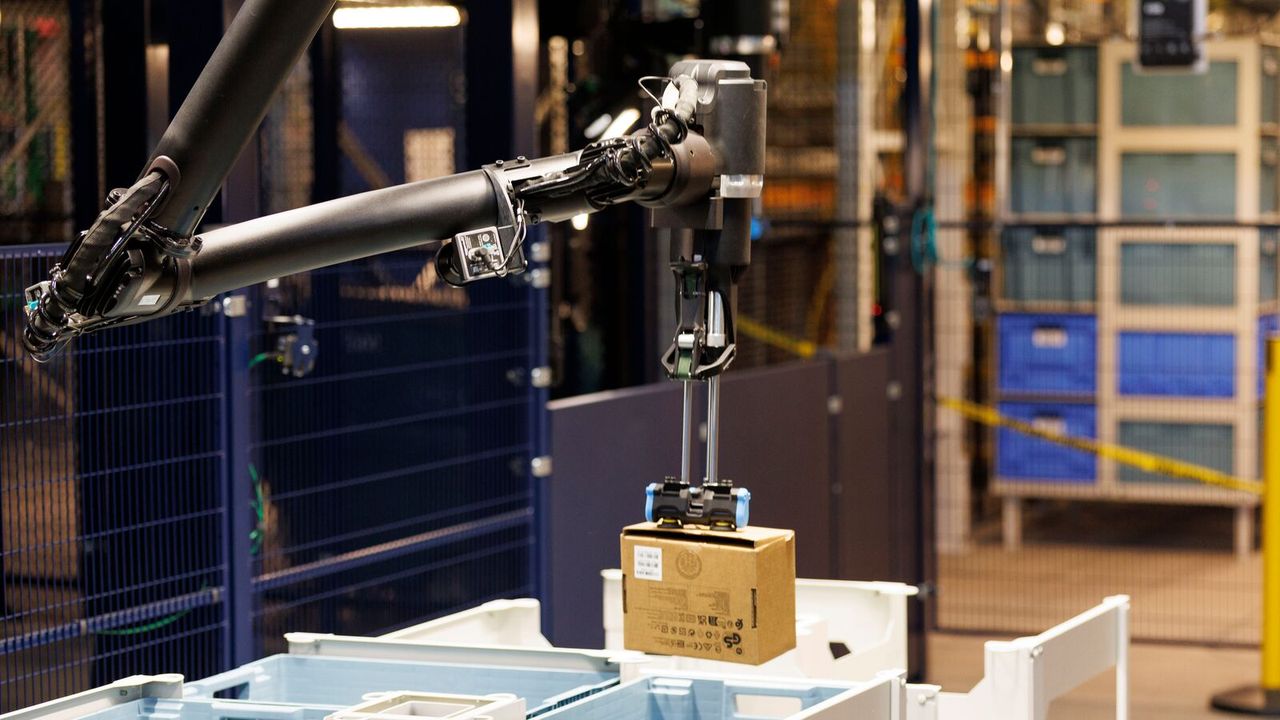
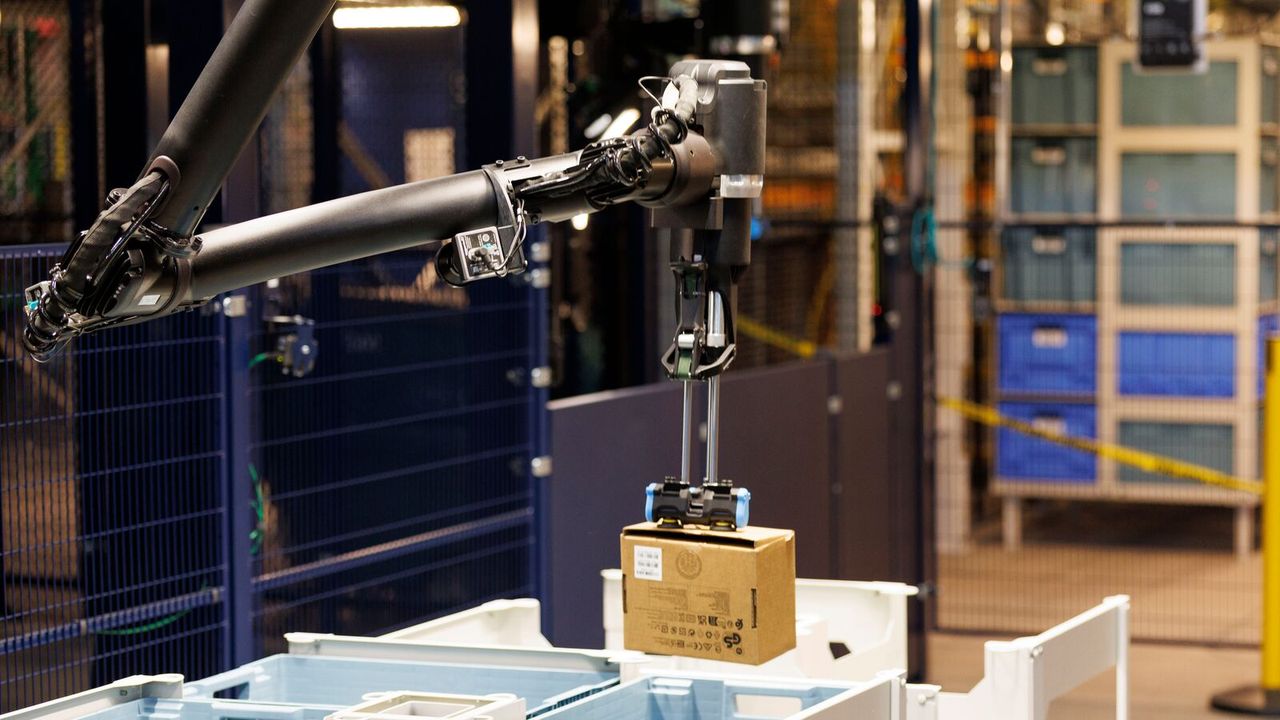
Blue Jay lasted less than six months despite rapid development speed
Prototype status was not clearly communicated during Blue Jay’s initial press announcements
Blue Jay employees are reassigned to programs leveraging core robotic innovations
Amazon has been steadily developing warehouse robotics since acquiring Kiva Systems in 2012, creating the foundation for automated fulfillment centers.
By July 2025, the company had deployed more than 1 million robots in its warehouses, showing a strong commitment to robotics while also highlighting the operational complexity involved.
Despite this scale, not every internal robotics initiative succeeds, and the company’s latest experiment, Blue Jay, illustrates the challenges of rapid innovation.
The rise and fall of Blue Jay
Unveiled in October 2025, Blue Jay was designed as a multi-armed robot capable of sorting and moving packages in same-day delivery facilities.
Testing began at a facility in South Carolina, with Amazon noting that the development cycle was unusually fast — approximately one year — compared with other warehouse robots, a speed attributed to advances in AI.
Despite its rapid development, the project lasted less than six months before being halted, showing that speed alone does not guarantee operational success.
Advertisement
Amazon confirmed that Blue Jay was introduced as a prototype, which it did not clearly state in earlier press announcements.
Sign up to the TechRadar Pro newsletter to get all the top news, opinion, features and guidance your business needs to succeed!
Employees who worked on the project are being reassigned to other robotics programs that use the core Blue Jay technology.
Terrence Clark, an Amazon spokesperson, said the company intends to accelerate the use of underlying Blue Jay innovations in future warehouse robotics, maintaining continuity while shifting focus to more sustainable applications.
Advertisement
While Blue Jay is no longer active, Amazon continues to develop other warehouse robots, including Vulcan.
Vulcan features two robotic arms — one dedicated to rearranging and moving items within storage compartments, while the other uses a camera and suction cups to pick and place individual goods with precision.
Its sensors allow it to detect the weight, shape, and orientation of packages, enabling it to handle items without causing damage.
Advertisement
The robot’s software continuously adapts to variations in package size and density, allowing it to optimize picking sequences and reduce delays in order fulfillment.
Vulcan operates within Amazon’s same-day delivery and high-density fulfillment centers, where space constraints require precise navigation and coordination with existing conveyor systems.
The robot’s dual-arm configuration allows it to handle multiple items at the same time, increasing throughput in storage compartments without requiring human intervention for repetitive lifting tasks.
Its vision and tactile sensors feed continuous data to onboard processing units, enabling real-time adjustments to grip force and movement paths.
Advertisement
Integration with warehouse management software allows Vulcan to receive task priorities.
It dynamically plans routes and communicates with other robotic units to prevent collisions or bottlenecks, supporting a more efficient automated workflow.
A man in Ireland has figured out a way to find the cheapest pint of Guinness using just AI programs. Matt Cortland became frustrated when he paid nearly $9 for a pint at a pub in Dublin, and decided he had to figure out a way to track prices across the country.
The first step was to find out the prices. To do that, Cortland created “Rachel” using the AI voice-generation platform ElevenLabs, then had her call every pub across Ireland — with a Northern Irish accent, of course. She ended up calling over 6,000 pubs, asking each one what their price was for a pint of Guinness.
The second step was to sort the data. He used Claude to create a price index called “Guinndex,” which he can update himself, or bartenders can update whenever prices change. This offers Cortland — and anyone else craving a Guinness — up-to-date prices.
Advertisement
The key was making AI feel authentic over the phone
Drazen Zigic/Getty Images
While it all sounds pretty methodical, the most successful part of Cortland’s AI procedure was making Rachel feel human. Rachel was inspired by Rachel Duffy, the winner of the U.K. reality show “The Traitors” – but given a Northern Irish accent. Cortland reported that most pubs across Ireland couldn’t even tell Rachel was an AI over the phone, which likely yielded more results.
A wide range of industries has started using AI to make phone calls. A study of car dealerships found that when AI handled customer service calls, it actually seemed more successful than average phone calls across the industry. Data from Regal found that humans actually appear to prefer talking to AI representatives more than human ones, staying on the phone longer and providing longer responses. Rachel’s phone calls with pubs appeared to reflect this, with bartenders happily telling her that she could even come in and get a pint for free.
Advertisement
It seemed like they didn’t even know she was AI — in reality, AI robots aren’t having as much success in that category. People have also reported not enjoying AI-led job interviews, likely already biased since they know it’s AI on the other end. Maybe let’s stick to the AI pint trackers.
In a recent video, creator ETA Prime showcases Red Magic’s phone running multiple Windows games directly on Android. The device is powered by a Snapdragon 8 Elite Gen 5 SoC, paired with 24GB of LPDDR5T memory and 1TB of UFS 4.1 Pro storage. Read Entire Article Source link
Samsung is putting the final nail in the coffin for its own messaging app. The smartphone maker posted an “End of Service Announcement” on its website, revealing that the Samsung Messages app will no longer be available by July of this year. Samsung also recommended that anyone still using Samsung Messages switch over to Google Messages as the default messaging app.
For Samsung Messages users in the US, the switch to Google offers RCS messaging that lets you send high-quality media, join group chats and get real-time typing indicators no matter the smartphone’s OS. Galaxy smartphone owners may lose out on some of the Samsung Messages customization options, but Google Messages will make up for it generative AI from Gemini that can remix your photos in chats. On top of those features, Google Messages makes it easier for Samsung users to switch chats between a smartphone, tablet or smartwatch.
It’s no surprise that Samsung is only using Google Messages from now on, since it has been phasing out Samsung Messages for a few years now. Dating back to the Galaxy Z Fold 6 and Flip 6, and then followed by the Galaxy S25 series, Samsung stopped preloading the Samsung Messages app and instead pre-installed the Google Messages app. The Samsung Messages app is still available on the Galaxy Store, but Samsung said the exact final date will eventually be announced on the app itself.
In short:Monzo announced on 1 April 2026 that it is closing its US operations, stopping new American sign-ups immediately and shutting existing accounts by June, and cutting approximately 50 roles. The decision comes three months after the UK challenger bank received a full banking licence from the European Central Bank and the Central Bank of Ireland, opening up expansion across the EU. It also arrives as Monzo prepares for a London IPO that Morgan Stanley is advising on, with a target valuation of between £6 billion and £7 billion.
Monzo is leaving the United States. The UK challenger bank announced on 1 April 2026 that it would cease accepting new American customers immediately, cut approximately 50 US-based roles, and close all existing American accounts by June. In a statement, the company framed the decision as a deliberate reorientation rather than a retreat: “With a fast-growing customer base of 15 million in the UK and the growth opportunity our European banking licence creates, we’re making a deliberate, strategic decision to focus on scaling in our home market and Europe and to step away from the US.” The announcement ends a seven-year experiment that never fully resolved its central structural problem, Monzo could not get a banking licence in the US, and without one, it could not compete.
Seven years, no charter
Monzo announced its American expansion in June 2019, rolling out a simplified version of its app to US customers and partnering with Sutton Bank, an Ohio-based FDIC-insured institution, to hold customer deposits and issue debit cards. The arrangement was always a workaround: without its own banking charter, Monzo could not originate loans, access core payment infrastructure directly, or compete in the lending and interchange revenue streams that define US retail banking profitability. It filed an application with the Office of the Comptroller of the Currency for a national bank charter in April 2020, but withdrew the application in late 2021 after regulators signalled it would not be approved. The company faced opposition from the National Community Reinvestment Coalition, among others, which argued that Monzo had not demonstrated sufficient commitment to serving local community needs. After withdrawing the OCC application, Monzo continued operating in the US through partner institutions, but it never secured the infrastructure that would have made its American business structurally viable.
The result, after seven years, was a product that offered a digital current account but not the full-service banking relationship that Monzo had built in the UK. US customers could not access mortgages, personal loans, or the premium credit products that generate meaningful revenue. They had a sophisticated spending tracker and a card linked to a partner bank’s balance sheet. That is a reasonable travel companion. It is not a challenger bank.
Advertisement
The European licence that changed the calculation
On 17 December 2025, the European Central Bank and the Central Bank of Ireland granted Monzo a full banking licence, making it the first digital bank to be fully regulated by the Central Bank of Ireland and establishing Dublin as its European headquarters. The licence unlocks what the OCC application never delivered: the right to hold customer deposits directly, originate loans, and operate as a full bank across the 27-member EU single market under the EU’s passporting regime.Europe’s appetite for homegrown technology champions in financial serviceshas grown considerably in recent years, and Monzo’s Irish licence positions it to compete for that opportunity on equal terms with incumbent banks for the first time. The three months between the Dublin licence and the US exit announcement are not coincidental. The company now has a credible path to scaled profitability in a market where it is already the dominant challenger; the US, by contrast, remained a market where it was permanently constrained.
The 💜 of EU tech
The latest rumblings from the EU tech scene, a story from our wise ol’ founder Boris, and some questionable AI art. It’s free, every week, in your inbox. Sign up now!
The listing has already generated internal turbulence. TS Anil, who served as Monzo’s CEO for five years, stepped down in February 2026 following a reported dispute with the board over the timing and location of the IPO. Anil is understood to have favoured an earlier listing and had expressed interest in a New York venue; the board opted for London and more time. Diana Layfield, who spent nearly a decade at Google and more than a decade at Standard Chartered, was named his successor in October 2025 and took the role subject to regulatory approvals. Her mandate is the European expansion and the public listing. The US exit is the first visible act of that mandate.
The numbers behind the decision
Monzo’s financial trajectory gives the pivot a logic that is easier to explain to prospective public market investors than to American customers receiving account-closure notices. For the financial year ending March 2025, the bank reported revenue of £1.24 billion, up 48% year on year. Adjusted pre-tax profit reached £113.9 million, an eightfold increase on the prior year. Customer deposits grew 48% to £16.6 billion.A year that saw digital banking’s growth trajectory sharpen considerably across European marketsvalidated the core bet: that a mobile-first bank with no branch network could generate the kind of revenue and profit that commands a credible IPO valuation. The US, in that context, was consuming resources that could instead be deployed against a market where the regulatory framework and customer base are already in place.
The subscription and premium-tier model that has driven platform revenue growth across technologyis central to how Monzo has reached profitability in the UK: Monzo Plus and Monzo Premium accounts charge monthly fees and bundle benefits including travel insurance, higher interest rates on savings, and cashback. Replicating that model in the US required a depth of product, overdrafts, credit, savings, that a partner-bank structure made impossible. In the UK and, increasingly, in Europe, Monzo can offer all of it.
For American customers, the practical consequence is a June 2026 account closure. Monzo said it would provide guidance in the coming days on how to transfer funds, redirect direct deposits, and access statements after the accounts are closed. For Monzo itself, the US chapter closes with a banking licence in Dublin, a public listing in preparation, and 15 million customers in the UK who collectively generated more than a billion pounds in revenue in a single year. The experiment in America is over. The business case for ending it is not difficult to read.
Marshals, a new Yellowstone spinoff starring Luke Grimes as Kayce Dutton, is airing on CBS right now. You can also tune in with Paramount Plus. The Yellowstone sequel series sees Grimes’ former Navy SEAL join an elite unit of US Marshals to bring range justice to Montana, according to a synopsis from CBS.
The show includes Yellowstone actors Gil Birmingham as Thomas Rainwater, Mo Brings Plenty as Mo and Brecken Merrill as Tate. Spencer Hudnut is the showrunner of Marshals — formerly known as Y: Marshals — and Taylor Sheridan is an executive producer.
Advertisement
When to watch new Marshals episodes on Paramount Plus
Episode 6 of Marshals airs on CBS on Sunday, April 5. Viewing options for Paramount Plus customers vary by subscription tier. You can watch the episode live if you have Paramount Plus Premium, which includes your local CBS station. If you subscribe to Paramount Plus Essential, you can watch the installment on demand the following Monday, but not live on Sunday.
Here’s a release schedule for the next three episodes of Marshals.
Episode 6, Out of the Shadows: Premieres on CBS/Paramount Plus Premium on April 5 at 8 p.m. ET/8 p.m. PT/7 p.m. CT. Streams on Paramount Plus Essential on April 6.
Episode 7, Family Business: Premieres on CBS/Paramount Plus Premium on April 12 at 8 p.m. ET/8 p.m. PT/7 p.m. CT. Streams on Paramount Plus Essential on April 13.
Episode 8, Blowback: Premieres on CBS/Paramount Plus Premium on April 19 at 8 p.m. ET/8 p.m. PT/7 p.m. CT. Streams on Paramount Plus Essential on April 20.
You can also watch CBS and the sixth episode of Marshals without cable with a live TV streaming service such as YouTube TV, Hulu Plus Live TV or the DirecTV MyNews skinny bundle. In addition to offering a lower-cost option, Paramount Plus lets you watch the other two Yellowstone spinoffs: the prequels 1883 and 1923.
After a price increase in early 2026, the ad-supported Essential version runs $9 per month or $90 per year. The ad-free Premium version runs $14 per month or $140 per year. Paying more for Premium gives you downloads, the ability to watch more Showtime programming than Essential and access to your live, local CBS station.
Terra Industries scales drone production to provide security for power plants, mines, and refineries
Local manufacturing cuts costs while raising new questions about production sustainability
Annual subscriptions introduce financial risk for clients in unstable economic environments
A Nigerian robotics startup is building thousands of drones each year to protect critical infrastructure across Africa.
It is applying a vertically integrated manufacturing strategy that draws inspiration from Apple rather than traditional defense contractors.
Terra Industries, founded in 2024 by two young Nigerians — 23-year-old Maxwell Maduka and 22-year-old Nathan Nwachuku — launched what it calls the largest drone factory in Africa in February 2025.
Article continues below
Advertisement
Factory scale and early deployments
The company has a 15,000-square-foot facility on the outskirts of Abuja, Nigeria, capable of producing 30,000 drones annually.
It is already exporting to eight African countries and Canada, protecting an estimated $11 billion worth of assets, including power plants, lithium mines, gold mines, and oil refineries.
Advertisement
Rather than assembling components from third-party suppliers, Terra Industries develops and manufactures its software, airframes, propellers, and lithium-ion battery packs in-house.
However, some sensors and cameras are imported from nations including South Korea; keeping core production internal helps provide much safer data security.
Sign up to the TechRadar Pro newsletter to get all the top news, opinion, features and guidance your business needs to succeed!
The AI-powered software, called ArtemisOS, collects surveillance data from multiple systems, analyzes it for threats in real time, and alerts response teams when dangers are detected.
Advertisement
By manufacturing locally, the company claims initial hardware purchases are up to 55% cheaper than international competitors, with savings passed directly to clients.
The company is achieving all these with little funding, raising less than $600,000 while reaching $1.9 million in revenue.
In May 2026, Terra won a $1.2 million contract with private security firm NetHawk Solutions to deploy AI-powered drones and surveillance towers at two hydroelectric power plants in Nigeria.
Advertisement
Terra has partnered with local cloud platform PipeOps rather than global firms to maintain data sovereignty.
Clients pay for the Terra software on an annual subscription basis, and without an active subscription, the hardware ceases to function.
For user data, they remain in Africa. Co-founder and CEO of Terra, Nathan Nwachukwu, said: “We must keep the data within African hands.”
This not only saves costs but also helps protect sensitive information from global leaks.
Advertisement
Terra’s playbook could be emulating the Ukrainian drone revolution, which showed how relatively low-cost unmanned systems could reshape modern security operations across both military and civilian contexts.
However, whether Terra’s vertically integrated model can sustain output at 30,000 units annually while maintaining consistent quality standards remains to be seen.
There is also uncertainty around the company’s ability to deliver reliable software updates across regions with uneven connectivity and infrastructure limitations.
Furthermore, its reliance on annual software subscriptions raises concerns about how clients handle budget constraints or delayed payments in these markets.
Consider Nvidia’s work on Neural Texture Compression (NTC). In its “Tuscan Wheels” demo, the company showed VRAM usage dropping from roughly 6.5GB with traditional BCN-compressed textures to 970MB using NTC, while keeping image quality close to the original. Read Entire Article Source link
Since March, Israeli attacks on Beirut and the occupation of southern Lebanon have displaced over 1 million people. Families are sheltering with relatives, renting if they can, or sleeping in cars and out in the open, placing immense strain on already fragile infrastructure. Over 130,000 people have also crossed into Syria, many in urgent need of food, cash assistance, and shelter, according to a report by the International Organization for Migration.
As humanitarian needs surge, so does the flow of money from abroad. Yet much of this support is not moving through traditional aid channels. Instead, it is being routed through digital fintech platforms to trusted individuals on the ground, who buy necessary items or distribute funds directly to the displaced.
There is no real-time dataset capturing donations linked specifically to the war. However, remittances—the closest available proxy—offer context. Lebanon receives roughly $6 billion to $7 billion annually from abroad, equivalent to about a third of its GDP, according to the United Nations Development Programme (UNDP) in 2023.
The UNDP reported that remittance costs there averaged 11 percent, higher than the global average. In times of crisis, these flows often shift towards emergency support. What is different now is how that money moves: Increasingly, it is being sent instantly, peer-to-peer, through digital wallets.
Advertisement
“These informal inflows are captured by the formal BDL figures and constitute around 70 percent of the inflows during the crisis,” the UNDP added, noting that money is also often sent as cash with people traveling to the country.
From Gift Cards to Financial Infrastructure
Being Lebanese myself, my social media feed has been inundated with former colleagues and friends setting up their channels to receive donations, sharing photos of receipts, and showing where money is going.
One grass-roots campaign run by Lebanese lawyer Jad Essayli raised $65,125 in 10 days, purely through social media and digital transfers. When asked which platforms have been the most impactful, he and other fundraisers pointed to Whish Money, though many other platforms, including Paypal, Zelle, and Venmo are also being used.
Originally launched to digitize gift cards, the company has evolved into a broad financial platform offering remittances, peer-to-peer transfers, and payment services with more than 2 million users across 110 countries. “We started off from the fact that we wanted to disrupt the distribution of gift cards,” says Toufic Koussa, cofounder and chairman of Whish Money, describing how the company built an early wallet system in 2007 that allowed retailers to issue digital cards on demand. Over time, that infrastructure expanded into a full financial ecosystem.
Advertisement
When Banks Stop Working
The company’s core focus has been the unbanked and underbanked—those with limited or unreliable access to traditional banking. Those groups became central during Lebanon’s financial collapse. Globally, 1.4 billion people remain unbanked; the World Bank cites access to affordable financial services as being “critical for poverty reduction and economic growth.”
In Lebanon, as banks froze deposits and restricted withdrawals, platforms like Whish Money filled a critical gap, enabling people to move and access money outside the traditional system.
That infrastructure now shapes how aid moves in crisis. Money from family, diaspora, or grass-roots campaigns lands straight in a digital wallet and can be spent immediately. On Whish Money, peer-to-peer transfers are the most popular, followed by international remittances. Koussa also notes that Whish Money is uniquely connected to US banking infrastructure, allowing users to link accounts abroad directly to wallets in Lebanon.
Displacement is changing how people use these platforms. Overall growth is steady, but transaction patterns have shifted. Families are making bigger purchases, stocking up on essentials as uncertainty grows. Grocery bills that might have been $200 are now climbing as people prepare for the worst, Koussa says.
Natural Cycles, the only FDA- approved contraceptive and fertility tracking app will now be integrated into select Garmin watches. This is an intriguing step forward for women’s health, as it could allow for more insight into individual cycles.
Compatible Garmin wearables, including many we’ve hailed as being among the best smartwatches, will now include the Natural Cycles app with either a monthly or annual subscription.
In case you’re unaware, Natural Cycles is a smartphone app that tracks your temperature throughout your cycle and shows you when you’re at your most fertile point. That means you can use Natural Cycles as an alternative to more “traditional” contraceptives like the pill or the coil, or you can use the app as a method to plan pregnancy.
Previously, you’d have to use either Natural Cycles’ own NC band, a compatible Oura Ring or Apple Watch to track your temperature. Now, those sporting a compatible Garmin watch can benefit too.
Advertisement
Advertisement
Natural Cycles’ integration with Garmin could be a huge leap for cycle tracking. While many of the best wearables do offer some cycle tracking, personally I find it difficult to find one that’s actually insightful. Plus, those on a controlled cycle (say if you’re on the pill) will likely find that wearables seem to almost guess what’s going on with their body.
As reported in a 2025 study, although “general biometric wearables, such as smartwatches and fitness trackers” do provide useful data, it’s thought they “fail to capture the complexity of menstrual cycles, hormone therapies and their physiological implications”.
I’d agree with this as I wear a Whoop MG and, although it’s undeniably great at tracking my (occasional) workouts and sleep, I wouldn’t necessarily rely on it for anything to do with my cycle tracking.
Sure, it offers somewhat of an overview, and allows me to log my periods and symptoms via the journal, but I find Whoop tends to automatically list general behaviour as a symptom of my cycle. For example, if I record that I’m feeling nervous: that’s PMS. Had disrupted sleep? Classic PMS sign right there (or was it actually because my phone went off after I failed to put it on do not disturb and woke me up? We’ll never know.)
Advertisement
Garmin and Natural Cycles
So, how will Garmin and Natural Cycles be any different? Well, a compatible Garmin will track your skin temperature during sleep, with the information then relayed to you via the Natural Cycles app. From here, you can see your fertile days — based purely on your own metrics rather than it being based on a “standard” 28-day cycle or relying on you, the user, to track your periods accurately.
Advertisement
According to Natural Cycles, tracking your cycle with its app will offer you up to 93% effectiveness, which is the same as the contraceptive pill. This stat will likely impress those who have previously taken the contraceptive pill and experienced many unwanted side effects, including mood swings, acne and weight changes too. That’s a pretty common occurrence for those on the pill, with controlled studies reporting nearly 50% of those observed reporting side effects. Not only that, but just open up the accompanying leaflet in a box of one of the mainstream pills and you’ll be greeted with an unpleasant array of side effects that may or may not affect you.

If you don’t want to risk experiencing any side effects, but want to avoid pregnancy, you’d be forced to avoid hormonal methods like the contraceptive pill and instead opt for either less reliable birth control methods or even have to endure an invasive and painful procedure instead. It undoubtedly feels like a lose/lose situation.
With this in mind, tools like Natural Cycles within Garmin offer a welcome alternative to traditional birth control methods.
Advertisement
However, all of this isn’t to say that anyone who wants to either prevent or plan a pregnancy should just opt for a Garmin smartwatch and Natural Cycles. Instead, this partnership is ideal for those who either want to move away from traditional and hormonal methods of birth control but still want control over their bodies.
While we still have a huge way to go, I’m quietly optimistic about this milestone and would be keen to try it myself.
T.H.E. Show returned to the Alexis Park Hotel in Las Vegas from March 20 to 22, 2026, marking its 30th anniversary right where it started. As North America’s longest running hi-fi show, its survival is not luck. It is persistence. Credit goes to the late Richard Beers for building it, Maurice Jung for keeping it alive after 2016, and now Emiko Carlin, who is steering the brand into its next phase with expanded events in Austin and New York City. The show had moved from Las Vegas to Southern California with stops in Newport Beach, Irvine, Long Beach, and now Costa Mesa, but it is still standing. That alone says something in an industry that tends to burn through its own history.
Context matters, and 2026 is shaping up to be one of the busiest show calendars this industry has ever seen. Between eight CanJam events, AXPONA, CES, ISE, NAMM Show, CEDIA Expo, the relocated Vienna based HIGH END, and a growing list of shows in Toronto, Paris, Singapore, SWAF, and CAF, it is relentless. There is barely time to unpack before the next badge gets printed.
Which makes T.H.E. Show’s return to Las Vegas feel less like nostalgia and more like defiance. Thirty years in, it is still in the fight.
With four events on the T.H.E. calendar in 2026, the Vegas stop did not exactly start on solid footing. The show was originally scheduled for January 9 to 11 at the Tuscany Suites & Casino, but had to be postponed to March due to unforeseen issues with the venue. Credit where it’s due, the team managed to regroup and secure the Alexis Park Hotel in less than three months. That kind of turnaround is not easy in Las Vegas, where convention space gets locked up fast.
There were tradeoffs. The new dates could not accommodate every exhibitor, and the show ended up noticeably smaller than originally planned. In total, eight oversized ballrooms were filled with high-end audio systems, supported by a modest marketplace that included T10 Bespoke, Island Routers, a vinyl seller, and a portable audio accessories vendor. It felt more curated by necessity than design.
Advertisement
Timing did not help either. Running the same weekend as the Montreal Audiofest split both exhibitors and attendees across two countries that are not exactly a quick plane ride apart. Add AXPONA 2026 looming just weeks later, with the eCoustics team heading to Chicago that same week, and the reality sets in. There is only so much travel budget and bandwidth to go around, even in an industry that seems determined to test both in 2026.
Best in Show
Best Over $50K: YG Acoustics / Bergmann
I’ve heard a number of YG Acoustics systems at shows over the years, and they rarely miss. This time, instead of rolling in with something that costs as much as a brownstone, they kept it almost reasonable. Almost. The Vegas system (presented by Supreme Acoustic Systems) came in around $100K and centered on the Vantage 3 Live active towers at $73K per pair, paired with a Bergmann Magne Airbearing Turntable at $12K, all sitting on a Music Tools ISOstatic rack at $1,495 per level.
The setup was refreshingly clean. No spaghetti pile of cables, no rack full of separates. Just two power cords and a pair of optical cables, one feeding each speaker. That alone tells you this is not your typical active speaker. The Vantage 3 Live uses a fully integrated DSP architecture with an external control unit that handles preamp duties and includes a phono stage. Everything is managed upstream, then sent digitally to the speakers.
The key here is that the signal stays in the digital domain all the way to the speakers, or is converted to digital before it gets there. That is why YG uses optical connections instead of traditional speaker cables. It is a different way of thinking about system design, and it cuts out a lot of variables.
There is no Bluetooth or Wi-Fi, but Ethernet based network streaming is built in, with support for TIDAL Connect and Qobuz Connect, and optional Roon integration. Use your phone or tablet, hit play, and let the system do the rest. No clutter, no guesswork, and very little standing between you and the music.
Advertisement
Bergmann Magne Airbearing Turntable with YG Acoustics Vantage 3 Live preamp/control unit.
Additional elements rounded out the system, including AGS Diffusors (Acoustic Groove System) from Nihon Onkyo Engineering, which could easily add another $20K to the total. No, I didn’t A/B test them like a lab experiment, but patterns matter. Two of the best sounding rooms at the show used AGS, and that’s not a coincidence. In addition, power conditioning was handled by the AudioQuest Niagara 5000 at $6,900, delivering clean and stable current to the entire system.
Advertisement. Scroll to continue reading.
The Vantage 3 Live is not shy about muscle. Each speaker packs 2,100 watts of amplification, with 700 watts dedicated to each driver. That kind of headroom is not just for bragging rights. It shows up immediately in control, dynamics, and composure, regardless of source.
“Is This Love” by Bob Marley and the Wailers on vinyl was captivating. The soundstage stretched wide without losing focus, and Marley’s voice stayed locked dead center. It had the kind of precision you expect from a mastering studio, pulling every last bit of information out of the grooves without sounding clinical.
Switching to digital via Roon and Anette Askvik’s “Liberty” didn’t feel like a compromise. Nothing collapsed, nothing softened. The presentation remained spacious, detailed, and controlled, with a level of consistency between analog and digital that most systems struggle to achieve. This is what YG does when everything lines up.
Best Under $50K: Atlantis Lab / Neoson / Audiobyte
Atlantis Lab A31 Pro Loudspeakers in foreground.
Interestingly, just a few rooms over, the Atlantis Lab speaker system (presented by U.S. distributor Decibel+) went in the exact opposite direction of the YG setup. Where YG leaned on brute force and digital control, this one stripped things down to something far more old school. We’re talking roughly 1/100th the power, less than half the price, and yet it delivered a wildly intoxicating tube driven presentation that pulled you in just as quickly, if not faster.
The system was built around three brands that, frankly, were not on my radar before this show. Atlantis Lab handled loudspeakers, Neoson provided amplification, and Audiobyte (new company out of Romania) rounded things out with a streamer and DAC.
It should not have worked as well as it did on paper, especially in a show environment. But sometimes the rooms that make the least sense end up being the ones you remember. This was one of them.
Neoson Evolution Tube Amplifier
Atlantis Lab brought its high efficiency loudspeaker lineup, with models ranging from just over $3K to roughly $24K. The system was driven by the Neoson Evolution Tube Amplifier at $11,828, delivering 20 watts per channel of pure Class A power. Digital duties were handled by Audiobyte with the SuperHub streamer ($4K) and SuperVOX multibit DSD DAC ($4,500).
Advertisement
What made this setup more than just another good room was the backstory. We were told that each of the French brands was founded by two friends who intentionally designed their products with the other in mind. That kind of collaboration usually sounds like marketing copy. Here, it translated into real system synergy.
Background (left to right): Atlantis Lab A16 Pro ($3,218) Atlantis Lab A18 Pro ($4,960) Atlantis Lab A21 Pro ($4,196) Atlantis Lab A23 Pro ($6,466) Atlantis Lab A31 Pro ($14,194) Foreground: Atlantis Lab A38 Pro ($23,939)
I spent time with the three largest Atlantis Lab floorstanding models, all paired with the same Neoson Evolution Tube Amplifier and Audiobyte front end. The A23 Pro ($6,466 per pair) did not quite deliver the same level of impact, but that felt more like a room mismatch than a flaw. Large hotel ballrooms are not forgiving, and if you are not sitting in the right spot, even good speakers can sound a bit restrained.
The two larger models stepped up in a meaningful way. They filled the room with more depth, width, and texture, the kind of presentation you usually do not hear until prices climb into far more uncomfortable territory. Comparing the A31 Pro and A38 Pro, which are separated by roughly $10K, was less straightforward. The flagship may have offered a bit more bass weight and scale, but the difference was not night and day. Some of that could have been expectation bias creeping in.
What stood out with both was their ability to throw a wide, stable soundstage while maintaining composure off axis. They did not collapse the moment you shifted in your seat. More importantly, they had a knack for uncovering layers of detail without sounding analytical, pulling you deeper into the performance rather than pushing it at you.
Advertisement
Advertisement. Scroll to continue reading.
These are not brands most people walk into a show expecting to hear. That should change.
Tony Minasian’s custom built loudspeakers remain one of those under the radar discoveries you tend to only encounter at T.H.E. Show. He is not chasing mass market appeal. He builds each pair by hand using the best parts he can source, and prices them accordingly. At $4,500 per pair, his bookshelf models are not entry level, but they are clearly aimed at listeners who care more about nuance than brute force, especially those drawn to acoustic, unamplified music.
The Oriaco G6 is the standout. It has an uncanny ability to expose the small things that most speakers gloss over. The pluck of a guitar string, the decay of a piano note, the snap of a snare drum. Nothing feels exaggerated, just revealed with a level of clarity that pulls you in rather than pushing detail at you.
Advertisement
Tony usually keeps things grounded with a Denon integrated amp and a vintage Marantz CD player, but this year he stepped it up with Electrocompaniet electronics. The system included the ECI 6 MKII integrated amplifier ($6,500) and EMC 1 MKV CD player ($7,200), bringing the total system north of $20K. He even supplied a full loom of his own hand crafted cables, adding another $2,300 to the tally.
It is a complete system with very little left to chance, but the real story is the speaker which features an extra up-firing tweeter for spaciousness. If you are in the market for a high-end bookshelf and live anywhere near Southern California, it is worth reaching out for an audition. Or wait for T.H.E. Show SoCal, where there is a good chance you will find Tony set up again, quietly reminding people what a well voiced speaker can do.

Stepping down to something far more attainable, Desert Premium Audio demonstrated a KEF and Eversolo system that landed just north of $16K and made a strong case for smart system building over brute force spending.
At the core were the R3 Meta bookshelf speakers ($2,500 per pair), supported by dual KEF KC92 subwoofers ($2,500 each), creating a full range foundation that punched well beyond what most would expect from standmounts. Amplification came from the Eversolo AMP-F10 ($2,480), while the DMP-A10 ($4,000) handled preamp duties and streaming. Rounding things out, the Onix XST20 SACD/CD transport ($2,399) added a physical media option for those not ready to abandon discs entirely.
Advertisement
It is a thoughtfully assembled system that balances modern streaming convenience with old school sources, and more importantly, shows how far careful matching can take you without chasing six figure territory.
German Physiks
The most expensive system at T.H.E. Vegas came courtesy of Aaudio Imports, and it did not hold back. Priced just shy of $400K, the setup centered on the distinctive Borderland MK II omnidirectional loudspeakers from German Physiks ($54K per pair), driven by the Emperor Extreme solid state integrated amplifier ($60K). Cabling alone, from Stage III, accounted for well over $100K, which tells you exactly where this system was aimed.
The source chain was equally ambitious. A Pink Faun 2.16 Ultra music server and streamer ($43K) fed the system alongside the Ancient Audio Lector Joy CD player ($26K). Digital conversion was handled by the Ypsilon DAC 1000 SE ($50K), supported by a SIN PSD 10 power distributor ($25K), Reiki network switches ($10K), and ART electromagnetic treatment ($18K) to address every possible variable in the signal chain.
Advertisement. Scroll to continue reading.
On paper, it is the kind of system that should stop you in your tracks. In practice, I wanted to be convinced. Here’s a sound clip on Instagram.
Advertisement
T10 Bespoke
Bear Clark, better known as “Hi-Fi Bear,” was on hand showing the T10 Bespoke wireless earbuds that we named Best in Show at CES 2026 just a few months ago. Starting at $3,000, each pair is hand built and fully customizable, along with its matching pendant charging case. And when we say customizable, we mean it. Snakeskin, gemstones, even diamonds. If you can imagine it, he can probably make it.
Or you can skip the subtlety entirely and go straight for The BillionEAR Attaché Smoker’s Edition at $14,500, which bundles the earbuds in an attaché case with cigars, a smoking pipe, and a few other indulgences thrown in for good measure.
The largest loudspeakers at T.H.E. Vegas came from Usher Audio with the Grand Tower ($42,000 per pair), driven by the BMC Audio CS3 integrated amplifier (around $10K). On paper, 200 watts per channel should have been more than enough to get them moving.
In reality, the room won. Inside a massive untreated ballroom, the Grand Towers struggled to pressurize the space and never quite locked in. It was less about the speakers and more about the environment. Even big systems can feel small when the room refuses to cooperate.
Island Router
The Island Router is aimed at listeners who take their network as seriously as their system. Priced at $499, it brings enterprise grade routing and firewall capability into the home, with features like fault tolerant failover when two internet lines are connected, straightforward app based setup, and optimization designed to squeeze the most out of whatever bandwidth your ISP delivers.
There is a catch. No built in Wi-Fi. You will need to connect a separate wireless access point or hotspot if you want coverage throughout the house. It is not designed to be an all-in-one solution. It is designed to be stable, secure, and out of the way.
Advertisement
Ai Pro
Ai Pro offered up a range of affordable fashion headphones, charging cases, and solar charger.
T.H.E. Vintage Lounge
A solid selection of vintage gear was also in active rotation, not just sitting there for nostalgia points. Highlights included the original Klipsch Cornwall, JBL 4430, and Falcon Acoustics LS3/5a, alongside racks of classic amplification.
The Bottom Line
T.H.E. Vegas 2026 was not the biggest show, and it never really recovered from the last minute venue change or the unfortunate calendar clash with the Montreal Audiofest. The lighter exhibitor list and smaller footprint were noticeable. There is no point pretending otherwise.
But smaller is not always worse. The upside was real. Less crowd noise, more time in the rooms, and actual conversations with designers and distributors that did not feel rushed or transactional. It created space to hear systems more clearly, swap components, and discover brands that might have been lost in a larger, more chaotic show.
Advertisement. Scroll to continue reading.
Credit to the T.H.E. team for getting this event back on its feet under difficult circumstances. That kind of recovery is not easy, especially in a year where the industry calendar is already stretched thin.
Advertisement
Next up, T.H.E. heads to Austin from May 22 to 24, 2026, while AXPONA 2026 is right around the corner. We will be in Chicago next week, where the scale, competition, and expectations all ramp up.
You must be logged in to post a comment Login