

Security teams log 54% of successful attacks and alert on just 14%. The rest move through your environment unseen.
The Picus whitepaper shows how breach and attack simulation tests your SIEM and EDR rules so threats stop slipping by detection.
American Airlines passengers could begin to connect to in-flight Wi-Fi through SpaceX’s Starlink satellite network next year. The airline announced Tuesday that it signed a deal with Elon Musk’s aerospace company to install Starlink internet across its Airbus fleet in 2027, which includes more than 500 narrowbody aircraft.
Commercial flights drive heavy internet usage, as passengers work on cloud-based documents or stream movies and TV shows, activities that require substantial data and reliable Wi-Fi connectivity.
Starlink is among the fastest in-flight internet options, with reported speeds nearly twice those of the next-closest competitor and comparable to or faster than some terrestrial broadband services. More than 10,000 satellites in low Earth orbit drive the system’s performance. By operating much closer to Earth than traditional satellites, they reduce latency — the time it takes for data to travel.
CNET senior writer Jeff Carlson tested Starlink’s in-flight internet on United Airlines and was impressed by the internet experience. “Honestly, I’d think I was at home on my high-speed fiber internet if not for the cabin noise and the occasional tight banking turn,” he wrote.
American is one of the world’s largest carriers by passenger volume, making it a significant contract win for SpaceX, which previously announced Starlink partnerships with United Airlines, Southwest Airlines and Alaska Airlines. Once American outfits the planes with Starlink technology, SpaceX’s service will be operating on more than 2,300 commercial aircraft.
Despite partnering with many of the largest international airlines, SpaceX doesn’t have a Starlink deal with airline giant Delta Air Lines, which is instead partnering with Amazon for its in-flight Wi-Fi service, which is expected to go into service later this year. Delta CEO Ed Bastian told Bloomberg that Amazon Leo is cheaper than SpaceX’s Starlink and includes a suite of streaming content.
The American-Starlink partnership comes just days after SpaceX’s filing for an initial public offering. SpaceX’s scope of operations recently expanded after a merger with another one of Musk’s companies, xAI. Analysts value the company at nearly $2 trillion and expect it could raise as much as $75 billion when it goes public, setting an IPO record and making Musk the world’s first trillionaire.
Representatives for SpaceX and American Airlines did not immediately respond to requests for comment.
Market intelligence platform Klue has publicly confirmed a recent security incident that allowed threat actors to steal OAuth tokens used to connect to customers’ Salesforce environments, as the new “Icarus” extortion group publicly claims the attack.
The disclosure comes after cybersecurity firms Huntress and ReliaQuest detailed how attackers abused compromised Klue Battlecards integrations to steal Salesforce CRM data from multiple organizations.
In a statement published this week, Klue CEO Jason Smith confirmed that the company discovered unauthorized activity on June 12 affecting part of Klue’s integration infrastructure.
“On June 12, we identified unauthorized activity affecting a portion of Klue’s integration infrastructure. Since then, we’ve been working alongside trusted cybersecurity experts to understand what happened, support our customers, and restore the connections you rely on,” wrote Smith.
“Our investigation determined that an attacker gained access through a compromised legacy credential associated with an integration service. The attacker used that access to obtain OAuth tokens used to connect Klue with certain third-party platforms, including Salesforce, and subsequently accessed data within a number of connected customer environments.”
The company says there is currently no evidence that customer content stored directly within the Klue platform was impacted and that the incident was limited to third-party integrations.
Klue says it immediately revoked affected credentials and tokens, removed unauthorized code, disabled impacted integrations, launched an investigation, and notified law enforcement. The company also confirmed it engaged CrowdStrike to assist with the response.
ReliaQuest and Huntress found that the attackers used stolen OAuth credentials associated with Klue integrations to access customer Salesforce environments and conduct large-scale data theft.
ReliaQuest observed attackers generating OAuth tokens and using Python scripts to query Salesforce’s API for extended periods, as data was stolen.
Huntress later disclosed that its own Salesforce environment was affected by the Klue breach and that the stolen data included business contacts, sales communications, pricing information, and other records.
While BleepingComputer and Huntress previously linked the incident to the Icarus extortion operation, the threat actors have now publicly claimed responsibility on their data leak site.
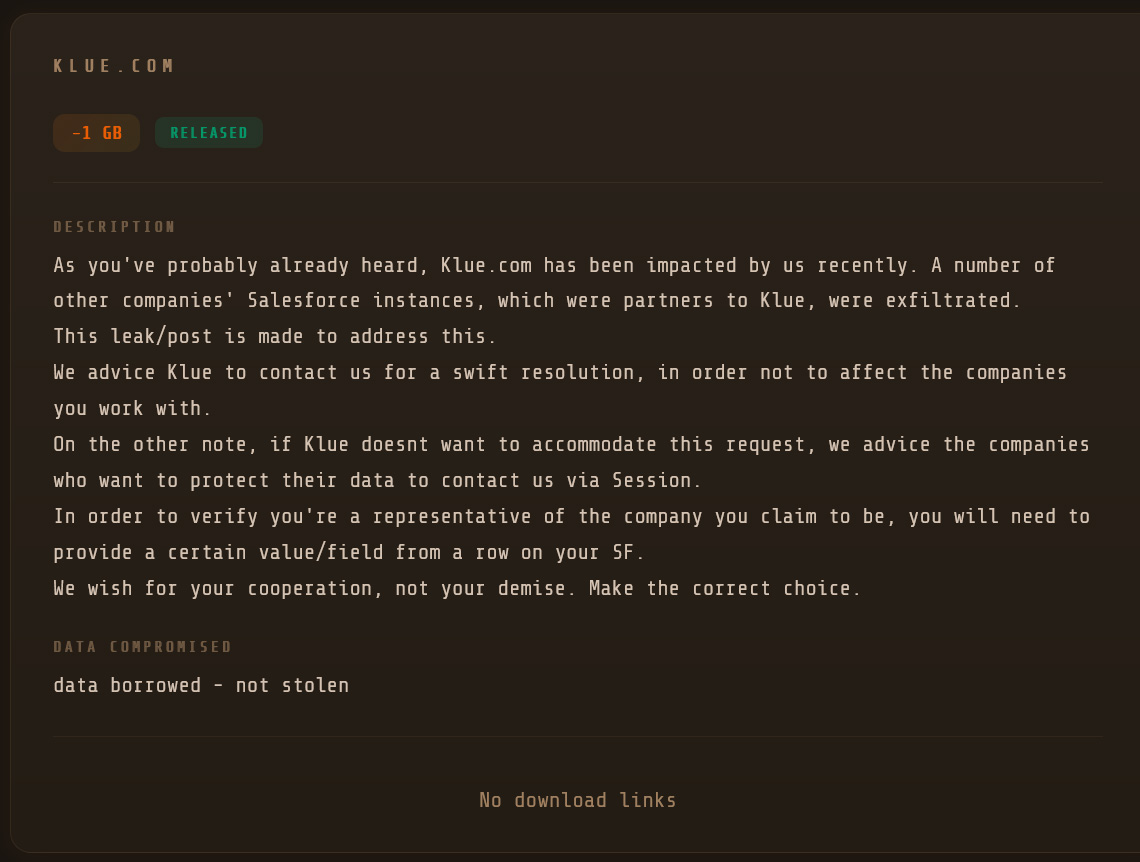
“As you’ve probably already heard, Klue.com has been impacted by us recently. A number of other companies’ Salesforce instances, which were partners to Klue, were exfiltrated,” reads the Icarus post.

The threat actors went on to pressure Klue and affected organizations to contact them through the Session messaging platform to prevent the leaking of stolen data.
The post comes after BleepingComputer previously reported that the attacks were linked to Icarus, after sources shared extortion emails sent to affected organizations. Huntress also independently connected the operation to Icarus through Session Messenger IDs used in the extortion emails and the group’s data leak site.
Since then, additional victims have disclosed that they were affected by the attacks, including Recorded Future, Tanium, Jamf, Sprout Social, Gong, and Insurity.
Almost all say the incident led to the theft of data from their Salesforce instances and did not affect their platforms, infrastructure, payment information, or internal systems.
Several organizations warned that the stolen business contact information could be used in follow-on phishing, social engineering, and extortion campaigns and urged customers to be vigilant.
Security teams log 54% of successful attacks and alert on just 14%. The rest move through your environment unseen.
The Picus whitepaper shows how breach and attack simulation tests your SIEM and EDR rules so threats stop slipping by detection.
If there’s an avid DIYer who doesn’t love a good tool sale, they are few and far between. Many of us are always on the lookout for a chance to score new tools or replace those that are getting old. Getting them at a discount feels like a win-win regardless of whether you’re buying tools for yourself or someone else.
At Lowe’s, you can choose from one of the tool brands it owns, brands with which it has exclusive relationships, or some well-known options that can also be found at other retailers. You can take advantage of the deep discounts Lowe’s is offering on its line of professional-grade tools in June of 2026 by shopping in-store or online.
There are discounts across much of Lowe’s product lineup, but we’ll look at examples ranging from standard mechanic’s hand tools, battery-powered cordless tools, carpentry and woodworking tools, and tools to make time spent working in your shop or garage more productive.
Tools are an investment in our future DIY projects. As such, the term “buy once, cry once” is as accurate here as it is in any situation. That’s why a quality tool storage solution is so important. It makes no sense to buy good tools only to throw them into a greasy pile in the corner of a musty garage.
There are a lot of pros and cons to consider when deciding if you need a $500 tool chest. However, what if you could get a $600 tool chest on sale at Lowe’s for just $400? Quality tool storage and deep discount pricing are obviously items to add to the pros column.
The tool chest we’re looking at is the $399 Craftsman 2000 Series. It’s a 52-inch wide, by 38.05-inch tall, 10-drawer red rolling steel tool cabinet (model CMST98273RB), and it also comes in black (CMST98273BK) for the same price while they’re on sale, ending July 8, 2026.
While there is likely some overlap in the reviews, Lowe’s credits the red version with 2,916 and the black with 3,004 reviews, with each model averaging 4.3 stars. The 10 drawers support up to 100 pounds of tools each, and the chest rolls on four 5-inch diameter by 2-inch wide casters, providing a final load rating of 1,500 pounds. A 10-year limited warranty provides protection for your investment.
It’s no surprise that DeWalt produces a popular cordless drill. It’s frequently at or near the top of the list anytime we see major cordless drill brands ranked worst to best. The surprise is that one of DeWalt’s top-rated cordless drills is currently hugely discounted at Lowe’s. The DeWalt 20V Max 1/2-in keyless brushless cordless drill kit (model DCD793D1) includes the drill, a 20V Max battery, and a battery charger that also charges 12V DeWalt batteries if you have them.
This drill provides up to 1,650 revolutions per minute (RPM) without a load, has a ratcheting ½-inch keyless chuck to hold bits securely without the need for tools, and lights up the workspace in front of it with an integrated LED work light. While Lowe’s claims it provides up to 16% more power using the included DCB203 battery than its DCD771 drill using the same battery, the DCD793’s biggest perk may be its 2-inch shorter head length compared to the DCD771. The DeWalt 20V Max drill is priced at $99 (down from $179) until July 15.
Whether you’re interested in creating cabinetry, installing trim inside your home, or building a pole barn, a good saw is a must-have. While you could make do with a number of different saw types, it’s important to pick the right saw for the job at hand. With these June 2026 deep discounts at Lowe’s, you might as well have a saw capable of creating compound miter cuts on your workbench.
Through July 31, 2026, Lowe’s has the Bosch Glide 12-inch 15-amp dual bevel sliding compound corded miter saw (model GCM12SD) priced at $449, a savings of $280 from its standard list price. The Bosch Glide miter saw is listed as one of Lowe’s best sellers and carries a 4.4-star customer approval rating.
The Bosch miter saw’s 15-amp corded electric motor delivers up to 4,000 RPM to power a 12-inch saw blade on a 1-inch diameter arbor. Compared to typical 10-inch-bladed saws, the 12-inch blade cleanly cuts through material up to 1 inch thicker. The upfront miter and bevel controls, along with easy-to-read scales and detents at common angles, make setting the precision saw a simple task.
The Bosch GCM12SD specifications show it can swing 52 degrees left and 60 degrees right, while allowing left and right bevel cuts of up to 47 degrees. It provides a 6.5-inch depth of cut measured at 90 degrees and a 4-inch maximum at 45 degrees.
Having a robust selection of tools, and just as importantly, a place for each tool, is one of life’s greatest blessings. That might sound a little dramatic, but the time saved by easily finding the right size tool, or having a visual reminder that something is out of place before calling the project finished, isn’t something to be taken lightly.
Lowe’s owns Kobalt, so the prices of these tools don’t fluctuate a lot, and deep discounts can be rare. However, the Kobalt 302-piece metric and standard (SAE) mechanics tool set with a hard case is on sale for $119 until July 29, 2026. While its discount of $30 from the standard Lowe’s price isn’t extremely deep, at this price point, it’s rare to find a comparable set of tools.
The comprehensive Kobalt tool set includes ¼, ⅜, and ½-inch drive socket wrench sets, each with 90-tooth ratchets, 100+ sockets including 6- and 12-point styles, combination wrenches, nut drivers, and other small tools. While the sockets, ratchets, and wrenches are made of heat-treated chrome vanadium steel polished to a grime-resistant finish, the two-drawer molded tool chest they come in might be the deciding factor if tool control is a high priority.
AI infrastructure startup Tensordyne has taped out its first commercial accelerator, with fabrication on TSMC’s 3nm process already underway.
Developed in collaboration with Juniper Networks and Broadcom, Tensordyne’s systems promise higher throughput and lower power consumption than GPUs. It claims to achieve this using an unorthodox approach to mathematics that uses logarithms – which you might recall from high school arithmetic – to make matrix multiplication heavy AI workloads less computationally intensive to run.
In conventional computing, addition is cheap, and multiplication is expensive. Logarithms flip this on its head. Using logs, multiplication essentially becomes an addition problem. a*b becomes log(a) + log(b).
The trick is converting those values to logs and back again efficiently. There are a couple of ways of dealing with this. One of the easier options would have been to use a lookup table (LUT). However, Tensordyne cofounder Gilles Backhus tells El Reg that relying on LUTs would have been too large to be practical.
Instead, the company uses a heuristic, specifically the Mitchell approximation, to estimate log and antilog for each value. This is still an approximation and on its own introduces too much error to be tenable. To overcome this, Backhus tells us Tensordyne has implemented a section-wise correction mechanism in hardware that delivers accuracy equivalent to that of FP16. However, it’s worth noting that Napier will also support FP8 and 4-bit block floating data types.
In effect, Tensordyne claims to have built a chip in which the multiply accumulate (MAC) unit works without actually doing multiplication in the conventional sense. The result is a chip that delivers power efficiency significantly greater than what you’d see on modern GPUs. Or at least that’s the claim.
Tensordyne says its rack systems will spit out up to 17x more tokens per watt and achieve 13x higher throughput than Nvidia’s Blackwell systems.
Tensordyne’s first commercial chip, Napier, boasts many of the same specs you’d have seen from a high-end GPU just a couple of years ago.
The accelerator boasts a 300-watt nominal TDP, 144 GB of HBM3e spread across four stacks, 4.7 TB/s of memory bandwidth, and up to 2.1 petaFLOPS of dense FP8 performance. This makes it roughly comparable to Nvidia’s H200 accelerators announced in 2023, while using nearly 60 percent less power.
Having said that, max achieved FLOPS often fall far short of peak FLOPS, so take that comparison with a grain of salt. We won’t know how Napier actually compares to Nvidia or AMD’s latest generation of GPUs until it arrives next year.

Backhus tells us that Tensordyne is leaning heavily on the scalability of its accelerators rather than individual performance. Each chip features roughly a terabyte of interconnect bandwidth, allowing for rack-scale deployments of up to 72 accelerators per pod.
Tensordyne’s system, codenamed the TDN72, consists of eight air-cooled compute blades, each with a single 10-core Intel Xeon-D host CPU and nine Napier accelerators.
These chips are interconnected by a high-speed interconnect fabric topology reminiscent of the one used by Nvidia’s GB200 NVL72 rack systems.
Each chip connects to six proprietary fabric switch blades developed by Tensordyne’s networking partner Juniper, located at the back of the system, in an all-to-all fabric.

Despite some similarities to Nvidia’s NVL72 racks, Tensordyne’s TDN72 will be much smaller and won’t require liquid cooling, which should make it easier to deploy in older brownfield datacenters.
According to Backhus, up to four 30 kW TDN72 systems can be packed into an – admittedly large – 52U rack. That works out to 608 petaFLOPS in a 120 kW footprint, or about 1.68x more dense FP8 compute per rack than Nvidia’s GB200 NVL72. That doesn’t take into consideration the fact that Nvidia’s kit supports NVFP4 acceleration while Napier is limited to FP4 weights. But again, don’t read too much into that comparison. Peak FLOPS are not representative of real-world performance.
Tensordyne’s TDN72 launches next year, and it’ll be competing against Nvidia’s next-gen Vera Rubin and Vera Rubin Ultra systems, which will no doubt be a stiffer fight, especially when software compatibility is taken into consideration.
Since building its first prototype silicon a few years ago, the company has gone to great lengths to keep its software platform as simple and easy for customers to deploy, as possible.
For example, the prototype lacked the error correction found in its Napier chips, and would have required users to use quantization-aware training to adapt their models to run accurately on the hardware – not exactly feasible for those looking to run trillion-parameter models.
The software has also matured such that the hardware’s compiler can convert existing models to run directly on its latest hardware, an approach we’ve seen from other chip startups like Tenstorrent.
For inference, Tensordyne has developed its own proprietary serving platform, as well as a runtime environment that Backhus says will allow customers to use their preferred inference servers, such as vLLM. PyTorch support is under development.
Before the chip has even shipped, the company is making some bold performance claims. Backhus expects the chips to deliver upwards of 1,000 tokens a second, and that’s without relying on multi-token prediction or other forms of speculative decoding to boost token generation.
Tensordyne’s platform has certainly attracted the attention of neocloud providers like Cirrascale and BlueSky Compute, both of which have expressed interest in deploying the company’s hardware when available.
But, as we’ve seen with AMD and others, software can make or break a chipmaker. With Napier slated for release in Q2 or Q3 of 2027, Tensordyne won’t have long to get things right. ®
Shibu Kaithalamattathil, a senior engineer at MSD, explores the day to day as an engineer in the biopharma space and having the opportunity to watch his son enter the industry.
Shibu Kaithalamattathil is a senior engineer at MSD Biotech in Dublin.
In this role, he oversees the day-to-day engineering activities that support manufacturing, “ensuring that equipment, processes and systems operate safely, reliably and in full compliance with site standards”, he tells SiliconRepublic.com.
Kaithalamattathil says that no two days feel alike in her job, which he puts down to the team and the culture on-site.
“You’re genuinely excited to go to work every morning,” he says.
Never was this truer, Kaithalamattathil says, than last year, when he had a “unique opportunity”.
“My son Alan joined MSD Biotech, Dublin as an intern and worked on-site alongside me,” he explains. “Alan is studying chemical engineering in college and to be able to work alongside him for that period of time was amazing, not just because of the feeling of pride I got knowing my son was following in my footsteps, but also the sense that he’s taking his first professional steps in what will be a hugely exciting and rewarding career.
“With the way science is advancing, I think it’s safe to say his day to day will eventually look very different to my own, but there’s so much excitement in that.”
One of the things I enjoy most about my role is that every day I have to use both technical and non-technical skills alike. My role is as much about dealing with machinery, systems and equipment as it is about dealing with people, so it’s a mix of very technical troubleshooting skills as well as communications, teamwork and project management.
And at the heart of it, the biggest skill I think is problem-solving, whether looking at equipment or looking at our ways of working, it’s about being able to adapt and solve any issues or challenges as they arise.
That is something I think Alan experienced first-hand during his internship as well. While at university, you’re so focused on the technical side of things with the science, the engineering and chemistry. Across STEM, softer skills can sometimes be an afterthought. But on a day-to-day basis, whatever area you end up specialising in, the skills that will come in handy are usually communication and problem-solving.
The most challenging part of the day is dealing with the unexpected. It creates a sense of excitement and learning, but at the same time it is always a challenge to manage unexpected breakdowns or issues, all while ensuring that planned work is completed on time no matter what is going on.
That requires quick decisions and effective prioritisation, as well as a real passion for problem-solving. Whatever issue is in front of you, it’s really about just stepping back, looking at it holistically and then figuring out what the best way to fix or address it is. It’s about not just finding a solution, but making sure you’re finding the best solution.
I start my day by taking a few minutes to prioritise my workload, focusing on key tasks and then I get working on the to-do list. Engineering roles can be fast-paced and unpredictable, so having a clear structure helps me stay focused and calm, even when challenges arise.
I tend to break tasks into smaller, manageable steps, which keeps me organised and makes it easier to maintain momentum throughout the day. I also make a point of taking short breaks to reset, especially during busy periods. Staying refreshed helps me think more clearly and safely, both are essential in a biotech environment. And finally, I’ve learned the value of leaning on the team.
I was struck by the importance of adaptability. Even with years of experience, I quickly learned that continuous learning is part of daily life here.
The facility is equipped with modern, cutting‑edge technology and the systems evolve regularly as the industry advances. Being open to new tools, new processes and new ideas has been just as important as any technical skill I brought with me. Having my son on-site with me, I tried to encourage those same habits and behaviours for him too as I really do think they make a difference. And it’s been brilliant to see him taking them on, both in his academic and professional development.
The biopharmaceutical sector is expanding rapidly and with that growth has come significant technological advancement. My role has evolved from focusing mainly on hands-on engineering tasks to now also incorporating more data-driven decision-making and working with highly sophisticated equipment, which has been very exciting.
Automation, digital systems and advanced monitoring tools have become part of our daily operations, allowing us to work more efficiently while maintaining the highest standards of safety and quality. I’m also sure that by the time Alan finishes university and moves fully into the workforce, the role will have evolved even further, given the pace at which technology, automation and digital systems continue to develop across the sector.
However, although the tools and processes have evolved, what hasn’t changed is the purpose behind the work. We’re producing medicines that make a real difference to people’s health and you can really feel how much that sense of responsibility guides everything our team does.
What I enjoy most is the atmosphere on-site. There’s a real sense of community at MSD Biotech, Dublin. People are friendly, supportive and proud of the work they do. It genuinely feels like a home away from home in a way and that makes a huge difference in an industry where teamwork and trust are so important.
Every day, I also get to work with colleagues who share the same commitment to quality and the same passion for improving patients’ lives. That always feels very powerful too.
Seeing Alan walk into the same site where I work and watching him experience the same warm, welcoming environment was such a proud moment. It just reinforced everything I love about this job, the strong culture, the sense of belonging and the meaningful work we do every day.
Don’t miss out on the knowledge you need to succeed. Sign up for the Daily Brief, Silicon Republic’s digest of need-to-know sci-tech news.
TIRED
I still remember the moment I realized Samsung’s The Frame Pro 2026 is the best art television around. I loaded Van Gogh’s The Starry Night painting with its various shades of blue. The masterpiece came alive with texture and realism thanks to the contrast ratio and clear picture quality. I marched friends and family members down to my office to gaze in wonder.
Installing The Frame Pro is a bit of a process, though. I ended up watching a YouTube video for help. About an inch thin, this model sits mostly flush to the wall. Rather than connecting your streaming boxes directly to the TV, Samsung’s Wireless One Connect breakout box acts as a bridge. I connected my Xbox Series X and PC to the HDMI ports (there are four total) on the breakout box, which then connects to The Frame Pro using Wi-Fi 7 from across the room. Navigating The Frame Pro was also easy, thanks to the intuitive UI and the lightweight, long-lasting remote.
Free users have access to Samsung’s rotating catalog of 30 free images, but subscribers willing to pay $4.99 monthly will have access to 5,000 pieces of art. The Frame Pro 2026 has the widest variety of artwork, including hundreds of masterpieces, but I preferred Amazon’s Ember Artline “moving artwork” feature better.
At $2,000, The Frame Pro is the most expensive option on our list, and it’s worth its price. Even though most manufacturers, Samsung included, don’t list specs for their art TVs, The Frame Pro 2026 displayed artwork and photos with the best contrast and picture quality.
I was blown away by the picture quality for movies. When viewing Netflix’s Awake, which displays a lot of night scenes, I was able to still see all of the action. In comparison, the same scenes looked muddy and dull on the TCL NXTVISION and Amazon Ember Artline.
The 2026 model now supports high-fidelity gaming with a 240 Hz refresh rate when connected to a gaming computer (though it does lower the resolution). I played Crimson Desert and the main character—wearing a black suit of armor—moved realistically and responded quickly to my controller nudges.
For AI features, you have a few options. Samsung lets you pick from Alexa+ or Samsung’s Bixby to control the volume by voice or ask about which thrillers came out this month. You can also use Microsoft Copilot or Perplexity. However, the Amazon Ember Artline was the only art television that let me generate AI artwork by voice.
The Frame Pro 2026 is my top pick for art TVs because paintings looked the most realistic. If you want the best quality and are willing to pay a higher price, it’s a phenomenal choice.
WIRED
While workers continue to explore ways to adopt AI in their everyday workflows, recruiters are warning they should be doing so when writing their resumes, new research has claimed.
More than half (56%) say they often or always receive resumes that contain at least some AI-generated text – two-thirds (67%) also note an increase in AI-generated content.
The report by Kickresume stresses the role of a resume is to demonstrate a person’s skills and character on paper, thus emotionless, polished text ultimately fails to represent individuals.
With AI generating more text that users might otherwise write, around a third (32%) said they’ve seen two-page CVs become more popular. “63% of professional CV writers report that generic/boiler plate content is the most common issue in client CVs,” the report revealed.
The data also reveals that workers often exaggerate skills or provide inaccurate information. Conversely, only 8% considered typos and spelling mistakes a noticeable issue – a double-edged sword implying that AI both produces better-quality resumes while also falsely representing an individual’s competency.
“AI is there to be leaned on, but what makes a CV stand out is the personal touch you add to it,” CEO Peter Duris commented.
“The specifics of your skills, experience, and achievements are only something individuals can provide.”
While Kickresume is discouraging the use of AI in producing CV content, it does recognize that generative AI has helped applicants express their own creativity. A quarter (24%) have seen an increase in personal branding and storytelling, and a fifth (18%) have seen more creative and infographic-style CVs.
Follow TechRadar on Google News and add us as a preferred source to get our expert news, reviews, and opinion in your feeds.

Artificial intelligence is rapidly becoming part of everyday life, and that includes classrooms. Students are turning to tools like ChatGPT for homework, research, writing assistance, and even basic questions. But a growing number of educators, researchers, and policymakers are questioning whether introducing children to AI at such a young age could do more harm than good.
Norway appears to agree. The country has announced a near-total ban on generative AI tools for elementary school students, arguing that children need to develop fundamental reading, writing, and math skills without relying on AI. The move could become an early sign of a broader trend, especially as governments around the world take a tougher stance on children’s use of technology.

Norwegian Prime Minister Jonas Gahr Støre said the government is concerned that AI could cause younger students to skip important stages of learning. The administration argues that reading, writing, and mathematics should remain the primary focus during a child’s early education.
That said, Norway is not completely shutting the door on AI in education. Under the new guidance, students aged 6 to 13 should generally not use generative AI tools, while those between 14 and 16 may use them under teacher supervision. Students in upper secondary education, aged 17 to 19, will be taught how to use AI responsibly so they are better prepared for higher education and the workplace.

A recent study found that even short periods of AI-assisted work may reduce independent critical thinking. Participants who relied on AI assistance were significantly more likely to struggle or give up when that assistance was removed, suggesting that frequent reliance on AI may reduce persistence and independent thinking.
The study focused on adults, which raises an obvious question. If mature minds can become dependent on AI after only brief exposure, what happens when children with developing brains use these tools every day? That question is becoming increasingly difficult for educators and policymakers to ignore, and Norway’s new restrictions suggest some governments are no longer willing to wait for a definitive answer.

Norway’s AI restrictions are part of a wider trend. The country has already banned smartphones in schools and has proposed tighter controls on children’s access to social media. Similar debates are taking place around the world as governments become increasingly willing to intervene when new technologies are seen as posing risks to young users.
Just a few years ago, the idea of restricting children’s access to social media platforms was viewed by many as unrealistic. Today, age-verification laws, smartphone bans, and social media restrictions are becoming increasingly common. AI could be heading down a similar path.
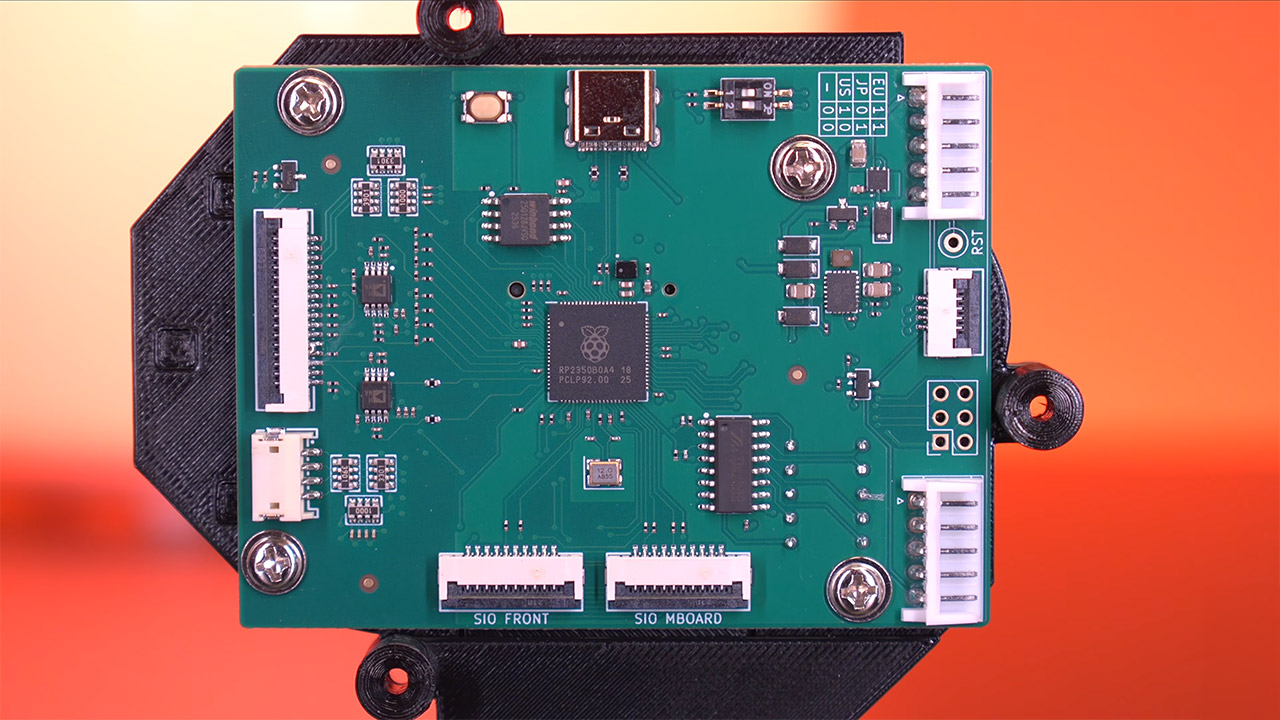
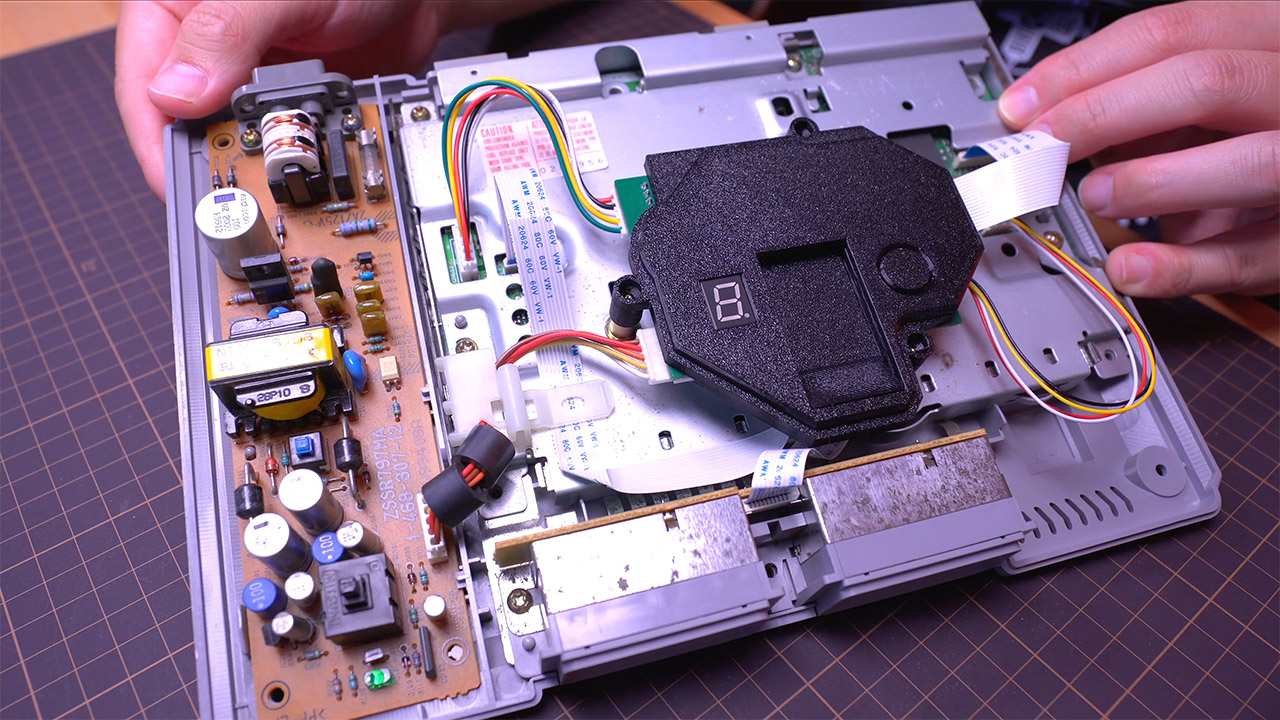
The Epson HX-20 is sometimes referred to as an early laptop computer. It’s a little odd in its form factor, and in its storage, relying on a microcassette drive to store data. It can be problematic to keep these tapes and drives going after so many decades, so [Andrew Menadue] has been tinkering with a more modern solution.
The replacement drive uses a Raspberry Pi Pico to emulate the original tape drive. The Pico uses a microSD card to store data instead of the magnetic media of old. The device has a small screen for showing status information and four buttons for navigation, allowing the faux drive to be controlled as to what “tape” it’s pretending to be. It’s also possible to use the device to emulate ROM cartridges that could be used with the HX-20 in place of its original tape deck storage solution.
We’ve seen some other old hardware get similar drive upgrades before, too. No surprise, because mechanical drives and media simply don’t last forever. Sometimes you need to build a replacement that’s viable today. Video after the break.
Amazon MGM has dropped Luca Guadagnino’s nearly completed Sam Altman biopic Artificial and is seeking another distributor for the film. The move comes months after Amazon expanded its multibillion-dollar partnership with OpenAI, fueling speculation about a potential conflict given the movie’s reportedly unflattering portrayal of Altman. The Independent reports: Artificial would have marked the Oscar-nominated Call Me By Your Name director’s third Amazon film, following the critically acclaimed Zendaya-led tennis romance Challengers (2024) and the academic scandal drama After the Hunt (2025), starring Julia Roberts. The new movie is said to chronicle the brief period when Altman was abruptly ousted as OpenAI’s CEO in 2023 and subsequently rehired. Monica Barbaro and Ike Barinholtz star alongside Garfield as former OpenAI CTO Mira Murati and SpaceX founder Elon Musk, while Yura Borisov, Cooper Hoffman, Jason Schwartzman, Cooper Koch, Billie Lourd, Zosia Mamet, Angus Imrie, Chris O’Dowd, Mark Rylance and Margo’s Got Money Troubles breakout Thaddea Graham round out the cast.
It is unclear exactly why the film was dropped, but according to Variety, the news came after it had already undergone positive screen tests. An early viewer told the publication that the film’s portrayals of Altman and newly minted trillionaire Musk are the two characters audiences would “like the least.” It was also reported that Amazon had already seen every early iteration of the script before Guadagnino was hired to direct. Altman and Amazon founder Jeff Bezos have developed a high-profile friendship over the years. In fact, the former was in attendance at Bezos’s wedding to Lauren Sanchez, which took place in Venice, Italy, in 2025. In recent months, the two have continued to deepen their professional partnership that began in 2015, when Amazon became one of OpenAI’s first investors. Ten years later, the companies closed their first major deal in November 2025, allowing the ChatGPT maker to run its systems on Amazon’s U.S. data centers.

Carrying bullhorns and signs depicting Amazon executives as war criminals, about two dozen people protested outside the Amazon Spheres in Seattle on Thursday evening, calling on the company to stop providing technology to Israel for what they described as genocide in Gaza.
The protesters said they were trying to disrupt what they believed to be a gathering of Amazon executives, state and local leaders, U.S. State Department officials and Australian government representatives on an upper floor of the Spheres, on the eve of the World Cup match between the U.S. and Australia.
Contacted Friday, Amazon described the gathering differently. The company said the event underway during the protest was for members of Seattle’s business and sports communities, Australian parliamentarians, and Amazon employees celebrating the World Cup. A separate meeting concluded before the protests began, the company said, without specifying who attended that meeting.
“We respect individuals’ rights to engage in peaceful public demonstrations,” said Montana MacLachlan, Amazon spokesperson, in response to GeekWire’s inquiry. The company, she added, is “committed to being a responsible corporate citizen in the Puget Sound region, Washington state, and every community we serve.”
The protest group, which goes by the name Amazon Worker Intifada, described the protest as part of an effort to escalate pressure on the company’s leaders over the issues. An affiliated group, No Azure for Apartheid, has been protesting Microsoft for more than a year over its work for Israel.
The protesters object to Amazon’s work with Israel, including Project Nimbus, a $1.2 billion contract that Amazon and Google won in 2021 to provide cloud and AI services to the Israeli government, including the Israeli military and weapons suppliers, according to leaked contract and procurement documents.
The protesters marched to the Spheres shortly before 6 p.m. Thursday, walking in a circle outside the glass-domed buildings with signs, drums, balloons, noisemakers and Palestinian flags, engaging in call-and-repeat chants such as, “Say it loud and say it clear — Amazon’s a war profiteer.”
Amazon workers and soccer fans walked by on the sidewalk, some stopping to take in the scene. Small groups of people in business attire walked through the protest to the Spheres entrance.
A banner at the edge of the space read “Amazon War Criminals Meeting Here.” Another depicted Amazon CEO Andy Jassy and AWS CEO Matt Garman, with blood on their hands, embracing what appeared to be a bomb. “We See Your Crimes,” it read.
Members of what appeared to be a wedding party, including a woman in a white bridal dress and a man in a suit, emerged at one point from one of the restaurants at the base of the Spheres and tried unsuccessfully to persuade the protesters to stop or move elsewhere.
In a press release after the protest, the group said its demonstration forced Amazon to reroute attendees, and that an arriving Australian delegation had to use a different entrance to get around the protesters. The group also said an event attendee grabbed and shoved a protester’s camera.
After protesting for an hour at entrances on both ends of the courtyard between the Spheres and Amazon’s Day One tower, the group moved to the Lenora Street side of the Spheres, where they released two helium balloons on strings with loud noisemakers attached, attempting to position the noisemakers outside the windows where an event could be seen taking place inside.
One of the leaders of the protest Thursday was Ahmed Shahrour, a Palestinian software engineer in Amazon’s Whole Foods division in Seattle who was fired in October over internal Slack posts criticizing the company’s ties to Israel.
Amazon said at the time that he violated multiple company policies, alleging that he “misused company resources, including by posting numerous non-work-related messages pertaining to the Israel-Palestine conflict.”
Shahrour called it “a blatant act of retaliation designed to silence dissent from Palestinian voices within Amazon and shield Amazon’s collaboration in the genocide from internal scrutiny.”
On Friday, Amazon spokesperson MacLachlan said of that incident, “We don’t tolerate discrimination, harassment, or threatening behavior or language of any kind in our workplace, and when any conduct of that nature is reported, we investigate it and take appropriate action based on our findings.”
No Azure for Apartheid, which includes current and former Microsoft workers, has staged repeated protests of its own, similarly calling on Microsoft to cut ties with Israel.
They set up an encampment on the Redmond campus last year, where 20 people were arrested for trespassing, and later occupied the office of Microsoft President Brad Smith. Microsoft has fired several employees over various protests and activities, citing violations of company policies.
After a Guardian investigation revealed that an Israeli military unit had used Microsoft’s Azure cloud to store millions of intercepted Palestinian phone calls, the company cut off the unit’s access and opened a review that recently led the company to announce that it would tighten its human-rights controls on its work with national security agencies.
No Jackpot Winner as $257 Million Prize Rolls Over to $269 Million Monday Draw
Zimbabwe Requires Crypto Businesses to Register Annually Under New FIU Regulations
Bitget enters Argentina’s regulated crypto market through PSAV registration
NanoClaw integrates JFrog registries to secure AI agent downloads
Matt Damon’s Viral Sci-Fi Thriller Has Taken Over HBO Max
Anthropic staff to meet White House officials next week, Axios reports
As AI companies race to go public, who else is along for the ride?
Bitcoin could crash to $48,000, if this historical pattern is triggered
Warning of disruption as Cardiff Crossrail works to start
“Israel’s” ban on ICRC visits ruled illegal, but Knesset moves to stop them permanently
Financial Accounting | Last Day Revision Strategy and Booster | CMA Inter – June 2026
Tributes to former deputy head teacher at Cambridge school among death and funeral notices
Deion Sanders Shares Powerful Post After Viral Advice To Deiondra
what doctors are seeing in ebike crashes
Weekend Open Thread: Miami – Corporette.com
Kate Middleton Glare Goes Viral After Kids Booed At Royal Event
XRP ETFs Outperform As Bitcoin And Ethereum Funds Extend Outflow Trend
Market Preview: SpaceX (SPCX) IPO Record, Federal Reserve Meeting, and Iran Nuclear Agreement
Over 400 Arch Linux packages compromised to push rootkit, infostealer
Invesco Quality Income Fund Q1 2026 Commentary
You must be logged in to post a comment Login