Welcome to our latest roundup of what’s going on in the indie game space. As a reminder, the latest edition of Steam Next Fest runs from February 23 until March 2, during which you’ll be able to check out demos for hundreds of upcoming games. A bunch are available already, including one for Denshattack!, which I definitely recommend checking out. As it turns out, doing Tony Hawk Pro Skater-style tricks with a high-speed Japanese train absolutely rips.
On Thursday, there were four showcases highlighting indie games all in a single day. It’s not exactly feasible for me to recap them in full here, unfortunately, but I can at least tell you about a few of the many highlights.
The Black History Month edition of the Black Voices in Gaming Showcase includes trailers and interviews for some games that are already available, such as Space Warlord Baby Trading Simulator, Aerial_Knight’s DropShot and Relooted. Of course, the stream featured plenty of games that are on the way too.
Erased, from solo developer Jerron Jacques, looks pretty interesting. It’s an open-world fighting game that takes place in a cyberpunk setting with dance battles, parkour, pets, strange creatures and much more. Jacques, who has been documenting the game’s development process on social media, even carried out some of the parkour motion capture work personally.
Advertisement
There was lots of good stuff in this week’s Convergence Showcase too, including another peek at Mouse: P.I. for Hire as we get to see one of the game’s bosses for the first time. This first-person shooter with rubber-hose animation is set to arrive on March 19.
There were other welcome announcements for me in this showcase. First, there was a release date for the Zelda-inspired adventure Gecko Gods. I’ve had this on my wishlist since 2022, so I’m glad to learn it’ll hit Nintendo Switch, PS5 and PC on April 16.
In addition, record shop sim Wax Heads (which probably should have been called Low Fidelity, tbh) is coming to PC, Xbox Series X/S, PS5, and Nintendo Switch on May 5. You can check out a Steam Next Fest demo for that one now.
The second edition of Indie Fan Fest had a trove of goodies as well. For one thing, Balatro publisher Playstack could be about to cause another mass reduction in collective productivity with Raccoin, which now has a release date of March 31. This is another roguelike deckbuilder, but this time it’s in the form of a coin pusher. I didn’t have a chance to check out the previous playtest to get a better sense of why there’s so much buzz around this one, but I’ll for sure be trying the Steam Next Fest demo, which is available now.
Advertisement
It remains deeply weird to refer to a game under Acclaim’s umbrella as an indie, but that’s where we are now. The publisher is bringing Ridiculous Games’ GridBeat to Nintendo Switch and Steam on March 26. This is a rhythm-based dungeon crawler in which you (a hacker) try to escape from a corporate network after pilfering valuable data. There’s a Next Fest demo available for this one too.
Meanwhile, a narrower release window for Japanese convenience store sim InKonbini: One Store. Many Stories was revealed. It’s coming to Steam, PS5, Nintendo Switch and Xbox in April.
Alongside a related sale on Steam, the first Quebec Games Celebration Showcase took place on Thursday. It’s always neat to learn about games being made in my neck of the woods.
One of those is Surfpunk, a co-op action RPG that looks a bit like Hades with surfing. Radical. You’ll venture to procedurally generated islands in search of loot. There are four weapon classes to choose from and gadgets you can craft after collecting resources on your run. There’s an updated Steam demo that’s said to have around five hours of gameplay. Surfpunk (which is from Convergence: A League of Legends Story developer Double Stallion) will arrive later this year.
Advertisement
I’m including this demo announcement trailer for Croak, a precision platformer from Woodrunner Games that appears to be heavily inspired by the likes of Celeste, separately for one main reason. You have to check out the studio’s head of “barketing.” (Okay okay, the game’s hand-drawn visuals look lovely too.)
There’s plenty of other interesting stuff in the Quebec Games Celebration Showcase, including another look at Tears of Metal from Paper Cult Games, the studio behind the very enjoyable Bloodroots. There’s a Steam demo available for the hack-and-slash roguelite, which should be out this spring. Gothic sci-fi Metroidvania Silent Planet looks quite tasty too.
New releases
Under The Island looks and sounds very The Legend of Zelda: A Link to the Past-coded. But since that’s my favorite game of all time, I am not complaining. I love that protagonist Nia appears to use a hockey stick as a weapon too.
This action PRG from Slime King Games (and co-publishers Top Hat Studios and Doyoyo Games) has debuted to strong early reviews. It’s available now on Steam, Xbox One, Xbox Series X/S, PS4, PS5 and Nintendo Switch for $20, though there’s a 15 percent launch sale (you’ll need to be a PS Plus member to get the discount on PS4 and PS5).
Advertisement
Demon Tides — a 3D, open-world platformer from Bubsy 4D and Demon Turf developer Fabraz — has lots of movement mechanics, including paragliders and hookshots. You can shapeshift into different forms as well.
You can create and share graffiti, and this will appear in other players’ games (which is a neat touch). Demon Tides is out now on Steam. It’ll usually cost $25, but until March 5, you can snap it up for $20.
Skate Bums is a 2D skateboarding game in the tradition of the OlliOlli series. As novice skateboarder Lux, you’ll try to take down the Skate Bums, a gang of bullies. There are “weird characters,” sick combos to pull off, coins to collect and wrecking balls to dodge.
There’s said to be a “simple directional trick system” while each run is apparently short. That seems ideal for quick, pick-up-and-play sessions on Nintendo Switch and Switch 2. I also just really like the title. Skate Bums, which is from Lucky Last Studio, will normally cost $15 but there’s a 15 percent discount until February 27.
Advertisement
Love Eternal is a psychological “horror platformer about escaping the domain of a selfish god,” which is a strong pitch from developer brlka and Demonschool publisher Ysbryd Games. You’ll need to flip between different gravitational pulls as you navigate this precision platformer, which follows teenager Maya on her attempt to return to her own reality.
During a dinner at home, Maya’s family disappears and she suddenly appears in an “eerie, desolate realm” that looks like an Iron Age castle. That’s a creepy enough set up to match the game’s haunting atmosphere. Love Eternal is out now on Steam, PS4, PS5, Xbox One, Xbox Series X/S and Nintendo Switch for $10. There’s a 15 percent launch discount (again, you’ll need to be a PS Plus member to take advantage of that on PlayStation).
You’ll have four hours to complete an ’80s adventure game of Woe Industries’ choosing. The developer will seemingly be monitoring your browser and smartphone activity to ensure you don’t consult a walkthrough. If you’re successful, you’ll receive an AGAT certification and diploma. Good luck!
Advertisement
“Musical narrative adventure” People of Note is coming to Steam, Epic Games Store, the Xbox App on PC, Nintendo Switch 2, PS5 and Xbox Series X/S on April 7 for $25 (though there’ll be a 10 percent launch discount). The game follows pop singer Cadence on her quest for stardom. Along the way, Cadence and her buds will have to overcome enemies in battles that have turn-based and rhythm-based elements.
I mostly enjoyed playing through a preview several months ago, though I had to grit my teeth through the turn-based combat, which is not something I enjoy as a rule. However, Iridium Studios will allow players to turn off elements like that and environmental puzzles so more people who might have otherwise been turned off can enjoy People of Note. You can sample the game now on Steam via a 90-minute Next Fest demo.
I don’t fully understand what’s going on in the reveal trailer for Titanium Court, which is from AP Thomson (a solo developer who previously worked on Consume Me) and publisher Fellow Traveller. Even the press release notes that it’s “impossibly difficult to describe.” But it has an absorbing trailer soundtracked by an odd, Bill Callahan-esque song and it has already picked up several IGF award nominations, so I’m intrigued.
What I am able to surmise is that it’s a surrealist, roguelike strategy game with match-three, auto battle and tower defense elements. It’s also for “clowns and criminals,” apparently. I’m gonna have to give the Steam Next Fest demo a shot to try to get my head around it. Titanium Court is coming to Steam “imminently.”
Advertisement
Sometimes, a game pops up that makes me think “how has no one done this before?” Such is the case with Become. It’s a third-person linear adventure from solo developer Valentin Wirth in which you take on the guise of a single sperm. You can probably guess what the goal is.
The game has “no explicit sexual acts, nudity or violence,” according to its Steam page, though you will encounter some danger along your journey. You can upgrade your bespectacled spermatozoon via skill trees and seemingly adorn various pieces of headgear. Become is slated to hit Steam later this year.
As the 2026Winter Olympics come to a close, a whole new game is afoot: the mad dash to make money on exclusive memorabilia. When the Games are over, most of the event’s coolest collectibles will become very hard to find, plundered by scalpers and bargain hunters and only available through online marketplaces like eBay and Vinted. And if the eye-popping prices already placed on the gear are any indication, they’re going to be quite valuable.
Of all the Milano Cortina Olympics memorabilia that’s hit the internet so far, the plushies of mascots Milo and Tina and the Swatch watches given to volunteers have proven to be standouts. Pins are also proving popular, particularly Snoop Dogg’s special edition and the ones dedicated to the torchbearers.
Originally, the Milo and Tina stuffed animals ranged in price from €15 to €50 (about $18 to $60), depending on size. Now the smallest stoat plushies are going for as much as three times their original price, and the bigger ones are four times as expensive as they originally were. (Some can still be ordered on the Olympics shop at their original prices. But there is one drawback: As of this writing, some of them may not be delivered until June.)
The Swatch watches, meanwhile, were only given to volunteers and not available for sale. Never-worn Swatches still in the box are already showing up for sale for anywhere from €200 to €500 ($235 to $590).
Advertisement
At least one of the Samsung Galaxy Z Flip 7 smartphones give to athletes has shown up on eBay with a Buy It Now price of $1,680.
As of this writing, you can still get Olympics souvenir pins on the Games’ official online shop. Prices there start at around €15, but resellers are putting them up for twice as much. Limited-edition pins from sponsors like Samsung go for around €100 ($118). WIRED Italia spotted pins given to Olympic torchbearers online for around €600 ($707). Also available? Replicas of Olympic medals, which start at around €50 for a single medal and €150 to €200 ($177 to $236) for a complete set.
The latest episode of The Leaders’ Room podcast season four features Rathnait Long, distinguished fellow of technology at Macom Technology Solutions. This series is created in partnership with IDA Ireland.
Once again in season four of The Leaders’ Room podcast, we get to know the leaders of some of the most influential multinationals in tech, life sciences and innovation, as well as getting insights into their leadership styles and the high-tech trends they see coming down the line.
In this latest episode, we speak to Rathnait Long, distinguished fellow of technology at Macom Technology Solutions, about her distinguished career in engineering, and now in leadership at the Lowell, Massachusetts-based semiconductor company with operations in Cork, Ireland. It’s a fascinating and wide-ranging chat about the transition from academia to industry, the imperfect but developing tool that is AI, and the future of technology.
Advertisement
Macom designs and manufactures semiconductors for a wide range of different sectors – including telecommunications, data centres, industrial and defence – so Rathnait has a bird’s eye perspective on how technology companies keep innovating amid rapid technological shifts.
Macom has an important hub in Cork, which has a strong focus on design, but is also core to other aspects of Macom’s international operations, so we discuss how Ireland fits into the larger multinational story for Macom.
Long shared her quandary at various stages of her career, whether to stick with academia or get out into industry – she clearly thrived in both. She tells us how she ultimately felt that draw to be involved in the application of the research in an industry setting.
She clearly gained enormously from the opportunity she had to spend her postdoc years in Stanford, and it struck me listening to her that many of today’s engineering students may not feel as welcomed to the US in the current climate, which is unfortunate.
Advertisement
It is also a reminder of how vital it is that Ireland is building even more superb postdoc opportunities and experiences here at home and in Europe. Having spoken recently to Minister James Lawless, TD and the new head of Research Ireland Diarmuid O’Brien on this subject, that is certainly Ireland’s ambition.
Long’s identity as an engineer is clearly central to everything she does. She is focused on problem-solving, and seeing her ideas and research translated into real-world applications. What is clear throughout the discussion is how neatly that translates into her pragmatic approach to leadership.
We’re grateful to all our interviewees again this season, for taking the time out of busy schedules to come into the studio and share their insights and their intelligence with us. And a big thanks as ever to our partners IDA Ireland who make this series possible.
The Leaders’ Room podcast is released fortnightly and can be found by searching for ‘The Leaders’ Room’ wherever you get your podcasts. For those who prefer their audio with visuals, filmed versions of the podcast interviews are all available here on SiliconRepublic.com.
Advertisement
Check out The Leaders’ Room podcast for in-depth insights from some of Ireland’s top leaders. Listen now on Spotify, on Apple or wherever you get your podcasts.
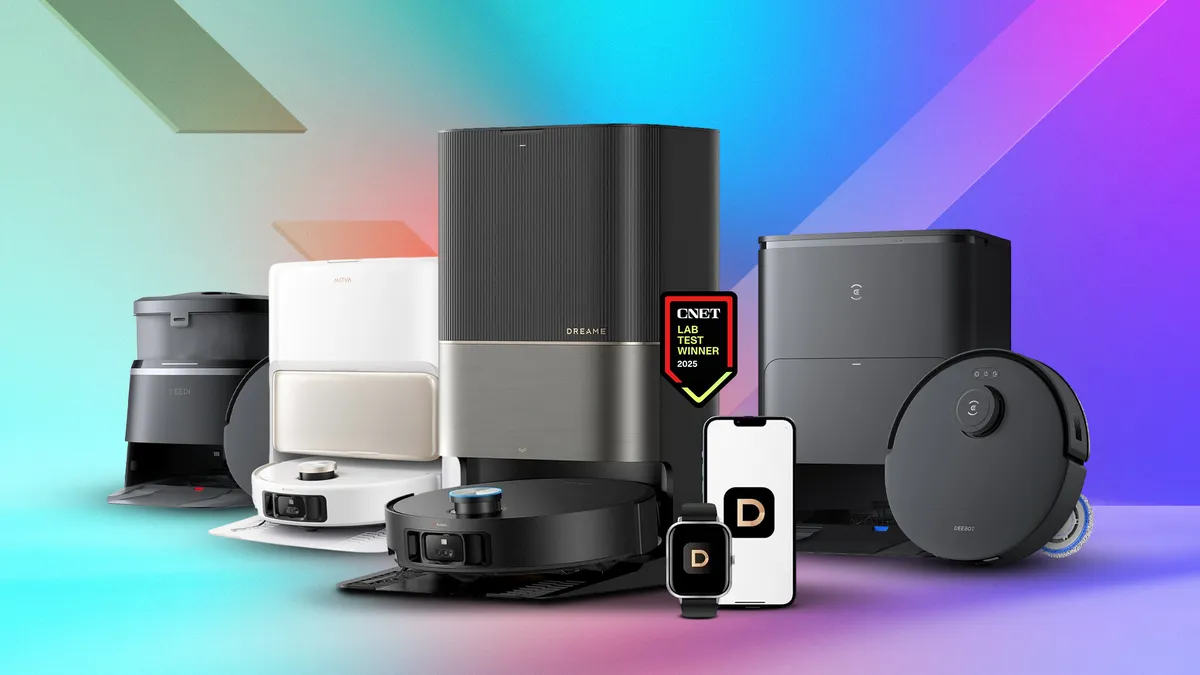
These robot vacuums are ones that tested well, scoring at least a 7 overall rating, or that might be the right fit for a specific situation.
Yeedi S16 Plus
The S16 Plus has great pet hair pickup, but not-so-good avoidance of pet waste.
Amazon/Zooey Liao/CNET
Yeedi S16 Plus: The Yeedi S16 Plus distinguishes itself with the best pet hair pickup we’ve tested, completely clearing our hardwood test area. It also has one of the most user-friendly app interfaces available. However, it falls short of our main list due to significant failures in obstacle avoidance and inconsistent cleaning power on specific surfaces. In our navigation tests, it avoided only two of six objects, running over a sock and two types of simulated pet waste, which makes it a risky choice for homes where messes might occur.
Advertisement
While its overall sand pickup average is a decent 51.51%, its specific performance lags behind top-tier competitors. It achieved a mediocre 86.13% pickup rate on hardwood and struggled significantly on midpile carpet, with only a 17.39% success rate. Consequently, despite its sleek design and effective self-rinsing Ozmo mop, we recommend models like the Eufy E28 for people who need reliable obstacle avoidance.
Yeedi M14 Plus
The M14 Plus has impressive obstacle avoidance capabilities, but has poor midpile carpet pickup.
Amazon/Zooey Liao/CNET
Yeedi M14 Plus: The Yeedi M14 Plus is a standout choice for smart navigation, tying for the best obstacle avoidance score in our testing by successfully evading five out of six common hazards, including pet waste and socks. It pairs these smarts with excellent hardwood performance, removing 92.7% of sand in our lab tests, and has what our testers rated as the most intuitive and comprehensive app interface available. With a base station that offers self-emptying and hot water mop washing, it’s a highly capable automated cleaner for homes with hard floors.
Advertisement
However, the M14 Plus falls short of our main list due to its abysmal performance on soft surfaces; it managed a dismal 8.7% pickup rate on midpile carpet, making it unsuitable for homes with rugs. Its navigation coverage was also below average at 71.18%, leaving more missed spots than top-tier competitors like the Mova V50 or Dreame X50. While often available at a deep discount, its high retail price of $1,199 makes the iRobot Roomba 205 DustCompactor a stronger value proposition for most buyers.
Roborock Qrevo Curv
The Qrevo Curv is an older and distinctive-looking robot vacuum.
Roborock/CNET
Robock Qrevo Curv: The Roborock Qrevo Curv is easily recognizable by its distinctive egg-shaped base station and has an AdaptiLift chassis that helps it cross high thresholds. In our lab tests, it proved to be a specialist for homes with plush rugs, achieving a 35.65% sand pickup rate on midpile carpet. This was the highest score recorded in its specific test batch and the second-highest midpile score we’ve seen to date, trailing only the Mova V50.
Advertisement
However, the Qrevo Curv misses our main list due to its underwhelming performance on hard floors and poor hazard detection. It removed only 75.91% of sand from hardwood, a mediocre result compared to top-tier competitors, which consistently score above 90%. Additionally, its navigation systems failed to identify common clutter. It avoided only one out of six obstacles in our avoidance test. Our lab experts also noted that its cleaning path was inefficient, with heat maps showing it focused heavily on the room’s edges while neglecting the center.
Eufy E25
The Eufy E25 is a capable robot vacuum for obstacle avoidance, but it doesn’t offer quite as much value as the E28.
Eufy/CNET
Eufy E25: The Eufy E25 stands out as one of the better obstacle-avoidance systems for robot vacuums. It successfully evaded five out of six hazards, including simulated pet waste and cords — a feat matched only by its sibling, the E28, and the Yeedi M14 Plus. While setup was a breeze, thanks to an app that instantly recognized the device, its cleaning power didn’t quite match its brains. It managed a respectable 85.4% sand pickup on hardwood but struggled significantly on soft surfaces, recording the lowest low-pile carpet score in its batch at just 31.88%.
Advertisement
We ultimately excluded the E25 from our main list because it offers less utility than the Eufy E28 for a similar or higher price. “I would recommend the Eufy E28 over this unit because it offers the carpet-cleaning functionality with similar cleaning abilities,” noted lab technician Schylar Breitenstein. With a price tag hovering around $1,300 without sales and a midpile carpet pickup rate of only 12.17%, it is hard to justify the E25 when the E28 provides the same elite obstacle avoidance plus a unique portable carpet cleaner for better value.
iRobot Roomba 705 Max
The Roomba 705 Max had the best cleaning coverage we’ve tested and it’s a capable cleaner on hardwood.
CNET
iRobot Roomba 705 Max: The iRobot Roomba 705 Max distinguishes itself with room coverage, with an impressive 86.36% score. It is a thorough cleaner on hard floors, picking up 92.7% of sand, and it has a compact, stylish base station that auto-empties the dustbin without dominating your floor plan. If you have a tidy home with predominantly hard floors and want a vacuum that won’t miss a spot, the 705 Max offers the thorough cleaning pattern iRobot is known for.
Advertisement
However, we excluded it from our main list because its obstacle-avoidance technology is virtually nonexistent compared to modern standards. In our lab tests, it failed to avoid a single object, running over everything from socks to simulated pet waste — an odd flaw for a robot touting its AI vision. Additionally, it lacks the mopping capabilities standard on most robots in this price class. Our lab team critiqued the app as “underdeveloped,” noting that the expensive warranty add-ons feel “like an unnecessary paywall.” For a smarter robot that can actually dodge trouble, we recommend the Eufy E28.
3i S10 Ultra
The 3i S10 Ultra is a unique water-recycling robot vacuum.
3i/CNET
3i S10 Ultra: We haven’t reviewed many robot vacuums from 3i, but the company has some unique offerings, including the S10 Ultra, which it says is the first water recycling robot vacuum in the world. What that means is that it’s capable of purifying and distilling its own wastewater extracted from the robot, as well as using water vapor and condensation from the air to refill the robot’s water tank with clean water. It’s a fascinating implementation that can help cut down on water wasted on mopping.
Advertisement
In terms of performance, the S10 Ultra is a capable robot vacuum, removing 93.45% of sand from hardwood floor, which is the third highest score on our list. However, carpet performance wasn’t as good, at 37.68% low-pile and 17.68% midpile, resulting in a 49.6% average. That said, it has all the key features you’d expect from a higher-end robot vacuum, including advanced lidar navigation, dirt and liquid detection, a self-cleaning spinning roller mop and AI obstacle avoidance. Our lab technician, Schylar Breitenstein, noted that the app wasn’t very user-friendly and that she had issues with connectivity to Wi-Fi. Obstacle avoidance was also a disappointment, with a complete failure for all six obstacles. The bulky and heavy base station weighs 50 pounds and takes up significant space. All this keeps it off our best list.
Ecovacs Deebot X9 Pro Omni
The X9 Pro Omni is a capable newer robot vacuum from Ecovacs, but we like its predecessor a bit better.
Ecovacs/CNET
Ecovacs Deebot X9 Pro Omni: The Ecovacs Deebot X9 Pro Omni distinguishes itself with reliable carpet detection that correctly ramps up suction when transitioning from hard floors to rugs, a feature our lab noted isn’t always consistent in this category. In terms of raw cleaning power, it performed decently, removing 88.32% of sand from hardwood floors and securing the third-highest midpile carpet pickup score in its test batch at 20.87%. Our testers also appreciated its navigation around furniture, noting that it “navigates well around chair legs” and easily cleared our 4-inch threshold tests.
Advertisement
However, the X9 Pro Omni misses our main list because its performance doesn’t justify its premium price tag. Despite claims of AI avoidance, it only successfully dodged two out of six obstacles in our hazard gauntlet. Furthermore, its room coverage was a middling 76.42%, with lab technicians observing that it “seems to clean in one direction” without the cross-hatch pattern that ensures a deeper clean. With a total average pickup score of 51.47%, it is a capable cleaner, but lacks the elite efficiency of top contenders such as the Mova V50.
Monsaga MS1 Max
Monsaga MS1 Max: The Monsaga MS1 Max caught our eye as a potentially affordable option that doesn’t skimp on features, offering lidar navigation and a self-emptying base station for a midrange price. In our lab testing, it actually punched above its weight class on hardwood floors, removing an impressive 92.7% of sand — a score that rivals some of our top picks, including the Yeedi M14 Plus. Our testers also appreciated the petite, lightweight base station, noting it was “easily transportable” compared to the bulky docks typical of this category.
However, the MS1 Max falls short of a recommendation due to what our lab team described as “atrocious” pet hair performance; hair became hopelessly tangled around the main brush and was scattered around the room rather than collected. It also struggled significantly on softer surfaces, managing only 44.06% pickup on low-pile carpet and a dismal 4.35% on midpile. Furthermore, its navigation smarts didn’t hold up in our hazard tests; the robot failed to avoid a single object in our six-item gauntlet, running over everything from cords to simulated pet waste.
Data centers for AI are turning the world of power generation on its head. There isn’t enough power capacity on the grid to even come close to how much energy is needed for the number being built. And traditional transmission and distribution networks aren’t efficient enough to take full advantage of all the power available. According to the U.S. Energy Information Administration (EIA), annual transmission and distribution losses average about 5 percent. The rate is much higher in some other parts of the world. Hence, hyperscalers such as Amazon Web Services, Google Cloud and MicrosoftAzure are investigating every avenue to gain more power and raise efficiency.
Microsoft, for example, is extolling the potential virtues of high-temperature superconductors (HTS) as a replacement for copper wiring. According to the company, HTS can improve energy efficiency by reducing transmission losses, increasing the resiliency of electrical grids, and limiting the impact of data centers on communities by reducing the amount of space required to move power.
“Because superconductors take up less space to move large amounts of power, they could help us build cleaner, more compact systems,” Alastair Speirs, the general manager of global infrastructure at Microsoft wrote in a blog post.
Copper is a good conductor, but current encounters resistance as it moves along the line. This generates heat, lowers efficiency, and restricts how much current can be moved. HTS largely eliminates this resistance factor, as it’s made of superconducting materials that are cooled to cryogenic temperatures. (Despite the name, high-temperature superconductors still rely on frigid temperatures—albeit significantly warmer than those required by traditional superconductors.)
Advertisement
The resulting cables are smaller and lighter than copper wiring, don’t lower voltage as they transmit current, and don’t produce heat. This fits nicely into the needs of AI data centers that are trying to cram massive electrical loads into a tiny footprint. Fewer substations would also be needed. According to Speirs, next-gen superconducting transmission lines deliver capacity that is an order of magnitude higher than conventional lines at the same voltage level.
Microsoft is working with partners on the advancement of this technology including an investment of US $75 million into Veir, a superconducting power technology developer. Veir’s conductors use HTS tape, most commonly based on a class of materials known as rare-earth barium copper oxide (REBCO). REBCO is a ceramic superconducting layer deposited as a thin film on a metal substrate, then engineered into a rugged conductor that can be assembled into power cables.
“The key distinction from copper or aluminum is that, at operating temperature, the superconducting layer carries current with almost no electrical resistance, enabling very high current density in a much more compact form factor,” says Tim Heidel, Veir’s CEO and co-founder.
Liquid Nitrogen Cooling in Data Centers
Ruslan Nagimov, the principal infrastructure engineer for Cloud Operations and Innovation at Microsoft, stands near the world’s first HTS-powered rack prototype.Microsoft
HTS cables still operate at cryogenic temperatures, so cooling must be integrated into the power delivery system design. Veir maintains a low operating temperature using a closed-loop liquid nitrogen system: The nitrogen circulates through the length of the cable, exits at the far end, is re-cooled, and then recirculated back to the start.
Advertisement
“Liquid nitrogen is a plentiful, low cost, safe material used in numerous critical commercial and industrial applications at enormous scale,” says Heidel. “We are leveraging the experience and standards for working with liquid nitrogen proven in other industries to design stable, data center solutions designed for continuous operation, with monitoring and controls that fit critical infrastructure expectations rather than lab conditions.”
HTS cable cooling can either be done within the data center or externally. Heidel favors the latter as that minimizes footprint and operational complexity indoors. Liquid nitrogen lines are fed into the facility to serve the superconductors. They deliver power to where it’s needed and the cooling system is managed like other facility subsystem.
Rare earth materials, cooling loops, cryogenic temperatures—all of this adds considerably to costs. Thus, HTS isn’t going to replace copper in the vast majority of applications. Heidel says the economics are most compelling where power delivery is constrained by space, weight, voltage drop, and heat.
“In those cases, the value shows up at the system level: smaller footprints, reduced resistive losses, and more flexibility in how you route power,” says Heidel. “As the technology scales, costs should improve through higher-volume HTS tape manufacturing and better yields, and also through standardization of the surrounding system hardware, installation practices, and operating playbooks that reduce design complexity and deployment risk.”
Advertisement
AI data centers are becoming the perfect proving ground for this approach. Hyperscalers are willing to spend to develop higher-efficiency systems. They can balance spending on development against the revenue they might make by delivering AI services broadly.
“HTS manufacturing has matured—particularly on the tape side—which improves cost and supply availability,” says Husam Alissa, Microsoft’s director of systems technology. “Our focus currently is on validating and derisking this technology with our partners with focus on systems design and integration.”
The new law aims to protect a victim from having to individually flag each platform-specific instance of abusive content to the platform in question.
The UK government is proposing a new law which would force tech platforms to remove intimate content within 48 hours of it being flagged as non-consensually shared or abusive.
Platforms that don’t act in time “could face fines of up to 10pc of their qualifying worldwide revenue or having their services blocked in the UK”, the government said.
The measure also intends that such images would only need to be reported once in order for action to be taken to remove them from all platforms where they appear, and to ensure blocking or deletion of any future uploads.
Advertisement
This aims to protect a user or victim from having to individually flag each platform-specific instance of abusive content to the platform in question.
UK prime minister Keir Starmer said: “The online world is the frontline of the 21st century battle against violence against women and girls. That’s why my government is taking urgent action against chatbots and ‘nudification’ tools.
“Today we are going further, putting companies on notice so that any non-consensual image is taken down in under 48 hours.”
The measure is a proposed amendment to the UK’s Crime and Policing Bill, and would also extend powers to internet service providers to block access to “rogue websites” that might fall outside legislative authority yet still be hosting such content.
Advertisement
The government’s technology secretary Liz Kendall said: “The days of tech firms having a free pass are over. Because of the action we are taking, platforms must now find and remove intimate images shared without consent within a maximum of 48 hours. No woman should have to chase platform after platform, waiting days for an image to come down.”
The UK’s media regulator Ofcom will be involved in handling the enforcement of the new measures, which intend to classify intimate image abuse in line with terrorist or child abuse material as per the country’s Online Safety Act.
French lawmakers have initiated a ban on social media for under-15s, while the country’s prosecutors recently raided X’s Paris offices as part of a multi-layered investigation into the company which is partially focused on deepfake content generated by its Grok chatbot.
Advertisement
Don’t miss out on the knowledge you need to succeed. Sign up for the Daily Brief, Silicon Republic’s digest of need-to-know sci-tech news.
We are calling on technology companies like Meta and Google to stand up for their users by resisting the Department of Homeland Security’s (DHS) lawless administrative subpoenas for user data.
In the past year, DHS has consistently targeted people engaged in First Amendment activity. Among other things, the agency has issued subpoenas to technology companies to unmask or locate people who have documented ICE’s activities in their community, criticized the government, or attended protests.
These subpoenas are unlawful, and the government knows it. When a handful of users challenged a few of them in court with the help of ACLU affiliates in Northern California and Pennsylvania, DHS withdrew them rather than waiting for a decision.
But it is difficult for the average user to fight back on their own. Quashing a subpoena is a fast-moving process that requires lawyers and resources. Not everyone can afford a lawyer on a moment’s notice, and non-profits and pro-bono attorneys have already been stretched to near capacity during the Trump administration.
Advertisement
That is why we, joined by the ACLU of Northern California, have asked several large tech platforms to do more to protect their users, including:
Insist on court intervention and an order before complying with a DHS subpoena, because the agency has already proved that its legal process is often unlawful and unconstitutional;
Give users as much notice as possible when they are the target of a subpoena, so the user can seek help. While many companies have already made this promise, there are high-profileexamples of it not happening—ultimately stripping users of their day in court;
Resist gag orders that would prevent companies from notifying their users that they are a target of a subpoena.
We sent the letter to Amazon, Apple, Discord, Google, Meta, Microsoft, Reddit, SNAP, TikTok, and X.
Recipients are not legally compelled to comply with administrative subpoenas absent a court order
An administrative subpoena is an investigative tool available to federal agencies like DHS. Many times, these are sent to technology companies to obtain user data. A subpoena cannot be used to obtain the content of communications, but they have been used to try and obtain some basic subscriber information like name, address, IP address, length of service, and session times.
Unlike a search warrant, an administrative subpoena is not approved by a judge. If a technology company refuses to comply, an agency’s only recourse is to drop it or go to court and try to convince a judge that the request is lawful. That is what we are asking companies to do—simply require court intervention and not obey in advance.
It is unclear how many administrative subpoenas DHS has issued in the past year. Subpoenas can come from many places—including civil courts, grand juries, criminal trials, and administrative agencies like DHS. Altogether, Google received 28,622 and Meta received 14,520 subpoenas in the first half of 2025, according to their transparency reports. The numbers are not broken out by type.
Advertisement
DHS is abusing its authority to issue subpoenas
In the past year, DHS has used these subpoenas to target protected speech. The following are just a few of the known examples.
On April 1, 2025, DHS sent a subpoena to Google in an attempt to locate a Cornell PhD student in the United States on a student visa. The student was likely targeted because of his brief attendance at a protest the year before. Google complied with the subpoena without giving the student an opportunity to challenge it. While Google promises to give users prior notice, it sometimes breaks that promise to avoid delay. This must stop.
In September 2025, DHS sent a subpoena and summons to Meta to try to unmask anonymous users behind Instagram accounts that tracked ICE activity in communities in California and Pennsylvania. The users—with the help of the ACLU and its state affiliates— challenged the subpoenas in court, and DHS withdrew the subpoenas before a court could make a ruling. In the Pennsylvania case, DHS tried to use legal authority that its own inspector general had already criticized in a lengthy report.
In October 2025, DHS sent Google a subpoena demanding information about a retiree who criticized the agency’s policies. The retiree had sent an email asking the agency to use common sense and decency in a high-profile asylum case. In a shocking turn, federal agents later appeared on that person’s doorstep. The ACLU is currently challenging the subpoena.
Amazon is warning that a Russian-speaking hacker used multiple generative AI services as part of a campaign that breached more than 600 FortiGate firewalls across 55 countries in five weeks.
A new report by CJ Moses, CISO of Amazon Integrated Security, says that the hacking campaign occurred between January 11 and February 18, 2026, and did not rely on any exploits to breach Fortinet firewalls.
Instead, the threat actor targeted exposed management interfaces and weak credentials that lacked MFA protection, then used AI to help automate access to other devices on the breached network.
Moses says the compromised firewalls were observed across South Asia, Latin America, the Caribbean, West Africa, Northern Europe, and Southeast Asia, among other regions.
An AI-powered hacking campaign
Amazon says it learned about the campaign after finding a server hosting malicious tools used to target Fortinet FortiGate firewalls.
Advertisement
As part of the campaign, the threat actor targeted FortiGate management interfaces exposed to the internet by scanning for services running on ports 443, 8443, 10443, and 4443. The targeting was reportedly opportunistic rather than against any specific industries.
Rather than exploiting zero-days, as we commonly see targeting FortiGate devices, the actor used brute-force attacks with common passwords to gain access to devices.
Once breached, the threat actor extracted the device’s configuration settings, which include:
SSL-VPN user credentials with recoverable passwords
Administrative credentials
Firewall policies and internal network architecture
IPsec VPN configurations
Network topology and routing information
These configuration files were then parsed and decrypted using what appears to be AI-assisted Python and Go tools.
“Following VPN access to victim networks, the threat actor deploys a custom reconnaissance tool, with different versions written in both Go and Python,” explained Amazon.
Advertisement
“Analysis of the source code reveals clear indicators of AI-assisted development: redundant comments that merely restate function names, simplistic architecture with disproportionate investment in formatting over functionality, naive JSON parsing via string matching rather than proper deserialization, and compatibility shims for language built-ins with empty documentation stubs.”
“While functional for the threat actor’s specific use case, the tooling lacks robustness and fails under edge cases—characteristics typical of AI-generated code used without significant refinement.”
These tools were used to automate reconnaissance on the breached networks by analyzing routing tables, classifying networks by size, running port scans using the open-source gogo scanner, identifying SMB hosts and domain controllers, and using Nuclei to look for HTTP services.
The researchers say that while the tools were functional, they commonly failed in more hardened environments.
Advertisement
Operational documentation written in Russian detailed how to use Meterpreter and mimikatz to conduct DCSync attacks against Windows domain controllers and extract NTLM password hashes from the Active Directory database.
The campaign also specifically targeted Veeam Backup & Replication servers using custom PowerShell scripts, compiled credential-extraction tools, and attempted to exploit Veeam vulnerabilities.
On one of the servers found by Amazon (212[.]11.64.250), the threat actor hosted a PowerShell script named “DecryptVeeamPasswords.ps1” that was used to target the backup application.
As Amazon explains, threat actors often target backup infrastructure before deploying ransomware to prevent the restoration of encrypted files from backups.
Advertisement
The threat actors’ “operational notes” also contained multiple references to trying to exploit various vulnerabilities, including CVE-2019-7192 (QNAP RCE), CVE-2023-27532 (Veeam information disclosure), and CVE-2024-40711 (Veeam RCE).
The report says that the attacker repeatedly failed when attempting to breach patched or locked-down systems, but instead of continuing to try to gain access, they moved on to easier targets.
While Amazon believes the threat actor has a low-to-medium skill set, that skill set was greatly amplified through the use of AI.
The researchers say the threat actor utilized at least two large language model providers throughout the campaign to:
Advertisement
Generate step-by-step attack methodologies
Develop custom scripts in multiple programming languages
Create reconnaissance frameworks
Plan lateral movement strategies
Draft operational documentation
In one instance, the actor reportedly submitted a full internal victim network topology, including IP addresses, hostnames, credentials, and known services, to an AI service and asked for help spreading further into the network.
Amazon says the campaign demonstrates how commercial AI services are lowering the barrier to entry for threat actors, enabling them to carry out attacks that would normally be outside their skill set.
The company recommends that FortiGate admins not expose management interfaces to the internet, ensure MFA is enabled, ensure VPN passwords are not the same as those for Active Directory accounts, and harden backup infrastructure.
Google recently reported that threat actors are abusing Gemini AI across all stages of cyberattacks, mirroring what Amazon observed in this campaign.
Modern IT infrastructure moves faster than manual workflows can handle.
In this new Tines guide, learn how your team can reduce hidden manual delays, improve reliability through automated response, and build and scale intelligent workflows on top of tools you already use.
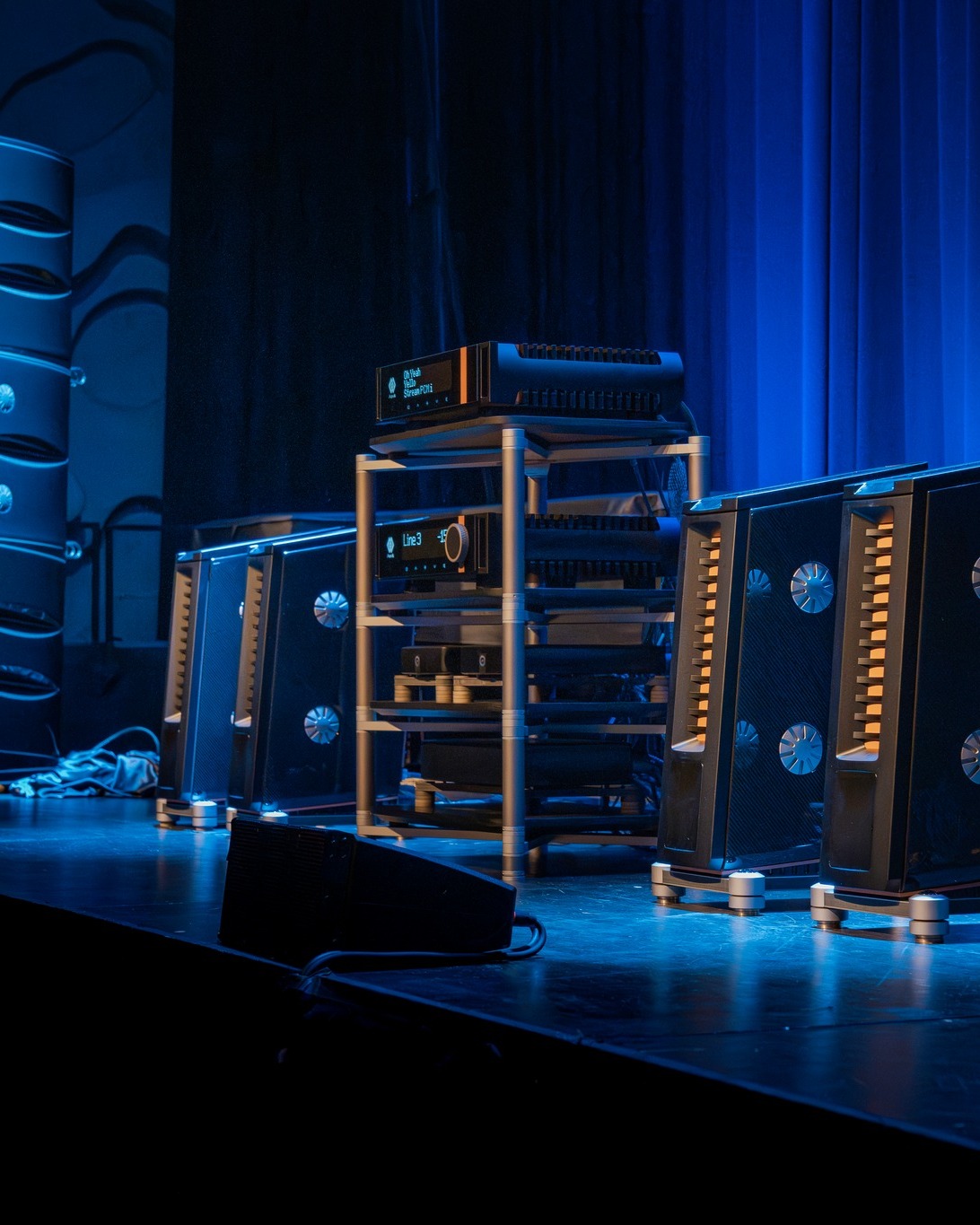
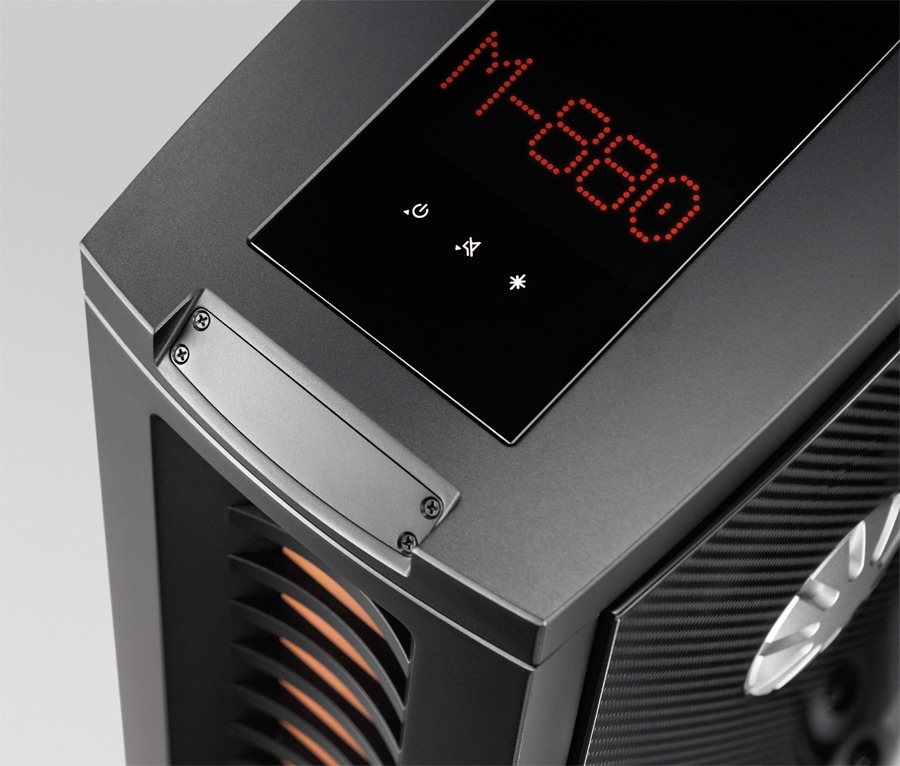
Audio Group Denmark doesn’t launch products so much as drop financial gravity wells. Last week in Aalborg, a select group of high-end press was flown in, not for a polite demo, but for a full-scale statement: the debut of Aavik’s new M-880 Monoblock Power Amplifier, now available to order at $115,000, alongside the equally subtle Børresen M8 Gold Signature loudspeakers, priced at $1,150,000 per pair. If that number made you blink, congratulations, you’re still connected to reality.
Four Aavik M-880 visible in photo during unveiling.
Aavik and Børresen may share DNA under the Audio Group Denmark umbrella, but they each stay in their own lane. Aavik handles the electronics. Borresen builds the loudspeakers. Six-figure systems aren’t aspirational here; they’re Tuesday. This is a group staffed by people with very serious résumés, including deep roots in Gryphon Audio Designs, another Danish name synonymous with “because we can” engineering and prices that don’t ask for permission.
The M-880 isn’t about chasing trends or filling a market gap. It reflects Aavik deliberately stepping outside its established lane; one it has navigated very well with its Class D designs to explore something more ambitious and more experimental. Based on what we heard and discussed at T.H.E. Show: NYC 2025, Aavik has earned credibility in modern amplification. The M-880 is what happens when a company with that foundation decides to see how far it can push its ideas when cost is no longer the primary governor.
Whether that exploration is worth $115,000 per channel is not a question for most people and pretending otherwise is pointless. That decision belongs to Persian Gulf emirs, Wall Street and tech executives, and a very small circle of listeners for whom six-figure components are a rational option, not a punchline. Dismissing the M-880 simply because almost no one can afford it misses the point. Ninety-nine point nine percent of the world can’t afford this level of audio engineering, but rarity alone doesn’t invalidate innovation.
Advertisement
Is it excessive? Absolutely. Does it make practical sense to assemble a $2 million system around amplifiers like these? Probably not. Would we do it if given the chance? Probably not. But excess has always been part of how the high-end moves forward, and among the components unveiled in Aalborg, the amplifiers are the more intellectually interesting statement. Loudspeakers at that level aim for spectacle. The M-880 aims for execution.
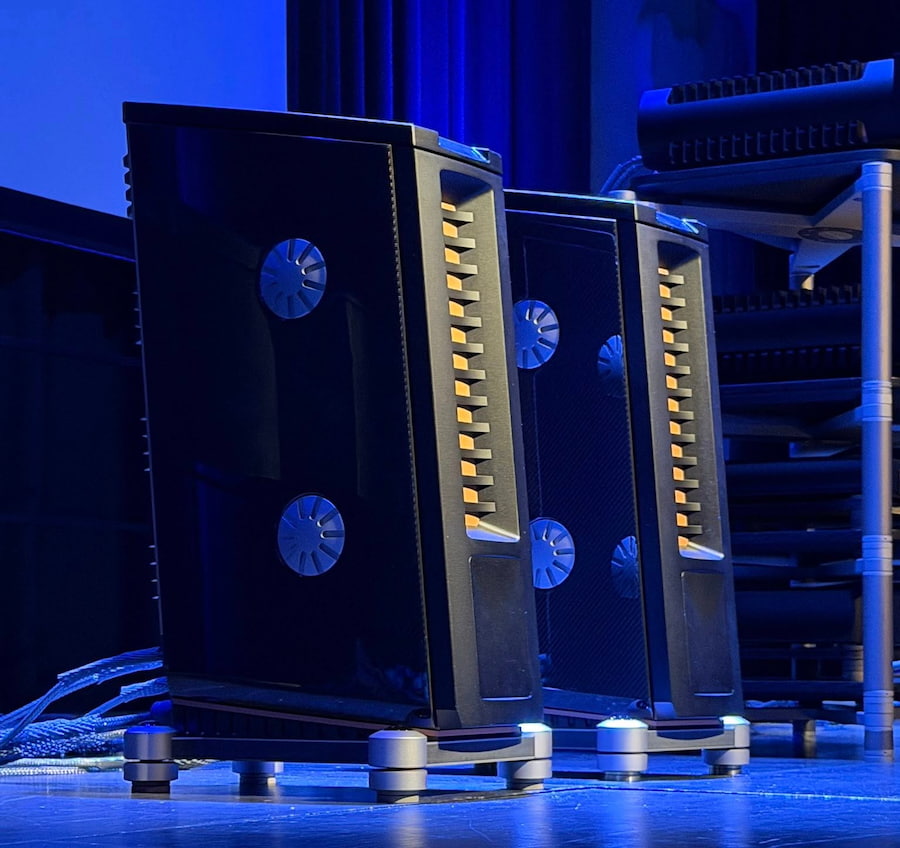
A pair of Aavik M-880 Monoblock Amplifiers at unveiling.
The M-880 was developed in direct response to the performance demands of the Børresen M8 Gold Signature loudspeaker. As the M8 Gold evolved toward higher levels of speed, resolution, and scale, Aavik concluded that conventional stereo amplifier architectures were no longer sufficient to fully exploit what the loudspeaker was capable of delivering.
The result is the M-880: a true monoblock amplifier conceived not as a standalone component, but as part of a unified system. Rather than treating amplification and loudspeaker design as separate exercises, Aavik engineered the M-880 to operate as a coherent counterpart to the M8 Gold Signature so power delivery, control, and dynamic behavior are aligned with the loudspeaker’s capabilities from the outset.
From Michael Børresen, Co-founder & CTO, Audio Group Denmark: “The M-880 is the result of pursuing absolute performance without compromise, while breaking visual conventions in the unmistakable style that only Flemming can create. For the M8 loudspeakers, nothing less would suffice — and I’m proud of what we achieved.”
Class A Amplification
The Aavik M-880 is designed to push Class A amplifier performance further than conventional implementations. Its output stage maintains a precisely controlled 0.63 V bias, exceeding the current required for operation and ensuring true Class A performance at all times, regardless of load or signal dynamics.
Advertisement
This approach enables the use of smaller, locally positioned capacitor banks. Each of the eight output transistor pairs is supported by its own dedicated local reservoir placed immediately adjacent to the devices, minimizing current travel, shortening signal paths, and reducing noise.
By stabilizing the bias at this level, Aavik preserves the purity, linearity, and harmonic integrity typically associated with Class A designs, while allowing the amplifier to operate at significantly lower temperatures than traditional high-bias Class A amplifiers. The result is improved long-term stability and reliability without sacrificing performance. And for the buyers this amplifier is aimed at, concerns about efficiency or electrical bills are predictably, not part of the conversation.
Advertisement. Scroll to continue reading.
Power Output: So… How Much Power Are We Talking About?
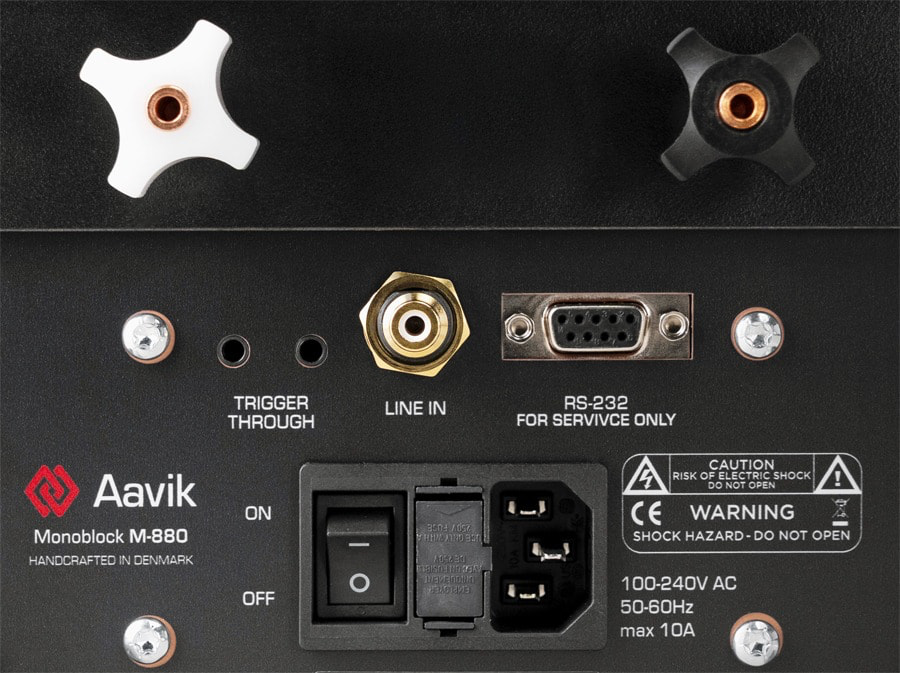
Each Aavik M-880 mono amplifier is rated to deliver 400 watts into 8 ohms, 800 watts into 4 ohms, and approximately 1,300 watts into 2 ohms. Its very low output impedance results in a damping factor exceeding 1,000 into 8 ohms, underscoring the level of control this amplifier is designed to exert over demanding loudspeaker loads.
That kind of output delivered in a true Class A operating regime is not common. At all. And while the M-880 was developed specifically to meet the requirements of the $1,150,000 Børresen M8 Gold Signature loudspeakers (ahem… very nice house), the amplifier itself opens up some rather interesting and far more flexible pairing possibilities. For listeners who may find the amplifiers more compelling than the speakers, there are flagship options from MartinLogan, Wilson Audio, Magico, Sonus faber, KEF, and DALI that would still leave room in the budget for… well, everything else.
Advertisement
The Power Supply
Rather than using a traditional linear power supply, the M-880 employs four high-speed, low-noise switching power supplies, each rated at 500 W / 20 A—twice the number used per channel in the earlier Aavik P-880 two-channel power amplifier.
These supplies are supported by a 266 mF local energy storage bank capable of storing up to 1,050 J and delivering peak currents of up to 130 A. The result is a power system that adapts dynamically to audio demand while maintaining an extremely low noise floor, contributing to greater stability, improved control, and a wider dynamic range.
Current Paths and Noise Suppression
The M-880 has reduced power dissipation, which enables the use of locally placed capacitor banks, with each output transistor pair supported by its own dedicated energy storage positioned directly adjacent to the devices. This results in exceptionally short current paths, reduced noise, and improved efficiency.
Noise rejection is system-wide through proprietary Aavik and Ansuz technologies, including Active Tesla Coils (ATC), Active Square Tesla Coils (AST), third-generation Analog Dither Technology (ADT), and Anti-Aerial Resonance Coils (AARC) applied to internal wiring.
Advertisement
Tesla coils in Aavik amplifiers are proprietary active, double-inverted, or square coils. The coils eliminate high-frequency noise and lower the noise floor, enhancing musical detail and transparency.
Mechanical Grounding and Enclosure Design
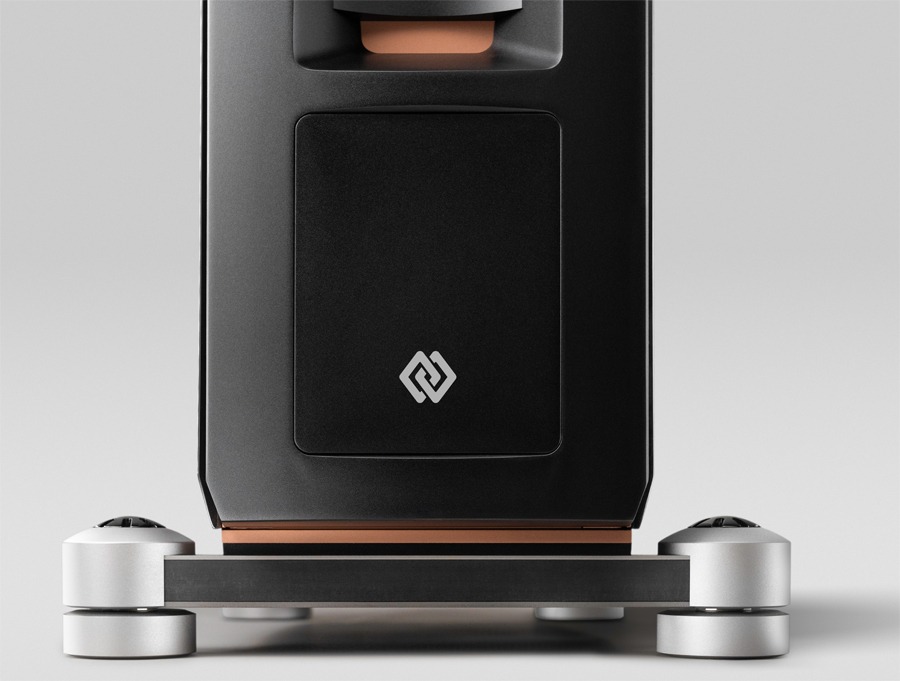
Each M-880 incorporates four Ansuz Darkz Z3w resonance control devices, providing mechanical isolation.
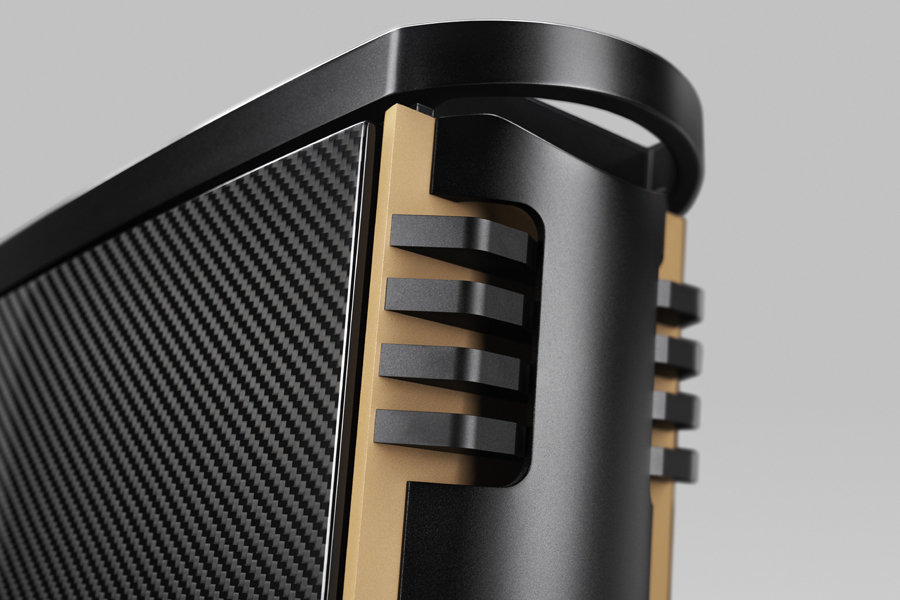
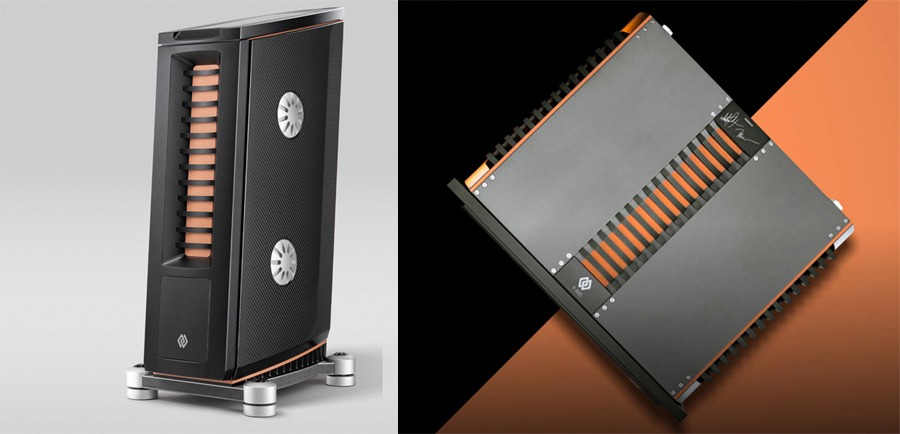
Its multi-layer construction features a wood-based laminate between a titanium base plate and an upper stainless-steel plate, topped by a internal copper chamber. This provides a controlled resonance behavior alongside exceptional EMI/RFI shielding.
Designed and Built in Denmark
Each Aavik M-880 monoblock amplifier is made at Audio Group Denmark’s facility in Aalborg, Denmark. The manufacturing process includes advanced CNC machining, cryogenic processing, and meticulous hand assembly. Each unit undergoes extensive electrical verification and final listening comparison against a reference before shipment.
Comparison
Not to scale.
Aavik Model
M-880
P-880
Product Type
Mono Power Amplifier
Stereo Power Amplifier
Price
$115,000
$73,500
Power Output
1 × 400 W @ 8 Ohm 1 × 800 W @ 4 Ohm
2 x 250W @ 8 Ohm 2 x 500W @ 4 Ohm
Distortion
< 0.007% (10 W, 1 kHz, 8 Ohm)
<0,007% (10W, 1kHz, 8 ohm)
Active Tesla Coils
N/A
182
Active GOLD Tesla Coils
112
N/A
Active Square Tesla Coils
112
411
Dither Circuitry
8
18
Active zirconium anti-aerial resonance Tesla coils
N/A
20
Gold Anti-Aerial Resonance Coils
12
N/A
Active zirconium cable anti aerial resonance Tesla coils
Not Indicated
4
Output Connections
Single-Wire Speaker Terminals (single channel)
Trigger (2)
Power Inlet
Advertisement
2 x Speaker Terminals Outputs (heavy-duty)
1 x Trigger Through
1 x RS232
Power Inlet
Advertisement
Input Connections
1 x Analog (RCA).
2 x Analog (RCA)
Power consumption
Standby: < 0.5 W Idle: 150 W
Standby: 1 W Idle: 150 W
Dimensions
HxWxD 794.02 x 342.00 x:509.68 mm 31.26 x 13.46 x 20.07 inches
LxWxH 580 x 510 x 155 mm
22 ⁵³/₆₄ x 20 ⁵/₆₄ x 6 ⁷/₆₄ inches
Weight
70.0 kg / 154.3 lbs
41 kg / 90.4 lbs
The Bottom Line
The Aavik M-880 exists at the intersection of extreme engineering and unapologetic excess, but it’s not empty spectacle. What makes it genuinely interesting are the technical choices: a true Class A output stage with tightly controlled bias, unusually high power delivery for a Class A design, extremely low output impedance, massive current capability, and a power architecture built around multiple high-speed switching supplies with large local energy storage placed exactly where it matters.
Advertisement. Scroll to continue reading.
This is not a scaled-up version of a conventional amplifier; it’s a deliberate rethink of how Class A can be executed when thermal limits, noise, and stability are engineered rather than tolerated.
Advertisement
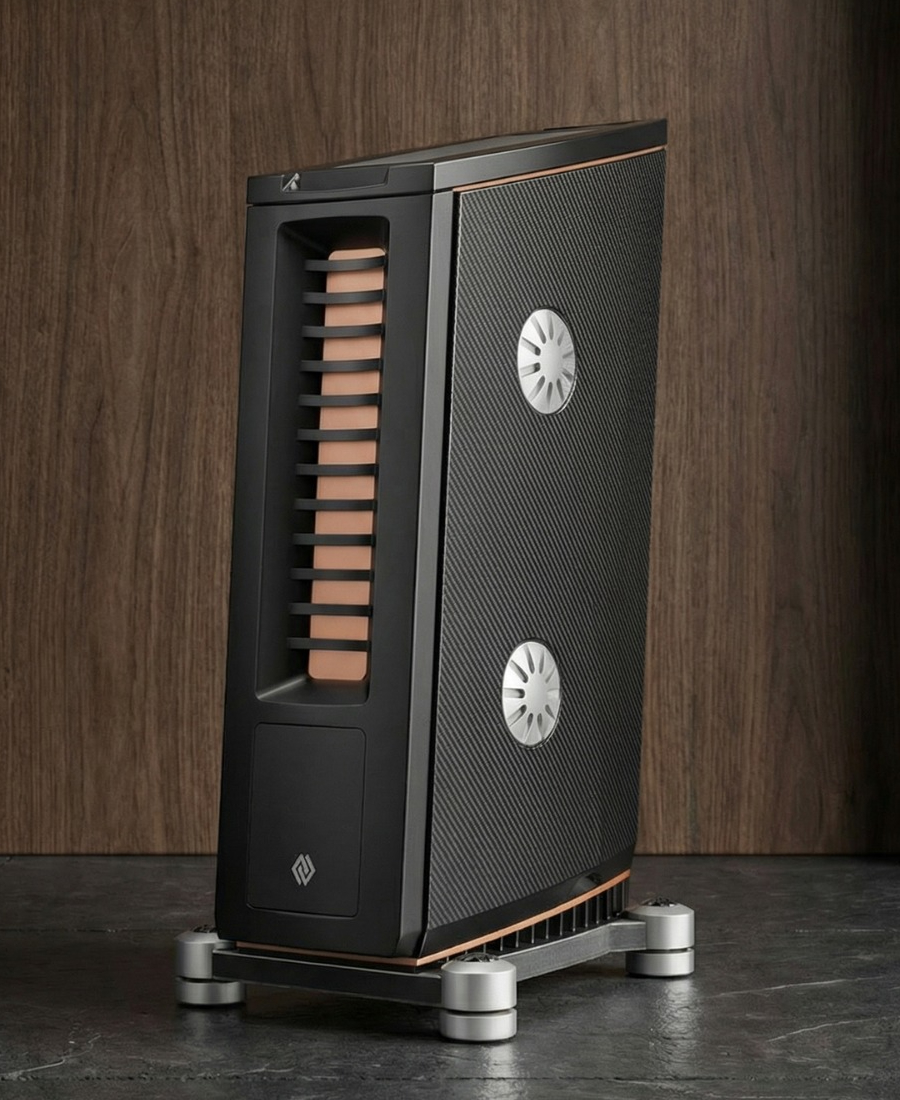
This amplifier is for a very specific audience: listeners who already own reference-grade loudspeakers, have dedicated rooms, reinforced floors, and zero interest in compromise or efficiency. At 31.26 × 13.46 × 20.07 inches and 70.0 kg / 154.3 lbs per chassis, each M-880 is effectively a small floor-standing speaker made of metal. You’ll need two for most stereo systems, and if you’re thinking about bi-amping, start counting in fours.
Is it rational? No. Is it serious? Absolutely. The M-880 isn’t meant to be relatable; it’s meant to explore what’s possible when experience, resources, and ambition align. For most people, this will remain a thought experiment. For a very small few, it’s a statement piece that also happens to be one of the more technically ambitious Class A amplifiers to emerge from Denmark—where, apparently, there is something in the herring.
Price & Availability
The Aavik M-880 Mono Power Amplifier is priced at $115,000 USD and available through Authorized Aavik Dealers.
The Trump administration’s project for erasing the parts of American history they find inconvenient continues unabated. But that doesn’t mean it doesn’t hit the occasional roadblock.
In January, the administration removed portions of an exhibit at the former Philadelphia home of George Washington that made reference to 9 slaves he owned that spent time at the house. That Washington owned slaves is not a matter of opinion. He did. That he also rotated those slaves in and out of the home, moving them elsewhere for short periods of time, all to get around laws in Pennsylvania that slaves within its borders for a certain period of continuous time would be automatically freed, is also uncontroversial to state. He did that. One of our founding fathers that brought “freedom” to America was also a slave owner. He wasn’t alone.
The Trump administration doesn’t like being reminded of that history. It also prefers that younger generations never learn of that history. I’d call it jingoism, but that doesn’t feel sufficient. This rings as something far more dastardly, fit for the musings of George Orwell.
Well, the city sued to have the exhibit restored and it appears the Judge in the case, a George W. Bush appointee, agrees with my assessment. You can read as much in her blistering opening in her ruling, in which she also orders the government to restore the exhibit to its previous state.
Advertisement
As if the Ministry of Truth in George Orwell’s 1984 now existed, with its motto ‘Ignorance is Strength,’ this Court is now asked to determine whether the federal government has the power it claims — to dissemble and disassemble historical truths when it has some domain over historical facts. It does not.
The ruling, which you can read embedded below, is actually quite technical. It turns out that the agreements, under which these specific sites operate, are shared between the city and federal governments, and they are both old and complicate the government’s efforts.
The layman’s version of this is that several historical sites in Philadelphia were created by an act of Congress in the 1940s. Ownership of the site is retained by the city, while curation of the exhibits are maintained only under the agreement of both the federal government and city government. Adding to the complication is that a 2006 updated agreement between both parties had a short term attached to it, but there is also a survivabilty clause, which states that the expiration of the term of the agreement doesn’t mean that the city loses its rights to agreement on the curation of the exhibits.
Although the 2006 Agreement, as updated by the Third Amendment, ceased as of May 1, 2010,94 the terms in its Project Development Plan remained effective under the Third Amendment Survival Clause. The Survival Clause states that “provisions which, by themselves or their nature are reasonably expected to be performed after the expiration or termination of this Third Amendment shall survive.”95 Because the President’s House project was not contemplated to be completed by the expiration of the Third Amendment, it was reasonably expected that terms relating to the Project Development Plan would remain in effect to ensure that the commemorative exhibit was realized in accordance with the parties’ initial plan. While the Third Amendment granted NPS the right to interpret the exhibit after it was completed, it is the Project Development Plan that established the interpretive framework that NPS would employ. Profound alterations to that framework, seen here in the effort to remove all references to slavery, AfricanAmerican Philadelphia, and the move to freedom for the enslaved, would, under the Project Development Plan, require the written approval of both the City and NPS.
Whoops.
Now, this doesn’t mean that this judge spared words of disgust at the general plan that the federal government is attempting to carry out.
Advertisement
Defendants have completely ignored their legislatively imposed duties. They have disregarded statutory authority, compelled by Congress, by taking unilateral action without seeking agreement from the City of Philadelphia. An agency, part of the Executive branch, is not entitled to act solely as it wishes. Rather, it is the Legislative branch which authorizes agency action, and the Executive branch must comply with that direction.
There’s a lot more in there, but it’s largely legally technical in nature. What is obvious from the analysis in the ruling is that, at least in this one case, the federal government acted outside of its authority due to agreements struck as a result of legislation from Congress that are in good standing. I fully expect the Trump administration to waste time and resources by appealing this decision, but this is fairly straightforward stuff.
Trump, no matter how hard he pretends, is not a king. He does not have as much power as he desires. He cannot change history. In far too many places, he is hiding that history, but he can’t change it.
And, at least in this case, at this moment, he has found the limits to his power.
Automation has become an unquestioned priority for IT and service-led organizations. AI sits in the center of service desks, sales workflows, security operations, and modern cloud environments. Leaders are under pressure to move faster, cut costs, and boost output through every tool available.
Yet the rapid shift has created an unexpected consequence: many teams are realizing that efficiency alone doesn’t build trust.
Justin Sharrocks
General Manager for EMEA, at TrustedTech.
Across the UK and Europe, I’m seeing organizations push automation to the point where the service model becomes brittle. Chatbots handle entire support journeys. AI sales agents run outbound activity. Security alerts are triaged end-to-end by automated playbooks.
These systems can be useful, but when they replace human judgement entirely, gaps appear. Customers notice when no one understands the content of their operations.
They notice when interactions feel generic, and their pain points are not acknowledged. And they notice quickly when a service provider has removed the people who can actually hear them and help them.
Where service models are starting to break
Most automation failures stem from the same issue: removing the “human layer” that holds a service experience together. This layer isn’t about constant hand-holding or slow manual work. It’s the part that interprets nuance and understands why a problem matters to the customer, not just what the problem is.
Advertisement
In support environments, some organizations are discovering this the hard way. Tickets get resolved faster on paper, but satisfaction scores fall because no one is building a relationship with the user. In sales, AI sequences deliver volume, but prospects lose interest because the outreach lacks relevance.
Sign up to the TechRadar Pro newsletter to get all the top news, opinion, features and guidance your business needs to succeed!
And in cybersecurity, automated responses can misjudge severity without human oversight.
These situations play out more often when teams automate to stretch limited headcount. It’s understandable, especially during periods of change or when IT teams are still modernizing legacy estates.
Advertisement
But full dependency on automation leaves systems rigid. When an exception appears, or when a customer simply needs to speak to a real expert, the experience collapses.
A similar scenario emerged when a client enabled a new AI tool to assist with Microsoft Copilot workflows. Without proper human oversight, the team inadvertently incurred a $35,000 cost due to selecting the wrong SKU, highlighting the financial and operational risks of fully automated systems without human checks.
Advertisement
The skills customers still rely on
Despite the volume of new AI tools entering the market, core human skills have grown in value, not diminished. Customers look for empathy when something breaks, context when they need guidance, and continuity when they rely on a long-term partner.
They want to know the person supporting them understands their environment, their constraints, and their goals. No amount of automated efficiency can replace that peace of mind.
Even the best-trained AI models struggle here. They can analyze patterns, flag risks, and summarize information, but they do not build rapport. They do not learn a customer’s preferences through years of interaction.
And they cannot recognize the moments when a problem might have a wider business impact that isn’t stated in the ticket.
Advertisement
In conversations with CIOs and IT directors, these human skills come up repeatedly as the factor that separates a strong service provider from a forgettable one. The organizations that combine automation with real expertise create resilience. Those that rely on automation alone create fragility.
How leaders can strike the right balance
Leaders don’t need to choose between automation and human-first service. The stronger approach is to place AI in the right parts of the workflow, then anchor it with experienced people who understand the organization. In practice, this starts with shaping journeys so humans remain present at the points that matter most.
AI can manage triage, data gathering, and pattern recognition, yet customers feel more supported when a real specialist guides the outcome and closes the loop.
Advertisement
Automation also works best when it elevates teams rather than replacing them. Handing routine cloud administration, patch reminders, or Copilot onboarding queries to AI frees technical staff to focus on higher-value conversations and proactive guidance. It creates the space for human expertise to be visible, not sidelined.
Clear ownership is another factor. Automated systems drift when no one oversees how they evolve, particularly during periods of rapid change. Keeping a named human owner for each account or operational area ensures accountability and prevents misjudged responses.
This sits alongside a final principle: investing in people who understand the complete technology stack. Cloud migration, Microsoft CSP environments, hybrid infrastructure, and security workflow automation all involve nuance.
Teams grounded in these areas recognize when automation genuinely helps the customer and when it risks creating blind spots in their experience.
Advertisement
The next wave of successful tech businesses will be the most human
AI will continue to advance and will handle more of the repetitive work that once consumed IT teams. This is positive progress. But as automation accelerates, the differentiator in the market will shift. Trust will matter more. Personal relationships will matter more.
And organizations that combine smart automation with genuine human expertise will outperform those that pursue automation at all costs.
The future of IT service isn’t fully automated. It’s human-led, technology-enhanced, and built around relationships. Businesses that get this balance right will deliver the speed, security and modernization their customers expect while keeping the qualities that matter most: empathy, continuity and real connection.
This article was produced as part of TechRadarPro’s Expert Insights channel where we feature the best and brightest minds in the technology industry today. The views expressed here are those of the author and are not necessarily those of TechRadarPro or Future plc. If you are interested in contributing find out more here: https://www.techradar.com/news/submit-your-story-to-techradar-pro








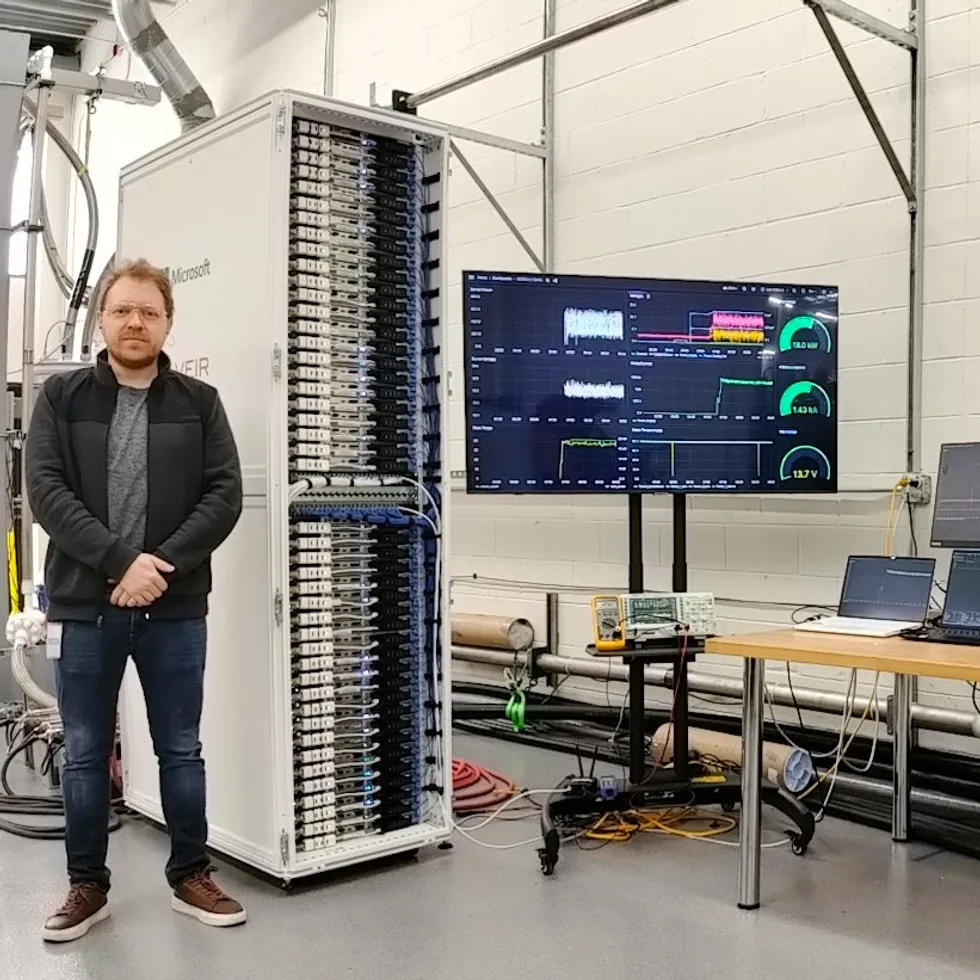
 Ruslan Nagimov, the principal infrastructure engineer for Cloud Operations and Innovation at Microsoft, stands near the world’s first HTS-powered rack prototype.Microsoft