Tech
Andover Audio FreePlay vs KEF Muo: Which Portable Bluetooth Speaker Is Better for Home, Travel, and Outdoors?

Portable Bluetooth speakers have grown far beyond the disposable little cylinders that once lived in kitchen drawers, rental cars, and beach bags until their batteries gave up the ghost. The category has exploded in recent years, drawing serious attention from brands such as KEF, DALI, Devialet, and Andover Audio, all of which see an opening for compact, battery-powered speakers that do more than make noise near a pool and can be tossed at that annoying relative who lacks a filter.
That brings us to the Andover Audio FreePlay and KEF Muo. On paper, there is a clear price difference, and the KEF arrives with the kind of industrial design pedigree and premium-brand cachet one expects. But this is not quite a battle between a luxury object and a lesser alternative. Both are designed to work at home, travel without complaint, and survive time outdoors; both also aim to offer more musical weight, clarity, and refinement than the usual Bluetooth-speaker suspects.
The real question is not which one has the fancier badge or the longer specification sheet. It is which portable speaker makes more sense for how you actually listen: on the kitchen counter, in a hotel room, by the grill, at the beach, or anywhere a proper stereo system would be excessive, impractical, or likely to attract complaints from someone who detests fun.
Related Reviews:
Andover Audio FreePlay vs. KEF Muo Specifications

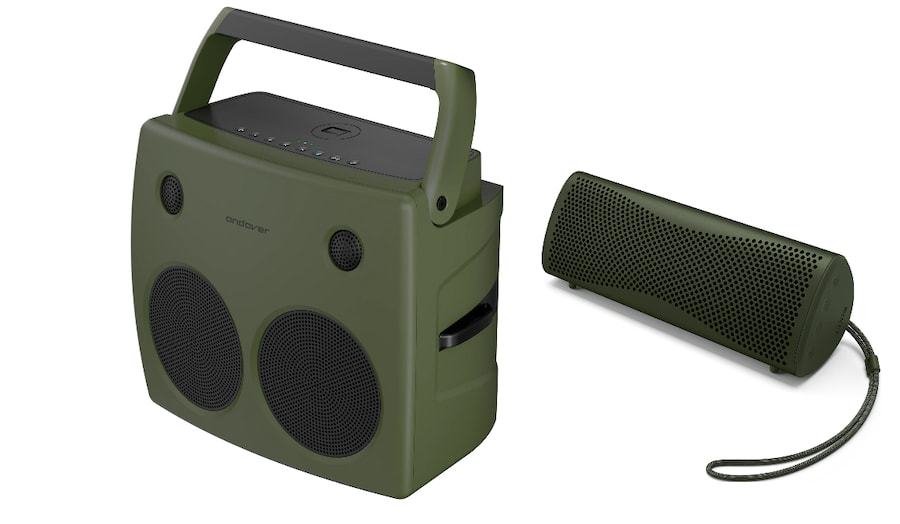
| Andover Audio FreePlay | KEF Muo | |
|---|---|---|
| Price | $429 | $249.99 |
| Speaker type | Portable stereo Bluetooth speaker | Compact portable Bluetooth speaker |
| Drivers | 2 x 5.25-inch aluminum-cone woofers, 2 x 25mm dome tweeters, rear passive radiator |
58 x 117mm racetrack mid/bass driver with P-Flex surround, 20mm dome tweeter |
| Amplification | Not published | 40W total Class D: 30W mid/bass, 10W tweeter |
| Frequency response | 55Hz to 20kHz | 43Hz to 20kHz |
| Maximum SPL | Not published | 90dB ±3dB at 1 meter |
| Bluetooth | Bluetooth 6.0 with LE Audio and Classic Bluetooth | Bluetooth 5.4 |
| Codecs | LC3, AAC, SBC | aptX Adaptive, AAC, SBC |
| Wired inputs | 3.5mm auxiliary input, dynamic microphone input, USB-C charging/power delivery | USB-C charging and audio playback |
| Wireless multi-speaker support | Party Mode links up to 99 additional FreePlay speakers | TWS stereo pairing; Auracast multi-speaker support |
| App control | No dedicated app | KEF Connect app |
| DSP / listening modes | Wide Range and Loud Mode, with Loud Mode adding 6dB | Orientation-aware DSP and app-based EQ adjustments |
| Battery life | Up to 24 hours; more than 23 hours in testing | Up to 24 hours at moderate volume |
| Charging time | About 3 hours | About 2 hours; 15 minutes provides up to 3 hours of playback |
| Phone charging | 5W Qi wireless charging pad; 45W bidirectional USB-C charging | No wireless phone charging |
| Weather resistance | IP67 | IP67 |
| Dimensions | 10 x 13 x 6.5 inches | 8.5 x 3.2 x 2.3 inches |
| Weight | 9 pounds | 1.6 pounds |
| Included carry accessory | Carry bag with shoulder strap | Removable carrying strap |
| Best fit | Room filling, outdoor gatherings, deeper bass, greater output | Desktop, kitchen, travel, close-range listening, smaller spaces |
Design, Portability, and Outdoor Use
Before getting into bass, detail, dynamic capabilities, and all of the other things people claim to hear while standing next to a braai with an ice-cold Castle Lager in one hand, the more useful question is how these speakers fit into daily life.

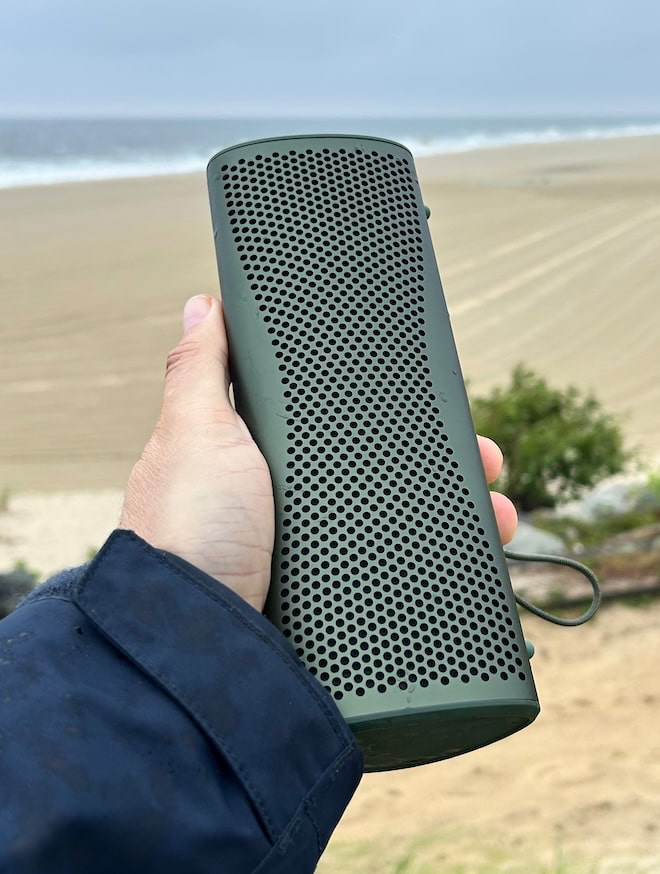
The FreePlay and Muo are both meant to travel beyond the living room, but that does not make them interchangeable. Size, weight, battery performance, weather resistance, charging, physical controls, wireless stability, and how easily each speaker moves from kitchen counter to hotel room to backyard all matter here. A portable speaker that sounds wonderful but stays on a shelf because it is too precious, too awkward, or too annoying to charge has rather missed the assignment.
Both proved more durable than their polished finishes might suggest. I used them at the beach, left them in the sand, poured water over them, and left both outside for roughly 30 seconds after the rain began. Neither speaker flinched. I did not submerge either one, because there is a difference between testing an IP67 rating and behaving like a man who has lost a bet.
The FreePlay’s protected connections inspire more confidence in that context. My only concern with the Muo is that its USB-C input is exposed rather than covered by a rubber flap. That has not proved to be a real-world issue so far. After nearly two months of regular use and more than a little abuse, the Muo is still kicking butt. But on a sandy beach or in wet conditions, it is one detail worth keeping in mind.
The two speakers approach portability from opposite ends of the dock.
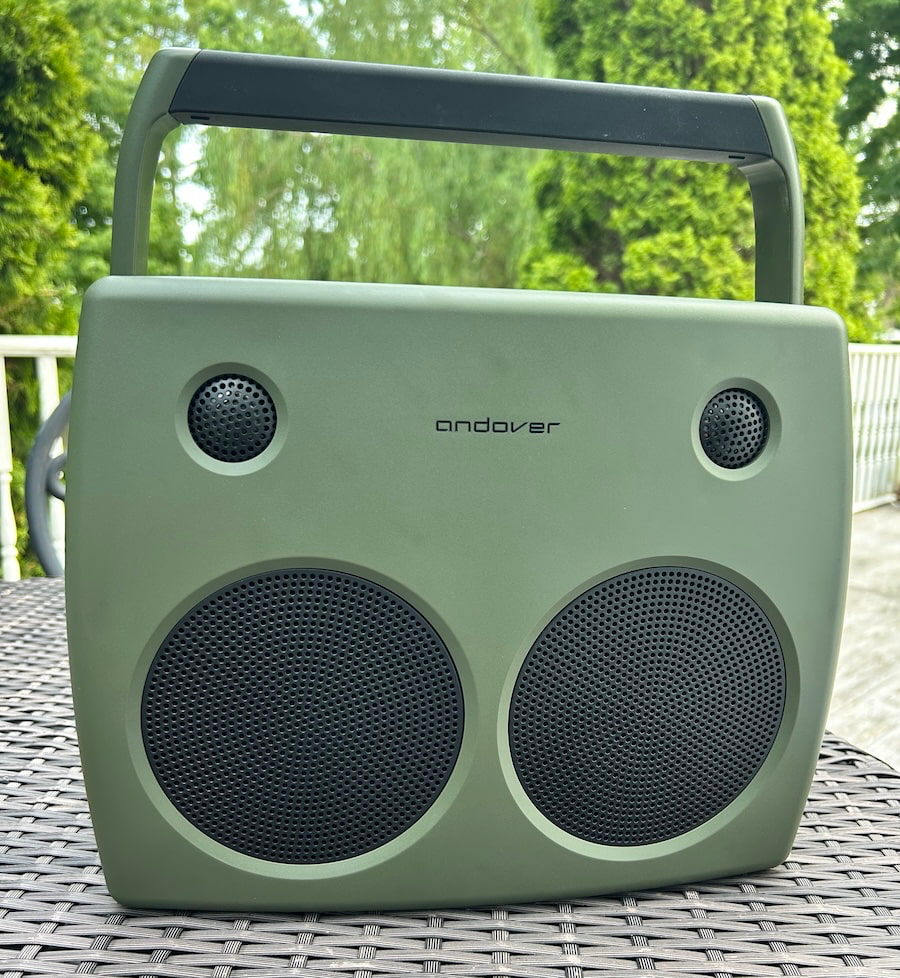

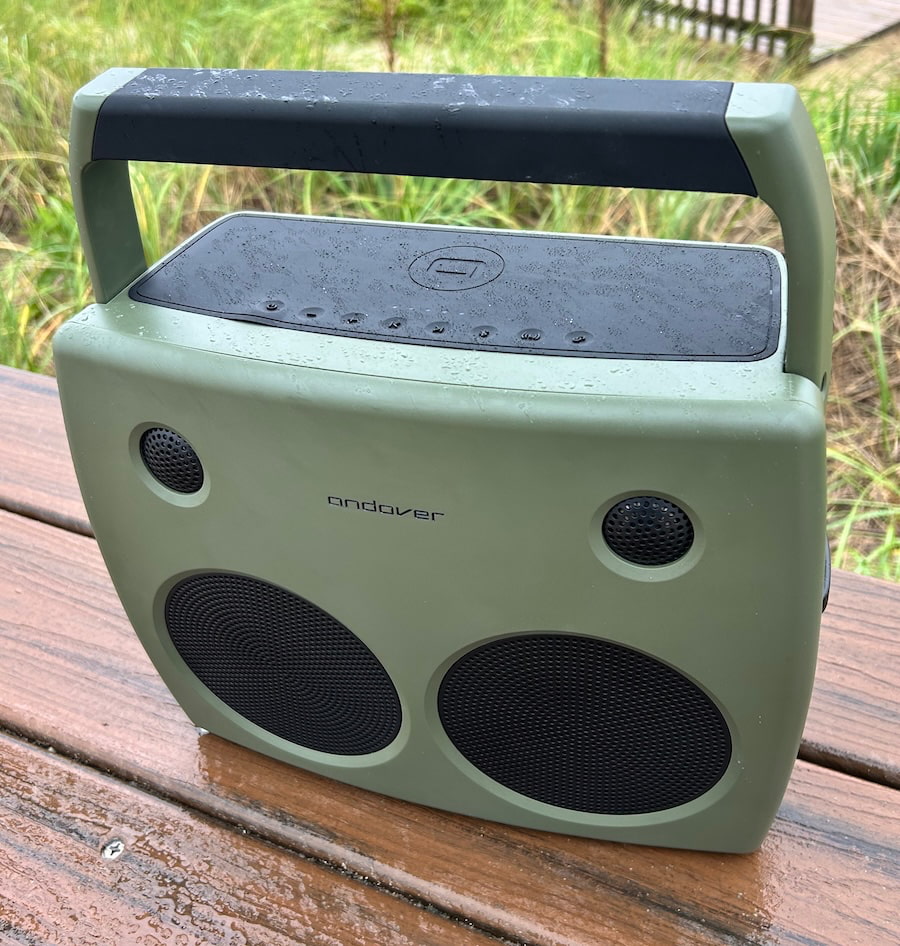
At 9 pounds, the Andover Audio FreePlay is not something you toss into a coat pocket before leaving the house. It is a substantial portable speaker built around a genuine stereo driver array: two 5.25-inch woofers, two 25mm dome tweeters, and a large rear passive radiator. The fold-down handle, tie-down bars, included shoulder bag, IP67 rating, 24-hour battery claim, Qi charging pad, USB-C power delivery, microphone input, and Party Mode make clear that Andover expects the FreePlay to work as the musical center of a patio, pool day, boat trip, golf outing, or camping trip to get away from all of the summer people.
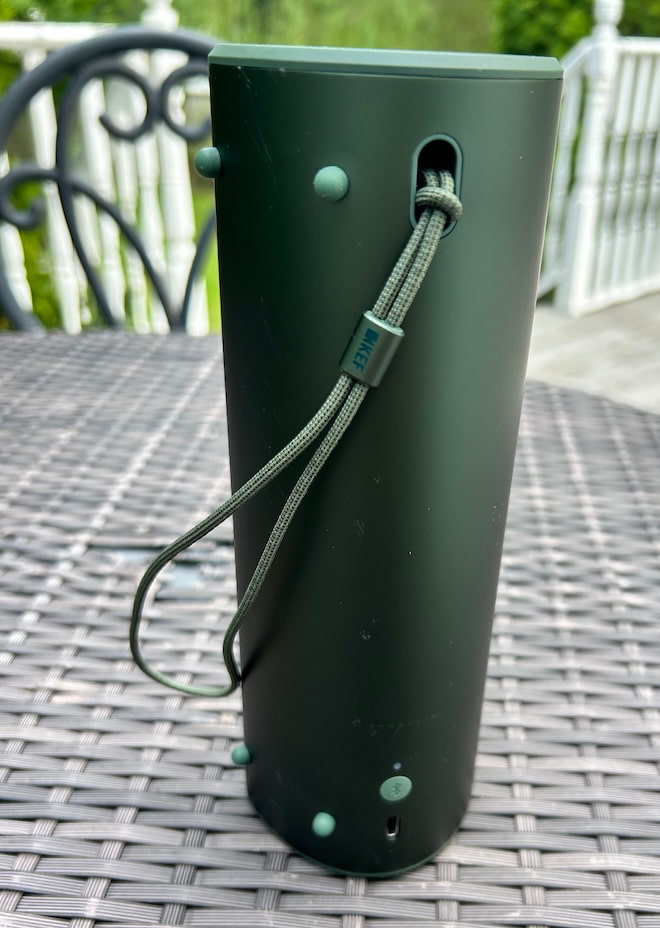
The KEF Muo is the more genuinely travel-friendly option. At only 1.6 pounds and 8.5 inches tall, it slides into a bag without requiring a logistical meeting first. Its sculptural aluminum enclosure, removable carry strap, IP67 protection, USB-C audio, Bluetooth 5.4 with aptX Adaptive, speakerphone function, KEF Connect app, and claimed 24-hour battery life give it a more compact and technologically polished brief. Pair two for dedicated left and right channels, or use Auracast to spread music across multiple compatible speakers.

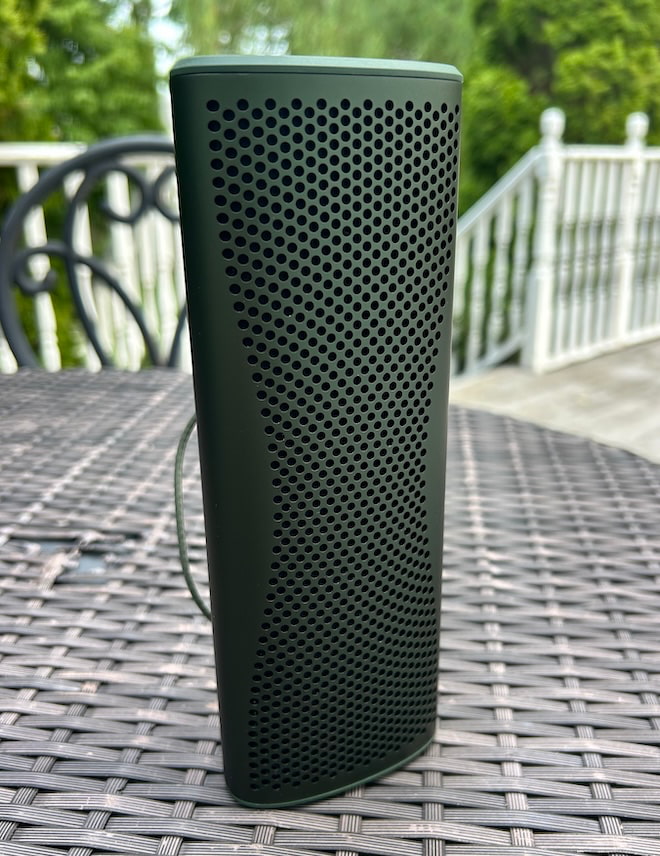
It also has a useful second life as a desktop speaker. Positioned horizontally beneath an Apple iMac or on a narrow IKEA desk shelf, the Muo fits neatly where a conventional pair of speakers would be impractical. Its small rubber feet create a stable contact surface, while its orientation detection adjusts the DSP when the speaker is placed on its side. The result is a broader, more room-filling presentation than its narrow cabinet suggests, with a soundstage that can extend meaningfully beyond the speaker itself.
That is why the price difference is not as straightforward as it first appears. The Muo asks you to pay for miniaturization, materials, everyday portability, and KEF’s refined industrial design. The FreePlay gives you far more physical speaker, true stereo from a single enclosure, more output potential, more bass-producing surface area, and features that make it feel closer to a compact outdoor music system than a conventional portable Bluetooth speaker.
Both can handle the kitchen counter, hotel room, pool deck, beach, or backyard. The difference is that the KEF is the one you carry everywhere because it disappears into a bag; the Andover is the one you bring when the music needs to annoy everyone within 100 feet in every direction.

Connectivity, DSP, and Real World Performance
The technology matters here because these are fundamentally different solutions. KEF uses DSP, compact engineering, and app-based adjustment to make the Muo unusually flexible for its size. Andover gives the FreePlay more cabinet volume, more drivers, and far more physical presence. Neither approach is accidental.
Bluetooth, Apps, and Useful Technology
Both speakers paired quickly and reliably, with connection taking less than a second in most cases. The KEF Connect app gives the Muo useful sound-adjustment options, while the FreePlay keeps things more direct. Casting from an iPhone to the FreePlay simplified playback, and TIDAL, Qobuz, and Spotify all worked without noticeable lag.
Inside the house, wireless range was broadly similar. Interior walls mattered more than either speaker’s Bluetooth implementation, depending on where the source device was located. Outdoors, the Muo held a slight edge in connection range.
Indoor Listening and Low Volume Performance
The Muo is particularly effective in close-range listening. Positioned horizontally beneath an iMac, on a desk shelf, or on a kitchen counter, its orientation detection adjusts the DSP and creates a wider, more focused presentation than its narrow enclosure suggests. Pointed toward the listener, it works extremely well as a personal speaker.
The FreePlay cannot play that role in the same way. It is too large to disappear beneath a monitor, but it fills a room more easily and sounds clearer overall. The KEF works best when you are sitting near it; the FreePlay makes more sense when the music needs to reach beyond one person at a desk or table.
Bass, Scale, and Outdoor Volume
This is not a close contest.
The FreePlay has larger drivers, more cabinet volume, more bass-producing surface area, and more output. Those advantages matter outdoors, where music has to compete with wind, conversation, traffic, water, and the general chaos of people enjoying themselves. It produces more weight, more scale, and greater presence, while maintaining clarity as the volume rises.
The Muo is capable outdoors for personal listening, a small patio, or a hotel balcony. But it is still a compact portable speaker. The FreePlay is the one to bring when the music is expected to carry an outdoor gathering rather than simply accompany it.

The Bottom Line
The Andover Audio FreePlay and KEF Muo are closer than their price tags and dimensions initially suggest, but they are not trying to solve the same problem.
The KEF Muo is the more elegant compact speaker. It travels easily, looks at home on a desk or kitchen shelf, works exceptionally well beneath a monitor in its horizontal orientation, and uses its DSP intelligently to create a wider, more focused presentation for close-range listening. It is the better choice for hotel rooms, desktop systems, smaller spaces, and listeners who want a genuinely premium portable speaker without carrying something the size of a small carry-on bag.
The Andover Audio FreePlay is the more complete all-purpose music system. Its larger cabinet, true stereo driver array, stronger bass, greater output, and superior ability to fill a room or outdoor space give it a clear advantage when more people are listening or the environment is working against you. It also brings useful extras, including Qi charging, USB-C power delivery, a microphone input, Party Mode, and the kind of ruggedness that makes it easy to use at the beach, by the pool, or during a braai without treating it like a museum piece.
Buy the KEF Muo if portability, desktop use, design, and close-range listening are the priorities. Buy the Andover FreePlay if you want more scale, more bass, more output, and a speaker that can comfortably move from the kitchen counter to the backyard without running out of breath.
The Muo is the better compact speaker. The FreePlay is the better choice when you need a portable speaker to behave like a real music system.
You must be logged in to post a comment Login