This, as well as Anthropic’s other recent compute deals, including with Amazon and Google, is allowing the company to increase usage limits for Claude Code and Claude API.
The company announced yesterday (6 May) that it is doubling Claude Code’s five-hour rate limits for Pro, Max, Team and seat-based Enterprise plans; removing the peak hours limit reduction on Claude Code for Pro and Max users; and raising API rate limits “considerably” for Claude Opus models.
Advertisement
Colossus 1 features more than 220,000 Nvidia GPUs, including dense deployments of H100 and H200 chips, and the newer GB200 accelerators.
The SpaceX data centre in Tennessee, US, considered to be one of the world’s largest, came under regulatory scrutiny earlier this year after it was ruled that xAI – now under SpaceX – acted illegally by using methane gas turbines to power Colossus 1 and 2.
Musk, at the time, said that the merger would allow for data centres to be transported to space in order to harness near-constant solar energy from the Sun. SpaceX’s Starship rockets are expected to begin delivering its next-generation satellites into orbit this year, according to his comments.
Advertisement
As part of its agreement with SpaceX, Anthropic has also “expressed interest” in partnering to develop multiple gigawatts of orbital AI compute capacity, the two jointly said. Both companies are preparing to file historic initial public offerings this year, with Anthropic hitting a $1.2trn implied valuation and SpaceX targeting $1.75trn.
“Grateful to be partnering with SpaceX here. We are going to need to move a lot of atoms in order to keep up with AI demand, and there’s nobody better at quickly moving atoms (on or off planet Earth),” said Anthropic co-founder and chief compute officer Tom Brown in a post on X.
Musk, meanwhile, said people at Anthropic were “highly competent and cared a great deal about doing the right thing”. These comments from Musk come just months after he called Claude “misanthropic and evil” for allegedly “hat[ing]” people of certain races, as well as “heterosexuals and men”.
Earlier this week, Anthropic partnered with investment giants Blackstone, Hellman & Friedman, and Goldman Sachs to form a new AI services company, further cementing itself into the enterprise market as AI inevitably becomes a core productivity tool.
Advertisement
In April, SpaceX said that it had an agreement in place to acquire AI start-up Cursor for $60bn. Cursor plans to leverage the Colossus infrastructure to scale up the intelligence of its models.
Don’t miss out on the knowledge you need to succeed. Sign up for the Daily Brief, Silicon Republic’s digest of need-to-know sci-tech news.
The South Korean technology giant said it will make every effort to minimize the impact for existing customers, and is reviewing its support infrastructure for business partners. The decision won’t affect Samsung’s other divisions in the region, meaning they will continue to sell products such as smartphones and tablets as… Read Entire Article Source link
John Roberts has spent years whining about how totally unfair it is that people claim he and his colleagues rule based on partisan leanings. He did it in 2014. He did it in 2017. He did it in 2019. Hell, he did it a couple months ago too. So it’s little surprise that he’s out there whining about people calling the Court partisan yet again.
Speaking at a conference for lawyers and judges in Hershey, Roberts said the Supreme Court is required to make decisions that are not popular and bemoaned that there is not a better understanding among the public of how the court operates.
“I think at a very basic level, people think we’re making policy decisions, [that] we’re saying we think this is what things should be as opposed to this is what the law provides,” Roberts said. “I think they view us as truly political actors, which I don’t think is an accurate understanding of what we do. I would say that’s the main difficulty.”
While he conceded that people have a right to criticize the court and its decisions, he added that there is a tendency to focus too much on politics.
“We’re not simply part of the political process, and there’s a reason for that, and I’m not sure people grasp that as much as is appropriate,” Roberts said.
Advertisement
The timing here is something else — a week after an obviously partisan ruling in Callais, which stripped away Section 2 of the Voting Rights Act. Notably, Roberts himself had pointed to Section 2’s existence back in 2013 as the reason that they could kill off Section 4 of the Voting Rights Act (which required a pre-review of voting maps for racial bias). And now he helped kill Section 2.
If it were just about making decisions that are “not popular,” then… why are nearly all of his “unpopular” decisions quite clearly in support of one party’s goals and ideology? Any look at the details shows why people conclude that Roberts has a partisan bent to his rulings:
In the 15 precedent-overturning cases with partisan implications, in other words, Justice Roberts voted for a conservative outcome 14 times (93%).
Chief Justice Roberts is one of only two justices since 1946 to support 100% of decisions overturning precedent that led to conservative outcomes.
Roberts’s record in precedent-overturning cases is the second-most conservative among 37 justices who have ruled in at least 5 precedent-overturning cases since 1946. With 84% conservative votes in precedent-overturning cases, Roberts only trails Justice Alito’s 88%.
Gee. I wonder why people think the Court is partisan, chief?
And, on Monday (as we pointed out) Roberts joined Alito and the conservatives on the bench to break standard practice and precedent, supporting Louisiana ripping up its election maps to favor more Republican seats — even as voting had already started — even though, just months ago, he and the conservatives had said that Texas’ map (deemed unconstitutionally based on race by a Trump-appointed judge) couldn’t be torn up because it was “too close” to an election and voters needed “certainty.” There is literally no explanation for December being too close to change the maps while May somehow required rushing a map change… in the same election… other than the partisan leaning of those two decisions.
Indeed, as Liz Dye points out, we have decades of the Supreme Court doing exactly this: it allows for election map changes when it will help Republicans, but says “no can do, too close to an election” whenever it’s expected to help Democrats:
Advertisement
The Court’s conservatives routinely scold lower court judges for changing voting rules too close to an election. This violates the Purcell principle, named for a 2006 case in which the Court rebuked the 9th Circuit for blocking Arizona’s voter ID law too close to an election and causing voter “confusion.” For 20 years, the Supreme Court’s conservatives have selectively invoked Purcell to allow elections to proceed using maps that courts have already deemed to be unlawful.
In 2022, after lower courts struck down Alabama’s electoral map for violating Section 2 of the Voting Rights Act and disenfranchising Black voters, the Supreme Court intervened to allow Alabama to use the unconstitutional map anyway in the midterms. In 2023, the Court agreed that the maps were illegal under the VRA — but only after they’d let Alabama Republicans use them to take back the House.
Just five months ago, the Court cited Purcell when it rebuked a federal district court for “improperly inserting itself into an active primary campaign” by blocking Texas’s unconstitutionally racial gerrymander.
But given the chance to insert themselves into an acting primary campaign, they regularly jump in with both feet. And in fact they’re equally happy to stomp into the primary itself.
So, chief, if you want people to stop thinking the Court is partisan, maybe stop making such obviously partisan decisions.
Advertisement
Oh, and also maybe talk to your colleagues. After all, at the very moment you were whining about people thinking the court was partisan, your colleague Justice Neil Gorsuch was appearing on a famously rightwing podcast to talk about why “young conservatives must have courage to stand by their beliefs.” Sounds kinda partisan.
Gosh. Why would the public think some of you are partisan. I wonder!
And, let’s not forget that Thomas’s wife was supportive of the attempt to steal an election from the rightfully elected Joe Biden in support of the failed Republican campaign of Donald Trump. And then there’s Justice Alito’s wife who, somewhat infamously, flew political flags outside their home, including one in support of the January 6th insurrection.
Advertisement
A real mystery, truly. Who could possibly think that there might be partisan bias? How unfair.
But you keep saying how unfair this is. Year after year, conference after conference, the same complaint: people just don’t understand us.
At some point, Chief Justice, the more productive question isn’t why the public doesn’t grasp your supposed non-partisanship. It’s why — after decades of rulings that break almost exclusively in one direction, colleagues who deliver speeches about the courage of young conservatives, and the existential threat of progressivism, and spouses flying insurrection flags — you’re still surprised that they don’t.
Maybe the problem isn’t the public’s understanding. Maybe it’s the Court’s behavior.
The Global Positioning System (GPS) was developed by the United States military in the 1970s, but it wasn’t long before civilians all over the planet started using it. By the early 2000s the technology was popping up in consumer devices such as mobile phones, and since then its become absolutely integral to our modern way of life.
But although support for GPS in our gadgets is nearly ubiquitous, it’s not the only option when it comes to figuring out where you are on the globe. As you might imagine, not everyone was thrilled with building their infrastructure around one of Uncle Sam’s pet projects, and so today there are several homegrown regional and global satellite navigation systems in operation.
Given the tensions of the Cold War, it will probably come as little surprise to learn that the Soviet Union introduced their own satellite-based navigation system to compete with GPS. Development of the Global Navigation Satellite System (GLONASS) started a few years later than its Western counterpart, with the first satellites not reaching orbit until 1982, officially making it the second Global Navigation Satellite Systems (GNSS) ever developed.
Advertisement
GLONASS satellites orbit at a slightly lower altitude than GPS, 19,100 kilometers (11,900 miles) compared to 20,200 km (12,600 mi) of the American system, and at a greater inclination. This makes reception better at higher latitudes, which makes sense given the desired coverage area.
As designed the capabilities and overall accuracy of GLONASS were very similar to GPS, but the early satellites had a short operational lifespan of just three years. For global coverage GLONASS required 24 satellites in orbit, and maintaining coverage over Russia required 18. But after the fall of the USSR, launches of new satellites were put on pause and the constellation started suffering losses. By 2001, there were just seven operational GLONASS satellites.
President Vladimir Putin made the restoration of GLONASS a key priority in his administration, leading to resumed launches and development of the second and third generation satellites. Within a few years, commercial interest in GLONASS started to pick up, and the network regained global coverage in 2011. While the constellation has experienced a few setbacks over the last several years, spare and replacement satellites have been launched regularly, with the most recent entering orbit in September of 2025.
BeiDou (China)
Unlike the American and Russian systems, the first iteration of BeiDou was of a much smaller scale. Rather than a global system, the goal was to provide regional coverage for China and the surrounding countries with just four satellites placed in a geostationary orbit at an altitude of approximately 35,786 km (22,236 mi). From an observer in China, the satellites would appear to be motionless in the sky, ensuring reception anywhere in the country. Known retroactively as BeiDou-1, the system was operational from 2003 to 2012.
Advertisement
That year it was replaced with the far more ambitious BeiDou-2. The design called for a constellation of satellites in various orbits: 5 geostationary to provide backwards compatibility with BeiDou-1, 27 in medium Earth orbit similar to GPS/GLONASS, and 3 in an inclined geosynchronous orbit. The latter meaning that from the perspective of Earth, the satellite would appear to loiter overhead rather than remain in a fixed position.
BeiDou-1 was largely a research project and saw little use outside of the Chinese government. Conversely BeiDou-2 was designed for both government and civilian use from the start, with two distinct levels of service — civilian users could plot their position within a radius of 10 meters (32 feet), while the military reportedly enjoyed an accuracy of 10 cm (4 inches).
The coverage area of BeiDou-2 was expanded considerably to the south to include include Indonesia and Australia, but it still didn’t provide global service. Commercial use of the network started to pick up at this point, and by 2014 smartphones from Sony, Samsung, and Xiaomi included support for it.
It wasn’t until the introduction of BeiDou-3 in 2015 that the system could boast global coverage, with the system reaching full operational status in June of 2020.
Advertisement
Galileo (European Union)
While civilian use of GPS, GLONASS, and BeiDou was always part of the plan, all three systems were ultimately designed as tools of their respective governments. Conversely, when the European Union set out to develop Galileo in the early 2000s, the goal was to create a satellite navigation system operated by private companies and aimed at civilian users.
That first part of the plan fell apart fairly quickly, and by 2006 Galileo was nationalized and the European Space Agency was entrusted with its development and operation. The first operational satellite was put into orbit in October 2011, and limited functionality was available to the public by 2016. While Galileo was designed for civilian use, it does offer a High Accuracy Service (HAS) with an accuracy of 20 cm (8 inches) that was initially intended to be accessible only by paying customers. But eventually it was decided to make HAS available to compatible receivers free of charge. When combined with its interoperability with GPS and GLONASS, Galileo offers exceptional accuracy.
Galileo reached full operational status in 2024 with a constellation of 24 satellites. Starting in 2027, these will be joined by a dozen upgraded Galileo Second Generation (G2) satellites that feature more electric propulsion for more efficient orbital maneuvers, improved antennas, and inter-satellite data links.
QZSS (Japan)
Development of the Quasi-Zenith Satellite System (QZSS) started in 2002, with the goal of offering high-accuracy position services to users in and around Japan. But rather than operating independently, QZSS was designed to augment GPS with five additional satellites.
Advertisement
Two of the satellites are in a geostationary orbit similar to those used in China’s BeiDou-1 system, while the other three are in a geosynchronous orbit like those introduced with BeiDou-2. These orbits are intended to keep at least one satellite directly over Japan at all times to improve reception in urban areas. The system became fully operational in 2018.
Navigation with Indian Constellation (NavIC), previously known as Indian Regional Navigation Satellite System (IRNSS), is an independent regional navigation system that covers India and the surrounding area using seven satellites.
Development of NavIC started in 2006, and the first satellite was launched in 2013. Like QZSS, the constellation is made up of satellites in both geostationary and geosynchronous orbits. Two levels of service are offered: the Standard Positioning Service for civilian use that offers an accuracy of 3 m (9.8 feet), and an encrypted Restricted Service intended for military and government applications that’s accurate to 2 m (6.7 ft)
Advertisement
One of the goals of NavIC was not only to launch and operate the system from within India, but to produce as much of the hardware domestically as possible. This includes the atomic clocks and microprocessors aboard each satellite as well as the receiver chips used in client devices. While India wanted to maintain ultimate control over NavIC for political reasons, it’s not an isolationist system — it is designed to be interoperable with other GNSS.
That last point is particularly important right now, as only three NavIC satellites are currently transmitting navigational data due to hardware issues. Those three satellites alone aren’t enough to plot an accurate position, so to compute their location receivers must pull in data from other systems such as GPS.
Better Together
Although having so many active satellite navigation systems may seem redundant, the fact that they all offer at least some level of interoperability with each other means that everyone with a multi-system receiver can benefit. Instead of being limited to the constellation of just one service, this cross compatibility lets a device pull in data from whatever satellites are overhead at the time.
Granted how much of an improvement this results in will be highly dependent on where you’re located on the globe, but no matter what, its always going to be better than being limited to just one system.
Singapore’s low TFR is more than just a financial problem
Singapore’s total fertility rate (TFR) hit an all-time low of 0.87 in 2025. To put that in perspective, a country needs a TFR of at least 2.1 to maintain its population without immigration. Singapore is now well below that threshold—and the decline shows little sign of slowing.
Deputy Prime Minister Gan Kim Yong called it an existential issue, warning that “over time, it will be practically impossible to reverse the trend because we will have fewer and fewer women who can bear children.”
Demographers project that by 2050, seniors aged 65 and above could make up half of Singapore’s population, while the working-age population may shrink by 16%. This is closely tied to falling birth rates: when fewer children are born over time, there are eventually fewer people entering the workforce to replace retiring generations.
Singapore has been aware of this problem for decades.
It has spent billions trying to fix it—annual spending on marriage and parenthood support alone quintupled to S$2.5 billion between 2001 and 2017, and has only grown since. But the results have been largely limited. Every prime minister since Lee Kuan Yew has tried to move the needle, but the TFR has only continued to decline from 1.82 in 1980 to 0.87 in 2025.
This raises an uncomfortable question: monetary aid is certainly helpful, but is the government actually addressing the right problem?
What the government has done
Minister for Social and Family Development Masagos Zulkifli./ Image Credit: Ministry of Sustainability and the Environment
For every newborn, parents receive a Baby Bonus Cash Gift of S$11,000 for the first and second child, a S$5,000 First Step Grant in a government co-savings account, a S$5,000 MediSave Grant for healthcare, and a S$5,000 Parenthood Tax Rebate. In total, this amounts to a baseline of around S$26,000 in direct benefits for a first child alone, before factoring in additional childcare subsidies, housing grants, and education-related support.
Advertisement
On parental leave, working parents now have a combined total of 30 weeks of paid leave, comprising 16 weeks of maternity leave, 4 mandatory weeks of paternity leave, and a new 10-week Shared Parental Leave pool.
On paper, this is an extraordinarily generous package by the Singapore government. And yet, the TFR keeps falling.
Singapore is not alone in trying all these monetary measures. Taiwan, South Korea, and Japan have all tried different versions of the same playbook—cash transfers, longer parental leave, more childcare—with equally disappointing results.
Financial incentives alone cannot fix what is fundamentally not a financial problem, despite the high cost of living being a key consideration in having a child in Singapore.
The Baby Bonus helps you once you’re pregnant. Parental leave supports you once a child is born. Childcare subsidies reduce the cost of raising a child you’ve already had. Even the housing priority scheme assumes you’ve already committed to starting a family.
Advertisement
Essentially, the government is optimising the experience of parenthood for those who have already chosen it, but doing almost nothing to address the far larger and more critical group: people who have decided they don’t want children at all.
The numbers bear this out. Singapore’s TFR problem is not primarily that parents are having fewer second or third children (though that matters, too). It’s that a growing proportion of Singaporeans are simply not becoming parents in the first place.
Taken together, these shifts point to a delayed and shrinking window for family formation, which helps explain the long-term decline in birth rates. But beyond delays alone, a growing number of young Singaporeans are not just postponing parenthood—they are choosing to forgo it entirely.
Advertisement
The government has made some cultural gestures, especially through the Families for Life community programmes, to promote a “family-friendly culture ” through bonding activities and supportive resources.
However, these are surface-level nudges rather than structural interventions. They assume the desire for children already exists and just needs encouragement. In doing that, they fail to grapple with the far harder question: what happens when that desire has been eroded entirely?
Moreover, the political discourse hasn’t helped. Conversations about marriage and parenthood in Singapore have historically been framed in transactional terms—what you get, what it costs, what the government will subsidise. When the narrative around having children is built on spreadsheets rather than meaning, it’s unsurprising that people run the numbers and opt out.
Why Singaporeans really don’t want children
Image Credit: Hananeko_Studio via Shutterstock
The real reasons more Singaporeans are choosing not to have children go beyond monetary concerns. They are psychological, philosophical, and cultural, and cannot be solved by the mere gift of a larger Baby Bonus.
1. Philosophical anxiety about a pessimistic future & generational trauma
A growing number of young Singaporeans carry a quiet but real fear: “What kind of life am I bringing a child into?”
Advertisement
This is largely not irrational, but a genuine reckoning with the Singapore they have inherited—high costs of living, relentless pressure to perform, a society where the path from birth to CPF feels pre-scripted and exhausting from the societal rat race.
“Do I really want to give life to a generation that will have to deal with what I am dealing with now that may only get possibly worse?” one netizen commented on an Instagram post by Rice Media discussing Singapore’s fertility rate. While not representative of everyone, it captures a sentiment that surfaces frequently, even if not always openly expressed.
There is also a growing awareness of generational trauma: the patterns of emotional unavailability, perfectionism, and anxiety that parents pass down to children (evident from the countless extracurricular classes, tuition and enrichment lessons children here are sent to)—and a conscious choice by some not to continue that cycle.
No financial incentive can speak to existential doubt this deeply.
Advertisement
2. Economic rationality & the real cost of tradeoffs
Yes, raising a child is expensive. But the bigger issue isn’t the price tag—it’s everything else you’re trading away to have one.
A child is not just a financial expense—it is a permanent reallocation of one’s time, identity, and autonomy.
When you have worked hard to build a life you enjoy, and you can see clearly what a child would cost you in terms of sleep, career, relationships, and spontaneity, the calculus looks very different from what it did for previous generations, for whom alternatives were fewer and social expectations of a nuclear family were much more strongly enforced.
Advertisement
3. Work culture & the myth of balance
Image Credit: Worawee Meepian via Shutterstock
Singapore’s work culture is often described as intense and demanding.
Several reports have found that Singapore is the most overworked country in the Asia Pacific Region. In fact, it has the longest working hours per week at 45, followed by China at 42.
In the Rice Media Instagram post, another netizen even noted that they only get about an hour a day with their children due to the demands of work.
Even where parental leave exists on paper, its use is often shaped by workplace culture. Research by the Ministry of Social and Family Development found that a key reason some fathers who wanted to take paternity leave did not do so was concern over career repercussions, workload implications, or the burden placed on colleagues during their absence.
Beyond the workplace, the “second shift” of parenthood is just as demanding.
Advertisement
The mental load of raising a child in Singapore—navigating an exam-driven education system, managing enrichment schedules, and constantly worrying about a child’s future in an intensely competitive environment—effectively becomes a full-time job layered on top of an already exhausting full-time job.
For dual-income couples already stretched thin, this is not a problem that can be solved simply by adding more childcare slots or financial incentives. It goes deeper: a question of whether the structure of work and life itself leaves enough space for parenthood to feel sustainable—or even desirable.
4. The era of non-commitment
Relationships are the foundation of family formation, and the landscape in Singapore has shifted dramatically.
This is partly economic (settling down is expensive), partly cultural (independence is more valued), and partly a reflection of the same risk-aversion that shows up elsewhere.
Committing to a partner, like committing to a child, is a bet on an uncertain future in an environment that feels precarious.
Resetting the narrative surrounding parenthood
Image Credit: buritora via Shutterstock
The question we should be asking is not “how do we make having children cheaper?” but rather: why did people once imagine having children, and why have they stopped?
Answering that requires looking at the lived experience of growing up and working in Singapore. The education system that measures worth in grades and portfolios from age seven. The social media landscape that makes childlessness look like freedom and parenthood look like sacrifice. The working adult’s calendar, where evenings and weekends are either recovery time or resume-building.
The question of whether there are spaces in Singapore to simply enjoy being alive, and whether those spaces are accessible without being expensive.
Advertisement
If children growing up in Singapore feel that their childhood was a series of performance reviews, they will not look back on it with warmth. And people do not recreate experiences they do not value.
The image of parenthood changes when the image of childhood changes. That means engaging seriously with education reform—moving away from a system built on academic anxiety toward one that allows children to actually enjoy their youth.
It means addressing work culture honestly, not just at the policy level but at the level of employer norms and social expectations. It means making space for young people to form genuine, committed relationships—and examining what cultural and structural forces are working against that.
None of this is easy, and it will take more than budget reforms to do the trick.
Advertisement
Read other articles we’ve written on Singaporean businesses here.
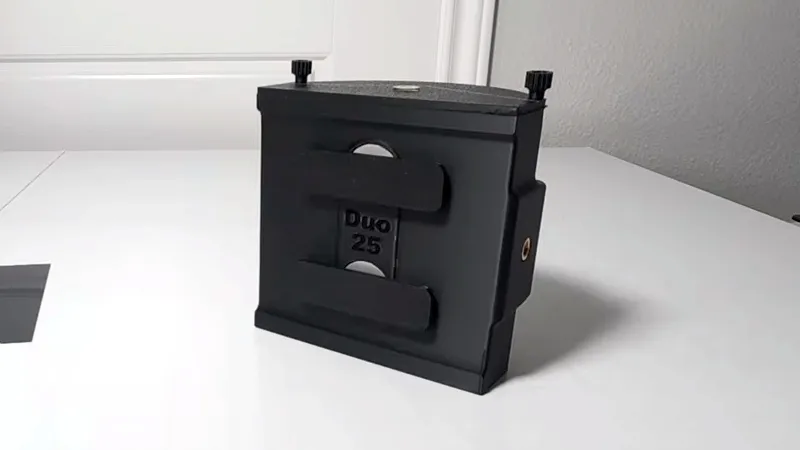
A pinhole camera is almost a rite of passage in photography, given that you can make one so easily with little more than a cardboard box and enough tape to keep the light from coming through the cracks. [Socialmocracy] has made one that’s 3D printed, and it’s a nice design that takes 4″ by 5″ photographic paper. The shutter is held on with magnets, and the lid is attached with thumbscrews.
As neat as printed pinhole cameras are, it’s not as though they’re particularly uncommon. What makes this one stand out from the rest is that it’s actually two cameras in one. One box, two cameras, side by side. Landscape format and it’s a pair of panoramic cameras, while in portrait mode it’s a stereo camera. Even the simplest of cameras can do wigglegrams!
We like this camera, because it manages to add something to such a simple formula.. He’s taking comments on whether to release the STLs, so drop in your two cents.
Are you even online in 2026 if you haven’t experienced the verbal tics of ChatGPT? It loves goblins, em dashes, and “it’s not A; it’s B” sentence constructions. But what you might not know is that the chatbot also has plenty of strange phrases it loves to say in Chinese, and they are driving Chinese users crazy.
ChatGPT does a decent job answering questions in Chinese, which is why it’s widely used in China despite being blocked by the government. But when users make a request, be it a math problem or an image-generation prompt, the chatbot loves to answer: 我会稳稳地接住你, which literally translates to “I will catch you steadily [when you fall].”
Catch … what? A more generous translation could be, “I’ll hold you steadily through whatever comes.” But to any native Chinese speaker, the expression is annoyingly affectionate and out of place. Sometimes, the model gets more effusive and says in Chinese: “I’m right here: not hiding, not withdrawing, not deflecting, not running. I’ll be steady enough to catch you.” Yes, the sound you just heard was millions of Chinese ChatGPT users rolling their eyes at the same time.
Today, this sentence is the most prominent example of many verbal tics that OpenAI’s models have exhibited when talking to people in Chinese. Another tic widely talked about on social media is how the model loves to say 砍一刀 (“Help me cut it once”), a maddeningly ubiquitous marketing slogan by PDD, a major Chinese ecommerce platform that also owns Temu.
Advertisement
The phenomenon where models latch onto a specific phrase and overuse them to the point that they feel forced is called “mode collapse,” says Max Spero, cofounder and CEO of Pangram, an AI writing detection tool. It’s usually caused by post-training where AI labs give LLMs feedback on their responses. “We don’t know how to say: ‘This is good writing, but if we do this good writing thing 10 times, then it’s no longer good writing,’” Spero says.
Becoming a Meme
The phrase “I will catch you steadily” comes up so often in ChatGPT’s responses that it has become a meme on the Chinese internet. One image depicts the chatbot as an inflatable rescue airbag, eagerly waiting to catch people as they fall.
Zeng Fanyu, a 20-year-old developer from Chongqing, China, tells WIRED the meme inspired him to develop an April Fools’ project called Jiezhu, or “catch” in Chinese. Jiezhu is an open-source-prompt engineering tool that helps chatbots understand a user’s intention. “The idea for Jiezhu was so funny that I had a lot of motivation when I was developing it,” Zeng says. When he used ChatGPT to help with coding, the chatbot once again used the phrase jiezhu in its responses, completely unprompted.
OpenAI is aware of the meme. When releasing its new image model in April, one of the sample images shared by the company actually made fun of the phenomenon. In the picture, which resembles a comic book, Boyuan Chen, a Chinese researcher at OpenAI, depicts himself looking frustrated that the new image model has once again learned to say the same phrase. “This sentence has been memed as an unnatural but funny Chinese sentence GPT likes to use on Chinese internet,” his prompt reads.
Advertisement
OpenAI didn’t immediately respond to WIRED’s request for comment.
Is It a Bad Translation?
There are two likely explanations for why ChatGPT has become obsessed with the phrase “I will catch you steadily.” The first is that it could be the result of an awkward translation.
Several people I spoke with noted the phrase has a similar meaning to “I’ve got you,” which makes sense as a catch-all response in English. But while “I’ve got you” in English reads casual and concise; “I will catch you steadily” in Chinese sounds wordy and desperate. One user also looked through their chat history to show me that the model often says jiezhu, the Chinese word for “catch,” in places where it likely meant to say “understand,” pointing to a potential misunderstanding of what jiezhu means in specific contexts.
The vivo X300 Pro was perhaps the best phone of 2025, and still is. But vivo has decided to do one better by launching the even more powerful Vivo X300 Ultra, along with the X300 FE. These two smartphones highlight the company’s strategy of covering both compact flagship users and ultra-premium buyers. Each device offers a different set of features, especially in performance and camera capabilities. Here’s what you need to know about both.
Vivo X300 FE Specifications
The Vivo X300 FE is designed for convenience. With its 7.99mm thin profile and just 191 grams, users will find it easy to carry and use daily. There are three colors from which consumers can pick their preferred choice, namely Lilac Purple, Noir Black, and Urban Olive.
The smartphone has a 6.31-inch Full HD+ AMOLED display that runs at a high refresh rate of 120Hz, ensuring fluid animations and smooth page scrolling. The smartphone ensures not only good screen performance but also efficient battery usage. Furthermore, the device uses a Snapdragon 8 Gen 5 processor along with quick memory and storage.
Battery performance is another major highlight of the Vivo X300 FE. The smartphone comes with a large 6,500mAh battery designed to last through heavy daily use. It also supports 90W wired charging and 40W wireless charging for quicker top-ups.
The company has paid great attention to photography in the X300 FE. This model is equipped with a 50MP primary camera with a Sony IMX921 image sensor, a 50MP telephoto camera with 3x optical zoom, and an 8MP ultra-wide camera. The front camera has a 50MP resolution. The manufacturer has also included additional useful camera options, such as ZEISS portrait effects, adaptive zoom flash, and a dedicated street photography setting.
Advertisement
Vivo X300 Ultra Specifications
The Vivo X300 Ultra is built with a clear focus on professional photography and premium performance. It comes in Eclipse Black and Victory Green, with a design that reflects a camera-inspired look.
The key feature of the Vivo X300 Ultra is its high-end ZEISS Master Lenses Camera. This comes with a 50MP ultra-wide-angle camera, 200MP main camera, and 200MP APO telephoto camera. Vivo has also ensured enhanced stabilization on this device, enabling users to capture sharp, detailed pictures at various zoom levels.
The Vivo X300 Ultra now supports external telephoto lens attachments, enhancing its zoom capabilities. In addition, a Photographer’s Kit will be available, including essential photography equipment and battery support. The smartphone can capture 4K videos at 120 fps with professional-grade video features.
For performance, the Vivo X300 Ultra uses the Snapdragon 8 Elite Gen 5 chipset paired with a large 6,600mAh battery. The device supports fast wired and wireless charging options. Vivo has also included a cooling system to prevent overheating during heavy use. Along with this, the phone will receive five years of OS updates and seven years of security support.
Price and Availability
In terms of pricing, Vivo has placed the X300 FE at Rs 79,999 for the 12GB + 256GB model and Rs 89,999 for the 12GB + 512GB variant. Meanwhile, the Vivo X300 Ultra has been priced at Rs 1,59,999 for the 16GB + 512GB variant. Both phones will be available starting May 14 through online and offline retailers, with pre-bookings already open.
Alongside its smartphones, Vivo has also launched optional photography accessories for users who want an enhanced camera experience. The X300 FE gets a Telephoto Extender Kit priced at Rs 15,999. Meanwhile, X300 Ultra buyers can purchase the Imaging Grip for Rs 11,999 and the advanced Telephoto Extender Gen 2 Ultra kit for Rs 27,999.
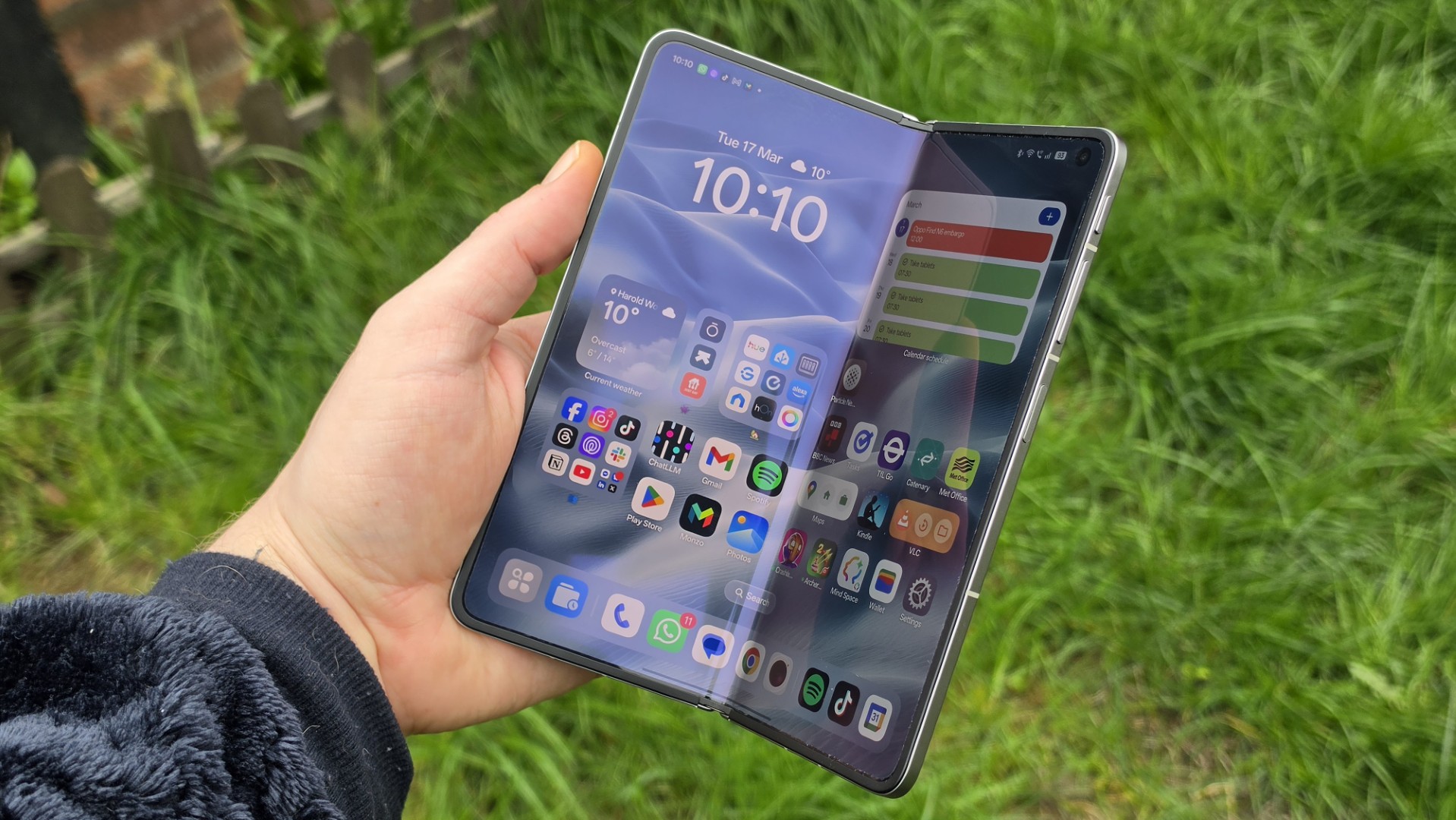
Apple’s first foldable iPhone, expected to launch as the iPhone Ultra, is shaping up to tackle one of the biggest pain points in the category: repairability.
According to a new leak, Apple is taking a surprisingly different approach to internal design that aims to make the device far easier to service than today’s foldables.
Foldable phones like the Samsung Galaxy Z Fold 7 and Google Pixel 10 Pro Fold have long struggled with cramped internals and fragile ribbon cables, making repairs complex and expensive. However, Apple’s version reportedly leans heavily toward a modular internal layout, a design that reduces complexity rather than adding to it.
The key idea is what the leak describes as a “logical yet elegant” stacking system. Instead of routing cables across the folding display area (one of the main failure points in foldables), Apple has allegedly reworked the internal layout. Now, connections run more directly through the chassis, with the motherboard reportedly positioned on the right side. Cables are routed upward to simplify disassembly and reduce strain on delicate components.
Advertisement
There are also some interesting hardware decisions tied to that approach. Leaked renders suggest Apple has moved the volume buttons to the top edge to help free up internal space and avoid cable congestion around the hinge area. It’s a small change on the surface, but one that feeds directly into the broader focus on serviceability.
Advertisement
Despite the structural rethink, the iPhone Ultra still sounds like a flagship device. It will feature a 7.8-inch inner display, a 5.5-inch cover screen, and Apple’s upcoming A20 Pro chip. The design will also accommodate what would be the largest battery ever in an iPhone, reportedly around 5,400mAh, made possible by more efficient internal stacking.
Other leaked features include Touch ID, a dedicated Camera Control button, and an eSIM-only setup. Analysts expect pricing to start near $2,000, with a launch window tipped for September alongside the iPhone 18 Pro lineup.
Advertisement
If the leak holds up, the iPhone Ultra won’t just be Apple’s first foldable; it could also be the one that finally makes the category feel less like a repair headache.
With the June 2026 deadline for implementing the EU’s Pay Transparency Directive just weeks away, many large member states are at risk of missing compliance.
Pay remains the main driver of job search decisions across Europe, yet despite this, salary information is still frequently absent from job postings, despite a years-long, EU-driven policy push to increase salary transparency, according to a recent report published by job-search platform Indeed.
Indeed’s research found that several major European markets are likely to miss targets set out by the upcoming EU Pay Transparency Directive deadline, which states that by June 2026, employers must have created an environment in which the discussion of pay is not shrouded in secrecy or otherwise restricted.
When it comes to the rate of inclusion of salary information on jobs postings, several large European economies, such as Germany (12pc) and Spain (17pc), were found to be lagging significantly, in comparison to the UK (56pc), the Netherlands (48pc) and France (43pc).
Advertisement
Italy is the only country so far to have noted a sustained rise in recent months, jumping from 22pc to 36pc. In contrast, the UK, though not directly impacted by the directive, experienced a decline, as the share of postings mentioning salary dropped from almost two-thirds to just over one-half.
In the three years since the Bill was first established, Indeed found, many major EU member states are still legislating, noting that Germany and France are unlikely to meet the June deadline and the Netherlands has pushed implementation out to 2027.
Ireland was found to be in the ‘middle of the pack’, with the new data from Indeed indicating that 39pc of Irish job postings feature salary information as of March 2026. However, concerns remain.
Recent additional research on Irish SMEs and the EU directive, published by HRLocker, found that the level of “unpreparedness is systemic”, noting that just 14pc of contributors to the research “strongly understand” the directive, leaving around 300,000 “in the dark”.
Advertisement
Commenting on the results of Indeed’s report, Lisa Feist, an economist at Indeed, said: “With most large EU member states yet to pass national legislation, many employers do not appear willing to change their job posting practices.
“Against this backdrop, the June 2026 EU deadline is less a hard trigger than a starting point for legislative processes that will play out across most member states over the coming months. Individual countries may go further than the directive and mandate upfront disclosure, but until they do so, the directive allows postings to omit pay.”
She added: “Until the introduction of a legal obligation, European employers will likely remain reluctant to adjust their job posting practices. Even then, the quality of disclosure is not guaranteed; some employers may respond by posting ranges wide enough to satisfy the letter of the law while revealing little about actual pay.”
Don’t miss out on the knowledge you need to succeed. Sign up for the Daily Brief, Silicon Republic’s digest of need-to-know sci-tech news.
Jamo’s 2026 comeback now has real products attached to the promise. Following its relaunch under Cinemaster and Rayleigh Lab, the Danish loudspeaker brand is introducing two new speaker families, Concert Legacy and Concert Element, both scheduled to arrive in August 2026 and both set to make their public premiere at High End Vienna 2026, running June 4 through June 7.
That matters because Jamo’s return was never going to survive on heritage alone. The brand still carries weight with listeners who remember when Scandinavian hi-fi meant clean design, practical engineering, and speakers that didn’t require a home equity conversation. But the market in 2026 is crowded, especially with DALI, KEF, Q Acoustics, Wharfedale, and others already fighting for the same living rooms. Concert Legacy and Concert Element are Jamo’s first real test: can the brand turn a familiar name into something relevant again, or is this just another comeback wearing nice Danish shoes?
Who Is Jamo Today? Danish Roots, New Global Muscle
Before we get to Concert Legacy and Concert Element, it is worth remembering that Jamo in 2026 is not simply being dragged out of the attic, dusted off, and told to look Scandinavian for the cameras. The revived brand is now being shaped by a team that combines Danish design heritage, European creative direction, and serious engineering and production resources from Asia.
Xiaodong Yang, CEO of Cinemaster, is central to the relaunch and brings prior experience with Jamo, which matters. This comeback needs someone who understands why the name still means something, not just someone hunting for an old badge with resale value. On the engineering and production side, Rayleigh Lab founder and CEO Thomas Li brings Shenzhen based development and manufacturing expertise, while the creative and design effort includes Kim Michel, Simon Matthews, Jamie Cobb, and Danish design agency HarritSorensen, founded by Thomas Harrit and Nicolai Sørensen.
Advertisement
That is the new Jamo equation: Danish DNA, global execution, and a brand trying to prove it can be relevant again without turning into another nostalgia act with nicer veneer. Heritage gets people to look. The speakers have to make them stay.
Jamo Concert Legacy Series
Concert Legacy is Jamo’s premium passive loudspeaker range for 2026, and the name is not accidental. This is the line designed to reconnect the revived Danish brand with one of its most respected chapters, the original Concert 8 and Concert 11 loudspeakers introduced in 1996.
The guiding idea is straightforward: what would the original Concert Series look and sound like today if Jamo had kept developing it for the past 30 years? That is a much better starting point than the usual “let’s slap an old badge on a new box and hope nobody asks questions” routine. Concert Legacy is not being pitched as a retro copy. It is Jamo trying to move the original concept forward with modern parts, updated acoustic engineering, and a stronger Scandinavian supply chain.
That Scandinavian angle matters here. Concert Legacy is made in Denmark, with drivers developed in partnership with ScanSpeak in Denmark and SEAS in Norway. Jamo also says the woofer materials use Finnish wood fibre, giving the range a genuinely Nordic engineering story rather than just a pale cabinet finish and some moody lifestyle photography.
Advertisement
The range also introduces some meaningful acoustic choices. Jamo DualCore architecture physically separates the midrange and bass chambers, which is designed to preserve midrange clarity as low frequency output increases. The speakers also use down firing bass loading, allowing for more flexible placement while keeping the cabinet design clean. In normal English: Jamo is trying to deliver bass that does not hijack the midrange and turn your living room into a badly supervised nightclub.
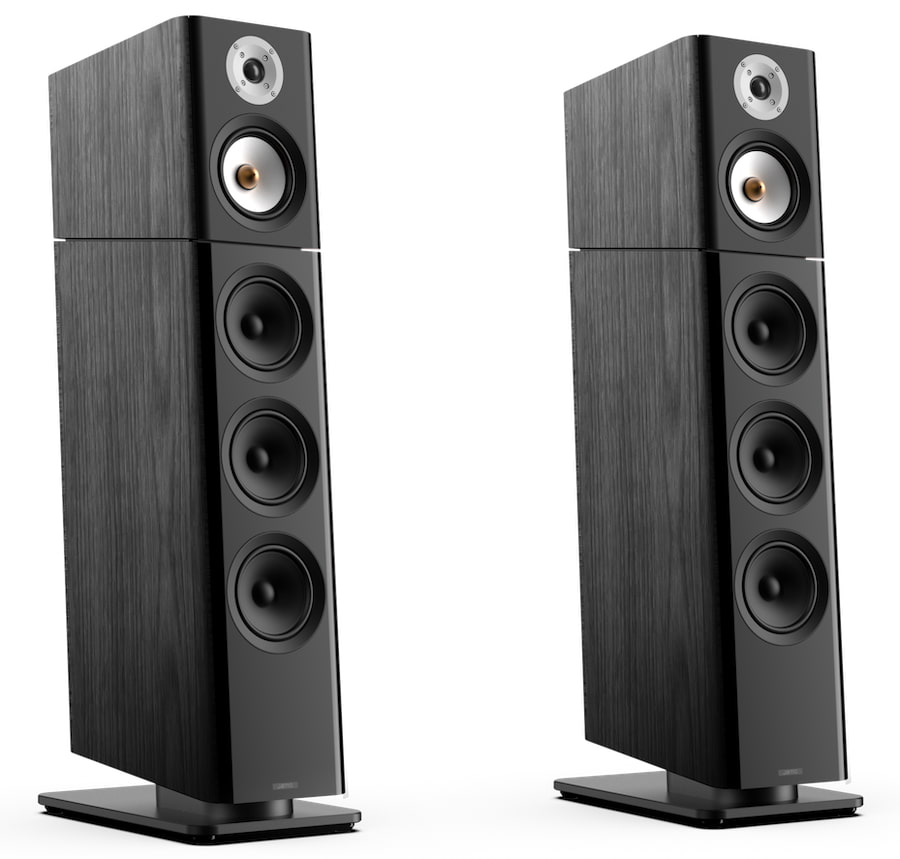
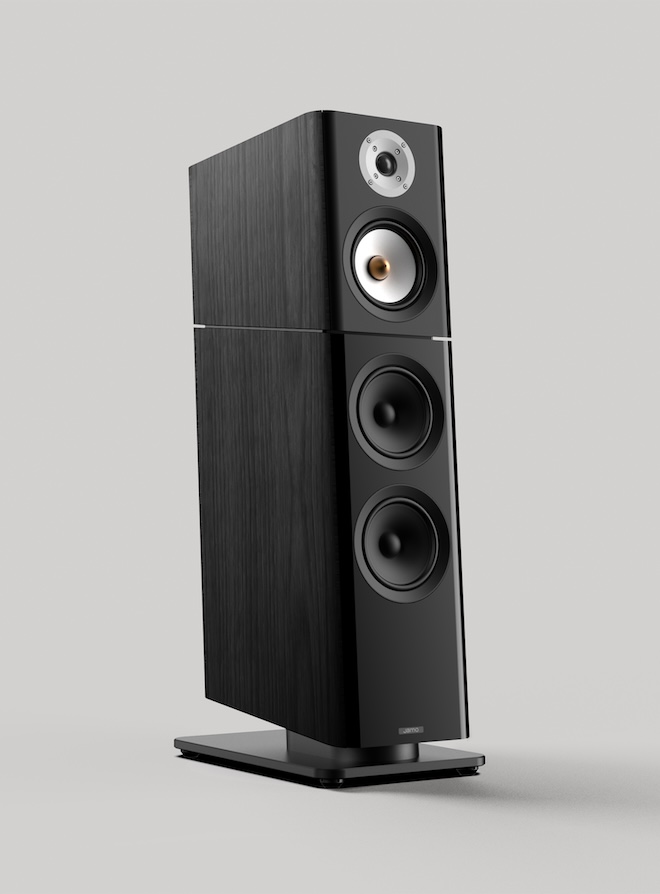
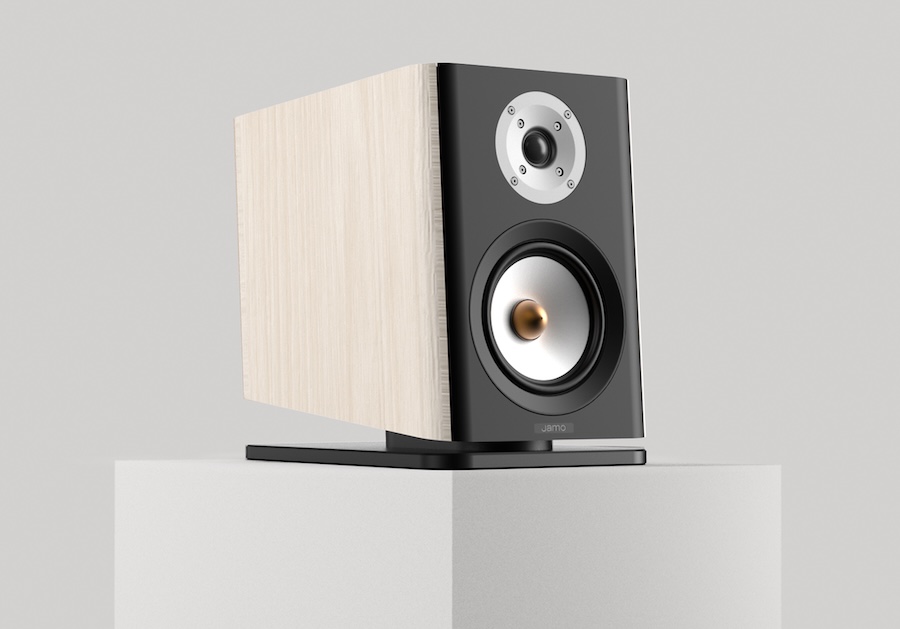
At the top of the range is the Jamo Concert Legacy 11, the flagship floorstanding model for listeners who want the most complete expression of the new series. The Concert Legacy 9 offers a more compact floorstanding option, while the Concert Legacy 8 brings the same design language and acoustic goals to a standmount format.
Pricing is per pair for all three Concert Legacy models. The Jamo Concert Legacy 11 will be available in Onyx, Heritage, and Northern Frost finishes for $7,999 per pair in the U.S. and €8,999 including tax in Europe. The Concert Legacy 9 is priced at $5,299 per pair and €5,499 including tax, while the Concert Legacy 8 comes in at $2,999 per pair and €3,299 including tax. All of the models are available in the aforementioned finishes.
Advertisement. Scroll to continue reading.
Advertisement
Jamo Concert Legacy 11
The Concert Legacy 11 is the flagship floorstanding model in the new Concert Legacy range and the most technically ambitious speaker in the family. It uses a 3-way bass reflex design with three 165 mm Scan Speak woofers, a 165 mm SEAS aluminium and magnesium midrange driver, and a 25 mm Scan Speak soft dome tweeter. Jamo’s DualCore cabinet construction isolates the midrange and tweeter section from bass pressure using a sealed upper chamber and a 75 Shore A rubber decoupling layer. With 94 dB sensitivity, a 4 ohm impedance, and a rated frequency response of 32 Hz to 21 kHz, this is the model aimed at listeners who want the full scale version of Jamo’s new Danish built Concert Legacy platform.
Drivers: 3 x 165 mm Scan Speak woofers, 1 x 165 mm SEAS midrange, 1 x 25 mm Scan Speak tweeter
Woofer material: Wood fibre cone material from Finland
Midrange material: Aluminium and magnesium cone with copper accented phase plug
Frequency response: 32 Hz to 21 kHz
Low frequency cut off: 26 Hz
Crossover points: 250 Hz and 3 kHz
Sensitivity: 94 dB
Impedance: 4 ohms
Recommended amplifier power: 50 to 250 W
Inputs: Bi-wiring terminals
Dimensions: 47.5 x 12.1 x 18.9 inches
Weight: 88.2 lbs per speaker
Included accessories: Magnetic grilles, adjustable rubber feet, terminal jumpers
Finishes: Heritage, Northern Frost, Onyx
Jamo Concert Legacy 9
The Concert Legacy 9 is the smaller floorstanding option and keeps much of the same design language and engineering approach as the Legacy 11. It uses a 3-way bass reflex configuration with two 165 mm Scan Speak woofers, a 165 mm SEAS aluminium and magnesium midrange driver, and a 25 mm Scan Speak soft dome tweeter. It also includes the DualCore enclosure, down firing port with aluminium plinth, bi-wiring terminals, and the same Heritage, Northern Frost, and Onyx finish options. Its 92 dB sensitivity and 33 Hz to 21 kHz frequency response make it the more room friendly floorstander without turning it into the “we made it smaller and hoped nobody would notice” version.
Drivers: 2 x 165 mm Scan Speak woofers, 1 x 165 mm SEAS midrange, 1 x 25 mm Scan Speak tweeter
Woofer material: Wood fibre cone material from Finland
Midrange material: Aluminium and magnesium cone with copper accented phase plug
Frequency response: 33 Hz to 21 kHz
Low frequency cut off: 27 Hz
Crossover points: 250 Hz and 3 kHz
Sensitivity: 92 dB
Impedance: 4 ohms
Recommended amplifier power: 40 to 200 W
Inputs: Bi-wiring terminals
Dimensions: 39.6 x 12.1 x 18.9 inches
Weight: 79.4 lbs per speaker
Included accessories: Magnetic grilles, adjustable rubber feet, terminal jumpers
Finishes: Heritage, Northern Frost, Onyx
Jamo Concert Legacy 8
The Concert Legacy 8 brings the Concert Legacy concept into a standmount speaker. It is a 2-way bass reflex design using a 165 mm SEAS aluminium and magnesium midwoofer and a 25 mm Scan Speak soft dome tweeter. The cabinet features real oak veneer, a 40 mm front baffle, bead blasted aluminium trim, bi-wiring terminals, and a down firing port in the plinth to reduce rear wall placement sensitivity. It is the smallest and most affordable model in the Legacy lineup, but it still uses Danish assembly and Scandinavian driver sourcing.
Drivers: 1 x 165 mm SEAS midwoofer, 1 x 25 mm Scan Speak tweeter
Midwoofer material: Aluminium and magnesium cone with copper accented phase plug
Frequency response: 34 Hz to 21 kHz
Low frequency cut off: 28 Hz
Crossover point: 3 kHz
Sensitivity: 87 dB
Impedance: 4 ohms
Recommended amplifier power: 40 to 200 W
Inputs: Bi-wiring terminals
Dimensions: 14.4 x 9.9 x 14.6 inches
Weight: 26.5 lbs per speaker
Included accessories: Magnetic grilles, terminal jumpers
Finishes: Heritage, Northern Frost, Onyx
Jamo Concert Element Series
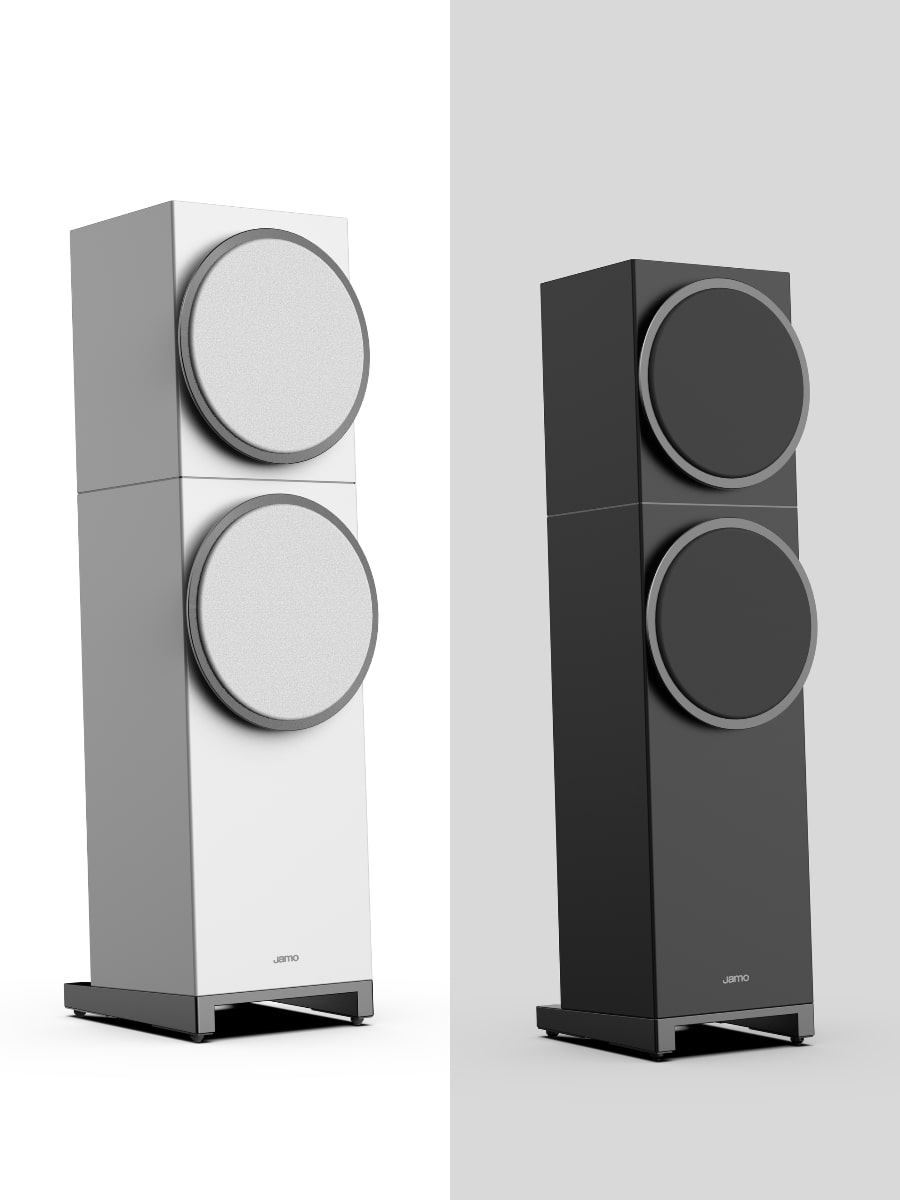
Concert Element is the more design driven half of Jamo’s 2026 Concert Series, developed with Copenhagen based HarritSørensen and built around the range’s “circle over rectangle” visual language. The circular driver module extends beyond the shallow cabinet, making the driver both the acoustic focus and the main design element. It is a cleaner, more domestic approach than the Concert Legacy range, but still uses passive loudspeaker architecture, bespoke drivers, and down firing ports across the speaker models.
The Element speakers were developed with SB Acoustics and use drivers tuned to their specific cabinet volumes. The range includes the Concert Element 50 bookshelf speaker, Concert Element 70 compact floorstander, Concert Element 90 larger floorstander, and the matching Concert Element SW10 subwoofer. Finishes are Onyx and Northern Frost, with magnetic grilles included in dark grey and light grey.
Jamo Concert Element 90
Jamo Concert Element 90 (left) and 70 (right)
The Concert Element 90 is the largest passive speaker in the Element range and uses a 3-way bass reflex design. It combines a 250 mm woofer, a 165 mm midrange driver, and a 25 mm soft dome tweeter. Both the woofer and midrange use Scandinavian nettle fibre cones, and the midrange includes a Jamo phase plug. The cabinet uses a dual chamber layout, with a ported woofer section and sealed midrange chamber, which is intended to keep bass output from affecting the midrange. The down firing port is designed to make placement less dependent on rear wall distance.
Midrange material: Scandinavian nettle fibre cone with Jamo phase plug
Tweeter: 25 mm soft positive dome
Bandwidth: 35 Hz to 22 kHz, plus or minus 3 dB
Low frequency cut off: 30 Hz at minus 6 dB
Sensitivity: 87 dB
Impedance: 4 ohms
Recommended amplifier power: 60 to 250 W
Inputs: Bi-wiring terminals
Dimensions: 43.8 x 12.6 x 14 inches
Weight: 73.2 lbs per speaker
Included accessories: Magnetic grilles in dark grey and light grey, adjustable rubber feet, terminal jumpers
Finishes: Onyx, Northern Frost
Jamo Concert Element 70
The Concert Element 70 is the smaller floorstanding speaker in the range. It uses a 3-way bass reflex design with a 200 mm woofer, 130 mm midrange driver, and 25 mm soft dome tweeter. Like the larger Element 90, the woofer and midrange use Scandinavian nettle fibre cones, while the midrange also includes a Jamo phase plug. The shallow cabinet keeps the footprint relatively compact, while the down firing port is intended to support more flexible placement in typical rooms.
Drivers: 1 x 200 mm woofer, 1 x 130 mm midrange, 1 x 25 mm tweeter
Woofer material: Scandinavian nettle fibre cone
Midrange material: Scandinavian nettle fibre cone with Jamo phase plug
Tweeter: 25 mm soft positive dome
Bandwidth: 40 Hz to 22 kHz, plus or minus 3 dB
Low frequency cut off: 35 Hz at minus 6 dB
Sensitivity: 87 dB
Impedance: 4 ohms
Recommended amplifier power: 50 to 200 W
Inputs: Bi wiring terminals
Dimensions: 40 x 10.8 x 12 inches
Weight: 41.4 lbs per speaker
Included accessories: Magnetic grilles in dark grey and light grey, adjustable rubber feet, terminal jumpers
Finishes: Onyx, Northern Frost
Jamo Concert Element 50
The Concert Element 50 is the bookshelf model and the most compact passive speaker in the Element family. Jamo describes it as a true bookshelf speaker rather than a standmount speaker, with a shallow cabinet designed to fit on actual shelves. It uses a 2-way bass reflex design with a 165 mm woofer and a 25 mm soft dome tweeter. The woofer uses a Scandinavian nettle fibre cone, 4 layer voice coil, and Jamo phase plug. The down firing port is intended to reduce placement issues when the speaker is used closer to walls or furniture.
Woofer material: Scandinavian nettle fibre cone with 4 layer voice coil and Jamo phase plug
Tweeter: 25 mm soft positive dome
Bandwidth: 45 Hz to 22 kHz, plus or minus 3 dB
Low frequency cut off: 40 Hz at minus 6 dB
Sensitivity: 89.5 dB
Impedance: 4 ohms
Recommended amplifier power: 40 to 150 W
Inputs: Single wiring terminals
Dimensions: 14.9 x 12.5 x 10.6 inches
Weight: 18.3 lbs per speaker
Included accessories: Magnetic grilles in dark grey and light grey, rubber pads
Finishes: Onyx, Northern Frost
Jamo Concert Element SW10
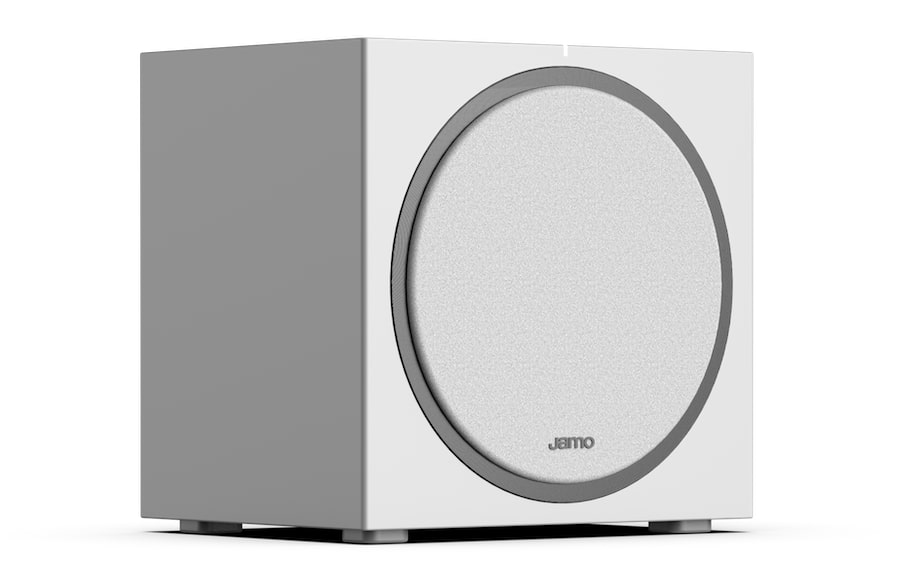
The Concert Element SW10 is the matching subwoofer for the Element range. It uses a sealed enclosure, a 250 mm long throw woofer, and Class D amplification rated at 150 W RMS and 300 W maximum. It includes a variable low pass filter from 40 Hz to 140 Hz, continuously adjustable phase from 0 to 180 degrees, and a fixed EQ boost option at 55 Hz. Inputs include dual RCA and LFE line in, with Auto and On operating modes. One important note: the product sheet lists the SW10 as an active bass reflex subwoofer in the technical specifications, while the feature section describes it as a sealed enclosure. That needs clarification from Jamo.
Specifications:
Type: subwoofer, active bass reflex
Driver: 1 x 250 mm long throw woofer
Voice coil: 4 layer voice coil
Bandwidth: 30 Hz to 250 Hz, plus or minus 3 dB
Low frequency cut off: 20 Hz at minus 6 dB
Adjustable low pass: 40 Hz to 140 Hz
Adjustable phase: Progressive 0 to 180 degrees
Adjustable EQ: 0 to plus 6 dB fixed at 55 Hz
Inputs: Dual RCA and LFE line in
Mode: Auto or On
Amplifier power: 150 W rated, 300 W maximum, Class D
Power supply: AC 100 to 120 V at 60 Hz, 220 to 240 V at 50 Hz
Standby power consumption: Less than 0.5 W
Dimensions: 14.2 x 14.4 x 11.6 inches
Weight: 26 lbs
Included accessories: Magnetic grilles in dark grey and light grey, power cord, rubber pads
Finishes: Onyx, Northern Frost
The Bottom Line
Jamo’s revived Concert Series looks like a real two lane comeback. Concert Legacy is the more traditional hi-fi play, with Danish assembly, Scan Speak and SEAS drivers, premium passive designs, and pricing aimed at listeners who still care about two-channel performance first. Concert Element is the more design-forward range, with HarritSørensen styling, shallow cabinets, SB Acoustics drivers, and pricing that should make Jamo visible again in real living rooms.
What is missing? No center channel speaker, no dedicated surround channels, and no subwoofer for the Concert Legacy lineup. The Element range does get the SW10 subwoofer, but Jamo still needs to clarify its enclosure description. On paper, this is a smarter return than another badge revival with nice veneer and better lighting. Legacy is for traditional hi-fi buyers. Element is for modern homes, apartments, and music fans who want proper speakers that do not visually mug the furniture.
Pricing & Availability
The new Jamo speaker line-up is expected to start shipping in August 2026.



























































You must be logged in to post a comment Login