Tech
Apos Launches $1,800 SJY Argos Electrostatic Headphones and $2,200 Hydra Amp for Headphones and Speakers

I have a weakness for electrostatic headphones. They are inconvenient, require specialized amplification, leak sound in both directions, and can turn a perfectly reasonable desktop system into a small electrical engineering project. And yet, when everything comes together, few headphone technologies can match their speed, transparency, imaging, and ability to uncover tiny details buried inside a recording.
Apos Audio apparently understands the attraction and some of the frustration.
The company has officially launched the SJY Argos Electrostatic Headphones alongside the Apos x ES Lab Hydra Integrated Amplifier, a rather unusual combination designed to make electrostatic headphone ownership considerably more flexible. The Argos is priced at $1,800, while the Hydra sells for $2,200; both are currently being offered at discounted pre-order prices of $1,620 and $1,980, respectively. Apos expects pre-orders to ship on or before October 15, 2026.
And while the Argos deserves attention as a new 580V Pro Bias electrostatic headphone, the Hydra might be the more interesting product.


Related Reviews:
SJY Argos: Another Electrostatic Headphone?
Not exactly.
Designed by Jeffrey Yin of SJY Audio, the open-back Argos uses a 6,375 mm² electrostatic transducer operating at the 580V Pro Bias standard, with a conventional 5-pin electrostatic connector. That means it is compatible with appropriately designed 580V Pro Bias amplifiers rather than being locked into a proprietary amplification system.


Apos is also taking a somewhat different approach to tuning. Electrostatic headphones have traditionally been celebrated for speed, transparency, treble extension, and resolution, but bass weight and impact have not always been their strongest attributes. Apos describes the Argos as having a natural, slightly warm tonal balance, with greater body in the bass and more texture through the midrange. We have not heard them yet, so consider those sonic descriptions manufacturer claims rather than conclusions from myself or Will Jennings.
The transducer uses a vented design intended to reduce pressure around the diaphragm, while the headphone itself is built around a CNC-machined aluminum chassis. The Argos weighs 431 grams without its 1.5-meter cable and 491 grams with it attached. Capacitance is rated at 130 pF including the cable.
SJY Argos Specifications
- Driver Type: Electrostatic
- Bias Voltage: 580V Pro Bias
- Driver Area: 6,375 mm²
- Capacitance: 130 pF with 1.5-meter cable
- Connector: 5-pin Pro Bias electrostatic
- Cable: 1.5 meters
- Chassis: CNC-machined aluminum
- Weight: 431 grams; 491 grams with cable
- Regular Price: $1,800 ($1,620 pre-order price at Apos Audio)
- Expected Shipping: On or before October 15, 2026
The Hydra Is Where Things Get Really Interesting

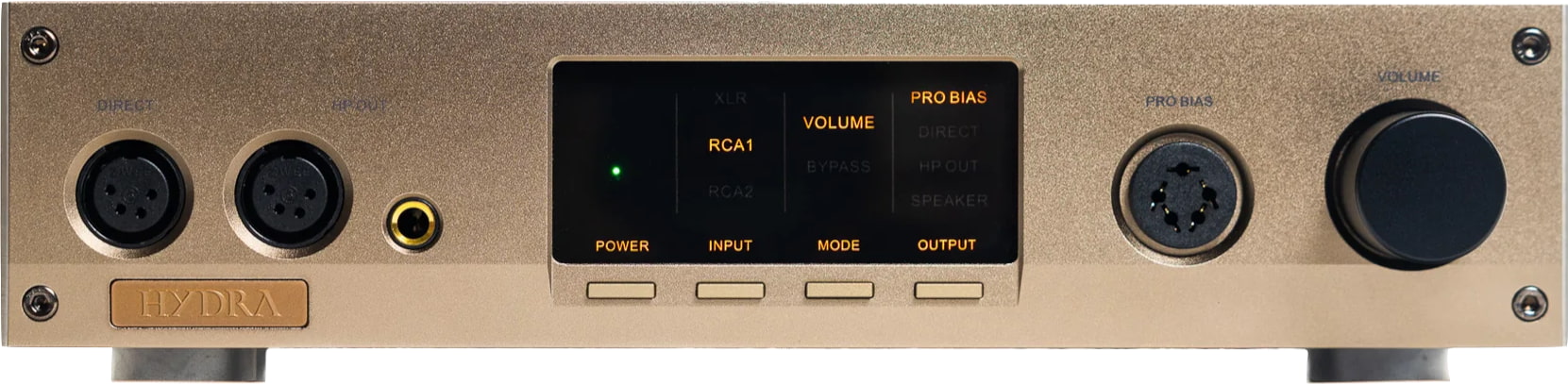

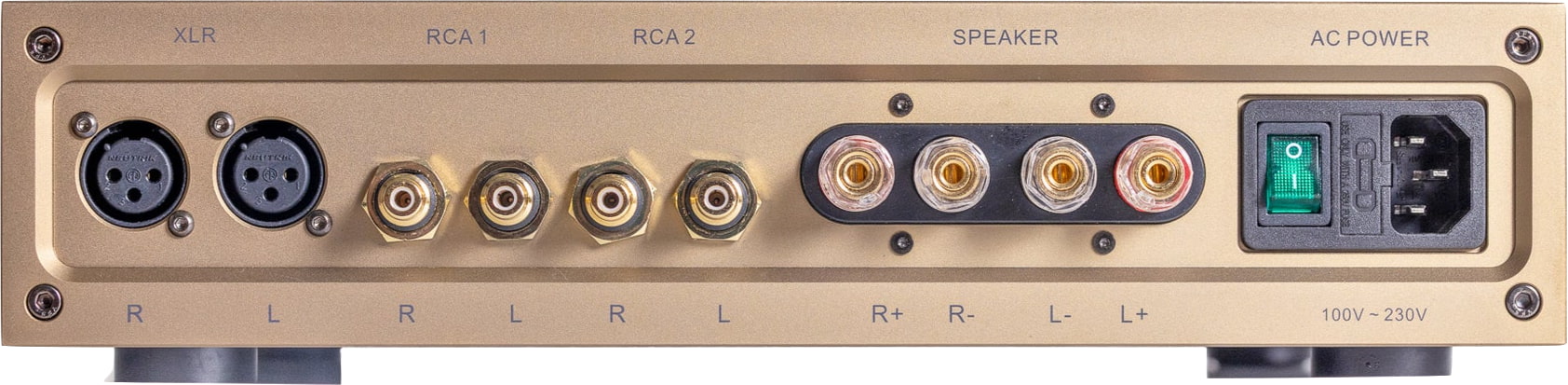
Electrostatic headphones normally require their own dedicated amplifier or energizer because a conventional headphone amplifier cannot provide the high-voltage bias required by the transducer. STAX has built an entire ecosystem around that requirement for decades.
The Apos x ES Lab Hydra takes another route.
Inside is a dedicated electrostatic drive section with a low-noise 580V DC bias generator and Japanese-made step-up transformers. But sitting alongside that is a conventional Class AB amplifier rated at 20 watts per channel into 8 ohms.
That means the same component can drive 580V Pro Bias electrostatic headphones, conventional dynamic headphones, planar magnetic headphones, and suitable passive loudspeakers.
That is not something we encounter very often.
There is also a dedicated 4-pin XLR Direct output connected directly to the power amplifier stage for demanding low-sensitivity headphones, along with an L-pad attenuator for more sensitive models. Inputs include one balanced XLR and two single-ended RCA connections, and owners can bypass the Hydra’s volume control when using a DAC or preamplifier with its own level control.
Apos x ES Lab Hydra Specifications
- Electrostatic Bias: 580V DC
- Amplifier Type: Class AB
- Power Output: 20 watts per channel into 8 ohms
- Gain: 20 dB
- Frequency Response: 10 Hz to 50 kHz at 1 watt, -3 dB
- THD+N: 0.0016% at 1 kHz, 10 watts into 8 ohms
- Input Sensitivity: 1.4V RMS
- Input Impedance: 50k ohms
- Conventional Headphone Impedance: 16 to 300 ohms
- Recommended Speaker Load: 8 ohms
- Inputs: 1 x balanced XLR, 2 x RCA
- Dimensions: 12.8 x 3.1 x 13.8 inches
- Weight: 11.2 pounds
- Regular Price: $2,200 ($1,980 pre-order at Apos Audio)
- Expected Shipping: On or before October 15, 2026
How Is This Different From STAX?


STAX remains the reference point for this category and has been building electrostatic headphones since the SR-1 arrived in 1960. We have reviewed a number of its headphones and amplifiers, including the SR-X1, SR-L700 MK2, SR-009S, and SRM-400S, and recently covered the new $2,890 SR-009D.
The important comparison here is actually the amplifier.
The $1,299 STAX SRM-400S is an excellent electrostatic driver and worked extremely well in our testing with the inexpensive SR-X1, flagship SR-009S, and even Audeze’s CRBN2. But it has one job: driving electrostatic headphones. Its RCA output is a pass-through rather than a volume-controlled preamp output, and there are no conventional headphone or loudspeaker outputs.
Hydra approaches the problem from the opposite direction.
If you own electrostatic, planar magnetic, and dynamic headphones — something that describes more than a few people in the Head-Fi community — one Hydra could potentially replace several amplifiers. Add an efficient pair of 8-ohm desktop loudspeakers and it can handle those as well.
That flexibility, rather than outright power, is the feature that makes it unusual.
And What About Audeze?


Audeze is primarily associated with planar magnetic headphones, and products such as the LCD-5s use very different driver technology and can operate from conventional headphone amplification. The company has, however, produced one of the most interesting electrostatic designs we have heard: the CRBN2.
The comparison between Argos and CRBN2 is interesting because both use the 580V Pro Bias standard, but they arrive there very differently.
Audeze’s $5,995 CRBN2 uses a proprietary carbon-nanotube-infused diaphragm and its Symmetric Linear Acoustic Modulator, or SLAM, system to improve pressure management and bass response. In our review, the CRBN2 substantially improved one of the traditional weaknesses of electrostatic headphones by delivering bass impact that could compete with some of the better planar magnetic and dynamic designs.
Argos does not use Audeze’s carbon nanotube diaphragm or SLAM technology. Instead, SJY uses a large vented electrostatic transducer and is targeting a somewhat fuller, warmer tonal presentation at less than one-third of the CRBN2’s price.
That does not mean the $1,800 Argos will perform like a $5,995 CRBN2. Nobody has done the listening required to make that claim.
But it does put another potentially interesting option into the middle of an electrostatic market that has historically jumped rather quickly from entry-level STAX models into some very expensive territory.
Who Is This For?
The Argos makes the most sense for listeners who already understand why electrostatic headphones are different and want their speed and resolution without immediately heading toward $3,000 to $6,000 headphones.
The Hydra has an even clearer audience: the enthusiast with a mixed headphone collection who is tired of having separate amplifiers for electrostatic, planar magnetic, and dynamic headphones.
If you only own one pair of electrostatics, Hydra’s $2,200 asking price may be difficult to justify against a dedicated amplifier. A STAX SR-X1 and SRM-400S combination, for example, remains considerably less expensive than purchasing Argos and Hydra together.
But somebody with electrostatics, a difficult planar design, conventional headphones, and efficient desktop loudspeakers suddenly has a very different equation.


The Bottom Line
I love electrostatic headphones for precisely the reasons that make them inconvenient. When properly driven, their speed, transparency, separation, and ability to illuminate the smallest details in a recording can be addictive.
The SJY Argos does not reinvent the basic electrostatic concept, and we need to hear it before deciding whether its promised warmer balance and fuller bass actually deliver. At $1,800, it also faces some formidable competition from STAX and sits beneath the far more ambitious Audeze CRBN2.
The Apos x ES Lab Hydra, however, is genuinely different. Instead of forcing electrostatic headphone owners into a separate amplification silo, it combines a 580V Pro Bias electrostatic stage with conventional headphone amplification and a 20-watt Class AB speaker amplifier.
Electrostatic headphones are probably never going to become the convenient option. But somebody finally decided the amplifier didn’t need to make the situation more complicated.
You must be logged in to post a comment Login