Tech
App Store ecosystem climbs to a record $1.4 trillion in 2025

AI apps led App Store growth in 2025, with the entire ecosystem garnering $1.4 trillion in payouts. Apple’s take of that is only 10%, assuming you agree with how they count.
Every year, typically right before WWDC, Apple releases a study showing how the App Store has fared over the prior year. In 2025, the App Store facilitated more than $1.4 trillion in developer billings. And, it said that the App Store ecosystem has tripled in size since 2019.
“Developers are the heartbeat of the App Store, and this year’s incredible milestone is a testament to their boundless creativity,” said Apple CEO Tim Cook.
“We are deeply committed to providing developers with the tools, technologies, and trusted platforms they need to build for the future,” Cook added. “Together, developers are creating apps that enrich the lives of users around the world.”
Commission eligible and ineligible revenue
Apple notes that for more than 90 percent of the billings and sales, Apple did not receive a commission. That means that most apps are making money outside of the App Store.
The study reports that 90% of App Store sales are commission-free. The study lists this number as $1,437 billion, or what most people, and Apple, generally call $1.4 trillion.
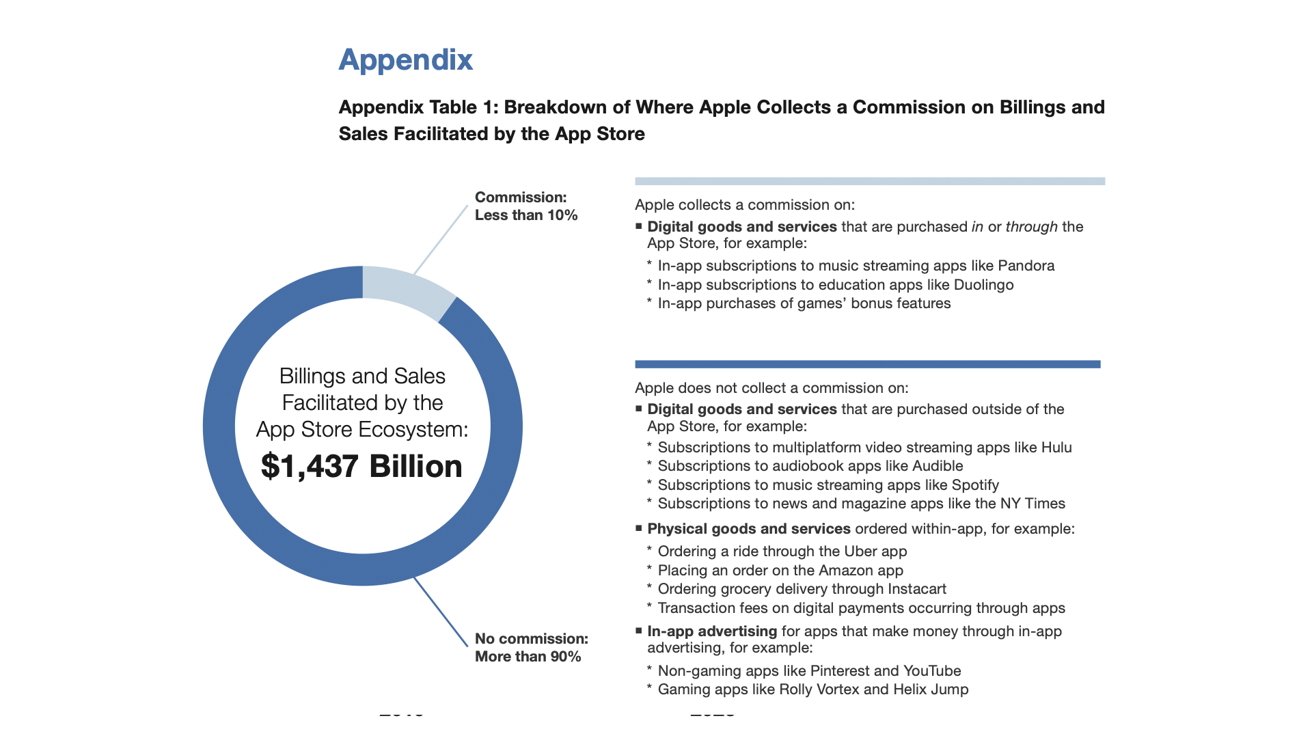
Image credit: Apple & Analysis Group
Interestingly, Apple counts digital goods and services purchased outside the App Store as sales that are not eligible for commissions, but still in the $1.4 trillion total. These include subscriptions to Hulu, Audible, Spotify, and the New York Times.
It’s hard to understand where exactly Apple fits into this. If a person purchases a subscription to, say, YouTube Premium outside of the App Store, but watches it on their Apple TV, does that count in this number?
The methodology mentioned in the study isn’t helpful, either. It reads:
“Sales and distribution of digital goods and services can occur through the App Store in the form of paid app downloads and in-app purchases, through linking out to webstores where content is consumed in-app but payments are made outside of the App Store, or through the sale of digital content and subscriptions from multi-platform apps that allow for the use and consumption of the app, both in the App Store ecosystem and elsewhere.”
It’s unclear whether the data includes purchases made after a user manually enters a website address to buy digital goods, or only purchases made through links accessed via buttons in the app.
The study also doesn’t say where it gets its data, really. A small line reads “data sources include data from Apple, app analytics companies, market research firms, and individual companies.”
So the digital goods and services section is a bit hard to parse. And it accounts for about 10.3% of Apple’s total $1.4 trillion revenue figure, or $149 billion.
Other sources of revenue include physical goods and services, such as buying items on Amazon or ordering delivery through Instacart. Lastly, it mentions in-app advertising revenue, including ads displayed on TikTok, Instagram, and in games.
AI market saturation
This year, Apple is placing special emphasis on artificial intelligence (AI), claiming that apps featuring consumer-facing AI have seen four times the growth of their non-AI counterparts. This specifically refers to the top 100 apps, of which 40 currently have some form of consumer-facing AI.
Of course, it’s hard to tell if AI was the primary growth driver or if the most popular apps were going to integrate AI regardless.
For example, 99% of Fortune 500 companies were using AI in some capacity in 2025. Customer service saw a 2199% growth increase between January 2025 and January 2026.
Global growth, by region
The App Store saw growth worldwide in 2025. And in some regions, that growth has exploded in the last several years.
According to the study, billings and sales facilitated by the App Store have more than doubled in China in the last six years. In that same time period, it’s more than tripled in the U.S. and Europe.
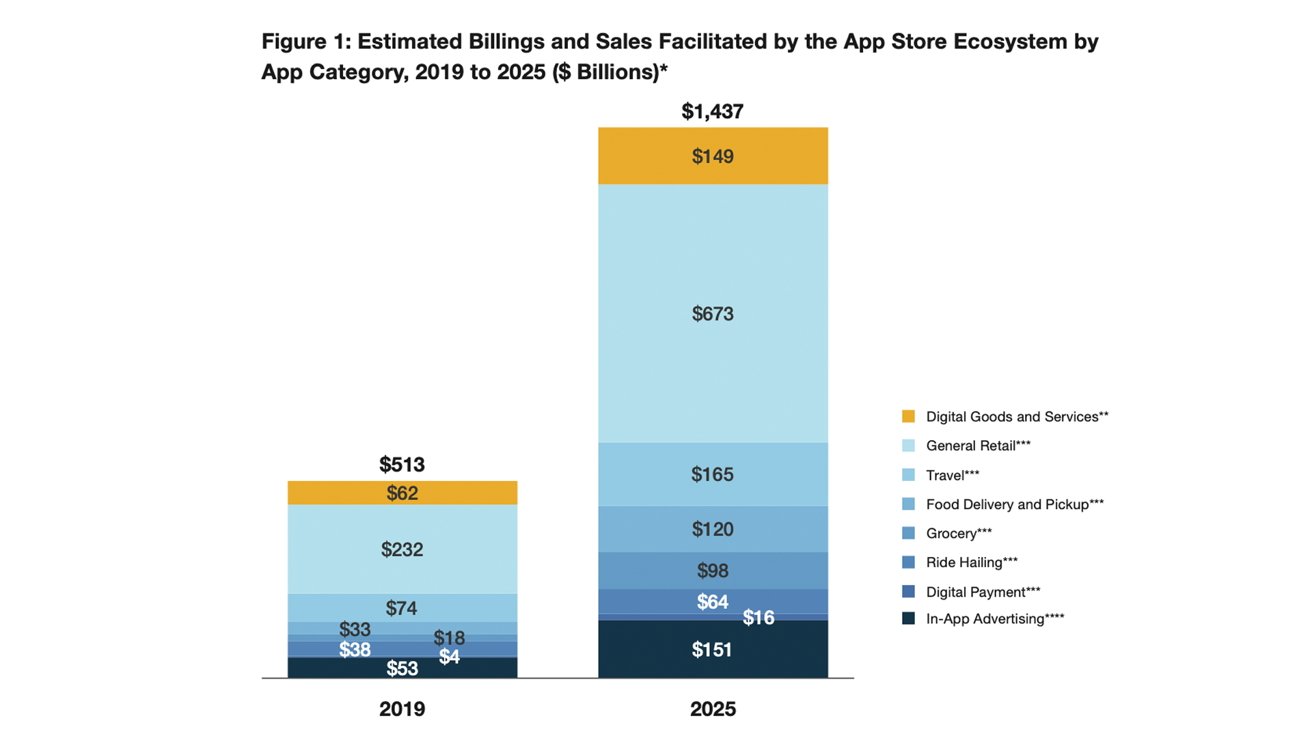
Image credit: Apple & Analysis Group
Globally, physical goods and services accounted for the majority of all sales made in the App Store.
However, sales differed a little across regions. For example, travel was the second-largest category of spending in physical goods and services in the U.S., Europe, Japan, Australia, New Zealand, and Brazil.
However, in Korea, food delivery was the second most popular. In the Chinese market, grocery and food delivery rounded out the top three slots.
Apple’s investment in developers
In 2025, Apple hosted thousands of developers at its developer centers. There are more than 20 Apple Developer Academies around the world, including Brazil, Indonesia, Italy, Saudi Arabia, South Korea, and the U.S.
Apple plans to open a Developer Center in Berlin sometime in 2026.
WWDC 2026 kicks off on June 8, allowing Apple to connect with developers and offer the first look at what tools and technologies will be available for the upcoming Apple operating system lineup.
Developers and students will have access to more than 100 new video sessions about tools, technologies, and design. They will also be invited to participate in Group Labs and join conversations in the Apple Developer Forums.
You must be logged in to post a comment Login