
Security teams log 54% of successful attacks and alert on just 14%. The rest move through your environment unseen.
The Picus whitepaper shows how breach and attack simulation tests your SIEM and EDR rules so threats stop slipping by detection.




In a nutshell: This year’s iOS, iPadOS, and macOS updates mark the beginning of Apple’s long-awaited response to the generative AI offerings from its rivals. The Cupertino-based company also used the opportunity to address growing concerns about child safety on mobile devices, refine its controversial Liquid Glass design language, and introduce performance improvements across its platforms.
Early testing is now available for iOS 27, iPadOS 27, macOS 27, watchOS 27, and visionOS 27. The updates, which bring generative AI features to Apple devices and strengthen child-safety controls, will enter public beta testing next month before launching this fall.

All supported Apple devices receive a revamped Siri experience that serves as the centerpiece of the company’s new generative AI platform. Siri can describe what it sees on screen, locate photos based on user descriptions, search the web for information, draft documents, and perform tasks across multiple apps.
Conversations are encrypted and stored in iCloud, allowing users to seamlessly continue interactions across Apple devices. However, it remains unclear how Apple has addressed the hallucination issues commonly associated with generative AI systems.

Apple Intelligence can also edit photos, generate images, surface relevant information during calls, organize email, create AI-generated shortcuts, and quickly update saved passwords. However, certain cloud-dependent features will be subject to daily usage limits, which users can remove with an iCloud+ subscription.

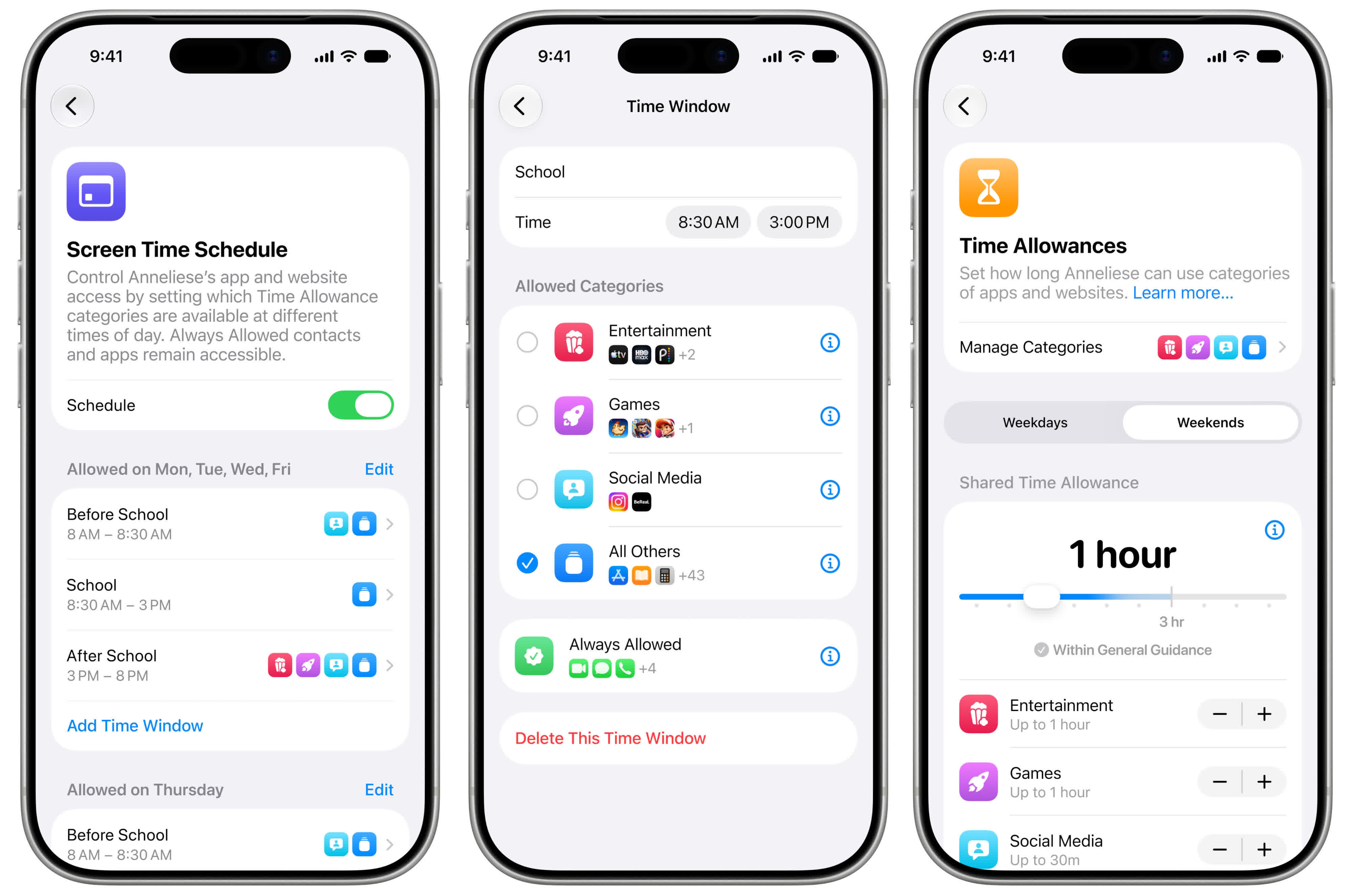
New child account controls give parents greater oversight of the apps, websites, and other content their children can access. Parents can also manage screen time and monitor purchases through a more intuitive interface.
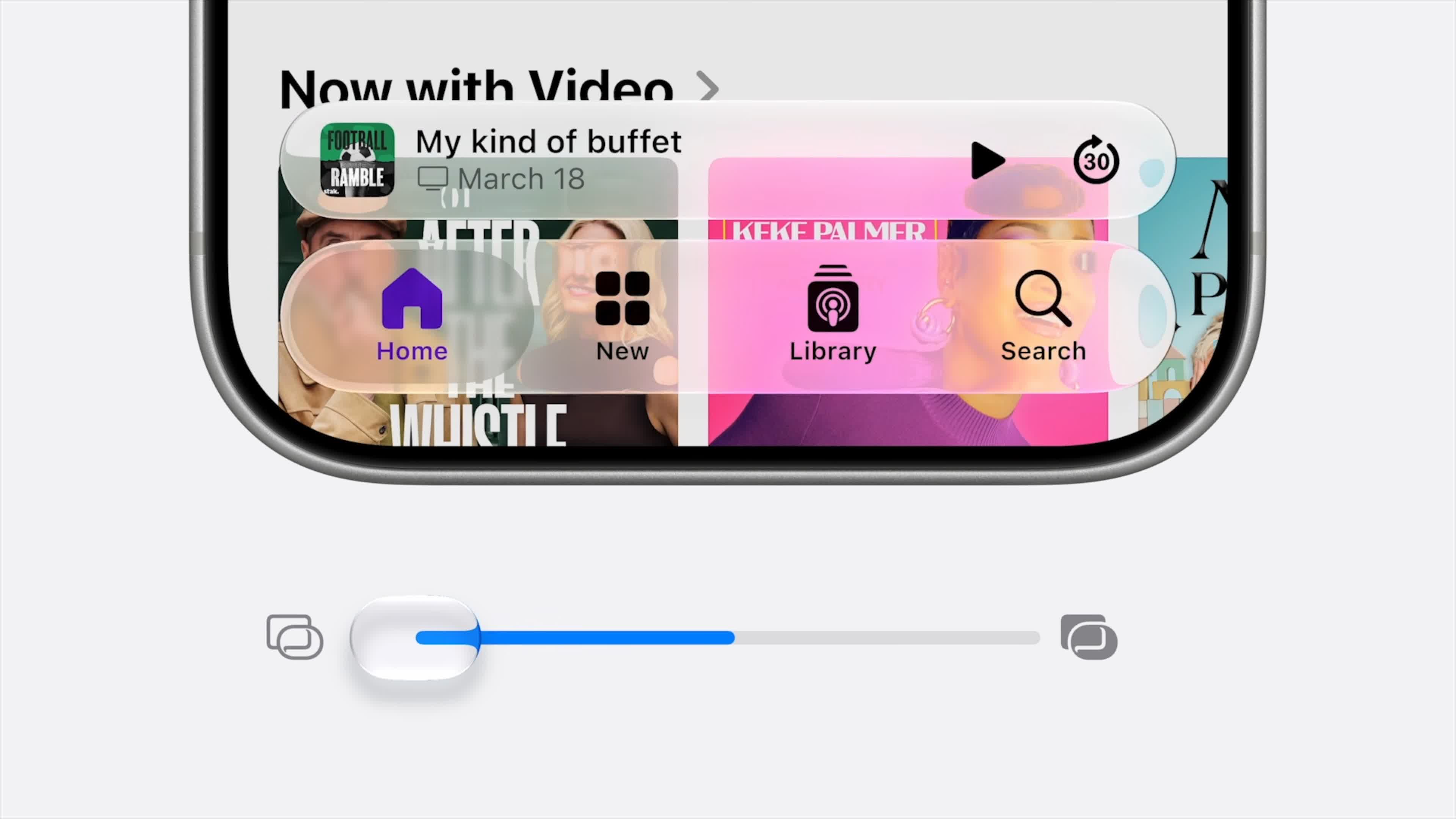
Following criticism of the Liquid Glass design language introduced last year, Apple is adding an opacity slider that allows users to adjust transparency levels for improved readability.
The company has also promised performance improvements across its platforms. According to Apple, apps will launch up to 30% faster, new photos will save up to 70% faster, and AirDrop transfers will be up to 80% faster.
Furthermore, iOS 27 and iPadOS 27 can switch between Wi-Fi and cellular networks more quickly and seamlessly, helping users stay connected while traveling. Additionally, an optimized CPU scheduler improves performance through a new approach to task prioritization, particularly on older devices.
Alongside these changes, macOS 27 adds improved support for ultrawide displays at resolutions of up to 5K and refresh rates of up to 120Hz. Mac users can also switch seamlessly between audio and video podcasts. Meanwhile, AirPods gain custom equalization settings, while watchOS 27 introduces custom Wallet passes that support any membership QR code or barcode.
iOS 27 supports the iPhone 11 and newer models, maintaining compatibility with every device that supported iOS 26.
Marking the end of support for Intel-based Macs, macOS 27 is compatible with MacBook Air and MacBook Pro models from 2020 or later, the 2021 iMac and newer, the 2020 Mac mini and newer, the 2022 Mac Studio and newer, and the 2023 Mac Pro.
iPadOS 27 supports the M4 iPad Pro and newer models, the 12.9-inch iPad Pro (4th generation and later), the 11-inch iPad Pro (2nd generation and later), the 13-inch and 11-inch iPad Air models powered by M2 chips or newer, the iPad Air (4th generation and later), the A16-powered iPad, the standard iPad (9th generation and later), and the iPad mini (6th generation and later), including the A17 Pro model.
This year’s Apple Watch update supports the Apple Watch SE 3, Series 10, Series 11, Ultra 2, and Ultra 3.
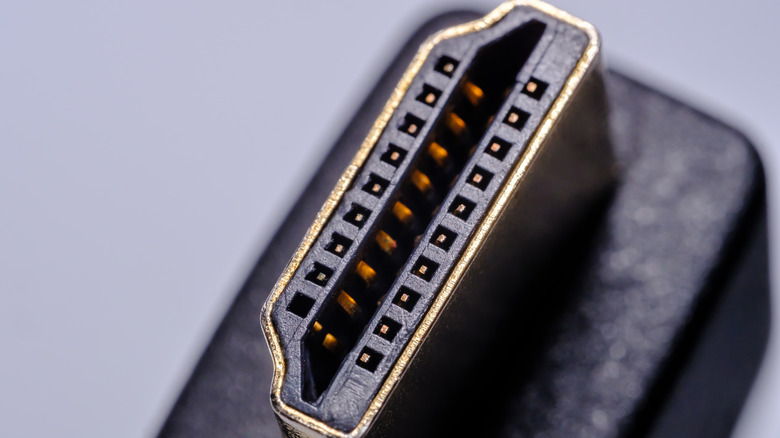
Since its introduction over two decades ago, HDMI has slowly but surely replaced the old video cables such as VGA. Eventually, it became an industry standard, and basically any TV, monitor, gaming console, and media player now uses HDMI as its primary connection port. Even if you don’t know what HDMI stands for, you likely know its use — to send high-definition video signals to a screen. However, last year, a new challenger arrived that could give HDMI a run for its money.
Bearing a similar name, GPMI (General Purpose Media Interface) was introduced by Shenzhen 8K UHD Video Industry Cooperation Alliance. The group is a consortium of over 50 Chinese companies, including well-known TV manufacturers like Hisense and TCL. The most impressive thing about GPMI is probably the fact that it’s designed to handle everything at once, meaning you get video, audio, data, control signals, and power with just one cable. And, as you likely know, eliminating cable clutter and management is always a good thing.
Fewer cables isn’t the only notable feature, since GPMI has some pretty good specs. For starters, it has noticeably more bandwidth than HDMI 2.0 and can offer higher bandwidth than HDMI 2.2. GPMI comes in two different formats: one uses the familiar USB-C standard (which delivers 96 Gbps and 240 watts of power), and the other uses a special Type-B cable designed just for this system. The Type-B cable steps things up, as it provides 192 Gbps and 480 watts. For comparison, HDMI 2.2 can deliver up to a maximum of 96 Gbps of bandwidth, which only matches GPMI’s USB-C connector.
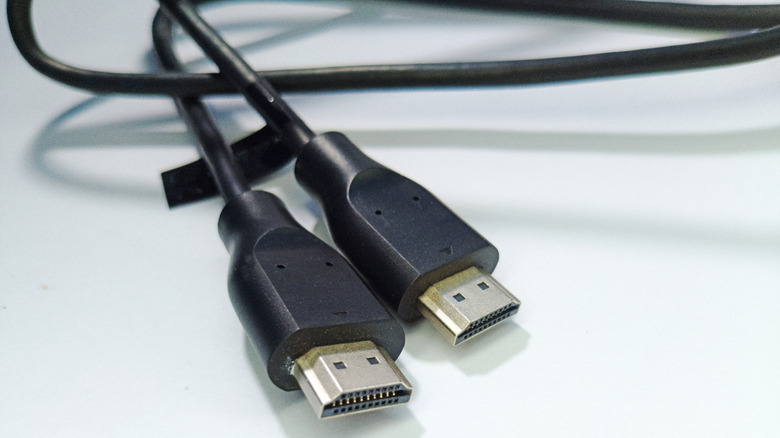
Similarly to GPMI, HDMI 2.2 was released last year as the latest and best HDMI to date. From a technical viewpoint, the GPMI obviously has better specs, with the all-in-one cable being a big quality-of-life improvement. But HDMI is a better-known technology that numerous companies use. Due to this, new TVs in the coming years, maybe even 2027, will have an HDMI 2.2 port, which is a luxury GPMI doesn’t have.
Naturally, we’re talking about GPMI use outside of China. Considering the massive number of Chinese companies behind the new standard, it’s reasonable to expect it becoming prevalent throughout the country in the near future. Elsewhere, though, it would take massive support from other companies and manufacturers to adopt it across the industry. This isn’t just for TVs either, since other items (like graphics cards and gaming consoles) would need to support GPMI inclusion. While Chinese companies might be in favor of adoption, it’s hard to say whether Western ones will follow suit.
Still, GPMI did put China on the map when it comes to connectivity standards, since that part of the industry has long been dominated by the West. It will be interesting to see how things will go from here, now that there’s one more contender. As it stands now, we’ll likely continue to use HDMI (despite several reasons why you might want to stop) for quite some time in our households.
Apple is being sued for alleged negligence regarding its App Store security measures. In a lawsuit filed on Friday in the U.S. District Court of Northern California, three plaintiffs claim they were tricked into downloading and installing a fraudulent crypto wallet app, leading them to collectively lose more than $1.8 million.
The lawsuit centers on Apple’s claim that it secures its App Store by reviewing apps before they go live to protect users from fraudulent and malicious apps. In this case, the plaintiffs downloaded an app called Sparrow Wallet, even though the official Sparrow Bitcoin wallet is not available on iOS.
The plaintiffs transferred their Bitcoin to the fraudulent app, losing large amounts of the virtual currency, according to the complaint. Plaintiff James Ramirez lost about $875,000; plaintiff Christopher Ellis lost around $840,000, and plaintiff Jalen Delgado lost roughly $120,000.
The complaint targets one of Apple’s longtime competitive arguments: that its tight control over its App Store makes its platform safer than those offered by its rivals. The company has used this claim to push back against deregulation of the app ecosystem, including third-party app stores and sideloading.
“As part of a sustained marketing campaign, Apple has positioned itself, its products and services, as offering a level of security and trustworthiness superior to any competing technology company,” the new filing states. “This includes assurances about the safety of applications distributed through its App Store. By retaining exclusive control over which apps are permitted on Apple devices, Apple has structured its platform to ensure that consumers depend entirely on its promise of safety and reliability,” it reads.
The complaint also accuses Apple of knowingly hosting fraudulent apps, pointing to public criticism by Sparrow Bitcoin Wallet’s creator, Craig Raw, who said Apple had allowed fake Sparrow Wallet apps to remain on the App Store.
The three are asking for a trial by jury and seek to recoup their lost money and other damages. They also want Apple to provide warnings and disclosures about the App Store’s risks.
Apple declined to comment on the lawsuit. The company did stand behind its security measures, telling TechCrunch that apps impersonating others are a violation of its guidelines and it takes swift action to remove them. Apple added that there are currently no Sparrow Wallet copycats on the App Store.
The company also pointed to its latest analysis of its ecosystem, which found that in 2025 it rejected more than 371,000 submissions that copied other apps, were spam, or otherwise misled users.
When you purchase through links in our articles, we may earn a small commission. This doesn’t affect our editorial independence.


Your GPU dashboard says 70% utilization. On paper, the cluster is busy. In practice, a large chunk of that time is spent with your $40,000 accelerators sitting idle, waiting on a file that lives three network hops away on a NAS box. The compute queue is empty, and the pipeline is fine. The problem is that data is just somewhere else.
This is the awkward truth underneath most stalled AI projects. The constraint in modern AI infrastructure stopped being storage capacity years ago. Now, it’s more about data placement and access. What matters is where files live and how they get to GPUs, along with how much copying happens in between. In that sense, AI infrastructure has become less of a storage capacity problem and more of an operational data problem. The Hammerspace Data Platform takes that as its starting point. It sits between your compute and the storage you already own, from NAS to object stores and even the NVMe drives bolted into your GPU servers. It makes all of that data addressable through a single global namespace. Instead of moving data to wherever the GPUs are, the architecture makes the compute aware of where the data already lives.
As a result, rather than treating each storage system as its own operational silo, Hammerspace separates the data layer from the underlying infrastructure, allowing heterogeneous storage, sites, and clouds to operate as part of the same coordinated data environment. Applications and AI pipelines access that data through standard protocols such as NFS, SMB, and S3, without proprietary clients or application rewrites.
Data fragmentation is a big problem for enterprises embarking on an AI journey. Training sets are scattered across departments, sites and clouds.
“The data is in disparate groups and disparate orgs and disparate silos within a company,” says Jonathan Flynn, director of applied systems at Hammerspace. “Having the data in a curated data set for you just to go train is rare. It has to be collected. It has to be moved around from system to system, and then the curation needs to happen in order to actually do the training on it.”
The fragmentation often leaves pipelines copying and staging files between systems that were never designed to talk to each other. None of this shows up on a storage IOPS chart, but it will visibly affect training velocity.
According to Gartner, 57% of organizations believe that their data isn’t AI ready. Alarmingly, two thirds of executives believe that no one in their organization understands all of the data they’ve collected and how to access it. That seems hard to swallow, until you recall that Facebook’s engineers have admitted the same thing. You can’t orchestrate what you can’t see.
Mike Bloom, who covers AR architecture at Hammerspace, says the default vendor response makes the problem worse. “They’ll go to a vendor that will promise them that if they sweep the floor and throw out all of their legacy storage arrays, their brand will solve the problem,” he says, adding that’s like throwing the baby out with the bath water. “Those data sets that are all over the place? They’re not sitting in a corner. They’re sitting on legacy storage arrays.”
There is also a less obvious idle resource in most AI environments: the NVMe inside the GPU servers themselves. A modern HGX or DGX box ships with eight to sixteen NVMe drives, each hanging off four lanes of PCIe. Almost every orchestration layer treats that capacity as local scratch space, used by one server and invisible to the rest of the cluster.
Hammerspace calls this “stranded” capacity, and it is now meaningful. It amounts to hundreds of terabytes per server, with two-petabyte GPU servers on the roadmap. Pull all of it into a shared namespace and you have a new layer that Hammerspace calls Tier 0. It uses storage you already paid for, attached to a network you already deployed.
Flynn argues this layer is structurally faster than anything sold as a separate appliance.
“Tier one is typically oriented around storage capacity. A 2U box, 24 NVMe, or 40 NVMe with some of the Dell systems in there,” he calculates. “That’s 96 lanes or 192 lanes of PCI Express, with maybe one or two 400 gigabit NICs, which gives you 16 or 32 lanes. So the over subscription just in the one box is massive.”
His more provocative claim is that it is also the cheapest tier in the rack. The compute and the network are already there. The drives (at least in the case of customers buying GPU servers) are already in the bill of materials. Compared with racking and stacking a dedicated all-flash array, adding metadata servers and a few data movers to existing GPU nodes barely registers as a procurement event.
Ripping and replacing infrastructure takes time most teams don’t have. The Hammerspace approach is assimilation, which the company describes as a metadata-only operation: scan the existing NAS, ingest the directory tree into the global namespace, and redirect mounts. The bytes never move.
Hammerspace says that fast deployment is a key benefit of this approach. Data access is restored almost immediately, even while assimilation continues in the background.
Underneath this, the source-of-truth NetApp, Qumulo or VAST array keeps serving the bytes, while Hammerspace presents a unified view on top. That has practical consequences.
If something tagged as a training input changes from being a tier-two archive file to a hot input, a policy (Hammerspace calls this an “objective”) can trigger an instance copy onto tier 0 without users having to do anything. “Nobody’s running a copy. Nobody’s running an rsync command,” Flynn says. “It’s all orchestrated based in the file system.”
That same orchestration layer can also support retrieval-augmented generation (RAG), inference, and agentic AI workflows, where distributed enterprise data needs to be continuously curated, governed, and made accessible without relying on large-scale data copying.
Once the training job finishes, that tier 0 copy is automatically vacated. The clean-up matters because the alternative (letting a hot tier fill up) creates a quality-of-service problem for everything else trying to land there.
“Other architectures that have a hot tier and a cold tier often have an issue where the hot tier becomes congested and that endangers the quality of service for the pipeline,” Bloom says. “Rather than requiring organizations to rebuild infrastructure around AI, the Hammerspace approach is designed to operationalize the storage, cloud, and compute environments enterprises already have in place.
Hammerspace’s positioning leans heavily on the word “standard”. The Samsung-Hammerspace submission that landed inside the top 10 of the IO500 10-Node Production benchmark in November 2025 used standard Linux, the upstream NFSv4.2 client, standard NVMe SSDs and IP-over-InfiniBand. There was no proprietary client, and no custom kernel modules. The company submitted its own results to MLPerf Storage v2.0 showing linear scaling out to 420.8 GB/s across 140 GPUs on five nodes with GPU utilisation above 96%.
That kind of performance is not achievable with traditional NFS architectures, which struggle with the parallel access patterns common in large-scale AI environments. Instead, Hammerspace runs on parallel NFS (pNFS). Instead of letting a single server handle file metadata transfer alongside data transfer, it creates a layout map that the client can then use to transfer data from multiple servers in parallel. That became the RFC 5661 standard in 2010. Hammerspace was also instrumental in extending pNFS in NFSv4.2 in 2018, introducing the Flex Files extension. This is what lets pNFS work with real-world hetergeneous storage across cloud tiers, legacy files, and multi-site deployments.
The larger implication is that open, standards-based infrastructure is no longer inherently at odds with AI-scale performance, challenging the assumption that enterprises must adopt proprietary storage stacks to support large-scale AI workloads.
“With the performance improvements that we contribute into the upstream, we’re actually seeing a decades-old file system transmute into a parallel access system that can rival WEKA, Lustre, and GPFS,” Flynn says.
Once a single global namespace spans on-prem arrays, cloud object stores and the NVMe inside GPU boxes, the next questions are jurisdictional. Where can a given file legally live? Who is allowed to copy it? The platform handles this through the same objectives mechanism used for performance tiering. Tag a dataset as EU-only and the orchestration layer will exclude it from North American volumes. Tag it as HIPAA-bound and write-once-read-many rules apply.
Because those policies operate at the data layer rather than within individual storage silos, governance persists even as data moves across clouds, sites, and performance tiers. That is becoming increasingly important as AI pipelines, inference workflows, and agentic systems operate across distributed infrastructure rather than within a single environment.
That matters more in 2026 than it did two years ago, since such operational flexibility also changes the economics of AI infrastructure expansion. The SSD supply situation has tightened. NAND and DRAM prices climbed through 2024 and into 2025, driven by AI build-out and hyperscaler hoarding. Buying your way out of a data-movement problem by adding another all-flash array is harder when the flash is harder to get. A control plane that understands workload, location and policy together is now a valuable procurement workaround.
The most useful data point about whether any of this matters at scale is Meta. The company runs two 24,576-GPU clusters used to train Llama 3 and deploys Hammerspace specifically to enable live job debugging and real-time code propagation across the training pipelines.
If a company with effectively unlimited engineering resources still hits a data-movement ceiling at that scale, the enterprises running a fraction of the workload are almost certainly hitting it too, and the standard answer of “buy more GPU” does not address a problem one layer below the compute plane.
Flynn put the underlying joke about NFS politely. “The joke I always heard was, NFS is not for speed.” That used to be true. The newer claim, that an open, standards-based file system can sit underneath an AI factory and feed it, casts the venerable file protocol in a new light.
ICustomers will likely want to see an independent benchmark of this system’s performance against the likes of VAST, WekaIO and NetApp in heterogeneous customer environments, using test systems not designed by the vendor. Nevertheless, it looks promising. In the meantime, the data placement architecture conversation is certainly the right one to be having.
Sponsored by Hammerspace.
OFFBEAT
Is there a simulator for the wail when you realize your precious one-off bootleg has just been chewed up?
If you have wistful longings for the days when your songs carried the subtle hiss of the cassettes you listened to, we have some reel good news. A new project takes modern music back to the analog era.
The project, available on GitHub, is called “Audio Cassette Simulation” and uses FFmpeg to transcode audio files to get that “wish I’d bought some decent tapes instead of the superstore’s own-brand” sound.
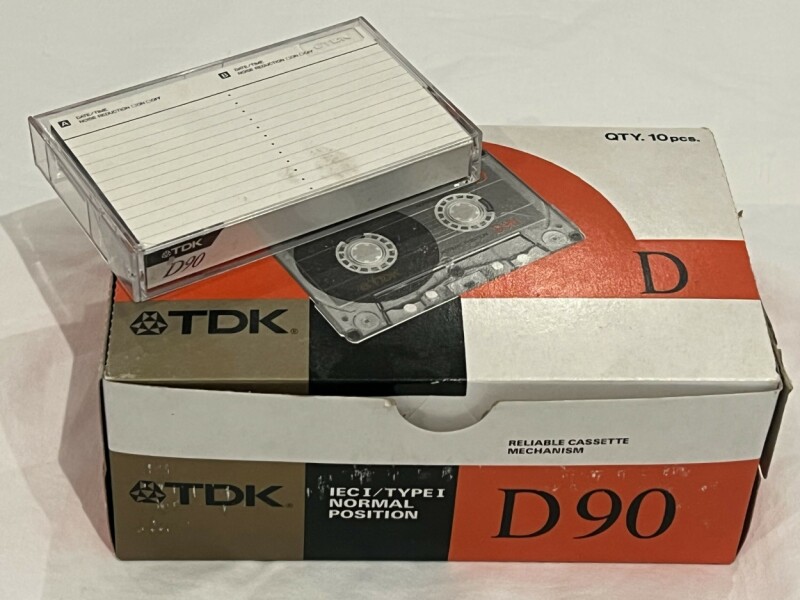
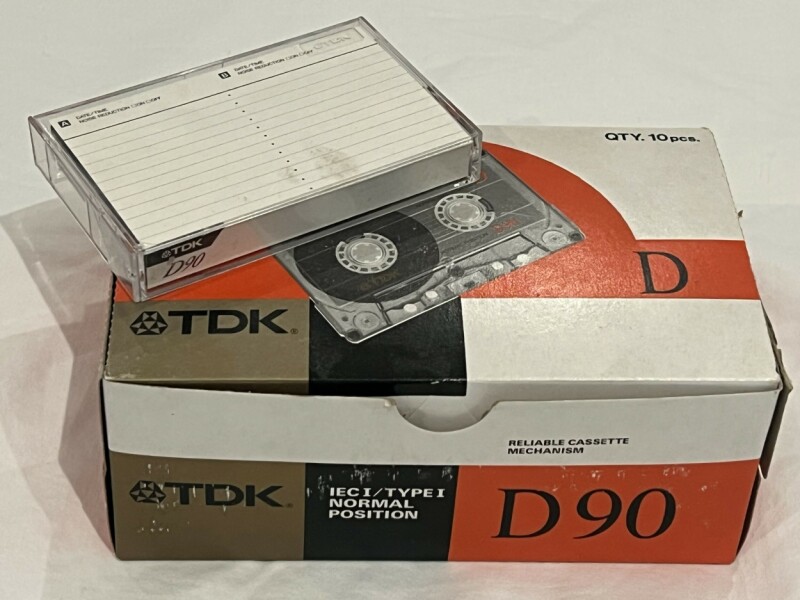
The repository includes simulations of BASF LH Extra C90, Maxell UD C90, Sony CHF60 Type I Normal, Sony CHF90, TDK D90, and even Soviet MK-60 tape. Navigate to the appropriate cassette folder using bash, then run the conversion code (or use it to convert a live stream).
The output is dumped into a ./out folder for a bit of retro enjoyment.
According to the README, “This project simulates cassette tape audio profiles using ffmpeg.
“It applies tape noise, wow and flutter pitch modulation, bandwidth limits, and equalizer adjustments.”
There’s no special magic going on behind the scenes – a glance at the .sh files shows that the real effort has gone into working out the FFmpeg filters to recreate the effect of the required tape. Audiophiles might be horrified to see the output being saved as .mp3 files, but let’s face it: if you’re after that compact cassette sound, the potential audiophile downsides of .mp3 probably won’t be too high on the list of worries.
Compact cassettes first appeared in the 1960s and stored magnetic tape wound between two reels inside a plastic shell. The tape would be unwound from the first reel and wound onto a second reel during use, with the whole thing enclosed in a case (hence “cassette”). Data could be stored on it (indeed, we’re sure plenty of readers have fond memories of home computers that used the media for software) as well as audio, which brings us to the simulator.
Different brands of cassettes (and hardware) could impart differing levels of distortion and hiss to the audio, giving it a unique sound. As with vinyl, cassette sales dropped as customers turned to digital formats decades ago but, also like vinyl, the medium has enjoyed a resurgence in recent years.
The simulator is therefore a bit of a quarter-way house. It can’t recreate the feel of a cassette in the user’s hands. Nor can it replicate the heart-stopping noise of tape being chewed up in a misbehaving mechanism.
But it can take some tediously pristine modern audio and make it sound like it’s the 1980s all over again. ®
We may receive a commission on purchases made from links.
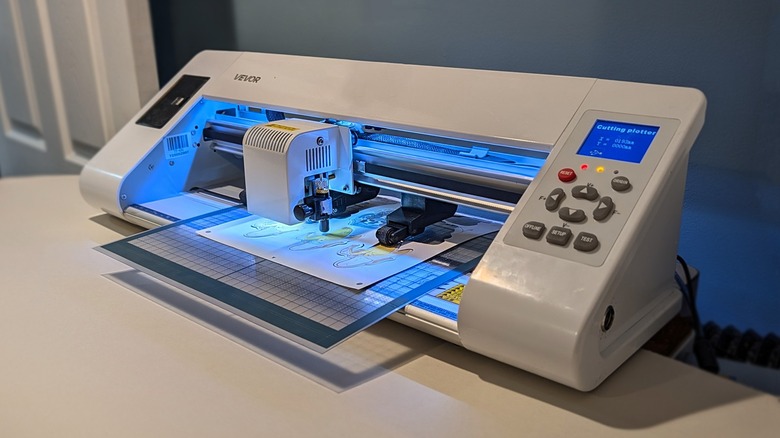
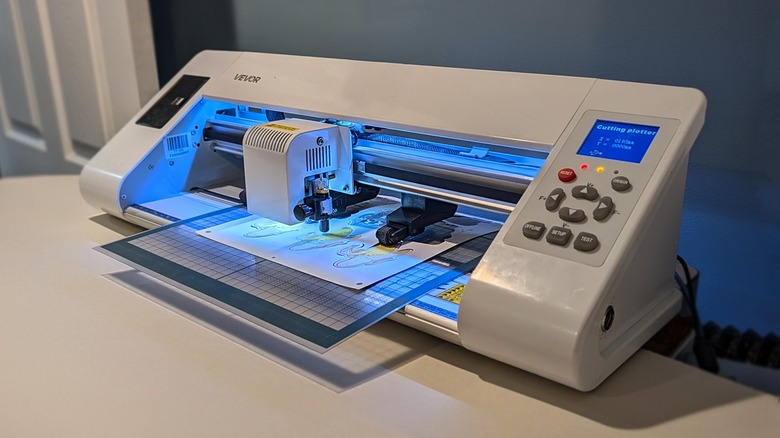
The Vevor TT-450 and its bundled SignMaster Craft software are not the most intuitive pieces of tech I’ve ever handled. Compared to the relatively simple systems delivered with some of the bigger (more expensive) names in DIY tech here in 2026, this vinyl cutter’s software and hardware feel like they were designed in the distant past. It feels clear that Vevor’s strength is not in start-to-finish “made for any skill level” user experience.
Instead, what we’ve got here is a piece of powerful hardware that does what it needs to do — so long as you can figure out how to tell it what needs to be done. If you’ve only ever used creative/DIY/maker devices from Glowforge, xTool, Silhouette, or Cricut, and you had trouble getting the hang of them, you’re going to want to throw your computer through a window before you figure out what you’re doing with Vevor’s software of choice. You want simple solutions? Get a pair of scissors and a label printer.
But don’t let that scare you! This device is not quite as simple to use as some of the other creative-aimed brands because of its lack of guardrails for the end user. This system allows plentiful granular control. This system’s hardware capabilities create a value that far outweighs the price (once you’ve gotten past the software’s not-insignificant learning curve).
The Vevor TT-450 is one of a collection of vinyl cutters available from the brand’s own-named store. This model has 14 inches of cutting space (and 18 inches of paper feed space) — and a roller system with no max dimension for paper — assuming you’ve got an endless roll to work with. This cutting machine is made to cut paper-thin materials using a metal blade. You want to cut thicker materials, you might want to consider a tiny laser cutter.
 Chris Burns/SlashGear
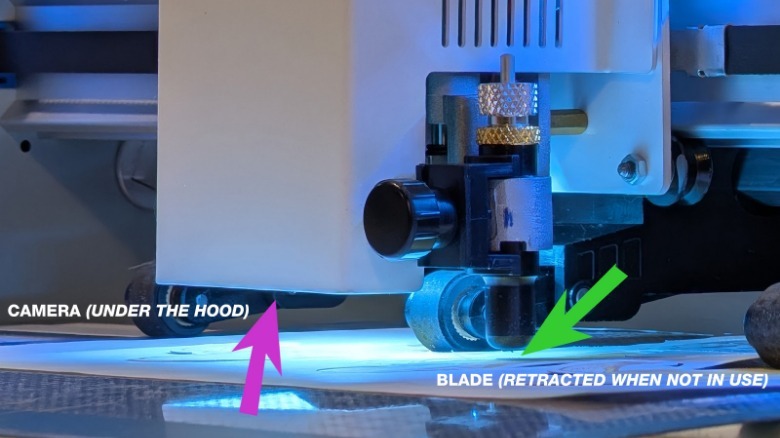
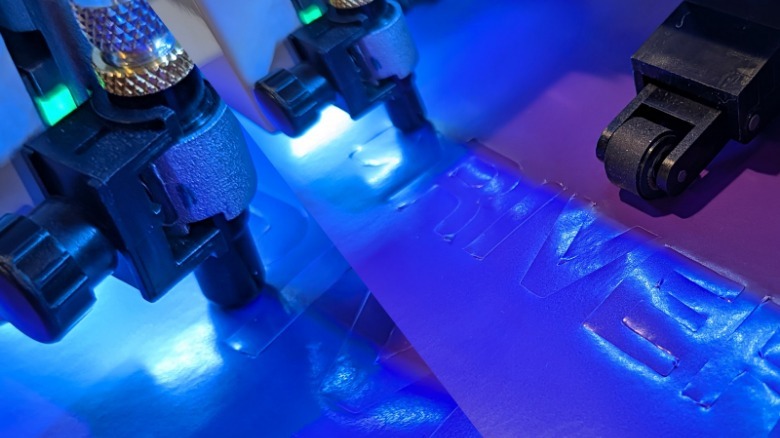
The machine has an alignment camera and a plug-and-play (or tighten-and-play) head system for replacing blades. The alignment camera is the key if you’re looking at this machine as a way to cut around the edges of pre-printed papers and vinyl.
You’ll need to calibrate the system before you start any of this, but once you do, it’s just a matter of importing artwork, telling the software to create an outline, printing (on your laser printer, this one just cuts), then telling the Vevor machine where to start cutting.
This device also has a simple ball-point-pen piece for calibration, testing, and marking. You will absolutely want to keep track of this pen if you want to use this device’s camera system for contour cutting.
 Chris Burns/SlashGear
Finding the right settings for cutting any design in any material requires a bit of trial and error. Once you find the settings you need, you’ll be pleased at the consistency with which this machine cuts. Just remember: It does what you tell it to do, no more, no less.
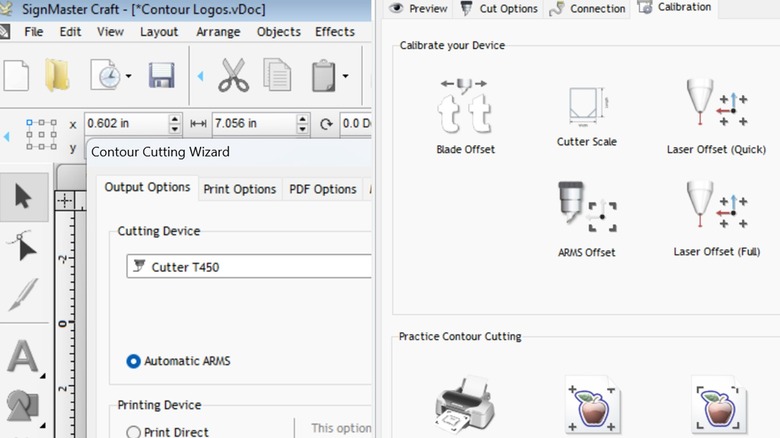
I’ve gotten used to software that gets in your way before you can use it. By that I mean it’ll say, “hey, if you want to be able to use this feature properly, you need to take these simple steps first.” This device does not include software that takes care of you in that way.
You could potentially jump from pressing the power button to cutting big important sheets of material before you realize you need to calibrate the machine for it to cut properly. This machine can cut before it knows the ins and outs of the machine it’s controlling.
This isn’t a “it just works” type of setup. Once you’ve calibrated (and told the software everything it needs to know about the machine), you’ll be ready to move forward with accurate cuts — but not before.
You’ll need a Windows PC to do any/all of this, along with one of Vevor’s recommended pieces of software to control the machine. That includes Artcut, Graph-Cut, Signcut, Signmaster, Flexi, and/or Coreldraw. This device comes with a unique product serial number for you to activate a copy of the software SignMaster Craft Home Edition.

This Vevor vinyl cutter is inexpensive for its size (14-inch-wide cutting space) and capabilities. Right this minute you’ll find a price of approximately $326 (or less if you register with the store and/or use a coupon) for the Vevor TT-450 listed in the brand’s online shop.
The closest machine Cricut has at the moment is the Cricut Maker 4 (with 11.7-inch-wide cutting space) that’s on sale for around $350 — and it normally costs around $400. From Silhouette the closest device is a Silhouette Cameo5α Plus (with a 14.5-inch-wide cutting space) for $400.
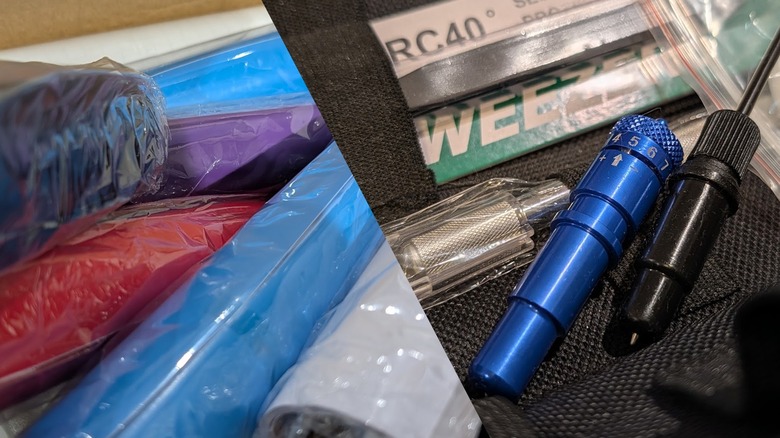
The Vevor TT-450 is well worth the money you’ll pay to own it. The hardware is solid and the device comes pre-constructed (except for the blade, which you’ll need to insert, but that’s easy). You’ll also get extra blades and a few rolls of basic-quality adhesive-backed color vinyl for practice. Just make sure you have a Windows computer to run the software you’ll need to control this vinyl cutter from the get-go. And don’t forget to have an inkjet printer ready so you can print the one-sheet calibration pages necessary for this cutter to work properly.
The hardware quality is good, and the software makes the hardware do what it’s mean to do. If you’re ready to trade simplicity for a very reasonable price, there’s little reason to buy any other brand. If you’re the sort of person that knows the software already, or you’re not one to let a bit of a learning curve turn you away from an enticing bit of hardware value — Vevor’s got what you’re looking for.


Mountains might be havens for skiers during the winter and off-road cyclists in the summer, but the steep inclines and declines of the roads getting up to them are no friend to the average truck driver. If you happen to live in the flat expanse of land somewhere in the Midwest that’s devoid of said mountains, it’s possible you’ve never encountered a road sign regarding runaway vehicles. They’re used to warn drivers who somehow lost the ability to slow down (i.e., failed brakes) as they’re coming down the backside of a high-elevation mountain pass.
These signs are primarily intended for big rigs, but they also apply to passenger cars. Despite the rigorous federal and state laws governing the upkeep and maintenance of semitrailers, Murphy’s Law — if anything can go wrong, it will — keeps everyone on their toes. The last place you want that particular law to pop up is when you’re headed downhill, applying the brakes to maintain a proper speed limit, and suddenly they stop working. If you find yourself in such a precarious predicament, though, know that you probably have a safe way out.
A runaway truck ramp is a feature built just off the side of the road that forces a truck or car to stop safely in an emergency. While these ramps come with different design elements, most are filled with huge quantities of sand or gravel and built with an uphill slope that’s angled away from the main highway to avoid causing even more problems. Think of it as a large quicksand pit that uses a combination of friction and gravity to force a vehicle into a controlled stop.

You’ll find these (mostly) yellow warning signs in mountainous areas. Interstate 80 meanders through the Sierra Nevadas on the way to Lake Tahoe and Reno, and I-5 crosses over the Tejon Pass (aka the Grapevine) on the way to Los Angeles. In Colorado, Interstate 70 snakes over the Eisenhower Pass at over 11,000 feet. You’ll also find these signs on Monteagle Mountain (Tennessee), Mount Rose Highway (Nevada), Teton Pass (Wyoming), and Interstate 40 in North Carolina.
The first runaway truck ramp in California opened in August 1956. In July of 2026, a new type of ramp was built along westbound Loop 375, near the I-10 interchange in El Paso, Texas. It uses a series of eight energy-absorbing nets bolted to reinforced concrete walls and will safely stop a 90,000-pound truck going 90 mph. Even with Jake Brakes, which are different from regular air brakes, trucks can have a hard time slowing down on steep declines. And while most ramps use gravel or sand, some (like the one in El Paso) are built using wire nets with breakaways. Where uphill gravity ramps aren’t possible, they’ll probably be level, but will have a much longer runway, giving the vehicle ample time and space to slow down.
On I-15 through Cajon Pass in Southern California, any vehicle can use the runaway truck ramp in an emergency scenario. Such is the case in most states, but because laws vary considerably from state to state, it’s always best to check local laws to make sure. Whatever the method used, they’ll be impossible to ignore thanks to prominent warning signage.


The Coca-Cola Company has confirmed that hackers stole data from its dairy subsidiary, Fairlife, during a ransomware attack earlier this month.
In a short statement earlier today, the global beverages giant says that it is still working to restore some of the impacted systems and operations, but most of the production in the U.S. has been resumed.
Coca-Cola disclosed the cyberattack in a filing with the U.S. Securities and Exchange Commission (SEC) on July 16, revealing that a ransomware attack had disrupted production operations at Fairlife.

Fairlife is a producer of ultra-filtered milk, protein shakes, and nutritional drinks. It operates four production facilities in the U.S., and has more than $1 billion in annual retail sales.
At the time, BleepingComputer sent a request for comments regarding the attack, but we received no reply.
A few days later, the Anubis ransomware gang claimed the attack and added Fairlife to the list of victims on its extortion site. The hacker group threatened to leak one terabyte of files allegedly stolen from the company, unless Fairlife paid a ransom.
The threat actor told BleepingComputer that they had encrypted the firm’s Nutanix systems, leaving no possibility of recovery.
As soon as Coca-Cola discovered the breach, the company reported the intrusion to the authorities and did not follow the attacker’s instructions to negotiate.
BleepingComputer contacted Coca-Cola again to validate the threat actor’s allegations, but a spokesperson declined to comment.
“The company previously disclosed that Fairlife experienced a ransomware event,” reads the Coca-Cola statement.
“This event involved access by an unauthorized third party to a portion of the company’s systems and taking of certain data, and a temporary suspension of production operations.”
Regarding Fairlife product availability, Coca-Cola says existing inventory helped cover temporary shortages caused by the production disruption, while product quality and safety were never jeopardized.
The timer that Anubis ransomware had previously set for the public release of the stolen data expired earlier today, and the data is now available for download.

Security teams log 54% of successful attacks and alert on just 14%. The rest move through your environment unseen.
The Picus whitepaper shows how breach and attack simulation tests your SIEM and EDR rules so threats stop slipping by detection.

Winners & losers: For the first time in nearly two decades, Mojang has announced a significant change in Minecraft’s hardware requirements, a rare move for one of the biggest gaming products in history. The Microsoft-owned studio wants to future-proof Minecraft: Java Edition, but players running older hardware won’t be cheering this time around.
Minecraft: Java Edition now officially recommends 16GB of RAM, and that’s just the starting point. Mojang recently explained that the wildly popular sandbox game is getting a more modern baseline for its system requirements, acknowledging that some players with aging systems will be disappointed as the company works to keep improving its blocky experience for everyone else.
The update arrives after 17 years without a change to Java Edition’s requirements, a long stretch by any video game’s standards. After nearly two decades, Minecraft has essentially grown out of its shoes: players will need stronger PCs to run future builds – no matter the impossibly expensive costs of crucial silicon components such as memory chips and GPUs.

Minecraft’s system requirements officially changed on July 21, covering both the “Fast” and “Fancy” presets. The game’s official store page now lists a 1080p, 30 FPS target for the Fast preset, and a 1080p, 60 FPS target for the Fancy preset. The Fast preset calls for 8GB of RAM with a discrete GPU, or 12GB with an integrated GPU. The Fancy preset, meanwhile, recommends 16GB of RAM for comfortably running Java Edition for the foreseeable future.
A 16GB recommendation might sound like a lot, especially considering Java Edition currently allocates only around 4GB of system memory by default. Mojang is also updating its CPU and GPU requirements, with stronger, modern processors, either x86-64 or Arm64, now needed to properly run the Fancy preset.
Minecraft: Bedrock Edition still has lower system requirements than Java Edition, though players will need the latter to use custom mods on PC. Mojang says the new requirements are still modest compared to modern AAA games, meaning Java Edition should keep running smoothly on most well-equipped gaming systems.

The company explained: “We want to make it clear for players what kind of computer can run Java Edition smoothly. While older devices may still launch the game, they will struggle to deliver a good experience. This can lead to low frame rates, visual issues, long loading times, or performance that doesn’t match what players expect.”
Guaranteed performance on older hardware is officially a thing of the past, but Mojang argues that’s for the best. Leaving aging systems behind will let developers focus on meaningful technical upgrades, starting with the shift from OpenGL to Vulkan.

Microsoft on Monday launched its first cybersecurity-specialized model alongside a new AI cybersecurity platform at a small event in San Francisco, taking a big swipe at major players in the space — namely Anthropic, Google and OpenAI.
The company describes MAI-Cyber-1-Flash as a model that’s built “to find challenging vulnerabilities in complex codebases.” The model is built to animate MDASH, Microsoft’s harness dedicated to software vulnerability identification and remediation.
The new security platform is dubbed Perception, and it’s designed to deploy teams of agents to assist with and automate various security workflows, including identifying and remediating bugs. The platform can also integrate with MDASH.
The company claims MAI-Cyber-1-Flash is significantly more powerful (and more cost-effective) than competitor models, based on its performance on an established AI cybersecurity benchmark.
“We’re very very excited to announce our results,” said Mustafa Suleyman, the co-founder of DeepMind and current CEO of Microsoft AI. “We have MAI-1 Cyber Flash binded [sic] with GPT 5.4 inside of the MDASH harness — which beats out Gemini, GPT 5.5 Cyber, GPT 5.6 Sol, and Mythos 5 on Cyber Gym, which is the primary benchmark that we all use. The golden benchmark.”
“We’re shipping this into production immediately,” he added.
Noting that hackers are increasingly using AI in their cyberattacks, Hayete Gallot, Microsoft’s vice president for security, described Perception as a way for enterprise defenders to “defend against AI with AI at the scale and speed that the attackers have.”
Perception uses agentic red teams, blue teams, and green teams. The red teams can provide detailed simulations of potential attacks — providing context about potential threat actors and the likely vulnerabilities that they might exploit. Blue teams are dedicated to detecting and triaging existing bugs, while green teams take “corrective actions” against those bugs.
Dave Weston, the lead engineer for Perception, described the platform as a massive efficiency upgrade for corporate defenders. “We’ve gone from this taking hours and hours of manual work from multiple specialized folks across the security organization — appsec hunters, remediation engineers, you name it — and in minutes, we have a fix for all of this. Not only do we discover the issues and prioritize them, but we have detection, posture fixing, and even a code fix.”
Though AI has offered new defensive capabilities to companies, its availability to cybercriminals has given rise to a dazzling array of potential threats.
Microsoft’s new security tools, which the company said will be available in preview on November 3, will enter an increasingly crowded field of AI cybersecurity solutions. Earlier this year, Anthropic launched Mythos, a security platform that was released to a small coterie of partner organizations through a program called Glasswing. OpenAI has also launched its own security solution in May through a program called Day Break.
When you purchase through links in our articles, we may earn a small commission. This doesn’t affect our editorial independence.


Apple is being sued by three people who claim approximately $1.8 million in Bitcoin was stolen after downloading and using a fraudulent Sparrow Wallet application from the App Store.
The complaint, filed on July 24 in California, alleges that Apple failed to adequately review and monitor applications distributed through the App Store while promoting the marketplace as a safe and trusted source for software.
Plaintiffs James Ramirez, Christopher Ellis, and Jalen Delgado say the malicious application impersonated the legitimate Sparrow Bitcoin wallet and instructed them to enter their seed phrases.
After entering those secret recovery credentials, the victims allegedly had their Bitcoin transferred to cryptocurrency wallets controlled by the scammers.
The legitimate Sparrow Wallet is a desktop application available for Windows, macOS, and Linux, and does not offer an iOS version.
However, Sparrow Wallet’s developer says that scammers have repeatedly published applications in Apple’s App Store that impersonate the cryptocurrency wallet.
According to the complaint, Delgado downloaded the fraudulent application on or around May 1, 2025, entered his seed phrase, and shortly afterward discovered that 1.05033242 Bitcoin, worth approximately $120,000, had been transferred to a scammer.
Ramirez allegedly downloaded the app on July 25, 2025, and lost 7.4 Bitcoin, valued at approximately $875,000. The complaint says Ramirez reported the fraudulent app and theft to Apple that same day, but alleges Apple never contacted him regarding that report or subsequent reports.
Just over a week later, on or around August 3, Ellis allegedly also installed the Sparrow app from the App Store. After entering his seed phrase, Ellis discovered that approximately $840,000 in cryptocurrency had been transferred to a scammer and immediately reported the app and theft to Apple.
The complaint also claims that Apple ranked the fraudulent Sparrow app and included it in curated cryptocurrency app collections, effectively recommending it alongside legitimate applications.
However, Apple had allegedly been warned about fraudulent Sparrow Wallet apps more than a year before the plaintiffs’ losses.
The complaint includes a January 6, 2024 post from Craig Raw, the developer of the legitimate Sparrow Wallet application, who said a scam Sparrow Wallet app remained available in the App Store despite him and others reporting it weeks earlier.
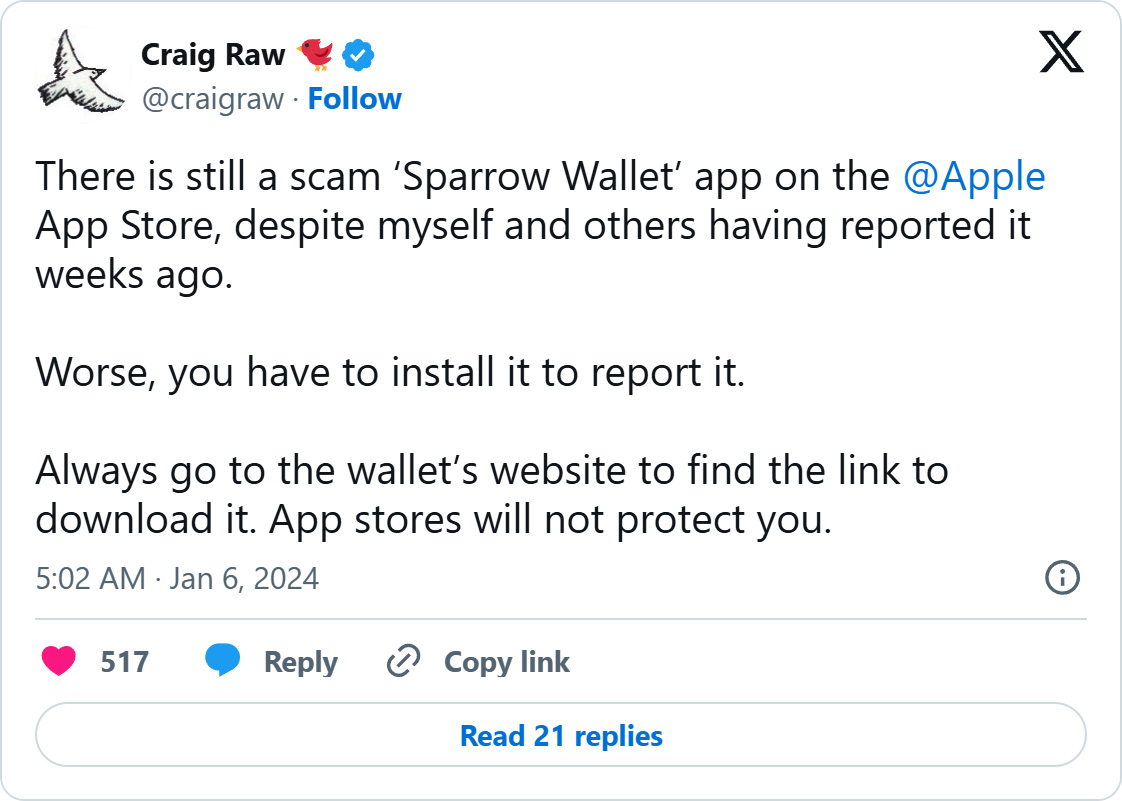
Raw also warned users to only obtain Sparrow Wallet through its official website rather than trusting an application solely because it was available through an app store.
MacRumors also shared a more recent attempt by Raw to protect users from the fake Sparrow applications on the Apple App Store by submitting an unpublished placeholder app that explained that mobile apps using the “Sparrow Wallet” name were fake.
According to Raw, Apple initially flagged his developer account for termination over alleged dishonest activity, but later reversed the decision.
Apple told BleepingComputer that it acted quickly to remove applications impersonating Sparrow Wallet and terminated the developer accounts associated with them.
Apple also said developers who believe content distributed through its services infringes their intellectual property can submit a dispute to the company’s legal department.
Customers can separately report suspected App Store scams and fraud through Apple’s Report a Problem service, and Apple said it takes immediate action when applications are found to violate its guidelines.
The plaintiffs are seeking reimbursement for the stolen cryptocurrency, compensatory and punitive damages, restitution, attorneys’ fees, and other damages.
They are also asking the court to require Apple to improve and publicly disclose its procedures for detecting and removing fraudulent applications, while also introducing warnings about the risks associated with cryptocurrency apps.
Security teams log 54% of successful attacks and alert on just 14%. The rest move through your environment unseen.
The Picus whitepaper shows how breach and attack simulation tests your SIEM and EDR rules so threats stop slipping by detection.





Weekend Open Thread: Brooks Brothers


Grayscale Files For Worldcoin ETF, WLD Registers Sharp Rise


How a former Blue Peter presenter stunned America’s Got Talent judges


Intel is reversing course and bringing hyper-threading back to its server chips


Sail Virtually Aboard The “Itanic” With IA-64 Emulator

Turtle Beach Command Series KB7 review: a nifty screen-equipped gaming keyboard

New Jersey voter registration controversy explained: How 6,600 noncitizens got on the rolls, and what happens next

Johnny Depp’s R-Rated Gothic Cult Classic Gets New Release Ahead of Sydney Sweeney Remake


Ethics, other provisions in crypto Clarity Act to be further discussed


Luke Littler dismantles Gerwyn Price to retain title in Blackpool

Shanghai science forum photos show China’s AI and robotics advances in rivalry with US

Commonwealth Games boxing: Jadumani Singh seals dominant 5-0 win over Pakistan’s Sumama Rehman to enter quarter-finals | Commonwealth Games News


2026 3M Open leaderboard: Scottie Scheffler finds putter in Round 1, sits three back


The Peugeot Family: How 200 Years of an “Old Money” Dynasty Died in A Boardroom


16 Dresses for the High Summer Event


Spain sweeps the board at 2026 World Cup with individual awards


Andrew Cuomo joins OKX board as crypto exchange expands in U.S.

A New Post-Apocalyptic Gundam Anime Series Blasts Into SDCC


BITCOIN JUST ENTERED THIS CRITICAL ZONE…


XRP Ledger adds $2.6B as RWA inflows rank second
You must be logged in to post a comment Login