Tech
Apple Is Testing a Four-HomePod Surround Sound System for Apple TV 4K

Apple has spent years insisting that one or two HomePods can handle home theater duties. To be fair, a stereo pair of 2nd generation HomePods can reproduce Dolby Atmos with an Apple TV 4K, and Apple’s computational audio does a respectable job of making two speakers positioned at the front of a room sound considerably larger than they actually are.
But two speakers are still two speakers, and new code discovered in audioOS 27 beta 8 suggests Apple is experimenting with something considerably more ambitious: a four-HomePod surround system using separate front-left, front-right, rear-left, and rear-right speakers. If Apple actually ships it, HomePod could evolve from an unusually capable stereo TV solution into something much closer to a legitimate wireless home theater platform.
That would put Apple into a very different fight.
What Is Apple Actually Testing?
Based on the code discovered, Apple has created tuning configurations for four 2nd generation HomePods arranged around the listening position. References in the software include front-left, front-right, rear-left, and rear-right speakers, along with automatic room calibration, speaker-position mapping, timing adjustment, bass management, EQ, dialogue enhancement, and separate processing modes for movies and music.
For stereo content, Apple also appears to be experimenting with two approaches: spatializing music across all four speakers or preserving conventional stereo playback through only the front pair.
That is considerably more sophisticated than simply grouping four AirPlay speakers and telling them to play the same thing. Timing correction and speaker-position mapping would be essential because four HomePods positioned around a room will rarely be equidistant from the listener, while bass management becomes particularly interesting when each full-size HomePod contains its own 4-inch high-excursion woofer.
Apple already uses computational audio, room sensing, and automatic bass correction within individual HomePods. Coordinating those capabilities across four separate locations could give the company far more control over imaging and surround placement than its existing one- or two-speaker implementation.


There Is Also Mystery Hardware
The beta code also contains references to a tuning system called “Forklift,” which reportedly combines two 2nd generation HomePods with two speakers carrying an unidentified AID12007 hardware designation. That identifier does not correspond to any currently available HomePod.
What exactly is it? Nobody outside Apple appears to know.
It could represent a future HomePod mini, a third-generation full-size HomePod, or another unreleased Apple audio product. There is currently no evidence that Apple plans to sell dedicated wireless surround speakers, so anything more specific would be speculation.
The presence of both configurations is nevertheless interesting because Apple may be testing more than one approach: four existing full-size HomePods in one arrangement and a combination of current and future hardware in another.
The code also references a new “Party Mode” for stereo-paired HomePods designed to create a more diffuse sound field across a room rather than optimizing playback around a tightly focused listening position. That could be useful for music, but the home theater work is considerably more consequential.
What We Don’t Know
Apple has not announced a four-HomePod surround system, and there is no guarantee that anything discovered in beta software will become a commercial feature. The Home app and Apple TV currently provide no way to configure four HomePods as a permanent home theater system, and Apple’s current implementation supports either one HomePod or a stereo pair with Apple TV 4K.
We also don’t know whether existing 2nd generation HomePods would be supported, whether new hardware would be required, what AID12007 actually represents, or how Apple would map Dolby Atmos channels across four speakers. There is no indication of a dedicated center speaker or wireless subwoofer, no confirmed release date, and no evidence yet that Apple intends to describe the finished system as 4.0, 5.1.4, 7.1.4, or anything else.
That last point is worth emphasizing. Four physical speakers do not necessarily equal four audio channels. Modern spatial-audio systems routinely use beamforming and virtualization to reproduce more channels than there are physical enclosures, and the current HomePod already supports Spatial Audio with Dolby Atmos using its five-tweeter beamforming array and computational processing.
The missing physical center channel would still present an interesting challenge. Movie dialogue is normally anchored to the center speaker, so Apple would need to generate a convincing phantom center or use another computational technique to keep dialogue locked to the screen across multiple seating positions. HomePod already offers Enhance Dialogue, but we do not yet know how Apple would incorporate that technology into a four-speaker layout.
Physics, annoyingly, still does not accept firmware updates.


Why This Matters
HomePod has always occupied a slightly odd position in Apple’s ecosystem. At $349, the 2nd generation model is considerably more capable than the average smart speaker, with a 4-inch high-excursion woofer, five beamforming tweeters, room sensing, automatic bass correction, computational audio, and Spatial Audio with Dolby Atmos.
Buy two and Apple already gives Apple TV 4K owners a surprisingly capable wireless television system. The obvious limitation is that all of the physical speakers remain at the front of the room, forcing Apple to create much of the surround experience through processing.
Real rear speakers would fundamentally change that. Surround information could originate behind the listener rather than being simulated entirely from the front, while four independently powered HomePods would give Apple multiple low-frequency sources and significantly more acoustic output to work with.
At the current $349 price, four HomePods would cost $1,396 before adding an Apple TV 4K. That is not inexpensive, but it puts the concept directly into premium soundbar and wireless home theater territory.
More importantly, Apple could finally give HomePod an upgrade path. Someone could theoretically start with one speaker, move to a stereo pair, and eventually expand into surround sound without discarding the hardware they already own.
Sonos has built a rather successful business around exactly that idea.
Sonos Is the Obvious Competitor
The newly introduced Sonos Beam Ultra makes that comparison particularly timely. The $699 compact soundbar moves Sonos to a true 7.1.2 Dolby Atmos architecture with nine drivers, including dedicated upward-firing height drivers, while retaining Trueplay room correction and the ability to expand the system with wireless surround speakers and a Sonos Sub.
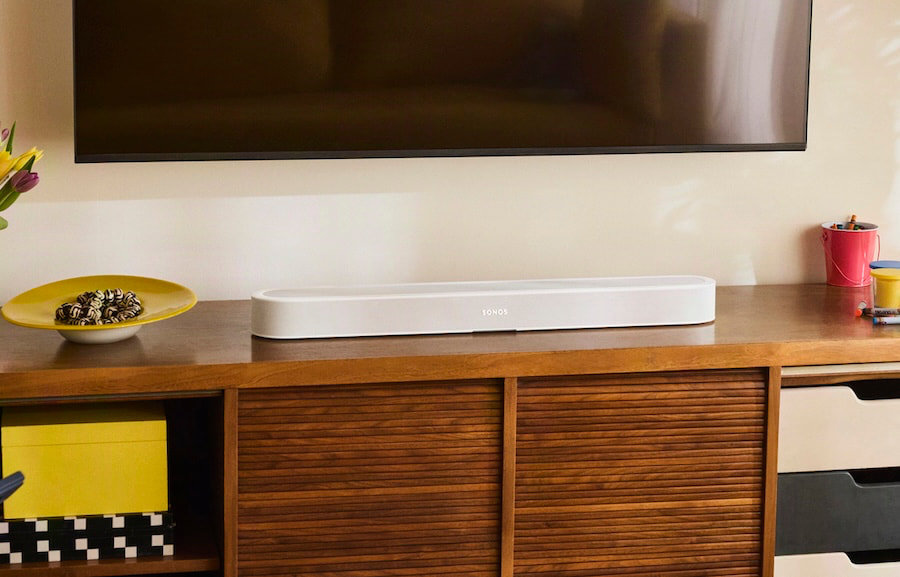

That means someone can start with Beam Ultra and gradually turn it into a larger home theater system instead of buying everything on day one. Sonos also has the advantage of HDMI eARC connectivity and years of experience integrating soundbars, surrounds, subwoofers, headphones, and multiroom audio into one platform.
The larger Arc Ultra pushes the concept further with a claimed 9.1.4 presentation and can similarly be expanded with wireless surrounds and subwoofers. Apple would therefore be entering a category where Sonos already offers consumers clear steps from a single soundbar to a much larger immersive system.
Apple’s potential advantage would be architectural. Instead of relying on a soundbar to perform most of the front-channel work, four HomePods could distribute amplification, bass reproduction, beamforming, and computational processing around the entire room.
Whether that sounds better is something we can worry about if Apple actually lets anyone buy it.
Sony May Be an Even Closer Comparison

The Sony BRAVIA Theatre Quad may actually be the more interesting technical comparison because it also abandons the conventional soundbar layout. Sony uses four separate wireless speaker enclosures positioned around the listening area and employs 360 Spatial Sound Mapping to create additional virtual speaker positions within the room.
That sounds remarkably close to the problem Apple appears to be trying to solve. Sony also has a clever solution for the missing physical center speaker: compatible BRAVIA televisions can participate in the system through Acoustic Center Sync, helping anchor dialogue directly to the screen.
There is currently no evidence that Apple plans anything comparable with a television’s internal speakers, but the similarity between Sony’s four-speaker architecture and the audioOS testing is difficult to ignore.
Apple Would Also Be Moving Beyond Google
Google has also pushed further into television audio by allowing one or two Google Home Speakers to operate with the Google TV Streamer, giving consumers another wireless alternative to a conventional soundbar.
Apple adding physically separate rear speakers would move HomePod considerably beyond that type of two-speaker arrangement. More broadly, Apple, Google, Sonos, Sony, Samsung, and others are all chasing the same consumer: someone who wants immersive television sound but has little interest in an AVR, speaker wire, or seven individual loudspeakers scattered around the living room.
Traditional home theater is not disappearing, but the middle of the market is becoming increasingly wireless.
The Bottom Line
Apple has not announced a four-HomePod surround system, and beta code should never be confused with a product announcement. Features get tested internally and disappear all the time.
But references to four physical speaker positions, room calibration, speaker mapping, timing correction, bass management, dialogue processing, multiple listening modes, and unidentified future hardware suggest that Apple is investigating something considerably more ambitious than another HomePod software update.
If Apple turns HomePod into an expandable wireless surround platform, it would create an obvious bridge between television speakers and a traditional component home theater system while placing Apple directly against Sonos Beam Ultra and Arc Ultra, Sony BRAVIA Theatre Quad, and other increasingly sophisticated wireless solutions.
For now, four HomePods surrounding the sofa remain an experiment. The important part is that Apple finally appears to be asking what happens when HomePod stops pretending that two speakers at the front of the room are enough.
You must be logged in to post a comment Login