


Connect with us
DAPA Banner
DAPA Coin
DAPA
COIN PAYMENT ASSET
PRIVACY · BLOCKDAG · HOMOMORPHIC ENCRYPTION · RUST
ElGamal Encrypted MINE DAPA
🚫 GENESIS SOLD OUT
DAPAPAY COMING

Tech

Architectural patterns for graph-enhanced RAG: Moving beyond vector search in production

Published

on

Retrieval-augmented generation (RAG) has become the de facto standard for grounding large language models (LLMs) in private data. The standard architecture — chunking documents, embedding them into a vector database, and retrieving top-k results via cosine similarity — is effective for unstructured semantic search.

However, for enterprise domains characterized by highly interconnected data (supply chain, financial compliance, fraud detection), vector-only RAG often fails. It captures similarity but misses structure. It struggles with multi-hop reasoning questions like, “How will the delay in Component X impact our Q3 deliverable for Client Y?” because the vector store doesn’t “know” that Component X is part of Client Y’s deliverable.

This article explores the graph-enhanced RAG pattern. Drawing on my experience building high-throughput logging systems at Meta and private data infrastructure at Cognee, we will walk through a reference architecture that combines the semantic flexibility of vector search with the structural determinism of graph databases.

The problem: When vector search loses context

Vector databases excel at capturing meaning but discard topology. When a document is chunked and embedded, explicit relationships (hierarchy, dependency, ownership) are often flattened or lost entirely.

Advertisement

Consider a supply chain risk scenario. While this is a hypothetical example, it represents the exact class of structural problems we see constantly in enterprise data architectures:

  • Structured data: A SQL database defining that Supplier A provides Component X to Factory Y.

  • Unstructured data: A news report stating, “Flooding in Thailand has halted production at Supplier A’s facility.”

A standard vector search for “production risks” will retrieve the news report. However, it likely lacks the context to link that report to Factory Y’s output. The LLM receives the news but cannot answer the critical business question: “Which downstream factories are at risk?”

In production, this manifests as hallucination. The LLM attempts to bridge the gap between the news report and the factory but lacks the explicit link, leading it to either guess relationships or return an “I don’t know” response despite the data being present in the system.

The pattern: Hybrid retrieval

To solve this, we move from a “Flat RAG” to a “Graph RAG” architecture. This involves a three-layer stack:

Advertisement
  1. Ingestion (The “Meta” Lesson): At Meta, working on the Shops logging infrastructure, we learned that structure must be enforced at ingestion. You cannot guarantee reliable analytics if you try to reconstruct structure from messy logs later. Similarly, in RAG, we must extract entities (nodes) and relationships (edges) during ingestion. We can use an LLM or named entity recognition (NER) model to extract entities from text chunks and link them to existing records in the graph.

  2. Storage: We use a graph database (like Neo4j) to store the structural graph. Vector embeddings are stored as properties on specific nodes (e.g., a RiskEvent node).

  3. Retrieval: We execute a hybrid query:

Reference implementation

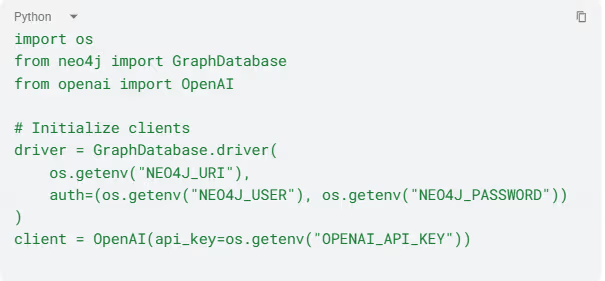
Let’s build a simplified implementation of this supply chain risk analyzer using Python, Neo4j, and OpenAI.

1. Modeling the graph

We need a schema that connects our unstructured “risk events” to our structured “supply chain” entities.

Image 1
Image 2

2. Ingestion: Linking structure and semantics

In this step, we assume the structural graph (suppliers -> factories) already exists. We ingest a new unstructured “risk event” and link it to the graph.

Image 3
Image 4

3. The hybrid retrieval query

This is the core differentiator. Instead of just returning the top-k chunks, we use Cypher to perform a vector search to find the event, and then traverse to find the downstream impact.

Image 5

The output: Instead of a generic text chunk, the LLM receives a structured payload:

[{‘issue’: ‘Severe flooding…’, ‘impacted_supplier’: ‘TechChip Inc’, ‘risk_to_factory’: ‘Assembly Plant Alpha’}]

This allows the LLM to generate a precise answer: “The flooding at TechChip Inc puts Assembly Plant Alpha at risk.”

Advertisement

Production lessons: Latency and consistency

Moving this architecture from a notebook to production requires handling trade-offs.

1. The latency tax

Graph traversals are more expensive than simple vector lookups. In my work on product image experimentation at Meta, we dealt with strict latency budgets where every millisecond impacted user experience. While the domain was different, the architectural lesson applies directly to Graph RAG: You cannot afford to compute everything on the fly.

Mitigation: We use semantic caching. If a user asks a question similar (cosine similarity > 0.85) to a previous query, we serve the cached graph result. This reduces the “graph tax” for common queries.

2. The “stale edge” problem

In vector databases, data is independent. In a graph, data is dependent. If Supplier A stops supplying Factory Y, but the edge remains in the graph, the RAG system will confidently hallucinate a relationship that no longer exists.

Advertisement

Mitigation: Graph relationships must have Time-To-Live (TTL) or be synced via Change Data Capture (CDC) pipelines from the source of truth (the ERP system).

Infrastructure decision framework

Should you adopt Graph RAG? Here is the framework we use at Cognee:

  1. Use vector-only RAG if:

    • The corpus is flat (e.g., a chaotic Wiki or Slack dump).

    • Questions are broad (“How do I reset my VPN?”).

    • Latency < 200ms is a hard requirement.

  2. Use graph-enhanced RAG if:

    • The domain is regulated (finance, healthcare).

    • “Explainability” is required (you need to show the traversal path).

    • The answer depends on multi-hop relationships (“Which indirect subsidiaries are affected?”).

Conclusion

Graph-enhanced RAG is not a replacement for vector search, but a necessary evolution for complex domains. By treating your infrastructure as a knowledge graph, you provide the LLM with the one thing it cannot hallucinate: The structural truth of your business.

Daulet Amirkhanov is a software engineer at UseBead.

Advertisement

Welcome to the VentureBeat community!

Our guest posting program is where technical experts share insights and provide neutral, non-vested deep dives on AI, data infrastructure, cybersecurity and other cutting-edge technologies shaping the future of enterprise.

Read more from our guest post program — and check out our guidelines if you’re interested in contributing an article of your own!

Source link

Advertisement
Continue Reading
Click to comment

You must be logged in to post a comment Login

Leave a Reply

Tech

Experts say Donut Lab’s “breakthrough” solid-state battery is just ordinary lithium-ion

Published

on

WTF?! Eye-catching battery claims are nothing new, but some deserve closer scrutiny. According to an investigation led by independent researcher Ziroth and supported by more than 20 battery experts, the much-hyped Donut Lab solid-state battery appears to be something far more familiar: a lithium-ion cell.

The conclusion doesn’t rest on speculation or anonymous sources. Instead, it comes down to how the battery behaves under testing. Data from Finland’s VTT, including voltage curves and expansion measurements, consistently points to lithium-ion chemistry rather than the sodium-ion solid-state design the company claimed.

Start with the voltage. At around 50% charge, the tested cell measures between 3.7 and 3.8 volts. That’s typical for lithium-ion batteries, particularly high-nickel NCM chemistries. Sodium-ion cells generally operate at lower voltages and do not reach that range under similar conditions. On its own, that discrepancy raises questions. Combined with the second line of evidence, it becomes much harder to dismiss.

The second clue is the cell’s physical expansion during charging. As ions move into the anode, the material expands in predictable ways. Lithium-ion batteries with graphite anodes exhibit a distinctive “kink” in the expansion curve midway through charging, reflecting how lithium ions arrange themselves within graphite’s layered structure. The Donut Lab cell exhibits the same pattern.

Advertisement

This detail is particularly significant because sodium ions are too large to intercalate into graphite in the same way. In other words, if the expansion curve matches that of a graphite anode, the underlying chemistry is almost certainly lithium-ion. As the investigation puts it, “it’s like we have a slightly noisy fingerprint and a picture of the suspect’s face. And yet again, it’s a match.”

The numbers reinforce that conclusion. Based on the test data, the cell’s energy density is roughly 298 Wh/kg – respectable for a lithium-ion battery, but well short of the 400 Wh/kg figure Donut Lab promoted.

The technical findings also trace the battery’s origins to CT Coatings, a German company described in the report as holding an unusual mix of patents, many of them unrelated to advanced battery technology. CT Coatings was presented as the technology provider, Nordic Nano as the manufacturer, and Donut Lab as the company bringing the product to market. According to the investigation, however, Nordic Nano has yet to manufacture a battery cell.

Advertisement

Some of the experts involved were blunt in their assessments. Julian Zanau of the Fraunhofer Research Institute told Electrek: “The first impression I got was that these people have no idea how a battery actually works. They were talking about no rare earth metals in their batteries and therefore no lithium, and to any chemist lithium has nothing to do with rare earth minerals.”

The report also raises questions about how the technology was vetted. Rather than relying on independent validation, Donut Lab appears to have conducted its own due diligence. That approach drew criticism from former Nordic Nano executive Lauri Peltola, who argued that neither company had the battery expertise needed to independently verify such claims.

Beyond the laboratory, the investigation points to inconsistencies in how the technology was presented publicly. Donut Lab said it had delivered a production vehicle in early 2026. However, internal communications cited in the report indicate that the first motorcycles were intended for Verge’s own fleet to refine manufacturing processes – a stage typically considered pre-production rather than customer delivery.

In later comments to Finnish media, CEO Marko Lehtimäki acknowledged that the cells tested by VTT were not the ones intended for customer vehicles. He also indicated that the headline performance figures had not yet been achieved by the batteries destined for production.

Advertisement

The financial side of the story adds another layer. Donut Lab raised about $25 million from more than 1,300 investors, many of them small shareholders who participated through earlier crowdfunding campaigns tied to Verge Motorcycles. After restructuring around its battery technology, the company’s valuation climbed sharply, reaching $1.25 billion following its CES debut.

Investor communications leaned heavily on the promise of a breakthrough battery, including projections of significant near-term returns. At the same time, internal emails cited in the investigation show the company asking its technology partner to provide evidence that those performance claims could be met.

Finnish authorities are now reportedly looking into the matter. For engineers and industry observers, it serves as a reminder that bold battery claims still have to withstand basic diagnostic testing – and in this case, the evidence points to a far more conventional technology.

Advertisement

Source link

Continue Reading

Tech

World Cup 2026 stream: How to watch live in 4K for free

Published

on

It’s been, well, 3.5 years since the last World Cup, but the biggest football tournament returns, spanning three countries as the action takes places across North America from Mexico to the United States and Canada.

The tournament begins in Mexico City on the 11th June, and over the course of five weeks (37 days to be exact), 48 teams will take part in 104 matches, making this the biggest World Cup yet.

And unlike the Champions League Final, the World Cup will be free-to-air, and if you live in the UK, there are two ways that you can the action live.

We can confirm that unlike Euro 2024, this tournament will be viewable in 4K HLG HDR, if you’re catching the action on iPlayer.

Advertisement

How to watch every World Cup 2026 game live for free

The rights to the 2026 World Cup is shared between BBC and ITV, and matches will be broadcast both on linear TV (through an aerial broadcast) and OTT streaming via iPlayer and ITVX.

Fair warning though. With matches kicking off across several time-zones, depending on the team you’re watching, you may be staying up very late (or waking up early) to catch your national team.

Advertisement

Here are the fixtures for the first week of the tournament and which channel/streaming service they’re on.

Advertisement

11th June

  • Mexico v South Africa, 8pm ITV/ITVX

12th June

  • South Korea v Czechia, 3am ITV/ITVX
  • Canada v Bosnia and Herzegovina, 8pm BBC/iPlayer

13th June

  • Qatar v Switzerland, 8pm ITV/ITVX
  • Brazil v Morocco, 11pm BBC/iPlayer
  • USA v Paraguay, 2am BBC/iPlayer

14th June

  • Haiti v Scotland, 2am BBC/iPlayer
  • Australia v Türkiye, 5am ITV/ITVX
  • Germany v Curaçao, 6pm ITV/ITVX
  • Netherlands v Japan, 9pm ITV/ITVX

15th June

  • Ivory Coast v Ecuador, 12am BBC/iPlayer
  • Sweden v Tunisia, 3am ITV/ITVX
  • Spain v Cabo Verde, 5pm ITV/ITVX
  • Belgium v Egypt, 8pm BBC/iPlayer
  • Saudi Arabia v Uruguay, 11pm ITV/ITVX

Advertisement

16th June

  • Iran v New Zealand, 2am BBC/iPlayer
  • France v Senegal, 8pm BBC/iPlayer
  • Iraq v Norway, 11pm BBC/iPlayer

17th June

  • Argentina v Algeria, 2am ITV/ITVX
  • Austria v Jordan, 5am BBC/iPlayer
  • Portugal v DR Congo, 6pm BBC/iPlayer
  • England v Croatia, 9pm ITV/ITVX

How to watch World Cup 2026 – what do I need?

With the World Cup 2026 being streamed in 4K, to see the action in its very best, you’ll need a 4K HDR HLG capable device or a display.

All 4K TVs sold support HDR, and all are required to support HDR10 and HLG.

BBC’s iPlayer app supports HDR HLG but ITVX does not. If you want to watch the matches in 4K HDR, you’ll need a display or streaming device that supports HLG streaming on iPlayer.

The BBC has a help guide for 4K viewing here, but you can expect TVs and streamer sticks going back years to feature support for HDR at the very least.

Advertisement

Advertisement

Source link

Continue Reading

Tech

Anthropic brings Mythos to the masses with Claude Fable 5, its most powerful generally available model ever

Published

on

Anthropic today launched two new AI models — Claude Fable 5 and Claude Mythos 5 — marking the company’s first broad release of the powerful “Mythos-class” AI capabilities it previously made available only to participating organizations in its restricted cybersecurity program, Project Glasswing, which it announced two months ago.

The company says Fable 5, which is the version most users and developers will get starting today, exceeds every Claude model it has previously made generally available — featuring stronger performance across software engineering, knowledge work, vision, scientific research and long-running tasks.

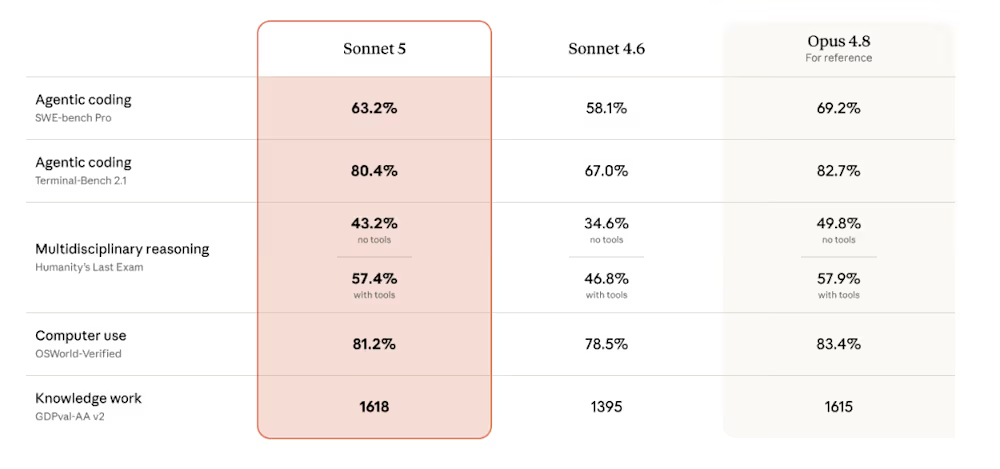
It smashes the existing benchmarks and comes atop on nearly all of them, though the prior Claude Mythos Preview version of the model still takes the top spots on computer use and multidisciplinary reasoning (see benchmark chart below and here).

Claude Fable 5 and Mythos 5 benchmark comparison chart

Claude Fable 5 and Mythos 5 benchmark comparison chart. Credit: Anthropic

Advertisement

The new Claude Mythos 5, by contrast, is less restricted in its capabilities, but more restricted in its availability. It is an upgraded version of the prior, similarly capable but limited release Mythos Preview model. As such, it has certain safeguards lifted — but it’s only officially accessible to Anthropic-approved users, including Anthropic’s cybersecurity partners in its Project Glasswing effort, and select biology researchers.

The key difference is that the general purpose Fable 5 wraps the same underlying Mythos-class capability in new safeguards. Anthropic says requests involving certain high-risk areas — including cybersecurity, biology and chemistry, and model distillation — are automatically routed to Claude Opus 4.8, Anthropic’s previously flagship general model, instead, with users notified when that happens. That is not the case on Mythos 5.

The company says more than 95% of Fable 5 sessions run entirely on Fable 5’s own responses, with no fallback, and that internal and external red-teaming efforts found no “universal jailbreaks” after more than 1,000 hours of testing.

Anthropic says Fable 5 is available to the general public today through its website, apps, and API, but that Mythos 5 will initially only be made available to users who already have access to the older Claude Mythos Preview.

Advertisement
Screenshot of Claude Fable 5 and Mythos 5 API information

Screenshot of Claude Fable 5 and Mythos 5 API information on Anthropic’s website.

Pricing, access and a tricky rollout

Anthropic is pricing both Fable 5 and Mythos 5 at $10 per million input tokens and $50 per million output tokens. The company says that is less than half the price of Claude Mythos Preview, but still ranks as the most expensive of major AI models available globally.

Model

Input

Advertisement

Output

Total Cost

Source

MiMo-V2.5 Flash

Advertisement

$0.10

$0.30

$0.40

Xiaomi MiMo

Advertisement

deepseek-v4-flash

$0.14

$0.28

$0.42

Advertisement

DeepSeek

deepseek-v4-pro

$0.435

$0.87

Advertisement

$1.305

DeepSeek

MiniMax-M3

$0.30

Advertisement

$1.20

$1.50

MiniMax

Gemini 3.1 Flash-Lite

Advertisement

$0.25

$1.50

$1.75

Google

Advertisement

Qwen3.7-Plus

$0.40

$1.60

$2.00

Advertisement

Alibaba Cloud

MiMo-V2.5

$0.40

$2.00

Advertisement

$2.40

Xiaomi MiMo

Grok 4.3 (low context)

$1.25

Advertisement

$2.50

$3.75

xAI

GLM-5

Advertisement

$1.00

$3.20

$4.20

Z.ai

Advertisement

Kimi-K2.6

$0.95

$4.00

$4.95

Advertisement

Moonshot/Kimi

GLM-5.1

$1.40

$4.40

Advertisement

$5.80

Z.ai

Grok 4.3 (high context)

$2.50

Advertisement

$5.00

$7.50

xAI

Qwen3.7-Max

Advertisement

$2.50

$7.50

$10.00

Alibaba Cloud

Advertisement

Gemini 3.5 Flash

$1.50

$9.00

$10.50

Advertisement

Google

Gemini 3.1 Pro Preview (≤200K)

$2.00

$12.00

Advertisement

$14.00

Google

GPT-5.4

$2.50

Advertisement

$15.00

$17.50

OpenAI

Gemini 3.1 Pro Preview (>200K)

Advertisement

$4.00

$18.00

$22.00

Google

Advertisement

Claude Opus 4.8

$5.00

$25.00

$30.00

Advertisement

Anthropic

GPT-5.5

$5.00

$30.00

Advertisement

$35.00

OpenAI

Claude Fable 5 / Claude Mythos 5

$10.00

Advertisement

$50.00

$60.00

Anthropic

For developers, Fable 5 is available through the Claude API as claude-fable-5. Anthropic says Fable 5 is fully available today on the Claude API and on consumption-based Enterprise plans.

Advertisement

For subscription users, the rollout is more complicated. Anthropic says Fable 5 will be included on Pro, Max, Team and seat-based Enterprise plans at no extra cost from today through June 22.

On June 23, the company plans to remove Fable 5 from those plans, after which using it will require usage credits. Anthropic says it aims to restore Fable 5 as a standard part of subscription plans as quickly as possible.

The difference between Fable 5 and Mythos 5

Anthropic is not presenting Fable 5 and Mythos 5 as two separate models in the usual “small versus large” sense. Instead, they appear to share the same base capability level. The difference is access control — that is, how easily it will be for users to get their hands on the models, and the guardrails embedded in each.

As previously mentioned Fable 5 includes a new safeguard layer that detects certain high-risk requests — including cybersecurity, biology and chemistry, and attempts to distill the model’s capabilities into other systems — and routes those requests to Claude Opus 4.8.

Advertisement

Mythos 5 lifts some of those restrictions for trusted users working in approved domains.

In practical terms, Mythos 5 is more powerful for sensitive cyber and biology work because it can answer in areas where Fable 5 falls back.

For most ordinary enterprise and developer tasks, however, Anthropic says Fable 5 performs effectively the same as Mythos 5.

The launch also signals how Anthropic plans to bring frontier models with dangerous dual-use capabilities into the market: not by releasing all capabilities to everyone, and not by simply refusing risky questions, but by routing some requests to a less capable model while keeping the stronger model available for the majority of everyday work.

Advertisement

A major improvement in autonomous coding

For enterprise buyers, the most immediate use case is likely software engineering. Anthropic says Fable 5 can work unattended for longer and with more independence than previous Claude models, which is exactly the capability enterprises need if they want AI agents to do more than autocomplete code or answer developer questions.

On SWE-bench Pro, which measures a model’s ability to complete difficult software engineering tasks, Anthropic says Fable 5 and Mythos 5 reach 80.3%, vastly outperforming OpenAI’s latest and greatest general model GPT-5.5, which scored 58.6%.

On Cognition’s FrontierCode Diamond benchmark, which tests high-quality, maintainable agentic coding, the models score 29.3%, compared with 13.4% for Claude Opus 4.8 and 5.7% for GPT-5.5, according to the benchmark table included in Anthropic’s materials.

Anthropic also says Fable 5 scores highest among frontier models on FrontierCode even at medium reasoning effort, suggesting the model may deliver stronger coding results without always needing maximum compute.

Advertisement

The most striking customer example comes from Stripe. Anthropic says Stripe tested Fable 5 in a 50-million-line Ruby codebase and found that the model completed a codebase-wide migration in one day that otherwise would have taken a team more than two months by hand. Stripe said, “Fable 5 compresses months of engineering into days. In our 50-million-line Ruby codebase, it did in a day what would’ve taken us more than two months by hand.”

Other early users describe the model as especially useful for long-horizon development tasks. Cursor said, “Fable 5 is the state of the art model on CursorBench. It’s opened up a class of long-horizon problems that were out of reach for earlier models.” Replit said Fable 5 is the highest-performing model it has tested on ViBench, its end-to-end “vibe-coding” benchmark, and that it builds apps in less time with fewer tokens. Figma said Fable 5 is “a clear step forward on agentic coding and prototyping.”

This is the enterprise shift Anthropic is trying to sell: AI coding systems that can take on larger units of work, not just individual tickets. That could include codebase migrations, app prototyping, pull request review, test generation, debugging across unfamiliar tools, user interface design and multi-step internal software projects.

Base44 said, “Fable 5 is much deeper and better at one-shotting full apps, and its tool calling is excellent.” Genspark said, “Fable 5 came out #1 on our evals, winning head-to-head against every model we tested. It was significantly stronger on the hardest tasks in the set — UI design and game coding.” Rakuten said, “At the highest effort, Fable 5 reflects on and validates its own work. For us, that’s what makes highly autonomous operations possible — the extra thinking pays for itself.”

Advertisement

For CTOs and engineering leaders, that suggests the model’s value may come less from raw code generation and more from sustained execution: understanding an intent, planning steps, calling tools, checking its own work and continuing through a task without constant human steering.

Knowledge work, finance, legal and operations

Anthropic is also positioning Fable 5 as a stronger model for enterprise knowledge work. On GDPval-AA, Anthropic reports a score of 1932 for Fable 5 and Mythos 5, compared with 1890 for Claude Opus 4.8, 1769 for GPT-5.5 and 1314 for Gemini 3.1 Pro.

On GDPpdf, a benchmark focused on visual document reasoning, Fable 5 and Mythos 5 score 29.8% without tools, compared with 22.5% for Opus 4.8, 24.9% for GPT-5.5 and 16.7% for Gemini 3.1 Pro.

That matters for enterprises because much of corporate work still lives in messy documents: PDFs, spreadsheets, charts, reports, contracts, filings, slide decks and screenshots. Anthropic says Fable 5 shows gains in document-based reasoning, chart and table interpretation and complex problem solving.

Advertisement

Hex said, “Fable 5 is the first to break 90% on our core analytics benchmark of complex, long-running analytical tasks — a 10-point jump over Opus. On the hardest questions, it shows strong judgment and attention to nuance.” Hebbia said Fable 5 was the highest-scoring model on its Finance Benchmark for senior-level reasoning, with double-digit gains in document reasoning, chart and table interpretation, and problem solving.

The finance examples are notable because they point to AI agents moving beyond summarization into higher-stakes analytical workflows.

IMC said Fable 5 “aced our trading-analysis evaluations nearly across the board: factual lookup, conceptual reasoning, root-cause analysis, expected-value analysis.” Optiver said the model was stronger than Opus 4.8 on its trading benchmark and “remarkably consistent,” scoring identically across repeated runs. Balyasny Asset Management said Fable 5 was the strongest finance-first model it had tested.

Legal and operations teams may also see immediate impact. Crosby Legal said, “Fable 5 feels materially different. In blind review, our lawyers found its redlines matched or beat our current model every time.” Notion said the model can take work “you’d chip away at all afternoon” and turn messy notes into a functioning project plan. Zapier said Fable 5 is the new leader on AutomationBench and is more autonomous than Opus 4.8: “Where Opus stops to ask, Fable 5 keeps looking.”

Advertisement

For enterprise software vendors, that points toward more capable embedded agents in workflow products: agents that can review a contract, update a project plan, assemble a spreadsheet, inspect a chart, file a ticket, run a query, call an internal API and keep going until the work is complete.

Vision and interface understanding

Anthropic says Fable 5 is also its strongest vision model. In its launch materials, the company says the model can extract precise numbers from detailed scientific figures and complete vision-based tasks such as rebuilding a web app’s source code from screenshots alone.

That has immediate implications for enterprise automation. Many business processes still depend on visual interfaces that are not cleanly exposed through APIs: dashboards, PDFs, forms, legacy apps, screenshots, scans and image-heavy reports. A stronger vision model could help agents operate across those environments with less custom integration work.

Anthropic also says Fable 5 needs less scaffolding than previous Claude models. As an example, the company says earlier Claude models struggled to play Pokémon FireRed even with extra tools, while Fable 5 impressively beat the game using a minimal vision-only harness. Anthropic posted a fast forwarded video of its playthrough to YouTube and in its blog post:

Advertisement

https://www.youtube.com/watch?v=CIQBP1w4B1M

The point is not gaming itself, but the broader agentic skill: reading a visual environment, remembering progress, deciding what to do next and executing over a long horizon.

In another internal test, Anthropic says it had the model play the deck-building game Slay the Spire with access to persistent file-based memory. The company says persistent memory improved Fable 5’s performance three times more than it improved Opus 4.8’s, and that Fable reached the game’s final act three times more often. For enterprise users, this suggests Fable 5 may make better use of notes, logs and stored context during multi-step work.

That could matter for internal agents that operate over days or weeks: sales operations agents that track account research, engineering agents that manage migrations, finance agents that update models, or support agents that remember what they tried across many turns.

Advertisement

From restricted cyber model to general-purpose enterprise AI

The announcement follows Anthropic’s April 2025 rollout of Claude Mythos Preview through Project Glasswing, a restricted program for cyber defenders, critical infrastructure providers and major software maintainers. Anthropic created Glasswing after internal evaluations showed Mythos-class models could find and exploit software vulnerabilities at a level that raised meaningful misuse concerns.

Following the debut of Glasswing and Mythos, U.S. officials and intelligence agencies began weighing how such models could reshape both cyber defense and offensive operations, while Sen. Mark Warner warned that AI-assisted vulnerability discovery should force industry to “accelerate and reprioritize patching.” Financial regulators also took notice: The Guardian reported that Mythos entered discussions among senior banking officials and regulators in the U.S. and U.K. because of fears that AI-accelerated cyberattacks could threaten payment systems and broader financial stability.

The reaction has not been limited to alarm. Governments also want access: Reuters reported that South Korea’s national internet security agency had secured Mythos access through Project Glasswing, reflecting a broader geopolitical race to use frontier AI for national cyber defense. At the same time, Anthropic has faced scrutiny over whether it can safely gate the very capabilities it says are too risky for general release. The Verge reported that unauthorized users accessed Mythos after its limited rollout, calling the incident damaging for a company that has built its brand around responsible AI.

Critics have also questioned whether Anthropic’s warning-heavy framing risks becoming a form of market positioning, since it casts the company as both the source of the new capability and the gatekeeper deciding which governments, companies and researchers get to use it.

Advertisement

With Fable 5, Anthropic is leaning into its gatekeeper role, attempting to separate the general enterprise value of a Mythos-class model from the riskiest parts of its capability profile. The company says Fable 5 can handle software engineering, research, visual reasoning, document analysis and long-running agentic workflows, while classifiers block or reroute requests that could provide what Anthropic calls “uplift” to malicious actors.

Those classifiers cover three main areas.

  1. Cybersecurity, where Anthropic says Mythos-class models can discover and exploit vulnerabilities and perform broader “agentic hacking” tasks such as reconnaissance, discovery and lateral movement.

  2. Biology and chemistry, where the company says the same reasoning that can help researchers design therapies could also help well-resourced malicious actors pursue dangerous biological work.

  3. Model distillation, where Anthropic says users may try to extract Claude’s capabilities to train competing models, including models that could be released without similar safeguards.

When Fable 5’s classifiers detect one of those categories, the response is automatically handled by Claude Opus 4.8. Anthropic says users will be told when this happens. That is a notable product decision: rather than declining those requests outright, Anthropic is trying to keep the user experience functional while reducing access to the most capable version of the model in sensitive areas.

Anthropic says it red-teamed the new classifier system internally and externally. The company says an external bug bounty produced no universal jailbreaks after more than 1,000 hours of testing, and external red-teaming organizations also failed to find a universal jailbreak. One external partner found that Fable 5 complied with zero harmful single-turn cyber requests related to planning cyberattacks, exploit development or defense evasion, even when prompts used any of 30 public jailbreak techniques, according to Anthropic.

Advertisement

The company is still acknowledging tradeoffs. Anthropic says the safeguards are deliberately cautious and may sometimes trigger on benign requests. That could frustrate security professionals, biology researchers and advanced enterprise users whose legitimate work overlaps with the blocked categories. The company says it plans to reduce false positives over time.

Mythos 5 and the restricted frontier

While Fable 5 is the broad commercial launch, Mythos 5 is the model to watch for enterprises operating in security, critical infrastructure and life sciences.

The company says all users with Claude Mythos Preview access can upgrade to Mythos 5 beginning today. It plans to expand access through a trusted access program, in collaboration with the U.S. government.

The distinction is important for sectors where the blocked capabilities are not edge cases but core workflows. A security team may need to reproduce vulnerabilities, test exploitability, analyze lateral movement or simulate attacker behavior in a controlled environment. A biology research team may need to reason through molecular design workflows that would trigger general-use safeguards. Fable 5 is not designed to give every user unrestricted access to those capabilities; Mythos 5 is designed for vetted users who need them.

Advertisement

Anthropic says Mythos 5 has the strongest cybersecurity capabilities of any model in the world. In the company’s benchmark table, the model family scores 78.0% on ExploitBench, compared with 69.0% for Claude Mythos Preview, 40.0% for Opus 4.8 and 34.0% for GPT-5.5. On CyberGym, Anthropic’s chart shows Mythos 5 at 83.8%, slightly ahead of Mythos Preview at 83.1% and far above Opus 4.8 with default safeguards.

The company is making a similar argument in biology. Anthropic says Mythos-class models outperform dedicated protein language models on a task involving adeno-associated viruses, a delivery mechanism used in gene therapies. The company frames that as both promising and risky: the same capability that could help gene therapy research could also be misused in dangerous biological work.

Anthropic says its internal protein design experts used Mythos 5 to accelerate parts of the drug design process by about tenfold. In one example, the company says Mythos 5, using protein design and bioinformatics tools without human assistance, matched or beat skilled human operators by choosing binding sites, selecting and running tools, and recovering from failures. Anthropic says nine of 14 protein targets in the study produced strong candidates for drug design that it is now investigating.

The company also says Mythos 5 produced novel molecular biology hypotheses that Anthropic scientists preferred over Opus-class model hypotheses about 80% of the time in blinded comparisons. Anthropic says several of those ideas have advanced to experimental evaluation, and one hypothesis involving an E. coli protein was later corroborated by an independent lab working on the same problem.

Advertisement

Those claims are potentially significant, but they should be treated carefully until more details are published. Anthropic says it intends to publish additional results in the coming months. For now, the strongest enterprise implication is directional: the company believes its highest-end models can already perform parts of scientific research workflows with less human intervention than prior systems.

New, longer data retention requirement

The company also introduced a new data-retention policy for Mythos-class models. Anthropic says it will require 30-day retention for all traffic on Fable 5, Mythos 5 and future models with similar or higher capability levels, across both first-party and third-party surfaces. The company says it will not use that data to train new Claude models or for non-safety purposes, and says it has added privacy protections including logging human access and deleting the data after 30 days in almost all cases.

That policy may become one of the most important enterprise buying questions around Fable 5. Many businesses want frontier AI capability but also want strict control over data retention, especially in regulated sectors. Anthropic’s position is that stronger monitoring is necessary for models with this level of capability. Enterprise customers will have to decide whether the capability gain justifies the retention requirement.

Enterprise implications

The broader enterprise significance of Fable 5 is that Anthropic is trying to commercialize a more autonomous class of AI model without exposing all of its capabilities to every user. That could become a template for how frontier labs release increasingly powerful systems: one model family, multiple access tiers, and domain-specific restrictions depending on user trust and risk.

Advertisement

If Fable 5 performs as Anthropic and early customers describe, developers may hand off larger tasks: code migrations, refactors, UI builds, test writing, bug fixing, documentation, internal tooling and multi-step app creation.

For knowledge-work-heavy enterprises, Fable 5 could make AI more useful in workflows where earlier models were too brittle: finance research, spreadsheet analysis, legal redlines, procurement review, board materials, market research, sales operations and project planning. The main gain is not just better answers; it is fewer turns, fewer corrections and more ability to keep working through ambiguity.

For security teams, the launch is more complicated. Most organizations will get Fable 5, not unrestricted Mythos 5. That means they may see stronger general coding and analysis, but not full access to the cyber capabilities Anthropic considers risky. Trusted defenders inside Project Glasswing will get Mythos 5, giving them a more direct way to use the model for vulnerability discovery and defensive testing.

For life sciences companies, the pattern is similar. Fable 5 may help with general research, literature analysis, data interpretation and scientific reasoning, but the more sensitive biological capabilities will be restricted. Anthropic is effectively creating a separate access path for vetted researchers whose work requires capabilities that could be dangerous in the wrong hands.

Advertisement

The launch also raises competitive pressure across the AI industry. Anthropic is claiming state-of-the-art results across agentic coding, knowledge work, vision, cybersecurity, legal reasoning, spatial reasoning and health benchmarks. But the more strategically important claim may be that it has found a workable release mechanism for models above its Opus class. If Fable 5’s safeguards hold up under real-world use, Anthropic will argue it can bring more powerful models to market sooner without fully opening the riskiest capabilities.

That is still a large “if.” The enterprise market will test not only Fable 5’s benchmark performance, but also its reliability, false-positive rate, data-retention tradeoffs and cost at scale. A model that can complete more work autonomously can also burn more tokens, trigger more governance questions and create new review burdens for teams that must verify its output.

Still, today’s launch marks a clear shift in the Claude lineup. Opus is no longer Anthropic’s top commercial capability tier. Mythos-class models now sit above it. Fable 5 is the first version of that tier for general users; Mythos 5 is the restricted version for trusted high-risk work. Together, they show how Anthropic plans to push frontier AI deeper into enterprise workflows while trying to keep the most dangerous capabilities gated.

Source link

Advertisement
Continue Reading

Tech

AT&T Now Offers $3 Day Passes For ‘Unlimited’ iPad Cellular Data

Published

on

The Unlimited Day Pass could be a good option for weekends away or tourists.

If you’ve ever needed iPad data for a day or two without signing a contract or paying for an entire month, AT&T has a new option. The company’s Unlimited Day Pass offers 24 hours of unlimited wireless data to eligible iPad users for a flat $3 rate, without a contract, subscription or credit check. “AT&T is the first and only major U.S. wireless provider to give eligible iPad users (with eSIM capabilities) the freedom to buy on-demand connectivity when they need it,” the carrier said in a press release. 

The plan is available to anyone (including non-AT&T customers), so it could be a good option for camping, weekends aways, or tourists. AT&T also notes that many folks with eSIM iPads have no cellular plan, so it could be a way to give your kid internet access when they’re using an iPad to study for exams. There’s no automatic renewal, so you’ll have no ongoing commitment or need to cancel. 

If you sign up, the first day pass is complimentary, limited to one iPad per customer, then available at a flat daily rate via credit or debit card. To use it with any Wi-Fi + cellular iPad model, simply activate the plan from your iOS device settings, with no app or Wi-Fi connection needed. “Open the Settings app, tap Cellular Data [and] add AT&T Unlimited Day Pass,” AT&T explains. The 24-hour data activation will start shortly after purchase.

Advertisement

The new service is available for any eSIM equipped iPad dating back to 2019, including iPad, iPad Mini, iPad Air and iPad Pro models. Android and other tablets are not yet eligible. AT&T said it plans to expand the service to include “multi-day options such as weekend and week-long passes” in the future. The company notes that it may slow data speeds if the network is busy.

Source link

Advertisement
Continue Reading

Tech

Apple Silicon MacBooks trounce Intel models in reliability

Published

on

The numbers are in! Given the same amount of time in use, with data spanning more than a decade, Intel Macs come in for service at twice the rate that Apple Silicon Macs have.

When it comes to device longevity, Apple’s products tend to last quite a long time, if cared for properly. While this has been a consistent feature of Apple’s hardware, it seems that the chip being used plays a factor.

According to a June report from UK Apple refurbisher Hoxton Macs, it has found that Intel Macs it has sold is returned for a hardware fault at twice the rate of Apple Silicon models.

In its figures, it says that there was a 0.9% hardware fault rate for Apple Silicon Macs sold across 2025. This refers to the share repaired or replaced under warranty in the first year after sales.

Advertisement

However, an Intel Mac sold under the same circumstances doubles this rate. Crucially, this covers Intel Macs that are of the same age as the equivalent Apple Silicon model. For example, the data counts failures from a 2016 MacBook Pro through 2018, the same as it counts a M1 MacBook Air from 2020’s failures through 2022.

In the last three years, the company’s blended warranty-return rate for all Mac models it sells has more than halved. In 2023, there was a 2.9% return rate for faults, but by 2025, it was 1.1%

“Matched for age, an Intel Mac comes back for a hardware fault about twice as often as an Apple silicon one,” the company says. “The faults that matter most — logic-board and battery failures — run at roughly double the rate on Intel.”

This overall failure rate from Intel machines is consistent with what our own data from a few Apple Stores across the East Coast showed through the 2010-2020 period. The industry as a whole is skewing towards more failures, not less, like Apple’s trending.

Advertisement

Fewer long-term problems

When it comes to why there are fewer Apple Silicon-related fault issues, the retailer insists it’s because the chip switch changed what could go wrong.

During the Intel era, it is reported that batteries wore out faster due to the requirements of the chip. Batteries were replaced more frequently because they were more easily drained.

By contrast, the batteries in an Apple Silicon MacBooks use less power, reducing the cycle count and minimizing the need for replacement.

Horizontal bar chart comparing MacBook battery charge cycles by age, showing consistently higher cycles for Intel models than Apple silicon across all age ranges from under 2 years to 5— 7 years

Battery cycle counts based on used Mac intake, based on device age. Image credit: Hoxton Macs

Advertisement

At all Mac ages, the Apple Silicon versions have less battery wear compared to their similar-aged Intel counterparts. A three-to-four-year-old Apple Silicon MacBook has about half the cycles of the Intel equivalent when it reaches the company’s restoration team.

There were also more reported issues with the USB Type-C ports on Intel Mac units, which also failed at a higher rate than on Apple Silicon machines.

The lack of a fan on the Apple Silicon MacBook Air is also helpful, unlike the fan-equipped Intel versions.

A fan moves air to cool the Mac’s components, providing a way for dust to be pulled inside. That dust then builds up and eventually clogs the airflow, preventing the thermal management system from working.

Advertisement

Since the Apple Silicon MacBook Air doesn’t use a fan for cooling at all, there are no blockage problems.

One theory is that the Apple Silicon design used fewer heat-generative components and has a cooler-running chip. Intel Mac faults clustered around the areas with high heat generation, including the separate graphics chip in some models.

Built a better MacBook reputation

The refurbishment repair report continues a trend for Apple, in being a very reliable manufacturer of computer hardware. It’s a reputation that it had for a long time, but it has seemingly improved further with the Apple Silicon era.

This is especially evident in annual surveys from the ACSI into customer satisfaction. In the September 2025 edition, Apple dropped from a score of 85 to 82, putting it narrowly in second place, behind HP.

Advertisement

With Intel hardware support finally dropped in macOS 27 Golden Gate, there’s now more of a reason for people still using Intel Macs to upgrade to Apple Silicon.

If they switch, it’ll be for a more hardy notebook than they’ve been using before.

Source link

Advertisement
Continue Reading

Tech

Jedify raises $24M to help companies arm AI agents with context on their business

Published

on

AI vendors promote their enterprise products as if they’re turnkey solutions, but the chances are low that AI agents will hit the ground running right away. Unless you put in the effort to train a model on the specifics of your business, it’s unlikely to understand how your company, for example, defines revenue or knows who is allowed to see which file. That’s part of the reason why we’re seeing AI companies deploying engineers to help integrate their AI products into customers’ systems.

New York-based startup Jedify is attacking this very gap. The company says its platform connects to enterprises’ knowledge sources via APIs to build a “context graph” about their business that AI agents can use to work better. These sources can be databases, data warehouses and lakes, SaaS apps or BI tools, as well as unstructured sources such as reports, documentation, code bases, and even Slack channels and meeting recordings.

To build that out, Jedify has raised $24 million in a Series A funding round led by Norwest, TechCrunch has exclusively learned. The round saw participation from returning backers S Capital VC and Cerca Partners, as well as new investor Oceans Ventures. Data giant Snowflake also participated as a strategic investor and is integrating the startup’s tech with its AI products, such as its Cortex AI service, Semantic Views, and CoWork.

Jedify’s pitch is that to be useful within enterprises, AI agents need access to the relationships between entities, data, permissions, domain knowledge, workflows, operational assumptions, and company-specific terminology. This context, the company says, allows an AI agent to narrow its attention to the information that is relevant to a particular task instead of searching across everything a company has.

Advertisement

Co-founder and CEO Assaf Henkin (pictured above, on the far right) pointed to Kiteworks, a compliance company, as an example of how customers are using Jedify. Kiteworks connected Snowflake, Tableau, Notion, and internal playbooks, including documents and screenshots, to Jedify, then built agentic tools for different customer workflows.

“They wanted to arm their sellers and account teams with a sophisticated app — you can think of it as both like a dashboard application and a real-time conversational application. When they go into a customer conversation, Jedify builds for them, on the fly, everything they need to know. And during the conversation, they can, in real time, get very specific details surfaced proactively,” Henkin said. 

Jedify’s context graph. Image Credits: JedifyImage Credits:Jedify /

Henkin argues that Jedify’s context graph is different from the semantic layers, metadata catalogs, and knowledge graphs that companies already use because it is multi-dimensional, capturing relationships across entities, data, people, permissions, and customers. It’s also model-agnostic and updates in real time as information flows into and out of the systems it is connected to.

“When you want to enable an agentic solution to really be autonomous, to drive decisions across CRM data, Zendesk tickets, maybe telemetry data that’s coming in real time, that’s when a context graph is much better in terms of capabilities versus a semantic layer,” he said.

Permissions are an obvious hurdle here. It wouldn’t do for an agent to give an intern access to the CFO’s revenue projections, for example. Henkin said his platform works to address that by inheriting permissions from identity systems, file systems, SaaS tools, and databases, including row-, column-, and table-level access rules, then lets its customers create additional groups that define what and whom agents or workflows are allowed to reach. It also offers observability and governance tools to help customers ensure their AI agents are behaving as intended.

Advertisement

Jedify is currently targeting mid-market and large enterprise customers that have mature data stacks and multiple databases or data warehouses. Henkin said the company has between 10 and 20 early customers, one of which is The Weather Company, and is seeing interest from data-heavy sectors such as gaming, industrials, and consumer packaged goods.

Snowflake’s investment and partnership are notable because large data platforms are also trying to build similar capabilities. But Henkin argues that Jedify is complementary to such efforts because much of a company’s data, and most of its institutional knowledge, isn’t usually stored with a single cloud provider.

“[The large data companies] will tell you, ‘Oh yeah, just bring everything.’ But in reality, companies have multiple databases, and warehouses, and data solutions […] The big thing is that not all of your data is in those environments, and most of your knowledge is not there, so it’s a bit of a disadvantage that they actually have,” he said.

Henkin also noted that for companies trying to do this on their own, training an AI model to build a comparable context layer can be cost-prohibitive, especially as companies are scrutinizing and clamping down on their AI token usage.

Advertisement

And the rapid advances in AI model development play into the company’s broader bet: as models grow more capable and more interchangeable, proprietary context that helps those models work better within businesses could prove a valuable and durable moat.

The startup will use the fresh cash for product development, hiring, and go-to-market motion. It brings the firm’s total funding to about $33 million.

When you purchase through links in our articles, we may earn a small commission. This doesn’t affect our editorial independence.

Source link

Advertisement
Continue Reading

Tech

Ex-Icertis executives raise $7.5M for Rivvun, a startup that recovers lost corporate cash

Published

on

Rivvun co-founders Anand Veerkar, Niranjan Umarane, and Patrick Linton. Photos via Rivvun, composite image by GeekWire

Two former executives from enterprise software giant Icertis have teamed up to launch a new Seattle startup aimed at a multi-trillion-dollar corporate headache.

Rivvun AI, which today is announcing a $7.55 million oversubscribed seed funding round from Sitara Capital and 3one4 Capital, is led by CEO Anand Veerkar and Chief Product Officer Niranjan Umarane

Both spent the last decade as executives at Icertis, helping scale the contract intelligence platform to more than $350 million in annual recurring revenue. They are joined at Rivvun by co-founder and serial entrepreneur Patrick Linton.

Rivvun is tackling what the founders describe as an “execution gap,” a costly friction point between what a corporation contractually negotiates and what actually hits its books. 

“The enterprise has spent a decade being told AI will transform how it operates,” said Veerkar. “What it needed was AI that creates direct, measurable impact on the P&L — not productivity narratives, not dashboards. Rivvun closes the gap between what was agreed and what was collected, recovering money that goes straight to the bottom line.”

Advertisement

Rather than building a conversational chatbot, a copilot or another analytics dashboard, Rivvun has built what it terms an “autonomous value execution layer.” 

Rivvun’s agents sit on top of a company’s internal ERP, CRM and procurement databases — like SAP, Ariba and Salesforce — to catch commercial discrepancies and write corrective actions back into those systems.

It dubs these AI agents “stewards” (focused on money going out to manage invoices, suppliers, and leakage) and “sentinels” (focused on money coming in to track renewals and customer behavior). 

It has also developed what it calls a “margin bridge”: a financial module that matches what you sell against what you spend to protect profit margins.

Advertisement

According to the company, these agents continuously monitor commercial events across corporate systems, apply governed playbooks and write corrective actions directly back into the systems while preserving an audit trail. 

To address specific industries, Rivvun is building vertical-specific logic tailored to sectors like pharmaceuticals, healthcare, banking and retail. 

For example, the company said that a large manufacturing company with $3 billion in spend may experience leakage across its disconnected systems, creating an invisible problem that financial dashboards and consultants may miss. In that scenario, Rivvun’s agents could run continuously across the data sources, recovering an estimated $110 million to $138 million annually. 

The company is targeting Chief Financial Officers, Chief Revenue Officers and other C-level executives who oversee large budgets, noting that there’s no “rip-and-replace” as the agents tie directly into existing software systems. 

Advertisement

Citing research from McKinsey, Rivvun said that companies lost an estimated 3 to 4 percent of their total external spend because of inefficiencies and non-compliance. That’s about $2 trillion when factored across the Fortune 2000 companies, which Rivvun said is money that basically “disappears in the gap between what was contractually committed and what enterprise systems were ever built to collect.”

In a statement, Anurag Ramdasan of 3one4 Capital said Rivvun is one of the strongest teams they’ve encountered. 

“They are not pitching a horizontal AI solution and hoping for enterprises to extract value out of it,” Ramdasan said. “They are delivering ROI on AI for large enterprises from the first day of implementation, which is very critical for enterprise AI adoption.”

Similar to how Icertis grew over the past decade, Rivvun is taking a dual approach to its operations. It is headquartered in Seattle, with engineering operations in Pune, India. It employs 15 people, with plans to double this year.

Advertisement

The company plans to use the new seed capital to fund engineering, customer pilots and expand its enterprise global sales operations.

Source link

Continue Reading

Tech

9 Best iOS 27 Upgrades Apple Announced at WWDC 2026

Published

on

At WWDC 2026, Apple unveiled iOS 27, the latest version of its iPhone software, packed with amazing AI-driven upgrades. From a new Siri experience to improved Photos editor tools and better system performance, many new capabilities have been introduced in the OS that will make life easier for users. Testing of iOS 27 on developers has already started, before its final release. Apple will roll out a public beta next month, in July, followed by a formal launch in the fall. Here are the nine best features coming to your iPhone.

1. Siri AI Gets a Major Upgrade

Siri AI upgrade

Siri AI by Apple has been included in iOS 27 as one of its most exciting innovations. The technology has been redesigned to make Siri smarter, more proactive, and better able to help users accomplish their tasks in real life. Because Siri now understands natural language, people can speak freely without using any commands.

The assistant can use information from apps such as Messages, Mail, Music, Phone, and Calendar to provide personalized responses to users. With Siri, users can ask questions about information in past messages. Because Siri can remember previous interactions, it can maintain a conversation.

2. New AI-Powered Features for Everyday Tasks

Making the iPhone user experience smarter is one of the key purposes of iOS 27. Currently, Apple Intelligence operates on several types of information: voice messages, text, images, and app information. In this way, the system will be able to identify users’ needs and assist them.

The improvements also enhance Siri’s performance, with better language comprehension and greater accuracy when transcribing the user’s voice. Users can personalize certain aspects of the Siri experience and converse more naturally with the assistant.

Advertisement

3. Liquid Glass Design Becomes Easier to Use

liquid glass macOS 27 Upgrades

This is the first time that Apple has introduced an upgrade to the Liquid Glass design with iOS 27. Apple has concentrated on practicality by improving readability and visual harmony. Higher contrast will enable people to see information more easily, either when they are using applications or accessing settings.

Apple has also updated app icons with sharper details and improved visual depth. Customization is now possible, allowing the user to choose whether the user interface will be clearer or tinted. This has been done to make the viewing experience more enjoyable.

4. Faster Performance Across the System

Performance is an important aspect of iOS 27 because Apple has made many adjustments that can enhance the system’s overall performance. Specifically, the operating system has been optimized in some key areas to allow users’ applications and services to load faster.

Apps can be opened 30% faster, and photographs open much more rapidly, particularly when dealing with large photo libraries. The speed at which documents can be shared using AirDrop is also much greater than previously. Furthermore, Apple has been able to optimize system process efficiency in older iPhones, too.

5. Visual Intelligence Gets Smarter

Visual Intelligence iOS 27 upgrades

A number of enhancements have been made to Visual Intelligence in iOS 27 to improve users’ experience with what their iPhone camera can offer. New functions have been integrated into Siri and can deliver helpful suggestions based on visual input from the camera.

This would allow users to learn about the nutritional details of any food item and gain insight into their eating habits. Another great feature is that it can scan information from any poster or brochure and automatically add events to the calendar according to those details.

Advertisement

6. Better Connectivity and Messaging Experience

With iOS 27, Apple is focusing on delivering fast, reliable communication by implementing improved network management capabilities. As a result of the latest updates, Apple will be able to switch between Wi-Fi and cellular data based on signal strength, and vice versa.

It also helps keep the conversation going, even under unfavorable network conditions. Texts can be sent instantly, without waiting for other content, such as photographs or video clips, to finish uploading. It also allows users to share images in full resolution in Shared Albums.

7. Safari Gets Smarter Browsing Tools

One of the biggest additions is the ability to organize tabs and web pages by topic. This makes it easier to manage multiple websites and quickly return to important content later. Safari also introduces a new monitoring feature that can track changes on specific web pages. Users can receive alerts when a sold-out product becomes available again or when concert tickets go on sale. Apple says these tools work while protecting user privacy, as much of the processing happens directly on the device.

8. Shortcuts and Passwords Become More Helpful

iOS 27 upgrades

The Shortcuts application becomes much more approachable with iOS 27 because it incorporates Siri’s power into its workflow. It is now possible to explain the process to Siri verbally, which will then create the automation itself, eliminating the need for complex settings.

Another way the firm is working on strengthening password protection is by making changes to the Passwords app. The app will be able to notify users of a breach and make it easy for them to change passwords. This reduces the amount of work that would otherwise be done manually.

Advertisement

9. Home App and AirPods Gain New Features

The Home app receives new features in iOS 27 that make managing smart home devices more convenient. Apple is adding support for higher-resolution security camera recordings, giving users clearer footage when reviewing events. The app can also automatically identify and save important clips, making them easier to find later.

Apple is also enhancing notifications by offering smarter updates about activities in the home. On the other hand, for AirPods customers, the ability to adjust sound settings has been improved by the addition of an equalizer button.

Source link

Advertisement
Continue Reading

Tech

Code in the iOS 27 Beta Points Straight to Apple’s Foldable iPhone Ultra

Published

on

iOS 27 Beta Foldable iPhone Ultra Leak
Photo credit: Sam Henri Gold
Exploration of the iOS 27 developer beta has turned up several strings of code that seem built specifically for a folding iPhone. These references include terms for tracking foldState along with the mechanical angle of a hinge measured in degrees. Such details would allow the operating system to understand exactly how the device is positioned at any given time, potentially unlocking new ways for apps to respond when the screens sit at different angles.


The latest iPhone beta has a new feature that reveals the total number of built-in displays. Most iPhones just have one screen, so this isn’t especially useful. However, analysts say it was not included in the most recent version, iOS 26, indicating that Apple is undoubtedly developing the software for the hardware. Just a few days ago, at the Worldwide Developers Conference, Apple developers were debating some significant modifications targeted at allowing apps to easily handle a broad range of screen sizes and shapes, which is exactly what you’d need for a phone that can fold out into a larger tablet-style display.

Sale


Google Pixel 10 Pro Fold – Unlocked Android Smartphone – Gemini AI Assistant – Advanced Triple Rear…
  • Unfold extraordinary with Google Pixel 10 Pro Fold; with Pixel’s largest screen and Gemini, Google’s most advanced AI, it’s made for…
  • Unlocked Android phone gives you the flexibility to change carriers and choose your own data plan[2]; it works with Google Fi, Verizon, T-Mobile…
  • The gearless, high-strength hinge makes it durable enough to handle about 10 years of folding[3]; plus, Pixel 10 Pro Fold is built with Corning…

That type of R&D is completely compatible with the concept of a folding iPhone, which many people have long speculated about, because it would require flexible display technology and a highly robust hinge mechanism to function correctly. Mark Gurman of Bloomberg investigated the beta files and determined that developers are working on the equipment we’ve all been waiting for. Apple has faced a lot of criticism for how they will make this work. The most recent beta files still don’t have all of the answers about size, pricing, or features, but they do give us some tangible information on which to base our expectations. Some have dubbed this unknown gadget the iPhone Ultra, although Apple has yet to reveal its official name. Expect them to provide further specifics later this year, when they generally announce new iPhones and the latest version of iOS.

Advertisement

Of course, there are still a few engineering challenges to overcome, such as how to make the item thin enough to carry around all day while also being robust enough to withstand repeated folding. Early predictions put this item’s beginning price at well above $2,000. Even yet, the fact that the capabilities are now in beta indicates that the project is likely considerably further along than we previously thought. As further testing is performed, we may gain a better understanding of what Apple is actually planning here.

[Source]

Source link

Advertisement
Continue Reading

Tech

What is Visual Intelligence? Everything you need to know ahead of iOS 27

Published

on

At its annual Worldwide Developers Conference (WWDC), Apple unveiled plenty of software upgrades that are set to launch across its devices later this year.

One of those upgrades centers around Visual Intelligence, the Apple Intelligence-powered tool that allows users to “quickly learn more” about what’s in front of them. But what is Visual Intelligence and how does it work? Plus, what are the updates that we can expect once iOS, iPadOS, MacOS and VisionOS 27 rolls out in the coming months?

We explain everything you need to know about Apple’s Visual Intelligence below. For more WWDC26 information, visit our round-up of the iOS 27 features and our Image Playground guide too.

What is Apple Visual Intelligence? 

Visual Intelligence is an Apple Intelligence tool that can be found on compatible iPhones, iPads, Macs and the Vision Pro – though we’ll explain the specific models later.

Advertisement

Visual Intelligence uses AI to scan an image (whether it’s one on screen or captured via the camera) and pulls up relevant information according to what it is. For example, you could take a photo of a dog to find out its breed, or hold your camera up to a gig poster to add the event to your calendar.

Advertisement

It’s essentially Apple’s answer to Google Lens and Circle to Search.

Visual Intelligence on iOS 26Visual Intelligence on iOS 26

While Visual Intelligence is available on compatible iPhones at the time of writing, Apple is planning on expanding its compatibility across its ecosystem with the rollout of OS 27. Once OS 27 launches, Visual Intelligence will then be integrated into the Camera app. Simply tap the shutter button to enable the new Siri AI to see what you see and receive a response. 

In addition, Siri AI will suggest relevant actions based on what’s in front of you. For example, if you point your camera at a plate of food, Siri can provide you with nutritional information. Or you can point your camera at a bill and split the costs with a group of friends.

Advertisement

Visual Intelligence isn’t just on iPhones either. Mac users can bring up Visual Intelligence with a dedicated keyboard shortcut which will then allow you to select something on display and ask Siri questions about it. Siri can also recognise what’s been selected and provide relevant actions too.

iPadOS Visual IntelligenceiPadOS Visual Intelligence
Image Credit (Apple)

Advertisement

iPad users won’t miss out on the fun, as Visual Intelligence is also integrated into the screenshot experience. That means you can simply take a screenshot of something and Visual Intelligence will provide you with relevant responses.

Finally, Visual Intelligence is also coming to VisionOS. When the update rolls out, Vision Pro users will be able to ask about things, simply by looking at them.

Visual Intelligence on VisionOSVisual Intelligence on VisionOS
Visual Intelligence on VisionOS. Image Credit (Apple)

Regardless of what you use Visual Intelligence for, all images captured will be saved privately in the Siri app.

Which devices support Visual Intelligence?

At the time of writing, Visual Intelligence is currently reserved for iPhones that support Apple Intelligence, which are the complete iPhone 17 and iPhone 16 series, plus the iPhone 15 Pro and iPhone 15 Pro Max.

Advertisement

However, Visual Intelligence is rolling out to more devices, including the Apple Vision Pro and M-series of Macs and iPads.

Advertisement

Is Apple Visual Intelligence available in the UK?

Yes, Visual Intelligence is available in the UK.

Advertisement

Source link

Continue Reading

Trending

Copyright © 2025