Tech
AROS, the FOSS recreation of AmigaOS, comes to Raspberry Pi

AROS is an all-FOSS re-implementation of AmigaOS, and after years of effort, it now supports Arm kit – both 32-bit and 64-bit Raspberry Pi hardware, especially the Pi 3.
The AROS project’s nightly builds page has some interesting new offerings. Notably, there’s raspi-aarch64-system for 64-bit capable Raspberry Pi hardware, including the Pi 3 and Pi Zero, and raspi-armhf-system for older ARMv6 based devices.
We first mentioned AROS 13 years ago, and last took a proper look in May 2025. Building a version of AROS that runs natively on Arm processors has been a long term goal, as the AROS Arm support page details. It has made good progress, though, and now the nightly images include a version which runs well on the Raspberry Pi 3. (Unfortunately, the Reg FOSS desk’s Pi 3 is currently running PiHole full-time, and Pi 4 support is slightly lagging, with no sound or networking.)
There’s no specific mention of what has changed on the project’s Github repo, but we suspect that some judicious use of LLM has enabled this sudden burst of progress. Since May 2026, there have been 13 commits by Claude Code.
Even so, it works. This is an existing, human-written OS which can now boot and run on a Raspberry Pi 3. The install images are small – only slightly over 100 MB in size – but if you want to give them a try, you should also copy the contents of the additional raspi-aarch64-contrib or raspi-armhf-contrib files, which contain an additional gigabyte of compressed files with apps, demos, accessories, and supplementary tools.
Whether or not it has been made with LLM bot assistance, we think this is an impressive step forwards. AROS has been able to run on Arm CPUs for years, but until this, it ran hosted on top of another Arm OS – usually Linux. Now it can boot and run on bare metal.
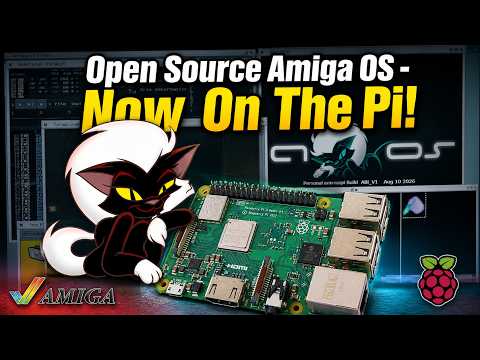
YouTuber Dan Wood tried out the experimental new version
We feel this is a good step for several reasons. Although the native platform for AROS was for many years x86-32, on that platform, AROS is a small fish in a big pond: there’s a vast array of off-the-shelf hardware for x86 PCs, and it’s impossible for a tiny experimental OS to support more than a fraction of it. We have tried and failed to get AROS running on bare metal more than once. For many years, the best way to try it was to run it under VMware thanks to a specialized distro called Icaros Desktop.
The Raspberry Pi represents a much narrower platform: there are only a handful of models of Pi, and as a result, a very small number of GPUs and network interfaces that AROS needs to support. That makes it much easier to offer complete coverage. The Pi is also a fairly severely constrained platform: except for the most recent – and most expensive – models, most of the older and cheaper Pi kit only has either 512 MB or 1 GB of RAM. That isn’t enough to do full justice to Linux, Windows, or any BSD with a graphical desktop – but it’s plenty for AROS. This initial build boots to the Workbench desktop in about five seconds.
And, of course, those lower-end Pis are still cheap, which is always welcome. For now, the Pi version of AROS is a prototype: it’s incomplete, may not be very stable, and lots of things don’t work yet. An important missing part is that it doesn’t have any 680×0 emulation yet, so it can’t run any classic Amiga apps. Even so, we suspect that quite a few old Amiga fans might enjoy playing with a brand-new £30 ($40) Amiga.
If you just want to play your old games, there are much easier ways to do that on a PC. Last year, we also looked at Commodore OS 3 – and in there, we gave PiMiga a mention as well. Both products are free Linux distros bundled with emulators and tons of Amiga apps, games, and demos. Easier still, if you’re a Windows user, just buy a copy of Amiga Forever. Either way, knock yourself out.
AROS is re-invigorating other bits of the Amiga world, as well. Later in 2025, we also reported on a new Amiga web browser, which runs on the A600 GS and A1200 NG computers. These are Arm-based machines which run Amiga software via emulation on an OS called AmiBench – which uses parts of AROS.
TheA1200 is now officially an Amiga
Alongside the A600 GS and A1200 NG Arm-based machines, last year we also mentioned THEA1200 from Retro Games Ltd. This is another Arm-based machine, based around a tweaked emulator, like RGL’s existing Sinclair reproduction The Spectrum.
However, THEA1200 just recently moved one step closer to Amiga legitimacy. On its Facebook page, RGL announced that THEA1200 is officially an Amiga product:
“The Amiga name has a new chapter. With the recent announcement from Mike Battilana and the Amiga Corporate [sic], we’re delighted to see the Amiga brand move forward with a clear and unified future. We’re proud to be part of that future with THEA1200, bringing the Amiga experience to a new generation while celebrating everything that made the original so special.”
As we said last year, THEA1200 is an Arm computer running Linux, which runs a bundled emulator derived from Amiberry. The same is true of the AmigaKit machines we mentioned earlier, the A600 GS and A1200 NG: they too run an emulator based on Amiberry on top of Linux, and inside that, they run AmigaKit’s AmiBench OS.
When RGL says it has come to an agreement with Mike Battilana and Amiga Corp, that means Cloanto. Cloanto is the company that sells AmigaForever, and it owns the Amiga trademarks, the Kickstart ROM, and the rights to the original 680×0 AmigaOS. Inside AmigaForever, along with various retro models for games compatibility, there’s even a higher-spec VM running Cloanto’s updated version of classic AmigaOS, which it calls 3.X – it also has a page about the improvements 3.X contains.


A deal with Cloanto means RGL can bundle the genuine original AmigaOS with TheA1200. This could give TheA1200 an edge over the AmigaKit models in terms of its compatibility with older games and original Amiga apps.
(As one sign of the complexity of Amiga ownership, German developer Hyperion also has an AmigaOS license, for the purposes of developing a PowerPC version. The Register covered this back in 2004, and Hyperion used it to develop AmigaOS 4 – used in, among other things, the Amiga X1000 which The Reg covered in 2010. Controversially, Hyperion is using this license to flog updates to classic AmigaOS: in 2022, we reported on AmigaOS 3.2.2 and in 2025 on AmigaOS 3.2.3.)
Christian Simpson – known on YouTube as Peri Fractic – recently revived Commodore International, and following its FPGA-powered Commodore 64 Ultimate computer, the company also launched a Sailfish-powered smart flip-phone, as The Register covered back in June. The Commodore brand is back, and it’s in the news. However, the revived Commodore doesn’t own the Amiga name, or IP, or code.
Feel free to call us excessively cynical, but we suspect that this could be a motivation behind licensing some Amiga rights to another vendor in 2026. This exposure will increase the value of Cloanto’s IP. Hypothetically, if Cloanto were to sell its rights to the revived Commodore, that could mean it could ask for more money. ®
You must be logged in to post a comment Login