Tech
ATC SCM20ASL Active Loudspeakers Review: Built Like a Tank and Sound Like a Revelation

High-end audio has always had a complicated relationship with diminishing returns. Spend twice as much and you do not get twice the performance, and there are plenty of products that arrive with heroic price tags, beautiful casework, and very little evidence that your money went anywhere near the sound. Every so often, however, something lands in the listening room that makes the equation considerably easier to defend. You hear where the money went. You can feel where the money went. And, in the case of ATC, you may even come away thinking they gave you rather more than you paid for. How novel.
This review is Part II of a three-part ATC trilogy. Part I featured the larger ATC SCM50ASL Active Loudspeakers, which set the bar extremely high, while the final chapter will involve ATC’s $99,999 EL50 Anniversary Active Loudspeakers, scheduled to arrive here in roughly a month. Having already heard the EL50 at AXPONA 2026, I have a reasonably good idea what is coming, although I will still need to explain to my children why two very large British loudspeakers worth more than any car I have ever owned are occupying valuable real estate. My floors have not been consulted.
Sitting between those two experiences are the considerably more compact ATC SCM20ASL Active Loudspeakers, and they raise a much larger question about where high-end audio is headed. Active loudspeakers are becoming increasingly difficult for audiophiles to ignore, and I am not talking about wireless speakers with streaming platforms, apps, DACs, HDMI inputs, and enough DSP to land a small aircraft. The SCM20ASL are something very different. Their analog signal is divided at line level by an active crossover before being sent to dedicated Class A/B amplifiers for the tweeter and mid/bass driver.
There is no external power amplifier, no passive crossover between amplifier and driver, and no need for loudspeaker cables. You still select the preamplifier, DAC, streamer, turntable, phono stage, CD player, or whatever else you want upstream.
For a hobby that has spent decades convincing itself that more boxes, larger power supplies, thicker cables, and increasingly elaborate amplifier matching are necessary steps on the road to enlightenment, that represents a rather significant change in thinking. An active system can eliminate one or more expensive components, remove the amplifier/loudspeaker matching exercise entirely, and allow the manufacturer to design the crossover, amplification, and drivers as one integrated system.
You still need AC power and interconnects running to each loudspeaker, so nobody has repealed the laws of cable management, but the equipment rack can become considerably less crowded.
And none of this appeared last Thursday. ATC, PMC, Amphion, and Genelec have spent decades moving between professional studios and domestic listening environments, giving their engineers the benefit of feedback from people who actually make records as well as those of us who obsessively listen to them.
So at $10,999 per pair, are the ATC SCM20ASL another expensive lesson in diminishing returns, or one of those increasingly rare high-end products where you can actually hear where every damn dollar went?
Related Reviews:
Build Quality: Bring a Friend and Save Your Back

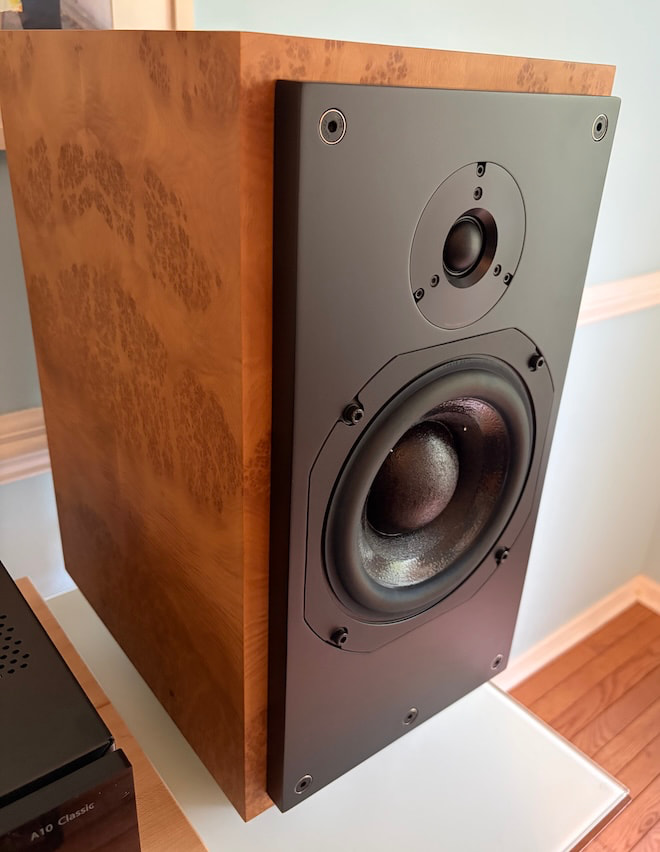
Calling the ATC SCM20ASL a stand-mounted loudspeaker is technically correct in the same way that calling a Bentley a means of transportation is technically correct. At 17 11/16 x 9 13/16 x 16 3/16 inches (HxWxD), the SCM20ASL does not consume a huge amount of floor space, but each loudspeaker weighs 53.6 pounds before you add a pair of stands.
Treat them like floorstanders. Very heavy floorstanders.
I learned this at a particularly inconvenient point during the review. A severe kidney stone attack landed me in the hospital, and the best part of that particular biltong-and-droëwors sandwich was that the treatment was followed by shingles and a severe rash that lasted for weeks. FUN. The upside, if one can call it that, was a lot of enforced time sitting in one place, listening to music and writing. The downside was having a pair of 53.6-pound active loudspeakers in the room that occasionally needed to be repositioned.
Ask a friend to help you set these up. Preferably one you like enough to warn beforehand.
The SCM20ASL cabinets are beautiful in that very British, purpose-driven ATC way. Nobody in Gloucestershire appears to have been asked to make them look like a spaceship or an expensive Italian handbag. The sealed 20-liter enclosure is constructed to be heavy and inert, using internal bracing, damping, and bitumastic panels at critical points to suppress unwanted cabinet resonance.
Knock on the side and you quickly understand that ATC was not looking for ways to save money on MDF or shipping weight. These things are tanks.
And not some cheap Soviet one that a Merkava could drive over on its way to lunch in Kiryat Shmona.
The quality of the cabinetry and veneer work is excellent. Standard finishes include Cherry, Black Ash, Walnut, and Oak real-wood veneers, along with Satin Black and Satin White. Premium options include Rosewood, European Crown Cut Walnut, Burr Magnolia, and Pippy Oak, with various high-gloss finishes, Piano Black, Piano White, and additional special-order options also available.
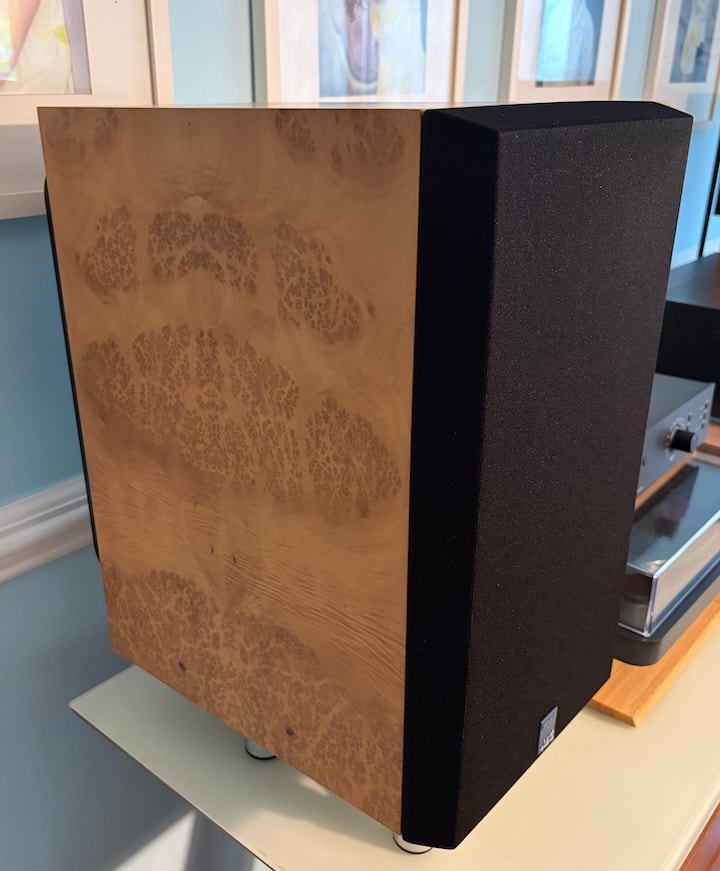
The removable black cloth grilles are another matter.
They do exactly what they are supposed to do: protect two very expensive drivers from fingers, pets, children, and whatever else might wander too close. They also look like they were designed sometime around 1983. My old Celestion Ditton 33 MKII loudspeakers had something similar, so perhaps there is some historical British precedent here.
I left them off.
The SCM20ASL looks considerably better with its 6-inch Super Linear mid/bass driver and recessed 1-inch S-Spec soft-dome tweeter exposed. You paid for the engineering, so you might as well be able to see it. Covering these drivers feels a little like installing a transparent hood on a muscle car and then throwing a blanket over it.

Amplification and Connectivity
Spin the SCM20ASL around and any illusion that this is merely a very substantial bookshelf speaker disappears.
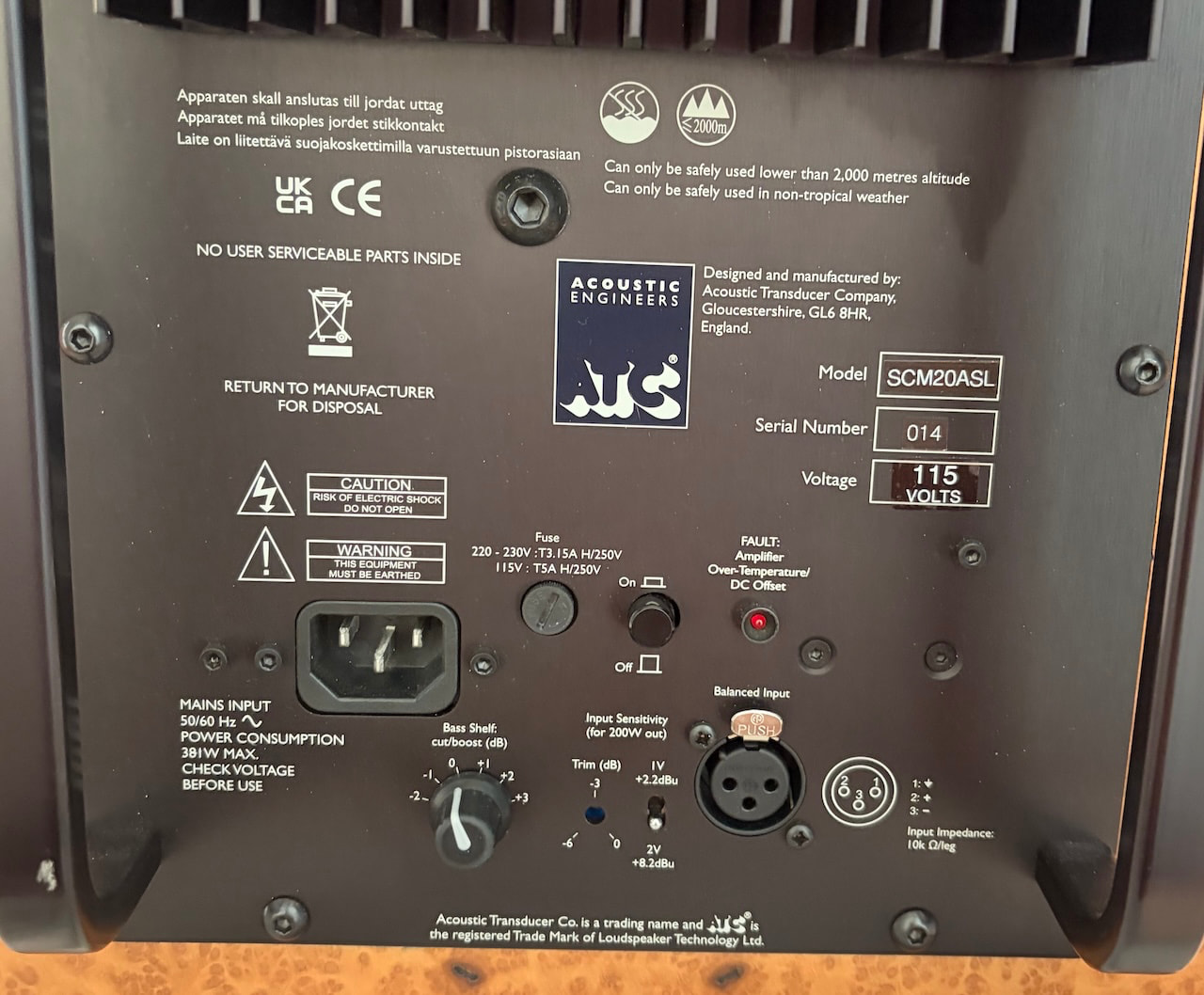
Most of the rear panel is occupied by ATC’s 250-watt amplifier pack, and it looks like a proper power amplifier because that is precisely what it is. A large, heavy-duty heatsink dominates the rear panel, while substantial handles make it considerably easier to maneuver 53 pounds of British engineering onto a stand without introducing it to the hardwood floor.
The handles are not decorative.
Inside are two discrete Class A/B MOSFET amplifiers, with 200 watts dedicated to the mid/bass driver and 50 watts to the tweeter. The amplifiers are convection cooled, hence the formidable heatsinking, and ATC integrates them with an active crossover ahead of the amplification stages rather than sending a full-range amplified signal through a conventional passive crossover.
That distinction matters.
The SCM20ASL is not a passive loudspeaker with an inexpensive amplifier module bolted onto the back so someone can call it “powered.” The drivers, active crossover, amplification, and cabinet were engineered as a complete system.


Connectivity is equally purposeful. Each loudspeaker provides one balanced female XLR analog input and requires its own AC connection. There are no RCA inputs, USB ports, HDMI sockets, streaming modules, Bluetooth radios, or network connections. These are active loudspeakers, not wireless all-in-one systems.
The rear panel also provides controls for input sensitivity and a low-frequency shelf. Input sensitivity can be adjusted from 1Vrms to 4Vrms for full output, while the bass control provides adjustment from -2dB to +3dB in 1dB increments, giving listeners some flexibility when dealing with room boundaries and placement.
Protection circuitry monitors amplifier DC offset and overheating, with a rear-panel LED providing fault indication.
It all feels engineered for decades of use rather than a product cycle.
ATC SCM20ASL Drivers: Two Is Plenty
There are only two drivers staring back at you, but ATC apparently decided that both of them had better be rather good.
The 6-inch SB75-150SL Super Linear mid/bass driver handles everything up to the 2.2kHz crossover point and uses an unusually large 3-inch voice coil with ATC’s underhung motor architecture. Its Super Linear Magnetic System is designed to reduce magnetic distortion in the motor structure, particularly through the bass and midrange where so much of the musical information lives. The driver also offers substantial linear excursion for its size, which becomes rather important once you start asking a compact sealed loudspeaker to behave like something considerably larger.


Above 2.2kHz, ATC’s 1-inch SH25-76S S-Spec soft-dome tweeter takes over. It is also designed and manufactured in-house and uses ATC’s dual-suspension architecture to improve stability and control of the dome and voice coil. The tweeter does not use ferrofluid and is designed for high output, low distortion, and long-term reliability rather than simply chasing an impressive upper-frequency number.
Both drivers are proprietary ATC designs, and that matters. The SCM20ASL is not a cabinet assembled around a pair of off-the-shelf transducers with an amplifier attached to the back. The drivers, amplification, active crossover, and sealed enclosure were engineered as a complete system.
And if you are looking at two drivers in a cabinet this size and wondering whether they can provide enough scale and low-frequency authority for a 16 x 13 x 9-foot or even 20 x 13 x 9-foot room, prepare to put the subwoofer back in the box.
These things have considerably bigger lungs than their dimensions suggest.
Setup: 54 Pounds of British Engineering Needs a Proper Perch
One slightly odd omission at this price is that ATC does not offer a dedicated factory stand for the SCM20ASL. ATC recommends using a heavy, rigid, non-resonant stand with the acoustic center at or just above ear level, but leaves the actual hardware choice to you. There are purpose-built third-party options, including the Custom Design OM44 and SQ 404, both offered specifically for the SCM20/SCM20ASL.
None of the stands I had on hand from Gig Harbor Audio, Q Acoustics, or Wharfedale were a good match. The height was workable, but the top plates were too small for a 53.6-pound loudspeaker this deep, and I had zero interest in testing their stability with Tyrion the Westie tearing around the house.
Fortunately, I had IsoAcoustics Aperta stands and OREA isolation footers, which allowed me to use the SCM20ASL safely on two different credenzas.
My BDI credenza proved to be the better option because I could pull the speakers farther from the wall, with the tweeters sitting slightly above ear level from the sofa. The second credenza placed the tweeters almost perfectly at ear level, but left the rear of the cabinets only 8 inches from the wall.
The sealed design made that placement less problematic than it would be with many rear-ported speakers, but the BDI setup ultimately gave me more flexibility and better results.

Listening
Because each SCM20ASL accepts its analog input through XLR, you need some means of controlling volume before the signal reaches the loudspeakers. That can be a DAC or network player with variable output, or a conventional preamplifier feeding the ATCs through XLR. A fully balanced signal path is not mandatory, although it certainly opens up more options with this type of loudspeaker.
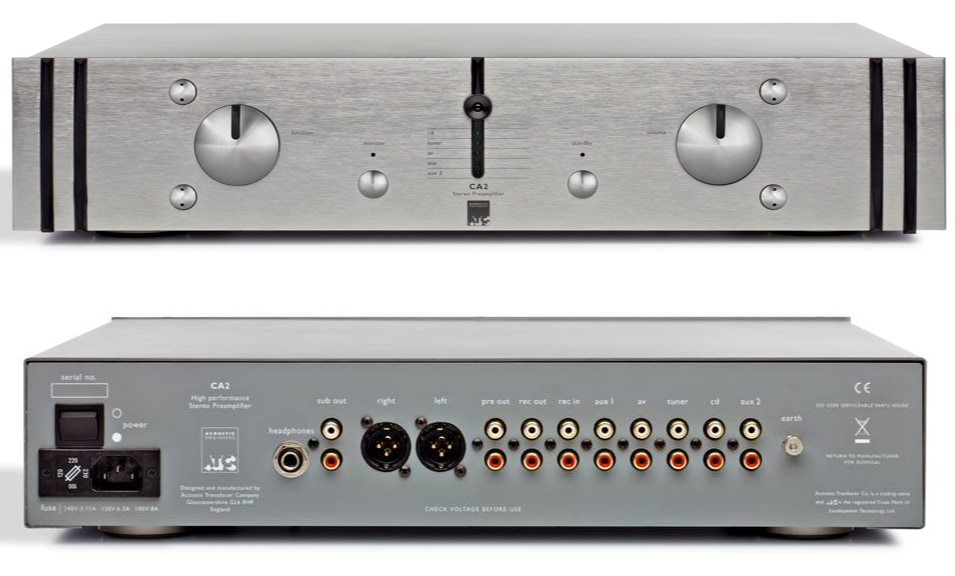
ATC makes two very good analog preamplifiers of its own. The SCA2 is the considerably more expensive flagship and provides genuinely balanced XLR inputs and outputs, while the less expensive CA2, which ATC supplied for this review, uses XLR output connectors but is actually an unbalanced design internally. The CA2 currently sells for $3,749, versus $12,999 for the SCA2, so there is quite a bit of daylight between them. You can obviously use your own preamplifier, and I suspect a lot of SCM20ASL owners will already have something rather good sitting in their rack.
They should.
One of the defining characteristics of the SCM20ASL is just how revealing it is of everything placed ahead of it. That does not mean you need to start burning $100 bills in the driveway before listening, but these loudspeakers are sufficiently transparent that better sources, DACs, phono stages, and recordings produce very obvious dividends. Based on other systems in which I have heard the SCM20ASL and larger ATC active models, I am not entirely convinced that I extracted even 90 percent of what these loudspeakers are capable of with the equipment available to me.

My analog front end consisted primarily of my Thorens TD-160 Super with an Ortofon 2M Black, feeding an E.A.T. phono preamplifier. Digital sources included the Bluesound NODE Icon Network Player with my Holo Audio Spring 3 DAC, along with the Cambridge Audio CXN100 Network Player. I even inserted the WiiM Ultra into the system because inexpensive digital front ends deserve their day in court as well. Audiolab and Marantz CD players and transports handled physical media.
Interconnects, power cords, and digital cables came from Cardas, Audio Art Cable, QED, Analysis Plus, and Clarus Audio, and I swapped enough of them during the review period to confirm something more important than which cable cost what: the SCM20ASL does not obscure changes upstream.
And that is where reviewing them becomes dangerous. The better the source became, the more the ATCs revealed, which raises the uncomfortable possibility that the $10,999 loudspeakers are not the component in your system you should be worried about.
No Warm-Up Required
One of my few nitpicks with the larger SCM50ASL was that they needed some volume before everything really started to click. At lower listening levels, some of their clarity, dynamic presence, and overall magic receded; once I became more liberal with the volume control, they were magnificent. The SCM20ASL did not behave that way. Right from the get-go, with Nick Cave, Jonatan Alvarado, and Jason Isbell, these smaller ATCs sounded fully engaged, even when I wasn’t trying to shake the furniture.
Something else became obvious very quickly: bad recordings will not be handled with tender hands. If a recording sucks, the SCM20ASL will let you know exactly how and where. Fortunately, the material I started with was well recorded and provided three very different male voices with which to judge tonal accuracy, texture, image stability, and the speaker’s ability to make a human voice sound like an actual human being.
Nick Cave’s growl, edge, and natural weight were exceptionally well served by the ATCs. There was clarity and inner detail for days, but none of it sounded clinical or dissected, which might surprise anyone expecting a loudspeaker with deep professional-audio roots to behave like a laboratory instrument. Cave had texture, chest, and physical presence, with enough impact to make his voice feel as though it had entered the room and hit me with a car. Nothing enormous. A Fiat 500 or Mini Cooper. But you’re definitely exchanging insurance information afterward.
“Avalanche” has always hit me differently depending on where my head was at when I listened to it, and the story behind the song connects with me on a very personal level. Through the SCM20ASL, the piano was reproduced with a combination of delicacy, weight, and percussive power that is extremely difficult to get right. Piano can expose a loudspeaker very quickly because the attack, harmonic structure, decay, and sheer physical weight of the instrument all have to work together. The ATCs created a rock-solid central image and allowed individual notes to carry both their initial impact and the quieter information that followed.
The soundstage in my system was not especially deep, although I am inclined to blame some of that on my placement limitations rather than the loudspeaker. Image specificity, however, was superb.
Argentine tenor Jonatan Alvarado provided a very different test. His lighter, almost ethereal vocal presentation was positioned noticeably farther back in the soundstage, which is precisely where I expected it to be. I have listened to the same recording through more than 40 pairs of loudspeakers, and only a handful have recreated that spatial relationship convincingly. The Bowers & Wilkins 703 S3, which I reviewed in 2023, was one of the best in that regard; the SCM20ASL belongs in the same very short conversation. The image was stable, appropriately distant, and frighteningly human.
Shivers down the spine.
Jason Isbell brought an entirely different kind of intensity. He remains one of the more underrated American songwriters of his generation, with a style that moves comfortably through country, rock, folk, and Southern roots music, but it is the combination of his guitar work and forceful vocal delivery that I find so compelling. Through the ATCs, that power was not created by pushing his voice artificially forward or sharpening its edges. The SCM20ASL preserved the texture, scale, and emotional force of the performance without turning it into a demonstration of how much detail the speaker could retrieve.
That might be the most important point.
The SCM20ASL are exceptionally revealing loudspeakers, but revealing and clinical are not the same thing. These speakers can dissect a poor recording without mercy and then turn around and make a great vocal recording feel unsettlingly human.
That is a much harder trick.
Put the Subwoofer Back in the Box
My primary listening room can be overloaded by loudspeakers with too much low-end energy, especially when they are pushed too close to the corners. Because the SCM20ASL were not positioned where most of my review speakers normally reside, I wasn’t entirely sure what to expect.
Unless your listening room is a cavern or some enormous open-concept loft, I suspect most listeners will find the SCM20ASL deliver more than enough bass on their own. The low end is tight, quick as hell, full, and genuinely impactful, without sounding thick or artificially enhanced.


I’ve been on something of a Rush kick lately because of the Fifty Something Tour, and “Xanadu” seemed like an entirely sensible way to determine how hard these little British tanks could be pushed. At what my children would describe as “WTF is wrong with you, Daddy?” levels, the SCM20ASL barely flinched. Alex Lifeson, Geddy Lee, and the late-Neil Peart remained firmly separated across the soundstage, with the scale, speed, and impact of the performance intact. “Xanadu,” from A Farewell to Kings, remains one of Rush’s great showcases for the interplay between all three musicians.
I was air drumming like the nerdy teenager who first saw Rush at Maple Leaf Gardens in the early 1980s.
Metallica, AC/DC, and The Police only reinforced the point. The SCM20ASL could play hard and extremely loud without turning everything into a congested wall of sound, and bass lines remained easy to follow even when guitars and percussion were going full throttle. Unless your objective is to have your significant other put something lethal in the biltong that just arrived from South Carolina, there is a lot more output here than the cabinet dimensions suggest.
Switching to Peter Gabriel’s “Sledgehammer,” Talking Heads’ “Born Under Punches,” Boards of Canada’s “Roygbiv,” Aphex Twin’s “Xtal,” The Orb’s “Little Fluffy Clouds,” and Kraftwerk’s “The Robots” revealed another strength. The ATCs could unravel dense layers of synthesizers, electronic percussion, bass, effects, and vocals with exceptional specificity while still presenting them as a coherent piece of music.
The SCM20ASL can pull a recording apart with almost forensic precision, but it does not leave the pieces scattered across the floor. Synths had weight and texture, electronic percussion had real snap, and the top end remained highly revealing without becoming hard unless the recording itself was dreck.
Timing, Texture, and No Place to Hide
I do not live in a house that particularly likes jazz. My kids are far more interested in MF DOOM, Tyler, the Creator, and about 30 other artists I couldn’t identify in a police lineup even if they were wearing name tags. And I should know. I’ve been in a few.
Jazz is therefore a late-night or very early-morning thing for me. I’m up at 5 a.m. every friggin’ day, which gives me a narrow window before the rest of the house starts moving. I make some Rooibos tea; I’ve stopped dipping the biltong, leave the lights off, and wait for the sunrise over the ocean five blocks away to slowly illuminate the room.
Then I close my eyes and think.
About the good things I’ve done. The bad things. The things I would change if the universe offered refunds. And, more often than I probably should, about one very specific person. Apparently this is how the universe has chosen to punish me. Some of it is probably deserved.
Miles Davis, Lee Morgan, McCoy Tyner, Donald Byrd, and Eric Dolphy have become the soundtrack for those hours, and this is where the SCM20ASL did something that very few loudspeakers manage. It could reproduce the intimacy, tension, anger, remorse, regret, and longing inside these recordings without turning any of it into an audiophile demonstration.
The ATCs let you hear frighteningly deep into a performance, but what matters is that they never forget there were actual people behind those notes. Imperfect people. Complicated people. Musicians trying to communicate something they perhaps could not say any other way. You hear the breath behind a horn, the weight of a piano key, the tension in a bass line, the decay of a cymbal into the room — but none of it feels clinical or sanitized.
There is something almost visual about it. A dim room. A stool. A piano. An ashtray somewhere nearby. The remains of a long night hanging in the air. Not because the ATC manufactures atmosphere, but because it preserves enough of what was captured to let your brain fill in the rest.
Very few loudspeakers I have heard can do that this convincingly. Maybe one percent.
The SCM20ASL can sound enormous when the music demands it, but its real gift may be how small and intimate it can become when there is nowhere for the emotion to hide.
The ATC understands that the notes are only half the story.

The Bottom Line
The ATC SCM20ASL are among the finest active loudspeakers I have heard because they combine studio-grade transparency with the kind of texture, weight, intimacy, and emotional connection that far too many “revealing” speakers manage to lose along the way. Their active architecture removes the amplifier-matching game entirely, the build quality is exceptional, and their ability to scale from late-night jazz to Rush at antisocial volume levels is genuinely impressive.
What are they missing? There is no wireless connectivity, streaming platform, digital input, room correction, or RCA connection, and ATC really should offer a dedicated stand for a loudspeaker this heavy and expensive. They also expose poor recordings and mediocre sources without much mercy.
At $10,999 per pair, the price is substantial, but context matters. Passive loudspeakers capable of this level of resolution, dynamics, and tonal accuracy are not inexpensive, and adding a truly comparable power amplifier can make the final bill considerably uglier.
The SCM20ASL are not cheap.
They are, however, one of those rare high-end products where it is very easy to hear where the money went.
Pros:
- Exceptional transparency without sounding clinical
- Superb dynamics, speed, and low-frequency control
- Excellent performance at both low and high listening levels
- Proprietary ATC drivers and dedicated Class A/B amplification
- Outstanding build quality and cabinet construction
- Reveals source and recording quality with remarkable clarity
- Can deliver serious scale without requiring a subwoofer in most rooms
- Removes the cost and guesswork of amplifier matching
Cons:
- $10,999 per pair is still a significant investment
- No wireless connectivity, streaming, DAC, room correction, or digital inputs
- XLR-only analog input limits some system configurations
- Poor recordings and mediocre sources get very little forgiveness
- Extremely heavy for a stand-mounted loudspeaker
- ATC does not offer a dedicated matching stand
- Grilles are functional but visually rather dated
Our Ratings:
★★★★★★★★★★ Sound Quality
★★★★★★★★★★ Build Quality
★★★★★★★★★★ Connectivity
★★★★★★★★★★ Value
For more information: lonemountainaudio.com | Locate dealers
You must be logged in to post a comment Login