In October 2025, Atlassian co-founder and CEO Mike Cannon-Brookes appeared on the 20VC podcast and said something that now reads rather differently. Technology creation, he argued, is ‘not output-bound.’ Atlassian would employ more engineers in five years, not fewer. They would just be more efficient.
On 11 March 2026, Mike Cannon-Brookes sent a memo to staff announcing 1,600 redundancies, approximately 10% of the company’s global workforce, framed as a necessary adaptation to the AI era.
The same week, the company’s shares had lost more than half their value since January, swept up in a sector-wide rout that traders have been calling the ‘SaaSpocalypse’: a sustained selloff in enterprise software stocks driven by investor fears that AI agents could make conventional SaaS tools obsolete.
The stated rationale in the memo was future-facing. Atlassian said the cuts would allow it to ‘self-fund further investment in AI and enterprise sales, while strengthening our financial profile.’ Cannon-Brookes was careful in his framing.
“Our approach is not ‘AI replaces people.’ But it would be disingenuous to pretend AI doesn’t change the mix of skills we need or the number of roles required in certain areas. It does. This is primarily about adaptation. We are reshaping our skill mix and changing how we work to build for the future.”
Advertisement
More than 900 of the affected roles are in software research and development, according to reporting from Implicator.ai.
By geography, North America bears the largest share, 40% of cuts, or around 640 people, followed by Australia at 30% (roughly 480), and India at 16% (around 250). The remainder is spread across Japan, the Philippines, and offices across Europe, the Middle East, and Africa. Atlassian filed a WARN notice in Washington state showing 63 affected workers, the majority of them remote employees in engineering and data science roles.
Departing employees will receive a minimum 16-week separation package, with one additional week per year of service, a pro-rated FY26 bonus, a $1,000 technology payment, and six months of extended healthcare coverage.
The restructuring is expected to cost between $225 million and $236 million in total charges, split between severance ($169–174 million) and office space reductions ($56–62 million), with most costs landing in the company’s third fiscal quarter. Atlassian said the cuts should be largely complete by the end of June 2026.
Advertisement
Alongside the layoffs, Atlassian confirmed that Rajeev Rajan will step down as chief technology officer on 31 March, after nearly four years in the role. Rajan, previously a VP of engineering at Meta and a two-decade veteran of Microsoft, has not publicly commented on the departure.
The company described it as a generational transition: two executives, Taroon Mandhana and Vikram Rao, will split the CTO responsibilities going forward. Mandhana, formerly Atlassian’s head of engineering for AI and products, takes the title of CTO Teamwork; Rao, previously chief trust officer, becomes CTO Enterprise and Chief Trust Officer. Atlassian described both as ‘next generation AI talent.’
The restructuring sits in some tension with Atlassian’s underlying trading performance. The company reported cloud revenue of approximately $1.067 billion in its most recent quarter, up 26% year on year. Remaining performance obligations, a forward indicator of contracted future revenue, stood at roughly $3.814 billion, up 44%.
Its Rovo AI assistant crossed five million monthly active users in February, and the company now counts more than 600 customers generating over $1 million in annual recurring revenue.
Advertisement
Atlassian reaffirmed its full-year financial guidance for the fiscal year ending June 2026 in the same SEC filing that disclosed the cuts.
That combination, strong operational metrics, healthy forward revenue, and 1,600 redundancies, has sharpened scrutiny of what is actually driving these decisions across the industry.
OpenAI CEO Sam Altman described the practice of using AI as justification for cuts made for other reasons as ‘AI washing’ in February, noting that fewer than 1% of 2025 job losses could be directly attributed to artificial intelligence.
Atlassian is not alone in the pattern.
Advertisement
Block cut roughly 4,000 employees last month as Jack Dorsey declared a shift to an ‘intelligence-native’ model, and the stock jumped the day after the announcement. WiseTech Global, another Sydney-based software firm, announced 2,000 cuts over two years. Oracle said AI was enabling it to shrink some development teams.
By early March 2026, tech layoffs globally had surpassed 45,000, according to RationalFX, with AI among the most frequently cited justifications. Whether the technology is genuinely driving workforce changes or serving as a convenient explanation for restructuring decisions shaped primarily by investor pressure is a question that has no clean industry-wide answer, and that Atlassian’s own numbers make harder, not easier, to resolve.
Atlassian has been unprofitable since 2017. Its shares were down around 33% for 2025 before the SaaSpocalypse selloff, and have fallen more than 84% from the peak they reached in 2021 during the pandemic-era surge in cloud-based collaboration tools.
The stock rose around 2% in after-hours trading following the restructuring announcement, the same market logic that rewarded Block, and that Cannon-Brookes might have had in mind when he wrote, with notable precision, about the bar for what ‘great’ looks like for software companies having gone up.
5G covers under 40% of landmass. This Whitepaper details how 3GPP Release 17 addresses six satellite challenges: delay, Doppler, path loss, polarization, spectrum, and architecture.
What Attendees will Learn
Why non-terrestrial networks are now integral to the 5G roadmap — Understand how the Third Generation Partnership Project (3GPP) Release 17 incorporates satellite-based connectivity into the 5G system, targeting ubiquitous coverage across maritime, remote, and polar regions where terrestrial networks reach less than 40% of the world’s landmass. Learn the distinction between New Radio non-terrestrial networks for mobile broadband and Internet of Things non-terrestrial networks for low-power machine-type communications.
How satellite constellation design shapes coverage, capacity, and latency — Examine how orbit altitude (low earth orbit, medium earth orbit, geostationary earth orbit), beam footprint geometry, elevation angle, and inclination determine coverage area, round-trip time, and differential delay across user equipment within a single beam. Explore the trade-offs between transparent bent-pipe and regenerative onboard-processing payload architectures.
What radio frequency challenges distinguish satellite links from terrestrial propagation — Explore the six major technical challenges: high free-space path loss, time-variant Doppler, differential delay across large beam footprints, Faraday rotation of polarization through the ionosphere, and spectrum coexistence between terrestrial and non-terrestrial bands in the S-band and L-band.
How 5G protocols must adapt to support non-terrestrial connectivity — Learn the specific amendments to hybrid automatic repeat request operation, timing advance control (split into common and user-equipment-specific components), random access procedure timing extensions, discontinuous reception power saving adaptations, earth-fixed tracking area management, conditional handover mechanisms, and feeder link switching for service continuity in a unique propagation environment.
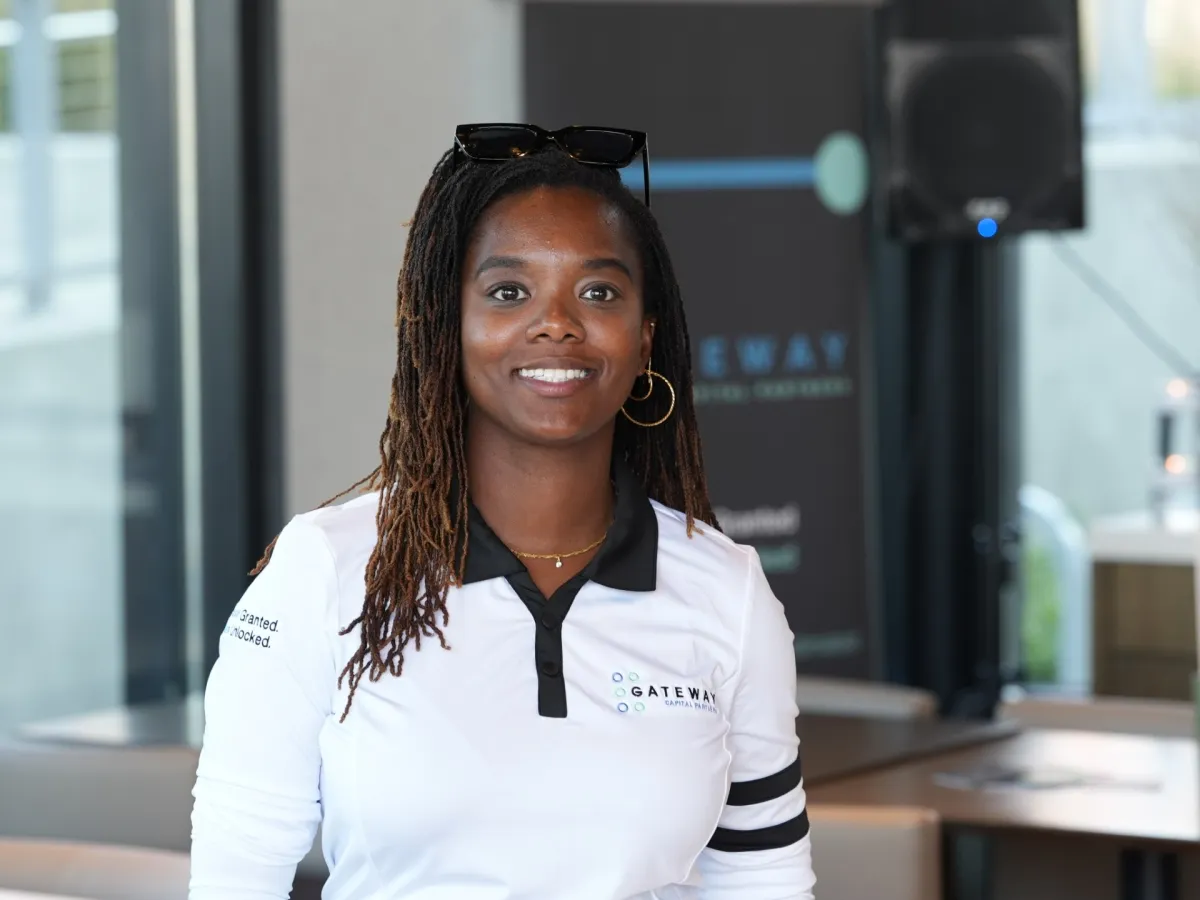
Gateway Capital Partners, the venture firm founded by Dana Guthrie, announced the first close for its $25 million target Fund II earlier this week, the Milwaukee-based firm told TechCrunch. Gateway Capital declined to share the exact amount of the first close.
The first close means Fund II can begin its investment operations.
Guthrie said the firm began raising its Fund II in the middle of last year. Fund II’s average check size will be between $500,000 and $600,000.
It will be industry-agnostic, she said, though it will have “a bias toward Midwest industries that are ripe for disruption,” such as supply chain and logistics, and manufacturing AI. Guthrie said she hopes to back at least 20 companies from this fund.
Advertisement
Gateway Capital, launched in 2020, last raised a $13 million Fund I in 2020.
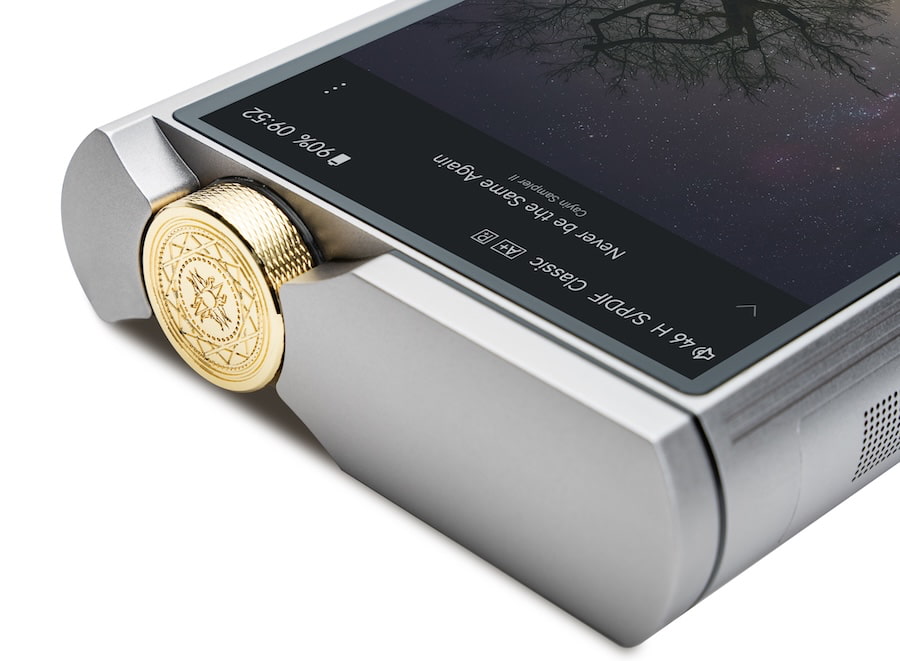
Cayin has officially taken the wraps off the N8iii, its next generation flagship digital audio player (DAP), and this time there is enough real information to move past speculation. The timing matters. Astell&Kern continues to dominate the premium tier with refined hardware and software, FiiO has become far more aggressive at the top end, and iBasso keeps pushing output and modular flexibility. Cayin is no longer competing in a niche it helped create. It is now part of a very crowded field where execution matters more than ambition.
Cayin is positioning the N8iii as a limited release with just 500 units worldwide and a suggested retail price of $3,999, placing it squarely in the upper tier of the DAP market and making it clear this is not intended for a broad audience.
A Flagship That Sticks With Tubes
Cayin is continuing with its hybrid tube and solid state approach. The N8iii introduces a Triple Timbre system with Tube Classic, Tube Modern, and Solid State modes. This is less about novelty and more about giving users different tonal options depending on the headphone and music. Cayin has been consistent here. It is one of the few brands willing to deal with the complexity of tube integration in a portable device, even if that comes with tradeoffs in size, heat, and battery life.
Power Output and Amplifier Design
The N8iii offers up to 900 milliwatts single ended and 1285 milliwatts balanced output, which translates to roughly 0.9 watts and 1.285 watts respectively. That is enough power for a wide range of headphones, including many planar magnetics and most dynamic designs in the portable category. It should not have any issue with efficient or moderately demanding full size headphones.
Where things get less certain is with high impedance dynamic headphones. Models in the 300 to 600 ohm range often require voltage swing as much as current, and Cayin has not provided enough detail yet to determine how the N8iii handles that. It is likely usable, but whether it offers full control and headroom is still an open question.
Advertisement
It is also worth stating the obvious. This is not designed for electrostatic headphones. That requires a completely different amplification approach, and Cayin is not trying to solve that problem here.
Cayin includes triple amplifier modes and dual output modes, which gives users some flexibility in how the player behaves, but it also adds complexity that will need to be justified in real world use.
DAC & Platform
Cayin is moving forward with a new flagship AKM DAC architecture, although full details have not been confirmed. That will appeal to listeners who prefer the AKM presentation, especially after several years where ESS dominated the category.
The N8iii runs on a Snapdragon 665 platform with 8GB of RAM and 256GB of internal storage. That is not cutting edge by smartphone standards, but it is in line with what most high end DAPs are using and should be sufficient for streaming and local playback without performance issues.
Advertisement
Software & Battery
The player uses a customized Android audio system with DTA, allowing SRC bypass for bit perfect playback across supported apps. This is expected at this level and Cayin is in line with the rest of the market here.
Battery capacity is listed at 13,500mAh with PD2.0 fast charging. That is a large battery, which makes sense given the use of tubes and relatively high output power. Actual runtime will depend on how those features are used, and Cayin has not provided estimates yet.
Advertisement. Scroll to continue reading.
The Competition
At this price and level, Cayin is up against established competition. Astell&Kern offers more polished industrial design and a mature user experience. FiiO is delivering strong performance with competitive pricing. iBasso continues to push output power and modular flexibility. These are complete products that balance sound quality with usability.
Cayin’s approach remains more specialized. The N8iii focuses on offering a different listening experience rather than trying to be the most practical option.
Advertisement
Cayin N8ii vs N8iii: What’s Actually Changed
Looking at the available data, the jump from the N8ii to the N8iii is not about reinventing the concept. Cayin is refining it, adding flexibility, and pushing output a bit further while trying to clean up some of the practical limitations that came with the earlier design.
The N8ii already established the blueprint. Snapdragon 660 platform, 6GB of RAM, 128GB storage, Android 9, ROHM DACs, and dual Nutube implementation. It was powerful for its time, but it also felt like a device that prioritized experimentation over usability. Battery life hovered around 8 to 11 hours depending on mode, the chassis was thick and heavy at around 442 grams, and while the output was respectable, it was not class leading.
On the output side, the N8ii delivered up to 420mW at 16 ohms from the single ended output in standard mode, and up to 720mW in its higher power setting. Balanced output pushed that further to 760mW standard and up to 1200mW in its higher power mode. That translates to roughly 0.76W to 1.2W balanced depending on how hard you push it. In practical terms, it could handle most headphones reasonably well, but it was not the last word in authority, especially with higher impedance dynamics where voltage swing matters more than raw wattage.
The N8iii moves that forward, but not dramatically. Cayin is now quoting up to 900 milliwatts single ended and 1285 milliwatts balanced output, which translates to roughly 0.9 watts and 1.285 watts respectively. That is enough power for a wide range of headphones, including many planar magnetics and most dynamic designs in the portable category. It should not have any issue with efficient or moderately demanding full size headphones.
Advertisement
Where things remain uncertain is with high impedance dynamic headphones. The increase in output is incremental, not transformative, and Cayin has not provided detailed voltage specs yet. That means headphones in the 300 to 600 ohm range may still be usable, but not necessarily driven to their full potential. And just to be clear, neither the N8ii nor the N8iii is designed for electrostatic headphones, so that remains outside the scope entirely.
The more meaningful change is in flexibility. The N8ii gave you tube or solid state. The N8iii expands that into Triple Timbre with Tube Classic, Tube Modern, and Solid State. That suggests Cayin is focusing more on user tuning and adaptability rather than just raw performance gains. It is a shift toward giving listeners more control over presentation depending on the headphone pairing.
Internally, there is also a shift in direction. The N8ii relied on dual ROHM BD34301 DACs, which offered a certain tonal character that some preferred over ESS implementations. The N8iii is moving to a new flagship AKM architecture, which likely signals a different tuning approach. That is not inherently better or worse, but it does indicate Cayin is responding to market preferences and the return of AKM supply.
Platform and usability are also getting a modest update. The N8iii moves to 8GB of RAM and 256GB of storage, along with a Snapdragon 665. That is not cutting edge, but it is an improvement and should make the device feel less constrained with modern streaming apps. The inclusion of a customized Android audio system with SRC bypass brings it in line with what competitors have already been doing, rather than pushing ahead.
Battery is another area where Cayin appears to be compensating for its design choices. The N8ii used a 10,000mAh battery rated at 38Wh and delivered between roughly 8 to 11 hours depending on mode. The N8iii increases that to 13,500mAh and adds PD fast charging. That suggests Cayin is trying to offset the power demands of tubes and higher output rather than fundamentally improving efficiency.
Advertisement
The rest of the design philosophy remains consistent. Both devices are heavy, complex, and not particularly concerned with being pocket friendly. Both are built around the idea that a portable device can approximate a desktop listening experience if you are willing to accept the tradeoffs.
Advertisement. Scroll to continue reading.
The Bottom Line
The Cayin N8iii builds on what the company has been doing with its flagship line. It keeps the tube hybrid concept, adds more flexibility in tuning, and delivers enough power for most headphones people are likely to use with a portable device. It is not intended to cover every use case. High impedance dynamics may still require more careful matching, and electrostatic headphones are not part of the equation.
At nearly $4,000 USD and with only 500 units available, this is a focused product for a specific audience. The competition is strong and more well rounded than it used to be. Cayin is relying on differentiation and sound tuning to justify its place at the top. Whether that is enough will depend on how it performs outside of the spec sheet.
What the charts from the previous model make clear is how much detail still has not been confirmed for the N8iii. The N8ii offered a very complete set of physical connections including both 3.5mm single ended and 4.4mm balanced headphone outputs, along with matching line outputs on both connections. It also included digital outputs over USB and I2S via a mini HDMI connection, plus coaxial S PDIF. That made it more than just a portable player. It could function as a transport or DAC in a larger system. With the N8iii, Cayin has not yet clarified whether all of those outputs carry over unchanged, or if anything has been added or removed. Given how important that flexibility is to this category, that is not a small omission.
Advertisement
Bluetooth is another area where details matter. The N8ii supported a wide range of codecs including LDAC, UAT, AAC, and SBC, with both transmit and receive capability. That placed it ahead of many competitors at the time, especially with UAT support for higher bandwidth wireless audio. So far, Cayin has not confirmed the codec support for the N8iii. If it remains unchanged, it is still competitive. If it has been updated, that could be a meaningful improvement. If it has been simplified, that would be a step backward. Right now, we simply do not know.
The digital section is where the lack of detail becomes harder to ignore. The N8ii supported PCM up to 32-bit/768kHz and DSD512 over USB and I2S, along with DoP support over coaxial. It could function as a USB DAC across multiple platforms and offered asynchronous USB audio with broad compatibility. Those are not niche features. They are part of what makes a flagship DAP viable as a hub in a desktop or transport based system. Cayin has confirmed a new DAC architecture for the N8iii, but has not yet outlined the full range of supported formats, digital input and output capabilities, or whether its USB DAC functionality has been expanded or refined.
MSRP: $3,999 (launch date not confirmed at en.cayin.cn).
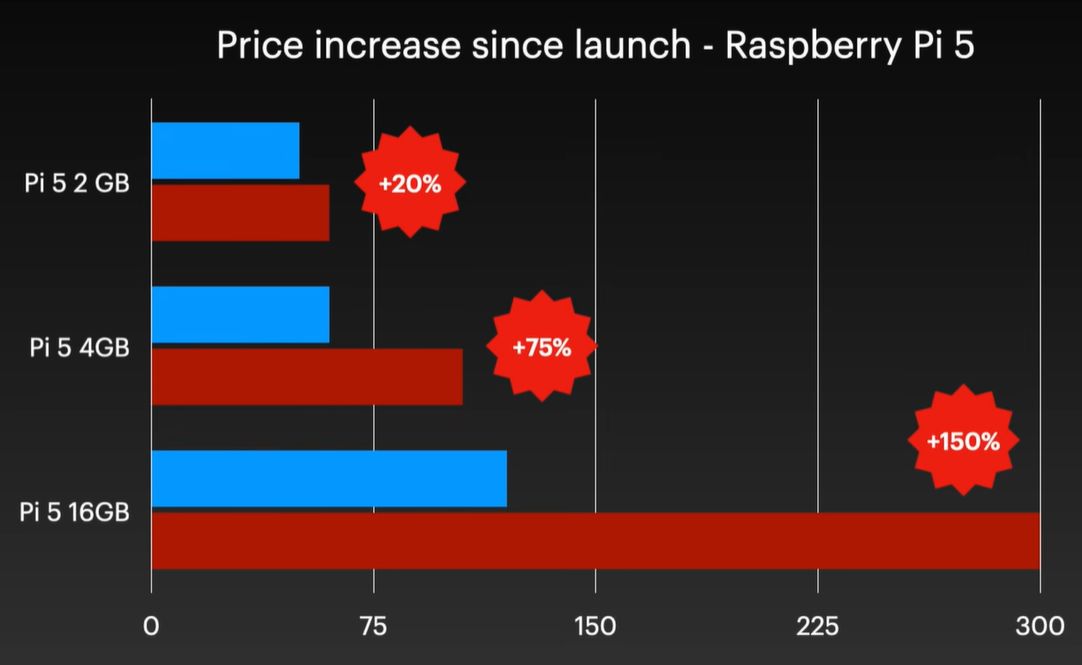
Raspberry Pi 5 price increases. (Credit: Jeff Geerling)
Although easily dismissed by some as another cruel April Fools joke, Raspberry Pi’s announcement of a new 3 GB model of the Raspberry Pi 4 along with (more) price increases for other models was no joke. Courtesy of the ongoing RAMpocalypse, supplies of LPDDR4 and LPDDR5 are massively affected, leading to this new RPi 4 model with two 1.5 GB LPDDR4 chips, as these are apparently cheaper to source.
Affected in this latest price increase across RP’s product range are RPi 4 and 5 models with 4 or more GB of RAM, with price bumps ranging from $25 on the low end to $150 for the Raspberry Pi 500+. If you wanted a Raspberry Pi 5 with 16 GB of RAM, you’re now paying $300 for the privilege.
Obviously, this news has got people like [Jeff Geerling] rather down in the dumps, essentially stating that using SBCs like the RPi is now beyond the means of many hobbyists. While you can still use SBCs that use e.g. LPDDR2 RAM, such as the older RPi Zero, 2 and 3 models, [Jeff] himself is now moving more towards wrangling with snakes on MCUs, as these boards are so far not significantly affected in terms of price.
With current projections in the RAM market being that this year will still see more price increases, it remains hard to tell exactly how ‘temporary’ this situation will be. That said, using readily available, powerful and cheap MCUs like the ESP32 variants for projects isn’t a bad idea if you really don’t need to be running more than perhaps FreeRTOS.
Google has confirmed that its Pixelsnap Charger receives firmware updates automatically and silently while charging a Pixel phone, with the latest release sitting at version 1.51.0.
Pixel owners can verify their charger’s firmware status by navigating to Settings, then Connected devices, and selecting the charger from the list of paired accessories, giving users a straightforward way to confirm whether their unit is running the most current software.
The updates maintain Qi compatibility and keep the charger performing at its intended standard, with Google framing the silent background update process as a hands-off approach that requires no input from the user during normal charging use.
The automatic update mechanism sets the Pixelsnap Charger apart from the vast majority of wireless chargers on the market, where firmware is either fixed at the factory or requires proprietary software and a PC connection to update, a process that most consumers never attempt.
Advertisement
For users without a Pixel device, Google has launched a dedicated web portal at pixel.google.com/pixelsnap that enables manual firmware updates through a different method, plugging the USB-C end of the charger into any Android 16 or newer phone and visiting the page through mobile Chrome rather than a desktop browser.
Advertisement
How to update manually
The manual update process involves selecting the Pixelsnap Charger from a list of compatible devices within the web portal, granting Chrome access to the connected accessory, and following the on-screen instructions to check and install any available firmware releases.
Google updated its Pixelsnap support documentation with these details over the past three months, suggesting the manual update pathway has been available quietly for some time before receiving wider attention from users and third-party publications.
Advertisement
The $39.99 Pixelsnap Charger sits within Google’s broader Pixel accessory ecosystem, and the introduction of a firmware update infrastructure reflects a growing expectation that charging hardware should receive software support in the same way smartphones and smartwatches do.
Users can check whether their charger requires an update at any time through either the Settings menu on a paired Pixel phone or by visiting the dedicated support portal on a compatible Android device.
Everyone’s four favorite anthropomorphic turtles are returning to the world of video games. Teenage Mutant Ninja Turtles: Empire City will be released on April 30 for the Meta Quest, Steam VR and Pico. It is made by VR game company Cortopia Studios and will retail for $25. Empire City is a first-person action game that you’ll be able to play solo or co-op with up to four people. And yes, that means all four of the turtles are playable.
We’ve seen a lot of the quartet flexing their fighting form in games over the years, but this is their first time appearing in a standalone VR title. In addition to the shelled heroes, the first part of the new game’s trailer highlights other familiar figures from the series, such as Karai of the Foot Clan and ripped rhino Rocksteady. And of course April is there providing pizza and intel.
schwit1 shares a report from the Kathmandu Post: In Nepal, helicopter rescue on high altitude is, by any measure, a genuine lifesaving operation. At high altitude, where oxygen thins and weather changes without warning, the ability to airlift a stricken trekker to Kathmandu within hours has saved countless lives. But threaded through that legitimate system, exploiting its urgency, its opacity, and its distance from oversight, is one of the most sophisticated insurance fraud networks in the world. Nepal’s fake rescue scam is not new. The Kathmandu Post first exposed it in 2018. Months later, the government convened a fact-finding committee, produced a 700-page report, and announced reforms. In February 2019, The Kathmandu Post published a long investigative report. Last year, Nepal Police’s Central Investigation Bureau reopened the file, and what they found is that the fraud did not stop — instead it was growing.
The mechanics of the fake rescue racket are straightforward: stage a medical emergency, call in a helicopter, check a tourist into a hospital, and file an insurance claim that bears little resemblance to what actually happened. But the sophistication lies in how each link in the chain is compensated, and how difficult it is for a foreign insurer — operating from Australia and the United Kingdom — to verify events that occurred at 3,000 metres in a remote Himalayan valley. The CIB investigation identifies two primary methods for manufacturing an “emergency.” The first involves tourists who simply don’t want to walk back. After completing a demanding trek — an Everest Base Camp trek, for instance, can take up to two weeks on foot — guides offer an alternative: pretend to be sick, and a helicopter will come. The guide handles the rest. The second method is more troubling. At altitudes above 3,000 meters, mild symptoms of altitude sickness are common. Blood oxygen saturation can drop, hands and feet tingle, headaches develop. In most cases, rest, hydration or a gradual descent is all that is needed. But guides and hotel staff, according to the CIB investigation, have been trained to terrify trekkers at precisely this moment. They tell them they are at risk of dying, that only immediate evacuation will save them. In some cases, investigators found that Diamox (Acetazolamide) tablets, used to prevent altitude sickness, were administered alongside excessive water intake to induce the very symptoms that would justify a rescue call.
In at least one case cited in the investigation, baking powder was mixed into food to make tourists physically unwell. Once a “rescue” is called, the financial choreography begins. A single helicopter carries multiple passengers. But separate, full-price invoices are submitted to each passenger’s insurance company, as if each had their own dedicated flight. A $4,000 charter becomes a $12,000 claim. Fake flight manifests and load sheets are fabricated. At the hospital, medical officers prepare discharge summaries using the digital signatures of senior doctors who were never involved in the case. In some cases, these are done without those doctors’ knowledge. Fake admission records are created for tourists who were, in some documented instances, drinking beer in the hospital cafeteria at the time they were supposedly receiving treatment. In one case, an office assistant at Shreedhi Hospital admitted that he had provided his own X-ray report taken about a year ago at a different hospital, to be used as a case for treatment of foreign trekkers to claim insurance. The commission structure that holds the network together was described in detail during police interrogations. Hospitals pay 20 to 25 percent of the insurance payment to trekking companies and a further 20 to 25 percent to helicopter rescue operators in exchange for patient referrals. Trekking guides and their companies benefit from inflated invoices. In some cases, tourists themselves are offered cash incentives to participate.
Looking for the most recent Strands answer? Click here for our daily Strands hints, as well as our daily answers and hints for The New York Times Mini Crossword, Wordle, Connections and Connections: Sports Edition puzzles.
Today’s NYT Strands puzzle relies on you having a good knowledge of a certain category of food. Some of the answers are difficult to unscramble, so if you need hints and answers, read on.
If that doesn’t help you, here’s a clue: Not vegetables.
Clue words to unlock in-game hints
Your goal is to find hidden words that fit the puzzle’s theme. If you’re stuck, find any words you can. Every time you find three words of four letters or more, Strands will reveal one of the theme words. These are the words I used to get those hints but any words of four or more letters that you find will work:
These are the answers that tie into the theme. The goal of the puzzle is to find them all, including the spangram, a theme word that reaches from one side of the puzzle to the other. When you have all of them (I originally thought there were always eight but learned that the number can vary), every letter on the board will be used. Here are the nonspangram answers:
ACAI, GUAVA, MANGO, PINEAPPLE, LYCHEE, PAPAYA
Today’s Strands spangram
The completed NYT Strands puzzle for April 3, 2026.
NYT/Screenshot by CNET
Today’s Strands spangram is TROPICALFRUIT. To find it, look for the T that’s five letters down on the far-left vertical row, and wind across, down, over and up.
Sony Interactive Entertainment, owner of the PlayStation brand, has acquired Cinemersive Labs, a UK startup developing tools to convert 2D photos and videos into 3D volumes. The startup team will join Sony’s Visual Computing Group, a research engineering team focused on graphical technology, including game rendering, video coding and generative AI models.
Cinemersive’s most recent product is a virtual reality app called Parallax that works as a viewer for parallax photos — three-dimensional images that you can peer around with natural head movements — captured using traditional smartphones and professional cameras with stereo lenses. The startup developed custom AI tools to convert 2D images into 3D volumes to make Parallax possible, and Sony apparently wants to apply that expertise to its own projects.
“Following the acquisition, the Cinemersive Labs team will join SIE’s Visual Computing Group (VCG) and contribute to our broader efforts in advancing state of the art visual computing within games,” Sony says. “This includes applying machine learning to enhance gameplay visuals, improve rendering techniques, and unlock new levels of visual fidelity for players.”
Machine learning has been a major focus of Sony’s efforts to improve graphical performance on the PlayStation 5 and future hardware. The PlayStation 5 Pro was designed around a new GPU, faster storage and PlayStation Spectral Super Resolution (PSSR), custom AI upscaling tech that let the console run games at a lower resolution and then upscale them to 4K. The company recently squeezed even more performance out of the Pro with an updated version of PSSR it released in March. And with AMD, Sony is working on Project Amethyst, a multi-pronged collaboration to improve ray tracing and upscaling on the future consoles.
Over the years there have been many designs for pan-and-tilt camera mounts suitable for single board computer cameras. Often they mount small servos for the movement, but those in turn present problems when the device finds its way outdoors. [GOAT Industries] is here with a novel solution to this problem, instead of trying to cover up the servos on the mount itself, the whole thing is remotely controlled by linear actuators through Bowden cables.
Testing was performed using Mole-Grips instead of actuators, and revealed a few design quirks. There are hefty springs to provide tension, and since they work against 3D printed assemblies those in turn have to be reinforced. The layout of the Bowden cable run is also important, as it has a bearing on the amount of springinesss in the system. But it provides a versatile pan-and-tilt mount for a Pi camera mounted in an IP-rated box, which is the object of the exercise.
For anyone wishing to build one the files can be found in a GitHub repository, and there’s a video below showing the device in action. Meanwhile it’s by no means the first pan-and-tilt head we’ve seen here at Hackaday, however many others are by necessity much more substantial affairs.

























































You must be logged in to post a comment Login