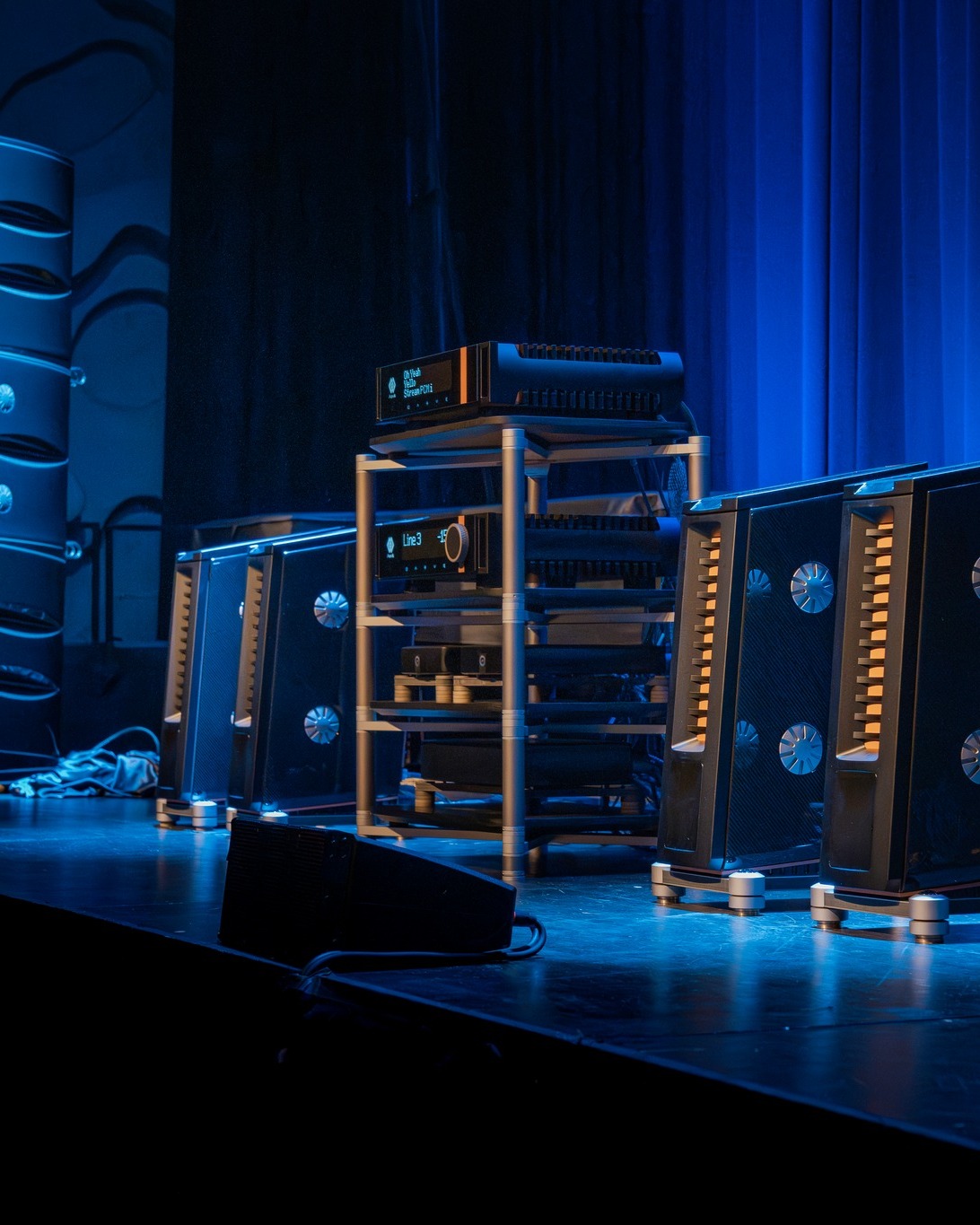
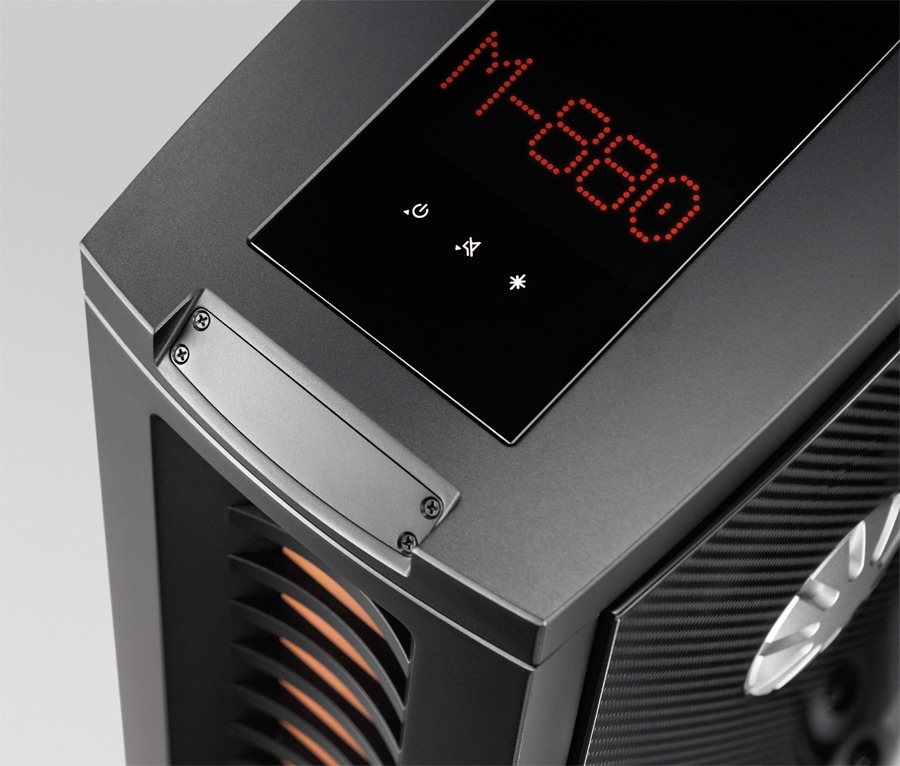
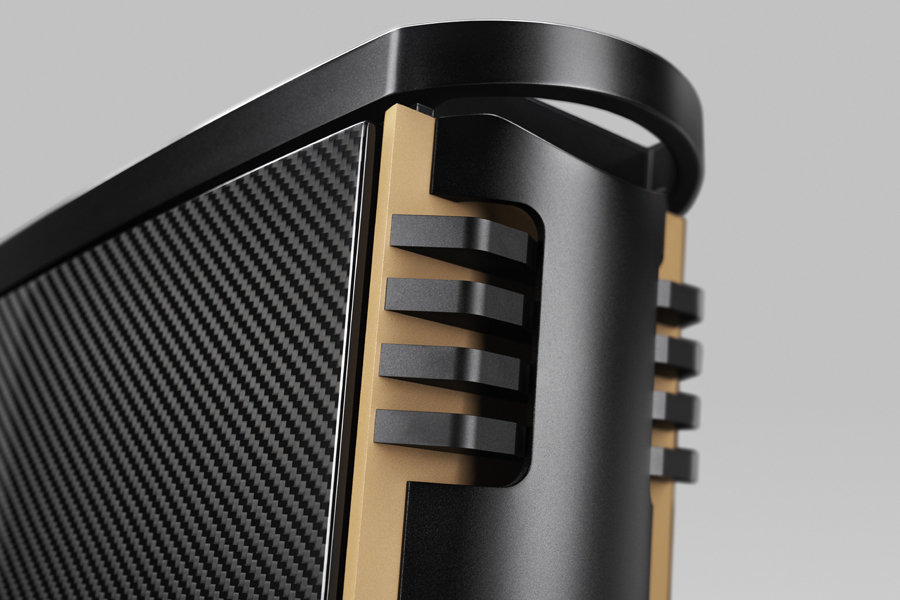
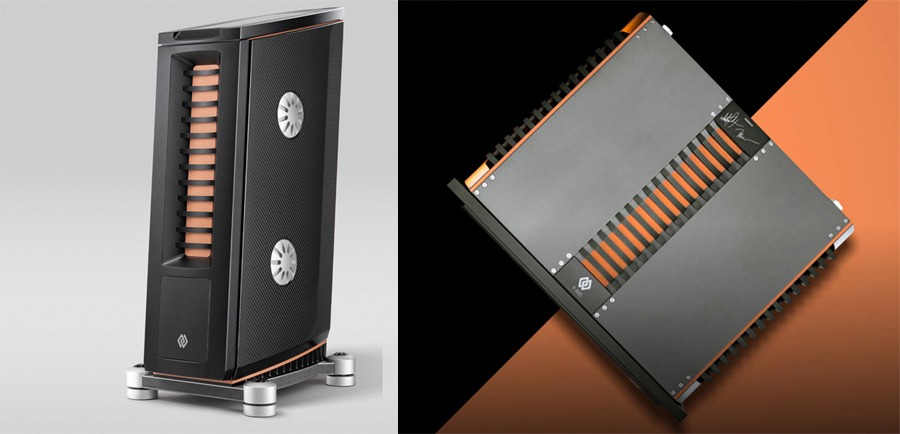
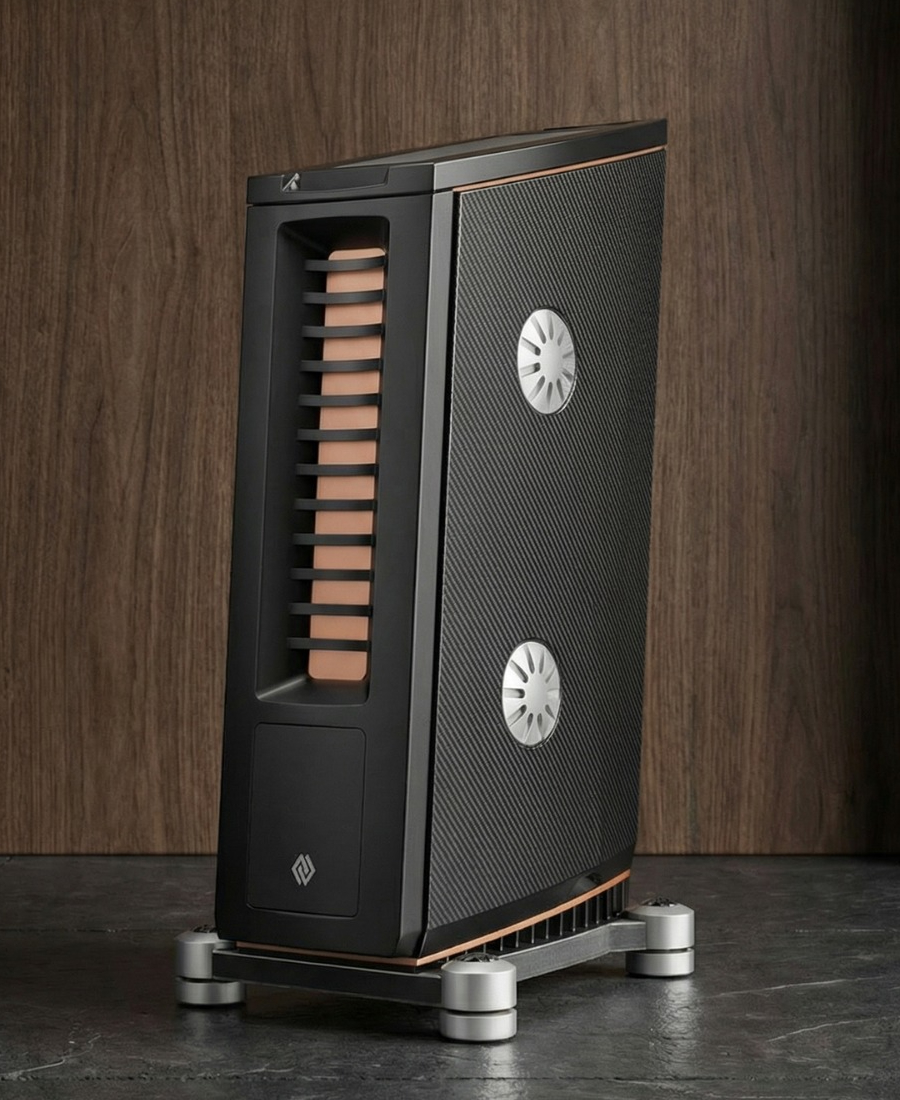











Audio Group Denmark doesn’t launch products so much as drop financial gravity wells. Last week in Aalborg, a select group of high-end press was flown in, not for a polite demo, but for a full-scale statement: the debut of Aavik’s new M-880 Monoblock Power Amplifier, now available to order at $115,000, alongside the equally subtle Børresen M8 Gold Signature loudspeakers, priced at $1,150,000 per pair. If that number made you blink, congratulations, you’re still connected to reality.
Four Aavik M-880 visible in photo during unveiling.
Aavik and Børresen may share DNA under the Audio Group Denmark umbrella, but they each stay in their own lane. Aavik handles the electronics. Borresen builds the loudspeakers. Six-figure systems aren’t aspirational here; they’re Tuesday. This is a group staffed by people with very serious résumés, including deep roots in Gryphon Audio Designs, another Danish name synonymous with “because we can” engineering and prices that don’t ask for permission.
The M-880 isn’t about chasing trends or filling a market gap. It reflects Aavik deliberately stepping outside its established lane; one it has navigated very well with its Class D designs to explore something more ambitious and more experimental. Based on what we heard and discussed at T.H.E. Show: NYC 2025, Aavik has earned credibility in modern amplification. The M-880 is what happens when a company with that foundation decides to see how far it can push its ideas when cost is no longer the primary governor.
Whether that exploration is worth $115,000 per channel is not a question for most people and pretending otherwise is pointless. That decision belongs to Persian Gulf emirs, Wall Street and tech executives, and a very small circle of listeners for whom six-figure components are a rational option, not a punchline. Dismissing the M-880 simply because almost no one can afford it misses the point. Ninety-nine point nine percent of the world can’t afford this level of audio engineering, but rarity alone doesn’t invalidate innovation.
Advertisement
Is it excessive? Absolutely. Does it make practical sense to assemble a $2 million system around amplifiers like these? Probably not. Would we do it if given the chance? Probably not. But excess has always been part of how the high-end moves forward, and among the components unveiled in Aalborg, the amplifiers are the more intellectually interesting statement. Loudspeakers at that level aim for spectacle. The M-880 aims for execution.
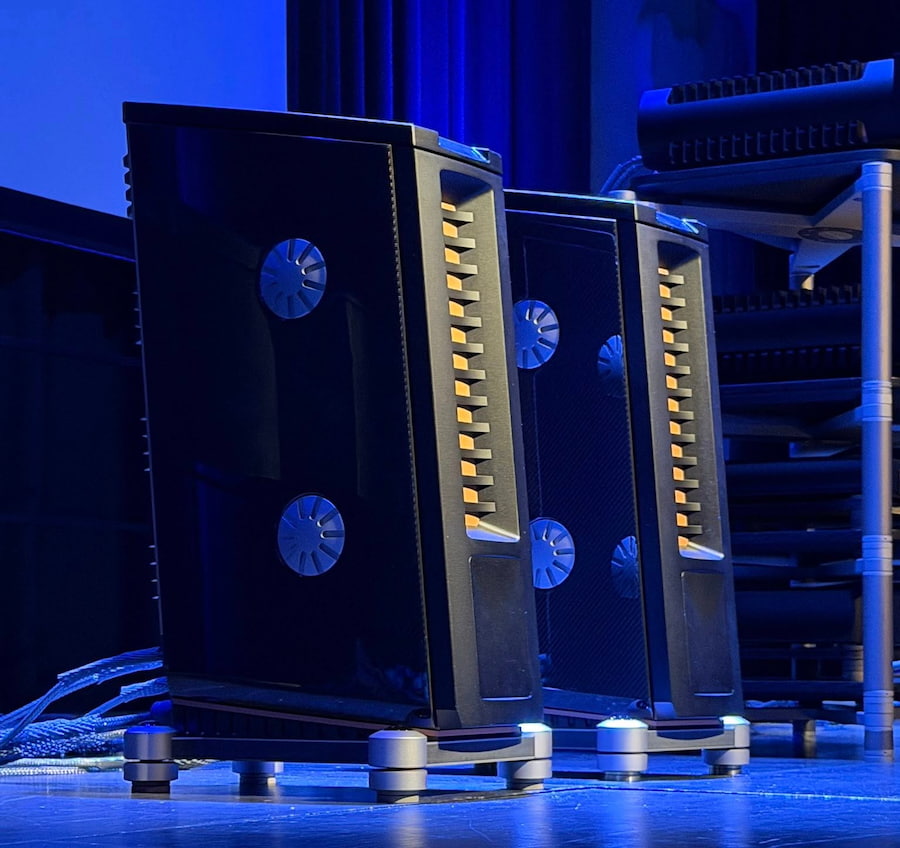
A pair of Aavik M-880 Monoblock Amplifiers at unveiling.
The M-880 was developed in direct response to the performance demands of the Børresen M8 Gold Signature loudspeaker. As the M8 Gold evolved toward higher levels of speed, resolution, and scale, Aavik concluded that conventional stereo amplifier architectures were no longer sufficient to fully exploit what the loudspeaker was capable of delivering.
The result is the M-880: a true monoblock amplifier conceived not as a standalone component, but as part of a unified system. Rather than treating amplification and loudspeaker design as separate exercises, Aavik engineered the M-880 to operate as a coherent counterpart to the M8 Gold Signature so power delivery, control, and dynamic behavior are aligned with the loudspeaker’s capabilities from the outset.
From Michael Børresen, Co-founder & CTO, Audio Group Denmark: “The M-880 is the result of pursuing absolute performance without compromise, while breaking visual conventions in the unmistakable style that only Flemming can create. For the M8 loudspeakers, nothing less would suffice — and I’m proud of what we achieved.”
Class A Amplification
The Aavik M-880 is designed to push Class A amplifier performance further than conventional implementations. Its output stage maintains a precisely controlled 0.63 V bias, exceeding the current required for operation and ensuring true Class A performance at all times, regardless of load or signal dynamics.
Advertisement
This approach enables the use of smaller, locally positioned capacitor banks. Each of the eight output transistor pairs is supported by its own dedicated local reservoir placed immediately adjacent to the devices, minimizing current travel, shortening signal paths, and reducing noise.
By stabilizing the bias at this level, Aavik preserves the purity, linearity, and harmonic integrity typically associated with Class A designs, while allowing the amplifier to operate at significantly lower temperatures than traditional high-bias Class A amplifiers. The result is improved long-term stability and reliability without sacrificing performance. And for the buyers this amplifier is aimed at, concerns about efficiency or electrical bills are predictably, not part of the conversation.
Advertisement. Scroll to continue reading.
Power Output: So… How Much Power Are We Talking About?
Each Aavik M-880 mono amplifier is rated to deliver 400 watts into 8 ohms, 800 watts into 4 ohms, and approximately 1,300 watts into 2 ohms. Its very low output impedance results in a damping factor exceeding 1,000 into 8 ohms, underscoring the level of control this amplifier is designed to exert over demanding loudspeaker loads.
That kind of output delivered in a true Class A operating regime is not common. At all. And while the M-880 was developed specifically to meet the requirements of the $1,150,000 Børresen M8 Gold Signature loudspeakers (ahem… very nice house), the amplifier itself opens up some rather interesting and far more flexible pairing possibilities. For listeners who may find the amplifiers more compelling than the speakers, there are flagship options from MartinLogan, Wilson Audio, Magico, Sonus faber, KEF, and DALI that would still leave room in the budget for… well, everything else.
Advertisement
The Power Supply
Rather than using a traditional linear power supply, the M-880 employs four high-speed, low-noise switching power supplies, each rated at 500 W / 20 A—twice the number used per channel in the earlier Aavik P-880 two-channel power amplifier.
These supplies are supported by a 266 mF local energy storage bank capable of storing up to 1,050 J and delivering peak currents of up to 130 A. The result is a power system that adapts dynamically to audio demand while maintaining an extremely low noise floor, contributing to greater stability, improved control, and a wider dynamic range.
Current Paths and Noise Suppression
The M-880 has reduced power dissipation, which enables the use of locally placed capacitor banks, with each output transistor pair supported by its own dedicated energy storage positioned directly adjacent to the devices. This results in exceptionally short current paths, reduced noise, and improved efficiency.
Noise rejection is system-wide through proprietary Aavik and Ansuz technologies, including Active Tesla Coils (ATC), Active Square Tesla Coils (AST), third-generation Analog Dither Technology (ADT), and Anti-Aerial Resonance Coils (AARC) applied to internal wiring.
Advertisement
Tesla coils in Aavik amplifiers are proprietary active, double-inverted, or square coils. The coils eliminate high-frequency noise and lower the noise floor, enhancing musical detail and transparency.
Mechanical Grounding and Enclosure Design
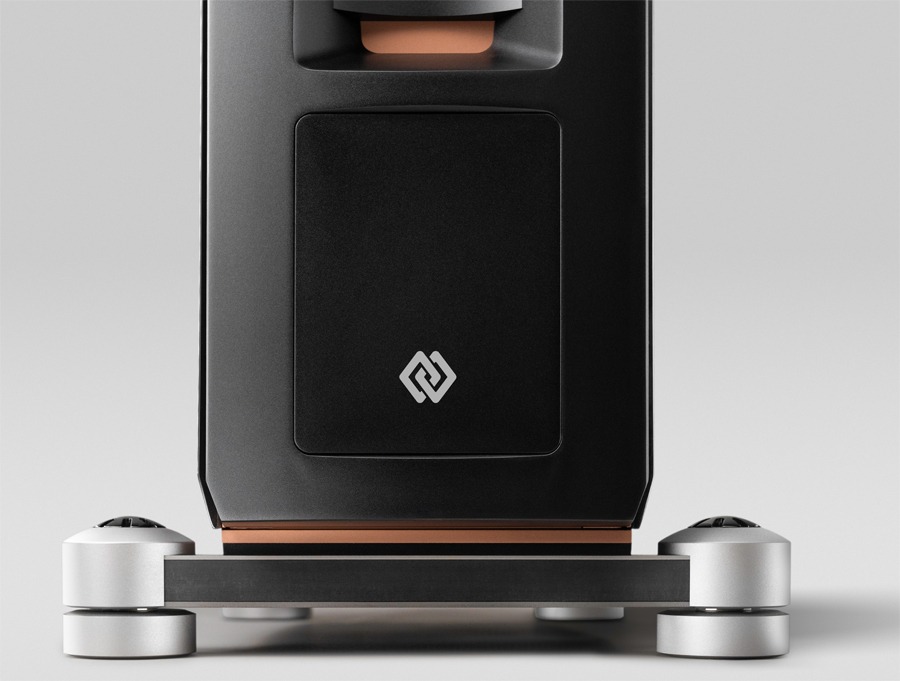
Each M-880 incorporates four Ansuz Darkz Z3w resonance control devices, providing mechanical isolation.
Its multi-layer construction features a wood-based laminate between a titanium base plate and an upper stainless-steel plate, topped by a internal copper chamber. This provides a controlled resonance behavior alongside exceptional EMI/RFI shielding.
Designed and Built in Denmark
Each Aavik M-880 monoblock amplifier is made at Audio Group Denmark’s facility in Aalborg, Denmark. The manufacturing process includes advanced CNC machining, cryogenic processing, and meticulous hand assembly. Each unit undergoes extensive electrical verification and final listening comparison against a reference before shipment.
Comparison
Not to scale.
Aavik Model
M-880
P-880
Product Type
Mono Power Amplifier
Stereo Power Amplifier
Price
$115,000
$73,500
Power Output
1 × 400 W @ 8 Ohm 1 × 800 W @ 4 Ohm
2 x 250W @ 8 Ohm 2 x 500W @ 4 Ohm
Distortion
< 0.007% (10 W, 1 kHz, 8 Ohm)
<0,007% (10W, 1kHz, 8 ohm)
Active Tesla Coils
N/A
182
Active GOLD Tesla Coils
112
N/A
Active Square Tesla Coils
112
411
Dither Circuitry
8
18
Active zirconium anti-aerial resonance Tesla coils
N/A
20
Gold Anti-Aerial Resonance Coils
12
N/A
Active zirconium cable anti aerial resonance Tesla coils
Not Indicated
4
Output Connections
Single-Wire Speaker Terminals (single channel)
Trigger (2)
Power Inlet
Advertisement
2 x Speaker Terminals Outputs (heavy-duty)
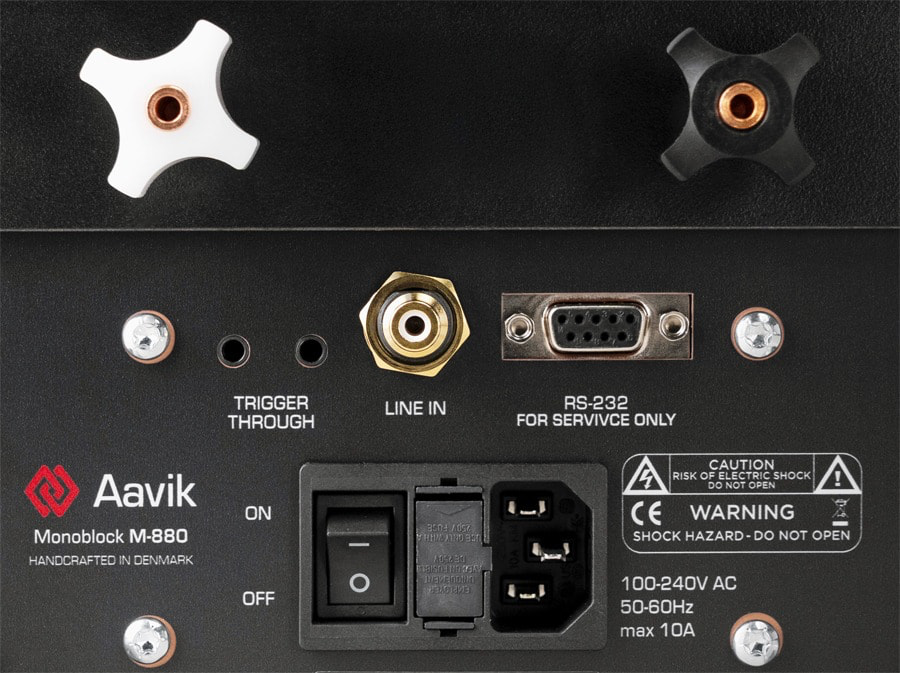
1 x Trigger Through
1 x RS232
Power Inlet
Advertisement
Input Connections
1 x Analog (RCA).
2 x Analog (RCA)
Power consumption
Standby: < 0.5 W Idle: 150 W
Standby: 1 W Idle: 150 W
Dimensions
HxWxD 794.02 x 342.00 x:509.68 mm 31.26 x 13.46 x 20.07 inches
LxWxH 580 x 510 x 155 mm
22 ⁵³/₆₄ x 20 ⁵/₆₄ x 6 ⁷/₆₄ inches
Weight
70.0 kg / 154.3 lbs
41 kg / 90.4 lbs
The Bottom Line
The Aavik M-880 exists at the intersection of extreme engineering and unapologetic excess, but it’s not empty spectacle. What makes it genuinely interesting are the technical choices: a true Class A output stage with tightly controlled bias, unusually high power delivery for a Class A design, extremely low output impedance, massive current capability, and a power architecture built around multiple high-speed switching supplies with large local energy storage placed exactly where it matters.
Advertisement. Scroll to continue reading.
This is not a scaled-up version of a conventional amplifier; it’s a deliberate rethink of how Class A can be executed when thermal limits, noise, and stability are engineered rather than tolerated.
Advertisement
This amplifier is for a very specific audience: listeners who already own reference-grade loudspeakers, have dedicated rooms, reinforced floors, and zero interest in compromise or efficiency. At 31.26 × 13.46 × 20.07 inches and 70.0 kg / 154.3 lbs per chassis, each M-880 is effectively a small floor-standing speaker made of metal. You’ll need two for most stereo systems, and if you’re thinking about bi-amping, start counting in fours.
Is it rational? No. Is it serious? Absolutely. The M-880 isn’t meant to be relatable; it’s meant to explore what’s possible when experience, resources, and ambition align. For most people, this will remain a thought experiment. For a very small few, it’s a statement piece that also happens to be one of the more technically ambitious Class A amplifiers to emerge from Denmark—where, apparently, there is something in the herring.
Price & Availability
The Aavik M-880 Mono Power Amplifier is priced at $115,000 USD and available through Authorized Aavik Dealers.
Keeping a workshop organized can feel like a never-ending task, and so any item that helps make organization easier can make a big difference. Fans of Harbor Freight will already be well aware that the retailer is a great place to look for cheap garage and workshop essentials, and one product in particular might come in useful for anyone trying to keep their workshop clutter within manageable levels. The Bauer storage system modular organizer features 12 individual bins that can be arranged in a custom configuration, making it a great place to store those small items that can get lost around the workshop.
All of the bins are removable, so there’s no need to haul around the entire organizer for smaller jobs. However, anyone who prefers to take everything with them on the go should still find the organizer useful, since it’s IP65 rated against dust and water ingress and can be connected to other Bauer storage system products. The brand offers a range of crates, tool boxes, and cases, alongside the modular storage organizer, in a similar manner to Milwaukee’s popular Packout storage system.
The Bauer organizer retails for $39.99 at Harbor Freight, and at the time of writing, it’s only available as an in-store exclusive and not online. However, if its reviews are anything to go by, it might be worth the trip to your local retailer.
Advertisement
The Bauer organizer gets consistently good reviews
Bauer makes plenty of top-rated power tools, and its modular storage organizer gets similarly glowing reviews from buyers. It has amassed just under 400 reviews from Harbor Freight buyers to date, with a near-perfect average score of 4.9 out of 5 stars. Several reviewers note how easy the organizer makes it to store a wide range of items, from screws and drill bits to pens and snacks. Others say that the organizer’s clear lid is a particularly useful feature, since it allows them to see exactly what’s in each bin at a glance.
Advertisement
Complaints about the organizer are few and far between. One reviewer who left a two-star review claimed that the material quality of the organizer wasn’t up to the task, while a few reviewers who left three-star reviews said rival systems were tougher overall. Aside from that, buyers remain consistently impressed with the organizer’s construction and its capabilities.
While plenty of reviewers like the Bauer organizer, it’s far from the only Harbor Freight product that might come in useful if you’re looking to cut down on clutter. The retailer also offers individual $3 stacking tilt bins that can help organize garages and workshops, and they get similarly good reviews from buyers.
When Google introduced Project Genie a few months ago, many described the AI tool as a potential game-changer for game development and other world-building tasks. According to a recent Google presentation, however, the Genie 3 AI model – the generative engine behind Project Genie – is still far from disrupting,… Read Entire Article Source link
Longtime Slashdot reader tsuliga writes: Two new episodes of Doctor Who that were previously lost have been found. The original Doctor Who episodes were wiped or deleted by the BBC because they were not aware of the future use of re-runs of these shows. Ninety-five of the 253 episodes from the program’s first six years are currently missing. How many more episodes are out there waiting to be rediscovered? “The main broadcasters in the UK in the 1960s, 70s, up to the 80s really, junked quite a lot of content,” said Justin Smith, a cinema professor at England’s De Montfort University and film archivist. “In some ways finding missing ‘Doctor Whos’ is the holy grail” of classic TV discoveries, Smith said.
The two episodes were “The Nightmare Begins” and “Devil’s Planet,” both of which aired during the show’s third series in 1965. It features William Hartnell as the Doctor in a story involving archvillains the Daleks — pepperpot-shaped metal aggressors whose favorite word is “Exterminate!” Smith said that for fans of the show, “it’s got it all, it really has. It is intergalactic, it’s got some great performances. It stands up really, really well.”
The Norwich-based agbiotech company launched the first new commercial banana varieties in more than 75 years in 2025. Now it has to build enough supply to meet demand.
The world’s favourite fruit is in serious trouble. Panama Disease Tropical Race 4, a fungal pathogen that travels in soil and water and leaves no cure in its wake, has now been confirmed in more than 20 countries.
It threatens, in the starkest terms, the near-total collapse of the global Cavendish banana, the single variety that accounts for over 90% of the export market and underpins a $25 billion industry that supports 400 million people.
The Cavendish survived its last existential crisis, in the 1950s, only by replacing its predecessor. There is currently nowhere left to go.
Against that backdrop, Tropic, a Norwich-based gene-editing company, has raised $105 million (approximately €91 million) in an oversubscribed Series C, co-led by Forbion through its Bioeconomy Fund and Corteva, via its Corteva Catalyst investment platform.
Advertisement
Significant participation came from Just Climate and IQ Capital, alongside new investors ABN Amro and Invest International. Existing backers Temasek, Five Seasons Ventures, Aliment Capital, Sucden Ventures, Genoa Ventures, and Polaris Partners also joined the round.
The company was founded in late 2016 at the Norwich Research Park by Gilad Gershon, an agritech investor and former Israeli Navy ship commander, and Dr Eyal Maori, a virologist and RNA biologist whose earlier work formed the scientific basis for Beeologics, an agricultural genetics startup later acquired by Monsanto.
Together they built out a platform using CRISPR gene editing and Tropic’s own proprietary technology, Gene Editing Induced Gene Silencing, or GEiGS, to make targeted modifications to tropical crops without introducing foreign DNA.
The milestone that drove this round happened in 2025: Tropic commercially launched two new banana varieties, the first to reach market in more than 75 years. The first is a non-browning banana, developed by disabling the gene that produces polyphenol oxidase, the enzyme responsible for the brown discolouration that begins within minutes of cutting.
Advertisement
The second is an extended shelf-life variety, which lengthens the banana’s green life by an additional 12 days by targeting the genes responsible for ethylene production, the plant hormone that triggers ripening. Tropic says this reduces transportation waste by up to 50 per cent. The non-browning variety was named one of TIME Magazine’s Best Inventions of 2025.
Gershon said demand is already outpacing what the company can produce.
“2025 proved that our technology delivers, not in the distant future, but right now. With two banana varieties already on the market and demand outstripping supply, this investment enables us to scale global production and expand into new crops faster than ever before.”
Regulatory approvals for the bananas are in place in the Philippines, Colombia, Honduras, the US, and Canada. Consumer launches in the US and Canada are planned for 2026. The technology is described by Tropic as non-GMO, as it makes targeted changes to the banana’s existing DNA without introducing genetic material from another organism.
Advertisement
The more urgent project, however, is TR4. Tropic is deploying its GEiGS technology to redirect the banana plant’s own RNA interference machinery to attack the fungal genes responsible for the disease. In 2025, the company shipped plants to establish a mother plantation, the first stage of production at commercial scale, with deployment of TR4-resistant varieties targeted for 2027.
The $25 billion banana industry figure for TR4’s potential impact comes from Tropic’s own framing; the existential scale of the threat is corroborated by extensive independent reporting.
The Series C capital will fund expanded plant production infrastructure, support commercial partnerships across export markets, and accelerate Tropic’s broader pipeline, including resistance to Black Sigatoka, a fungal disease that currently costs farmers between $2,000 and $3,000 per hectare annually in pesticide treatment, and the company’s rice programme.
Tropic has also licensed its GEiGS technology to a set of third parties, including Corteva for disease resistance traits in corn and soybean, British Sugar for disease-resistant sugar beet, and animal genetics company Genus. The licensing track suggests the underlying technology has commercial reach well beyond tropical fruits.
Advertisement
Joy Faucher, General Partner at Forbion, who will join Tropic’s board alongside Tom Greene of Corteva and Siddarth Shrikanth of Just Climate, framed the investment in terms of broader planetary health.
“Tropic is an exemplary case of how advanced biotechnology can be applied with precision to challenges in planetary health, starting with banana and rice.”
For Corteva, whose Senior Director Tom Greene also joins the board, the appeal sits partly in the consumer-facing dimension.
“Tropic’s non-browning banana varieties are a promising example of how the agriculture industry is leveraging innovation to deliver new and improved choices for farmers and consumers worldwide.”
Advertisement
Tropic’s total pre-Series C funding stood at approximately $73.5 million, comprising a $10 million Series A in 2018 led by Pontifax AgTech and Five Seasons Ventures, a $28.5 million Series B in 2020 led by Temasek, and a $35 million Series C in 2022 led by Blue Horizon. The new $105 million round, its second to carry the Series C designation, reflects a significant step-change in scale.
The commercial challenge now is less scientific than logistical. Gene editing the world’s most widely grown export banana is one thing. Producing it at a scale capable of supplying meaningful volumes across global export markets, while simultaneously developing disease-resistant varieties against a pathogen with no known cure, is another order of magnitude entirely. What this round is funding, in large part, is the answer to that second question.
Editor and reporter Taylor Soper joined GeekWire in 2012 out of the University of Washington. (GeekWire Photo / Kurt Schlosser)
After more than 13 years as a GeekWire reporter and editor, Taylor Soper is preparing for his next big assignment: he’ll soon join AI2 Incubator as director of AI House, the Seattle startup hub that has quickly become a gathering place for AI founders, practitioners, and researchers.
This is a big change for all of us. We are going to miss Taylor deeply, and we know GeekWire’s readers and community will, as well. But we’re excited to see what he’ll do in his new role, and we’ll be using the opportunity to bring fresh eyes to GeekWire’s coverage of startups and the broader tech community in the Seattle region and the rest of the Pacific Northwest.
In a post announcing Taylor’s new role, AI2 Incubator Managing Director Yifan Zhang says that he “brings a unique combination of skills that fits our thesis for today’s AI era: over a decade of deep relationships across Seattle tech, an intense and insatiable curiosity, and a talent for asking the right questions.”
We can vouch for that. Taylor was GeekWire’s first editorial hire, back in 2012, straight out of the University of Washington, when we were in a 10×10 foot office next to the Ballard Bridge.
In the years that followed, he became one of the most connected and respected business and tech reporters in the Pacific Northwest, covering everything from early-stage startups to Microsoft and Amazon at the highest levels, breaking funding scoops and acquisition news.
Advertisement
In recent years, as GeekWire’s editor, he has led and coordinated our news team and guided our reporting on everything from civic coverage to artificial intelligence.
Taylor Soper on the job through the years, including the video (center) that he submitted in support of his original GeekWire job application.
Taylor’s impact goes well beyond what he’s reported and published. The Seattle tech community is better for the long hours and dedication he brought to the job, year after year.
“I’m grateful to GeekWire for giving me an opportunity and supporting my growth, and to all of my colleagues for the work we did together reporting on the Seattle tech ecosystem,” he said. “I’m excited to work alongside founders and help supercharge the next generation of startups in this AI era.”
GeekWire remains as committed as ever to covering startups and the tech community. GeekWire co-founder Todd Bishop will be stepping back into the role of editor while continuing to report and write, working with staff reporters Lisa Stiffler and Kurt Schlosser, co-founder and publisher John Cook, and regular contributors including Alan Boyle and Thomas Wilde.
We’re also looking to add reinforcements to our news team over time.
Advertisement
Taylor’s last day at GeekWire will be March 25, and if the pattern holds, he’ll be reporting and publishing stories to the end. We feel fortunate that GeekWire has been his home for so long, and we have no doubt his impact will continue for many years to come.
Few things are as iconic to camping as the green Coleman stove. Every summer you’ll find them, along with Coleman lanterns and coolers, on picnic tables across America. At WIRED, we’re big fans of the Coleman Cascade stove, but all Coleman stoves are capable of cooking up delicious camp food. There is more to Coleman than stoves, of course. I’m a fan of the coolers as well, along with the tents (simple and sturdy), and the Forester Sling chair for lounging. No matter what you need to outfit yourself for outdoor adventure as warmer weather arrives, we have a Coleman promo code and coupons to help you save.
Claim Up to 30% Off Select Items During the Spring Cooking Sale
Right now, Coleman is offering up to 30% off select cooking gear and outdoor essentials. The sale runs through March 21, and features some great deals like the 3-burner Even-Temp Propane camp stove. Three burners are a must for family adventures, and the Even Temp offers two 11,500 BTU burners, with a less powerful burner in the middle, meaning you can fry eggs and pancakes for the kids, and make your coffee as well.
Snag a 15% Coleman Promo Code When You Sign Up
If what you want isn’t on sale, no problem. You can get a 15% discount on one full-price purchase just for signing up for Coleman email list. Separately, you can save 15% on a full-price purchase and get free standard shipping when you sign up for texts.
Members Get Free Shipping at Coleman
If you create an account online on Coleman, you can snag free shipping. Free shipping doesn’t apply to the expedited delivery options, but so long as you’re not in a rush it’ll save you a few dollars. Just create an account, login, and the free shipping will be automatically applied during checkout. This Coleman free shipping deal is only valid for standard shipping within the contiguous United States.
The sun shines a spotlight on the steep face of an unnamed crater. NASA’s Lunar Reconnaissance Orbiter (LRO) took this photo on August 30, 2023. This spacecraft has been orbiting the moon since 2009, continuously collecting photographs of its surface using its cameras. When the camera started rolling, the orbiter was floating about 100 kilometers above the moon’s surface, with the sun’s rays coming in at an angle of 82 degrees from the right.
This particular crater is 10 kilometers wide and dips off by more than 2 kilometers at 70 degrees south latitude and 302.46 degrees east longitude, and it is relatively close to the Bailly O crater. The sides of this crater are 36 degrees, which is roughly the angle at which debris falls on the moon, and the lines are rather clean, with the exception of a few small impact craters at the top. This shows that the crater is rather young, possibly no more than 2 million years old.
Build a realistic LEGO Technic lunar rover model – This LRV building kit for adults is packed with authentic details including seats, steering…
NASA model for adults – Enjoy a mindful project assembling all the details of the rover and equipment including the battery pack, heating and…
A build for NASA fans – Remember the Apollo 17 mission with a display that features the lunar roving vehicle alongside 3 detailed equipment…
The angle at which the light comes in allows you to see all of the tiny details that you would otherwise miss in a normal photo. So, in this view, which depicts a 12-kilometer stretch of lunar surface, you can see a lot of little differences in the landscape and minerals. There is a 3.5-kilometer length where the wall and floor have a distinct and dramatic contrast, with all sorts of small elements in the front and the backdrop fading into the shade.
Advertisement
The LRO has done a great job of creating a complete map of the moon’s surface over the years as a result of all of the photos it has taken, and these can be used in the future to identify safe landing sites, locate ice in the polar regions, and calculate how much radiation you will be exposed to. And as new technology emerges, it becomes easier to prepare for long-term expeditions to the moon.
Apple’s cheapest laptop is also its most repairable. iFixit gave the new MacBook Neo a 6/10 repairability score. Although that number would only be mediocre for, say, a game review or final exam grade, it’s the MacBook line’s highest iFixit score in about 14 years.
As always, iFixit goes into great detail about the product’s repairability, but a few points stand out. First, the MacBook Neo’s battery is screwed down rather than glued — moving it from “this might burn the house down” to “routine repair” territory. The laptop also has a flat disassembly tree. That means its battery, speakers, ports and trackpad are all immediately accessible after opening the back case.
In other areas, a simplified antenna assembly helps the screen come away cleanly. Keyboard repair is still a bit tedious (41 screws and tape), but at least it isn’t riveted to the top case like on other models. (The screwed-not-glued battery helps here, too.) Apple’s decision to forego a Force Touch trackpad and return to a mechanical style improves repairability as well. And in a nice touch, all the machine’s Torx Plus screw sizes are clearly labeled inside the case.
Apple
Several other encouraging signs carry over from recent MacBooks. iFixit found that Apple’s Repair Assistant accepted all replacement parts it tried without a fuss. And its USB-C ports and headphone jack are modular, so replacing either doesn’t “turn into logic board work.”
Advertisement
Not everything is peachy. As expected, the Neo still has soldered RAM and storage, so there’s no upgrade path there. iFixit describes Apple’s pentalobe screws on the bottom case as an “annoying” choice. And while the device’s speakers are easy to remove, they, well, just aren’t very good. (Had to cut that cost somewhere.)
While iFixit describes the Neo’s repairability as “a real comeback,” it’s premature to assume higher-end MacBooks will follow suit. After all, with this $599 device ($499 for schools), Apple is targeting the educational sector, where repairability could mean more bulk orders. Until Apple is convinced that the MacBook Air or Pro would sell better with similar serviceability, this kind of score may be limited to the budget model.
In his latest Power On newsletter, Bloomberg’s Mark Gurman claimed that Apple will price its first foldable iPhone at “roughly $2,000,” much lower than previously rumored. If Gurman’s prediction holds, the iPhone Fold would match the pricing of the Samsung Galaxy Z Fold 7, which starts at $1,999 for the… Read Entire Article Source link
Chirp reinvented the wheel—or at least one type, the yoga wheel. Chirp Wheels are effective in relieving upper and lower back pain, sciatica, and tension headaches. WIRED contributor Hannah Singleton has said the Chirp Wheel XR-3 Pack has even helped undo her tech neck and alleviate her brain fog.
Recently, the wellness brand has expanded beyond its flagship wheels into recovery gear. The lineup now includes powered rolling massagers (which I’ve been using a lot lately for back pain relief), TENS units, and even a full massage table (Chirp Contour) that I’m currently testing (stay tuned for the full review). Where Chirp stands out from heavyweights like Hyperice and Therabody is in its simplicity and value. The products tend to focus on doing one thing well rather than piling on features you may never use. Chirp promos and discounts run frequently on the Chirp website, and we have Chirp discount codes, so you can get an even better deal on recovery gear that’s already reasonably priced.
Save up to 67% on Chirp Products With Daily Deals
I like checking Chirp’s Daily Deals page because the exclusive offers rotate frequently, and you can save as much as 67%. I’ve spotted the Chirp Wheel XR 3-Pack on there, but you’ll also find different versions of the wheel, along with storage accessories. Some wheels skip the pressure-point nodes, which can feel better if you’re focusing on improving spinal mobility and flexibility rather than digging into stubborn knots. If the Chirp RPM Mini pops up at a special discount, it’s worth considering for your first purchase. It’s essentially an electric roller that kneads muscles more gently than most percussive massage guns; it also comes with a carrying case, so you can toss it in a bag and take it with you.
Get up to 50% Off Refurbished Chirp Products
If you’re looking to save money, check out Chirp’s refurbished collection. These open-box units may show minor cosmetic wear from previous use, but they’re still fully functional. Inventory changes frequently, and the best deals tend to sell out fast, so it’s worth snagging as soon as it’s available. Keep in mind that refurbished items can’t be returned. Any other order you place sitewide is covered by a 30-day return policy.
Advertisement
Get a Free Chirp Wheel+ Deep Tissue 2-Pack When You Spend $99 or More
Spend $99 or more, and Chirp will throw in a complimentary Chirp Wheel+ Deep Tissue 2-Pack, which retails for $75. The bundle includes two wheels: a 6-inch Deep Tissue Wheel designed for larger muscle groups and a 4-inch Focus Wheel meant to target trigger points in the neck and other small areas. You’ll need to sign up for the email newsletter to claim the freebie before adding it to your order.
Get Free Shipping on Chirp Orders Over $75
Chirp customers receive free shipping on U.S. orders over $75, and the perk stacks with the brand’s daily deals and most codes. If you time it right, you can shave a decent chunk off the final price. No promo code at checkout required.
Chirp Discount Code: Select Customers Can Get 15% Off
Chirp offers a 15% discount to certain groups through an online verification process. That includes: active-duty military personnel, veterans, and their dependents; first responders and law enforcement officers; medical professionals and healthcare workers; and teachers and academic administrators at any grade level.