



Connect with us

Tech

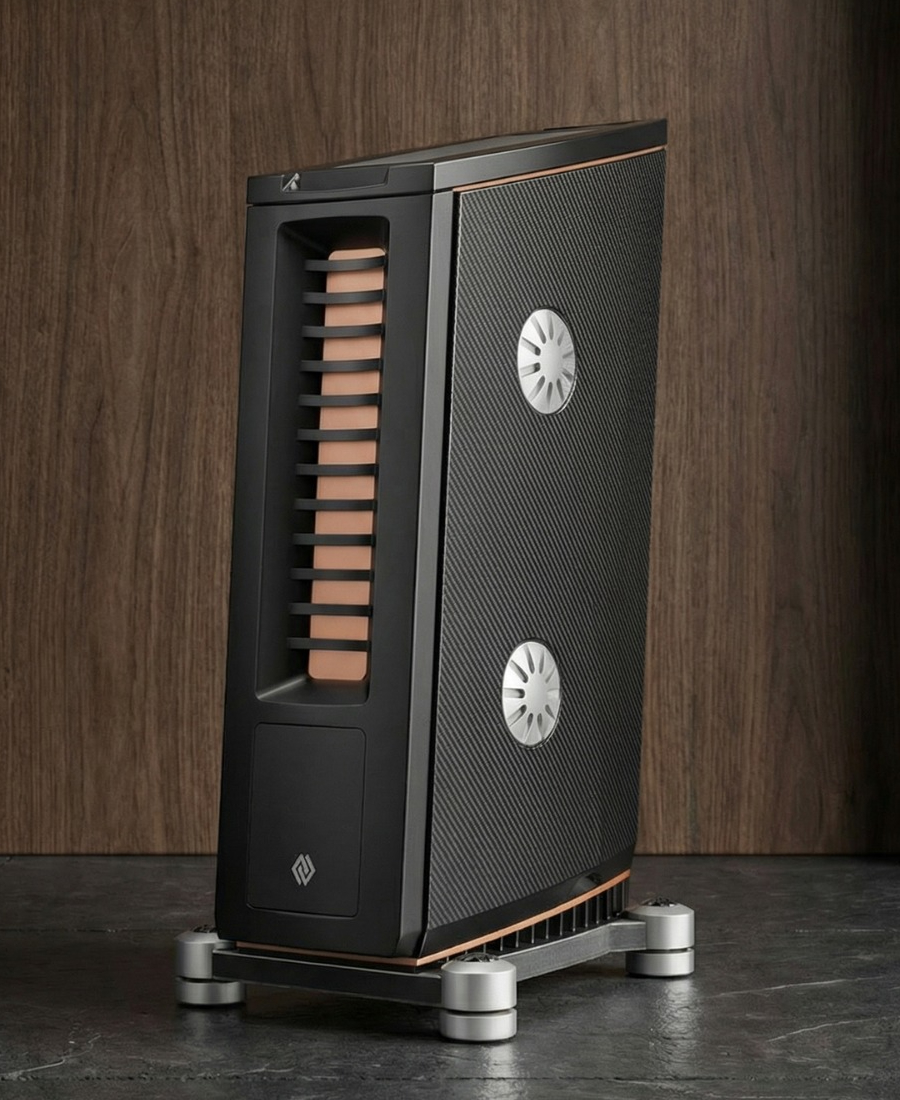
Audio Group Denmark’s Aavik M-880 Mono Amplifiers: Ultra-Luxury Pricing, Reference Ambitions, Zero Interest in Restraint

Published

on

Audio Group Denmark doesn’t launch products so much as drop financial gravity wells. Last week in Aalborg, a select group of high-end press was flown in, not for a polite demo, but for a full-scale statement: the debut of Aavik’s new M-880 Monoblock Power Amplifier, now available to order at $115,000, alongside the equally subtle Børresen M8 Gold Signature loudspeakers, priced at $1,150,000 per pair. If that number made you blink, congratulations, you’re still connected to reality.

Aavik components 2026
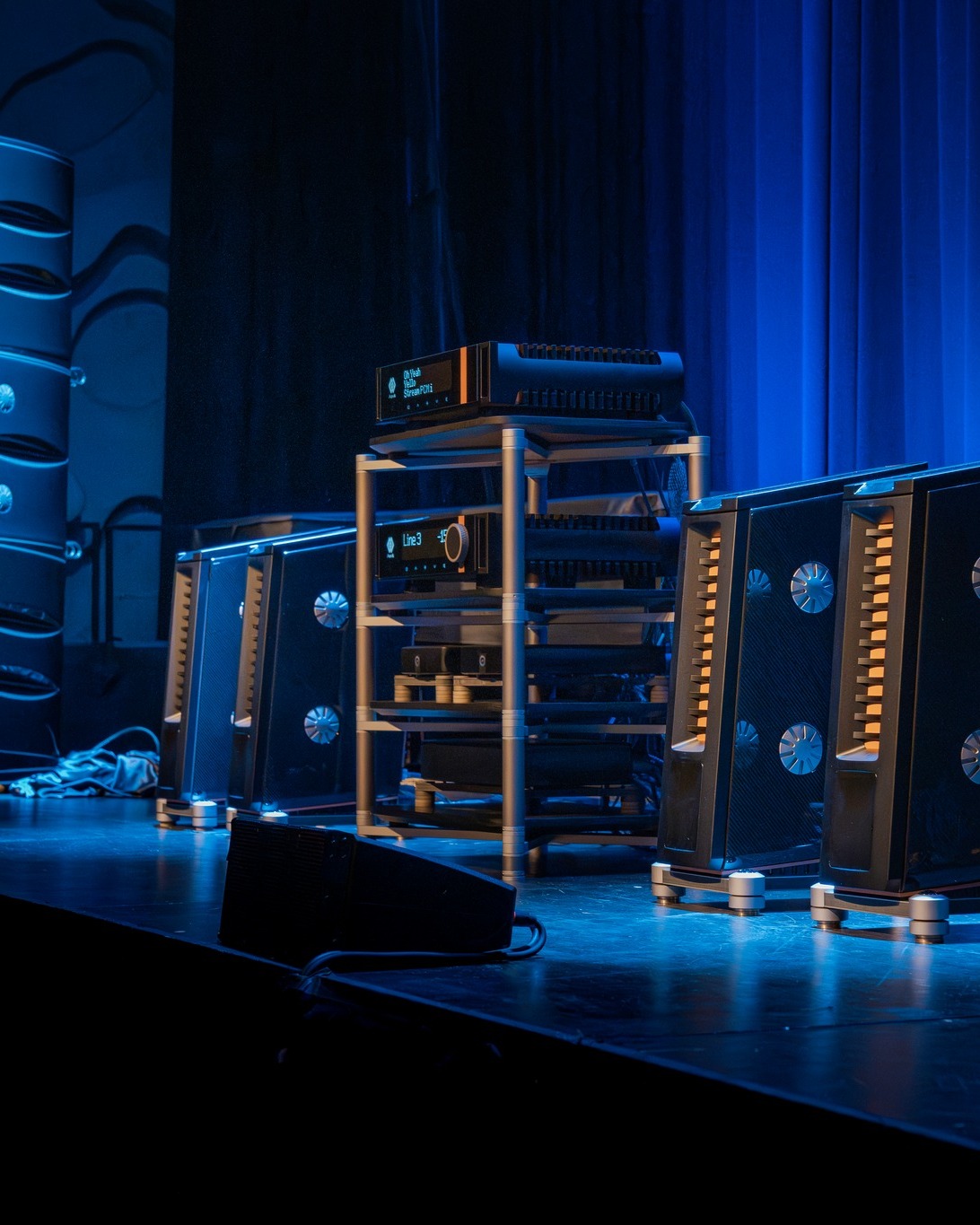
Four Aavik M-880 visible in photo during unveiling.

Aavik and Børresen may share DNA under the Audio Group Denmark umbrella, but they each stay in their own lane. Aavik handles the electronics. Borresen builds the loudspeakers. Six-figure systems aren’t aspirational here; they’re Tuesday. This is a group staffed by people with very serious résumés, including deep roots in Gryphon Audio Designs, another Danish name synonymous with “because we can” engineering and prices that don’t ask for permission.

The M-880 isn’t about chasing trends or filling a market gap. It reflects Aavik deliberately stepping outside its established lane; one it has navigated very well with its Class D designs to explore something more ambitious and more experimental. Based on what we heard and discussed at T.H.E. Show: NYC 2025, Aavik has earned credibility in modern amplification. The M-880 is what happens when a company with that foundation decides to see how far it can push its ideas when cost is no longer the primary governor.

Whether that exploration is worth $115,000 per channel is not a question for most people and pretending otherwise is pointless. That decision belongs to Persian Gulf emirs, Wall Street and tech executives, and a very small circle of listeners for whom six-figure components are a rational option, not a punchline. Dismissing the M-880 simply because almost no one can afford it misses the point. Ninety-nine point nine percent of the world can’t afford this level of audio engineering, but rarity alone doesn’t invalidate innovation.

Advertisement

Is it excessive? Absolutely. Does it make practical sense to assemble a $2 million system around amplifiers like these? Probably not. Would we do it if given the chance? Probably not. But excess has always been part of how the high-end moves forward, and among the components unveiled in Aalborg, the amplifiers are the more intellectually interesting statement. Loudspeakers at that level aim for spectacle. The M-880 aims for execution.

aavik-m-880-side-angle
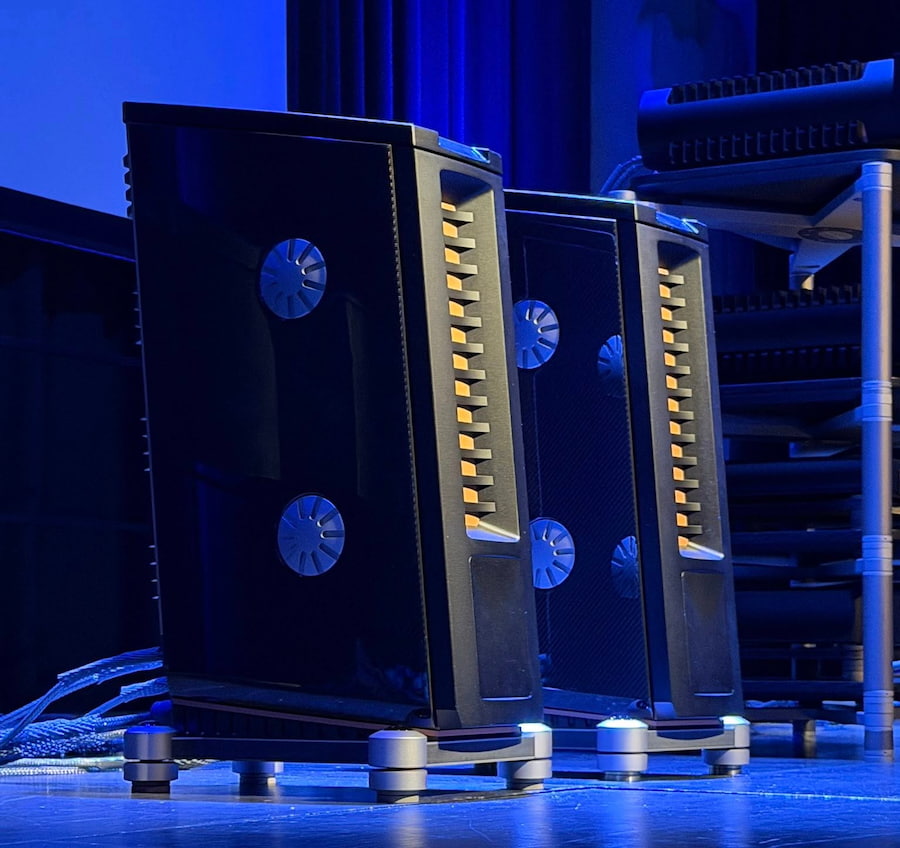
A pair of Aavik M-880 Monoblock Amplifiers at unveiling.

The M-880 was developed in direct response to the performance demands of the Børresen M8 Gold Signature loudspeaker. As the M8 Gold evolved toward higher levels of speed, resolution, and scale, Aavik concluded that conventional stereo amplifier architectures were no longer sufficient to fully exploit what the loudspeaker was capable of delivering.

The result is the M-880: a true monoblock amplifier conceived not as a standalone component, but as part of a unified system. Rather than treating amplification and loudspeaker design as separate exercises, Aavik engineered the M-880 to operate as a coherent counterpart to the M8 Gold Signature so power delivery, control, and dynamic behavior are aligned with the loudspeaker’s capabilities from the outset.

From Michael Børresen, Co-founder & CTO, Audio Group Denmark: “The M-880 is the result of pursuing absolute performance without compromise, while breaking visual conventions in the unmistakable style that only Flemming can create. For the M8 loudspeakers, nothing less would suffice — and I’m proud of what we achieved.”

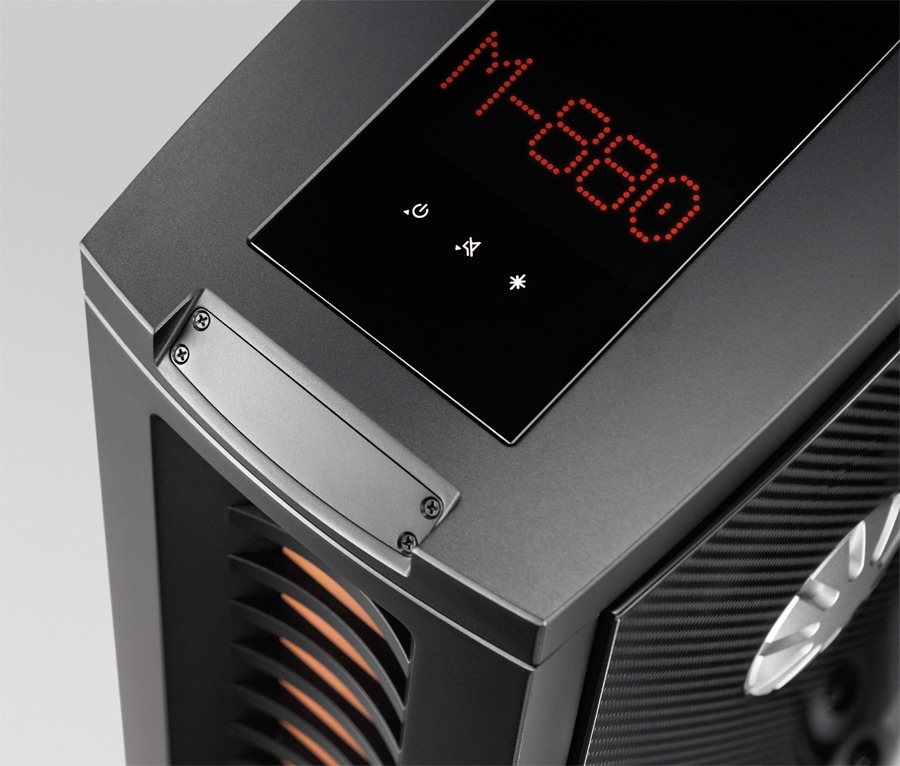
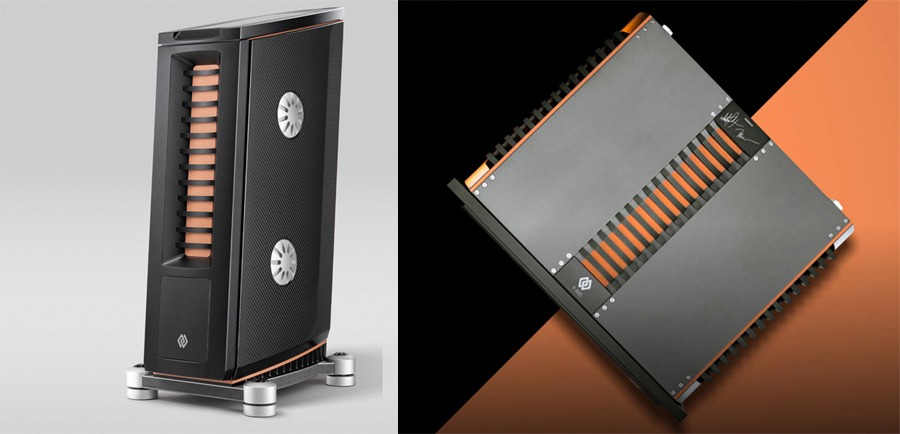
aavik-m-880-top

Class A Amplification

The Aavik M-880 is designed to push Class A amplifier performance further than conventional implementations. Its output stage maintains a precisely controlled 0.63 V bias, exceeding the current required for operation and ensuring true Class A performance at all times, regardless of load or signal dynamics.

Advertisement

This approach enables the use of smaller, locally positioned capacitor banks. Each of the eight output transistor pairs is supported by its own dedicated local reservoir placed immediately adjacent to the devices, minimizing current travel, shortening signal paths, and reducing noise.

By stabilizing the bias at this level, Aavik preserves the purity, linearity, and harmonic integrity typically associated with Class A designs, while allowing the amplifier to operate at significantly lower temperatures than traditional high-bias Class A amplifiers. The result is improved long-term stability and reliability without sacrificing performance. And for the buyers this amplifier is aimed at, concerns about efficiency or electrical bills are predictably, not part of the conversation.

Advertisement. Scroll to continue reading.
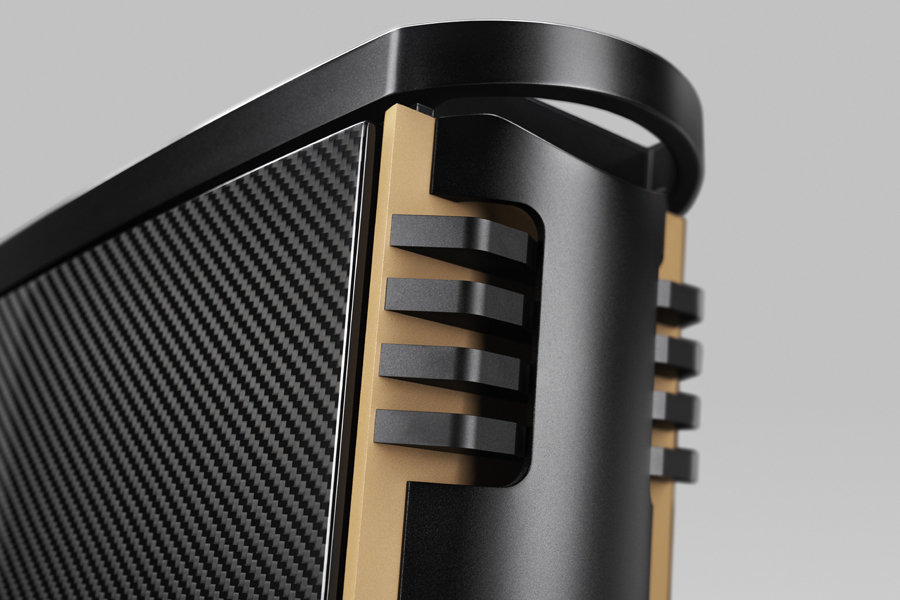
Aavik M-880 Mono Amplifier  Front Cabinet Design

Power Output: So… How Much Power Are We Talking About?

Each Aavik M-880 mono amplifier is rated to deliver 400 watts into 8 ohms, 800 watts into 4 ohms, and approximately 1,300 watts into 2 ohms. Its very low output impedance results in a damping factor exceeding 1,000 into 8 ohms, underscoring the level of control this amplifier is designed to exert over demanding loudspeaker loads.

That kind of output delivered in a true Class A operating regime is not common. At all. And while the M-880 was developed specifically to meet the requirements of the $1,150,000 Børresen M8 Gold Signature loudspeakers (ahem… very nice house), the amplifier itself opens up some rather interesting and far more flexible pairing possibilities. For listeners who may find the amplifiers more compelling than the speakers, there are flagship options from MartinLogan, Wilson Audio, Magico, Sonus faber, KEF, and DALI that would still leave room in the budget for… well, everything else.

Advertisement
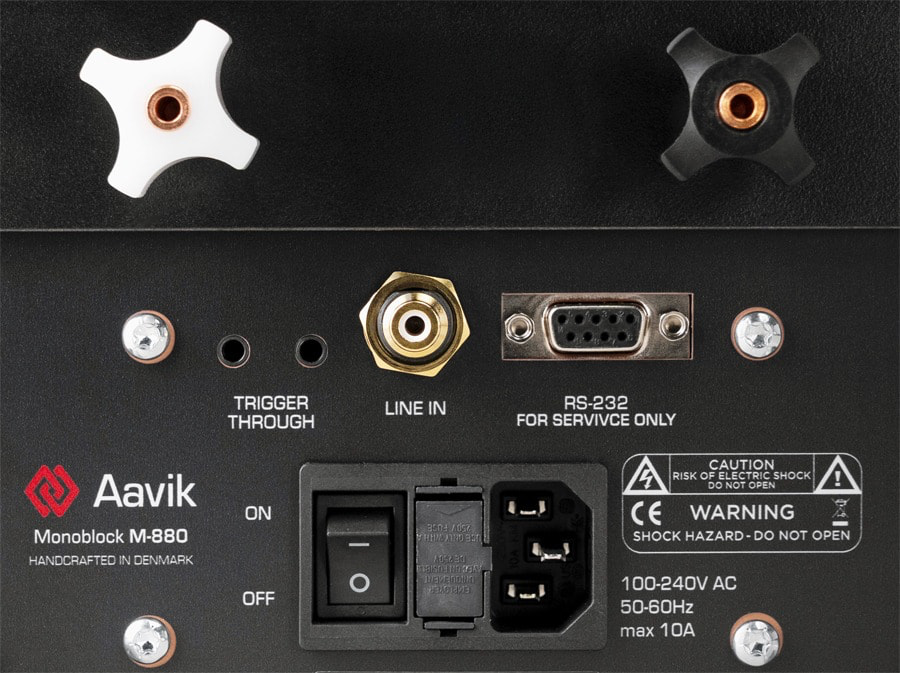
aavik-m-880-inputs

The Power Supply 

Rather than using a traditional linear power supply, the M-880 employs four high-speed, low-noise switching power supplies, each rated at 500 W / 20 A—twice the number used per channel in the earlier Aavik P-880 two-channel power amplifier.

These supplies are supported by a 266 mF local energy storage bank capable of storing up to 1,050 J and delivering peak currents of up to 130 A. The result is a power system that adapts dynamically to audio demand while maintaining an extremely low noise floor, contributing to greater stability, improved control, and a wider dynamic range.

Current Paths and Noise Suppression 

The M-880 has reduced power dissipation, which enables the use of locally placed capacitor banks, with each output transistor pair supported by its own dedicated energy storage positioned directly adjacent to the devices. This results in exceptionally short current paths, reduced noise, and improved efficiency. 

Noise rejection is system-wide through proprietary Aavik and Ansuz technologies, including Active Tesla Coils (ATC), Active Square Tesla Coils (AST), third-generation Analog Dither Technology (ADT), and Anti-Aerial Resonance Coils (AARC) applied to internal wiring. 

Advertisement

Tesla coils in Aavik amplifiers are proprietary active, double-inverted, or square coils. The coils eliminate high-frequency noise and lower the noise floor, enhancing musical detail and transparency. 

Mechanical Grounding and Enclosure Design 

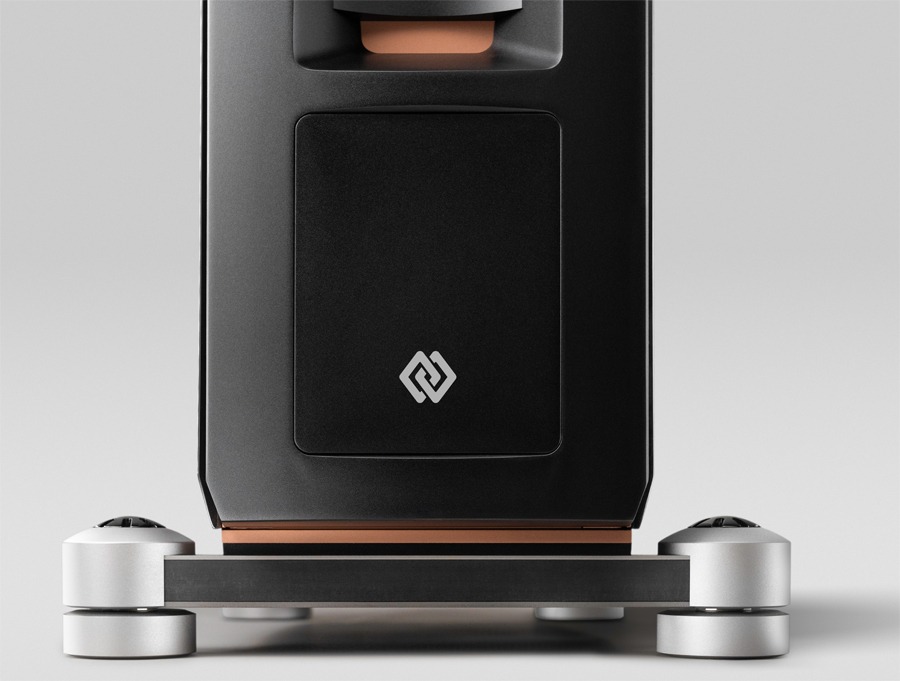
Each M-880 incorporates four Ansuz Darkz Z3w resonance control devices, providing mechanical isolation.

The enclosure, developed by Flemming Erik Rasmussen in collaboration with Michael Børresen, follows a form-follows-function philosophy. 

Advertisement

Its multi-layer construction features a wood-based laminate between a titanium base plate and an upper stainless-steel plate, topped by a internal copper chamber. This provides a controlled resonance behavior alongside exceptional EMI/RFI shielding. 

aavik-m-880-base-front

Designed and Built in Denmark 

Each Aavik M-880 monoblock amplifier is made at Audio Group Denmark’s facility in Aalborg, Denmark. The manufacturing process includes advanced CNC machining, cryogenic processing, and meticulous hand assembly. Each unit undergoes extensive electrical verification and final listening comparison against a reference before shipment. 

Comparison

aavik-m-880-p-880
Not to scale.
Aavik Model M-880 P-880
Product Type  Mono Power Amplifier Stereo Power Amplifier
Price $115,000 $73,500
Power Output 1 × 400 W @ 8 Ohm  
1 × 800 W @ 4 Ohm
2 x 250W @ 8 Ohm  
2 x 500W @ 4 Ohm
Distortion < 0.007% (10 W, 1 kHz, 8 Ohm) <0,007% (10W, 1kHz, 8 ohm)
Active Tesla Coils N/A 182
Active GOLD Tesla Coils 112 N/A
Active Square Tesla Coils 112 411
Dither Circuitry 8 18
Active zirconium anti-aerial resonance Tesla coils N/A 20
Gold Anti-Aerial Resonance Coils 12 N/A
Active zirconium cable anti aerial resonance Tesla coils Not Indicated 4
Output Connections  Single-Wire Speaker Terminals (single channel)

Trigger (2)

Power Inlet

Advertisement
2 x Speaker Terminals Outputs (heavy-duty)

1 x Trigger Through 

1 x RS232

Power Inlet

Advertisement
Input Connections 1 x Analog (RCA). 2 x Analog (RCA)
Power consumption Standby: < 0.5 W  
Idle: 150 W
Standby: 1 W
Idle: 150 W
Dimensions  HxWxD
794.02 x 342.00 x:509.68 mm
31.26 x 13.46  x 20.07 inches
LxWxH
580 x 510 x 155 mm

22 ⁵³/₆₄ x 20 ⁵/₆₄ x 6 ⁷/₆₄ inches

Weight 70.0 kg / 154.3 lbs 41 kg / 90.4 lbs
aavik-m-880-ampliifer-angle

The Bottom Line 

The Aavik M-880 exists at the intersection of extreme engineering and unapologetic excess, but it’s not empty spectacle. What makes it genuinely interesting are the technical choices: a true Class A output stage with tightly controlled bias, unusually high power delivery for a Class A design, extremely low output impedance, massive current capability, and a power architecture built around multiple high-speed switching supplies with large local energy storage placed exactly where it matters.

Advertisement. Scroll to continue reading.

This is not a scaled-up version of a conventional amplifier; it’s a deliberate rethink of how Class A can be executed when thermal limits, noise, and stability are engineered rather than tolerated.

Advertisement

This amplifier is for a very specific audience: listeners who already own reference-grade loudspeakers, have dedicated rooms, reinforced floors, and zero interest in compromise or efficiency. At 31.26 × 13.46 × 20.07 inches and 70.0 kg / 154.3 lbs per chassis, each M-880 is effectively a small floor-standing speaker made of metal. You’ll need two for most stereo systems, and if you’re thinking about bi-amping, start counting in fours. 

Is it rational? No. Is it serious? Absolutely. The M-880 isn’t meant to be relatable; it’s meant to explore what’s possible when experience, resources, and ambition align. For most people, this will remain a thought experiment. For a very small few, it’s a statement piece that also happens to be one of the more technically ambitious Class A amplifiers to emerge from Denmark—where, apparently, there is something in the herring. 

Price & Availability

The Aavik M-880 Mono Power Amplifier is priced at $115,000 USD and available through Authorized Aavik Dealers.

For more information: audiogroupdenmark.com

Advertisement

Source link

Continue Reading
Click to comment

Leave a Reply

Your email address will not be published. Required fields are marked *

Tech

T2 Linux Restores XAA In Xorg, Making 2D Graphics Fast Again

Published

on

Berlin-based T2 Linux developer René Rebe (long-time Slashdot reader ReneR) is announcing that their Xorg display server has now restored its XAA acceleration architecture, “bringing fixed-function hardware 2D acceleration back to many older graphics cards that upstream left in software-rendered mode.”


Older fixed-function GPUs now regain smooth window movement, low CPU usage, and proper 24-bit bpp framebuffer support (also restored in T2). Tested hardware includes ATi Mach-64 and Rage-128, SiS, Trident, Cirrus, Matrox (Millennium/G450), Permedia2, Tseng ET6000 and even the Sun Creator/Elite 3D.

The result: vintage and retro systems and classic high-end Unix workstations that are fast and responsive again.

Source link

Advertisement
Continue Reading

Tech

The Salvation Army Opens a Digital Thrift Store On Roblox

Published

on

Slashdot reader BrianFagioli writes: The Salvation Army has launched what it calls the world’s first digital thrift store inside Roblox, an experience named Thrift Score that lets players browse virtual racks and buy digital fashion for their avatars.

While I understand the strategy of meeting Gen Z and Gen Alpha where they already spend time and money, I feel uneasy about turning something that, in the real world, often serves low income families in genuine need into a gamified aesthetic inside a video game, even if proceeds support rehabilitation and community programs, because a thrift store is not just a quirky brand concept but a lifeline for many people, and packaging that reality as entertainment creates a strange disconnect that is hard to ignore.
“To be clear, proceeds from Thrift Score are intended to support The Salvation Armyâ(TM)s programs nationwide…” this article points out. “If it drives awareness and funds programs that help people in need, that is a win. But if it turns thrifting into just another cosmetic skin in a digital marketplace, then we should at least be willing to say that it feels off.”

Source link

Continue Reading

Tech

This Blink Outdoor 4 XR 4-camera kit is 45% off, and it’s a smart way to cover more of your property for less

Published

on

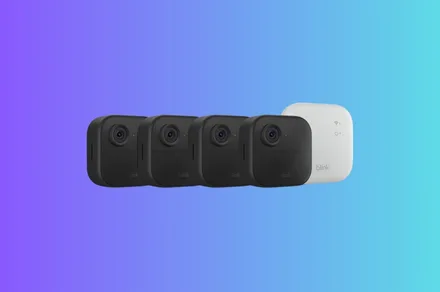
Home security deals can get expensive fast once you start adding multiple cameras, which is why this one stands out. The Blink Outdoor 4 XR 4-camera system is down to $164.99 for a limited time, which is a big drop from $299.99. That’s 45% off, and more importantly, it gets you a full multi-camera setup at a price that feels realistic for most households.

The angle here is coverage. A lot of people start with one camera and then realize they need another for the driveway, one for the backyard, and one near a side entrance. This bundle skips that slow, piecemeal process and gives you a more complete setup from day one.

What you’re getting

This is a 4-camera wireless security system built around convenience and range. The standout features are the two-year battery life claim and the extended wireless range, with up to 1000 feet open-air range (or around 400 feet with typical use).

That matters because placement is usually where camera systems get annoying. If you’ve got a detached garage, a longer driveway, or a larger yard, range can be the difference between “works great” and “constant headaches.”

Advertisement

A four-camera kit also gives you flexibility right away. You can cover the obvious spots first, then move things around as you learn where your blind spots are.

Why it’s worth it

This deal works because it solves a practical problem without overcomplicating it. You’re getting a recognizable, battery-powered outdoor camera setup at a price that’s well below what many four-camera packages cost. The long battery life is also a big part of the appeal, because fewer battery swaps mean you’re more likely to keep the system running consistently.

The other reason this is worth a look is the timing. Security camera deals this deep don’t always show up on full bundles, and when they do, the best value is usually in the multi-pack rather than buying individual units later.

The bottom line

At $164.99, this Blink Outdoor 4 XR 4-camera system is a genuinely good deal if you want broad home coverage without spending a ton upfront. The long battery life and strong range make it especially appealing for larger properties or tricky camera placements. If you’ve been putting off a home security setup because the cost adds up too quickly, this limited-time price makes the decision a lot easier.

Advertisement

Source link

Continue Reading

Tech

We tested Amazon’s speedy delivery live on the podcast: Here’s what it says about the future of retail

Published

on

GeekWire’s Todd Bishop unpacks an Amazon Now delivery that was ordered when the show began, and arrived well before it ended.

Amazon promises 30-minute delivery with its new Amazon Now service. We put it to the test — live on the GeekWire Podcast — with help from Michael Levin and Josh Lowitz, co-founders of Consumer Intelligence Research Partners and two of the sharpest Amazon watchers we know.

While we wait for our order of yogurt, blueberries, and flossers (long story), Levin and Lowitz explain why Amazon closed its grocery stores, what its massive future 225,000-square-foot superstore in suburban Chicago could mean, and why Amazon’s real play is becoming the ultimate convenience store.

“They’ve totally rewritten so much of retail, and I don’t think they’re done,” Levin said. Amazon has essentially substituted its logistics operation for its physical retail presence, with well over half of orders now arriving same day or next day, up from a small fraction five years ago.

In other words, don’t take the store closures as capitulation.

“Their investments in logistics are working, and I wouldn’t expect them to take their foot off the gas at all,” Lowitz said. “They’re not scared of making mistakes.”
Plus: Test your Amazon knowledge in our trivia segment. Will Josh and Mike get it right?

Advertisement

Related stories and links: 

Audio editing and production by Curt Milton.

Source link

Continue Reading

Tech

How Mike Markkula transformed Apple from garage experiment into the business that reshaped personal computing

Published

on


Long before Apple became synonymous with Steve Jobs’ product launches and minimalist design philosophy, the company’s survival depended on a quieter figure operating behind the scenes.

An InfoWorld article published on July 18 1983 described Mike Markkula as the person who turned Apple from a clever engineering experiment into a real business — the man who wrote its first proper business plan, secured crucial funding, and helped build the company that would later dominate consumer technology.

Source link

Continue Reading

Tech

A sub-$100 Sony ANC headphone deal is hard to ignore

Published

on

This is the kind of deal that doesn’t need much overthinking. If you’ve been wanting a pair of wireless noise-canceling headphones from a brand you already trust, $99.99 is a very comfortable price to jump in. That’s $78.01 off the $178 comp value, and it puts Sony’s WH-CH720N in a range where they make a lot more sense for everyday buyers.

What I like about this deal is that it hits the practical middle ground. You’re not paying premium flagship prices, but you’re also not gambling on a random off-brand pair that looks good on paper and disappoints a week later. For commuting, working from home, travel, or just getting some quiet time, this is the kind of upgrade you’ll actually use every day.

What you’re getting

The Sony WH-CH720N is a wireless over-ear headphone with active noise canceling, which is exactly what most people want in this category. You get the comfort of full-size headphones, Bluetooth convenience, and noise reduction that helps take the edge off background sound when you’re on a flight, in a coffee shop, or trying to focus in a noisy house.

This is also the kind of headphone that works well as an “all-arounder.” It’s not trying to be a niche audiophile product or a flashy fashion piece. It’s built to be easy to live with. That matters more than people admit. If a pair is comfortable, reliable, and simple to use, it tends to become your default pair fast.

Advertisement

Sony also has a long track record with headphones, and that shows up in the little things. The controls are usually straightforward, the wireless connection is stable, and the overall experience tends to feel polished instead of frustrating.

Why it’s worth it

At $99.99, this deal stands out because it brings real ANC headphones into impulse-buy territory without feeling cheap. That’s a big difference. A lot of under-$100 headphones look tempting, but many of them cut too many corners. This one feels more like a “buy once and use it for a while” purchase.

It’s a particularly good fit for students, office workers, frequent travelers, and anyone who just wants less noise in their day. It also makes a lot of sense as a backup pair for work or travel if you already own something nicer and don’t want to risk losing your expensive set.

The bottom line

The Sony WH-CH720N at $99.99 is a smart, easy recommendation for anyone who wants wireless noise-canceling headphones without spending a ton. It’s a practical deal on a product category people use constantly, and that usually ends up being money well spent.

Advertisement

Source link

Continue Reading

Tech

Predator spyware hooks iOS SpringBoard to hide mic, camera activity

Published

on

Predator spyware hooks iOS SpringBoard to hide mic, camera activity

Intellexa’s Predator spyware can hide iOS recording indicators while secretly streaming camera and microphone feeds to its operators.

The malware does not exploit any iOS vulnerability but leverages previously obtained kernel-level access to hijack system indicators that would otherwise expose its surveillance operation.

Apple introduced recording indicators on the status bar in iOS 14 to alert users when the camera or microphone is in use, displaying a green or an orange dot, respectively.

Wiz

US-sanctioned surveillance firm Intellexa developed the Predator commercial spyware and delivered it in attacks that exploited Apple and Chrome zero-day flaws and through 0-click infection mechanisms.

While its ability to suppress camera and microphone activity indicators is well known, it was unclear how the mechanism worked.

Advertisement
iPhone cam/mic activation indicators
Source: Jamf

How Predator hides recording

Researchers at mobile device management company Jamf analyzed Predator samples and documented the process of hiding the privacy-related indicators.

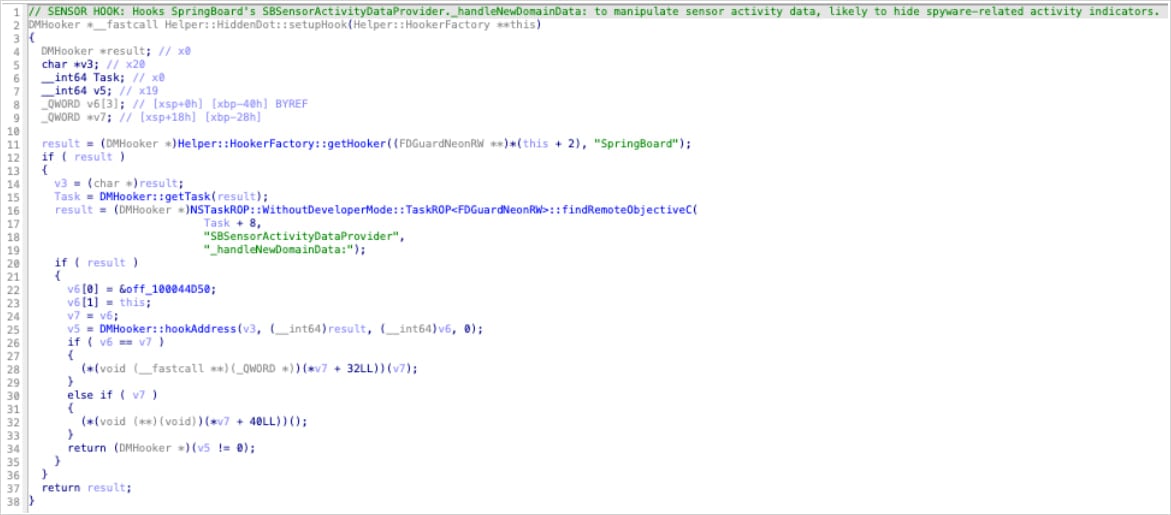
According to Jamf, Predator hides all recording indicators on iOS 14 by using a single hook function (‘HiddenDot::setupHook()’) inside SpringBoard, invoking the method whenever sensor activity changes (upon camera or microphone activation).

By intercepting it, Predator prevents sensor activity updates from ever reaching the UI layer, so the green or red dot never lights up.

“The target method _handleNewDomainData: is called by iOS whenever sensor activity changes – camera turns on, microphone activates, etc.,” Jamf researchers explain.

“By hooking this single method, Predator intercepts ALL sensor status updates before they reach the indicator display system.”

Advertisement
Function targeting the SBSensorActivityDataProvider
Source: Jamf

The hook works by nullifying the object responsible for sensor updates (SBSensorActivityDataProvider in SpringBoard). In Objective-C, calls to a null object are silently ignored, so SpringBoard never processes the camera or microphone activation, and no indicator appears.

Because SBSensorActivityDataProvider aggregates all sensor activity, this single hook disables both the camera and the microphone indicators.

The researchers also found “dead code” that attempted to hook ‘SBRecordingIndicatorManager’ directly. However, it doesn’t execute, and is likely an earlier development path that was abandoned in favor of the better approach that intercepts sensor data upstream.

In the case of VoIP recordings, which Predator also supports, the module responsible lacks an indicator-suppression mechanism, so it relies on the HiddenDot function for stealth.

Jamf further explains that camera access is enabled through a separate module that locates internal camera functions using ARM64 instruction pattern matching and Pointer Authentication Code (PAC) redirection to bypass camera permission checks.

Advertisement

Without indicators lighting up on the status bar, the spyware activity remains completely hidden to the regular user.

Jamf notes that technical analysis reveals the signs of the malicious processes, such as unexpected memory mappings or exception ports in SpringBoard and mediaserverd, breakpoint-based hooks, and audio files written by mediaserverd to unusual paths.

BleepingComputer has contacted Apple with a request for a comment on Jamf’s findings, but the company never responded.

Modern IT infrastructure moves faster than manual workflows can handle.

In this new Tines guide, learn how your team can reduce hidden manual delays, improve reliability through automated response, and build and scale intelligent workflows on top of tools you already use.

Advertisement

Source link

Continue Reading

Tech

Ultra Rare 1996 Nissan NISMO 400R Could Be Yours for the Right Price

Published

on

1996 Nissan NISMO 400R
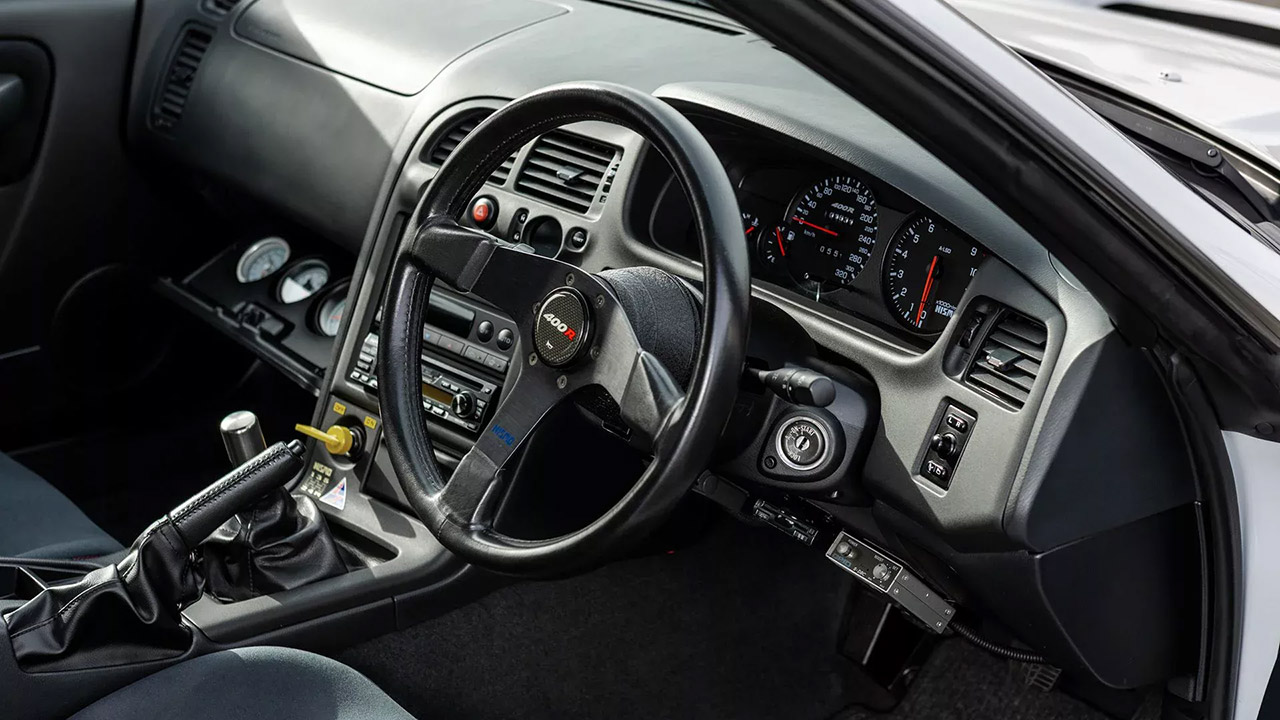
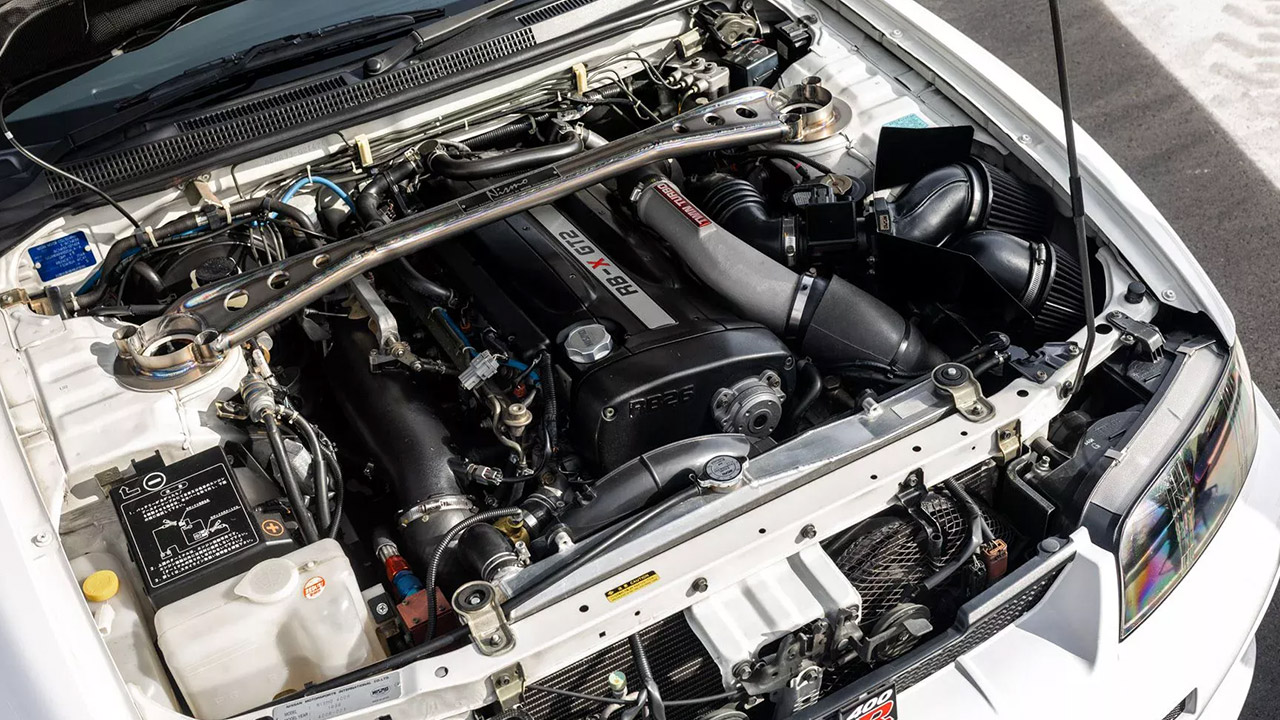
The 1996 Nissan NISMO 400R is one of those rare, ultra exclusive performance cars that came out of Japan in the 1990s and currently up for auction. To be honest, NISMO built this model mostly as a tribute to their work on the Le Mans GT-R LM. Engineers took the R33 Skyline GT-R V-Spec base and made it into something far more capable than a production car.


The engine, a twin-turbo inline-six, was bored from 2.6 to 2.8 liters, resulting in the RBX-GT2 engine built by REINIK. This resulted in it generating an impressive 400 horsepower and 346 pound-feet of torque, well above the unofficial Japanese limit of 276 horsepower. The acceleration from zero to 60 mph takes around four seconds, and the top speed is 186 mph.


LEGO Technic 2 Fast 2 Furious Nissan Skyline GT-R (R34) Car – DIY Kit and Building Set for Adults…
  • BUILD AN ICONIC CAR – Adults can relive their favorite movie moments with the LEGO Technic 2 Fast 2 Furious Nissan Skyline GT-R (R34), a detailed…
  • CAR MODEL KIT FOR ADULTS – Fans of model car kits and building blocks will enjoy discovering details as they build, like functioning steering, a…
  • GROUNDBREAKING DRIFT FUNCTION – The first-ever LEGO Technic drift mechanism raises the car so builders can recreate the movie’s most impressive…

1996 Nissan NISMO 400R
They tackled the challenge with a twin-plate clutch and a six-speed manual transmission to handle the power coming from that behemoth. The suspension was also updated with NISMO springs and Bilstein dampers, which reduced the ride height by nearly two inches in order to make the car drive more sharply. The brakes on the V-Spec base were fine, but NISMO chose to enhance them with their own pads. The styling has also been updated, with bigger fenders, new bumpers to increase airflow, side skirts, a carbon fiber hood, and a large rear spoiler. Then they slapped on some three-piece Rays LM-GT1 wheels.

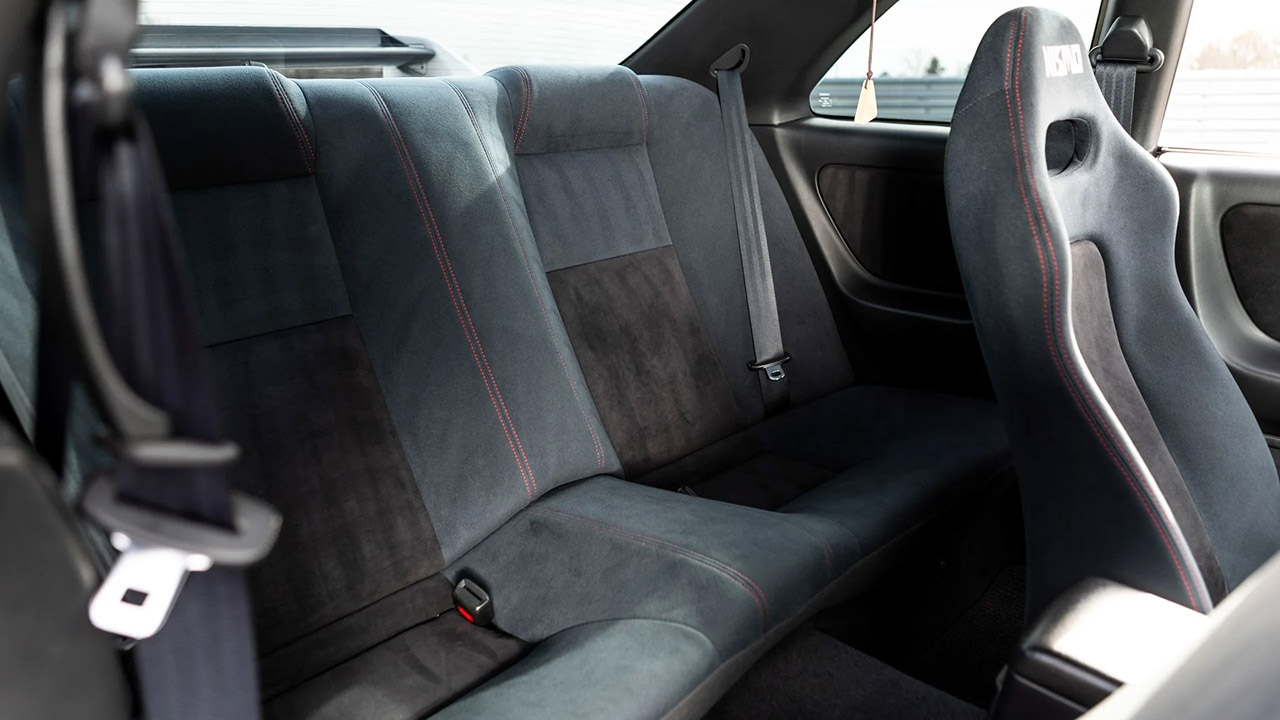
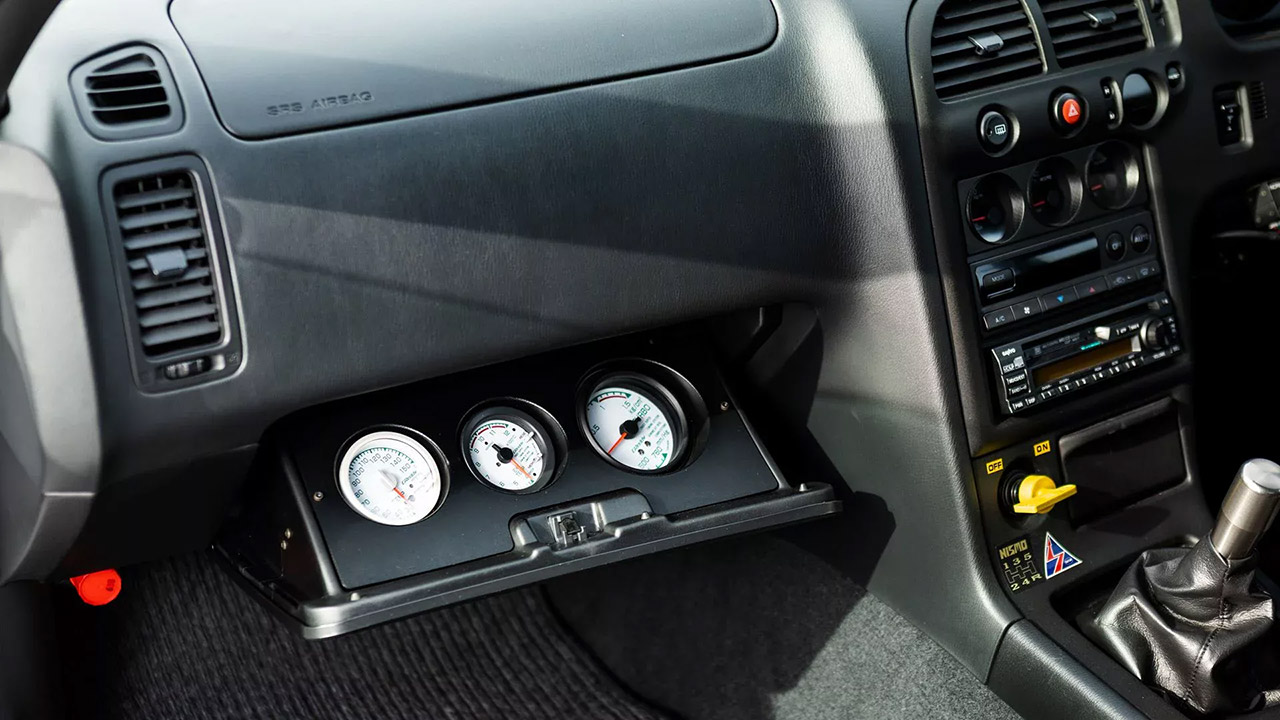
1996 Nissan NISMO 400R Interior
Prior to the R33 shutdown, just 44 units were built, compared to the original plan of 100 units. Because of its rarity, the 400R has become the ultimate collector’s item. The majority of them were held in Japan for many years.

1996 Nissan NISMO 400R
This specific car carries the chassis number 008, indicating that it is the eighth car ever manufactured. It’s a true show stopper, with QM1 White exterior and a black interior with plenty of red stitching. There are just 16,313 kilometers (10,136 miles) on the odometer and was initially registered in July 1996. It remained in Japan for more than 30 years until being shipped to Canada in 2023 and, finally, to the United States in 2024. Last year, this car won the Hagerty Car Culture Award at the Amelia Concours.

1996 Nissan NISMO 400R
Broad Arrow Auctions will offer this 400R at The Amelia Auction on March 7, 2026, in conjunction with the Amelia Concours. They estimate the price between $900,000 and $1,100,000, demonstrating the increasing value of low-mileage and documented cases. A similar vehicle sold for $995,000 at the RM Sotheby’s Monterey auction in 2025.
[Source]

Source link

Advertisement
Continue Reading

Tech

A judge ruled Tesla still has to pay $243 million for a fatal crash involving Autopilot

Published

on

Tesla is still on the hook for $243 million after a US judge rejected the EV maker’s bid to overturn a jury verdict from last year. On Friday, US District Judge Beth Bloom upheld the jury’s decision to hold Tesla partially responsible for a deadly crash that happened in 2019 and involved the self-driving Autopilot feature.

The judge added that there was enough evidence to support the jury’s verdict, which was delivered in August 2025 and ordered Tesla to pay millions in compensatory and punitive damages to the two victims in the case. Judge Bloom added that Tesla didn’t present any new arguments to dispute the decision.

While the case has been moving along recently, the incident dates back to several years ago when the driver of a Model S, George McGee, was using Tesla’s Autopilot feature while bending down to retrieve a dropped phone. The Model S then crashed into an SUV that was parked on a shoulder, where Naibel Benavides Leon and Dillon Angulo were standing aside. Benavides was killed in the crash, while Angulo was severely injured.

Tesla hasn’t publicly commented on Judge Bloom’s decision yet, but it won’t be a surprise to see the company appeal the latest ruling with a higher court. Tesla’s lawyers previously tried to pin the blame on the driver, claiming that the Model S and Autopilot weren’t defective. As this major case plays out, Tesla is also facing several investigations from the National Highway Traffic Safety Administration for both its Autopilot and Full-Self Driving features.

Advertisement

Source link

Continue Reading

Tech

These Are The 10 Most Popular Ryobi Tools, According To The Brand

Published

on


Ryobi is a Japanese manufacturer of everything from cars to printers and, of course, power tools. The company got its start in the 1940s, making die-cast products in a modified soy sauce factory. It wasn’t until the 1960s that the company started making the power tools it’s known for today.

In the United States, Ryobi power tools and related products are manufactured and distributed by Techtronic Industries (TTI), under an agreement with Ryobi, beginning in 2000. TTI also owns Milwaukee, Hoover, Dirt Devil, and other popular brands. Ryobi holds a decent chunk of the power tools market share, nipping at the heels of other brands like Craftsman and DeWalt.

Sometimes, when you’re window shopping for new tools, toys, or anything else, it’s worth considering the wisdom of the crowd. If consumer choice is any indicator, Ryobi tools are a safe choice for your everyday power tool needs. If you’re not even sure what you need, or if you need anything at all, the crowd can help with that, too. These are the 10 most popular Ryobi products (at least right now), according to the company’s own ratings. The top 10 products can and will change as new products are released and consumer preferences evolve, but this is what Ryobi consumers are buying in February 2026.

Advertisement

USB Lithium 3-Port Charger and Power Source

If you’re lucky, you’ll get through the entire day without your phone, tools, and other electronic devices dying on you. For everyone else, a portable power source can make a huge difference. Ryobi’s most popular tool is the USB Lithium 3-Port Charger and Power Source.

Advertisement

It’s a portable two-in-one power source that can recharge your phone and tools at the same time. You can use a cable to charge your mobile phone and other small electronic devices, and to charge up to three rechargeable USB lithium batteries. It’s compatible with a belt clip (sold separately), has a carabiner, and features a battery indicator light to let you know when the power source needs to be recharged.

It’s designed for use with Ryobi’s USB lithium batteries, which can power any of the tools and gadgets in Ryobi’s USB Lithium System. Each 3Ah battery can power handheld drivers, work lights, powered pruning shears, glue guns, misting fans, and more. The batteries can be charged individually using a USB-C cable, but this power source can charge up to three of them at the same time, giving you up to 9Ah of portable power. User reviews call it a “game changer,” saying it’s an excellent portable power solution, and “super useful” for anyone who has at least a couple of Ryobi’s lithium devices.

Advertisement

18V ONE+ HP Brushless Hybrid Forced Air Propane Heater

Cold fingers lose dexterity and become less responsive, so staying warm in a drafty garage or cold worksite can make a big difference in productivity, especially during the winter. Maybe that’s why Ryobi’s 18-Volt ONE+ HP Brushless Hybrid Forced Air Propane Heater is so popular.

A forced air heater works by heating air with gas or electricity (in this case, it’s propane gas) and then distributing that air with a blower fan. It’s essentially the same technology in your home’s furnace, except this blows warm air out into the environment instead of through your ductwork. It comes with a 15-foot hose and regulator to connect the heater to a propane tank and has an attached carrying handle for easier transportation.

It can run either on a ONE+ battery or plugged in with an extension cord. A temperature control dial on the outside lets you set the heater output between 75,000 and 125,000 BTUs (British Thermal Unit, the amount of energy needed to raise the temperature of a pound of water by one degree), so you can heat an area up to 3,125 square feet. You can keep the heater running for nearly three hours with a 4Ah battery and over eight hours with a 12Ah battery, provided you’ve got enough propane.

Advertisement

40V Battery Topper Light

It’s difficult to get anything done if you can’t see, but construction jobs, home renovations, and other hands-on projects often require working in poor lighting. That’s where work lights come in. This 40-Volt Battery Topper Light is powered by Ryobi’s 40-volt batteries. It clicks right on top of the battery and provides between 100 and 1,000 lumens of light.

Advertisement

Using a fully charged 40-volt 12Ah battery, this light can run for up to 11 days in ultra-low mode (100 lumens). With the same battery, it can operate on low (300 lumens) for roughly 5.6 days, on medium (600 lumens) for 2.9 days, and on high (1,000 lumens) for 1.9 days. If you’re using a battery with a smaller capacity, your runtime will be affected.

The light has a customizable head that can be oriented in nearly any direction, pivoting up and down 120 degrees and rotating 300 degrees side to side. It has an attached metal hook so you can hang the light onto wooden studs and other anchor points and it has a USB-C port for charging your phone and other small electronics. It basically turns your Ryobi 40-volt battery into a portable battery bank with an attached spotlight.

Advertisement

18V ONE+ 3-Tool Light Combo

Keeping the lights on is an important part of keeping any project or worksite running smoothly. The Ryobi 18-Volt ONE+ 3-Tool Light Combo is an all-in-one lighting solution powered by Ryobi’s 18-volt ONE+ batteries. The lighting combo includes one 18-volt ONE+ Hybrid LED Panel Light, one 18-volt ONE+ LED Spotlight, and one 18-volt ONE+ Flexible LED Clamp Light.

The panel light is compatible with a tripod and has three LED panels. The middle panel pivots 150 degrees, and the side panels rotate 360 degrees so you can direct light exactly where you need it. There are low, medium, and high settings and it’s capable of delivering up to 3,000 lumens. The panel light is also capable of getting power from an extension cord if you need a more permanent lighting solution.

The spotlight has low, medium, and high settings and puts out 3,000 lumens in a 650-yard beam. It also has a hanging loop for hands-free lighting. Lastly, the clamp light emits up to 400 lumens, can be set to high or low, and it can be oriented in pretty much any direction thanks to its 16-inch flexible neck. The light also rotates at the base and features a clamp that can grip objects up to 1.75 inches thick.

Advertisement

80V 1000W Power Source

Between power tools, mobile phones, tablets, and other portable electronic devices, sometimes you need a way to take power with you on the go. A pocket-sized portable battery bank is good for phones and other small devices, but if you need to charge your power tools and other heavy-duty devices you’ll need a more robust power source.

Advertisement

The 80-Volt, 1,000-Watt Power Source connects to Ryobi’s 80-volt batteries, transforming them into a mobile power solution. It delivers 1,800 watts of starting power and 1,000 watts of running power, enough to power large devices like televisions and refrigerators. The power station has two 120-volt AC outlets, two USB-A ports, and one USB-C port so you can plug in your large devices and power your smartphone and other small devices at the same time.

It serves as a portable power source but can also be used as emergency power during a power outage. Using a 10Ah battery, this power station can charge your phone more than 60 times or power your refrigerator for 12 hours. The power station can also connect to the Ryobi 80-volt Riding Lawn Tractor and utilize the power from all three of its 80V batteries, tripling your runtime.

Advertisement

40V 15-Inch Attachment Capable String Trimmer Kit

If you need a grass trimmer for cleaning up the edges of your yard, you could get a basic weed eater, or you could spring for one of Ryobi’s most popular products, the 40-Volt 15-Inch Attachment Capable String Trimmer Kit.

It’s a string trimmer much like your conventional gas-powered weed eaters, except it’s powered by Ryobi’s 40-volt batteries. You can get about an hour of runtime from a 40-volt 4Ah battery and if you have a bigger yard, you can get longer runtime out of a battery with greater capacity. It features a variable speed trigger and a quick-change coupler so you can attach and detach the string trimmer from the power head with ease.

The string trimmer comes in a kit with a 40-volt power head, a straight shaft trimmer attachment, one 40-volt 4Ah battery, and a 40-volt battery charger. The handle is compatible with Ryobi’s Expand-It line of products. You can detach the string trimmer and replace it with an eight-inch cultivator, eight-inch edger, sweeper, pole saw, snow thrower, and more.

Advertisement

18V ONE+ 3/8 Inch Drill Kit

A power drill is a common part of your basic tool collection. Once you’ve selected a hammer, a tape measure, and a collection of drivers and wrenches, a drill is usually the first power tool most people add to their collection. There are low-power drills for everyday at-home use and more robust power drills capable of drilling hundreds of holes into concrete with relative ease.

Advertisement

The Ryobi 18V ONE+ ⅜ Inch Drill is on the lower end of the power drill spectrum. It’s an affordable option with relatively low power. It’s probably not the drill professionals are likely to reach for before heading to the construction site, but it’s a popular choice for day-to-day drilling at home.

It’s a fairly basic drill with a ⅜ inch keyless chuck. It gets up to 600 RPMs, which isn’t the most powerful, but is enough to drill through drywall and wooden studs to hang a picture or mount a TV. It’s lightweight at just 2.8 pounds, so you can hold it overhead without fatigue. It has a built-in LED light for illuminating your workspace and a variable speed trigger. It comes in a kit with one 18-volt ONE+ 1.5Ah lithium battery and an 18-volt ONE+ battery charger.

Advertisement

40V 550 CFM Blower Kit

Ideally, a power tool should take a difficult or tedious manual job and turn it into an easier and faster task through the introduction of mechanical help. The leaf blower is a perfect example of this relationship. When autumn comes and the leaves change colors and fall, people often need a way to clear their yard of leaves and debris. You could do it the old fashioned way with a rake and a little elbow grease or you can do it with a battery powered blower.

Ryobi’s 40-Volt 550 CFM Blower moves as much as 550 cubic feet of air per minute and can generate wind speeds of up to 120 miles per hour. It’s more powerful than a 25cc gas powered leaf blower, according to Ryobi. On high, you’ll get about 15 minutes of runtime with a 4Ah battery and 31 minutes with 8Ah battery. On low, that same 8Ah battery could last you up to 158 minutes. The smaller 4Ah battery more commonly paired with the blower can still get 75 minutes on low, more than enough time to clean up your average yard.

The blower comes in a kit with a 4Ah battery and a 40-Volt battery charger. Users describe it as a good value for the money and say it has plenty of power to handle regular yard cleanup.

Advertisement

18V ONE+ 1800-Watt Power Station Kit

Ryobi customers love a portable power station, and the 18-Volt ONE+ 1800-Watt Power Station is no exception. It’s built on the foundation of Ryobi’s 18-volt ONE+ battery platform, so it’s broadly compatible with your other Ryobi tools.

Advertisement

This power station uses Ryobi’s 18-Volt ONE+ batteries to deliver enough power to keep your refrigerator, televisions, and other electronics, both large and small, running for hours. You can also pull individual batteries to power your tools while you’re out in the field. It comes in a kit with four 18V ONE+ 6Ah lithium high-performance batteries and a charging adapter.

It only comes with four batteries but it’s capable of holding up to eight 18-volt ONE+ batteries at a time and the higher their capacity, the more you’ll be able to power. The station delivers 3,000 starting watts and 1,800 running watts, enough energy to power energy-hungry devices. With the four included 6Ah batteries you could charge your phone more than 45 times or run a refrigerator for up to four hours. With eight 12Ah batteries, you could power a refrigerator for up to 28 hours. You can monitor the power station with the Ryobi GenControl app, and when you get home for the day, you can recharge your 18V ONE+ batteries with the included charging adapter.

Advertisement

Tripower Tripod LED Light

If you’re serious about lighting, this is arguably the best option that Ryobi has to offer. The TriPower Tripod LED Light delivers 3,800 lumens, making it the brightest Ryobi light to date, according to the company. The TriPower part of the name refers to the light’s ability to be powered in three different ways. It’s compatible with any 18-volt ONE+ battery, and Ryobi 40-volt battery, or an extension cord and a wall outlet.

It has four brightness modes (high, medium, low, and single-panel) and you can get over 25 hours of lighting on single-panel mode using a 40V 6Ah battery. The light is mounted to a telescoping tripod stand, which extends up to seven feet into the air. The light can also be disconnected and placed wherever you look using the attached metal hook.

Using a 40V 12Ah battery you can get 13.5 hours on high. By contrast, an 18-volt 12Ah battery will run for about 7.5 hours on high with a full charge. The light’s head pivots 135 degrees, and the adjustable panels let you shine light in 360 degrees. The stand is compatible with other Ryobi ONE+ products like fans or speakers and it collapses down into a compact package for transportation and storage when not in use.

Advertisement


Source link

Advertisement
Continue Reading

Trending

Copyright © 2025