Tech
AudioBro V2 Adds Conversational AI and Room Memory to Its Hi-Fi Room Optimization Platform

AudioBro launched globally less than two weeks ago with a simple but potentially useful pitch for hi-fi and home theater owners: before you buy another amplifier, streamer, loudspeaker, subwoofer, DAC, cable, isolation puck, or mystical cable riser, perhaps figure out whether the room is the problem.
It probably is.
The Australian company has already followed that launch with AudioBro V2, which is either an impressively fast development cycle or evidence that software version numbers now require a seat belt. The update does not abandon the original platform so much as pull its previously separate room-analysis tools into one conversational interface.
Users can describe what sounds wrong, upload room photographs, REW measurements, speaker layouts, and AVR calibration screenshots, and let AudioBro determine which analyses are relevant before recommending one practical, high-impact next move. V2 also adds persistent Room Memory, while Pro users can speak with the platform and receive its guidance by voice.

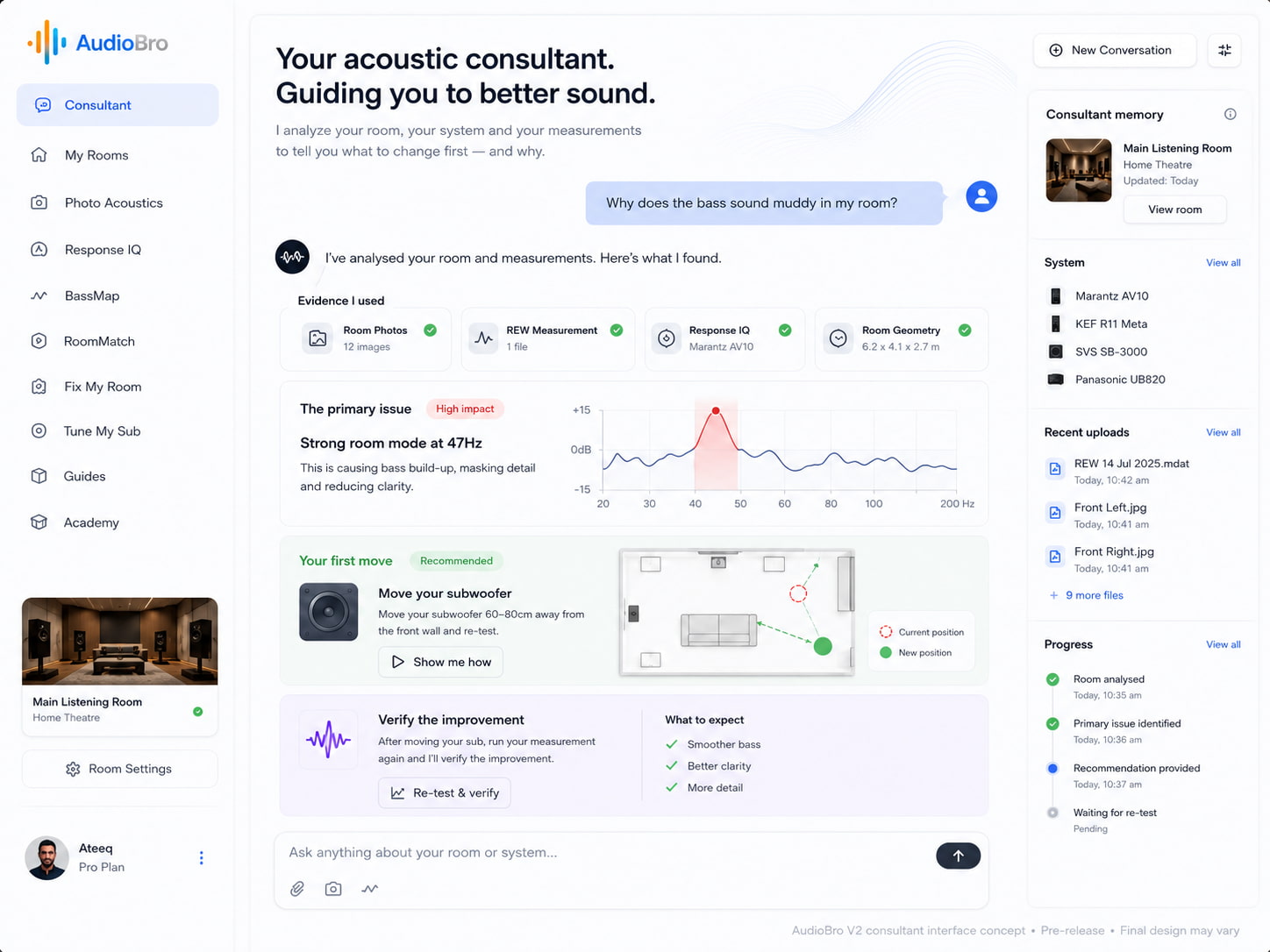
AudioBro remains a web-based platform designed to identify what is actually limiting a system’s performance. That could be room acoustics, loudspeaker placement, seating position, subwoofer integration, calibration settings, or some messy combination of all of the above. It is available globally through AudioBro.ai, with pricing listed in U.S. dollars.
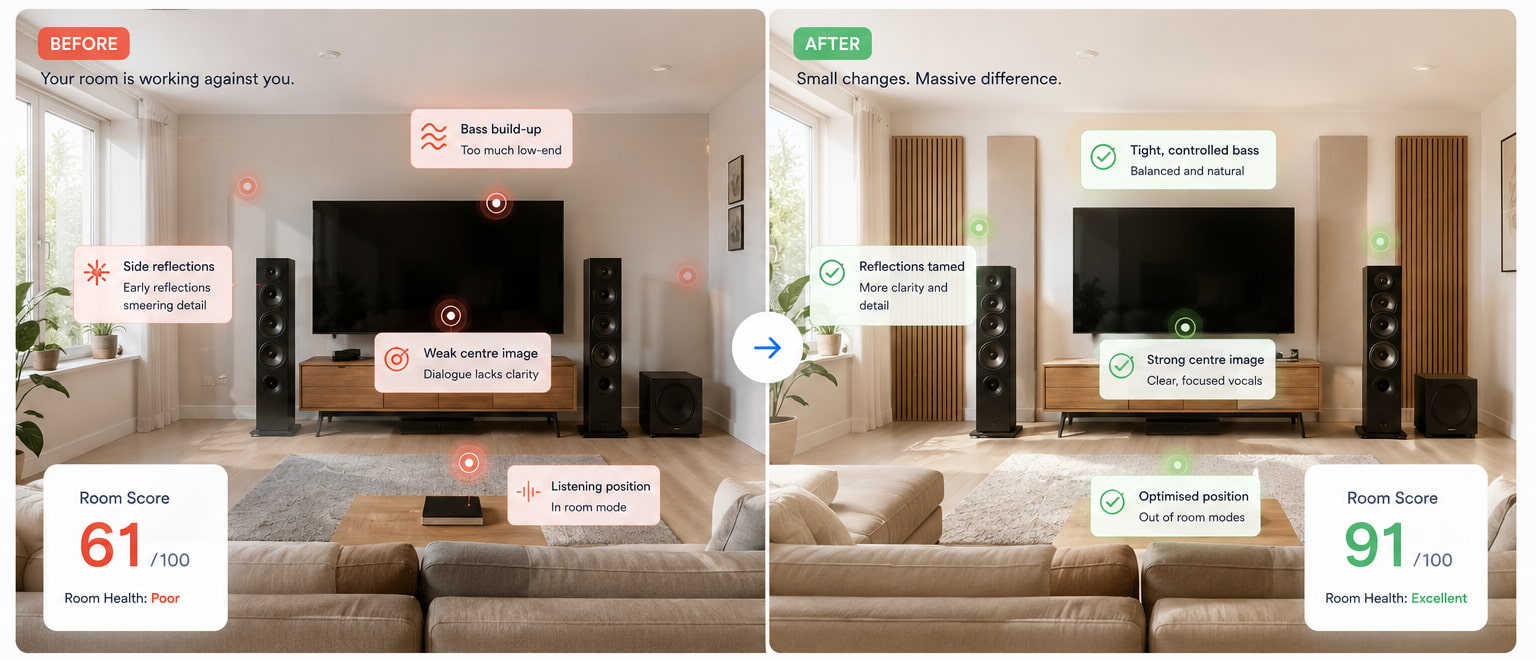
That matters because the upgrade treadmill is very real. A lot of systems do not fail because the loudspeakers are bad or the amplifier is underpowered. They fail because the speakers are shoved into the wrong part of the room, the listening chair is parked in a bass null, the center channel is aimed at someone’s knees, or the subwoofer is doing its best impression of a drunk forklift. My back would concur with that last point.
AudioBro was founded by Ateeq Sheikh and has been in development for more than three years. The company describes V2 as its largest evolution to date, combining visual, geometric, calibration, and measured evidence with conversational guidance, persistent room history, and retesting. In theory, that should make it easier for users to understand what is limiting their system before they start replacing equipment that may not be the problem.

What AudioBro V2 Actually Does
AudioBro V2 is not a black box that magically fixes your room while you make coffee. Users still have to supply the evidence: room photographs, dimensions, loudspeaker layout, system details, listening concerns, calibration screenshots, and, when available, measurements from tools such as REW, Dirac Live, Audyssey, Yamaha YPAO, Anthem ARC Genesis, and Lyngdorf RoomPerfect. More advanced users can also upload native REW .mdat measurement files and exported measurement data for deeper analysis.
What has changed is how users access AudioBro’s underlying tools. The original platform separated its capabilities into Photo Acoustics for visual room analysis, RoomMatch for loudspeaker and listening-position guidance, Tune My Sub for subwoofer optimization, Fix My Room for broader room diagnosis, BassMap for low-frequency placement modeling, and Response IQ for interpreting calibration screenshots. V2 brings those functions into one conversational interface, so users no longer have to decide which tool to open before they understand what is wrong. They can describe the problem, upload whatever evidence they have, and let AudioBro determine which analyses are relevant.

The platform then attempts to prioritize the problem rather than burying the user in a graph cemetery. A room photograph, REW measurement, and AVR calibration screenshot can now be considered together before AudioBro recommends what it believes is the single highest-impact next move. V2 also adds persistent Room Memory, which keeps previous analyses, uploaded measurements, implemented recommendations, and verified changes connected over time. Pro users can speak with the platform and receive its guidance by voice, which should be useful when both hands are occupied moving a 90-pound subwoofer that someone previously insisted belonged in the worst possible corner.
That last part remains central to AudioBro’s value proposition. The pitch is not merely that AI can look at your room. It is that the platform can combine several kinds of evidence, decide what deserves attention first, and remember what happened after you changed it. The important questions are still the same: what should you fix first, did the recommendation actually help, and does the platform know when it lacks enough evidence to answer confidently?


The arrival of AudioBro V2 has not changed the published pricing structure. Users who would rather have someone else examine the evidence can still purchase a one-off Room Review without subscribing. A Quick Room Review costs $97, a Full Room Diagnosis is $149, and a Measurement Review is $199. AudioBro says each report is personally reviewed by founder Ateeq Sheikh rather than generated and fired back by AI while everyone goes to lunch, with recommendations delivered within 72 hours.
For users who want to work through the platform themselves, Starter costs $24.99 per month or $199.90 annually, which works out to $16.66 per month. Pro costs $49.99 monthly or $399.90 annually, equivalent to $33.33 per month. Starter includes room analysis, placement guidance, Photo Acoustics, browser-based sweeps, saved rooms, and progress tracking, while Pro adds REW and .mdat interpretation, calibration analysis, microphone workflows, and more advanced measurement validation.
AudioBro is also offering limited founding-member lifetime access to the first 500 users. Starter Lifetime is listed at $199, while Pro Lifetime costs $299 and includes future features, beta access, and one expert consultation. Those prices are conspicuously lower than paying for even one full year at the annual rate, suggesting AudioBro is very eager to put early adopters in the room before someone from accounting notices.


AudioBro Founder Ateeq Sheikh Answers Our Questions
AudioBro makes some ambitious promises about helping users identify room, placement, and calibration problems before they spend more money on equipment. We asked founder Ateeq Sheikh about his industry background, the role of AI, who reviews the company’s paid reports, and why anyone might need a continuing subscription once the loudspeakers have stopped fighting the room.
eCoustics: Why did you create AudioBro?
Ateeq Sheikh: After more than 30 years in the hi-fi industry, I kept seeing enthusiasts spend thousands of dollars upgrading equipment when the biggest limitation was usually the room, loudspeaker placement, or system setup.
The goal of AudioBro has always been to make expert, room-first optimization accessible to more people and help them understand what to change first before spending more money.
eCoustics: Do you have professional credentials in acoustic engineering, calibration, or installation?
Sheikh: I do not hold a formal degree in acoustic engineering. My formal education is in business and IT, but I have spent more than 30 years working professionally in the hi-fi industry across technical, product-management, training, and leadership roles.
During that time, I worked with brands including Denon, Marantz, McIntosh, Wharfedale, Quad, Audiolab, KEF, MartinLogan, Audio Research, Dynaudio, Tannoy, Anthem, and many others. I also completed extensive manufacturer training covering loudspeakers, room-calibration technologies, A/V receivers, and system design.
I was fortunate to be mentored by the late John Dunlavy, whose approach to loudspeaker design, room interaction, and measurement had a lasting influence on how I think about audio reproduction.
Much of my career also involved creating and delivering training. As Head of Product Management at IAG Australia, I was responsible for developing and presenting technical training for dealers, installers, and staff across the Wharfedale, Quad, and Audiolab brands.
In later roles representing Denon, Marantz, McIntosh, Anthem, and other manufacturers, I continued leading product education, technical training, and system demonstrations throughout Australia.
AudioBro reflects that combination of industry experience, manufacturer training, and practical system optimization rather than a purely academic approach to acoustics.

eCoustics: Does a person oversee the Room Review reports, or is the entire process handled by AI?
Sheikh: One of the core principles behind AudioBro is that AI should augment experience, not replace it.
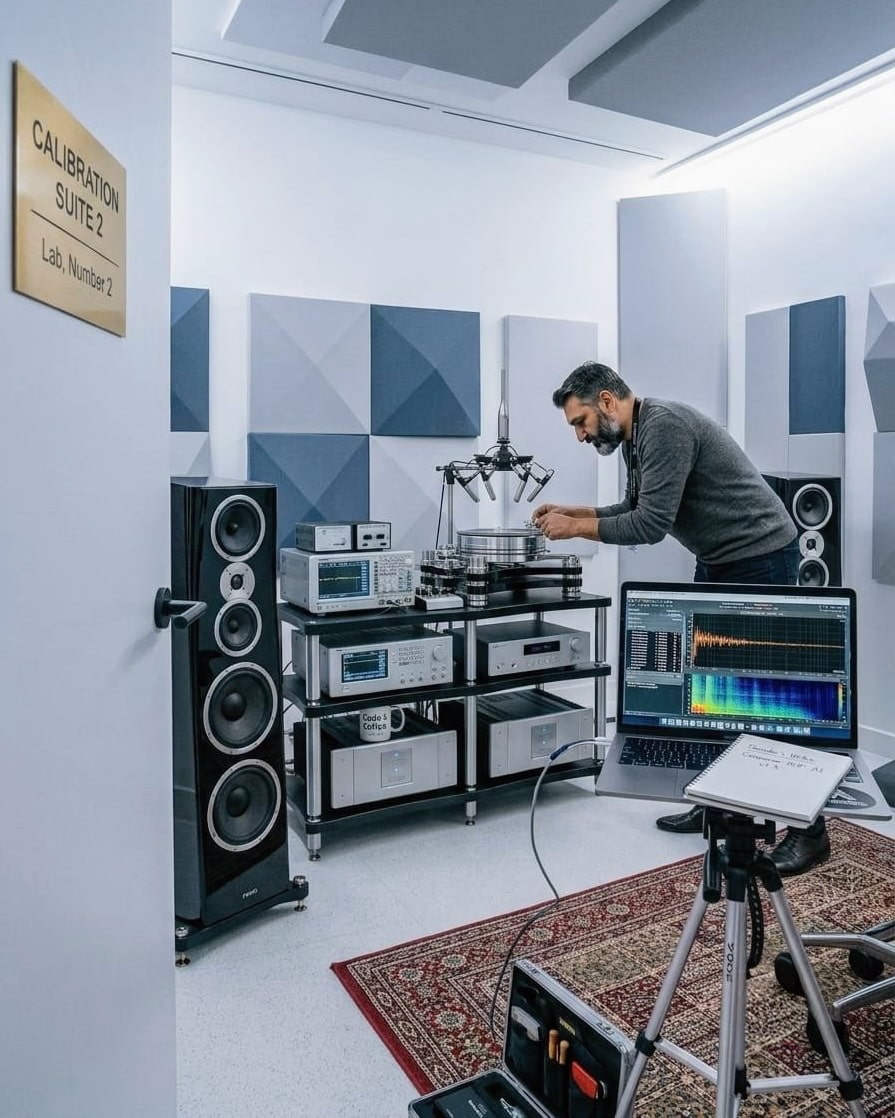
The platform uses AI and machine learning to analyze the available evidence, but the Room Review service is personally reviewed by me. AudioBro has always been designed around a human-in-the-loop approach, combining AI with decades of real-world audio experience.
eCoustics: Does anyone other than you currently handle Room Reviews or consultations?
Sheikh: At the moment, I personally oversee all Room Reviews and consultations.
As AudioBro grows, I will expand that side of the business, but maintaining consistency and quality has been important during the early stages.
eCoustics: Why offer a monthly subscription? Would most users not need the service only once?
Sheikh: That is a question I have spent a lot of time thinking about.
Some people will only need AudioBro once, particularly when setting up a new room, and that is why we introduced the one-off Room Reviews.
Other users continue making changes. They add equipment, integrate subwoofers, move house, optimize multiple rooms, experiment with placement, or compare measurements over time. The subscription allows the platform to evolve alongside those users while we continue adding new tools, workflows, and capabilities.
eCoustics: Is there any particular meaning behind the name AudioBro?
Sheikh: Absolutely. Hi-fi can sometimes feel intimidating, overly technical, or even elitist. I wanted to build something that felt approachable and helpful instead.
The idea behind the name was simple: imagine having a knowledgeable friend beside you, helping you achieve better sound without the jargon or guesswork. That is the personality I wanted the platform to have from day one.

Is AudioBro V2 Unique?
Sort of. The idea that room acoustics matter is not new. Neither are acoustic measurements, room correction, placement modeling, or remote calibration. REW users, custom installers, acousticians, and home theater owners have been wrestling with this stuff for years—usually while staring at enough graphs to make an actuary reconsider their career choices.
What is different is the packaging. AudioBro V2 pulls its previously separate analysis tools into one conversational interface that can consider room photographs, dimensions, speaker layouts, REW measurements, and calibration screenshots together. It then attempts to determine which analysis matters, recommend one practical next move, and remember what happened after the user made it. Pro subscribers can also interact with it by voice.
That combination of conversational guidance, multimodal evidence, prioritization, and persistent Room Memory is the more interesting part of V2. AudioBro is trying to make room optimization feel less like joining a secret society with a calibrated microphone and more like working through a guided consultation. It now sits somewhere between a measurement interpreter, placement tool, acoustic consultant, calibration assistant, and room-history file.
That could be genuinely useful because most listeners do not need another conflicting forum thread with 173 replies and four people arguing about microphone orientation. They need someone—or something—to say: move this first, measure again, and do not buy that thing yet.
The caveat remains obvious. AudioBro’s recommendations are only as reliable as the evidence supplied, the quality of its analysis, and the user’s willingness to follow through. A poorly taken measurement, incomplete room photograph, or inaccurate set of dimensions can still lead the entire exercise into the weeds. The Audio Science Review crowd will almost certainly dissect all of this across several hundred posts, followed by a “thank you, sir, may I have another” meeting held under strictly controlled conditions. That is 100% guaranteed.


Why Not Just Use Dirac Live?
Because AudioBro and Dirac Live are not the same thing.
Dirac Live is room-correction software that measures a system with a microphone and creates filters to correct frequency and timing issues. Dirac also offers Bass Control for subwoofer integration and ART for more advanced speaker cooperation and resonance control in compatible systems.
AudioBro does not replace that. It does not install filters inside your AVR, processor, or computer audio chain the way Dirac Live can. It is not a DSP engine.
Instead, AudioBro is more of a diagnostic and decision-support layer. It can help users understand whether the problem is placement, seating, reflections, subwoofer location, crossover choices, calibration settings, or room behavior before they start applying correction. It may also help people interpret what Dirac, Audyssey, ARC Genesis, YPAO, RoomPerfect, or REW are already telling them.
In other words, Dirac asks, “How do we correct this system?” AudioBro asks, “What is wrong with this setup, and what should we fix first?”
Those are related questions, but they are not identical.
A properly set up Dirac system can be extremely powerful. But room correction is not a permission slip to place speakers badly, ignore subwoofer position, or pretend glass walls are acoustic treatment. AudioBro’s room-first approach is useful precisely because it focuses on the physical setup before assuming software can clean up the entire crime scene.
Who Is AudioBro For?

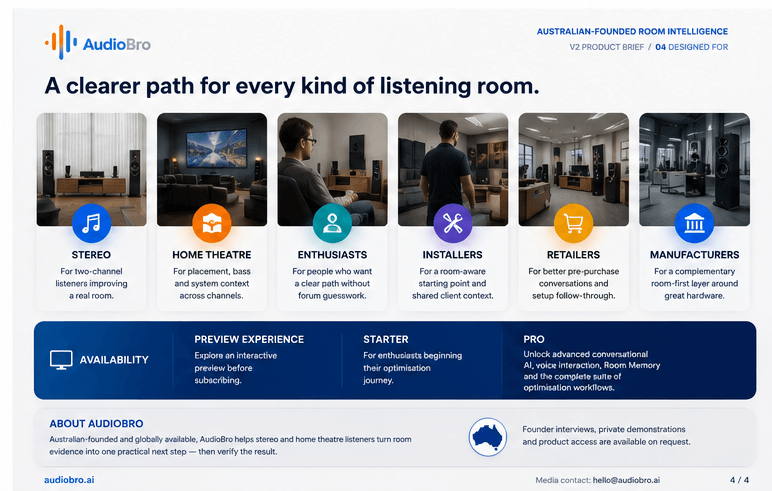
AudioBro is probably best suited to three types of users.
The first is the serious two-channel listener who owns good equipment but feels the sound is flat, boomy, vague, bright, or poorly focused. That person may not need new speakers. They may need better placement, a different listening position, basic treatment, or a clearer understanding of how the room is interacting with the system.
The second is the home theater owner who keeps adjusting dialogue, bass, and surround levels but never gets the system to lock in. Center-channel aim, subwoofer integration, seating position, crossover settings, and room layout can all sabotage an otherwise capable system.
The third is the measurement-curious user who has REW, Dirac, Audyssey, ARC Genesis, YPAO, or RoomPerfect data but does not fully understand what the results mean. AudioBro Pro and the Measurement Review option seem aimed directly at that group.
It is probably not for people who already work confidently with REW, understand modal behavior, know how to integrate multiple subwoofers, and can interpret calibration data without needing a second opinion. Those people may still find it useful, but they are not the obvious target.

The Bottom Line
AudioBro V2 makes considerably more sense than the original collection of separate tools. Bringing room photographs, REW files, calibration screenshots, placement analysis, and previous recommendations into one conversational workflow gives users a clearer path from “something sounds wrong” to “move this first and measure again.” Room Memory also adds genuine value for anyone changing equipment, integrating multiple subwoofers, or working through more than one room.
Founder Ateeq Sheikh does not hold a formal acoustical-engineering degree, but he brings more than 30 years of industry experience and currently reviews every paid Room Review personally. That human oversight matters. It does not guarantee that every recommendation will be correct, but it gives the one-off services more credibility than an automated report fired back by a chatbot wearing an imaginary lab coat.
The pricing also gives users several ways in. Starter costs $24.99 per month or $199.90 annually, while Pro costs $49.99 per month or $399.90 annually. For listeners who only need help once, the more sensible options may be the $97 Quick Room Review, $149 Full Room Diagnosis, or $199 Measurement Review. The subscription is easier to justify for users who regularly change equipment, add subwoofers, move house, or enjoy rebuilding their systems every six weeks because financial stability was becoming tedious.
The limitations remain obvious. AudioBro is only as reliable as the photographs, dimensions, screenshots, and measurements supplied by the user, and it still needs stronger public case studies showing detailed before-and-after results. It cannot confirm that the microphone was positioned correctly, that the measurements were valid, or that the user actually followed the advice.
Still, AudioBro V2 could become a useful bridge between forum chaos, intimidating measurement software, automated room correction, and hiring a professional calibrator. Helping listeners fix the room before buying another amplifier, cable, or mystical accessory is a smart idea. AudioBro now needs to prove that its recommendations are consistent, repeatable, and worth paying for.
For more information: audiobro.ai
You must be logged in to post a comment Login