Tech
AudioQuest DragonFly Copper Lands at High End Vienna 2026: The Dongle DAC OG Isn’t Done Yet

AudioQuest did not invent portable digital audio, but with the original DragonFly USB DAC in 2012, it did something arguably more important: it made the category make sense to normal people. Plug it into a laptop, connect headphones or a real system, and suddenly the miserable little audio section inside your computer could go sit in the corner and think about its life choices.
That original DragonFly was designed by Gordon Rankin, the same Gordon Rankin behind Wavelength Audio — and yes, the man also knows his way around a tube amplifier. His 300B-based Wavelength Duetto remains the best tube amp I ever owned, which is still a sore subject. Damn you, ex-wife’s lawyers.
AudioQuest says more than 300,000 DragonFly DACs have been sold worldwide, which is not a rounding error. That is a category-defining number. I still have the original DragonFly, DragonFly Red, and DragonFly Cobalt somewhere in the black hole otherwise known as my box of hi-fi accessories. Every audiophile has one. Some have three.
Some still have one plugged into an older MacBook that refuses to turn back on. Damn you, dead hard drive and the piece of biltong I used to beat that smug aluminum bastard like it owed me money.

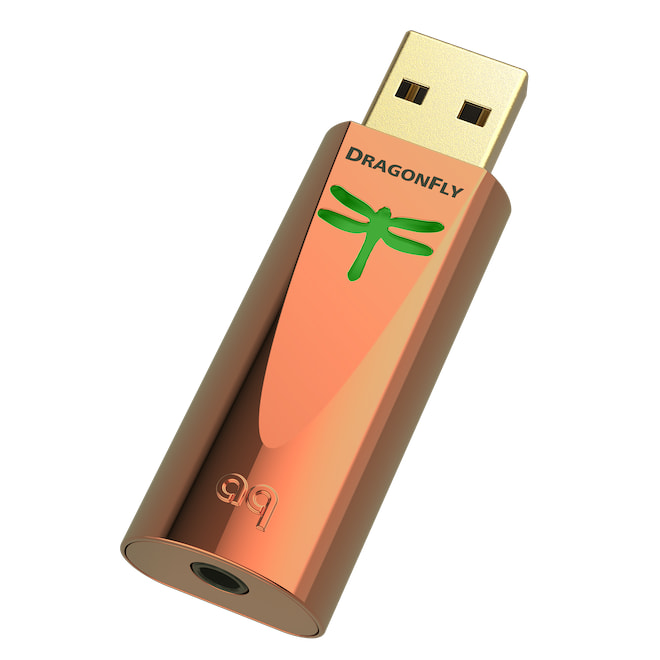
The new AudioQuest DragonFly Copper, introduced at High End Vienna 2026, arrives in a very different market. The original DragonFly helped create the USB DAC/dongle DAC category; in 2026, that category is packed tighter than a Knicks watch party outside Penn Station. iFi Audio, FiiO, Cayin, Questyle, Astell&Kern, Campfire Audio, and others now offer pocket-sized DAC/headphone amps with higher published resolution support, balanced outputs, app control, wireless codecs, and in some cases Bluetooth support for aptX, aptX HD, aptX Lossless, and LDAC.
So Copper cannot win merely by being cute, copper-colored, or historically important. Nostalgia is not a feature set. Thankfully, AudioQuest appears to understand that.
DragonFly Copper Is More Powerful, More Efficient, and Still Designed to Be Simple

The headline changes are straightforward: DragonFly Copper uses a 32-bit ESS Sabre ES9218 DAC/headphone amplifier, outputs 2.1 volts, draws 25% less current than previous DragonFly models, and delivers twice the output power of any earlier DragonFly, according to AudioQuest. It remains a portable USB DAC, preamplifier, and headphone amplifier designed for headphones, powered speakers, preamps, amplifiers, and full audio systems.
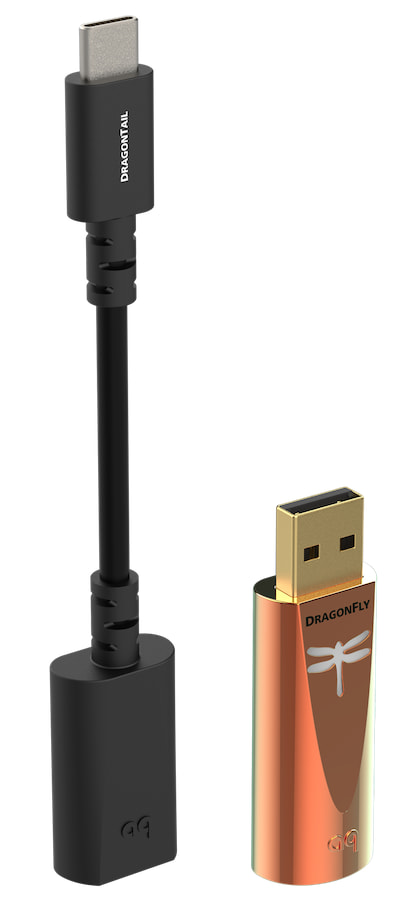
That matters because DragonFly has always lived or died on ease of use. Copper still works with Apple, Windows, iOS, and Android devices, meets USB Audio Class standards, and does not require additional drivers. AudioQuest also includes a DragonTail USB-A to USB-C adaptor, which is far more useful in 2026 than another removable cap destined to vanish under a car seat. My mother once found one under the back seat of her Subaru, and I still have no idea how it got there.
The volume is still controlled by the phone, tablet, or computer. That may look less fancy than a rotary knob or OLED screen, but Rankin’s explanation is practical: DragonFly negotiates with the host device and uses its own internal volume control, allowing the host to send bit-true audio while avoiding extra controls that add power draw and fragility.
AudioQuest has confirmed the core DragonFly Copper specifications, although not every measurement has been published yet. Copper uses a 32-bit ESS Sabre ES9218 DAC/headphone amplifier and delivers 2.1 volts of output from its 3.5mm analog headphone/preamp output. It supports PCM playback at 44.1, 48, 88.2, and 96kHz, with the DragonFly logo changing color to show standby and sample-rate status: red for standby, green for 44.1kHz, blue for 48kHz, yellow for 88.2kHz, and light blue for 96kHz.

The Copper Case Is Not Just Jewelry
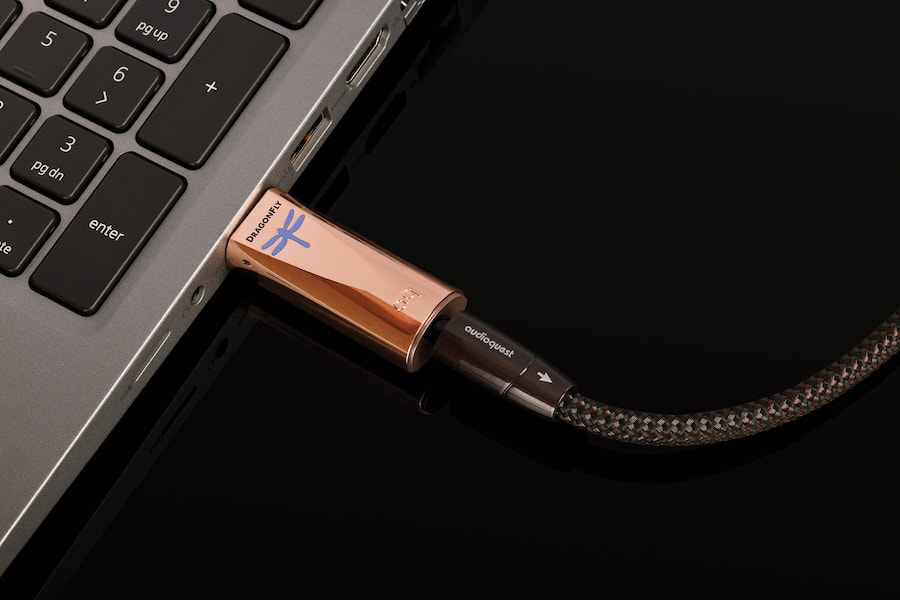
AudioQuest says the copper-plated case is designed to improve RF-noise drainage, drawing from the company’s work on the RF-draining barrels used in its Mythical Creatures interconnects. Garth Powell says the direct-plated copper case was chosen before the product name, because the material is highly conductive at radio frequencies and more effective at draining induced RF noise than polymer, brass, zinc, or aluminum.
That is the most AudioQuest part of the story, and yes, some people will immediately start sharpening their measurement knives. Fair enough. But RF noise in compact USB-powered audio devices is a real engineering problem, especially when the source is a laptop, tablet, phone, or streamer with more digital hash flying around than a Best Buy returns counter on December 26th.
Copper is also compatible with AudioQuest’s JitterBug FMJ USB filter, unlike Cobalt, which already incorporated some similar filtering technology and was not always an ideal match with an external JitterBug in series. AudioQuest says Copper is its quietest DragonFly yet, but additional noise rejection is possible with JitterBug.
No 32-bit/384kHz, No DSD Arms Race
This is where the 2026 market comparison becomes important. Many current dongle DACs advertise 32-bit/384kHz PCM, DSD256 or higher, balanced 4.4mm outputs, onboard displays, app control, and sometimes wireless support. On a spec sheet, DragonFly Copper looks conservative because it remains limited to 24-bit/96kHz playback.
AudioQuest is not pretending otherwise. Rankin’s argument is that Full Speed USB tops out at 24/96 and consumes significantly less power than High Speed USB implementations used for 32/384 playback. His position is blunt: higher-rate processing often increases current draw, heat, noise, and processing demands without necessarily improving real-world performance from a phone-powered DAC.
That will not satisfy everyone. Some buyers want the biggest numbers because the spec sheet told them to feel something. But AudioQuest is clearly not chasing the dongle DAC arms race. Copper is being positioned as a better DragonFly: more power, less current draw, lower distortion, better RF noise management, and the same plug-and-play simplicity that made the line popular in the first place.
Gordon Rankin Had to Restart the Project After MQA Became Yesterday’s Sandwich
The development story is also more interesting than the usual “we improved everything because adjectives” routine. According to Rankin, the next DragonFly had originally been planned as a more powerful MQA-rendering model, codenamed “Ruby.” Then COVID delayed development, MQA’s relevance collapsed, and the war in Ukraine disrupted access to materials used in earlier DragonFly components. That forced AudioQuest and Rankin to rethink the design goals and parts strategy.
Removing MQA from the mandate changed the engineering path. Without MQA rendering, the processor no longer had to inspect and process incoming frames for MQA data, reducing DSP requirements and allowing a lower-power design. Rankin says ESS delivered the ES9218 integrated DAC/headphone solution, enabling twice the headphone power of previous DragonFly models while retaining digital filter options used in Cobalt.
The other major work was less glamorous but likely more important: capacitors, board layout, and careful tuning. That sounds boring until you realize that small USB-powered DACs live or die by layout, power behavior, and noise management. Tiny boxes do not forgive sloppy engineering. They just make it portable.


The Bottom Line
DragonFly Copper Enters a Much Tougher Dongle DAC Market.
This is the part AudioQuest cannot duck. In 2012, DragonFly was a revelation. In 2026, it is walking into a knife fight wearing a very nice copper jacket.
The competition is real. iFi has been aggressive in the portable DAC space. FiiO offers strong value and increasingly polished hardware. Cayin and Questyle bring serious amplification credibility. Astell&Kern knows premium portable audio better than almost anyone. Campfire Audio has also entered the USB DAC/amp market with products aimed at IEM and headphone users who want small, clean, travel-friendly solutions.
Many of those competitors offer features DragonFly Copper does not: balanced outputs, higher-resolution PCM and DSD support, gain modes, displays, firmware customization, app-based settings, and wireless codec support. Copper’s counterargument is not more buttons. It is execution, power efficiency, reduced current draw, low noise, improved output, and the fact that it remains one of the easiest ways to improve sound from a phone, tablet, laptop, streamer, or desktop system.
Pricing & Availability
AudioQuest DragonFly Copper is available for $249.95 at Crutchfield, which includes USB-C adapter. but we don’t yet know when the product ships. For more information, visit audioquest.com.
You must be logged in to post a comment Login