

Connect with us
DAPA Banner
DAPA Coin
DAPA
COIN PAYMENT ASSET
PRIVACY · BLOCKDAG · HOMOMORPHIC ENCRYPTION · RUST
ElGamal Encrypted MINE DAPA
🚫 GENESIS SOLD OUT
DAPAPAY COMING

Tech

Belkin’s Pricey New Battery Grip Makes My Switch 2 Feel Like a Steam Deck

Published

on

The Nintendo Switch 2 is my favorite gaming handheld right now, but its battery life is still a weak point compared to older Switches. Belkin’s new $100 battery pack and grip combo accessory, called the Charging Grip, solves some of the battery issues and even handheld comfort. But it makes the Switch 2 a lot bigger in the process.

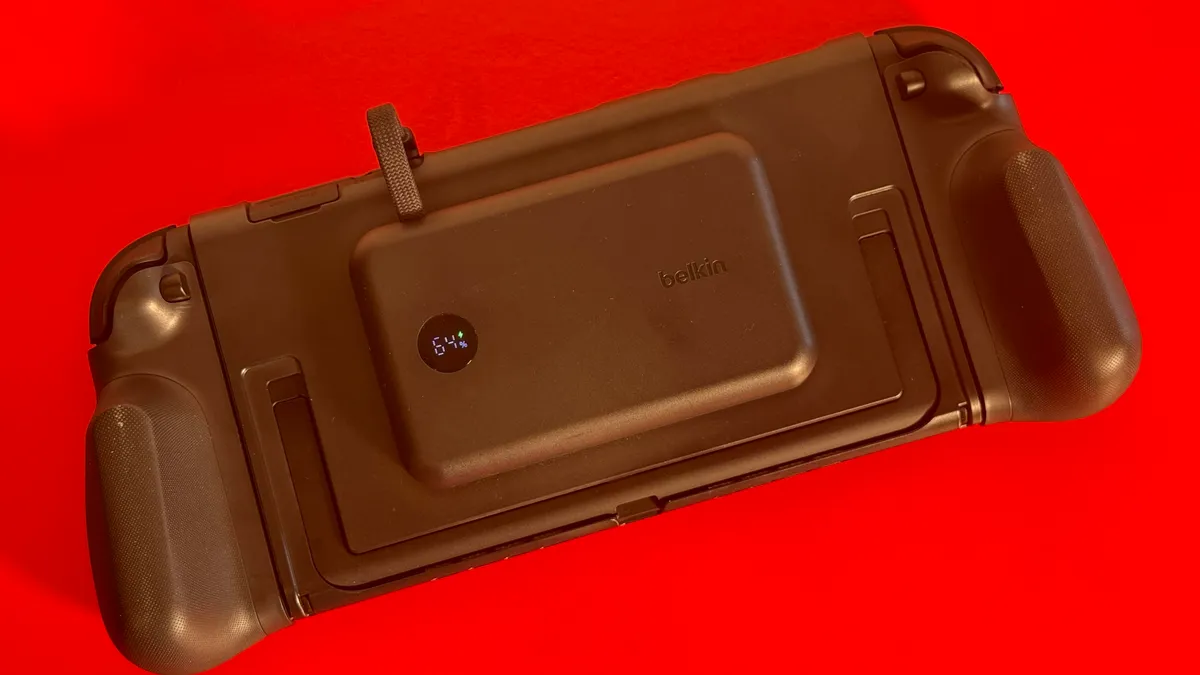
I’ve been trying an early review sample of the Charging Grip over the last week, and there’s stuff I appreciate. The 10,000-mAh battery has an LED screen to show charge amount, and generally resembles the battery that also came in an already-available battery pack-embedded Belkin Switch 2 case. 

This time, the battery sticks onto the Switch 2 itself. A snap-on plastic shell has a magnetic panel the battery snaps onto, and then a little USB cable pops into the top to charge at 30W. The case I’m trying is black, but it also comes in lilac and olive. Belkin promises 1.5 Switch 2 recharges with the battery. So far, it’s been a helpful way to top off the Switch 2 over a day without redocking or plugging in.

Advertisement
Nintendo Switch 2 with Belkin grip case on, next to Steam Deck OLED

With the Charging Grip on, the Switch 2 is basically Steam Deck size.

Scott Stein/CNET

The plastic shell feels a bit flimsy, although it’s at least a little more protection for the Switch 2 body. There’s a cut-out on the back for the Switch 2’s kickstand to pop out.

Advertisement

Two large Joy-Con controller grips come in the package, sliding on easily and locking in place. The rubbery texture and their overall size does make holding the Switch 2 feel more comfy to me, more like the generous size of Steam Deck and Windows gaming handhelds.

Nintendo Switch 2 with Belkin Charging Grip case on

I like it, but maybe not enough to keep it on all the time. 

Scott Stein/CNET

But the overall battery-plus-grip cosmetic change to the Switch 2 bulks it up a ton. It can still prop up with a kickstand on a table, and can technically narrowly slide into the dock without removing the grip case. But it definitely won’t fit into regular Switch 2 carry cases, although Belkin’s selling a new shoulder-carry travel bag for that.

Advertisement

One of my favorite parts of the Switch 2 versus Windows handhelds is how much more compact it is, and unfortunately Belkin’s grip case erases that advantage. But if you’re looking for a battery boost and a comfier grip no matter the cost or size, this might be for you.

Source link

Advertisement
Continue Reading
Click to comment

You must be logged in to post a comment Login

Leave a Reply

Tech

An RGB Keyboard For Your Hackaday Communicator Badge

Published

on

The most recent Hackaday event badge has been the Communicator, a handheld wireless terminal with a rather nice QWERTY keyboard. It’s good enough as delivered, but [makeTVee] has gone one better and made his Communicator keyboard into a fully RGB light-up experience.

The feat is achieved with the help of a new front panel holding some very thin side-emitting addressable LEDs. The keys are custom-printed, and there’s a TPU mat to hold them all together. The LEDs are driven from one of the device’s GPIOs.

We saw this badge in real life at the recent Hackaday Europe conference in Lecco, Italy. It really is as good as it looks in the video below, the care and attention which has gone into the build is extremely impressive.The original badge used a silicone cast set of keys, and we’d say if you are making a device with a keyboard then these might make a very good option.

Advertisement

If you’re not familiar with the Communicator, it’s worth having a look at the launch announcement.

Advertisement

Source link

Continue Reading

Tech

JBL Debuts Summit Everest and K2 Flagship Loudspeakers at High End Vienna 2026

Published

on

HARMAN Luxury Audio Group has arrived at High End Vienna 2026 with several new high-end audio products, but the headline for JBL is the next generation of its Summit Everest and Summit K2 flagship loudspeakers.

Timed with JBL’s 80th anniversary, the updated Everest and K2 join the Summit Makalu, Summit Pumori, and Summit Ama, which debuted at High End Munich in 2025. Together, they complete the five-model JBL Summit Series for residential audio.

JBL describes the Summit Series as one of its most advanced loudspeaker efforts for the home, and only the fifth JBL loudspeaker family to carry the “Project” designation in the company’s eight-decade history. That label matters: JBL has historically reserved it for its most ambitious engineering platforms, not just another expensive box with prettier woodwork and a Sherpa-friendly name.

The JBL Project Legacy

Only a select few JBL loudspeakers have ever carried the “Project” designation since 1954, beginning with Project Hartsfield, followed by Project Paragon, Project Everest, and Project K2.

Advertisement

Each JBL Project loudspeaker reflects a particular stage in the company’s high-end engineering work, with changes in driver design, enclosure construction, horn geometry, crossover design, and system integration shaping each generation.

For nearly 40 years, Project Everest and Project K2 have been central to JBL’s high-end loudspeaker development. Successive versions have introduced updates to transducers, compression drivers, cabinet construction, waveguides, and overall system tuning.

The latest generation Summit Everest and Summit K2 carry that tradition forward with patented and proprietary technologies developed at JBL’s renowned Acoustic Center of Excellence in Northridge, California.

Summit Everest

jbl-summit-everest-ebony-front

Summit Everest, named after Earth’s highest mountain, is the flagship of the Summit Series and the successor to four generations of Project Everest loudspeakers released over the years. 

Mid/High Frequency: The core of the latest Everest is a newly engineered mid/high-frequency system that combines the output of three patented JBL D2820 2-inch dual-diaphragm, dual-motor compression drivers with a custom-designed, patent-pending 3-into-1 expansion manifold, seamlessly mated to a custom large-format Sonoglass High-Definition Imaging (HDI) horn

Advertisement

Mid-Bass/Bass: For mid-bass and bass, there are dual 10-inch cast-frame Differential Drive mid-bass drivers and dual 15-inch cast-frame Differential Drive woofers, each utilizing JBL’s triple-layer Hybrid Carbon Cellulose Composite Cone (HC4) for stiffness, low distortion, and exceptional power handling that define a true reference design.

3.5 Way Configuration: The result of its driver configuration, the Everest is a 3.5 Way floor-standing loudspeaker that is designed to support elevated resolution, dynamic authority, tonal precision, and spatial realism across a bandwidth extending from 20 Hz to beyond 23 kHz.

Advertisement. Scroll to continue reading.

Summit K2

jbl-summit-k2-ebony-front

The Summit K2, named after Earth’s second-tallest mountain, is JBL’s most accomplished 15-inch 3-way floor-standing loudspeaker, built upon the legacy of four generations of Project K2 development. The K2 brings signature musicality forward with measurable advances in resolution, transparency, and tonal accuracy. 

Mid/High Frequency: The latest K2 incorporates a newly engineered mid/high-frequency system pairing three patented D2815 1.5-inch dual-diaphragm, dual-motor compression drivers with a custom-designed, patent-pending 3-into-1 expansion manifold and large-format Sonoglass® HDI™ horn. 

Advertisement

Mid-Bass/Bass A 10-inch cast-frame Differential Drive mid-bass driver and a 15-inch cast-frame Differential Drive woofer are included, both of which feature HC4 cones. This design anchors the K2’s sonic foundation, delivering the dynamic precision and emotional immediacy that have defined this speaker since its 1989 debut. 

The Summit Standard

The Summit Everest and Summit K2 bring together the main technologies developed for the Summit Series, including updated transducers, horn/waveguide geometry, crossover design, and cabinet construction.

A MultiCap crossover network, supporting single-wire, bi-amp/bi-wire, and tri-amp/tri-wire connectivity, replaces traditional large capacitors with a greater number of smaller capacitors, reducing electrostatic resistance and minimizing energy loss for greater signal transfer, increased power handling, and ultra-low distortion. 

The Everest and K2 are housed in a precisely engineered enclosure with internally offset, multi-braced, and damped pre-stressed pressed curved-wall construction designed to minimize internal standing waves. 

Custom-designed JBL | IsoAcoustic isolation feet decouple the loudspeaker from the supporting surface, contributing to tighter bass performance, a more expansive soundstage, and imaging defined by greater clarity and spatial precision. 

Advertisement

Finishes and Binding Posts

jbl-summit-everest-ebony-rear-connections

Summit Everest and Summit K2 are offered with a choice of high-gloss painted black with Summit Platinum accents or high-gloss Macassar Ebony wood veneer with Summit Gold detailing. The Everest and K2 employ sustainably sourced engineered wood cabinetry that reflects JBL’s commitment to materials and execution.

The speaker binding posts are rhodium-plated, wrapped in carbon fiber, with Ohno-Continuous-Cast (OCC) long-crystal oxygen-free silver-plated copper internal wiring.

JBL 2026 Summit Series Comparison

jbl-summit-loudspeakers-black-full-line
JBL Summit Series in high gloss black
JBL Summit Model Everest 
(2026)
K2
(2026)
Makalu
(2025)
Pumori
(2025)
AMA
(2025)
Speaker Type 3.5-way floor-standing Floor-standing Reference Loudspeaker 3-way floor-standing Floor-standing Reference Loudspeaker 3-Way Bass Reflex Floor-standing Reference Loudspeaker 3-Way, Bass Reflex Floor-standing Reference Loudspeaker 2-Way, Bass Reflex Stand-mount Reference Loudspeaker
Price (pair) $159,990 $99,990 $44,995 $29,995 $19,995
High Frequency Control HDI™ Sonoglass® Horn HDI™ Sonoglass® Horn HDI™ Sonoglass® Horn HDI™ Sonoglass® Horn HDI™ Sonoglass® Horn
Tweeter (HF Transducer) D2820 2-inch dual-diaphragm, dual-motor compression drivers D2815 1.5-inch dual-diaphragm, dual-motor compression drivers D2830K: Dual 3-inch (75mm) Teonex® D2 Compression Driver D2815K: Dual 1.5-inch (38mm) Teonex® D2 Compression Driver D2815K: Dual 1.5-inch (38mm) Teonex® D2 Compression Driver
Mid-Bass (MB Transducer) Dual 10-inch HC4, Differential Drive Motor 10-inch HC4, Differential Drive Motor
 
8-inch HC4, 2.5″ Voice Coil, Ferrite Motor, Cast Frame 8-inch HC4, 2.5″ Voice Coil, Ferrite Motor, Cast Frame N/A
Woofer (LF) 15-inch HC4, 3″ Voice Coil, Differential Drive Motor 15-inch HC4, 3″ Voice Coil, Differential Drive Motor 12-inch HC4, 3″ Voice Coil, Differential Drive Motor 10-inch HC4, 2.5″ Voice Coil, Ferrite Motor 8-inch HC4, 2.5″ Voice Coil, Ferrite Motor
Ports 2 2 2 2 1
Input Type Bi-amp / Bi-wire Capable with Dual Sets of Binding Posts Bi-amp / Bi-wire Capable with Dual Sets of Binding Posts Bi-amp / Bi-wire Capable with Dual Sets of Binding Posts Bi-amp / Bi-wire Capable with Dual Sets of Binding Posts Bi-amp / Bi-wire Capable with Dual Sets of Binding Posts
Crossover MultiCap™ with Bi-amp/Bi-wire and tri-amp/tri-wire MultiCap™ with Bi-amp/Bi-wire and tri-amp/tri-wire MultiCap™ with Bi-amp/Bi-wire MultiCap™ with Bi-amp/Bi-wire MultiCap™ with Bi-amp/Bi-wire
Finish  High-gloss black with Platinum accents 

High-gloss Macassar Ebony wood veneer with Summit Gold detailing

High-gloss black with Platinum accents 

High-gloss Macassar Ebony wood veneer with Summit Gold detailing

Advertisement
Black High Gloss / Ebony Veneer w/ Gloss Black High Gloss / Ebony Veneer w/ Gloss Black High Gloss / Ebony Veneer w/ Gloss
Dimensions (HWD) 56.8″ x 39.1″ x 27.3″ 50.4″ x 25.0″ x 18.1″ 43.4″ x 18.3″ x 15.5″ 41.6″ x 15.5″ x 14.7″ Speaker: 18.6″ x 12.1″ x 13.2”
Stand: 21.7″ x 16.2″ x 16.2″
Weight  523 lbs 239 lbs 152.6 lbs 140.8 lbs 58 lbs
jbl-80-years-benson-boone

JBL Celebrates 80th Anniversary

JBL is celebrating its 80th anniversary in 2026, marking eight decades since James B. Lansing founded the company in 1946. That is not a small footnote in audio history. JBL has been part of professional studios, cinemas, concert venues, home audio systems, cars, portable speakers, headphones, and more than a few cultural moments where the sound system mattered as much as the crowd.

The brand’s reach is unusually broad. JBL Professional continues to play a major role in cinemas, studios, stadiums, houses of worship, clubs, and live venues, while JBL’s consumer division has become one of the most visible names in portable audio and headphones. Few audio companies can claim that kind of spread without sounding like the marketing department got loose with the espresso machine. In JBL’s case, the claim has some weight behind it.

Founded by one of the most important loudspeaker engineers of the 20th century, JBL built its reputation on high-output loudspeakers, studio monitors, professional sound reinforcement, and home audio products that helped define what American hi-fi looked and sounded like. The company’s history includes major technical achievements in loudspeaker design and recognition from both the film and recording industries, including Academy Awards for sound engineering achievements and a Grammy Award for its long-running contribution to concert, studio, cinema, and broadcast sound.

Advertisement. Scroll to continue reading.
jbl-80-year-legacy

That legacy still matters because JBL is not just trading on old photographs and orange grilles. The company remains active across professional, luxury, portable, automotive, and personal audio, while also investing in spatial audio, adaptive sound, immersive listening, and more sustainable product design. Not every one of those phrases needs a parade, but they do point to where JBL thinks audio is going next.

For 80 years, JBL has been defined by an uncompromising pursuit of acoustic excellence, and the Project loudspeakers have always represented the absolute summit of that pursuit,said David Tovissi, Vice President & GM, HARMAN Luxury Audio. “With Summit Everest and Summit K2, we are honoring four generations of legendary engineering while introducing technologies that move the state of the art forward. These are reference loudspeakers built for listeners who refuse to compromise and who recognize what it means to own the very best.”

Advertisement
jbl-summit-everest-ebony-lifestyle-no-grille
JBL Summit Everest Loudspeakers in High-gloss Macassar Ebony wood veneer with Summit Gold detailing.

The Bottom Line 

With Summit Makalu, Pumori, and Ama introduced in 2025, JBL expanded the Summit Series below its established Everest and K2 flagships. The arrival of the latest Summit Everest and Summit K2 completes the line at the top, giving JBL a five-model residential flagship range tied directly to its Project loudspeaker heritage.

What makes Everest and K2 different is not just scale or price. These are JBL’s statement platforms for horn-loaded compression-driver design, large-format woofers, advanced cabinet construction, and high-output, low-distortion playback in larger rooms. Everest remains the larger dual-15-inch statement model, while K2 continues as the more compact single-15-inch flagship. Both are built for listeners who want JBL’s studio, cinema, and professional audio DNA translated into a domestic loudspeaker system.

These are not lifestyle speakers, and they are not for casual background listening. They are for large rooms, substantial amplification, careful setup, and buyers who want the most ambitious version of JBL’s high-end sound at home. The Summit Ama, Pumori, and Makalu may be more realistic choices for many systems, but Everest and K2 exist for the customer who wants the top of the JBL mountain and has the room, budget, and patience to let them work properly.

jbl-summit-k2-ebony-lifestyle
JBL Summit K2 Loudspeakers in High-gloss Macassar Ebony wood veneer with Summit Gold detailing.

Pricing & Availability

The JBL Summit Everest and JBL Summit K2 will be globally available later in 2026 through authorized JBL Summit dealers and partners, with the following prices:

Advertisement
  • Everest: $159,990 USD (159,998 EUR / 139,998 GBP) per pair
  • K2: $99,990 USD (84,998 EUR / 71,998 GBP) per pair

Previously released in 2025, the Summit Models that round out the prestigious speaker line.

  • Makalu: $45,000 USD (43,998 EUR / 36,998 GBP) per pair
  • Pumori: $30,000 USD (30,998 EUR / 26,998 GBP) per pair
  • Ama: $20,000 USD (17,498 EUR / 14,995 GBP) per pair including stands

For more on the JBL Summit Series, visit jbl.com/summit-series

Source link

Continue Reading

Tech

What’s fueling an IPO rush from SpaceX, Anthropic, and OpenAI

Published

on

Welcome to the era of the big three.

We’re not talking rappers here — although according to Kendrick Lamar, it’s “just big me” — we’re talking AI companies: Anthropic, SpaceX, and OpenAI.

These three leading artificial intelligence companies are all expected to go public this year. Elon Musk’s SpaceX, which recently acquired another Musk company, xAi, is on track to open up to investors later this month. Anthropic, the company behind the chatbot Claude, just filed confidentially with the States Securities and Exchange Commission for its own initial public offering. Reports say OpenAI could also go public as soon as September. (Disclosure: Vox Media is one of several publishers that have signed partnership agreements with OpenAI. Our reporting remains editorially independent.)

SpaceX’s IPO, when it happens, could be the largest in history and mint Musk as the world’s first trillionaire. With Anthropic and OpenAI, the combined value of AI IPOs could total over $3 trillion.

Advertisement

But it’s not as simple as going public and raking in cash. “There’s this race that’s been going on between SpaceX, OpenAI, and Anthropic,” Liz Lopatto, a senior writer at The Verge said. “There’s this fear that if you don’t go public at the right time or you don’t go public first, investors aren’t going to wait for you.”

To understand why some of the world’s richest men, at the helm of some of the world’s richest companies, are now courting the public’s money, Today, Explained co-host Sean Rameswaram spoke with Lopatto.

She’s been deep in SpaceX’s public filings and has been covering the court drama between Musk and OpenAI’s Sam Altman. Her latest piece for the Verge is titled “The SpaceX IPO is great for Elon Musk and terrible for you.”

Sean and Lopatto chat about what each of the companies hope to gain from the public, why this moment could be like internet 1.0’s dot-com bubble, and whether these companies chasing shareholder profits will be good for us.

Advertisement

Below is an excerpt of their conversation, edited for length and clarity. There’s much more in the full podcast, so listen to Today, Explained wherever you get podcasts, including Apple Podcasts, Pandora, and Spotify.

Why do [these companies] need to go public right now?

Whoever goes public first is going to scoop up better investors or have an easier time convincing investors. That is fueling this rush toward the market. So that’s thing one.

But thing two is that AI is extremely expensive. And I think that’s something that people often forget about because right now we’re sort of in, like, the early days of Uber, where you’re using this very expensive tool for free and then they’re going to try to get you hooked on it so that you’ll pay real prices later on.

Advertisement

In order to get the money that you need for compute, to build all of these data centers, to do all of the things that you need to do in order to have these frontier models, that’s just an incredibly capital-intensive business. One way to get capital is to go public.

Anthropic has had some better discipline than the other companies in terms of behaving like actual adults. They might actually tell us a little bit less before it happens than we’ve heard from, for instance, SpaceX.

Tell me more about behaving like adults when it comes to IPOs, which feels like a very adult thing to do.

There are sort of a lot of things that come into play with an IPO. And basically what you’re doing is you are setting out what your company is, what the company’s vision is, how you plan to make money, and what you’re going to do with all the money that you’re raising in the IPO. And for SpaceX, there’s a bunch of nonsense about Mars in there that doesn’t really feel real to me. There’s nothing about the biological risks of going to Mars, for instance, and the risk factors, which, if that were a real thing, you’d see it.

Advertisement

One of the things that’s been notable is that both Anthropic and OpenAI seem to have better businesses, based on what we know. Anthropic is actually about to make a profit. Anthropic in particular didn’t make any images with its AI. It stuck to text and it focused specifically on programming. It’s not a sexy business, it’s enterprise software. But you don’t have to be sexy to make money.

Just looking at the difference between like the flash we’re seeing about, like, spreading the light of human consciousness among the stars and actually making money, which is the point of a company. I would say that Anthropic seems like it’s run by adults by comparison. And then I would put OpenAI somewhere in the middle.

Why? What is Open AI doing that isn’t very adult-like behavior?

OpenAI as a business is really scattered. They created and shut down Sora, which was AI-generated videos. They have these AI image generators that have created a whole new level of headaches for them. They’re embroiled in a number of lawsuits.

Advertisement

Sam Altman, the CEO, was running it effectively as a startup composed of little startups within it and was like, “Well, we’ll just see which one of them wins.” And that’s maybe not the best way to run a company. It’s a fine way to run a portfolio, but a company is not a portfolio.

Liz, you’re very tapped into this world out there in Silicon Valley and you were at the trial between Altman and Musk. It sounds like these companies are all being talked about in the same breath even though two of them are very specifically AI companies and one of them wants to colonize Mars. Why is that? Is it just because they all may IPO soon?

I think that’s part of it. I also think there’s been this investment thesis that frontier AI models are effectively going to be a boom on the scale of internet 1.0, if you remember 1999.

This is sort of the moment where we’re going to find out who’s Google and who’s Amazon and who’s Pets.com, right? And so I think that’s why people are talking about them in this way, because it’s not just these three companies that are AI companies. Obviously Google has an AI arm that is very good. But then you have companies like Databricks, which you maybe haven’t heard of.

Advertisement

Yeah. This is a perfectly fine company. It’s got a business. But it’s not in that conversation because I don’t think people expect it to be one of the behemoths in the way that they’re looking at these three as the potential behemoths of this generation of technology.

This reminds me that when social media companies went public, they started prioritizing things like shareholder profit rather than safety. I think Facebook — Meta — is probably the most prominent example of this.

Do we want the still mostly dudes holding our future in their hands to be beholden to market forces and profits above all else?

Arguably they already are.

Advertisement

This is one of the arguments that has been made about OpenAI: that the reason they’ve had some of these issues around safety has been because they are motivated by chasing the market and trying to raise money. Because unlike social media, this is a very capital-intensive business.

You need to be showing investors something. You need to be proving yourself out in a way that you didn’t necessarily have to with social media right off the bat. So I think that’s part of it. But I think that going public potentially makes that worse. The chatbot will try to keep you engaged. It will give you an answer and then it will ask a tag question. And that’s an engagement tool that keeps you engaged with the AI.

You see that also with some of the sycophantic behavior you see with these AI where they’re like, “Wow, that’s such a smart question. Gee, you’re so bright.”

And is that really good for us? I don’t think it is. But it does keep people involved, and it does keep people engaged with the AI, and if you need to be showing user numbers or otherwise showing metrics to investors, those are the ones you show.

Advertisement

It seems almost silly to ask if being a publicly traded company could make these companies more accountable or even safer. But then again, if you think about Anthropic and their whole dustup with the Pentagon, without being publicly traded, they said, you know, you guys are crossing the red line and we have to reassess our relationship.

Do you think something about being publicly traded post-IPO could make a company like Anthropic or OpenAI a little bit more conservative in their developments and their technology?

To the degree that you can say, “Hey, like I was misled by this company as a shareholder because they told me there were these safety practices that actually were not in play and then take them to court” — that is something that can be done, sure. Unless you’re talking about SpaceX, which has a governance structure that effectively bars shareholder suits, unless you have a specific percentage of holding.

So not SpaceX, but maybe Anthropic, maybe OpenAI have this additional measure of accountability where shareholder lawsuits can potentially move the needle.

Advertisement

But most likely of all we just start to see a lot more ads.

I think that’s right. I think you also see prices go up for the enterprise products — and maybe for all of the other products as well.

Source link

Advertisement
Continue Reading

Tech

OSHA’s 5 Basic Safety Rules For Hand And Power Tools And Why They’re Important

Published

on


OSHA, or the Occupational Safety and Health Administration, is a federal body dedicated to overseeing safe working conditions wherever Americans ply their trade. OSHA operates as a regulatory agency with sanction power and plenty of muscle. The organization also produces guides and best practices for workers to ensure they’re always operating as safely as possible, aiming to limit the need for intervention.

OSHA’s internal documentation includes some key safety rules, and it has published what it calls “five basic safety rules” that can prevent hazards when using hand and power tools. These rules are essential for professionals working with tools on a daily basis, but they’re equally important for DIYers and other amateur tool users to follow. 

There are obvious hazards to remain wary of while operating machinery. There’s also the important step of avoiding using gasoline-powered tools indoors (alongside some other power tools that should remain strictly outdoor-use only). But these basic frameworks extend to cover virtually all interactions you might have with tools of all sorts, and they can help keep you safe through all of the ambitious projects on your to-do list.

Advertisement

Maintain your tools to prolong their life

Proper tool maintenance is one of OSHA’s most important rules. Tools of all varieties get put through the wringer as they go about their business. Heavy-duty power tools like impact wrenches take a beating, and so do basic implements like utility knives and screwdrivers. To make matters worse, tool users often operate in dirty workspaces.

Home mechanics often seek to build entire tool sets that feature oil and solvent-resistant handles and sealed encasements for power tools that protect against the chemicals and other substances found within the workshop. But this doesn’t mean that these tools are impervious. A tool that has been hit with oil or water might become slippery, making it a little less safe to use. But if you leave those irritants on the tool, they can lead to rust or corrosion that degrades its long-term function. Wiping down your tools after use and scrubbing away debris that might have accumulated in grooves are just some of the key practices that all tool users should engage in regularly.

Advertisement

Always use the right tool for the job

No matter the job you’re facing, there’s probably a niche piece of equipment designed to handle that specific demand. For every obscure tool you might encounter, there’s a versatile alternative that can probably get the job done. For instance, there are plenty of alternatives to the angle grinder. But this one tool offers coverage for a wide range of tasks, making it a frequently useful inclusion. I’m a tool user with only a few niche solutions in my own collection, and the idea that has stuck with me for many years is that ‘every tool is a hammer.’ In a pinch, you can swing just about any implement at a fastener or workpiece. But this approach runs completely counter to one of OSHA’s critical safety rules.

The reality is that just because you can swing a wrench or even the back end of a drill at a target, this is rarely a good idea. In this example, alternative tools can easily be damaged when used this way, and you may even create more problems than you solve by kicking debris into the air. Using the wrong tool is frequently less efficient, often making your working conditions less safe while adding numerous complications.

Advertisement

Don’t use damaged tools

In the same way that using incorrect tools for a job can introduce wild variables into the mix, damaged tools are also a significant hazard. Broken bladed instruments may expose your hands or other body parts to a rapidly spinning cutting edge. This can introduce a grisly hazard to your workspace. Similar issues arise with striking and prying tools. Working with broken instruments can cause additional damage to workpieces, yourself, or the people with whom you share the space.

Damaged equipment will frequently operate in unexpected ways. This creates uncertainty and many unforeseeable potential problems. It’s entirely possible that a broken tool will continue performing the way you anticipate, with only small issues outside its primary function. But you can’t be certain that this is the case and that some kind of hidden structural issue isn’t lurking beneath the surface. The potential for harm or unexpected damage to other equipment or material is just too great. Therefore, damaged gear should be repaired or replaced instead of being used.

Advertisement

Use your tools as they’re intended

Sometimes, there is a case to be made for improvisation and augmentation of tools. Cutting away the top of a wrench’s box end, for instance, might provide just enough extra clearance for a tool user to handle work in a uniquely tight area. This should only be done by experienced tool users, however, as it’s reserved for rare situations where standard tools don’t fit. An augmented tool is typically one that has been altered to handle one hyper-specific task. This kind of modification may run afoul of OSHA’s advice. 

By intentionally using your equipment outside of its operating guidelines, you place additional strain on the tool. This can also create working conditions vulnerable to new and unexpected hazards. One example that I’ve been guilty of, for instance, involves pushing a circular saw past its stated beveling capacity. My tool was inexplicably able to do it, but the entire experience of using the tool outside of its scope was harrowing to say the least. It felt incredibly dangerous, but I was only cutting a small segment of MDF baseboard material, so it wasn’t a particularly demanding task. Even so, it’s not something I’d recommend and goes directly against the OSHA guidelines for safe tool operation.

Advertisement

Use the correct personal protective equipment (PPE)

Lastly, if you’re using inadequate personal safety equipment, you’re placing yourself in harm’s way.  Operating heavy machinery without ear protection can lead to tinnitus and other negative ear health issues. The same can be said for eyewear, which keeps flying debris out of your eyes and protects you from things like sparks and even dust that can irritate you or temporarily impair your vision. Masks are important, too. When painting, sanding, or using chemicals, wearing the correct type of mask to protect your lung health can make a huge difference.

Must-have jobsite protective gear isn’t just essential for those using power tools. When removing nails or hand-sanding, these same key protective elements remain at the forefront. Your health is the most important thing, and it stands far above the outcome you’re looking to create with any project. If you aren’t around to fully enjoy the fruits of your labor, these tasks will not have been worth much in the grand scheme of things. Protective equipment is typically fairly inexpensive, and most DIYers and other tool users have been guilty of overlooking these accessories. This is not something that any tool user can afford to do if they want to protect their health and the safety of the people working with them.

Advertisement


Source link

Advertisement
Continue Reading

Tech

Cash app just launched a wand for payments because phone scans and taps are so boring

Published

on

Contactless payments are great, but have you ever paid for your coffee with a magic wand?

Cash App, the digital payments service run by Block, has just launched the Cash App Wand – a pearlescent, star-shaped, NFC-enabled keychain accessory that lets you tap to pay at any contactless terminal. Yes, it is a real product that costs $25, and it is available right now for Cash App Card holders to buy in the app.

So how does this magical wand work?

The Cash App Wand is the first product under a new hardware line called Cash App Tags. Tags are NFC-enabled physical devices that require no Wi-Fi or Bluetooth connection to function. To set one up, you simply hold it to the back of your phone, and it links directly to your Cash App account.

After that, it works exactly like a debit card, except it clips onto your keychain or handbag like a charm bracelet. Block’s hardware lead Thomas Templeton says the whole idea is to make payments feel visible, fun, and expressive again.

He points out that digital payments have made buying things almost invisible, and even Cash App’s own cards spend 90% of their time sitting in people’s pockets. Cash App wants the wand to be the first thing you reach for when it is time to pay.

Advertisement

This is just the beginning of Cash App Tags

The wand is the first of many quirky tap-to-pay hardware designs coming down the line. Limited runs of new Cash App Tag designs will drop to Cash App cardholders in the coming weeks, with general availability opening up later this summer.

Whether you need a wand to pay for your morning coffee or just want to feel like a wizard at the checkout counter, Cash App has you covered.

And if a magic wand wasn’t enough to make you spend more money, Google is also making online checkout faster and easier than ever by removing OTP and replacing it with a simple biometric check.

Source link

Advertisement
Continue Reading

Tech

Dark Cherry color shown in claimed iPhone 18 Pro leak

Published

on

A new series of images claiming to be the iPhone 18 Pro chassis have been leaked, showing black, blue, and dark cherry red.

It’s always suspicious when a leaker has just a single image of a purported device, but now a series of shots have shown off most of the colors expected for the iPhone 18 Pro.

On Yeux1122’s blog, fellow leaker Lanzk claims to have samples of the aluminum frame for the iPhone 18 Pro. They comprise the back and sides of the phone, and appear to be stamped with “2026” plus some unclear Chinese-language markings.

Hand holding a metallic magenta smartphone frame with large circular cutout and three camera lens openings, resting on a light surface near a keyboard and scattered papers

Dark Cherry looks ever more certain to be one of the iPhone 18 Pro’s colors – image credit: Lanzk

Advertisement

The leaker has shown off one Dark Cherry frame, two black ones, and three of the light blue version. There’s no distinguishable difference between the units when two or three are displayed.

There’s no indication of the source of the components. However, each of the black and light blue ones shown have a small plastic bag that appears to contain a SIM-card tray.

That would suggest that, however they got to the leaker, they may have come from manufacturers in China. There are other countries that still require a physical SIM card, however.

Even if the leak is as accurate as it appears, it may not be the complete set of colors due to be unveiled for the iPhone 18 Pro, and iPhone 18 Pro Max. While the current iPhone 17 Pro ships in three colors, previous rumors have said that the iPhone 18 Pro will return to the norm of having four.

Advertisement

Those four are the ones shown in this leak plus a light silver. If reports correct and there will be a Dark Cherry option, it’s predicted to become a hit just as the iPhone 17 Pro Max’s Cosmic Orange has been.

Two identical black smartphone back frames with three circular camera cutouts each, lying side by side on foam, with small clear plastic bags containing tiny components near the bottom.

Black version of the same frame part – image credit: Lanzk

However, some users will be more pleased at the return of a black option. That was last seen with 2024’s iPhone 16 Pro.

In the course of this review, we examined the image in depth. While there was no EXIF data to speak of, there generally isn’t and that’s not a sign of a fake.

Advertisement

There are none of the hallmarks of a photo edit, or generative AI having fabricated the images. The chassis’ internal protrusions are not identical to that of the iPhone 17 Pro, either. We think these are the real thing, unlike data gathered from case manufacturers.

That all said, leaker Lanzk has not previously reported on iPhone colors. However, they have leaked accurately about Apple’s plans for what would ultimately become the MacBook Neo.

Source link

Advertisement
Continue Reading

Tech

AI Leaders Call for Rules on Synthetic DNA to Limit Bioweapons Risk

Published

on

The big names in the artificial intelligence industry don’t always get along. We’ve seen lawsuits between AI companies and intense rivalries between leaders that turn into all-out feuds. But it seems that they generally agree on at least one thing: AI should not be used to create biological weapons.

AI Atlas

CEOs of some of the world’s leading AI companies signed a public letter this week urging governments to address the risks that could come from bad actors using their technology. The letter encourages Congress to enact laws to improve the tracking of synthetic DNA sequences that could be used to create biological weapons. 

Signed by OpenAI’s Sam Altman, Anthropic’s Dario Amodei, Meta’s Alexandr Wang, Microsoft AI’s Mustafa Suleyman, Google DeepMind’s Demis Hassabis and other scientists and AI lab leaders, the letter suggested legislation to require companies that sell synthetic DNA and manufacturers of synthesis machines to thoroughly check “sequences of concern and to verify customer legitimacy before shipping orders.”

Advertisement

The letter, also signed by leaders in the synthetic DNA industry and experts in national security, makes it clear that AI accelerates the threat of biosecurity threats.

“While the issue is not new, the pace of progress in artificial intelligence is. AI systems now outperform Ph.D-level virologists on questions about highly technical laboratory procedures in their own domains of expertise,” the letter states. 

“AI systems are improving rapidly, and alongside incredible benefits to science and medicine, there is a real possibility that the knowledge barriers which have historically prevented bad actors from obtaining biological weapons will meaningfully erode.”

The letter has a distinct sense of urgency, requesting that lawmakers implement guardrails swiftly. “This is a rare moment of agreement across stakeholders that are often at odds,” it reads. “We hope policymakers will meet it with decisive action.”

Advertisement

Source link

Continue Reading

Tech

Belkin Made A Charging Grip For The Switch 2

Published

on

It more than doubles your gaming time while giving you a better grip.

Belkin has introduced a new charging grip for the Switch 2 that lets you game longer and be more comfortable doing it. The Gaming Charging Grip for Nintendo Switch 2 comes with a 10,000 mAh power bank, built-in charging cable and modular grips for the Joy-Cons. 

To use it, you slide your Switch 2 into the charger case and snap the modular grips onto the Joy-Con 2s. Once connected via the built-in 30 watt USB-C cable, the power bank can recharge the console 1.5 times, letting you play well over twice as long as without it (150 percent longer, of course). The charging level is shown in a digital display on the back. 

The grips are ergonomic and non-slip, Belkin says, and detach with the Joy-Con 2s when you remove them. They look pretty thick, so should support your hands well even if they get a bit slick after some hours of play. On the main charging case, there’s a slot at the bottom so it won’t interfere with the Switch 2’s kickstand. 

Belkin also introduced the Travel Bag for Nintendo Switch 2, a cross-body everyday bag for gamers looking for a practical way to tote their console and accessories. It comes with a dedicated soft-lined pocket with a velcro strap, spacious storage, quick-access front pockets and a hidden compartment for trackers.

Advertisement

Belkin loves to experiment with Switch 2 charging, having already released a Charging Case that doubles as a tabletop stand and a Charging Case Pro. The Gaming Charging Grip is now available at belkin.com, Amazon and other retailers for $100 in black, lilac and olive, while the travel bag can be purchased in those same colors for $50. 

Source link

Advertisement
Continue Reading

Tech

Nvidia, Fei-Fei Li back Generalist’s $400m round to scale AI robotics

Published

on

Generalist hopes to make ‘general intelligence’ robotics a reality.

US AI robotics company Generalist has raised $400m at a reported $2bn valuation to accelerate its plans towards achieving “physical” artificial general intelligence (AGI).

The round was led by Radical Ventures, with participation from Nvidia’s venture arm NVentures, Jeff Bezos’ Bezos Expeditions, World Labs founder and leading AI expert Fei-Fei Li, and Zoom CEO Eric Yuan.

Other participants include 8VC, Union Square Ventures, Hanabi Capital, Norwest, Boldstart Ventures, Spark Capital, NFDG and serial entrepreneur Naval Ravikant.

Advertisement

With a team of AI and robotics experts with experience across Big Tech, Generalist hopes to make “general intelligence” robotics a reality.

The company was founded in 2024 by former DeepMind scientists Pete Florence, Andy Zheng, and former Boston Dynamics roboticist and Harvard machine learning scientist Andrew Barry.

Generalist launched its Gen-0 class of AI models last November, which it said was trained on an “unprecedented” scale of real-world data. The company said the model proved that physical experience and larger models could predictably produce more capable systems.

In April, it launched Gen-1, which showed commercial viability, it added. Gen-1 was three-times faster than similar state-of-the-art models, showcasing 99pc reliability on diverse tasks and demonstrated the ability to learn new and complex physical skills, according to Generalist.

Advertisement

“Scaling robot learning creates better models, better models can do more useful physical work, and data from real businesses drives the next generation of more capable models,” the company said in a statement.

The new funding will allow Generalist to continue “scaling robot learning”, including building new models, scaling its physical data engine, expanding compute and training infrastructure and working with industries for commercialisation.

“Our goal is not to tie ourselves to any single method or label. Our goal is to build whatever is needed to make physical AGI real,” said the company.

The exact definition of AGI is difficult to pin down. According to Google, AGI refers to the hypothetical intelligence of a machine that allows it to “understand” or “learn” intellectual tasks that humans can, while IBM calls it the “abstract goal of AI development”, where human intelligence can be replicated by machines or software.

Advertisement

Robotics rise

The robotics industry has gained renewed energy in recent years, fuelled by AI. For the world’s biggest chipmaker Nvidia, robotics represents the biggest market for potential growth after AI.

Last month, Meta acquired US start-up Assured Robot Intelligence to reportedly pursue its plans for humanoid robotic hardware to help with household chores, and Amazon made its own robotics-related acquisition with Fauna Robotics in March.

Meanwhile, Alphabet’s robotics software R&D company Intrinsic joined Google to work in close proximity with DeepMind, as well as tap into Google’s Gemini AI models and cloud services.

Don’t miss out on the knowledge you need to succeed. Sign up for the Daily Brief, Silicon Republic’s digest of need-to-know sci-tech news.

Advertisement

Source link

Continue Reading

Tech

App Store ecosystem climbs to a record $1.4 trillion in 2025

Published

on

AI apps led App Store growth in 2025, with the entire ecosystem garnering $1.4 trillion in payouts. Apple’s take of that is only 10%, assuming you agree with how they count.

Every year, typically right before WWDC, Apple releases a study showing how the App Store has fared over the prior year. In 2025, the App Store facilitated more than $1.4 trillion in developer billings. And, it said that the App Store ecosystem has tripled in size since 2019.

“Developers are the heartbeat of the App Store, and this year’s incredible milestone is a testament to their boundless creativity,” said Apple CEO Tim Cook.

“We are deeply committed to providing developers with the tools, technologies, and trusted platforms they need to build for the future,” Cook added. “Together, developers are creating apps that enrich the lives of users around the world.”

Advertisement

Commission eligible and ineligible revenue

Apple notes that for more than 90 percent of the billings and sales, Apple did not receive a commission. That means that most apps are making money outside of the App Store.

The study reports that 90% of App Store sales are commission-free. The study lists this number as $1,437 billion, or what most people, and Apple, generally call $1.4 trillion.

Infographic showing Apple App Store ecosystem billings and sales totaling $1,437 billion, with a donut chart and bullet lists explaining categories where Apple collects commissions and where it does not

Image credit: Apple & Analysis Group

Interestingly, Apple counts digital goods and services purchased outside the App Store as sales that are not eligible for commissions, but still in the $1.4 trillion total. These include subscriptions to Hulu, Audible, Spotify, and the New York Times.

Advertisement

It’s hard to understand where exactly Apple fits into this. If a person purchases a subscription to, say, YouTube Premium outside of the App Store, but watches it on their Apple TV, does that count in this number?

The methodology mentioned in the study isn’t helpful, either. It reads:

“Sales and distribution of digital goods and services can occur through the App Store in the form of paid app downloads and in-app purchases, through linking out to webstores where content is consumed in-app but payments are made outside of the App Store, or through the sale of digital content and subscriptions from multi-platform apps that allow for the use and consumption of the app, both in the App Store ecosystem and elsewhere.”

It’s unclear whether the data includes purchases made after a user manually enters a website address to buy digital goods, or only purchases made through links accessed via buttons in the app.

Advertisement

The study also doesn’t say where it gets its data, really. A small line reads “data sources include data from Apple, app analytics companies, market research firms, and individual companies.”

So the digital goods and services section is a bit hard to parse. And it accounts for about 10.3% of Apple’s total $1.4 trillion revenue figure, or $149 billion.

Other sources of revenue include physical goods and services, such as buying items on Amazon or ordering delivery through Instacart. Lastly, it mentions in-app advertising revenue, including ads displayed on TikTok, Instagram, and in games.

AI market saturation

This year, Apple is placing special emphasis on artificial intelligence (AI), claiming that apps featuring consumer-facing AI have seen four times the growth of their non-AI counterparts. This specifically refers to the top 100 apps, of which 40 currently have some form of consumer-facing AI.

Advertisement

Of course, it’s hard to tell if AI was the primary growth driver or if the most popular apps were going to integrate AI regardless.

For example, 99% of Fortune 500 companies were using AI in some capacity in 2025. Customer service saw a 2199% growth increase between January 2025 and January 2026.

Global growth, by region

The App Store saw growth worldwide in 2025. And in some regions, that growth has exploded in the last several years.

According to the study, billings and sales facilitated by the App Store have more than doubled in China in the last six years. In that same time period, it’s more than tripled in the U.S. and Europe.

Advertisement
Stacked bar chart comparing 2019 and 2025 App Store ecosystem sales by app category, showing substantial overall growth across digital goods, physical goods, services, advertising, and other segments.

Image credit: Apple & Analysis Group

Globally, physical goods and services accounted for the majority of all sales made in the App Store.

However, sales differed a little across regions. For example, travel was the second-largest category of spending in physical goods and services in the U.S., Europe, Japan, Australia, New Zealand, and Brazil.

However, in Korea, food delivery was the second most popular. In the Chinese market, grocery and food delivery rounded out the top three slots.

Advertisement

Apple’s investment in developers

In 2025, Apple hosted thousands of developers at its developer centers. There are more than 20 Apple Developer Academies around the world, including Brazil, Indonesia, Italy, Saudi Arabia, South Korea, and the U.S.

Apple plans to open a Developer Center in Berlin sometime in 2026.

WWDC 2026 kicks off on June 8, allowing Apple to connect with developers and offer the first look at what tools and technologies will be available for the upcoming Apple operating system lineup.

Developers and students will have access to more than 100 new video sessions about tools, technologies, and design. They will also be invited to participate in Group Labs and join conversations in the Apple Developer Forums.

Advertisement

Source link

Continue Reading

Trending

Copyright © 2025