



The Americans were closing in, the situation was getting more dangerous by the minute — and President Xi Jinping was waiting for my recommendation.
Tech
Belkin’s Pricey New Battery Grip Makes My Switch 2 Feel Like a Steam Deck
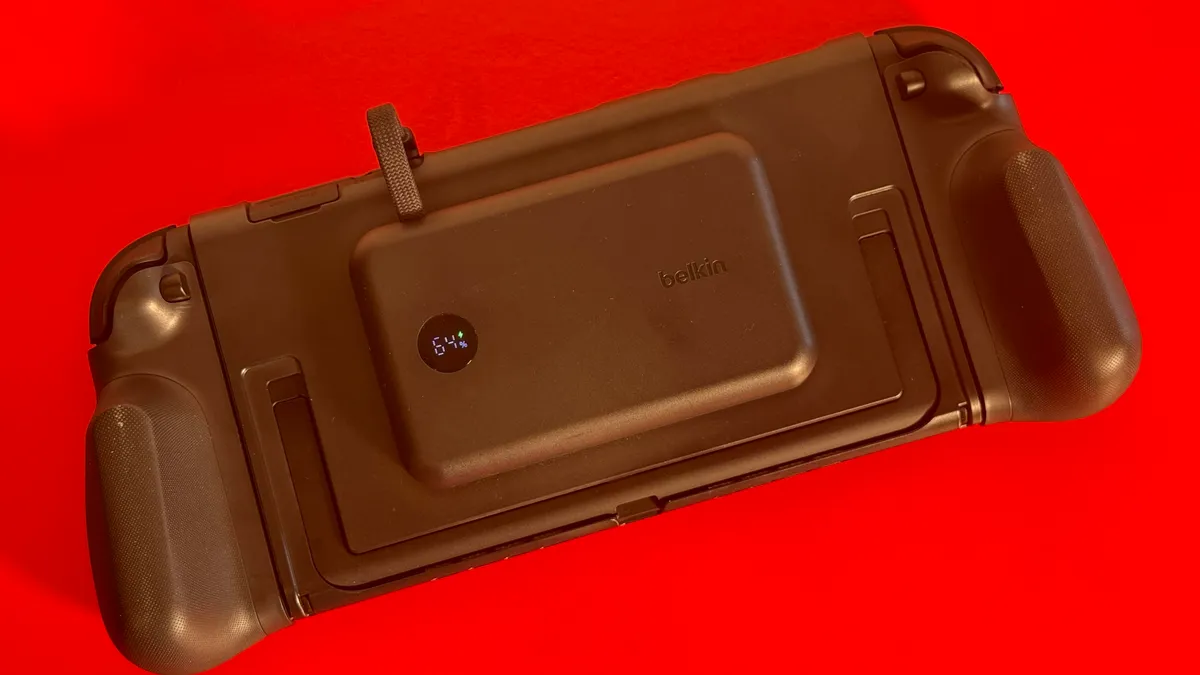
The Nintendo Switch 2 is my favorite gaming handheld right now, but its battery life is still a weak point compared to older Switches. Belkin’s new $100 battery pack and grip combo accessory, called the Charging Grip, solves some of the battery issues and even handheld comfort. But it makes the Switch 2 a lot bigger in the process.
I’ve been trying an early review sample of the Charging Grip over the last week, and there’s stuff I appreciate. The 10,000-mAh battery has an LED screen to show charge amount, and generally resembles the battery that also came in an already-available battery pack-embedded Belkin Switch 2 case.
This time, the battery sticks onto the Switch 2 itself. A snap-on plastic shell has a magnetic panel the battery snaps onto, and then a little USB cable pops into the top to charge at 30W. The case I’m trying is black, but it also comes in lilac and olive. Belkin promises 1.5 Switch 2 recharges with the battery. So far, it’s been a helpful way to top off the Switch 2 over a day without redocking or plugging in.
With the Charging Grip on, the Switch 2 is basically Steam Deck size.
The plastic shell feels a bit flimsy, although it’s at least a little more protection for the Switch 2 body. There’s a cut-out on the back for the Switch 2’s kickstand to pop out.
Two large Joy-Con controller grips come in the package, sliding on easily and locking in place. The rubbery texture and their overall size does make holding the Switch 2 feel more comfy to me, more like the generous size of Steam Deck and Windows gaming handhelds.
I like it, but maybe not enough to keep it on all the time.
But the overall battery-plus-grip cosmetic change to the Switch 2 bulks it up a ton. It can still prop up with a kickstand on a table, and can technically narrowly slide into the dock without removing the grip case. But it definitely won’t fit into regular Switch 2 carry cases, although Belkin’s selling a new shoulder-carry travel bag for that.
One of my favorite parts of the Switch 2 versus Windows handhelds is how much more compact it is, and unfortunately Belkin’s grip case erases that advantage. But if you’re looking for a battery boost and a comfier grip no matter the cost or size, this might be for you.
Tech
The Instagram Plus Subscription Has Officially Launched
Paying users will have tools for reaching either wider or more-specific audiences.
We learned last month that Meta was planning to introduce a subscription tier to several of its social media properties. Today marks the global rollout of the Instagram Plus option, and the company offered more details about exactly what will be included for paying users.
The bulk of the features are about getting people to see content. Story Spotlight prioritizes your profile for friends while Story Extend keeps the disappearing content visible for 48 hours instead of 24. Subscribers can also create multiple audience lists and pick which one will see a given story. There is a tool to preview stories, stats about how often your stories were rewatched and a way to search the people who have viewed a story. And if you don’t want a piece of content to show up in the main feed, you can opt to publish a post directly to your profile or highlights.
There are also some customization options. Subscribers can select from a collection of app icons and pick the text font for their bios. They’ll be able to pin six items to the top of their profile and send animated super hearts when reacting to friends’ stories.
Meta’s announcement noted that more capabilities will be added in the coming months. Instagram Plus costs $3.99 a month.
Tech
The AI IPO Race Heats Up, DOGE Whistleblower Sues Elon Musk, and Instagram Gets Hacked
Zoë Schiffer: Deviants and freaks, the new name of our podcast. And this is, I mean, just going back to red teaming, that’s work that a trust and safety team typically does. And those teams—
Leah Feiger: We don’t have those anymore.
Zoë Schiffer: They’re not as big as they used to be. There’s just not as much work. So yeah, I mean, it will be interesting to see how this plays out. Obviously within Meta, we’ve been talking to folks this week who kind of met the news with a sigh. The company has just laid off a large portion of the workforce. We’ve written about that. We’ve talked about that. And I checked in with people being like, “Well, how’s it going now?” The hack was kind of an excuse to talk to people, see how they’re doing. And they’re like, “I mean, as you’d expect, we’re asked to do two jobs now instead of one.” So you can imagine how that’s playing out.

Brian Barrett: I also, we were talking about AI regulation earlier and all this emphasis on national security and these high-level things, but again, not as much on consumer-facing products, which would be if you had say some sort of bureau that looked after consumer finances and protecting that, that would be helpful to have in this moment as well. We used to have one of those. Technically, I guess we still do. Not really. So all of this broader deregulation is coming at this moment when the tools that were once available are not. These new tools are very fallible. We’re going to see a lot more of this.
Leah Feiger: Can I bring us to a topic that has nothing to do with AI, guys?
Brian Barrett: Please.
Zoë Schiffer: Wow. I didn’t know one existed, but yes, go off, queen.
Brian Barrett: Also, I think we can probably try to find a way to tie it back in.
Zoë Schiffer: We can. We can.
Leah Feiger: No, absolutely not. Well, OK. This story is something that we have been thinking about, covering, looking at for a long time, but it is all about a DOGE whistleblower who just filed a lawsuit against Elon Musk. This all really started last year. On April 14, 2025, Dan Berulis, an IT staffer at the National Labor Relations Board, the NLRB, filed a whistleblower complaint with a massive claim. He said that DOGE had compromised the agency’s data and appeared to be exfiltrating it out of the NLRB.
Archival audio: A whistleblower is coming forward with claims that DOGE not only accessed data from his agency but also took a substantial amount of sensitive data with them. According to a disclosure shared with Congress, “Around 10 gigabytes of data, the equivalent of a full stack of encyclopedia is worth if someone printed these files as hard copy documents.”
Leah Feiger: This was a massive claim, especially at the same time as you guys very much remember, DOGE teams were firing federal workers and accessing sensitive data across the country. We were in the height of this last year in April. Berulis went public in an NPR article. His name was attached to it, and he claimed a threatening note had been taped to his door, and he was already scared about speaking out. Fast-forward a little bit, Berulis has now filed a defamation lawsuit in a DC court against Elon Musk. He said that Musk made him a target of further violence by falsely stating that Berulis’ whistleblower claim against DOGE was fake. This is a really intense claim for a variety of reasons, and what this all really harkens back to is Musk last year resharing an X post from a right-wing influencer claiming that DOGE had been cleared and that this whistleblower’s testimony was fake basically. After that happened—
Tech
What AI means for nuclear escalation
The standoff began in May, when the US announced a package of anti-aircraft and anti-ship missiles to Taiwan that would significantly upgrade the island’s ability to repel a Chinese invasion. We ordered massive military exercises in the region as a show of force. The US soon responded by sending the USS Abraham Lincoln to lead its own exercises with a joint contingent of Australian and Japanese forces.
If we showed weakness, Taiwan might be lost to China forever. If we were too aggressive, it could lead to World War III. But with so many ships and aircraft menacing the region, all with unclear intentions, the situation was getting too complex for commanders to process, and the risk of a deadly miscalculation was rising. Already, there had been a tense near-miss when a Chinese maritime militia fired on an American helicopter — thankfully, without casualties.

- Recent events in Ukraine and Iran show that the use of artificial intelligence on the battlefield has very quickly gone from a speculative scenario to a current reality.
- This has led to fears that AI could increase the risk of nuclear escalation, either by acting in a way that its designers don’t intent, or simply moving too fast for human commanders to keep up.
- Ironically, it turns out be the best way to decrease the risks of how AI will perform in war may be to train humans in how to interact with it.
Perhaps it was time to let the machines take over.
The commander of the Chinese naval strike force in the region requested permission to turn on our recently deployed AI hub, which could coordinate the defense systems of all ships in the region and was capable of differentiating between friend and foe, firing in response to threats, and finding the optimal course of action based on China’s rules of engagement and available resources. In other words, if the Americans attacked, it could decide the appropriate response faster than any human.
As the vice chairs of the Central Military Commission, my colleagues and I were tasked with making a recommendation to the president. The system could buy us precious seconds to rescue ships from imminent attack, but it was also untested in combat situations and had reached only 95 percent accuracy in tests.
After a tense discussion, we ultimately decided to employ the new system, but keep it in a “human-in-the-loop” setting that would require us to give a final order before firing. We were taking a cautious approach.

Not cautious enough, as it turned out.
A few days later, the AI-enabled system malfunctioned, opening fire on a US vessel and killing a number of US soldiers. Soon, American politicians and media were calling for payback. US ships began conducting joint patrols with the Taiwanese navy. Our intelligence sources indicated President Donald Trump was close to declaring an official alliance with Taiwan and basing US troops on the island.
We were on the brink of all-out war.
As you’ve probably surmised, this is a fictional scenario. I am not actually a high-ranking Chinese general, and Trump risking war with China over Taiwan is not exactly what transpired in the real May 2026.
The story comes from the script of a wargame conducted by Stanford University’s Hoover Institution that I participated in last fall. The “vice chairs” in the simulation were a bipartisan group of staffers and China policy wonks sitting in a comfortable Washington, DC, conference room over coffee and bagels. (As a condition of participating in the game, I agreed not to name or directly quote any of the participants.)
But the concern that the game illustrates, of an AI-enabled defensive system causing a military crisis to spin out of control, is a very real one. Experts are increasingly worried that AI-enabled systems could cause military conflicts to escalate faster than any human can control or anticipate — or that a miscalculation could lead to AI taking military actions that humans never intended, with deadly consequences. And the risks are especially acute when it comes to nuclear-armed countries like the US and China.
To date, AI-enabled systems have been used mainly by militaries like America’s and Israel’s in conflicts where they already had overwhelming advantages over their opponents, or by countries like Ukraine to level the playing field against a much larger foe. But what would it look like in a war between two “near peer” superpowers like the US and China?
This is no longer just a theoretical question. Under an initiative that began in the Biden administration, the US is working to develop fleets of small, cheap AI-enabled drones that could create a cost-effective “hellscape” to counter a Chinese invasion of Taiwan. The decisions my team made in our simulated conflict could be on the table in a real conflict sooner rather than later.
We may not be able to turn back from this new frontier. But if government and military leaders can figure out its rules and update their thinking in time, they might be able to head off the global war that they’ve spent generations trying to prevent.
The rise of battlefield AI
Jacquelyn Schneider, director of the Hoover Wargaming and Crisis Simulation Initiative, has been conducting games related to the topic of artificial intelligence and crisis escalation for several years now, with participants roleplaying nations on both sides of hypothetical conflicts. When she began running the war games, the capabilities in the “May 2026” scenario still felt futuristic. Lately, the game has “felt a little bit less like science fiction,” she told me.
The Pentagon has been actively working to accelerate the use of AI to detect threats, identify targets, and support commanders’ decision-making for years now. Its early initiatives during the first Trump administration were born in part out of officers’ frustration with data analysis failures that led to the deaths of US troops in Iraq and Afghanistan. The US military collected vast amounts of information from sensors, satellites, and human sources, but was often too slow to find threats to troops on the front lines. The dream was a system that could detect potential dangers earlier and give users options for how to destroy them far faster than human analysts, dramatically shortening what military planners call the “kill chain.”
Now we’re seeing AI programs handle real-world combat situations on a daily basis. Maven Smart System, the Palantir-supplied system that integrates data from satellites, drones, and numerous other sensors, has been used by the US to pass along dozens of potential Russian targets per day to Ukrainian forces. The Ukrainians themselves have developed a system nicknamed “Uber for artillery” to coordinate fire across the frontline. During the war in Gaza, the Israeli military system employed an AI-enabled system known as “Lavender” to identify Hamas targets, though some reports suggest it may have had an error rate of around 10 percent.
The US military has used AI in its recent operations in Venezuela and Iran, which generated significant scrutiny after a targeting mistake killed at least 175 people at a school in Minab, most of them children. It’s not clear yet whether the AI systems Claude and Maven Smart System played a role in that specific strike, but both were widely used in the bombing campaign, according to US officials.
Nonetheless, Secretary of Defense Pete Hegseth is aggressively pushing to deploy AI more widely across US military systems. Earlier this year, the Pentagon threatened to block Anthropic, Claude’s owner, from being used across government — reportedly over the company’s demand that its software never be used for mass surveillance or autonomous weapons. Anthropic wanted to keep a human in the loop on life-or-death decisions, while Pentagon officials reportedly wanted the option to bypass the company and use the program however they wished.
Which brings us back to the US and China. While AI-enabled errors may have led to tragic civilian deaths in Gaza and Iran, those errors in a US-China conflict could have truly global consequences.
The bombing of the Minab school, for example, has been compared in some coverage to the accidental US bombing of the Chinese embassy in Belgrade in 1999. That incident, which occurred at a time when US-Chinese relations were comparatively friendly and China’s military was much smaller, sparked a diplomatic crisis. Today, something similar might spark a war — and, in an increasingly automated battlefield, one that could turn from a conventional conflict into a nuclear exchange faster than human military leaders can keep up.
AI and the escalation ladder
This isn’t the first time a new military technology has forced a rethink of how limited wars can turn into much bigger ones. The advent of nuclear weapons made the management of conflict escalation a pressing issue for Cold War defense strategists.
The most famous of these was the RAND Corporation’s Herman Kahn, who devised a 44-run “escalation ladder” in 1965 to model conflict in a nuclear era. The ladder began at a nonviolent cold war, and ascended through conventional war with “limited” nuclear exchange kicking in around rung 15, ascending all the way up to a mindless and apocalyptic nuclear “spasm” at rung 44.
Kahn’s writings are unnerving in their cold rationality. (He was one of the inspirations for Stanley Kubrick’s character, Dr. Strangelove.) But a concern throughout the nuclear era has always been that a crisis could escalate due to human miscalculation or technical error rather than rational calculation.
Just a few years earlier, in 1962, this had very nearly happened during the US-Soviet confrontation over Cuba. In what is generally acknowledged as the closest the Cold War ever got to going nuclear, the US, alarmed by the deployment of Soviet missiles to Cuba, ordered a blockade of the island, warning that any attempt by the Soviets to ship additional military hardware to the island would be met with force.
In one of the most unnerving near-misses of the Cuban Missile Crisis, the captain of the Soviet submarine B-59, after being hit by US depth charges and finding himself unable to contact Moscow or other ships in the area, nearly fired a nuclear-armed torpedo.
Both sides in the standoff came away convinced that they needed to find ways to signal their moves up and down the escalation ladder more clearly in order to prevent an accidental war. The next year, Washington and Moscow installed a “hotline” for instant phone communication between the US president and the Soviet premier.
“Few things are more important to militaries in crisis situations than informational awareness and control over decisions.”
— Michael Horowitz, former deputy assistant secretary of defense
But what if the next several steps up the escalation ladder happened without their input at all? In a 2019 paper, Michael Horowitz, a former deputy assistant secretary of defense, now a professor at the University of Pennsylvania, imagined how the Cuban Missile Crisis might have played out in the age of AI. After ordering the US Navy to blockade Cuba, President John F. Kennedy could have had a system like the one in the Hoover simulation pre-programmed to fire on any Soviet ship that attempted to run the blockade.
It’s possible this could be effective signaling. A popular metaphor in the Cold War era involved one player in a game of “chicken” throwing their steering wheel out the window to resolve any doubt about where they were headed.
If Kennedy could have convinced the Soviets that his killer robots would fire on any ship that approached Cuba without even waiting for his orders, it might have deterred Russian leaders who might otherwise doubt America’s willingness to fight a nuclear war. On the other hand, the US would be putting an extraordinary amount of trust in an automated system not to make mistakes or — as in the B-59 episode — to interpret an ambiguous incident the same way a human commander who doesn’t want to see his own family incinerated in a nuclear blast might.
“Few things are more important to militaries in crisis situations than informational awareness and control over decisions,” Horowitz wrote.
A nuclear “flash crash”
One major concern is that if key decisions are delegated to AI systems, which may themselves be responding to decisions taken by the enemy’s AI systems, a conflict could simply escalate too fast for human decision makers to keep up.
In his book, Army of None, Paul Scharre, the former Pentagon official who’s now at the Center for a New American Security, cites the example of the 2010 “flash crash,” in which the Dow Jones lost nearly 9 percent of its value within minutes, only to recover it less than hour later — an incident blamed on the cascading interactions of algorithmic trading programs responding to each other’s moves without human intervention. The fear is that the next superpower war could be a “flash war.”
Rebecca Hersman — former director of the Pentagon’s Defense Threat Reduction Agency who’s now at the Center for the Governance of AI (GovAI), an independent think tank — has warned that modern technologies, including AI, have the potential to scramble the linear escalation ladder envisioned by Kahn into a more unpredictable dynamic she refers to as “wormhole escalation.”
She sees several ways this could happen, and they don’t necessarily require humans to cede complete control to an AI defense system. The data the enemy’s AI systems are using to assess threats could be spoofed or contaminated, pushing leaders into a quick decision with bad intelligence. Or AI-generated disinformation or deepfakes could influence the decisions of military or political leaders deciding whether to escalate or de-escalate a conflict: This risk was dramatically demonstrated during the brief 2025 armed conflict between India and Pakistan, when social media on both sides were flooded with misinformation, making it difficult to get an accurate picture of the battlefield and driving both sides toward more aggressive stances. (This was also likely the first armed conflict between two nuclear-armed rivals in which both sides used AI-augmented weapons and AI-generated misinformation against their adversaries.)
“An AI optimized around predefined goals may overlook opportunities for de-escalation, not because it technically malfunctions, but because it was never designed with the ambiguity to build trust or manage a crisis.”
— James Johnson, author of AI and the Bomb: Nuclear Strategy and Risk in the Digital Age
The risks are compounded by other trends, including the commingling of nuclear and non-nuclear capabilities on the battlefield. Russia, for instance, has made abundant use of its nuclear-capable “Oreshnik” missiles (armed, thankfully, with conventional payloads) in deadly strikes against Ukrainian cities. China also has dual-capable missiles that would make it difficult for analysts to tell nuclear from non-nuclear launches during a conflict.
Where does AI come in? Stephen Herzog, professor at Middlebury Institute of International Studies’ James Martin Center for Nonproliferation Studies, imagined a combat scenario in which the US is attempting to destroy a Chinese target with a conventionally armed intercontinental ballistic missile fired from hundreds or even thousands of miles away. If the launch failed, an AI battle management system might decide that a submarine right off the Chinese coast should destroy the target instead. But this could cut the amount of time the Chinese had to decide whether they were under nuclear attack from minutes to seconds.
“That’s incredibly effective operationally, but it is terrifying from an escalation perspective, because we’ve now lost time for interpretation, we’ve lost time for signaling, and we’ve lost time for potential restraint,” Herzog said.
Then there’s the question of whether AI itself is inherently escalatory. Leaders decide to start and end conflicts by weighing the risks and benefits, but also by using human intuition to guess their counterparts’ thinking, imagine their intentions and fears, and consider whether there’s room for common ground. Two algorithms sizing each other up might approach these questions in a fundamentally different way.
“An AI optimized around predefined goals may overlook opportunities for de-escalation, not because it technically malfunctions, but because it was never designed with the ambiguity to build trust or manage a crisis,” said James Johnson, a senior lecturer at the University of Aberdeen and author of the book AI and the Bomb: Nuclear Strategy and Risk in the Digital Age.
A study from King’s College London published in February found that in simulated war games, chatbots including ChatGPT, Claude, and Gemini are extremely likely to use nuclear signalling and tactical nuclear weapons use, and tend to treat “nuclear weapons as legitimate strategic options, not moral thresholds.” Hoover’s Schneider has found similar results when she has popular chatbots play her wargames. However, other researchers have found that models can be properly prompted to provide less escalatory options.
AI technology, unlike nuclear weapons, is also still in its relative infancy. While the Cold War powers could rely on mutually assured destruction — a credible fear that both sides would be annihilated in any nuclear conflict — to discourage brinkmanship, some experts fear that a breakthrough in AI on one side could lead the other to conclude it had to act quickly or lose its ability to defend itself.
“One of the biggest effects of AI may be that, if, say, the US is just so much better at integrating AI than China that the US may rapidly win a conflict over Taiwan, that puts pressure on the Chinese to use nuclear weapons right away,” said James Acton, co-director of the Nuclear Policy Program at the Carnegie Endowment for International Peace.
Other tech innovations could also tilt decision-makers toward escalation. AI-enabled targeted and intelligence monitoring could make “decapitation” strikes like the one that recently killed Iran’s Supreme Leader Ayatollah Ali Khamenei easier to carry out — precisely the sort of scenario one could imagine prompting a leader like North Korea’s Kim Jong Un or Russia’s Vladimir Putin to consider reaching for the nuclear codes.
It’s probably too late to put the military AI genie back in the bottle, given the arms race between countries to develop cutting-edge systems first. The best way to handle the risks going forward might be, ironically enough, to train the humans responsible for using these systems to be more skeptical about their value.
As in nearly every domain, the people who fight wars for a living are clearly getting more comfortable with AI. The top US general commanding US forces in South Korea recently raised eyebrows after telling reporters he regularly consults ChatGPT to help with command decisions.
Nonetheless, most humans are still very reluctant to give up full control to the machines when it comes to life and death decisions. In the US-China war game I played, all of the groups chose to keep the AI system in “human-in-the-loop” mode, despite the assurances we were given about the system’s reliability, and that decision held no matter how dangerously the crisis escalated.
“At a minimum, meaningful human control means that when I delegate an authority to a system, it will not exceed the authority that it has been given,” said Hersman, of GovAI.
Many experts are less worried about AI escalating conflicts on its own, though, than they are with AI making humans more likely to escalate conflicts. A frequently expressed concern about the military use of AI is “automation bias,” the human tendency to give undue deference to computer-generated advice and conclusions.
“What seems to be most dangerous with AI is not necessarily uncertainty, but instead, perhaps overconfidence and misplaced certainty, and AI can really provide that,” said Schneider, the Stanford researcher who conducted the wargame. “The tools themselves are built to engender confidence.”
Schneider noted that Anthropic’s Claude, the system the Pentagon is hoping to remove with its systems, is the one that’s “more likely to tell you where uncertainty lies, as opposed to other models, which might take a more kind of strictly rational, ‘LeMay’ kind of approach” — a reference to the notoriously hawkish Cold War Air Force commander Curtis LeMay who once summed up warfare as “when you’ve killed enough [people] they stop fighting.”
It’s possible this bias towards AI-prompted escalation can be addressed with the right training. A recent study by Horowitz, the former Pentagon official and UPenn professor, found, encouragingly, that West Point cadets exhibit automation bias at less than half the rate of civilians. The results suggest “we’re not condemned to a future of accidents due to overconfidence,” Horowitz said, as officers learn to take their suggestions with a grain of salt.
Horowitz believes that the design of AI interfaces, which present users not only with information but with the sources of that information, will go a long way toward determining what impact AI has on the battlefield. Though he’s relatively confident in how those systems are designed in the US, he notes, “I don’t know what China’s equivalent of Maven Smart System looks like.”
Ultimately, AI may do less to change the way people fight wars than to amplify it. While much of the coverage of the strike on the Minab school and Israel’s use of Lavender focused on the role of AI, ultimately it was most likely outdated targeting data in the first case and extremely permissive rules of engagement in the second that led to civilian casualties.
Hegseth’s push for expanded AI use comes as he also looks to loosen the rules of engagement and reduce the role of lawyers in military oversight, which have raised concerns that the US is becoming more tolerant of collateral damage and less willing to hold people accountable for potential war crimes.
“If you’ve programmed your AI well, trained it well, and ensured that only high-quality data goes into it, I could well believe that the results will be better than just the use of humans,” said Carnegie’s Acton. “Now, do I trust the current US or Israeli governments to use it responsibly? Probably not, is the answer.”
If the US finds itself in a major international conflict in the coming years, there may be a temptation to blame AI for speeding up the battlefield or engendering overconfidence in commanders. But ultimately, it will be humans who choose to put themselves in that situation.
This story was produced in partnership with Outrider Foundation and Journalism Funding Partners.
Tech
How To Watch Apple TV+ Free for a Limited Time
Apple TV+ is known for its lineup of exclusive content, including popular dramas, comedies, documentaries, and original films. Apple regularly offers free access through trials and promotional offers tied to its products and subscriptions. These deals allow new users to stream popular shows, movies, and documentaries without paying. Here are some of the easiest ways to watch Apple TV+ at no extra cost for a limited period.
Before claiming a free Apple TV+ offer, take a moment to review the eligibility requirements and subscription terms. Apple generally offers these trials to people who have not subscribed before. Users must enter a payment method to activate the offer. Since subscriptions automatically renew after the trial period, it’s a good idea to mark the end date on your calendar if you plan to cancel. Apple does not allow users to combine some Apple TV+ promotions with other discounts or free trials.
Anyone Can Start With a Free 7-Day Trial

Apple TV Plus offers a one-week free trial for new customers who wish to test its content. The trial allows new subscribers to watch and enjoy original content, including movies, TV series, and documentaries. Signing up for the free trial can be done either online or via the Plus application.
To start the trial, one needs to enter billing details and select a valid payment method. Although the product is free for the first seven days, the trial automatically continues after that. That is why it is recommended to set a reminder in case one plans to use only the free trial. By taking advantage of the trial, viewers can sample Apple’s exclusive content and decide whether the service is worth paying for.
Get Three Months Free With a New Apple Device

Individuals who buy a new eligible Apple device might be able to get three months of free access to Apple TV+. The promotion covers select new Apple devices, including iPhones, iPads, Macs, and Apple TV models. Buyers must purchase through approved retailers. This can be an added advantage for those consumers who had plans to buy a new Apple gadget anyway.
However, you must meet a few requirements to qualify for the offer. You need to purchase a brand-new device directly from Apple or an authorized reseller. Apple generally does not allow current Plus subscribers to use this promotion, and you usually cannot combine it with other free trial offers.
Try Apple One and Get Apple TV+ Included

People who regularly use Apple services may find Apple One to be a better value than subscribing to each service separately. Eligible customers can use the free Apple One trial to receive Apple TV+ and other services within the bundle for 30 days without paying anything extra.
The promotion is particularly effective for individuals who do not subscribe to Apple TV+ at all. Along with Apple TV+, customers get access to other Apple services offered under the same plan. Note that Apple will charge customers for this service after the trial period.
Students Can Access Apple TV+ Through Apple Music

The Student Plan for Apple Music would be a perfect choice for those looking to reduce their monthly entertainment spending. Along with a discounted Apple Music subscription, the plan includes Apple TV+ at no extra cost. This allows students to enjoy both services while paying less.
To qualify, users must be enrolled in a recognized higher education program and complete Apple’s student verification process. Once enrolled, the user will be able to stream music and Apple TV+ content without subscribing separately. Apple might require users to undergo a yearly re-verification process to ensure they remain eligible, as the reduced rates will apply only for a limited number of years.
Tech
ARCAM Turns 50 at High End Vienna 2026 with A50 Signature Amp and New CD25 CD Player
ARCAM is celebrating its 50th anniversary at High End Vienna 2026 with the new A50 Signature integrated amplifier and CD25 CD player. Two products that lean hard into the company’s original reason for existing: proper British hi-fi without the tea and crumpets.
That matters because ARCAM was never built on lifestyle fluff. The company started as A&R Cambridge in 1976, and the A60 integrated amplifier became one of the defining British amplifiers of its era. Fifty years later, the A50 Signature feels like a deliberate nod to that legacy, but with modern expectations around digital connectivity, system integration, and performance. The new CD25 is just as interesting, because ARCAM clearly still sees value in silver-disc playback at a time when half the industry treats physical media like something found in a box at a Torquay flea market.
The larger question is whether the A50 Signature and CD25 are true anniversary statement products or simply elevated Radia components with better tailoring. ARCAM has the history, engineering credibility, and British hi-fi baggage to make this launch matter. Now it has to prove that 50 years of institutional memory still buys you more than a nicer front panel and a slice of birthday cake.
ARCAM A50 Signature: Class G Moves Up the Radia Ladder

ARCAM is marking its 50th anniversary at High End Vienna 2026 with the A50 Signature integrated amplifier and CD25 CD player. Both products extend the Radia Series upward, with the A50 Signature positioned as ARCAM’s most advanced integrated amplifier to date and the CD25 arriving as the new flagship CD player in the range.
The A50 Signature connects directly to ARCAM’s amplifier history. The company was founded in Cambridge in 1976 as A&R Cambridge and later shortened its name to ARCAM in the 1980s. The “A” has always stood for amplification, and the A50 Signature keeps that part of the company’s identity front and center.
ARCAM co-founder John Dawson was involved in the project, with his signature appearing on the rear cowl and PCBs. The point is not retro theater. ARCAM says his role was to help ensure the amplifier reflects the company’s long-standing design philosophy while addressing how people listen today.
The A50 Signature is the first ARCAM integrated amplifier to use a fully dual mono Class G architecture. Each channel has its own PCB, output stage, Class G lifter stages, power regulation, and transformer windings. The design is intended to improve channel separation and reduce crosstalk.

Power output is rated at 150 watts per channel into 8 ohms. Digital conversion is handled by an ESS ES9039Q2M DAC in a fully differential configuration, supported by an ESS reference voltage regulator.
Connectivity is broad. The A50 Signature includes HDMI eARC/ARC, USB-C audio, optical and coaxial S/PDIF inputs, two-way Bluetooth with Snapdragon Sound, lossless-capable Bluetooth support, and Auracast. Analogue inputs include three RCA inputs, one balanced XLR input pair, and a built-in Class A MM/MC phono stage. RS232, trigger input/output, and USB service access are also included.
ARCAM CD25: A New Flagship CD Player for Radia

The CD25 is ARCAM’s new flagship CD player for the Radia Series and continues the company’s long-running work in disc playback. It supports CD, CD-R, and CD-RW playback and is designed to pair with the A50 Signature, SA45, SA35, A25+, or any amplifier with suitable analogue inputs.
The technical story is more substantial than “new CD player, nice glass front.” ARCAM says the CD25 is its first design since the FMJ D33 DAC to use a dual mono DAC architecture, with separate conversion paths intended to improve stereo separation and channel performance. It is also ARCAM’s first product to use ESS Hyperstream 4 DAC technology.
The CD25 uses a linear toroidal power supply, chosen for stable, low-noise operation and consistent analogue output performance. ARCAM has also included a vibration-damped internal structure to support accurate disc reading and reduce mechanical interference during playback.

Outputs include balanced XLR and single-ended RCA analogue connections, giving the CD25 some flexibility in higher-performance two-channel systems. The balanced outputs also make it a natural partner for the A50 Signature, which includes a balanced XLR input pair.
Visually, the CD25 follows the rest of the Radia Series, with a glass front panel, OLED display, and metal chassis. It looks modern without pretending that CD playback needs to apologize for itself.
Radia Series Expansion
The A50 Signature and CD25 represent the fourth phase of ARCAM’s Radia platform, moving the range into higher-performance integrated amplification and premium CD playback. Both products are designed to work as part of a wider ARCAM system rather than as isolated components.
That approach fits the brand. ARCAM’s best products have usually been about practical engineering, system matching, and long-term usability — not theatrical reinvention with a commemorative napkin.


The Bottom Line
The ARCAM A50 Signature and CD25 are not just anniversary products with nicer badges. The A50 Signature is technically significant because it is ARCAM’s first fully dual mono Class G integrated amplifier, with separate PCBs, output stages, Class G lifter stages, power regulation, and transformer windings for each channel. Add 150 watts per channel into 8 ohms, an ESS ES9039Q2M DAC in fully differential mode, HDMI eARC/ARC, USB-C audio, balanced XLR input, MM/MC phono, Snapdragon Sound, and Auracast, and this becomes the most complete Radia amplifier so far.
The CD25 matters because it pushes ARCAM’s CD playback platform forward with dual mono DAC architecture, ESS Hyperstream 4 DAC technology, a linear toroidal power supply, vibration-damped construction, and balanced XLR outputs. For listeners with large CD collections, it gives the Radia Series a proper disc source rather than treating physical media like an awkward relative at dinner.
Together, the A50 Signature and CD25 move Radia into more ambitious territory: higher-power Class G amplification, better digital architecture, broader system connectivity, and a renewed commitment to CD playback. Not retro. Not lifestyle fluff. Just ARCAM remembering what the “A” is supposed to stand for.
Pricing & Availability
The ARCAM A50 Signature and CD25 will make their global debut at High End Vienna 2026 and are expected to become widely available Q3 2026.
- ARCAM Radia A50 Signature Integrated Amplifier – $2,999.95 USD (€2,799, or £2,499).
- ARCAM Radia CD25 CD Player – $1,799.95 USD (€1,599, or £1,499).
For more information: arcam.co.uk
Related Reading:
Tech
HP Introduces Next-Generation AI PCs With NVIDIA RTX Spark
HP has announced a new line of Windows PCs equipped with NVIDIA RTX Spark, designed to enhance AI computing experiences. They’re targeting creators, gamers, and developers who need to run intense apps and use new AI workflows. HP wants these PCs to be super capable, ultra-responsive, and ready for what’s ahead.
The new lineup includes the OmniBook Ultra 16 and OmniBook X 14. Both come with NVIDIA RTX Spark tech, which blends AI and superior graphics while boosting battery efficiency. So, HP is all about amazing performance without sacrificing battery life or mobility. The company claims these laptops will rank among the world’s thinnest models without compromising battery life.
Built For Creators, Gamers, And AI Developers

The platform gives us the computing power for video production, digital design, and content creation. Plus, gamers get better graphics and a more responsive experience. AI developers can make and test AI models right on their computers, too. This mix of AI and graphics tech makes advanced computing easier for a lot more people to use.
Along with its new AI laptops, HP is expanding into desktops, workstations, and enterprise systems. The company is preparing a compact RTX Spark-powered desktop that combines strong AI performance with a space-saving design. HP is also building advanced systems using NVIDIA GB300 technology for demanding business tasks. Furthermore, for those needing more security, there’s the ZGX Nano. It provides a safe space to develop and deploy AI without worries.
Expected Price and Availability
HP plans to launch the OmniBook Ultra 16 and OmniBook X 14 later in 2026. The company has not revealed pricing details for either laptop yet. More details about the devices are expected closer to release. HP also plans to launch the OmniDesk Mini Desktop PC in August 2026. Buyers can expect further information about features and pricing before the products reach the market.
Tech
Flakey OLED MacBook Ultra rumor contradicts reliable leakers
A new research report has Apple’s first MacBook Pro with OLED shipping weeks or months sooner than other, more reliable leakers have been claiming for months, if not years.
We’ve seen rumors about the fabled OLED Apple laptop for years, all with various release dates. But recently, reports have coalesced on a release window of anywhere between October 2026 from older reports, and newer ones saying the early months of 2027.
Despite that, research outfit Omdia now believes that Apple is readying the MacBook Ultra for a release sooner than that. In its report on OLED display demand, Omdia says the new premium laptop will debut in the third calendar quarter of 2026.
If accurate, that means the MacBook Ultra could debut as soon as July 2026. There’s almost no chance of that.
But more realistically, we’re looking at a September timeframe at the very earliest.
The thing is, September is normally new iPhone and Apple Watch season. It remains to be seen whether Apple is willing to have its biggest product launches of the year share the month with a brand-new laptop.
This news also flies in the face of an April 2026 report claiming the MacBook Ultra had been delayed to 2027. Global RAM and SSD shortages were blamed for the delay, and they’ve certainly not improved.
Going back to August 2025, Bloomberg’s Mark Gurman pointed to a late 2026 or early 2027 release.
More recently, the same outlet’s February 2026 report believed the OLED laptops would debut near the end of the year, but no sooner.
With all of this in mind, it’s a surprise to now see mention of a release as early as September.
OLED, coming soon
Release window aside, the report notes that Samsung Display is set to produce 14.3- and 16.3-inch OLED panels for the unannounced laptop. It’ll use a hybrid OLED technology based on TFT and RGB tandem technology, Jerry Kang, Practice Leader at Omdia, believes.
The move to a hybrid OLED display is expected to gather pace following the MacBook Ultra’s release. It’s easy to see why, with the technology allowing for a thinner construction.
A recent report believed Samsung Display would be capable of supplying Apple with two million OLED displays by year’s end.
Tech
Canada Prime Minister Mark Carney Announces Questionable National AI Strategy
The new “AI for All” plan prioritizes strengthening data protections and increasing AI adoption.
Canadian Prime Minister Mark Carney has announced a new AI strategy that will guide Canada’s next five years of legislation and infrastructure investment. While the new “AI for All” plan is slightly more focused on the impact the technology will have on normal people than President Donald Trump’s similar framework for the US, it’s just as concerned with growing his country’s domestic AI industry, while ignoring the growing backlash.
“With the global AI market projected to reach US $4.8 trillion by 2033,” the announcement claims, “Canada has a limited but real opportunity to ensure AI works for all Canadians — to harness this technology to create jobs, protect Canadians and strengthen our prosperity.” The plan aims to achieve those goals by building Canadians’ trust in AI, increasing AI adoption and investing in the foundations of AI technology that’s built, hosted and run in Canada.
AI for All calls for legislative frameworks to be updated to “[strengthen] protections for Canadians’ personal information, including against harmful practices such as deepfakes and surveillance pricing” and the creation of an “online safety regime” to protect chatbot and social media users. The strategy also lays out a plan to establish a National AI Literacy Initiative to provide free entry-level AI training, and commits to offering “access to trusted AI agents for every post-secondary student.” Among other benefits, Carney says the strategy will provide “up to 90,000 AI-related jobs and work placement opportunities.”
For Canadian businesses, AI for All also calls for the construction of a “public AI supercomputer” and further investment in sovereign — as in Canadian-owned and operated — compute and cloud infrastructure. These infrastructure investments will be made in line with Canada’s clean energy goals and assisted with access to growth capital through government procurement.
While the full strategy document acknowledges Canadians’ skepticism towards AI, it largely ignores evidence that adopting AI technologies doesn’t necessarily increase productivity and that there’s a growing distaste for the technology in general. More laws regulating AI tools seems necessary, but Carney’s plan to increase AI adoption might be focused on the wrong issue. AI for All suggests these problems are a matter of communication and access, but considering tools like ChatGPT, Gemini and Claude can be used for free, Canadians not using AI enough might be reflective of problems with AI and what it produces, not their understanding of it.
Tech
MSI Put a Talking Dragon Inside a Glass Cylinder on Its Latest Gaming Desktop, the MEG Vision X2 AI+

MSI just showed off the MEG Vision X2 AI+, a gaming desktop that does something no other mainstream PC has done before. A clear glass cylinder stands on the front of the chassis. A red dragon floats inside it in three dimensions. The creature wears golden armor and sports large lobster-style claws. Its name is LuckyClaw, and it serves as the visible face of an AI that can hear commands and carry them out.
Builders delve beneath the hood of the MEG Vision X2 AI+ to uncover some important hardware within the futuristic cylinder. You can upgrade to an Intel Core Ultra processor, including the 285K variant. Early models contain top-tier NVIDIA GeForce RTX 5090 graphics cards that can handle anything you throw at them. It’s all topped off with DDR5 RAM and PCIe 5.0 SSDs, which is some very high-end hardware. A large 360mm liquid cooler keeps the heat under control, while an MSI Project Zero motherboard keeps all of the wires neatly tidied up, so you don’t even notice they’re there. This monster can produce up to 3400 TOPS of AI performance when all of the components work together.
MSI installs LuckyClaw on every machine right from the factory floor. When you first load up your PC, you are welcomed with the dragon, and I mean immediately. A microphone is conspicuously placed at the front, waiting for you to express your thoughts (or type into a box on screen if that’s your thing), and the dragon springs into action, since it’s quite the talker! The cartoon mood lends it a “personality,” complete with a high-pitched, excited voice. The dragon is currently aiding with tasks comparable to those carried out on a computer. To change the performance mode, simply bark an order at the dragon, and it will do so. If you want to change the colour of the RGB lighting, simply tell it. If you have an MSI monitor, it can even transfer those settings to the screen via voice commands. Future software updates will surely add new tricks to LuckyClaws’ repertoire, and the MEG Vision X2’s brilliance is that the AI can learn alongside you.
LuckyClaw’s 3D appearance is created by a combination of mirrors and projection, removing the need for specialized holographic equipment. MSI intends to run the AI locally on the GPU to speed things up and reduce the need for server requests in the future. You also have to give them credit for putting the dragon right up front where you can see it, because it completely changes how you interact with the PC. The days of a monotonous PC tower that only lights up when you’re gaming are over, as the MEG Vision X2 is more like having your own tiny copilot sitting on your desk. The AI is basically focused on system control and the MSI ecosystem, which makes logical given that this is the first edition, and it provides a clear purpose to communicate with your PC without having to run apps or know a multitude of hotkeys.
There is no information on pricing yet, but MSI demonstrated it at Computex in Taipei, so it should be accessible through all of the standard retail channels. When it will be available is a little more uncertain, as we expect regional variations to influence this. MSI provides a range of configurations, but it is safe to assume that the CPU, GPU, and RAM options will influence the final price.
[Source]
Tech
4 Things That Can Cause A Grinding Noise When Shifting Gears
Whenever you feel a grind, jerk, or resistance, it could be your car telling you that something inside the transmission or clutch system isn’t working the way it should. Grinding gears in particular are often a sign that the transmission might not be in order. And the longer you ignore it, the worse it’s going to get. But to understand why it occurs, and how to avoid it in the first place, you need to understand what’s supposed to happen when you shift gears.
To change gears smoothly, your engine and wheels need to be in sync. Specifically, the input and output shafts in your gearbox must be moving at the same speed before a gear can engage cleanly. If they’re not able to sync up, that forces the gears to engage while moving at different speeds. The result is that unmistakable grinding sound you hear when driving.
In modern manual vehicles, there’s a component called a transmission synchronizer, also called synchro, that helps facilitate this process, which is why shifting feels smoother than with a vintage car, for instance, or a commercial truck. However, when that component begins to degrade, it disrupts the synchronization process and eventually causes grinding. For automatic transmissions, although not as frequently as in manual cars, grinding can also occur due to contaminated transmission fluid, a faulty torque converter, or worn internal gears. Let’s go over each potential cause in detail, so you understand what’s going wrong and whether your driving or maintenance habits might be making it worse.
1. Damaged synchronizers
If the grinding in your car happens consistently in one particular gear, damaged synchronizers are likely the cause. In a manual transmission, synchronizers function like small individual clutches, each assigned to a gear. Their main role is to spin at the same speed as the output shaft before the gears connect. This process is what allows you to shift smoothly. But when it fails, the gears are forced to engage while still moving at different speeds, and that mismatch is exactly what produces that harsh collision of metals.
These rings are typically made from either brass or steel. Brass is more common and works well under normal driving conditions, but wears out faster. Steel handles heat and heavy use better, though it synchronizes more slowly and costs more. Either way, both types wear down over time — it’s just a question of when.
Several other factors, however, can speed up how quickly they wear down. The most significant is aggressive shifting. When driving, if you have a habit of forcing the gear lever without fully pressing the clutch pedal, you’re overloading the friction surfaces on the synchro rings, causing them to degrade faster than they normally would. Overheating from heavy-load driving also doesn’t help matters. This will result in some of your car components facing more stress than they are designed to handle. If your synchronizers are worn out, the fix is to replace them. Attending to it quickly is important so it doesn’t lead to broader transmission damage.
2. Low or contaminated transmission fluid
Transmission fluid is very important to the functioning of your transmission system in multiple ways. It acts as a lubricant, reducing friction between the moving metal parts inside the transmission. It also serves as a coolant, preventing components from overheating while you’re driving. And in automatic transmissions, it maintains the hydraulic pressure that makes gear shifts possible in the first place. Basically, your transmission system relies on it to keep internal components moving freely and quietly.
But when the fluid level drops too low, air gets mixed into the fluid, which reduces its ability to lubricate and cool effectively. Metal components that were previously separated by this fluid begin to make direct contact with one another, and the resulting friction produces the grinding noise you hear during gear changes. More importantly, if this continues unchecked, this kind of friction increases wear across other components and generates heat that pushes the transmission toward overheating.
You’ll most likely experience the same thing if your fluid gets contaminated. Once this happens, its chemical properties break down, and it loses its ability to do its job properly. One key thing to look out for is that the fluid begins to darken and develop a burnt smell. In severe cases, contaminated fluid can even contribute to burnt torque converters and damaged valves, leaving you with a deep hole in your wallet. Of all the causes of grinding gears, this one is arguably the most preventable. All you need to do is regular maintenance. Make sure your fluid never runs low and always do routine transmission fluid changes.
3. Malfunctioning clutch
Despite the dominance of automatic-transmission vehicles, there are still cars that offer manual transmissions. If you drive one, the clutch is one of the components you use the most, so when it’s not working as it should, the effects are easily noticeable. Simply, it is what separates the engine from the transmission. When you press the clutch pedal down, you are telling the engine and the gearbox to temporarily stop communicating, which gives you the window you need to move the gear lever cleanly from one gear to the next. If the clutch fully disengages and then re-engages smoothly, the gear change is seamless. But if it doesn’t, it can cause your car to grind.
The most common reason a clutch reaches this point is simple wear. The clutch relies on friction material to transfer power from the engine to the transmission. This friction material degrades over time through normal use until it can no longer make the clean contact it needs to. It then gets to a point where the clutch begins to slip or fails to engage properly. Any of these can cause the unsettling jolt you feel when the car does not shift properly.
Beyond normal wear, certain driving habits can be harming your transmission. One of the most damaging is riding the clutch, which means keeping the pedal partially engaged rather than fully up or fully down. It’s a common mistake that can ruin your engine. Also, hesitating while changing gears can put additional strain on the clutch assembly. While it’s natural for your clutch to eventually wear out, you’ll be doing yourself a lot of good if you catch it early. It is a far less expensive repair than one that has been driven into the ground.
4. Faulty torque converter
The torque converter performs the function of a clutch in an automatic-transmission vehicle. Just like the clutch, it sits between the engine and the gearbox and serves the same fundamental purpose: connecting and disconnecting power between the engine and the transmission. Inside the torque converter, four main components work together, namely the pump, the turbine, the stator, and the transmission fluid that flows between them.
The engine powers the pump, which keeps fluid flowing through the converter. That fluid flow turns the turbine, which is linked to the transmission, and that’s how power is transferred to the wheels. The stator sits between them, redirecting fluid to improve efficiency, particularly at lower speeds. When any component within that system wears out or is damaged, it can lead to slipping gears, vibration, and unusual noise.
Several things can cause a torque converter to deteriorate. High mileage is the most common one. The internal components simply wear down over time with accumulated use. Overheating is another major factor. Towing heavy loads, driving in extreme temperatures, or a cooling system that is not doing its job properly can all generate excessive heat inside the transmission, damaging the internal components of the converter.
Aside from the grinding noise, a faulty torque converter can give you a serious headache if you don’t attend to it early. Because it regulates the flow of fluid throughout the system, a failing converter can cause the transmission fluid to overheat, which in turn accelerates wear across the entire transmission. So, once you notice the grinding noise or any of the other indicators we listed above, it’s best to take your vehicle to a mechanic to prevent a complete transmission failure.
How we compiled this list
We started by going over consumer forums like Reddit to get a good sense of what drivers were actually dealing with. That includes which gears were often grinding, under what conditions, and how they ended up resolving it. From there, we consulted trusted repair shops and transmission specialists to see what the experts had to say about what usually causes these grinding noises. Once we had a shortlist of problems, we went over detailed mechanic breakdowns on each one to understand why it occurs and what often makes the damage worse.
Since grinding noises can happen in both manual and automatic transmissions, we tried to include causes that apply to both. In most cases, you’ll still need a mechanic to diagnose and recommend a repair plan. Our goal, however, is to help you understand what could be going on under the hood and when it might be dangerous to ignore the noise, so you’re in a much better position to decide what to do next.
-
Tech7 days agoWaymo dominates autonomous vehicle registrations as Tesla trails behind
-
News Videos6 days agoThis is BROKEN! INSANE 5x MONEY CAR WASH WEEK! The NEW GTA Online UPDATE Today! (GTA5 New Update)
-
Tech5 days agoSpaceX just won a second Golden Dome contract. This one is $4.16 billion.
-
Business3 days agoJade Biosciences, Inc. (JBIO) Discusses Positive Interim Results From JADE101 Phase I Healthy Volunteer Study and Development Plans Transcript
-
News Videos6 days agoSHE IS KILLING XRP!!! WATCH URGENT AND ACT FAST
-
NewsBeat6 days agoFIRST NIGHT REVIEW: Take That bring the Circus back to life in spectacular sun-soaked style
-
Business5 days agoIs the Spurs Phenom Already Better Than Prime Diesel?
-
Crypto World6 days agoCFTC Has Approved the First Regulated Bitcoin Perpetual Contract in the U.S.
-
Politics6 days agoThe House | Inside Andy Burnham’s Makerfield Campaign: “Nobody Thinks This Is In The Bag”
-
Sports2 days agoFrench Open 2026 results: Alexander Zverev beats Rafael Jodar and will play Jakub Mensik in semi-finals
-
NewsBeat6 days ago
Novak Djokovic v Joao Fonseca LIVE: French Open latest scores and results after Jannik Sinner’s shocking collapse
-
Entertainment6 days agoWeak ‘Supergirl’ Box Office Tracking Amid Milly Alcock Backlash
-
Tech2 days agoCryZENx Releases Fresh Playable Content Deep Inside Jabu-Jabu for His Ocarina of Time Remake
-
Crypto World6 days ago
Snowflake (SNOW) Stock Rallies on Strong Q1 Results and AI Product Growth
-
Entertainment6 days agoMaddox Jolie-Pitt Legally Requests to Drop Brad’s Surname
-
Business6 days agoDemand Conditions Improve In Chemicals Sector In April 2026
-
Entertainment5 days agoOne of the Greatest Sitcoms of All Time Shoots Up Apple TV’s Charts 11 Years Later
-
Crypto World6 days agoMicroStrategy Moves $30 Million in BTC to Coinbase Prime: Is the Bitcoin Sell-Off Already Here?
-
Tech6 days agoThis Week In Security: Ubiquiti Fixes, And FreeBSD Joins The Club You Don’t Want To Join
-
Entertainment6 days agoBruce Willis’ Generosity Resurfaces Amid His Dementia


You must be logged in to post a comment Login